

Saved Bookmarks
This section includes 7 InterviewSolutions, each offering curated multiple-choice questions to sharpen your Current Affairs knowledge and support exam preparation. Choose a topic below to get started.
| 1. |
What is meant by Doppler effect ? Discuss the following cases (1) Source in motion and Observer at rest (b) Source moves away from the observer (2) Observer in motion and Source at rest . (a) Observer moves towards Source (b) Observer resides away from the Source (3) Both are in motion (a) Source and Observer approach each other (b) Sources and Observer resides from each other (c)Source chases Observer (d) Observer chases Source |
|
Answer» Solution :Doppler Effect: When the source and the observer are in relative motion with respect to each other and to the medium in which sound propagates, the frequency of the sound wave observed is different from the frequency of the source. This phenomenon is called Doppler Effect. 1. Source in motion and the observer at rest  (a) Source moves towards the observer: Suppose a source S moves to the right (as shown in figure)with a velocity `v_(s)` and let the frequency of the sound waves produced by the source be `f_(s)` . We assume the velocity of sound in a medium is v . The COMPRESSION (sound wave front) produced by the source S at three successive instants of time are shown in the figure. When S is at position `x_(1)` the compression is at `C_1` When S is at position `x_2` the compression is at `C_2` and similarly for `x_(3)` and `C_3`. Assume that if `C_1` reaches the observer.s position A then at that instant `C_2` reaches the point B and `C_3` reaches the point C as shown in the figure. It is obvious to see that the DISTANCE between compressions `C_2` and `C_3` is shorter than distance between `C_1` and `C_2` This means the wavelength decreases when the source S moves towards the observer O (since sound travels longitudinally and wavelength is the distance between two consecutive compressions). But frequency is inversely related to wavelength and therefore, frequency increases. Let `lambda` be the wavelength of the source S as measured by the observer when S is at position `x_1` and `lambda` be wavelength of the source observed by the observer when S moves to position `x_2` . Then the change in wavelength is `Delta lambda = lambda - lambda. = v_s t` where t is the time TAKEN by the source to travel between `x_1` and `x_2` ,Therefore, `lambda.= lambda - v_(s) t "" .... (1) ` But `t = (lambda)/(v)"" ...... (2)` On substituting equation (2) in equation (1) , we get`lambda. = lambda (1 - (v_(s))/(v))` Since frequency is inversely proportional to wavelength , we have `f. = (v_(s))/(lambda.)` and `f = (v_(s))/(lambda)` Hence , ` f . = (f)/((1 - (v_(s))/(v))) "" ... (3)` Since , `(v_(s))/(v) lt lt 1` , we use the binomial expansion and retaining only first order in `(v_(s))/(v)` , we get `f. = f (1 + (v_(s))/(v)) v "" .... (4)` (b) Source moves away from the observer: Since the velocity here of the source is opposite in direction when compared to case (a), therefore, changing the sign of the velocity of the source in the above case i.e, by substituting`(v_(s) to - v_(s))` in equation (1) , we get `f. = (f)/(1 + (v_(s))/(v)) "" .... (5)` Using binomial expansion again , we get , `f. = f(1 - (v_(s))/(v)) "" .... (6)` 2. Observer in motion and source at rest: a) Observer moves towards Source:Let us assume that the observer O V moves towards the source S with velocity `v_(o)` .The source S is at rest and the velocity of sound waves (with respect to the medium) produced by the source is v. From the figure, we observe that both `v_(o)`and v are in opposite direction. Then, their relative velocity is `v_(r) = v + v_(o)` .The wavelength of the sound wave is `lambda = (v)/(f)` , which means the frequency observed by the observer O is `f. = (v_(r))/(lambda)` . Then `f. = (v_(r))/(lambda) = ((v + v_(o))/(v)) f= f ( 1+(v_(o))/(v)) "" .... (7)` (b)Observer recedes away from the Source: If the observer O is moving away (receding away) from the source S, then velocity `v_(o)`and v moves in the same direction. Therefore, their relative velocity is `v_(r) = v - v_(0)` Hence, the frequency observed by the observer O is `f. = (v_(r))/(lambda) = ((v-v_(0))/(v)) f = f (1 - (v_(0))/(v))` (3) Both are in motion : (a) Source and observer approach each other :   Let `v_(s)`and `v_(0)`be the respective velocities of source and observer approaching each other as shown in figure. In order to calculate the apparent frequency observed by the observer, as a simple calculation, let us have a dummy (behaving as observer or source) in between the source and observer. Since the dummy is at rest, the dummy (observer) observes the apparent frequency due to approaching source as given in equation (3) as `f_(d) = (f)/(1 - (v_(s))/(v)) "" .... (9)` At that instant of time, the true observer approaches the dummy from the other side. Since the source (true source) comes in a direction opposite to true observer, the dummy (source) is treated as stationary source for the true observer at that instant. Hence, apparent frequency when the true observer approaches the stationary source (dummy source), from equation (7) is `f. = f_(d) (1 + (v_(0))/(v)) implies f_(d) = (f.)/((1 +(v_(0))/(v))) ""..... (10)` Since this is true for any arbitrary time , therefore , comparing equation (9) and equation (10) , we get `(f)/(( 1 - (v_(s))/(v))) = (f.)/((1 + (v_(0))/(v))) implies (vf.)/((v + v_(0))) = (vf)/((v- v_(s)))` Hence , the apparent frequency as seen by the observer is `f. = ((vv )/(vv)) f` (b) Source and observer recede from each other :  Here , we can derive the result as in the PREVIOUS case . Instead of a detailed calculation , by inspection from figure , we notice that the velocity of the source and the observer each point in opposite DIRECTIONS with respect to the case in (a) and hence , we substitute `(v_(s) to - v_(s))` and `(v_(0) to - v_(0))` in equation (11) , and therefore , the apparent frequency observed by the observer when the source and observer recede from each other is `f. = ((v - v_(0))/(v + v_(s))) f "" .... (12)` (c) Source chases the observer  Only the observer.s velocity is oppositely directed when compared to case (a) . Therefore , substituting (`v_(0) to - v_(0))` in equation (11) , we get `f. = ((v- v_(0))/(v + v_(s)))f "" .... (13)` (d) Observer chases the source Only the source velocity is oppositely directed when compared to case (a) . Therefore , substituting `v_(s) to - v_(s)` in equation (12) , we get `f. = ((v+ v_(0))/(v + v_(s))) f "" .... (14)` |
|
| 2. |
Two black bodies at temperature 327^(@)C and 427^(@)C are arranged in a box of 27^(@)C variable temperature of free space, the ratio of their rate of radiant energy is. . . . .. |
|
Answer» `6/7` `(dQ)/(dt)=eAsigma(T^(4)-T_(S)^(4))` `:.((dQ)/(dt))_(1)/((dQ)/(dt))_(2)=(T_(1)^(4)-T_(s)^(4))/(T_(2)^(4)-T_(S)^(4))` `T_(1)=273+327=600K` `T_(2)=273+427=700K` `:.((dQ)/(dt))_(1)/((dQ)/(dt))_(2)=((600)^(4)-(300)^(4))/((700)^(4)-(300)^(4))` `:.((dQ)/(dt))_(1)/((dQ)/(dt))_(2)=(10^(8)[(6)^(4)-(3)^(4)])/(10^(8)[(7)^(4)-(3)^(4)])` `=(1296-81)/(2401-81)` `=(1215)/(2320)` `=(243)/(464)` |
|
| 3. |
A block of mass Mis susended fom a wire of length L area of cross section A and Young.s modulus Y. Find the elastic potential energy stored in the wire. |
|
Answer» Solution :`U=(1)/(2)` stress STRAIN. Volume `U=(1)/(2)` stress `("stress")/(Y)A.L` `U=(1)/(2)(Mg)/(A).(Mg)/(AY)A.L=, U=(1)/(2)(M^(2)G^(2)L)/(AY)` |
|
| 4. |
A particle initially at rest at a distance of 5 cm from its mean position performs a SHM completing 60 oscillations in 2 seconds. Find the equation representing the displacement of the particle at any subsequent instant. What will be its equation if initially the particle were at the mean position? |
|
Answer» Solution :Time TAKEN by the particle in SHM to complete 60 OSCILLATION = 2 s. `THEREFORE` Time period of the particle, `T=2/60=1/30s`. Angular velocity of the particle, `omega=(2pi)/T=(2pi)/(1/30)=60pi`. The particle was at REST and about 5 CM away from its equilibrium position. `therefore` Amplitude of the particle, a = 5 cm. Let, at any time t, the particle is x cm away from its equilibrium position. `therefore` Displacement of the particle, `x=5cos(60pit+theta)cm` At t = 0, x = 5 cm `therefore" "5=5costhetaor,costheta=1or,theta=0` `therefore" "x=5cos60pit` If the particle starts its oscillation from the equilibrium position, then, `x=5sin60pit`. |
|
| 5. |
Electric field at the centre of uniformly charge hemispherical shell of surface charge density sigma is (sigma)/(n epsi_(0)) then find the value of n. |
|
Answer» |
|
| 6. |
Mention the type of ultrasonic waves and its frequency. |
| Answer» Solution :Ultrasonic waves are MECHANICAL and LONGITUDINAL with FREQUENCY GREATER than 20 KHz. | |
| 7. |
Calculate the rate at which water flows through a capillary tube of length of 0.5 m with an internal radius of1 mm. Coefficients of viscosity is 1.3xx10^(-3)kg/m-s. The pressure head is 20 cm of water. |
|
Answer» SOLUTION :From Poisecuille.s FORMULA `V=(piPr^(4))/(8 etal)` `=(3.14xx20xx10^(-2)xx1000xx9.8xx(10^(-3))^(4))/(8xx1.3xx10^(-3)xx0.5)=7.4xx10^(-8)m^(3)s^(-1)`. |
|
| 8. |
Separation of Motion of a system of particles into motion of the centre of mass and motion about the centre of mass : (a) Show p=p_(i).+m_(i)V where p_(i) is the momentum of the ith particle (of mass m_(i)) and p_(i).=m_(i)v_(i).. Note v_(i). is the velocity of the i^(th) particle relative to the centre of mass Also, prove using the definition of the centre of mass Sigmap_(i).=0 (b) Show K=K.+(1)/(2)MV^(2) where K is the total kinetic energy of the system of particles, K. is the total kinetic energy of the system when the particle velocities are taken with respect to the centre of mass and (1)/(2)MV^(2) is the kinetic energy of the translation of the system as a whole (i.e. of the centre of mass motion of the system). The result has been used in Sec. 7.14). (c ) Show vecL=vecL.+vecRxxvec(MV) where vecL.=Sigmavec(r_(i)).xxvec(p_(i)). is the angular momentum of the system about the centre of mass with velocities taken relative to the centre of mass. Remember vec(r._(i))=vec(r_(i))-vecR, rest of the notation is the velcities taken relative to the centre of mass. Remember vec(r._(i))=vec(r_(i))-vecR rest of the notation is the standard notation used in the chapter. Note vecL, and vec(MR)xxvecV can be said to be angular momenta, respectively, about and of the centre of mass of the system of particles. (d) Show vec(dL.)/(dt)=sumvec(r_(i).)xxvec(dp.)/(dt) Further, show that vec(dL.)/(dt)=tau._(ext) where tau._(ext) is the sum of all external torques acting on the system about the centre of mass. (Hint : Use the definition of centre of mass and Newton.s Thrid Law. Assume the internal forces between any two particles act along the line joining the particles.) |
|
Answer» SOLUTION :Here `vec(r_(i))=vec(r_(i.))+vecRandvec(V_(i))=vec(V_(i))=vecV_(i).+vecV` where `vec(r_(i.)) and V_(I.))` are the position vector and velocity of `i^(th)` particle with respect to centre of mass O.  (a) Momentum of `i^(th)` particle `vecp=m_(i)vecV_(i)` `=m_(i)(vecV_(i).+vecV)` `=m_(i)vecV_(i).+m_(i)vecV` `vecp=vecp_(i)+m_(i)vecV` (B) Kinetic energy of system `K=(1)/(2)Sigmam_(i)v_(i)^(2)` `=(1)/(2)summ_(i)vecV_(i).vecV_(i)` `=(1)/(2)summ_(i)(vecV_(i).+vecV).(vecV_(i).+vecV)` `=(1)/(2)summ_(i)v_(i)^(.2)+(1)/(2)summ_(i)v_(i)^(.2)+summ_(i)vecV_(i).vecV` `=(1)/(2)MV^(2)+K.` where `M=Sigmam_(i)=` TOTAL mass of system `K.=(1)/(2)underset(i)summ_(i)v_(i)^(2)` `(1)/(2)MV^(2)` = kinetic energy of centre of mass Now, `underset(i)summ_(i)vecV_(i)..vecV=summ_(i)(vecdr_(i))/(dt).vecV` `=(d)/(dt)(summ_(i)vec(r_(i).)).vecV` `=(d)/(dt)(vec(MR).vecV)` `=0` (c ) Total momentum of system of particle `vecL=vec(r_(i))xxvecp` `=(vec(r_(i).)+vecR)xxunderset(i)summ_(i)vecV_(i)` `=(vec(r_(i).)+vecR)xxunderset(i)summ_(i)(vecV_(i).+vecV)` `=underset(i)sum(vecRxxm_(i)vecV)+underset(i)sumr_(i)+m_(i)vec(V_(i).)` `+(underset(i)summ_(i)vec(r_(i).))xxvecV+vecRxxunderset(i)summ_(i)vecV_(i)` `=underset(i)sum(vecRxxm_(i)vecV)+sumvec(r_(i).)+m_(i)vecV_(i)` `+(underset(i)summ_(i)vec(r_(i).))xxvecV+vecRxx(d)/(dt)(underset(i)summ_(i)vec(r_(i).))` There should not be last two TERMS `+(underset(i)summ_(i)vec(r_(i).))xxvecV+vecRxx(d)/(dt)(underset(i)summ_(i)vec(r_(i).))` `=MvecR-MvecR=0` From the defination of centre of mass `underset(i)sum(vecRxxm_(i)vecV)=vecRxxvec(MV)` Hence `vecL=vecRxxMvecV+underset(i)sumvec(r_(i).)xxvecp_(i)` `vecL=vecRxxMvecV+vecL.` where `vecL.=Sigmavec(r_(i)).xxvec(p_(i))` (d) From final answer `vecL.=Sigmavec(r_(i)).xxvec(p_(i))` `(vec(dL).)/(dt)=sumvec(r_(i).)xx(dvec(p_(i)))/(dt)+sum(dr_(i))/(dt)+vec(p_(i))` `=sumvec(r_(i).)xx(dvec(p_(i)))/(dt)` `=sumvec(r_(i).)xxF_(i)^(vec(ext))=vec(tau_(ext)^(.))` and `sum(vec(dr)_(i).)/(dt)xxvecp_(i)=sum(vecdr_(i).)/(dt)xxvec(mv)_(i)=0` total torque `vectau=sumvec(r_(i))xxF_(i)^(vec(ext))` `=sum(vec(r_(i).)+vecR)xxF_(i)^(vec(ext))` `=sumvec(r_(i).)xxF_(i)^(vec(ext))+vecRxxsumF_(i)^(vec(ext))` `=tau_(ext)^(vec.)+tau_(0)^(vec(ext))` where `vec(tau_(0))` torque about point O `tau_(ext)^(vec.)=sumvec(r_(i))xxF_(i)^(vec(ext))` `=sumvec(r_(i))xx(vec(dp)_(i).)/(dt)` `=(d)/(dt)sum(vec(r_(i))xxvec(p_(i)))` `=(dvecL.)/(dt)` |
|
| 9. |
A temperature scale has its making0^@ and 100^@corresponding to temperature of -40^@ and 160^@Crespectively . Find the temperature corresponding to the reading of 40^(@) shown by the thermometer . |
|
Answer» |
|
| 10. |
Satellite is revolving around earth. If it's radius of orbit is increased to 4 times of the radius of geostationary statellite, what will become its time period ? |
|
Answer» Solution :According to KEPLER's third law, `T prop R^(3//2)` `:. (T_(2))/(T_(1))=((r_(2))/(r_(1)))^(3//2) or T_(2)=T_(1)(4)^(3//2)=8T_(1)=8` days |
|
| 11. |
Magnitudes of vectors vecP, vecQ and vecRare equal, IfvecP + vecQ+vecR =0, thenangle betweenvecRand vecQ is alpha while ifvecP + vecQ = vecR, the anglebetweenvecR and vecPis beta, then : |
|
Answer» `ALPHA = 2 BETA` 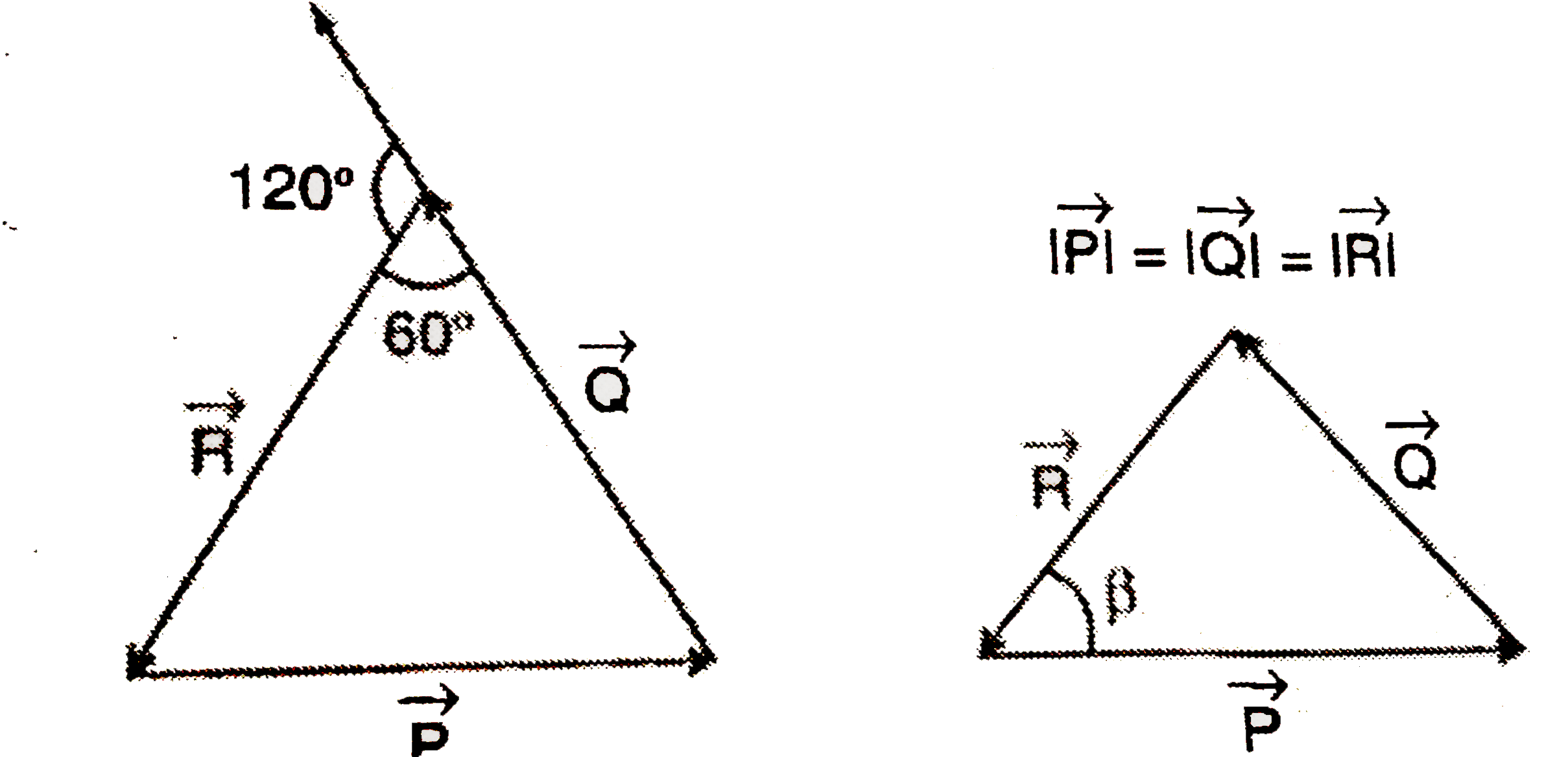
|
|
| 12. |
Particles of masses m_(1) and m_(2) are at a fixed distance apart. If the gravitational field strength at m_(1) and m_(2) are vec(I_(1)) and vec(I_(2)) respectively. |
|
Answer» `m_(1)VEC(I)_(1) + m_(2)vec(I)_(2) = 0` |
|
| 13. |
A body projected obliquely with velocity 19.6 ms^(-1) has its kinetic energy at the maximum height equal to 3 times its potential energy there. Its position after 1 second of projection from the ground is (h = maximum height) |
| Answer» Answer :D | |
| 14. |
A person travelling in car along East with speed 'u' observes the velocity of another car as sqrt(5)u at tan^(-1)(2) S of W. The velocity of other car is |
|
Answer» `2u tan^(-1)` (1/2) S of E |
|
| 15. |
The bob of a simple pendulum of period T I s given a vegarve charge. If it is allowed to oscillate with an identical . If it is allowed to oscillate with an identical charge at the point of suspension. The new time period will be |
|
Answer» EQUAL T |
|
| 16. |
Consider the object shown in the figure. It consist of a solid hemisphere of mass M and radius R. There is a solid rod welded at its centre. The object is placed on a flat surface so that the rod isvertical. Mass of the rod per unit length is (M)/(2R). What is the maximum length of the rod that can be welded so that the object can performoscillations about the position shown in diagram? Note : Centre of mass of a solid hemisphere is ata distance of (3R)/(8) from its base. |
|
Answer» |
|
| 17. |
The escape velocity of a projectile from the earth.s surface is given by the formula ( Rrarrradius of the earth and .g. is acceleration due to gravity) |
|
Answer» `SQRT(2gR)` |
|
| 18. |
Which of the following is not a wave characteristics?(a) reflection (b) refraction (c) interference (d) diffraction (e) polarisation (f) rectilinear propagation |
| Answer» SOLUTION :RECTILINEAR PROPAGATION | |
| 19. |
Explain why (a) to keep a piece of paper horizontal,you should blow over, not under it. (b) When we try to close a water tap with our finger, the fast jets of water gust through the openings between our finger. (c ) A fluid flowing out of a small hole in a vessel, results in a backward thrust on the vessel. (d) the size of the needle of a syringe controls better than teh thumb pressure exerted by a doctor while administering an injection. (e ) A spinning cricket ball in air does not follow a parabolic trajectory. |
|
Answer» Solution :(a) When we blow over the paper, the velocity of air blow increases and hence pressure of air on it decreases (ac cording to Bernoulli's theorem), whereas pressure of air below the paper is atmospheric. hence, the paper stays horizontal . (b) By doing so the area of outlet of water JET is reduced, so velocity of water increases ac cording to equation of continuity. `a upsilon = a consta nt` (c ) When a fluid is flowing out of a small hole in a vessel, it acquires a LARGE velocity and hence possesses large MOMENTUM. since no external force is acting on the system, a backward velocity must be attained by the vessel (ac cording to LAW of conservation of momentum). As a result of it, an impulse (backward thrust) is experienced by the vessel. (d) Here, size of the needle controls velocity of flow and thumb pressure controls pressure. Ac cording to Bernoulli's theoram , `P = rho gh + 1/2 rho upsilon^(2)` = a constant shows that P oc curs with power one and `upsilon` oc cours with power TWO, hence the velocity has more influence. that is why the needle has a better control over flow. (e )N/A. |
|
| 20. |
Give the unit and dimension of power. |
|
Answer» Solution :POWER is DEFINED as the rate of work done or energy delivered. Unit : WATT . Dimensional formula : `[ML^2 T^(-3)]` |
|
| 21. |
What do you mean by weight of a body? Is it a scalar or vector? |
| Answer» Solution :WEIGHT of a body is defined as the GRAVITATIONAL FORCE with which a body is attracted towards the center of the earth. Hence the weight of a body is given byW = MG ( or) `vec(W) = m vec(g)` | |
| 22. |
Figure shows the orientation of two vectors u and v in te XY plane . Ifu = a hat(i) + bhat(j) andv = p hat(i) + qhat(j) .Which of the following is correct ? |
|
Answer» <P>a and p are POSITIVE while b and q are NEGATIVE |
|
| 23. |
A uniformthin rodof length 1mand mass 3 kgis attachedto a uniformthincirculardisc ois |
|
Answer» `0.375` m |
|
| 24. |
If a body is projected with speed less than escape velocity, then (a) the body can reach a certain height and may fall down following straight line path (b) the body can reach a certain height and may all down following a parabolic path (c) the body may orbit the earth in a circular path (d) the body may orbit the earth in an elliptical path. |
|
Answer» only a & B are TRUE |
|
| 25. |
The angle turned through by the flywheel of a generator during a time interval r is given by f=at+bt^(3)-ct^(4),where a, b, and care constants. What is the expression for its (a) angular speed and (b) angular acceleration? |
| Answer» SOLUTION :(a)`a+3bt^(2)-4ct^(3)`, (B) `6bt-12ct^(2)` | |
| 26. |
What is a relation between Intensity of gravitation and gravitational potential on a point ? |
|
Answer» Solution :`IMPLIES I = (Gm_e)/R and V = (-Gm_e)/r` `:. V = -I`is gravitational POTENTIAL of a POINT, it is negative at that point. |
|
| 27. |
It is found that |A+B|=|A|,This necessarily implies. |
|
Answer» `VECB = 0 ` |
|
| 28. |
The free end of a simple pendulum is attached to the ceiling of a box. The box is taken to a height and the pendulum is oscillated. When the bob is at ts lowest point, the box is released to fail freely. As seen from the box during this period, the bob will |
|
Answer» CONTINUE its oscillation as before |
|
| 29. |
Reels of thread in the form of solid cylinder is allowed to unroll by holding the loose end of the thread in hand. The acceleration with which the reel falls down is (g=9.9" ms"^(-2)) |
|
Answer» `9.9"MS"^(-2)` |
|
| 30. |
The decrease in the acceleration due to gravity at a height above the earth's surface is …… the decrease in the acceleration due to gravity at the same depth below the surface of the earth. [Fill in the blanks] |
|
Answer» |
|
| 31. |
Which of the following units is a unit of power? |
|
Answer» kilowatt hour |
|
| 32. |
In the arrangement shown in Fig the ends P and Q of an unstrechable string move downwards with uniform speed U pulley A and B are fixed Mass M moves upward with a speed |
|
Answer» `2U cos THETA` `v cos theta = U RARR v = U cos theta` |
|
| 33. |
A car is moving in circular horizontal track of radius 10 m with a constant speed of 10 m/s A plumb bob is suspended form the roof of the car by a light rigid rod of length 1 m The angle made by the rod with the track is |
| Answer» Solution :(C) | |
| 34. |
Weight of a body of mass 'm' decreases by 1% when it is raised to a height 'h' above the earth's surface. If the body is taken to a depth 'h' in a mine, the change in its weight is |
|
Answer» DECREASES by 2% |
|
| 35. |
Two bodies with moment of inertia I_(1) and I_(2)(I_(2)gtI_(1)) are rotating with same angular momentum If K_(1) and K_(2) their kinetic energies then |
| Answer» Answer :B | |
| 36. |
The momentf inertiaof a solidcylinder about an axis parallelto itslengthand passingthroughits centreis equalto itsmoment ofinertiaabout an axisperpendicular to thelength of cylinder and passingthroughitscentre .The ratio of radius of cylinderand itslength is |
|
Answer» `1:sqrt(2)` |
|
| 37. |
A rocket consumes 20 kg fuel per second. The exhaust gases escape at a speed of 1000 ms^(-1) relative to the rocket. Calculate the upthrust received by the rocket. Also calculate the velocity acquired. When its mass is 1/100 of the initial mass. |
|
Answer» `2XX10^(4)N , 4.6 Km//s` |
|
| 38. |
Four moles of a perfect gas heated to increase its temperature by 2^@ C absorbs heat of 40 cal at constantvolume. If the same gas is heated at constant pressure find the amount of heat supplied. (R = 2 cal/mol K). |
|
Answer» Solution :Numebr of moles=4 changein temperature`= 2^@ Cimplies 4 xx C_9 xx 2 = 40C_v= 5cal // molK` `IMPLIES C_p =C_v+R= 7 cal// mol K ` heatenergyabsrbedat constantwhen4moles of GASIS heatedthrough`2^0= ""^(n) C_rDeltaT = 4 xx7xx 2 = 56cal ` |
|
| 39. |
An ideal heat engine exhausting heat at 77^(@)Cis to have a 30% efficiency. It must take heat at |
| Answer» Answer :B | |
| 40. |
A simple pendulum is oscillating with out damping when the displacement of the bob is less than maximum its acceleration vector .a. is correctly shown is: |
|
Answer»
|
|
| 41. |
A stone is tied to a string and swings with uniform motion in a horizontal circle. The string breaks and at a time t, the stone is displaced Deltar=3 hat(i)+4hat(j)-5hat(k) metres. (The positive z-axis is vertically up) Select the correct alternative. |
|
Answer» the time t is 1 s |
|
| 42. |
How do you justify the results in the above two thermometers in measuring the same quantity. |
|
Answer» |
|
| 43. |
Two identical balls are dropped from the same height onto a hard surface, the second ball being released exactly when the first ball collides with the surface. If the first ball has made two more collisions by the time the second one collides. Then the coefficient of resitution between the ball and the surface satisfies. |
|
Answer» `E gt 0.5` |
|
| 44. |
(A): When a glass of hot milk is placed in a room and allowed to cool, its entropy decreases.(R ): Allowing hot object to cool does not violate the second law of thermodynamics. (2006) |
|
Answer» Both (A) and(R ) are TRUE and (R ) is the correct EXPLANATION of (A) |
|
| 45. |
A car moving with a velocity of 72 KMPH stops engine just before ascending an inclined road. If 25% of energy is wasted in overcoming friction, the car rises to a height of (g=10 ms^(-2)) |
| Answer» ANSWER :D | |
| 46. |
Two particles having position vectors vecr_1 = (3hati + 5hatj)mand vecr_2 = (-5hati + 3hatj)mare moving with velocities vecV_1 = (4hati - 4hatj) ms^(-1)andvecV_2 = (a veci - 3vecj) ms^(-1) . If they collide after 2 seconds, the value of 'a' is |
|
Answer» 2 |
|
| 47. |
Give the magnitude and direction of the net force acting on a stone of mass 0.1 kg, [Neglect air resistance throughout].(a) just after it is dropped from the window of a stationary train.just after it is dropped from the window of a train running at a constant velocity of 36 km/h.(c ) just after it is dropped from the window of a train accelerating with 1 ms - 2 (d) lying on the floor of a train which is accelerating with 1 ms - 2, the stone being at rest relative to the train. |
|
Answer» Solution :(a) Here, `m=0.1 kg, a=+g=9.8 m//s2`, Net force, F = ma `=0.1xx9.8=0.98 N` (b) When the train is running at a constant velocity its acc. = 0. No force acts on the STONE DUE to this motion. Therefore, force on the stone F = weight of stone `= mg = 0.1xx9.8=0.98 N` This force also acts vertically downwards. (c ) When the train is accelerating with 1 m/s 2, an ADDITIONAL force `F^(1)=ma = 0.1xx1=0.1 N` acts on the stone in the horizontal direction. But once the stone is dropped from the train, `F^(1)` becomes zero and the net force on the stone is F = mg `= 0.1xx9.8=0.9N`, acting vertically downdards. (d) As the stone is lying on the horizontal direction of motion of the train. Note the weight of the stone in this CASE is being balanced by he normal rection. |
|
| 48. |
A helicopter is ascending vertically with a speed of 8.0 "ms"^(-1). At a height of 12 m above the earth, a package is dropped from a window. How much time does it take for the package to reach the ground ? |
|
Answer» 1.23s |
|
| 49. |
Two cars P and Q start from a point at the same time in a straight line and their positions are represented by x_p(t)= at+ bt^2 and x_1(t) =ft-t^2.At what time do the cars have the same velocity? |
|
Answer» `(a-f)/(1+b)` |
|


