

Saved Bookmarks
This section includes 7 InterviewSolutions, each offering curated multiple-choice questions to sharpen your Current Affairs knowledge and support exam preparation. Choose a topic below to get started.
| 1. |
What is binding energy of satellite ? Write its equation. |
|
Answer» Solution :`implies` The minimum AMOUNT of energy required for a satellite to escape from earth.s GRAVITATIONAL INFLUENCE is called binding energy of satellite. `implies` Total energy of satellite is - `(GM_(E)m)/(2r)` . At INFINITY distance total energy is zero. To MOVE the satellite to infinity we have to supply minimum positive energy of `+ (GM_(E) m)/(2r)` `implies` This is binding energy of satellite. `implies`Binding energy of satellite. `= (GM_(E)m)/(2r) ` where `r = R_(E)+h`. |
|
| 2. |
Can a steel wire be elongated to twice its initial length by hanging a load from its end? |
| Answer» Solution :By hanging a load from its FREE end, a STEEL wire cannot be elongated to twice its INITIAL LENGTH. This is because the wire snaps before attaining that elongation, as it crosses its breaking load. | |
| 3. |
The amplitude of a damped oscillator decreases to 0.9 times its original value in 5s. In another 10s it will decreases to a times its original magnitude, where alpha is: |
|
Answer» 0.81 |
|
| 4. |
Two gases A and B having same pressure P, volume V and temperature T are mixed. If the mixture has volume and temperature as V and T respectively, then the pressure of the mixture is |
|
Answer» P |
|
| 5. |
What is specific gas constant? Is it same for all gases? |
| Answer» Solution :Gas constant per UNIT MASS is called SPECIFIC gas constant .r. Value of specific gas constant is not constant. Its value of r CHANGES from gas to gas. | |
| 6. |
Does moment of inertia of a body change with the change of the axis of rotation? |
| Answer» Solution :YES, the MOMENT of inertia of a BDOY CHANGES with the chasgne in position and orientation of the axis of rotation. | |
| 7. |
When are stationary waves produced? |
| Answer» Solution :STATIONARY waves are PRODUCED when two indentical waves travelling in opposite DIRECTIONS through a MEDIUM superpose each other. | |
| 8. |
Find the dimensions of a/b in the equation. F=asqrtx+bt^(2) where F is force, x is distance and t is time. |
|
Answer» SOLUTION :`[asqrtx]=[F]` `therefore [a]=([F])/([SQRTX])=(MLT^(-2))/(L^(1//2))=ML^(1//2)T^(-2)` `[BT^(2)]=[F]` `therefore [b]=([F])/([t^(2)])=(MLT^(-2))/(T^(2))` `=MLT^(-4)` `[a//b]=(ML^(1//2)T^(-2))/(MLT^(-4))=L^(-1//2)T^(2)` |
|
| 9. |
A spring is connected to a mass m suspended from it and its time period for vertical oscillation is T. spring is now cut into two equal halved and the same mass is suspended fron one of the havles. The period of vertical oscillation is : |
|
Answer» `T'=sqrt(2)T` `k.=2k` Time PERIOD of the spring, `T=2pisqrt((m)/(k))` If the spring is halves, So the time period `T.=2pisqrt((m)/(k.))=2pisqrt((m)/(2k))` `T.=(1)/(sqrt(2))xx2pisqrt((m)/(k))impliesT.=(T)/(sqrt(2))` |
|
| 10. |
Ball 1 collides with an another identical ball 2 at rest as shown in figure. For what value of coefficient of restitution e, the velocity of ball 2 becomes two times that of ball I after collision? |
|
Answer» `1/3` `v_1 = ((1 - e)/(2)) u and v_2 = ((1 +e)/(2)) u :. (v_2)/(v_1) = (1 + e)/(1 - e)` But `v_2 = 2v_1` (given ) `:. 2 = (1 + e)/(1 - e)` On solving, we GET `e = 1/3`. |
|
| 11. |
In the figure, an ideal liquid flows through the tube, which is of uniform cross - section. The liquid has velocities upsilon_(A) and upsilon_(B), and pressures p_(A) and p_(B) at points A and b respectively a) upsilon_(A)=upsilon_(B) b) upsilon_(B)gtupsilon_(A) c) p_(A)=p_(B) d) p_(B)gtp_(A) |
|
Answer» a and B are correct |
|
| 12. |
A pendulum is hanging from the ceiling of a car having an acceleration a_(0) with respect to the road. Find the angle made by the string with vertical at equilibrium. Also find the tension in the sting in this position. |
|
Answer» Solution :(A) `T sin theta = ma_(0)` ….(i) `T COS theta = mg` …..(ii) `THEREFORE tan theta = (a_(0))/(G)` `therefore` the string is making an angle `tan^(-1)((a_(0))/(g))` with VERTICAL at equilibrium (B) squaring and adding (i) and (ii) `T^(2)sin theta +T^(2)cos theta = m^(2)(a_(0)^(2)+g^(2))` `T= m sqrt(a_(0)^(2)+g^(2))` 
|
|
| 13. |
A shell is projected from a level ground with a velocity of 20 m/s at 45^(@) to the horizontal. When the shell is at the highest point it breaks into two equal fragments. One of the fragments whose initial velocity after the explosion is zero falls vertically downward. At what distance from the point of projection does the other fragment fall ? (g=10 ms^(-2)) |
| Answer» Answer :B | |
| 14. |
The man who has won Nobel prize twice in Physics is |
|
Answer» Einstein |
|
| 15. |
Let us consider an infinite plane charged conducting plate. Now the charge distributes on both sides of the conducting plate.The field of such charged plate arises from the superposition of the fields of two sheets of charge. Can you guess the value of E for points outside the plate? What will be the field inside the plate, and why? |
| Answer» SOLUTION :`E=(SIGMA)/(in_0)` and INSIDE the PLATE E=0. | |
| 16. |
What is meant by angular oscillation? |
| Answer» Solution :When a body is allowed to rotate freely about a given AXIS then the OSCILLATION is KNOWN as the angular oscillation. | |
| 17. |
The two forces 2 sqrt2N and xN are acting at a point their resultant is perpendicular to hat(x)N and having magnitude of sqrt6N. The angle between the two forces and magnitude of x are |
|
Answer» `theta = 120^(@), x = sqrt2N` |
|
| 18. |
A thin circular loop of radius R rotates about its vertical diameter with an angular frequency omega .Show that a small bead on the wire loop remains at its lowermost pointfor omega lt sqrt( g// R)Whatis theangle made by the radius vector joining the centre to the bead with the vertical downward direction for omega = sqrt(2g// R) ?neglect friction. |
|
Answer» Solution :Consider the free-body diagram of the bead when the RADIUS vector joining the centre of the wire MAKES an angle `theta` with the vertical downward direction.We have mg `= N cos theta` and `m R sin thetaomega^2 = N sin theta` .These equations GIVE` cos theta = g//Romega^2`.Since `cos theta lt= 1,` the bead remains at its lowemost point `omega lt= sqrt(g/R )` For `omega = sqrt((2g)/(R ), cos theta = 1/2 i.e theta = 60^@` |
|
| 19. |
Two identical trains A and B move with equal actual speeds on parallel tracks along the equator. A moves from east to west and B, from west to east. Which train will exert greater force on the tracks? |
|
Answer» A |
|
| 20. |
It is found that ifa neutron suffersan elasticcollinear collision with deuerium at rest , fractional loss of energyis P_(d) whilefor itssimilarcollisionwith carbon nucleous at rest , fractional loss of energy is P_(c ) are respectively ......... |
|
Answer» `(.89,.28)`  From law of conservationof momentum `mv_(0) +mv_(1)+2mv_(2)` ` :. V_(0) =v_(1)+2v_(2) ""…..(2)` ` :. V_(1)+2v_(2) =v_(2) -v_(1)` ` :. 2v_(1) =-v_(2)` From EQU . (2) `v_(0)= -2v_(1) -v_(1) =-3v_(1)` ` :. v_(1) = - (v_(0))/3` ` :. v_(2) = (2v_(0))/3 ` Decreasein kinetic ENERGY `P_(d) =(1/2mv_(0)^(2)-1/2mv_(1)^(2))/(1/2mv_(0)^(2))` `=(v_(0)^(2) -(v_(0)^(2))/9)/(v_(0)^(2)) "" [ :. v_(1)=-(v_(0))/3]` `P_(d) =8/9 = 0.8888 APPROX 0.89` Now is econd collision:  From law of conservation of momentum `mv_(0) =mv_(1) +mv_(2)` ` :. v_(0) =v_(1) +12v_(2) "".....(3)` For elasticcollisione = 1 `v_(2) -v_(1) = v_(0) ""....(4)` From (3) and (4) `v_(1)+12v_(2)=v_(2)-v_(1)` ` :. 2v_(1) = 011v_(2)` ` :. v_(1)-(11v_(2))/2 and v_(2) = -(2v)/13` ` :. v_(1)= -(11v_(2))/2 and v_(2) = - (2v_(1))/13 ` `Now , 13v_(1) = -11v_(0) +v_(1) and v_(2) = - (11v_(0))/13 + v_(0)` ` :. 2v_(1) =-11v_(0) "" :. v_(2) =(2v_(0))/13 ` ` :. v_(1) = (11v_(0))/13` Decrease in kinetic energy `P_(c) = ((1/2mv_(0)^(2))-1/2m(-(11v_(0))/13)^(2))/(1/2mv_(0)^(2))` `:. (v_(0)^(2)-(121v_(0)^(2))/169)/(v_(0)^(2))=(169-121)/169 =48 /169 = 0.28` ` :. P_(d) = 0.89 ,P_(c ) = 0.28` . |
|
| 21. |
A body of mass 1 kg is moving in a vertical circular path of radius 1 m. The difference between the kinetic engeries at the highest and lowest position is |
|
Answer» 20 J Velocity at the lowest point, `v_L = sqrt(5 gr)` Velocity at the HIGHEST point , `v_H = sqrt(gr)` Difference in kinetic ENERGY = `1/2 m[v_L^2 - v_H^2]` `= 1/2 m[(sqrt(5 gr))^2 - (sqrt(gr))^2] = 2 mgr = 2 xx 1 xx 10 xx 1 = 20 J`. |
|
| 22. |
Derive an expression for Young modulus of a wire in terms of its radius . |
|
Answer» Solution :`Y = (Fl)/(A DELTA l)` where `A = PI r^(2)` HENCE `Y = (Fl)/(pi r^(2) Delta l)` |
|
| 23. |
A particular block floats in water at 4^(@)C so that 0.984 of its height is under water. At what temperature, will it just sink in water? Neglect expansion of block. (Volume coefficient of expansion of water =2.1 xx 10 ^(-4) per ^(@)C) |
|
Answer» Solution :` d _(t) = (d _(0))/( 1 + GAMMA t ) , d _(0) = 1 GM//c.c ,d _(t) = 0.984 gm //c.c,` The block sinks when the density of the block and the water are just equal. `therefore 0.984 = (1)/( 1 + 2.1 xx 10 ^(-4) t ) therefore 1 + 2.1 xx 10 ^(-4) t = (1)/( 0.984) = (1000)/(984) = (500)/(492)` `therefore 2.1 xx 10 ^(-4) t = (8)/( 492),t = ( 8xx 10 ^(4))/( 492 xx 2.1) = 77.43 ^(@)C,` It MUST be heated to `77.43+4 = 81.43 ^(@)C` |
|
| 24. |
A gas is compressed isothermally to half its initial volume. The same gas is compressed seperately through an adiabatic process until its volume is again reduced to half. Then |
|
Answer» Compressing the gas isothermally will require more WORK to be DONE |
|
| 25. |
(A): Work done by gravitational force in moving a body is path independent (R ): Gravitationa lforce is non conservative force. |
|
Answer» Both 'A' and 'R' are TRUE and 'R' is the CORRECT EXPLANATION of 'A's |
|
| 26. |
State true/false: S_1 : Hydrostatic pressure is a scalar quantity even though pressure is force divided by area and force is a vector quantity? S_2: A barometer made of a very narrow tube (see figure) is placed at normal temperature and pressure. The coefficient of volume expansion of mercury is 0.00018//.^@C and that of the tube is negligible. The temperature of mercury in the barometer is now raised by 1^@C but the temperature of the atmosphere does not change. Then, the mercury height in the tube remains unchanged. S_3 A block of ice with a lead shot embedded in it is floating on water contained in a vessel. The temperature of the system is maintained at 0^@C as the ice melts. When the ice melts completely the level of water in the vessel rises. |
|
Answer» TTF Pressure is always acting normal to hence it is considered as scalar. `S_(2)` :False On INCREASING the temperature of mercury its density. Hence level of mercury in barometer tube will INCREASES. `S_(3)`: False When ice melts level of water does not change. in case of lead, it was initially i.e., it would had displaced the water equal to weight of lead. so, volume of water displaced would be `V_(1)=m/(rho_(w))` (m=mass of lead) Now, when ice melts lead will sink and it would displace the water equal to volume of lead itself so, volume of water displaced in this case would be `V_(2)=m/(rho_(l))` Now, as `rho_(l) GT rho_(w), V_(2) gt V_(1)` or level will fall. |
|
| 27. |
A Student records the initial length l, change in temperature DeltaT and change in length Deltal of a rod as follows : If the first observation is correct what can you say about observations 2, 3 and 4. |
|
Answer» Solution :From FIRST observation, `alpha=(Deltal)/(lDeltaT)` `=(4xx10^(-4))/(2xx10)` `=2xx10^(-5)" "^(@)C^(-1)` From second observation, `Deltal=alphalDeltaT` `:.Deltal=2xx10^(-5)xx1xx10` `=2xx10^(-4)m!=4xx10^(-4)m` `:.` Thus, the observation is incorrect From third observation, `Deltal=alphalDeltaT` `=2xx10^(-5)xx2xx20` `=8xx10^(-4)m!=2xx10^(-4)m` `:.` Thus, the observation is incorrect. From fourth observation, `Deltal=alphalDeltaT` `=2xx10^(-5)xx3xx10` `=6XX10^(-4)m=6xx10^(-4)m` Thus, the observation is true. |
|
| 28. |
A cube is subjected to a uniform volume compression from all side. If the side of the cube decreases by 1%, the bulk strain ((Delta V)/(V)) is …… |
|
Answer» `0.01` When each side length decreases by ` % `then new length, L. = L - L ` of `1%` `= L -0.91 L = 0.99 L` `therefore` New volume `V. = (0.99 L) ^(3)` `therefore ` Change in volume `Delta V =V - V.` `= L ^(3) - (0.99L)^(3)` `=L^(3) [1- 0.99]^(3)` `=L^(3) [1- (1-0.01)^(3)]` `=L^(3)[1-(1-0.03+...)]` [Neglecting TERMS having higher power in expansion] `=L ^(3) [0.03]` `therefore (Delta V )/(V) = ( L ^(3) xx 0.03)/(L ^(3))` `therefore `BULK strain `= 0.03` |
|
| 29. |
(a) In the previous example, determine the temperature rise at which the solid is completely immersed, neglect expansion of solid? (b) if, f _(s1) and f_(s2) are the fractions submerged for rise of temperatures, Delta T and Delta T_(2), determine yof the liquid (c) Under what conditions will the sphere sink, lift up, considering expansion of solid? |
|
Answer» Solution :(a) From previous problem, `f _(s) = (rho)/(sigma),` When the temperature is INCREASED by `Delta T.` `f _(s) . = 1 = f _(s) (1 + gamma Delta T) or Delta T = (1 - f _(s))/( gamma f _(s))` (B)`f _(s _(t)) = f _(s) (1 + gamma Delta T _(1)), f _(s), = f _(s) (1 + gamma Delta T _(2)) implies (f _(s _(1)))/( f _(s _(2))) = ((1 + gamma Delta T _(1))/( 1 + gamma Delta T _(2)))` On solving for `gamma,` we have `gamma = (f _(s _(1))- f _(s _(2)))/( f _(s _(2))Delta -f _(s _(1)) Delta T _(2))` (C ) As `f _(s) = (rho )/(sigma ) and f _(s) . = (rho .)/( sigma .) = ((rho )/( 1 + gamma _(1) Delta T )) ((1 + gamma _(2) Delta T ))/( sigma) =f _(s) ((1 + gamma _(2) Delta T )/( 1 + gamma _(1) Delta T ))` If ` gamma _(2) gtgamma _(1),` the solid sinks, If `gamma _(2) = gamma _(1),` no EFFECT on submergence. `If gamma _(2) lt gamma _(1),` the solid lifts up. |
|
| 30. |
The gravitational field in a region is given by barE= (5hati+12hatj)N"/"Kg. The change in gravitational potential energy if a particle of mass 1kg in taken from the origion to the point (12m, 5m). |
| Answer» ANSWER :C | |
| 31. |
A particle moves according to the law x=a "cos"(pit)/2. The distance covered by it is the time interval between t=0 to t=3 sec is |
|
Answer» Solution :Comparing the given equation with `x=a cos omega t` `impliesomega=(pi)/2""(2pi)/T=(pi)/2impliesT=4` SEC The given time t=3 sc is really `(3T)/4` At time t=0 PARTICLE at x=a (at extreme position) and at t=3 sec `=(3T)/4` it will be at MEAN position x=0 `:.` distance covered wil be 3a. |
|
| 32. |
A particle of moves with constant angular velocity in a circle. During the motion its |
|
Answer» ENERGY is conserved |
|
| 33. |
A block of mass 'm' moves on a horizontal rough surface with initial velocity 'v'. The height of the centre of mass of the block is 'h' from the surface. Consider a point 'A' on the surface of sliding |
|
Answer» Angular momentum about 'A' is MVH initially |
|
| 34. |
Does the forceof friction depends on the area of contact |
| Answer» SOLUTION :The forceof FRICTION does not dependon THEAREA of CONTACT. | |
| 35. |
The property of viscosity in gas is due to |
|
Answer» COHESIVE FORCES beween the molecules |
|
| 36. |
Which mass, gravitational or inertial, does the mass of a cellestial body refer to ? |
| Answer» SOLUTION : INERTIAL MASS. | |
| 37. |
In the HCl molecule, the separation between the nuclei of the two atoms is about 1.27A. Find the approximate location of the centre of mass of the molecule, given that the chlorine atom is about 35.5 times as massive as a hydrogen atom and nearly all the mass of an atom is concentrated in its nucleus. |
Answer» Solution : Given, `R=1.27A` `m_H=1u,m_(CL)=35.5u` `r_1((m_(cl))/(m_H+m_(cl)))r` and `r_2=((m_H)/(m_H+m_(cl)))r` i.e `r_1=(35.5)/(36.5)xx1.27A` and `r_2=(1xx1.27A)/(36.5)` `r_1=1.235A` and `r_2=0.03479A` `:.` Centre of mass of the MOLECULE is at 1.235 A from H and 0.035A from Cl ATOM. |
|
| 38. |
Consider the motion of a particle described by x = a cos t, y = a sin t and z = t. The trajectory traced by the particle as a function of time is |
|
Answer» Helix |
|
| 39. |
Two particles are initially located at points A and B distant d apart. They start moving at time t=0 such that the velocity vecu of B is always along the horizontal and velocity vecv of A is contiunously aimed at B. At t=0 , vecu is perpendicu lar to vecv The particles will meet after time: |
|
Answer» `(vd)/(V^(2)-U^(2))` 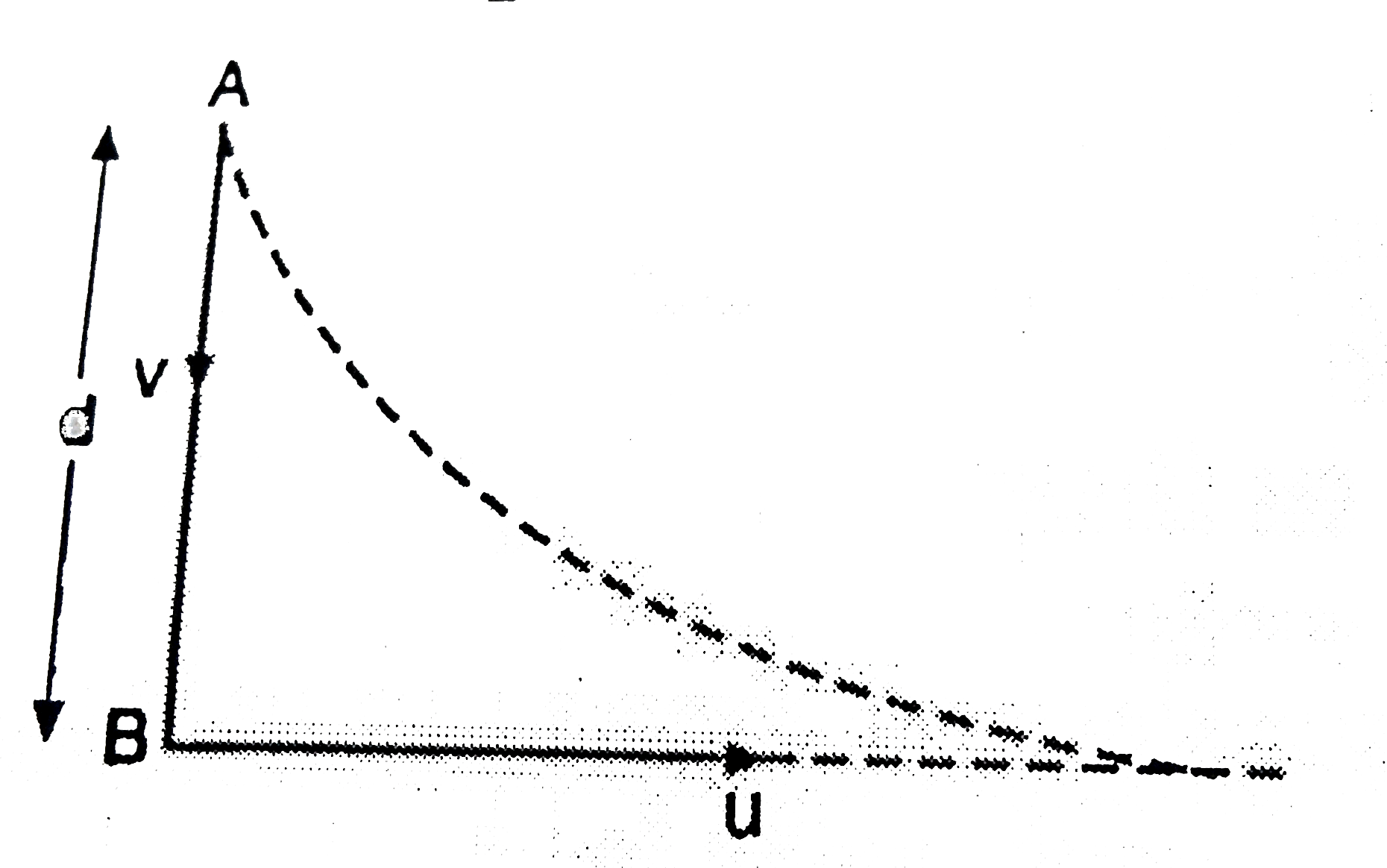
|
|
| 40. |
When an air bubble moves up from the bottom of a lake a. Velocity decreases and becomes zero b. acceleration increases and becomes zero c. velocity increases and becomes constant d. acceleration decreases and becomes zero |
| Answer» Answer :C | |
| 41. |
Two identical concentric rings each of mass (m) and radius (r ) placed perpendicularly. So the moment of inertia about axis of one of the ring is ………….. |
|
Answer» `(1)/(2)mr^(2)`  `I_(1)` = Moment of inertia about diameter = `(1)/(2)mr^(2)` `I_(2)` = Moment of inertia about AXIS PASSING through centre and PERPENDICULAR to plane = `mr^(2)` `I=I_(1)+I_(2)=(1)/(2)mr^(2)+mr^(2)=(3)/(2)mr^(2)` |
|
| 42. |
Fill in the blanks using the word (s) from the list appended with each statement : (a)Surface tension of liquids generally …… with temperatures |
| Answer» SOLUTION :DECREASES | |
| 43. |
Give an example for a matter wave. |
|
Answer» Solution :MATTER in motion is ASSOCIATED with matter wave. e.g., ELECTRON in motion AROUND the nucleus, an ACCELERATING electron in a vacuum tube are associated with matter wave. |
|
| 44. |
Air is streaming past the wings of an aeroplane with a speed of 90ms below and 120ms above the surface. If the wing is 15 m long and has an average width of 2m, then : [Density of air =1.2kg//m^(3)] |
|
Answer» Pressure DIFFERENCE between the bottom and TOP of the WING is 4090 PA |
|
| 45. |
A metal ball immersed in alcohol weighs w_(1) at 0^(@) Cand w_(2)at 50^(@) C . Assuming that the density of the metal is large compared to that of alcohol, then |
| Answer» Answer :C | |
| 46. |
The free end of a flexible rope of length L and mass lamda per unit length is released from rest in the position shown in the (a) part of the figure. Determine the velocity v of the moving portion of the rope interms of y sqrt(kgy[(L-y//2)/(L-y)]), the value of k is |
|
Answer» |
|
| 47. |
The figure shows a block 'A' resting on a rough horizontal surface with mu = 0.2. A man of mass 50 kg standing on the ground surface starts climbing the hanging ideal string. The maximum possible tension in the string is 1000N. The minimum time taken by the man to reach upto the pulley: |
| Answer» Answer :c | |
| 48. |
To have an earth satellite synchronous with the rotation of the earth, it must be launched at a paper height |
|
Answer» from WEST to EAST in EQUATORIAL PLANE |
|
| 49. |
A satellite is orbiting in an orbit witha velocity 4 km/s . Then find acceleration due to gravity at that height. |
|
Answer» Solution :As CENTRIPETAL ACCELERATION EQUALS to acceleration due to GRAVITY at thatheight , then `a=V^2/R=g_h` and `V^2=(GM)/r =(gR^2)/r` `rArr r=(gR^2)/V^2=(10xx6400xx6400xx10^6)/(16xx10^6)(g=10m//s^2)` =25600 Km `therefore g_h=a=V^2/r= (16xx10^6)/(25600xx10^3)=10/16m//s^2` |
|
| 50. |
A rod of length 1 and negligible mass is suspended at its two ends by two wires of steel (wire A) and aluminium (wire B) of equal lengths as shown in figure. The cross-sectional areas of wires A and B are 1.0 mm^(2) and 2.0 mm^(2) respectively. Y_("steel”) = 200 xx 10 ^(9) Nm ^(-2) and Y_("auminium”) = 70 xx 10 ^(9) Nm ^(-2) |
|
Answer» Mass m should be suspended close to wire A to have equal stresses in both the wires. 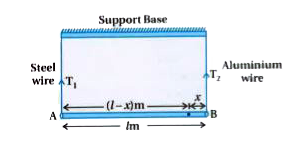 Let 1 is for steel wire and 2 is for aluminium wire. `T_(1) and T_(2)` are the tension in steel and aluminium wire RESPECTIVELY and `S_(1) and S_(2)` are stress and `in _(1) and in _(2)`are strain `a_(1) and a_(2)` are cross sectional areas. For BALANCE of wire. `sum T = 0` `therefore T_(2) x - T_(1) (l -x) =0` `therefore T _(2) x = T (l -x)` `therefore (T_(2))/( T _(1)) = (l-x)/( x) ""...(1)` Stress: For steel wire `S _(1) = (T_(1))/(a_(1)) ""...(2)` For aluminium wire `S_(2) = (T_(2))/( a _(2)) ""...(3)` If stress is equal, `S_(1) = S_(2)` `therefore (T_(1))/( a _(1)) = (T_(2))/(a_(2))` `therefore (T_(1))/( T _(2)) = (a_(1))/( a _(2)) = (1.0)/( 2.0 ) = 1/2 ` `therefore (x)/( l -x) = 1/2 [ because ` From eq. (1)] `therefore 2x =l -x` `therefore 3x =l` `therefore x = l /3` is the distance from end B and `l-x =l - l/3 = (2l)/(3)` is the distance from end A. `therefore (l)/(3) lt (2l)/(3)` hence option (B) is correct. Now, if strain are same, `Y_(1) = (S_(1))/( in _(1)) .and Y_(2) = (S_(2))/( in _(2))` but ` in _(1) = in _(2)` `therefore ( Y_(1))/( Y _(2)) = (S_(1))/( S _(2)) ` `therefore (200 xx 10 ^(9))/( 70 xx 10 ^(9)) = (T_(1))/( a _(1)) xx (a _(2))/( T_(2))` [`because` From equation (2) and (3)] `therefore (20)/(7) =(T_(1))/( T _(2)) xx (a _(2))/( a _(1))` `therefore (20 )/(7) = (x)/(l -x) xx (2.0)/(10) [because ` From eq. (1)] `therefore ( 10 )/(7) = (x)/( l -x)` `therefore 10 l -10 x = 7x` `therefore 10l = 17x` `therefore x = (10 l )/(17)` is the distance from end B `and l - x =l - (10l)/(17) = (7l)/(17)` is distance from end A. `therefore ( 7l)/(17) lt (10 l)/( 17)` hence option (D) is correct. |
|