

Saved Bookmarks
This section includes 7 InterviewSolutions, each offering curated multiple-choice questions to sharpen your Current Affairs knowledge and support exam preparation. Choose a topic below to get started.
| 1. |
Mass M is divided into two parts xm and (1-x)m . For a given separation the value of x for which the gravitational attraction between the two pieces becomes maximum is |
|
Answer» `1//2` |
|
| 2. |
Block A of mass m_(A) = 200 g is placed on an incline plane and a constant force F = 2.2 N is applied on it parallel to the incline. Taking the initial position of the block as origin and up along the incline as x direction, the position (x) time (t) graph of the block is recorded (see figure (b)). The same experiment is repeated with another block B of mass m_(B) = 500 g. Same force F is applied to it up along the incline and its position – time graph is recorded (see figure (b)). Now the two blocks are connected by a light string and released on the same incline as shown in figure (c). Find the tension in the string.["tan"theta = (3)/(4), g = 10m//s^(2)] |
|
Answer» |
|
| 3. |
A projectile of mass 5 kg, in its course of motion explodes on its own into two fragments. One fragment of mass 3 kg falls at three fourth of the range R of the projectile. Where will the other fragment fall? . |
|
Answer» Solution : It is an explosion of its own without any external influence. After the explosion, the center of mass of the projectile will continue to complete the parabolic path even THOUGH the fragments are not FOLLOWING the same parabolic path. After the fragments have fallen on the ground, the center of mass rests at a distance R (the range) from the point of projection as shown in the diagram. It is an explosion of its own without any external influence. After the explosion, the center of mass of the projectile will continue to complete the parabolic path even though the fragments are not following the same parabolic path. After the fragments have fallen on the ground, the center of mass rests at a distance R (the range) from the point of projection as shown in the diagram.  `m_(1)x_(1)=m_(2)x_(2)` where `m_(1)=3 KG, m_(2)=2kg x_(1), (1)/(4) R`. the value of `x_(2)=d` `3xx(1)/(4)=2xxd,` `d=(3)/(8)R` The distance between the point of launching and the POSITION of 2 kg mass is`R+d` `R+d=R+(3)/(8)R=(11)/(8)R=1.375R` he other fragment falls at a distance of 1.375R from the point of launching. (Here range of the projectile.) |
|
| 4. |
In head on elastic collision of two bodies of equal mass |
|
Answer» the FASTER BODY SPEEDS up further and the SLOWER body SLOWS down |
|
| 5. |
If the density of mercury at 0^(@)C is 17 gm/c.c then find its density at 200^(@)C. (given coefficient of real expansion of mercury is 0.18 xx 10 ^(-3) // ^(@)C). |
| Answer» SOLUTION :`16.41 gm//c.c` | |
| 6. |
(A) : If a man with a wrist watch on his hand falls from the top of a tower, its watch gives correct time during the free fall. (R): The working of the wrist watch depends on spring action and it has nothing to do with gravity. |
|
Answer» Both 'A' and 'R' are TRUE and R' is the correct EXPLANATION of 'A' |
|
| 7. |
The quantities RC and (L/R) (where R, L and C stand for resistance, inductance and capacitance respectively) have the dimension of |
|
Answer» force `(L)/(R)= ("henry")/("ohm")= ("ohm" xx "second")/("ohm")="second"= [T]` both RC and `(L)/(R)` have DIMENSIONS of time. |
|
| 8. |
Two forces P and Q are in ratio P: Q = 1 : 2. If their resultant is at an angle tan^(-1) ((sqrt3)/(2)) to vector P. then angle between P and Q is: |
| Answer» Answer :D | |
| 9. |
For an ideal liquid |
|
Answer» the bulk MODULUS is infinite `therefore` CHANGE in volume `Delta V =0` `therefore` Bulk modulus `B = (P)/(Delta V //V)` `therefore B = (P)/(0)` infinite `therefore` option (A) is correct. In an IDEAL liquid tangential force cannot sustain. `therefore ` Shear modulus `G = ("Shear STRESS")/("Shear strain") = (0)/("Shear strain")=0` `therefore ` Option (D) is correct. |
|
| 10. |
In which condition two substance can be considered as a particles ? |
| Answer» Solution :When dimensions of the body are too SMALL with RESPECT to DISTANCE between them, they can be CONSIDERED as particles. | |
| 11. |
Obtain the co-ordinates of centre of mass of a system of 4 particles 1 kg, 2 kg,3 kg and 4 kg respectively located at the corners of a square of 1 m side. Take origin at 1 kg, 2 kg and 3 kg respectively on x and y-axes. |
|
Answer» |
|
| 12. |
The period of a simple pendulum on the surface of the earth is 2s. Find its period on the surface of this moon, if the acceleration due to gravity on the moon is one-sixth that on the earth ? |
|
Answer» |
|
| 13. |
(A): If a man with a wrist watch on his hand falls from the top of a tower, its watch gives correct time during the free fall. (R) : The working of the wrist watch depends on spring action and it has nothing to do with gravity. |
|
Answer» Both 'A' and 'R' are true and R' is the CORRECT explanation of 'A' |
|
| 14. |
"Heat cannot by itself flow from a cold body to a hot body" is a statement or consequence of |
|
Answer» CONSERVATION of mass |
|
| 15. |
A ball of mass m hits a floor with a speed v making an angle of incidence with the normal. The coefficient of restitution is .e.. Find the speed of the reflected ball and the angle of reflection of the ball. |
|
Answer» Solution :Suppose the angle of reflection is `theta.` and the speed after the collision is v.. The floor exerts a force on the ball along the normal during the collision. There is no force PARALLEL to the SURFACE, Thus, the parallel component of the velocity of the ball remains unchanged. This gives v. in ` theta = v sin theta ""...(i)` For the components normal to the floor, the velocity of separation is `v. cos theta ` and the velocity of approach is `v cos theta.` Here `v. cos theta . = EV cos theta""...(II)` From (i) and (ii), `v.=v sqrt (sin ^(2) theta + E ^(2) cos ^(2) theta ) and tan theta . = (tan theta )/(e) implies e = (tan theta )/( tan theta ^(1))` |
|
| 16. |
Complete the statement : Angular momentum of a particle is equal to twice… . |
| Answer» Solution :ANGULAR moment of a particle is EQUAL to twice the product of its MASS and areal VELOCITY. | |
| 17. |
One end of a light spring of natural length d and spring constant k=64N/m is fixed on a rigid wall and the other is attached to a smooth ring of mass m=1 kg which can slide without friction on a vertical rod fixed at a distance d=3m from the wall. Initially the spring makes an angle of 37^(@) with the horizontal as shown in fig. When the system is released from rest the speed of the ring when the spring becomes horizontal [sin37^(@) =3//5] |
|
Answer» |
|
| 18. |
A pump of 200W power is lifting 2kg water per second from an average depth of 10m. The velocity with which water comes out of the pump is, (g= 9.8 ms^(-2)) |
| Answer» Answer :A | |
| 19. |
What is meant by subtraction of vectors? |
|
Answer» SOLUTION :For two non-zero vectors consider `vec(A) and vec(B)`that are inclined to each other at an ANGLE `theta` , the difference `vec(A) - vec(B)`is obtained as follows . first obtain ` - vec(B)`as in figure (SUBTRACTION of vectors) . The angle between `vec(A) and - vec(B)`is`180 - theta` . The difference `vec(A) - vec(B)`is the same as the resultant of `vec(A) and - vec(B)` We can write `vec(A) - vec(B) = vec(A) + (-vec(B)) `and using the equation , we get `|vec(A)- vec(B)| = sqrt(A^(2) +B^(2)+2A B cos (180 - theta))` Since , cos `(180 - theta) = - cos theta `, we get `|vec(A) - vec(B)| = sqrt(A^(2) +B^(2) - 2 ABcos theta)` Again from the figure, and the equation similar to the equation `tan alpha_(2) = (B sin ( 180^(@) - theta))/(A + B cos (180^(@)- theta))` But , sin `(180^(@) - theta) = sin theta`HENCE we get `:. tan alpha_(2) = (B sin theta)/(A - B cos theta)` 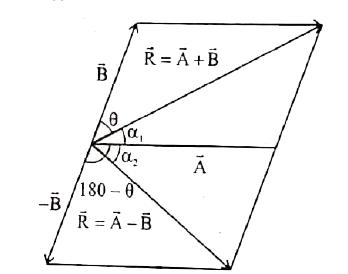
|
|
| 20. |
Explain graphically the formation of superposition when two pulses travelling towards each other ? |
Answer» Solution :When a jerk is given to a strethced STRING that is tied at one end, wave pulse is PRODUCED and the pulse travels ALONG the string. Suppose two persons holding the strethced string on either side give a jerk simultaneously, then these two wave pulses move towards each other. Then wave pulses meet at some point and move away from each other with their original identiy. Their behaviour is very different only at the crossing/meeting POINTS. In addition, this behaviour depends on whether the two pulses have the same or different shape. When the pulses have the same shape, at the crossing point the total displacement is given by the algebraic sum of their individual is higher than the AMPLITUDES of the individual pulses. Whereas, if the two pulses have same amplitude but shapes are `180^(@)` out of phase at the crossing point. Hence the net amplitude vanishes at that point. and the pulses will recover their identities after crossing. Only waves can posses such a peculiar propery, that is called superpsition of waves. This means that thet principle of superposition explains the net behavirour ofthe waves when they overlap . Generalizing to any number of waves i.e., if two are more moves in a medium move simultaneously. When they overlap, their total displacement is the vector sum of the individual displacement. |
|
| 21. |
The velocity of efflux of an ideal liquid does not depend on |
|
Answer» the area of orifice |
|
| 22. |
When a man stands on a moving escalator he goes up in 500 sec . And when he walds up the moving escalator he goes up in 30 sec . Then the man walks up the stationary escalator in a time of |
|
Answer» |
|
| 23. |
Reel of thread in the form of solid cylinder is allowed to unroll by holding the loose end of the thread in hand. The acceleration with which the reel falls down is (g = 9.9 ms^(-2)) |
|
Answer» `9.9 MS^(-2)` |
|
| 24. |
Two simple harmonic motions y_1= A sin omega t and y_2 = A cos omega tare superimposed on a particle of mass m. Find the total mechanical energy of the particle. |
|
Answer» Solution :PHASE difference between the two SHMS is `90^@` THEREFORE, resultant amplitude is `A= sqrt(2A), E=1/2 momega^2 A_R^2 = 1/2 m omega^2 (sqrt2 A)^2 - m omega^2 A^2` 
|
|
| 25. |
When the velocity of a body executing shm is zero its acceleration is not zero. Why? |
| Answer» SOLUTION :Because it is under the ACTION of the RESTORING FORCE | |
| 26. |
Coefficient of volume expansion of a vessel is greater than the liquid it contains. If the vessel is heated for long time, the level of liquid in the vessel |
|
Answer» FALLS |
|
| 27. |
The mass of a uniform ladder of length 5 m is 20 kg. A person of mass 60 kg stands on the ladder at a height of 2 m from the bottom. The position of centre of mass of the ladder and man from the bottom nearly is |
|
Answer» 1 m |
|
| 28. |
A small sphere of radius 2 cm falls from rest in a viscous liquid. Heat is produced due to viscous force. The rate of production of heat when the sphere attains its terminal velocity is proportional to |
|
Answer» `2^2` `(DQ)/(DT) = F_v xx v_r". F_v = 6 pi eta R v_t` `=6 pi eta r v_t xx v_t "" v_t = 2/9(r^2(rho - sigma))/(eta) g` `(dQ)/(dT) prop r v_1^2 "" v_T prop r^2` `(dQ)/(dt) prop r(r^2)^(2) IMPLIES (dQ)/(dT) prop r^5` Here radius of the sphere is 2 cm, so `(dQ)/(dT) prop 2^5`. |
|
| 29. |
A ball of mass 50 g falls from rest vertically downwards through a distance of 40 m and hits the ground. Find the kinetic energy and final velocity of the ball before it hits the ground (g=9.8 ms^(-2)). |
|
Answer» Solution :`m=50 gm=50xx10^(-3)KG`, `h=40 m, g=9.8 MS^(-2)` From LAW of CONSERVATION of energy loss in P.E = gain in K.E. `rArr mgh =(1)/(2) mv^(2)`and `v=sqrt(2gh)` Final velocity, `v=sqrt(2xx9.8xx40)=28 ms^(-1)` `K.E. = (1)/(2)mv^(2)=(1)/(2)xx50xx10^(-3)xx28xx28=19.6 J` |
|
| 30. |
Two liquids at temperatures 60^(@) and 20^(@) C respectively have masses in the ratio 3 : 4 and their specific heats in the ratio 4 : 5. If the two liquids are mixed, the resultant temperature is |
| Answer» Answer :D | |
| 31. |
By repeating the same measuremetn several times, the errors that can be reduced are |
|
Answer» DETERMINATE errors |
|
| 33. |
If E, M, L and G denote energy, mass, angular momentum and universal Gravitational constant respectively, prove that (EL^(2))/(M^(5)G^(2)) is a dimensionless quantity. |
|
Answer» Solution :Taking dimensional formulae energy `(E )= ML^(2)T^(-2)` mass (M) `= ML^(0) T^(0)` ANGULAR Momentum `(L)= ML^(2)T^(-1)` Universal GRAVITATIONAL constant `(G )= M^(-1) L^(3) T^(-2)` Substituting in `(EL^(2))/(M^(5)G^(2))`, we get `((ML^(2)T^(-2))(ML^(2)T^(-1))^(2))/((ML^(0)T^(0))^(5)(M^(-1)L^(3)T^(-2))^(2))= (M^(1+2)L^(2+4)T^(-2-2))/(M^(5-2)L^(0+6)T^(0-4))` = A dimensionless quantity. |
|
| 34. |
A man can swim in still water at a speed of 6 kmph and he has to cross the river and reach just opposite point on the other bank. If the river is flowing at a speed of 3 kmph, and the width of the river is 2 km, the time taken to cross the river is (in hours) |
|
Answer» `(3)/(4), (9)/(4)` |
|
| 35. |
a, b are the magnitudes of vectors vec(a) & vec(b). If vec(a)xx vec(b)=0 the value of vec(a).vec(b) is |
| Answer» Answer :C | |
| 36. |
Two ships A and B are 4 km apart. A is due west of B. If a moves with uniform velocity of 8kmhr^(-1) due east and B move with a uniform velocity of 6kmhr^(-1) due south, calculate (i) the magnitude of velocity of A relative to B, (ii) the closest distanc apart of A and B. |
|
Answer» |
|
| 37. |
A mild steel wire of length 2L and cross sectional area A is stretched, well within elastic limit, horizontally between two pillars. A mass m is suspended from the mid point of the wire. The mid point is lowered by x. Strain in the wire is |
|
Answer» `(x^2)/(2L^2)` |
|
| 38. |
Suppose a diatomic gas gets ionised to a certain extent without any expenditure of heat energy. If the fractional change in the number of moles of the gas be eta. Then ignoring any energy loss, the fractional change in the temperature of the gas will be: |
|
Answer» `( - eta)/( eta +1)` |
|
| 39. |
Assertion: The stress-strain behaviour varies from material tomaterial. Reason: A rubber can be pulled to several time its original length and still returns to its originshape. |
|
Answer» |
|
| 40. |
In the question number 64, the maximum acceleration of the collar is |
|
Answer» `5ms^(-2)` `a_(max)=omega^(2)A=(K)/(m)A ""(becauseomega=sqrt((k)/(m)))` `=(500" N "m^(-1))/(5kg)xx0.1m=10ms^(-2)` |
|
| 41. |
When a drop splits up into a number of drops |
|
Answer» AREA increases |
|
| 42. |
An elastic ballsfalls from a height of 10 m . If lose 80 % of its total energy due to impact . The ball will now rise to a height of ? |
|
Answer» 80 m MGH = 20 % mgh ` h = 0.2 h = 0.2 xx100` ` :. h = 20 m ` |
|
| 43. |
A hemispherical sheli of mass M and radius R made to vibrate as shown in figure. Find its frequency of oscillation. |
|
Answer» Solution :CENTRE of mass of the hemispherical shell is at a distance `R//2` from the centre of hemisphere. `:.` The TORQUE in displaced position in `Mg"(R )/(2) sintheta` `M.I.` of the hemispherical shell about the AXIS passing through `O` is `(2MR^(2))/(3)`. (same as the `M.I.` about a diameter of the base as they are equidistant from the centre of mass) `rArr IALPHA= -Mg.(R )/(2)sintheta` (Torque and `theta` oppositely directed) `rArr (2)/(3)MR^(2)alpha=-Mg"(R )/(2)theta`(`theta` is small ) `alpha=(3)/(4)(g)/(R )theta` `OMEGA^(2)=(3)/(4)(g)/(R )` `T=2pisqrt((4R)/(3g))=4pisqrt((R )/(3g))` 
|
|
| 44. |
A boy and a man carry a uniform rod of length .L. horizontally in such a way that the boy get 1/4 of the load. If the boy is at one end of the rod, the distance of the man from the other end is |
|
Answer» `L//6` |
|
| 45. |
The size of an object as percieved by an eye depends primarily on |
|
Answer» actual SIZE of the OBJECT |
|
| 46. |
As we move far from the earth's surface the magnitude of acceleration due to gravity ...... |
| Answer» SOLUTION :DECREASES. | |
| 47. |
A converging lens is used to form an image on a screen. When the upper half of the lens is covered by an opaque screen |
|
Answer» HALF of the IMAGE will disappear |
|
| 48. |
If P represents radiation pressure, C speed of light, and Q radiation energy striking unit area per second and x,y,z are non zero integers, then P^x Q^y C^zis dimensionless. The values of x,y and z are respectively |
|
Answer» 1,1,-1 |
|
| 49. |
A rocket moves, in the absence of external forces, acceleration depends upon time 't' as a = Kt where k is a positive constant. Derive an expression, for the mass 'm' of the rocket at any instant, if its initial mass be m_(0) and the exhaust escape with a constant velocity 'u' relative to the rocket is m = m_(0) e^(-(k t^(2))/(x u)) where 'x' is |
|
Answer» |
|
| 50. |
An object is subjected to num ber of external forces. Can this object remain stationary |
| Answer» SOLUTION :Yesif RESULTANTOF givenforcesactingobjectis zerothenobjectcan remainstationary | |