

Saved Bookmarks
This section includes 7 InterviewSolutions, each offering curated multiple-choice questions to sharpen your Current Affairs knowledge and support exam preparation. Choose a topic below to get started.
| 1. |
The ratio of magnitudes of unit for viscosity in SI to that in CGS is x. Then the value of (x+2//2) is. |
|
Answer» |
|
| 2. |
A wooden block with a coin placed on its top, floats in water as shown infigure . The distance L and H are shown in the figure .after sometime the coin falls into the water , then |
|
Answer» L decreases When the coin falls into water ,weight of the (block +coin)system decreases and upward force ALSO decreases . If L decreases , upward force also decreases , HENCE L decreases . (Option A) As l decreases volume of water decreases , hence h decreases . (Option B) Note : When coin falls in water it is DISPLACED by a volumeof water which is very small so it cannot be TAKEN into consideration . |
|
| 3. |
If vessel is filled half by water, then its centre of gravity will go ….. . |
|
Answer» |
|
| 4. |
Which measurement is most precise? |
|
Answer» Vernier CALIPERS having 5 divisions on SLIDING scale. |
|
| 5. |
A platinum resistance thermometer is used for measuring temperatures ranging from……. To ………. |
| Answer» SOLUTION :`-260^@C` to `1200^@C` | |
| 6. |
Show that the instantaneous speed of a particle is equal to the slope of the distance-time graph. |
|
Answer» SOLUTION :The slope of the distance -TIME GRAPH is `(ds)/(DT)`. Again if `Delta`t is the time in which the DISPLACEMENT of the particle is `Delta`s, then speed v `= (Deltas)/(Deltat)` Now, if `Delta t to 0`, instantaneous speed = `underset(Deltat to0)"lim"(Deltas)/(Deltat)=(ds)/(dt)` |
|
| 7. |
One of the satellites of Jupiter, has an orbital period of 1.769 days and the radius of the orbit is 4.22 xx 10^8 m. Show that mass of Sun is about one thousand times that of the Jupiter. (Take 1 year = 365.25 mean solar day). |
|
Answer» Solution :For a satellite of Jupiter, orbital period, `T_1 = 1.769 `DAYS = `1.769 xx 24 xx 60 xx 60 s` Radius of the ORBIT of satellite, `r_1= 4.22 xx 10^8 m`, Mass of the Jupiter.`M_1` is GIVEN by `M_1 = (4pi^2 r_1^3)/(GT_1^2) = (4pi^2 xx (4.22 xx 10^8)^3)/(G xx (1.769 xx 24 xx 60 xx 60)^2)`....(1) We know that the orbital period of Earth around the Sun, T= 1 year = 365.25 x 24 x 60 x 60s, Orbital radius, r=1A.U. ` =1.496xx10^11m ` . Mass of the Sun is given by `M = (4pi^2 r^2)/(GT^2) = (4pi^2 xx (1.496 xx 10^11 )^3)/(G xx (365.25 xx 24 xx 60 xx 60)^2)`......(2) Dividing (2) by (1) , we GET `(M)/(M_1) = (4pi^2 xx (1.496 xx 10^11)^3)/(G xx (365.25 xx 24 xx 60 xx 60)^2) xx (G xx (1.769 xx 24 xx 60 xx 60)^2)/(4pi^2 xx (4.22 xx 10^8)^3) = 1046` or`(M)/(M_1) = 1046 ~~ 1000 " or " M ~~ 1000M_1 `, which was to be proved |
|
| 8. |
A 1 kg block situated on a rough incline isconnected to a springconstant 100 Nm^(-1) as shown in figure . The block is released from rest with the spring in the unstretched position . The block moves 10 cm down the incline before coming to rest . Find the coefficient of friction between the block and the incline .Assume that the spring has a negligible mass and the pulley is frictionless. |
|
Answer» Solution :Massof block m = 1 kg , `g = 10 ms^(-1)` Spring constant `k = 100 Nm^(-1)` `theta = 37^(@)` [ and take `sin 37^(@) = 0.6 and cos 37^(@) = 0.8`] DISTANCE covered by blosk x = 0.1 m Net force on the block down the incline , `F = mg si theta -f` `= mg sin theta - MU N "" [ :. F = muN] ` ` = mg sin theta - mu mg cos theta "" [ :. N = mg cos theta]`  Work DONE by applying force F for the MOTION of block , `F = Fx = mg(sin theta - mu cos theta)x` The work done when the block stop stored as potential energy in the spring , `W= V = 1/2 kx^(2)` ` :. mgx (sin theta- mu cos theta ) = 1/2 kx^(2)` ` :. sin sin theta - mu cos theta = (1/2kx)/(mg)` ` :. mu cos theta = sin theta -(kx)/(2 mg)` ` :. mu =1/(cos theta ) [ sin theta -(kx)/(2mg)] ` ` =1/(cos 37^(@))[ sin 37^(@)-(100xx0.1)/(2xx1xx10)] ` ` :. mu =1/(0.8) [0.6 - 0.5]` ` =1/(0.8) [0.1]` ` :. mu = 1/8 = 0.125` |
|
| 9. |
A machine gun having a power 27kW fires 'n' bullets per second each of mass 10gm. If the velocity of each bullet is 300 ms^(-1), the value of 'n' is |
|
Answer» 60 |
|
| 10. |
Specific heat of a gas during an isothermal change is |
|
Answer» Zero |
|
| 11. |
A monoatomic gas, initially at temperature T_(1), is enclosed in a cylinder fitted with a frictionless piston. The gas is allowed to expand adiabatically to a temperature. T_(2) by releasing the piston suddenly. Of L_(1) and L_(2) are the lengths of the gas column before and after expansion respectively, then T_(1)//T_(2) is given by |
|
Answer» `[L_(1)/L_(2)]^(2/3` |
|
| 12. |
A body P is thrown vertically up with velocity 30ms^(-1)and another body Q is thrown up along the same vertically line with the same velocity but 1 second later from the ground When they meet(g=10ms^(-2)) |
|
Answer» <P>P TRAVELS for 2.5 s |
|
| 13. |
A hollow sphere and solid sphere having same mass and same radii are rolled down a rough inclined plane |
|
Answer» The HOLLOW sphere REACHES the bottom first |
|
| 14. |
If mass, length, time and electric current is represented as M, L, T, I respectively, then dimension of resistance will be ..... |
|
Answer» `ML^(2)T^(-2)` `=(E)/(I^(2)t) "" [ :. V=(E)/(Q), Q=It]` `[R]=(E)/([I]^(2)[t])` `=((ML^(2)T^(-2)))/((I^(2))(T))` `=ML^(2)T^(-3)I^(-2)` |
|
| 15. |
A heavy ball of mass 2M moving with a velocity v_(0) collides elastically head on with a cradle of three identical ball each of mass M as shown in figure. Determine the velocity of each ball after collision. |
Answer» Solution :Assume some spacing between the BALLS  After collision of `2M` with ball 1  `u=((2M-M)/(2M+M))v_(0)=(v_(0))/3, v_(1)=(2(2M)v_(0))/(2M+M)=4/3v_(0)` Now ball 1 colldes with 2 and itself COMES to rest, then 2 will collide with 3 itself comes to rest, so we have  Now again `2M` will collide with ball 1, after this collision we have  Now 1 will collide with 2 and itself comes to rest so we have  Now `2M` will again collide with 1, after this collision we have  So final VELOCITIES are as shown in above figure. |
|
| 16. |
A boat is moving with a velocity v_(b w) = 5km//hr relative to water. At time t = 0, the boat passes through a piece of cork floating in water while moving downstream. If it turns back at time t_(1) = 30 min, (a) when the boat meet the cork again ? (b) The distance travelled by the boat during this time. |
Answer» Solution : Consider an OBSERVER attached with cork. The boat has same SPEED upstream and downstream RELATIVE to cork. Hence, if the boat travels for 30 min. while moving away from cork, it travel the same time whileapproaching the cork. Therefore the boat meet the cork at T = 2t = 60 min. 1h The distance travelled by boat in this time, `S = V_(BW) XX T = 5 xx 1 = 5km` |
|
| 17. |
A 30 kg box has to move up an inclined plane of slope 30^(@) to the horizontal with a uniform velocity of 5 ms^(-1).If the frictional force retarding the motion is 15ON, the horizontal force required to move the box up is(g=10ms^(-2)) |
|
Answer» `300xx(2)/(sqrt3)N` |
|
| 18. |
(A) : Vector may change if frame of reference is rotated. ( R) : A scalar quantity is dependent of the Orientation of frame of reference. |
|
Answer» Both (A) and ( R) are TURE and ( R) is the CORRECT explanation of (A) |
|
| 19. |
Let y=f(x) is a function . Its maximal (or) minimal can be obtained by |
|
Answer» y=0 |
|
| 20. |
The dimensions of (b)/( a) in the equation P= (a-t^(2))/(bx)where P is pressure, x is distance and t is time are |
|
Answer» `[M^(2)LT^(-3)]` |
|
| 21. |
When a uniform wire of radius r, is stretched by a 2 kg weight, the increase in its length is 2.00 mm. If the radius of the wire is R/2 and other conditions remaining the same, the increase in its length is |
|
Answer» 2.00 MM |
|
| 22. |
Ina darkroomwouldyou be ableto tellwhethera givennotehadbeenproducedby apianooraviolin ? |
| Answer» Solution :Yes, in a dark room we can easily identify a sound PRODUCED by a Piano or a Violin by using the KNOWLEDGE of TIMBER or quality of sound. The two sources even though having the same intensity and fundamental frequency will be associated with different number of overtones of different relative intensities. These overtones combine and PRODUCE different sounds which enables us to identify them. | |
| 23. |
A particle is acted upon by a force vec(F) = (hat(i) - 2hat(j) + hat(k))N. If the particle is at P(-1m, 2m, 3m), the torque of the force about Q(2m, 3m, 1m) is |
|
Answer» zero |
|
| 24. |
Given below are densities of some solids and liquids. Give rough estimates of the size of their atoms : [Hint : Assume the atoms to be 'tightly packed' in a solid or liquid phase, and use the known value of Avogadro's number. You should, however, not take the actual numbers you obtain for various atomic sizes too literally. Because of the crudeness of the tight packing approximation, the results only indicate that atomic sizes are in the range of a few Å]. |
| Answer» SOLUTION :Carbon[1.29 Å ], GOLD [1.59 Å], Liquid NITROGEN [1.77 Å ], LITHIUM [ 1.73 Å ], Liquid fluorine[1.88 Å] | |
| 25. |
The work done in blowing a soap bubble of radius 0.2 m is (surface tension of water is 0.06N/m) |
|
Answer» `192pixx10^(-4)J` |
|
| 26. |
A body hangs from a spring balance supported from the ceiling of an elevator. (a) If the elevator has an upward acceleration of 2.45m//s^(2) and the balance reads 50 N, what is the true weight of the body? (b) Under what circumstances will the balance read 30 N? (c) What will be the reading in the balance if the cable of the elevator breaks ? |
|
Answer» Solution :(a) Reading in the spring balance is EQUAL to the tension in the spring = 50 N. As the elevator is ACCELERATING in upward DIRECTION with `2.45m//s^(2)`. The ACCELERATION of the block `=a=2.45m//s^(2)=g//4` CONSIDERING the body, `T-mg=ma` `50-mg=m(g//4)` `mg=40N` Therefore the true weight is 40 N 
|
|
| 27. |
A boy throws a ball in air in such a manner that when the ball is at its maximum height he throws another ball. If the balls are thrown with the time difference 1 second, the maximum height attained by each ball is |
|
Answer» 9.8 m |
|
| 28. |
Four capillary tubes p,q,r & s of same length and radii in the ratio 1:2:6:4 respectively are dipped in a beaker containing water. The ascending order of mass in the capillary tubes are |
| Answer» Answer :B | |
| 29. |
Two mankeys (a) and (b ) of same mass m=1 kgare hanging on the dtring such that block of amss2 kg ramains at rest and it is given that monkeys( B)is just holding the string then which of the following statement (S) is /are correct (g=10m//s^(2)) |
|
Answer» Acceleration of maney (B ) is `10m//s^(2)` upwards |
|
| 30. |
A body freely falling from a height h describes (7h)/16 in the last second of its fall. The height h is (g = 10 ms^(-2)) |
|
Answer» 80m |
|
| 31. |
A string 120 cmin length sustains a standing wave with the points of the string aat which the displacement amplitude is equal to 3.5 mm being separated by1.50 cm. Find the maximum displacement amplitude . To which overtone do these oscillations correspond ? |
|
Answer» Solution :When astring fixed at both the ensds sustains a standing wave , there are `n` (a whole number) segments of the length of the string , where particles in each segment of the string oscillate in phase with each other and are out of phase with the particles of the adjacent segment , the string contain `n` LOOPS between its ends . Under this condition the amplitude of the oscillation varies from the point to point on the string as a harmonic function ( a sine function or a cosine function ). A typical equation for the standing wave can be given as ` y = y _(max)sin kx cos omega t`. Let the string be lying along the x - axis between ` x = 0` and ` x = 120 CM`. Let the amplitude variation along the length of the string be given by ` a = a_(max) sin kx` , where `k` is the propagation constant. First Method : `(k = ( omega)/( v) = ( 2pi)/( lambda))` Let the string be OSCILLATING in its `nth` harmonic . The string will constant ` n` loops with end points as node . The points in a loop , where the displacement amplitudes are `3.5 mm` will be located symmetrically about antinode , as shown in the Fig . 7.37. Now `BC = DE = ... = 15 cm and CD = EF = ... = 15 cm cm`( A sine function given by ` y = sin x ( 0 le x le pi)` is symmetrical about ` x = pi//2`, etc.) ` CD = CN_(2) + N_(2) D` ` = ((120)/( 2 n) - 7.5) + ((120)/( 2n) - 7.5 ) = 2 (( 120)/( 2 n) - 7.5)` THus , ` 2(( 120)/( 2 n) - 7.5 ) = 15 or n = 4` The oscillations corresponds to the ` 4 th` harmonic ( the `3 rd` overtone ). The atring will oscillate in `4 ` loops . There are a total of ` 5` nodes ( including the nodes on the end of the next node the distance is ` lambda //2` , the length of the string ` l = 4 lamda //2` . or ` lamda //2 = l//4 = 30 cm or lambda = 60 cm` ` k = ( 2 pi)/( lambda) = (pi)/( 30)` Amplitude as function of ` x` is ` a = a_(max) sin kx = a _(max) sin (( pi x)/(30))` Now at ` x = 7.5 , 12.5 cm , a = 3.5 mm ` or` 3.5 =a _(max) sin (7.5 (pi)/( 30))` or ` 3.5 = a_(max) sin (pi) /(4) = ( a _(max))/( sqrt(2))` ` a _(max) = 3.5 sqrt(2) = 4.935 = 5 mm` Second Method : Suppose that the points shown in Fig . `7.38` REPRESENT the points which have equal amplitudes and are equally spaces . Now , distance two consecutives nodes is `lambda //2` . Therefore , ` a + b + c = lambda // 2`(i) From symmetry considerations ` a = c = d `(ii) Now , for such points to be equidistant throughout the string , `b = c + d`(iii) From Eqs. (ii) and (iii), ` b = 2 a ` From Eq. (i) , we get ` a + 2a + a = lambda //2` or ` a = lambda//8`(iv) ` b = 2 a = lamda//4`. The points where displacement amplitudes are ` 3.5 mm` are `lambda//4` apart. `:.lambda//4 = 15 or lambda = 60 cm` Hence , ` a = lambda//8 = 7.5 cm` [ Note that only one value for `b` , i.e., distance between to such consecutive points exist , hence only one such set of points exist on the string and such points are ` lambda//4 ` apart ] No. of loops `= (2L)/( lambda) = ( 2 xx 120 )/( 60) = 4` The string is in the ` 4 th` harmonic or `3 rd` overtone . 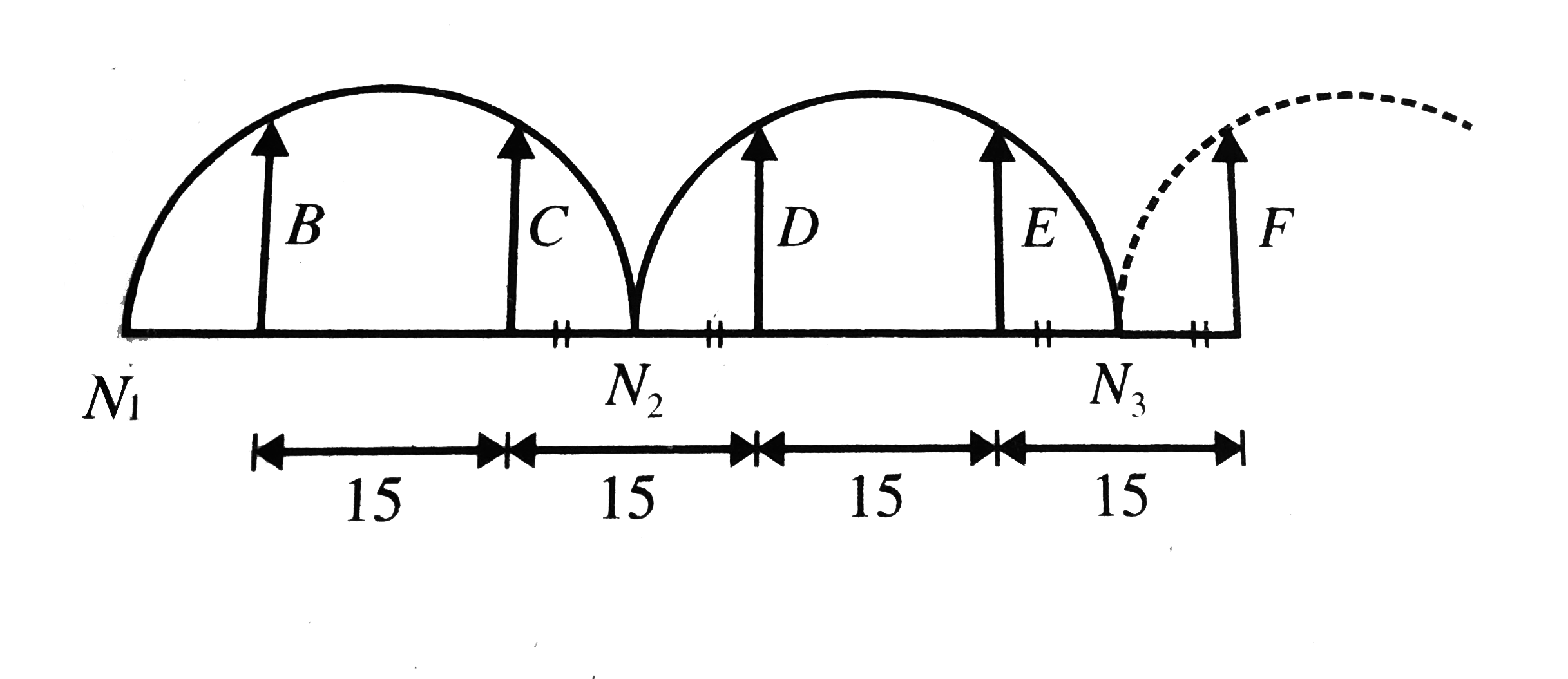 
|
|
| 32. |
When a particle of mass m moves on the X-axis in a potential of the form V(x) = kx^(2), it performs simple harmonic motion. The corresponding time period is proportional to sqrt((m)/(k)), as can be seen easily using dimensional analysis. However, the motion of a particle can be periodic even when its potential energy increases on both sides of x = 0 in a way different from kx^(2) and its total energy is such that the particle does not escape to infinity. Consider a particle of mass m moving on the X-axis. Its potential energy is V(x)=a x^(2) (a gt 0) for |x| near the origin and becomes a constant equal to V_(0) for |x| ge X_(0) For periodic motion os small amplitude A . The time periodic T of this particle is proportional to |
|
Answer» `Asqrt(m)/(ALPHA)` It is given that V(x) = `alphax^(4)` hence dimensions of `alpha` is `[ML^(-2)T^(-2)]` From dimensional analysis we can see that time PERIOD is proportional to `(1)/(A) sqrt((m)/(alpha))`, hence option (b) is correct. |
|
| 33. |
A bal tied to a sting takes 4 s to complete revolution along a horizontal circle. If by pulling the cord, the radius of the circle is reduced to half of the previous value, then how much time the ball will take in one revolution. |
|
Answer» Solution :Formula: By conservation of angular MOMENTUM `I_(1)omega_(1)=I_(2)omega_(2)` or `mr^(2). (2pi)/(T_(1))=m(r/2)^(2) .(2pi)/(T_(2))` TIME taken by the BALL, `Tk_(2)=1/4 T_(1)` `=1/4xx4=1s` |
|
| 34. |
When a particle of mass m moves on the X-axis in a potential of the form V(x) = kx^(2), it performs simple harmonic motion. The corresponding time period is proportional to sqrt((m)/(k)), as can be seen easily using dimensional analysis. However, the motion of a particle can be periodic even when its potential energy increases on both sides of x = 0 in a way different from kx^(2) and its total energy is such that the particle does not escape to infinity. Consider a particle of mass m moving on the X-axis. Its potential energy is V(x)=a x^(2) (a gt 0) for |x| near the origin and becomes a constant equal to V_(0) for |x| ge X_(0) The acceleration of this particle for |X|>X_(0) is |
|
Answer» proportional to `(v_(0)/(mX_(0)))` CONSTANT HENCE `F = -(dU)/(dx) = 0` Hence is absence of force acceleration of the particle REMAINS zero. |
|
| 35. |
An unsymmetrical sprinklerthe top view of the setup has frictionless shaft and equal fluid flows through each nozzle with a velocity of 10 m/sec relative to nozzle. If the shaft is rotating at constant angular speed then its angular speed of rotation is : |
|
Answer» 3 rad/s |
|
| 36. |
A particle starts from rest from origin and moves along a sraight line according to the lawa= mu cost where a= acceleration and mu is a constant. Find is displacement in time t. |
|
Answer» `S= MU ( 1+cos t)` |
|
| 37. |
In a planet a sucrose solution of coefficient of viscosity 0.0015N-Sm^(2) is driven at a velocity of 10^(-3) "ms"^(-1) through xylem vessels of radius2mu m and length 5mu m. The hydrostatic pressure difference across the length of xylem vessels in "Nm"^(-2) is |
|
Answer» 5 |
|
| 38. |
A satellite of mass .m. revolves around the earth of radius R at a height x from its surface. IF .g. is the acceleration due to gravity on the surface of the earth, than the orbital speed of the satellite is |
|
Answer» gx |
|
| 39. |
{:("Column-I","Column -II"),("A) Time period of infinite pendulum ","P) Time period of a physical pendulum pivoted at its COM"),("B) Time period of a body in a satelite ","Q) Time period of a body in a smooth chute made inside the earth"),("C) Time period of oscillation of particle is SHM ","R) Time period of seconds pendulum"),("D) Time period of oscillation is equal to 2 seconds ","S) Half of the time period of oscillation of kinetic cnergy of a oscillating particle"):} |
|
Answer» |
|
| 40. |
Which of the following functions of time represent (a) simple harmonic b. periodic but not simple harmonic. And c. non periodic motion? Give period for each of case of periodic motion (omega is ay positive constant) , 1. sinometa t-cos omegat 2. sin^(3)omega t 3. 3 cos (pi//4-2omegat) 4. cos omegat+cos 3 omega t+cos 5 omega t 5. e^(-omega^(2)t^(2) 6.1+omegat+omega^(2)t^(2) |
|
Answer» Solution :1. `sin OMEGA t-cos omega t=sqrt(2)[sin omega t "cos "(pi)/4-cos omega t "sin"(pi)/4]` `=sqrt(2)(omegat-(pi)/4)` It is simple harmonic with a time period `T=(2pi)/(omega)` 2. `sin^(3) omegat` is a periodic FUNCTION but not simple harmonic because `a alpha -y` condition ios not satisfied. Its time period is `T=(2pi)/(omega)` 3. `3cos (pi//4-2omegat)=3cos (2omegat-pi//4)` it is simple harmonic with a time period `T=(2pi)/(2omega0=(pi)/(omega)` 4. `cos omega t+cos 3 omegat+ cos 5 omega t` is a periodic funtion but not simple harmonic. The time periods of each periodic function are `(2pi)/(omega),(2pi)/(3omega)` and `(2pi)/(5omega)`. Since `(2pi)/(omega)` is the multiple of the other two periods, the given sum is periodic with time period `(2pi)/(omega)` 5. `e^(-omega^(2)r^(2))` is not periodic as t increases the function `e^(-omega^(2)t^(2))` DECREASES and tends to zero as `to to oo` 6. `1+omegat+omega^(2)t^(2)` is not periodic as function increases with increase in t with out repetition. |
|
| 41. |
For what value of x, will the two vectors A=2hati+2hatj-xhatk and B=2hati_hatj-3hatk are perpendicular to each other? |
|
Answer» `x=-2//3` |
|
| 42. |
In a simple pendulum experiment, length is measured as 31.4 cm with an accuracy of 1mm. The time for 100 oscillations of pendulum is 112.0s with an accuracy of 0.1s. The percentage accuracy in g is |
|
Answer» 1 |
|
| 43. |
Explain the relation in phase between displacement velocity and acceleration in SHM, graphically as well as theoretically. |
|
Answer» SOLUTION :The RELATION in phase between displacement, velocity and ACCELERATION in SHM can be SHOWN graphically. Displacement `x=ASIN(omegat+phi_(0))`.  Velocity, `v=omegaAcos(omegat+phi_(0))`  Acceleration `a=-omega^(2)Asin(omegat+phi_(0))`  Here, x and v differ in phase by `pi/2`, v and a differ in phase by `pi/2`. |
|
| 44. |
The work done in adiabatic process is given by |
|
Answer» `(nR(T_(1))-T_(2))/(gamma)` `W=overset(V_(2))UNDERSET(V_(1))intPdv=Koverset(V_(2)underset(V_(1))int(dV)/(V^(gamma)` `W=(1)/(1-gamma)[(P_(2)V_(2)^(gamma))/(V_(2)^(gmma-1))-(P_(1)V_(1)^(gamma))/(V_(1)^(gamma-1))]=(1)/(1-gamma)[(P_(2)V_(2)-P_(1)V_(1))]` `=(nR)/(1-gamma)(T_(2)-T_(1))=(nR(T_(1))-T_(2))/(gamma-1)` |
|
| 45. |
A simple pendulum 4 m long swing with an amplitude of 0.2 m. What is its acceleration at the ends of its path? (g=10m//s^(2)) |
|
Answer» SOLUTION :`T=mgcos theta` `:.F_("NET")=MG sin theta` and acceleration `=g sin theta` `=(10)((0.2))/4=0.5m//s^(2)` 
|
|
| 46. |
The dimension of impulse is |
|
Answer» `ML^(-1)T^(-2) ` |
|
| 47. |
What is the advantage of a linear thermopile ? |
| Answer» Solution :Linear bolometer MEASURES RADIATION from just a narrow BAND of WAVELENGTH. | |
| 48. |
A ball of mass 600 gm strikes a wall with a velocity of 5ms^(-1) at an angle 30^(@) with the wall and rebounds with the same speed at the same angle with the wall. The change in momentum of the ball is, (in kg ms^(-1)) |
|
Answer» 15 |
|
| 49. |
A man of 60 kg gains 1000 cal of heat byeating 5 mangoes. His efficency is 28%. To what height he can jump by using this energy? |
| Answer» ANSWER :A | |