

Saved Bookmarks
This section includes 7 InterviewSolutions, each offering curated multiple-choice questions to sharpen your Current Affairs knowledge and support exam preparation. Choose a topic below to get started.
| 1. |
A gaseous mixture consists of 16 g of helium (He) and 16 g oxygen (O_2), the ratio C_P/C_V of the mixture is = ...... |
|
Answer» 1.4 For 16 g `O_2, n_2=16/32=1/2` For mixture of gas, `C_V=(n_1C_(V1)+n_2C_(V2))/(n_1+n_2)` where, `C_V=f/2 R` `C_P=(n_1C_(P1)+n_2C_(P2))/(n_1+n_2)` where, `C_P=(f/2+1)R` For `H_2, f_1=3, n_1=4`, For `O_2, f_2=5, n_2=1/2` `therforeC_P/C_V=(n_1((f_1)/2+1)R+n_2((f_2)/2+1)R)/(n_1f_1R+n_2(f_2R))` `=(4(3/2+1)R+1/2(5/2+1)R)/(4(3/2R)+1/2xx5/2R)` `=(4xx5/2R + 1/2xx7/2R)/(6R+5/4R) =(10R+7/4R)/(6R+5/4R)` `=(40R + 7R)/(24R+5R)=47/29`=1.62 |
|
| 2. |
If the mass of a spring, m, is not negligible but small compared to the mass M suspended from it, show that the period of oscillations is given by T= 2pisqrt((M+m/3)//k), where k is the force constant of the spring. [Hint: If x and v be the instaneous displacement and velocity of the lower end, then the displacement of an element at a distance z from the fixed end is xz/l and velocity zv/l. The kinetic energy of the spring = (int_(0)^(t))1/2(mdz/l)z^(2)v^(2)/l^(2) = 1/6 mv^(2) Total energy of the system = 1/6mv^(2)+1/2Mv6(2) + 1/2kx^(2) = a constant. Differentiate anmd find T.] |
|
Answer» |
|
| 3. |
Audible frequencies have a range of 20 Hz to 20 xx 10^(3) Hz. Express 't' is range in tems of (i) period T, (ii) wavelength air at, (iii) angular frequency w. (Given velocity of sound in 0^(@)C =331 m//s). |
|
Answer» Solution :Velocity of sound in air at `0^(@)` C = 331 m/s. Audible frequencies, `lambda_(1) = 20 Hz`, `lambda_(2)= 20 xx 10^(3)` Hz (i) Period (T): Time period `T= 1/gamma`, we get, `THEREFORE T_(1) =1/gamma_(1) =1/20 = 0.05` s `T_(2) = 1/gamma_(2) = 1/(20 xx 10^(3)) = 0.055 xx 10^(-3)`s `therefore` Time period RANGE is `0.055 xx 10^(-3)` s. , (ii) Wavelength `lambda`: From the formula, `lambda = v/gamma` `therefore lambda_(1) =v/gamma_(1) = 331/20 = 16.55`m and `lambda_(2) =v/gamma_(2)= 331/(20 xx 10^(3)) = 0.0165`m `therefore` Wavelength ranges is 16.55 m to 0.0165 m. (III) Angular frequency `omega`: From the formula, `omega = 2pi gamma` `therefore omega = 2 PI gamma_(1)= 2pi xx 20 = 40 pi "rads"^(-1)` and `omega_(2) = 2pi gamma_(2) = 2pi xx 20 xx 10^(3)` `=40 pi xx 10^(3)` rad/s. `therefore` Angular frequency range is `40 pi` to `40 pi xx 10^(3)` rad/s. |
|
| 4. |
A closed container of volume 0.02m^(3)contains a mixture of neon and argon gases at a temperature of 27^(0) C and pressure of 1 xx 10^(5) N//m^(2)The total mass of the mixture is 28gm. If the gram molecular weights of neon and argon are 20 and 40 respectively, find the masses of the individual gases in the container, assuming them to be ideal. |
|
Answer» SOLUTION :If the mass of neon is .m., the mass of argon wiU be (28- m) , so `n_(Ne) = (m)/(20) and n_(Ar) = ((28 - m))/(40)` `therefore n = n_(Ne) + n_(Ar) = (m)/(20) + ((28 - m))/(40) = (28 + m)/(40)` ..... (1) n = `(PV)/(RT) = (1 xx 10^(5) xx 0.02 )/(8.314 xx 300) = 0.8 `... (2) So from EQUATION (1) and (2), `(28 + m )`40 = 0.8 , i.e., m = 4 gm so `m_(Ne) = `4 gm and `m_(Ar)` = 28 - 4 = 24 gm |
|
| 5. |
A metallic rod having area of cross section A, Young's modulus Y, coefficient of linar expansion alpha and length L tied with two strong pillars. If the rod is heated through a temperature t ^(@)C then how much force is produced in rod ? |
|
Answer» Solution :`Y = (F//A)/( L //L ) = (FL )/(AL)` where `l = L prop Delta t` `THEREFORE Y = (FL)/(AL prop DELTAT ) = (F)/(A prop Delta t )` |
|
| 6. |
The abgular acceleration the toppling pole shown in figure is given alpha="k "sin theta, where theta is te angle between the axis of the pole and the vertical and k is a constant. The pole starts from rest at theta=0. Choose the correct options |
|
Answer» The tangntial acceleration of the end of the POLE is `LK SINTHETA` |
|
| 7. |
(A) : Information on time is absent in Work - energy theorem.(R ) : Work - energy theorem involves an integral over an interval of time. The temporal (time) information contained in the statement of Newton.s second law is integrated over and is not available explicitly. |
|
Answer» Both (A) and (R ) are TRUE and (R ) is the correct EXPLANATION of (A) |
|
| 8. |
Find the frequency and angular frequency of 'sint' |
|
Answer» Solution :FREQUENCY =`1/T = 1/(2PI) = 0.16 HZ`. ANGULAR Frequency `OMEGA = (2pi)/(T) = (2pi)/(2pi) = `1 rad/sec |
|
| 9. |
When a tree is cut, the cutter makes a cut on the side facing the direction in which he wants it to fall. Why ? Explain. |
| Answer» SOLUTION :To produce TORQUE due to its WEIGHT about the point of cut, so that the TREE turns and rotates about that point | |
| 10. |
Define thermal capacity. |
| Answer» SOLUTION :The heat capacity of a BODY is defined as the AMOUNT of heat required to raise its temperature through ONE degree. | |
| 11. |
The linear expansivity of A and B are alpha_(1) and alpha_(2) respectively. If the cubical expansivity of B is 3 times the superficial expansivity of A, then |
|
Answer» `alpha_(2) = 2 alpha_(1)` |
|
| 12. |
An air bubble is rising at a constant rate of 3 mm/sec through a liquid of density 2.47 xx 10^(3)" kg/m"^(3). What will be the coefficient of viscosity of liquid if the radius of air bubble is 5 mm? |
|
Answer» |
|
| 13. |
A planoconvex lens ,when silvered at its plane surface is equivalent to a concave mirror of focal length 28cm when its curved sruface si silveredand the plane surface nor silvered ,tis is equivalent to a concave mirror of focal length 10cmthen the refractive index of the material of the lens is: |
|
Answer» <P>`9//14` `P_(eq)=2P_(1)+P_(m)rArr (1)/(-f_(eq)) =(2)/(f_(1))` `(1)/(-(-28))=(2)/(f_(1)) rArr f_(1)=56cm` `(1)/(f_(1))=(MU-1)((1)/(R_(1))-(1)/(R_(2))) rArr (1)/(56)=((mu-1))/(R) ……(1)` 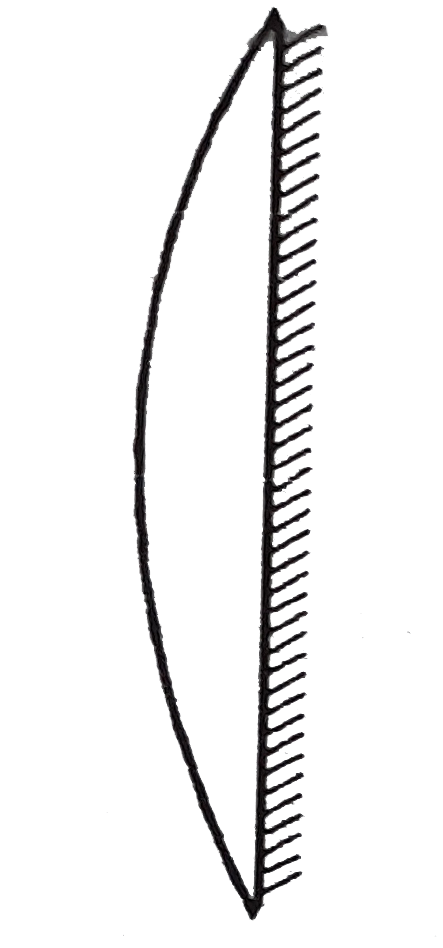 when curved surface is silvered `P_(eq)=2P_(1)+P_(m) rArr (1)/(-f_(eq))=(2)/(f_(1))-(1)/(f_(m))` `(1)/(-(-10))=-(2)/(56)-(1)/(f_(m)) rArr f_(m)=(-280)/(18)` `R=(-280)/(9)....(2)` 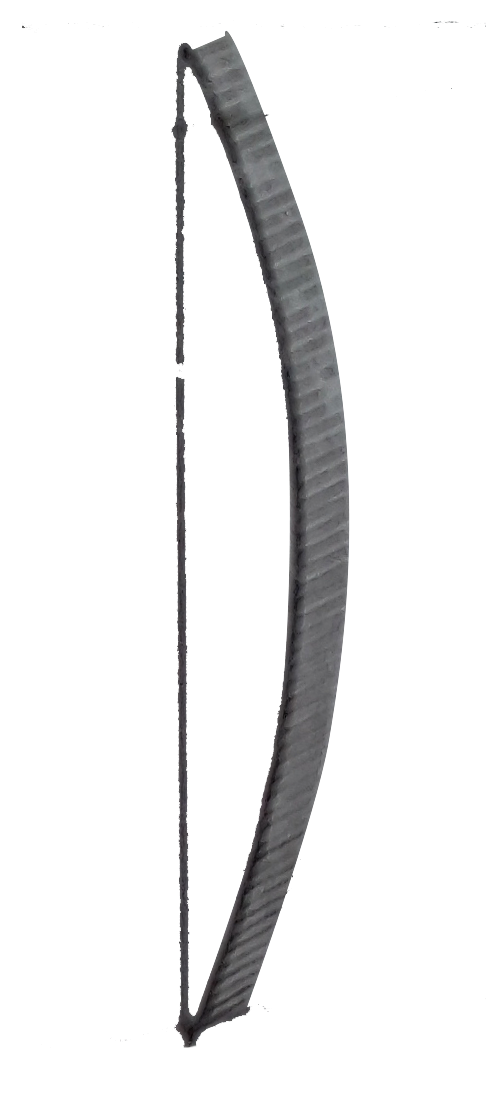 From (1)&(2) `(1)/(56)=((mu-1)9)/(280)` `(mu-1)=(280)/(56xx9) rArr mu-1=(5)/(9) rArr mu=(14)/(9)` |
|
| 14. |
If the zero of potential energy is at infinity, the total energy of an orbiting satellite is negative of its ...... energy. |
| Answer» SOLUTION :KINETIC ENERGY | |
| 15. |
Which thermometer is more sensitive a mercury or gas thermometer ? |
| Answer» SOLUTION :GAS THERMOMETER is more sensitive as COEFFICIENT of expansion of Gas is more than mercury. | |
| 16. |
Distance of two planets from the sun are 10^11 m and 10^(10)m respectively. Then find the ratio of time period of these two planets. |
| Answer» SOLUTION :`IMPLIES T_1/T_2 =((R_1)/R_2)^(3/2)=(10^(11)/(10^(10)))^(3//2) = 10^(3/2) = 10sqrt10` | |
| 17. |
A circular loop of string rotates about its axis on a frictionless horizontal plane at a uniform rate so that the tangential speed of any particle of the string is u. If a small transverse disturbance is produced at a point of the loop, with what speed (relative to the string) will this disturbance travel on the string ? |
|
Answer» Solution :m=mass per UNIT length of the string. R=Radius of the loop w=angular velocity V=Linear velocity of the string 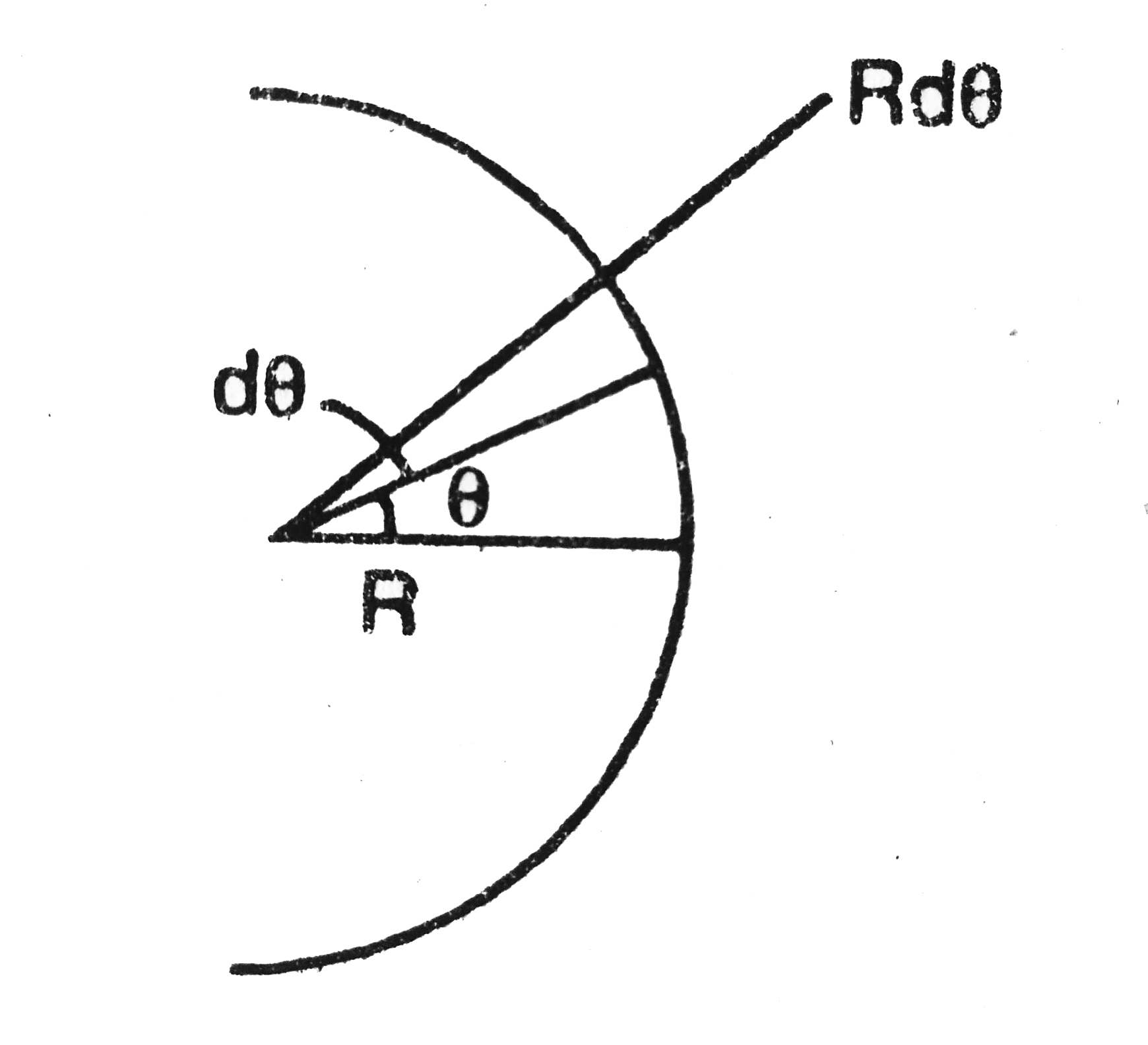 CONSIDER one HALF of the string as shown in URE. The hal loop experiences centrifugl force at every point, away from centre, which ils balanced by tension 2T. Consider an elemennt of angular part `dtheta` at angle `theta. consider another element symmetric to this. Cenrifugal force experience by the element `=(mRdtheta)w^2R` `(......Length of element =Rdtheta, mass =mRdtheta) Resolving in to rectangular components, net force on the TWO symmetirc elements, dF=2mR^2dthetaw^2sintheta` [Horizontal components cncels each other] so, total `F=int_0^(pi/2)2mR^2omega^2sithetadtheta` `=2mR^2omega^2[-costheta]` `=2mR^2w^2` `Again 2T=2mr^2w^2` `rarr T=mR^2w^2` velocity of transverse vibration `V=sqrt((T/m))` `=sqrt((mR^2omega^I2)=omegaR=V` |
|
| 18. |
(A): Zeroth law of thermodynamics definesthermal equilibrium (R): At thermal equilibrium of two bodies theyhave same internal energies |
|
Answer» If both (A) and (R) are true and (R) is THECORRECT EXPLANATION of (A) |
|
| 19. |
A man wishes to row across a river flowing to the right with speed of 2m//s . If the velocity that the boat can have V_(B)=4 m//s how should the man row so as to reach across in (a) shortest path (b) shortest time |
|
Answer» Solution :(a) Shortest path If the MAN has to MOVE along the shotest path , then the path of his boat should be AB (perpendicular to river) If the man rows vertically, the river will carry him to right, hence the man should incline his boat to the left . When his velocity is inclined it has two components `V_(x) "and" V_(y)`[compare with inclined velocity of cat] The horizontal component `V_(x)` should cancel the speed of the river. Thus, `V_(x)=V_(b)cos theta =V_(R)` `:. 4 cos theta =2 , theta 60^(@)` Alternatively , we can use resultant velocity that should lie along th evertical as in cat mouse problem (Method3)  . . (b) Shortest time Nothe that when the man rows along shortest distance, he DOES NOT cross the river in shortest time, because time taken to cross the river =`("width of river" )/("vertical velocity" )`  As long as the boat is inclined at angle `theta` , vertical velocity is `V_(B) sin theta ` which is less than `V_(B)`. To row in shortest time , the entire velocity of boat should be USED in vertical direction i.e. Man should row perpendicular to stream . When the man rows in shortest time, he does not reach point B but instead point B . shortest distance is ANALOGOUS to reaching a point on opposite bank (say house) whereas shortest time is linkedwith only reaching opposite bank. 
|
|
| 20. |
A falling ball undergoes elastic collision with the ground and repeatedly rebounds to the same light long the same path. Is the motion of the ball simple harmonie? |
| Answer» SOLUTION :No. It is not simple harmonic motion since the ACCELERATION is not VARYING with displacement. It is moving under acceleration DUE to gravity, a constant at the GIVEN place. | |
| 21. |
Match Column-I with Column-II : {:("Column-I","Column-II"),("(1) Positive acceleration","(a) Speed of particle decreases"),("(2) Negative acceleration","(b) Speed of particle increases"),(,"(c) Speed of particle keep on changing"):} |
|
Answer» |
|
| 22. |
A man walking briskly in rain with speed upsilon must slant his umbrella forward making an angle(with the vertical). A student derives the following relation between theta and upsilonn : tan theta = upsilon and checks that the relation has a correct limits : as upsilon rarr 0, theta rarr 0. as expected. (we are assuming there is no strong wind and that the rain vertically for a stationary man). Do you think this relation can be correct ? ifnot, guess the correct relation. |
|
Answer» Solution :The RELATION `tan theta = upsilon has a CORRECT limit, as upsilon rarr 0 , theta rarr0.` However, `RHS = tan theta = [M^0 L^0 T] and LHS = upsilon = [M^0 L^1 T^(-1)].` Therefore, the relation is not correct dimensionally. As we go through unit 3 of the book, we shall find that the correct relation is tan `theta = (upsilon^2)/(rg)` |
|
| 23. |
Mention the cause of earthquake . |
|
Answer» Solution :Since earth.s CRUST is notuniform , but has DISCONTINUITY and dislocations that are called FAULT lines . These fault lines in the earth.s crust are like compressed springs and POSSESS a large amount of potential energy . AN earthquake results when these fault lines readjust . |
|
| 24. |
Four indentical masses m are kept at the corners of a square of side a. Find the gravitational force exerted on one of the masses by the other masses. |
|
Answer» `(GM)/(3a^(2))` |
|
| 25. |
An automobile is moving at 100 kmph and is exerting attractive force of 3920 N. What horse power must the engine develop, if 20% of the power developed is wasted ? |
|
Answer» |
|
| 26. |
An ideal fluids flows through a pipe of circular cross -section made of two sections with diameters 2.5 cm and 3.75cm .The ratio of the velocities in the two pipes is …… |
|
Answer» `9:4`  According to equation of CONTINUITY , `A_(1)v_(1)=A_(2)v_(2)` `thereforepir_(1)^(2)v_(1)=A_(2)v_(2)` `therefore(v_(1))/(v_(2))=((r_(2))/(r_(1)))^(2)` `therefore(v_(1))/(v_(2))=((3.75cancel2)/(2.5cancel2))^(2)` `therefore(v_(1))/(v_(2))=(9)/(4)(9:4)` |
|
| 27. |
Write condition that vehicle can be parked on circular road with slope. |
|
Answer» Solution :The velocityof thevehicleon acircularbalancedroadis GIVENBY `v_(max) = [rg ((mu_(s)+ tan theta)/(1-mu_(s) tan theta))]^(1/2)` Herewe HAVETO TAKE `mu_(s)= 0` asthe surfaceis smooth `v_(max)= [rg ((tan theta)/( 1))]^(1/2)` At thisspeedfrictionforceis notneededat alllittlewearand tearon THETYRES`v_(o)` is calledtehoptimumspeed for`v ltv_(o)` frictionalforcewill beupwardand avehiclecan be parked on a slopeonly if tan `theta le mu_(s)` |
|
| 28. |
Size of atomic nucleus is ………….. |
|
Answer» `10^(-10)` m |
|
| 29. |
Calculate the temperature at which a body may appear (i) deep red (7900A) and (ii) blue (5000A). |
|
Answer» |
|
| 30. |
A particle suspended from a vertical spring oscillates 10 times per second. At the highest point of oscillation, the spring becomes unstretched. Take g=pi^(2)m*s^(-2) The maximum speed of the particle is |
|
Answer» `5picm*s^(-1)` |
|
| 31. |
A concave lens of focal length f forms an image which is n times the size of the object. What are the distance of the object from the lens in terms of f and n? |
|
Answer» SOLUTION :The concave LENS formula is `1/v-1/u=1/f` where no sign conventions are to be USED. Then , `u/v-1=u/f or 1/n-1=u/f (because v/u=n)` or `u=((1-n)/n)f` |
|
| 32. |
22320 cal of heat is supplied to 100g of ice at 0^(@)C. If the latent heat of fusion of ice is 80 cal g^(-1) and latent heat of vaporization of water is 540 cal g^(-10, the final amount of water thus obtained and its temperature respectively are |
|
Answer» `8G, 100^(@)C` `=(100g) (80 "cal" g^(-1)) + (100g) (1 "cal" g^(-1) ""^(@)C^(-1)) (100^(@)C)` =8000 cal + 10000 cal = 18000 cal But 22320 cal of heat is supplied, so remaining amount of heat =22320 cal - 18000 cal = 4320 cal Let the amount of water evaporated by remaining heat be m. Then `m(540 "cal" g^(-1)) = 4320` cal or `m= (4320"cal")/(540 "cal" g^(-1)) = 8g` Thus the final amount of water OBTAINED at `100^(@)C = 100g- 8g` = 92g |
|
| 33. |
A wedge with a rough circular track AB, is fixed on the plane XX'. The radius of the track is R and the coefficient of friction of the track varies as mu=mu_(0)x. The workdone on mass m in moving from A to B is mgR[(mu_(0))/n+1]. Here C is the centre of the circular track AB and x is the distance along positive X-axis from origin O. Then the value of n. |
|
Answer» |
|
| 34. |
A mass m of water at T_(1) is mixed with an equal mass of water at T_(2). Find the change in entropy in the process Sp. Heat capacity of water =C. |
|
Answer» |
|
| 35. |
When temperature increases, the ferquency of a tuning fork |
|
Answer» INCREASES |
|
| 36. |
Set the drifts suffered by boat in increasing order. (a) d = 1000m V_( R) = 2m//s " "V_(b)=4m//s (b) d = 500m V_( R) = 1m//s" " V_(b) = 6m//s ( c) d=1000m V_( R) = 6m//s"" V_(b)=6m//s ( d rarr width of river V_( R) rarr velocity of river v_(b)rarr velocity of Boat ). The boat moves perpendicular to width of the river |
|
Answer» a, B, C |
|
| 37. |
For a particle executing S.H.M, which of the following statements is not correct ? |
|
Answer» The total energy of a particle always remains the same |
|
| 38. |
Two bodies of masses m_(1) and m_(2) are moving with velocities 1ms^(-1) and 3ms^(-1) respecively in opposite directions. If the bodies undergo one dimensional elastic collision, the body of mass m_(1) comes to rest. Find the ratio of m_(1) and m_(2). |
|
Answer» Solution :`u_(1)=1 MS^(-1), u_(2)=-3 ms^(-1), v_(1)=0` `v_(1)=((m_(1)-m_(2))/(m_(1)+m_(2)))u_(1)+((2m_(2))/(m_(1)+m_(2)))u_(2)` `0 = ((m_(1)-m_(2))/(m_(1)+m_(2)))1+((2m_(2))/(m_(1)+m_(2)))(-3)` `m_(1)-m_(2)=6m_(2), m_(1)=7 m_(2), (m_(1))/(m_(2))=(7)/(1)` |
|
| 39. |
The motion of a particle is expressed by the equation a = -bx where 'a' is acceleration, 'x' is the displacement from the equilibrium position and 'b' is a constant. The periodic time will be |
|
Answer» `(2PI)/B` |
|
| 40. |
Friction |
|
Answer» ALWAYS OPPOSES the motion of a moving body |
|
| 41. |
A and B are two satellites revolving round the earth in circular orbits have time periods 8 hr and 1hr respectively. The ratio of their radius of orbits |
| Answer» ANSWER :C | |
| 42. |
In thermal equilibrium ,the average velocity of gas molecules is |
|
Answer» PROPORTIONAL to `sqrtT` |
|
| 43. |
A particle is moving eastwards with a velocity of 5 m/s. In 10s the velocity changes to 5 m/s northwards. The average acceleration in this time is |
|
Answer» zero `a=(1)/(sqrt2)MS^(-2)` 
|
|
| 44. |
Assertion: The specific heat of a gas in an adiabatic process is zero and in an isothermal process is infinite. Reason: Specific heat of a gas is directly proportional to the heat in system and inversely proportional to change in temperature. |
|
Answer» Both ASSERTION and REASON are TRUE and the reason is the CORRECT EXPLANATION of the assertion. |
|
| 45. |
A cylindrical isotropic solid of coefficient of thermal expansion alpha and density rho ( at STP) floats partially in a liquid of coefficient of volume expansion ( gamma) and density d ( at STP ) {:("Column-I","Column-II"),("A) Volume of the cylinder inside the liquid remains constant","P)" gamma=0),("B) Volume of cylinder outside the liquid remains constant","Q)" gamma=2 alpha),("C) Height of the cylinder outside the liquid remains constant","R)" gamma= 3 alpha ((d)/(rho)) ),("D) Height of the cylinder inside the liquid remains constant","S)" gamma= [ 2 alpha + alpha ( d/rho) ]):} |
|
Answer» |
|
| 46. |
A block of mass M is being pulled along rough horizontal surface. The coefficient of friction between the block & surface is mu. If another block of mass M/2 is placed on the block & it is again pulled on the surface. The coefficients of friction between the block and surface will be |
| Answer» ANSWER :A | |
| 47. |
During a total solar eclipse the moon almost entirely covers the sphere of the sun. Write the relation between the distances and sizes of the sun and moon. |
|
Answer» Solution :Consider the diagram given below `D_(me)` = Distance of moon from EARTH Dge = `D_(se)` istance of sun from earth Let angle made by sun and moon is , we can write `theta=(A_(s))/(D_(SC)^(2))=(A_(m))/(D_(me)^(2))`  Here `A_(s)`= AREA of sun `A_(m)`= Area of the moon `theta=(pi R_(s)^(2))/(D_(se)^(2))=(piR_(m)^(2))/(D_(me)^(2))` `:.((R_(S))/(D_(se)))^(2)=((R_(m))/(D_(me)))^(2)` `:.(R_(s))/(R_(m))=(D_(se))/(D_(me))` `:. (R_(s))/(R_(m))=(D_(se))/(D_(me))` (Here, RADIUS of sun and moon represents their sizes respectively) |
|
| 48. |
A sphere and a block both are released from rest at the top of an inclined plane. After some time they reach the bottom. For all the options assume that angle made by the plane with the horizontal is more than angle of repose. |
|
Answer» If surface is frictionless then sphere and BLOCK reach the bottom simultaneously. If surface is rough but not sufficiently rough to provide pure rolling to sphere then ALSO acceleration of both the objects will be same that is equal to `(g sin THETA - mu g cos theta)`. Hence in this case also both will reach the bottom simultaneously, so option (b) is correct. When surface is sufficiently rough then acceleration of block will be given by (` g sin theta- mu g cos theta)`, but same for the sphere will be given by `(mg s in theta)/(m+(I)/(r^(2)))`. Due to DIFFERENT accelerations, time taken will be different to reach the bottom hence option (c) is correct. In case of pure rolling total mechanical energy of the sphere remains conserved whereas there is loss of energy in case of block hence kinetic energy of the sphere at the bottom will be more than that of the block. |
|
| 49. |
Two particles having position vectors vec(r_1) = (3hati +5hatj) m and vec(r_2) =(-5hati-3hatj) m are moving with velocities vec(v_1) = (4hati +3hatj)ms^(-1) and vec(v_2) = (a hati + 7 hatj) ms^(-1). If they collide after 2 seconds, the value of a is |
|
Answer» 2 `vecv_1 = (4hati + 3 hatj) MS^(-1), vec(v_2) = (a hati + 7 hatj) ms^(-1)` `:. DELTA vec(r) = vec(r_1) - vec(r_2) = (3 hati + 5 hatj) - (5hati - 3hatj)= (8 hati + 8 hatj) m` and `Delta vecv = vec(v_2) - vec(v_1) = (a - 4) hati + 4hatj` But `Delta vec(v) = (Delta vecv)/(Delta t) :. (a - 4) hati+ 4hatj = ((8 hati + 8 hatJ))/(2)` On SOLVING , we get `a = 8` |
|
| 50. |
A thin taut string tied at both ends and oscillating in its third harmonic has its shape described by the equation y(x,t) = (5.60 cm) sin [(0.0340 "rad"/cm)x] sin [(50.0 "rad"/s)t], where the origin is at the left end of the string, the x-axis is along the string and the y-axis is perpendicular to the string. (a) Draw a sketch that shows the standing wave pattern. (b)Find the amplitude of the two travelling waves that make up this standing wave. (c) What is the length of the string? (d) Find the wavelength, frequency, period and speed of the travelling wave. (e) Find the maximum transverse speed of a point on the string. (f) What would be the equation y(x,t) for this string if it were vibrating in its eighth harmonic? |
Answer» 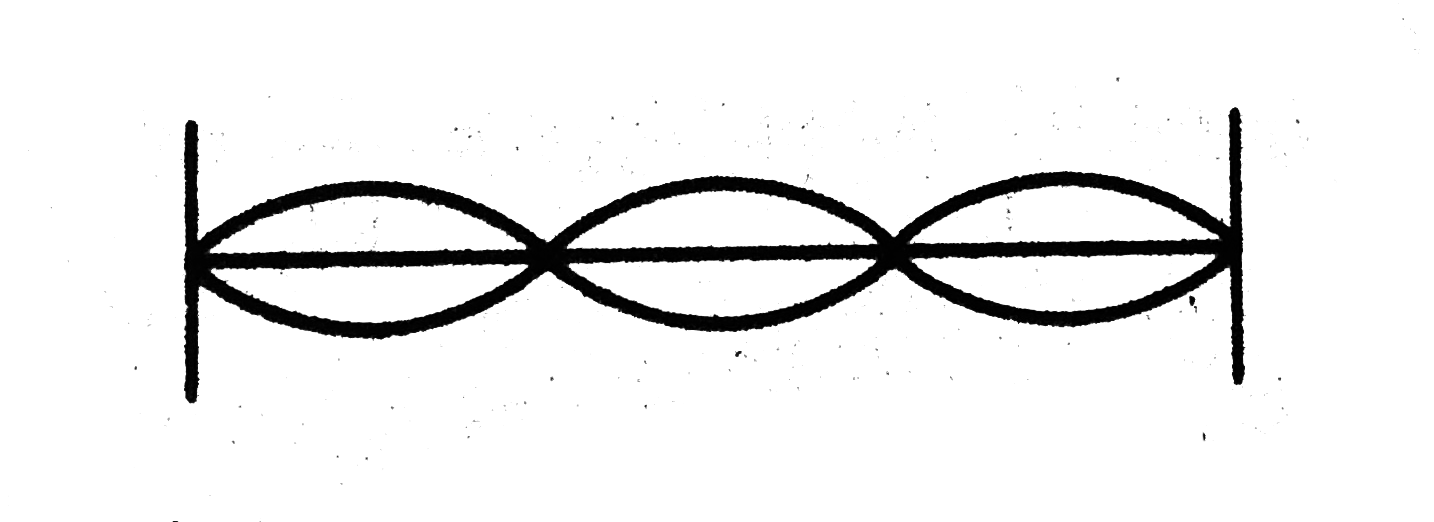 Third harmonic (b) `A= 5.6/2 = 2.8cm ` (c) `k= 0.034 cm^-1` `lambda = (2pi)/k = 184.7 cm ` `L = (3lambda)/2 = 277 cm ` (d) ` lambda = 184.7 cm ` `f = omega/(2pi) = 50/ (2pi) = 7.96 Hz.` `T = 1/f = 0.126 s` ` v= flambda = 1470 cm//s ` (e) `v_(MAX) = omega A_(max)` = `(50)(5.60)` `= 280 cm//s` (f) Frequency and HENCE `omega` will BECOME 8/3 times. `:. omega' = 50 xx 8/3 = 133 rad//s` `k = omega/v` or `k prop omega` Hence, k will become`8/3` times. `k' = (8/3) (0.034) = 0.0907 "rad"// cm .` |
|