

Saved Bookmarks
This section includes 7 InterviewSolutions, each offering curated multiple-choice questions to sharpen your Current Affairs knowledge and support exam preparation. Choose a topic below to get started.
| 1. |
In the question number 52, the speed with which the stone hits the ground is |
|
Answer» 15 m `s^(-1)` `u_(x) = 15 ms^(-1), a_(x) = 0` `v_(x) = u_(x) + a_(x)t = 15 + 0 xx 10 = 15 ms^(-1)` Motion along vertical direction, `u_(y) = 0, a_(y) = G` `v_(y) = u_(y) + a_(y)t = 0 + 9.8 xx 10 = 98 ms^(-1)` `THEREFORE` Speed of the stone when it hits the ground is `v = sqrt(v_(x)^(2) + v_(y)^(2)) = sqrt((15)^(2) + (98)^(2)) ~~ 99 ms^(-1)` |
|
| 2. |
A sound wave is passing through air column in the form of compression and rarefaction. In consecutive compressions and rarefactions. |
|
Answer» (a)denisty remains CONSTANT. |
|
| 3. |
A 2 cm thick slab of commercial thermocole, 100" cm"^(2) in cross-section and having thermal conductivity 2xx10^(-4) cal sec^(-1)" cm"^(-1)(C^(0))^(-1) has insulating regions differing by 100^(0)C. The quantity of heat flowing through it in a day will be |
|
Answer» 20.4 KCAL |
|
| 4. |
A thin circular ring of mass 'm' and radius R is rotating about its with a constant angular velocity omega. The objects each of mass M are attached gently to the opposite ends of a diameter of the ring. The new angular velocity of ring is |
|
Answer» `(OMEGAM)/(M+m)` |
|
| 5. |
An ideal gas goes from the state I to to the state f as shown in figure. The work done by the gas during the process |
|
Answer» is POSITIVE |
|
| 6. |
A disc rotates with angular velocity omega and kinetic energy E. Then its angular momentum |
|
Answer» CONSERVED about COM only |
|
| 7. |
Three moles of an ideal gas at 300 K are isothermally expanded to five times its volume and heated at this constant volume so that the pressure is raised to its initial value before expansion. In the whole process 83.14 KJ heat is required. Calculate the ratio C_p//C_v of the gas. log. 5 = 1.61 and R = 8.3 Joules/mole K. |
|
Answer» Solution :For the isothermal expansion, by Boyle.s law, we have `P_1 V_1=P_2 V_2or(P_1)/(P_2) = (V_2)/(v_1) = (5V_1)/( V_1) = 5` Now, applying gas law at constant volume, we GET `(P_2)/(T_2)=(P_3)/(T_3)( thereforeP_3 = P_1)(or)(P_2)/(T_2) =(T_2)/(T_3) = (T_1)/(T_3)` (As FIRST expansion was isothermal, HENCE `T_1 =T_2`.) `threfore(T_3)/(T_1) =(P_1)/(P_2) = 5or T_3 = 5T_1 = 5 xx300= 1500K` Now ` dQ= dU+ DW= nC_vd Tint_( V_i)^(v_2) PdV ` But `P= nRT_1 //V`, where `mu`is the number of moles of the gas. ` thereforedQ= nC _v dT + nRT_1log _e(V_2 //V_1)` Now `C_p-C_v=Rand(C_p -C_v) = gamma. so C_v = R // ( gamma -1)` `therefored Q=( nR)/( gamma -1) dT+ nRT_1log_e(V_2)/(v_1)` SUBSTITUTING the values : `83.14 xx 10^3` Joule `=( 3 xx 8.3 )/( gamma -1)` `(1500- 300 ) +8.3300log_e5 (or)83140 =( 29880)/( gamma -1) + 12027( log_e 5=1.61 ]thereforegamma= 1.42` |
|
| 8. |
An ice box made of styrofoam (thermal conductivity =0.01" Jm"^(-1)s^(-1)K^(-1)) is used to keep liquids cool. It has a total wall area including lid of 0.8" m"^(2) and wall thickness of 2.0 cm. A bottle of water is placed in the box and filled with ice. If the outside temperature is 30^(0)C the rate of flow of heat into the box is : (in J-s^(-1)) |
|
Answer» 16 |
|
| 9. |
A sphere rolls off the top of a stairway with a horizontal velocity of magnitude 200 cm/sec.The steps are 10 cm high and 10 cm wide. Which step will the ball hit first ? (g = 10m//s^(2)) |
|
Answer» 8 |
|
| 10. |
The work done by the string of a simple pendulum in one complete oscillation is equal to |
|
Answer» ZERO |
|
| 11. |
A horizontal force F pushes a 4 kg block (A) which pushes against a 2 kg block (B) as shown. The blocks have an acceleration of 3m//s^(2) to the right. There is no friction between the blocks and the surfaces on which they slide. What is the net force B exerts on A ? |
|
Answer» 6N to the right `a=(T_(3))/(m_(1)+m_(2)+m_(3)), T_(2)=(m_(1)+m_(2))a` |
|
| 12. |
If a cyclist moving with a speed of 4.9 m/s on a level can take a sharp circular turn of radius 4 m, then coefficient between the cycle tyres and road is |
|
Answer» |
|
| 13. |
Two identical loudspeakers placed 3.00 m apart are driven by the same oscillator as shown in Fig. 7.12. A listener is originally at point O , located 8.00 m from the centre of the line connecting the two speakers. The listener then moves to point P, which is a perpendicular distance 0.350 m from O , and she experiences the first minimum sound intensity . What is the frequency of the oscillator ? |
|
Answer» Solution :In this example , signal representing the sound is electrically SPLIT and sent to two different loudspeakers . After leaving the speakers , the sound waves recombine at the positionof the listener. Despite the difference in how thesplitting occurs , the path differnce discussion related to Fig . 7.12 can be applied here. Because the sound waves from two separate sources combine , we apply the waves in interference analysis model. Figure 7.12 shows the physical arrangement of the speakers , along with two shaded right triangles that can be drawn on the basis of the lengths described in the problem . The first minimum occurs when the two waves reaching the listener at point `P are 180^(@)` out of phasw , in other words , when their path difference `Delta R equals lambda//2`. From the shaded triangles , find the path lengths from the speakers to the listener : `r_(1) = sqrt (( 8.00 m)^(2) + ( 1.15 m)^(2)) = 8.08 m` `r_(2)= sqrt(( 8.00 m)^(2) + ( 1.85 m)^(2)) = 8.21 m` Hence, the path difference is ` r_(2) - r_(1) = 0.132 m`. Because this path differnce must equal `lambda//2` for the first minimum , `lambda = 0.26 m`. To OBTAIN the oscillator FREQUENCY , use equation `v = lambda f`, where ` v` is the speed of sound in AIR , `343 m//s`. |
|
| 14. |
If a vertical mass spring system is taken to the moon, will its time period after? |
| Answer» Solution :The TIME PERIOD will not be CHANGED. Because the time period of a body SUSPENDED to the end of spring is `T= 2pi sqrt((m)/(k))`. | |
| 15. |
Give the quantities for which the following are the dimensions: M^(1)L^(-1)T^(-2) |
|
Answer» |
|
| 16. |
A river of width 'w' is flowing variable velocity given by v_(r)=v_(0)(1+ (sqrt(3)-1)/(w)y). Where 'y' is perpendicular distance from one bank. A boat is driven such that it moves perpendicular to bank. Velocity of boat in still water is 2V(0) Drift of boat is |
|
Answer» `(W pi)/(3(SQRT(3)-1))` |
|
| 17. |
A river of width 'w' is flowing variable velocity given by v_(r)=v_(0)(1+ (sqrt(3)-1)/(w)y). Where 'y' is perpendicular distance from one bank. A boat is driven such that it moves perpendicular to bank. Velocity of boat in still water is 2V(0) The velocity of boat wrt to water when it reaches opposite bank |
|
Answer» `2V_(0)` |
|
| 18. |
The density of hydrogen at S.T.P is 0.08696 gm/litre. Find the gas constant of hydrogen. |
|
Answer» Solution :Density of hydrogen at S.T.P = 0.08696 gm/litre VOLUME of 1 gm of hydrogen `=1/0.08696"litre"=1000/0.08696c.c` At S.T.P, pressure `=76 TIMES 13.6 times 980"DYNE"//cm^(2)` , Temperature = 273 K , Get constant, `r=(PV)/T` `""=((76 times 13.6 times980)(1000/0.08696))/(273)=(76 times 13.6 times 98)/(273 times 8696) times 10^(9)=0.04267 times 10^(9)` `""=4.267 times 10^(7)" ERG "gm^(-1)K^(-1)=4.267" J "gm^(-1)K^(-1)=4267" J "Kg^(-1)K^(-1)` |
|
| 19. |
A river of width 'w' is flowing variable velocity given by v_(r)=v_(0)(1+ (sqrt(3)-1)/(w)y). Where 'y' is perpendicular distance from one bank. A boat is driven such that it moves perpendicular to bank. Velocity of boat in still water is 2V(0) Time taken to reach other bank |
|
Answer» `(pi w)/(6(sqrt(3)-1)V_(0))` |
|
| 20. |
A ball is thrawn downward from a height of 30m with a velocity of 10 ms^(-1).Determine the velocity with which the ball strikes the ground by using law of conservation of energy. |
|
Answer» Solution :Height from which the ball is DROPPED = 30 m Velocity with which the ball is dropped=`10 MS^(-1)` According to law of conservation of energy, Gain in kinetic energy=Loss in POTENTIAL energy For bodies falling down `v62 = u^2 + 2gh ` ` v^2 = (10)^2 + 2 xx 9.8 xx 30 = 688` ` v = 26.23 ms^(-1)` |
|
| 21. |
What is calorimeter ? What is Calorimeter ? Explain its principle and construction. |
|
Answer» Solution :CALORIMETRY means measurement of heat. A device in which heat measurement can be MADE is called calorimeter. When there is no heat EXCHANGE between system and surroundings, then it is called isolated system. When different PARTS of an isolated system are at different temperature, a quantity of heat transfers from the part at higher temperature to the part at lower temperature. The heat lost by the part at higher temperature is equal to the heat gained by the part at lower temperature. When a body at higher temperature is brought in contact with another body at lower temperature, the heat lost by the hot body is equal to the heat gained by the colder body, provided no heat is allowed to escape to the surroundings. Construction : It consists a metallic vessel and stirrer of the same material LIKE copper or aluminium. The vessel is kept inside a wooden jacket which contains heat insulating materials like glass, wool etc. The outer jacket acts as a heat shield and reduces the heat loss from the inner vessel. There is an opening in the out jacket through which a mercury thermometer can be inserted into the calorimeter. |
|
| 22. |
(A) : Power developed in circular motion is always zero.(R ) : Workdone in case of circular motion is not zero. |
|
Answer» Both (A) and (R ) are true and (R ) is the CORRECT EXPLANATION of (A) |
|
| 24. |
Thermodynamic process are indicated in the following diagram. Match the following |
|
Answer» <P>`P rarr C, Q rarr A, R rarr D, S rarr B` `:.` Process `I rarr` Isochoric, `P rarr C` As slope of curve II is more than the slope of curve III. Process `II rarr` ADIABATIC and Process `II rarr` Isothermal `:. Q rarr A, R rarr D` In process IV, pressure is constant Process `IV rarr` Isobaric, `S rarr B` |
|
| 25. |
The upper end of a wire of radius 4mm and length 100cm is clamped and its other end is twisted through an angle of 30° then the angle of shear is |
|
Answer» `0.012^(@)` |
|
| 26. |
A particle of mass m moving with velocity 2v collides with another particle of mass 3m moving with velocity v in the same direction. If it is perfect inelastic collision, the loss of K.E. of the system is |
| Answer» Answer :A | |
| 27. |
Answer the following question : What is the frequency of oscillation of a simple pendulum mounted in a cabin that is freely falling under gravity ? |
| Answer» SOLUTION :Gravity DISAPPEARS for a MAN under free FALL, so frequency is ZERO. | |
| 28. |
Necessary condition of equilibrium is that acceleration of body should be zero. |
|
Answer» |
|
| 29. |
A ball with initial speed of10m/s collides elastically with two other identical balls at rest as shown in figure, whose centres are on a line perpendicular to the initial velocity and which are initially in contact with each other.All the three balls are lying on a smooth horizontal table. The first ball is aimed directly at the contact point of the other two balls.All the balls are smooth. Find the velocities of the three balls after the collision. |
|
Answer» |
|
| 30. |
A block is projected with an initial velocity v_("Block") on a long conveyor belt moving with velocity v_("Block") (at that instant)having constant acceleration a_("Belt"). Mark the correct option regarding friction after long time (friction coefficient between block and belt = mu). If : {:(,"Column-1",,"Column-2"),("(A)",v_("Block")=2v_("Belt")and a_("Belt")=0,"(P)","zero"),("(B)",v_("block")=2v_("Belt")and a_("Belt")gt mug,"(Q)",f_(s)"static friction" (0 lt f_(s) lt f_(L))),("(C)",v_("Block")=2v_("Belt")and a_("Belt")=mug,"(R)",f_(L)"limiting friction"),("(D)",v_("Block")=2v_("Belt")and a_("Belt")lt mug,"(S)",f_(K) "kinetic friction"):} |
|
Answer» |
|
| 31. |
A force vec(F) = (4hat(i) - 3hat(j) - 5hat(k)) N moves a body for (3hat(i) + 6hat(j) + 3hat(k)) m to (ahat(i) - 8hat(j) + 5hat(k)) m. If the work done by the force is 8j, the value of .a. is |
|
Answer» 6 |
|
| 32. |
Aman of mass 60kg lifts a 15 kg mass to the top of a building of height 10 m in 5 minutes. H is efficiency is |
|
Answer» 0.1 |
|
| 33. |
A wire is hanged from the ceiling without any weight below it, would there any stress in the wire ? |
| Answer» Solution :Yes, it is because the WEIGHT of wire is acting as a deforming FORCE. | |
| 34. |
Displacement of a body is (5vec i+3 vecj-4vec k)m when a force (6 veci+6vecj+4veck)N acts for 5 sec. The power in watt is |
|
Answer» `16` |
|
| 35. |
The equation given below is the Vandar Wall's equation for a gas (P+(a)/(V^2))(V-b)=RT where P is the pressure, V is the volume, R is the universal gas constant and T is the temperature. Find the dimensions of a"/"b. |
|
Answer» <P> Solution :`[P]=((a)/(V^2))` (only quantities of similar dimension can be ADDED or SUBTRACTED)`[a]=[PV^(2)]` `[ML^(-1)T^(-2)][L^3]^(2)= [ML^(5)T^(-2)]` Similar, `[B]=[V]=[L^3]` `[(a)/(b)]=[(ML^(5)T^(-2))/(L^(3))]=[ML^(2)T^(-2)]`. |
|
| 36. |
(A) When a body slides on rough surface, its momentum is not conserved. (B) When a ball falls from a height, momentum of earth ball system is conserved (C )In case of explosion of flying bomb, momentum is conserved |
| Answer» Answer :A | |
| 37. |
A stone is dropped from the top of a tower of height 60 m. At the same time, another stone is thrown up from the foot of the tower with a velocity 20 m/s. Calculate the displacement of the centre of mass of the two stones at time of collision. (g=10 m/s^(2)) |
|
Answer» SOLUTION :Initially the centre of mass of the TWO stones is at a height of 30 m from the ground. Acceleration of the centre of mass `= (mxxg+mxxg)/(m+m)`=g (downward) Let the stones colide after time t. At that time DISTANCE travelled by the first STONE `= (1)/(2) "gt"^(2)` and distance travelled by the second stone = `ut -(1)/(2)"gt"^(2)` Now, `(1)/(2)"gt"^(2)+ut-(1)/(2)"gt"^(2)=60` `:.""t=(60)/(u)=(60)/(20)=3 s` Initital speed of the centre of mass, `u_("cm") = (mxx0+mxx20)/(m+m)` = 10 m/s (upward) `:.` Displacement of the centre of mass `= u_("cm")xxt-(1)/(2)"gt"^(2)=10xx3-(1)/(2)xx10xx9=-15`m Therefore, the centre of mass will move downward by 15 m. |
|
| 38. |
A body projected up reaches a point A in its path at the end of 4^(th) second and reaches the ground after 5 seconds from the start. The height of A above the ground is (g=10ms^(2)) |
| Answer» ANSWER :D | |
| 39. |
The velocity of a particle under going SHM at the mean position is 4ms^(-1). Find the velocity of the particle at the point where is equal to half the amplitude. |
|
Answer» `2sqrt(3)MS^(-1)` |
|
| 40. |
Derive an expression for the time period (T)of a simple pendulum which may depend upon the mass (m) of the bob , length (l) of the pendulum and acceleration due to gravity(g). |
|
Answer» Solution :Let `T=km^(x) l^(y)g^(Z) ` where k is a DIMENSIONLESS constant. WRITING the equation in dimensional form, we have `[M^(0)L^(0)t^(1)]=[M]^(x)[L]^(y)[LT^(-2)]^(z)=[M^(x)L^(Y+Z)T^(-2Z)]` Equating exponent of M,L and T on both sides, we get `x=0,y+z=0,-2z=1`. Solving the eq., we get `x=0,y=1/2,z=-1/2` Hence , `T=ksqrt(l/g)`, where k is constant. |
|
| 41. |
Spherical waves of frequency 1500 Hz are emitted from a 1.0 W source in an isotropic non-absorbing medium.What will the intensity and amplitude of the wave 1.0 m from the source if density of the medium be 1.3 kg m^(-3) and wave velocity is 300 ms^(-1). |
|
Answer» |
|
| 42. |
A block A of mass m_(1) rests on a horizontal table. A light string connected to it passes over a frictionless pulley at the edge of table and from its other end another block B of mass m_(2) is suspended. The coefficient of kinetic friction between the block and the table ismu_(k). When the block A is sliding on the table the tension in the string is |
|
Answer» `((m_(2)+mu_(k)m_(1))g)/((m_(1)+m_(2)))` Hence resultant force on the blocks = `m_(2)g-mu_(k)m_(1)`g Their ACCELERATION, a = `(m_(2)g-mu_(k)m_(1)g)/(m_(1)+m_(2))` If the TENSION in the string is T, then for block B, `m_(2)g-T=m_(2)a` `:. T=m_(2)(g-a) = m_(2)g(1-(m_(2)-mu_(k)m_(1))/(m_(1)+m_(2)))` =`m_(2)g (m_(1)+mu_(k)m_(1))/(m_(1)+m_(2))` `=(m_(1)m_(2)(1+mu_(k))g)/(m_(1)+m_(2))` 
|
|
| 43. |
A girl swings in a cardle with period pi//4 second and amplitude 2m. A boy standing infront of it blows a whistle of natural frequency 1000Hz. The minimum frequency as heard by the girl is (Velocity of sound in air is 320ms^(-1)) |
|
Answer» `850Hz` `V_(s)=V_(b)=0n_(MIN)=((V-V_(0))/(V))n` |
|
| 44. |
A copper wire of length 2.2 m and a steel wire of length 1.6 m, both of diameter 3.0 mm, are connected end to end. When stretched by a load, the net elongation is found to be 0.70 mm. Obtain the load applied. Young's modulus of copper Y _(C) =1.1 xx 10 ^(11) Nm ^(-2) Young's modulus of steel Y _(S) =2.0 xx 10 ^(11) Nm^(-2). |
|
Answer» SOLUTION :Let C copper and S for steel EQUAL radius of wire, `r = (3.0 xx 10 ^(-3))/( 2) = 1.5 xx 10 ^(-3) m` Length of copper wire `L _(C)=2.2 m` Length of steel wire `L _(S) = 1.6 m` Total increase in length for both wire, `Delta L _(C) + Delta L _(S) = 0.7 xx 10 ^(-3) m` Young.s modulus `=("Strees")/("Strain") = ("Stress")/((Delta L)/(L))` `therefore Y xx (Delta L )/(L)=` Stress [`because ` Strain `= (Delta)/(L)]` Stress on both THW wire is same, `therefore Y _(C) xx ( Delta L _(C))/( L _(C)) = Y _(S) xx ( Delta L _(S))/(L _(S))` `therefore (Delta L _(C))/( Delta L _(S)) = (Y_(S))/( Y _(C)) xx (L _(C))/( L _(S)) = (2.0 xx 10 ^(11))/(1.1 xx 10 ^(11)) xx (2.2)/(1.6)` `therefore (Delta L _(C))/(Delta L _(S))=2.5` Expanding `(Delta L _(C) + Delta L _(S))/( Delta L _(S)) = (2.5 + 1.0)/(1.0)` `therefore (0.7 xx 10 ^(-3))/( Delta L _(S))= 3.5` `therefore Delta L _(S) = (0.7 xx 10 ^(-3))/( 3.5) = 1/5 xx 10 ^(-3)` `= 2 xx 10 ^(-4) m` Now, `Delta L _(C) + Delta L _(S) =0.7 xx 10 ^(-3)` `therefore Delta L _(C) = 7 xx 10 ^(-4) -2 xx 10 ^(-4)` `= 5 xx 10 ^(-4) m` `therefore Y = ("Stress")/("Strain")` `therefore ` Stress `= Y xx` Strain `therefore F/A =Y xx` Strain `therefore F = Y xx` Strain ` xx A` `therefore F = Y _(S) xx (Delta L _(S))/(L _(S)) xx pi r ^(2)` `=2.0 xx 10 ^(11) xx(2.0 xx 10 ^(-4))/( 1.6) xx 3.14 xx (1.5 xx 10 ^(-3)) ^(2)=17.6625 xx 10 ^(1)` `therefore ~~1.8 xx 10 ^(2) N` where, F is appied load `F = Y_(C)xx (Delta L _(C))/(L _(C)) xx pi r ^(2)` From this formula load canbe calculate. 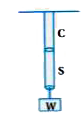
|
|
| 45. |
When a block of iron floats in mercury at 0°C, a fraction K_1 of its volume is submerged, while at the temperature 60^(@)C, a fraction K_2 is seen to be submerged. If the coefficient of volume expansion of iron is gamma_(Fe) and that of mercury is gamma_(Hg) then the ration ( K_1)/(K_2) can be expressed as |
|
Answer» `( 1+ 60 gamma_(FE))/( 1+ 60 gamma_(Hg))` |
|
| 46. |
A gas has pressures 100 cm and 136.99 cm of Hg temperatures 0^(@)C" and "100^(@)C under constant volume. Calculate the pressure coefficient ? |
|
Answer» |
|
| 47. |
If amplitude of particle executing SHM is doubled, which of the following quantites are doubled a.Time period b. Maxomum velocity c. Maximum acceleration d. total energy |
| Answer» Answer :A | |
| 48. |
If the change in the value of g at a height h above the surface of the earth is same as at depth .x. below the surface of the earth,then (h lt lt R) |
| Answer» ANSWER :B | |
| 49. |
The length and breadth of a table are (125+-0.4)cm and (75+-0.5)cm respectively. What is the area of the table? |
|
Answer» |
|
| 50. |
A square plate of moment of inertia 'I' is pivoted at its centre. It has a small projection of neglegible mass to one of its sides. A particle of mass 'm' moving with a velocity v parallel to the side having projection strikes to projection and stricks to it. If 'l' is the side length, the angular velocity of plate is |
|
Answer» `(MVL)/(2[I+(ML^(2))/(4)])` |
|