

Saved Bookmarks
This section includes 7 InterviewSolutions, each offering curated multiple-choice questions to sharpen your Current Affairs knowledge and support exam preparation. Choose a topic below to get started.
| 1. |
If 13.6 gm/c.c and 13.52 g/c.e are the densities of a liquid at 10^(@)C and 50^(@)C, find the coefficient of real expansion of the liquid |
|
Answer» Solution :Density of the liquid at `10^(@)C (d_(1)) = 13.6 GM //c.c.` Density of the li1quid at `50^(@)C (d _(2)) = 13.52 gm //c.c` From `gamma _(R) = (d _(1) -d _(2))/( d _(2) (t _(2) -t _(1))) = (13.6 - 12.52)/( 13.52 (50-10)) = (0.08)/( 13.52 XX 40) = 0.0001479 therefore 14.79 xx 10 ^(-5) (C ^(@)) ^(-1)` |
|
| 2. |
A false statement is |
|
Answer» Angle of contact `thetalt90^(@)`, if cohesive FORCE `lt` adhesive force `xxsqrt(2)` |
|
| 3. |
The average acceleration in one time period in a simple harmonic motion is |
| Answer» Answer :D | |
| 4. |
A calorimeter of water equivalent 10xx10^(-3)kg is filled with 70xx10^(-3)kg of a substance at its melting point. The substance is found to solidify completely in 21 minutes. A similar calorimeter containing 80xx10^(-3)kg of water at the same temperature cools at the rate of 1.5^(@)C per minute, the room temperature being the same in both cases. What is the latent heat of fusioin of the substance? (Specific heat capacity of water =4200 Jkg^(-1) K^(-1)) |
|
Answer» |
|
| 5. |
Two 3 kg masses have velocities vecv_(1) = 2hati + 3hatj m//sand vecv_2 = 4hati-6hatj m/s . Find a) velocity of centre of mass, b) the total momentum of the system, c) The velocity of centre of mass 5s after application of a constant force vecF = 24hati N d) position of centre of mass after S if it is at the origin at t = 0. |
|
Answer» Solution :(a) `vecv_( c) =(m_(1)vecv_(1) + m_(2)vecv_(2))/(m_(1) + m_(2)), vecv_( c)=(3(2hati + 3hatj)+3(4hati - 6hatj))/6, therefore` Velocity of centre of mass `vecV_( c) = 3hati - 1.5 HATJ ms^(-1)` b) The momentum of the system = `Mv_( c)=6 kg(3hati - 1.5 hatj) ms^(-1) = 18hati - 9hatj KGMS^(-1)` c) To find the velocity of centre of mass after 5 s of application of the force `vecF = 24hatj N` we first find the acceleration of the centre of mass. It is given by: `veca_( c) = vecF/M =(24hati)/6 = 4hati ms^(-2)` The velocity of centre of mass before the force is applied is `vecv_( c)`and from the EQUATION: `vecv_(c) = vecv_( c) + veca_(c).t` `vecv_(c ) =(3hati - 1.5 hatj) + (4hati)5 =(3hati -1.5 hatj + 20 hatj), V_(c )^(1) =(23 hati - 1.5 hatj) ms^(-1)` d) From the equation of the position vector `vecr = vecr_(0) + vecv_(0)t + 1/2 at^(2)`, where `vecr_(0)=VEC0` (origin at t=0), `vecv_(0) = vecv_(c ), veca = veca_( c)` and t= 5s `vecr =(3hati - 1.5 hatj) + 5 + 1/2(4hati) 25 =(15hati - 7.5 hatj + 50hati), therefore vecr =(65 hati - 7.5 hatj)`m The coordinates of the centre of mass after 5 s of application of the force `vecF`are (65 m, - 7.5 m) |
|
| 6. |
The possible range of masses is (of the order of) |
|
Answer» `10^(-30) KG ` to `10^30 kg ` |
|
| 7. |
An ideal gas undergoes a process in which co-efficient of volume expansion of gas gamma, varies with absolute temperature by the relation gamma=(2)/(T). Let C is molar heat capacity in this process and C_(p).C_(V) are molar heat capacities at constant pressure and volume respectively. Then |
|
Answer» `C=3C_(V)+2R` |
|
| 8. |
Select the correct pair from the following statements. Vectors can be added : |
|
Answer» ALGEBRICALLY and vectorially |
|
| 9. |
The rate of steady volume flow of water through a capilary tube of length .l. and radius .r. under a pressure difference of P is V. This tube is connected with another tube of the same length but half the radius in series. Then find the rate of steady volume flow through them. (The pressure difference across teh combination is P) |
| Answer» SOLUTION :`V/(17)` | |
| 10. |
A particle of mass m is made to move with a uniform speed "v' along the perimeter of a polygon of n sides inscribed in a circle of radius "a". |
|
Answer» The magnitude of the inpulse at each corner of the polygon is 2mv sin `(2pi//a)` |
|
| 11. |
Which of the following works on Pascal's law? |
|
Answer» barometer |
|
| 12. |
A bob of mass m attached to an inextensible string of length l is suspended from a vertical support. The bob rotates in a horizontal circle withan angular speed omega rad/s about the vertical support. About the point of suspension |
|
Answer» ANGULAR momentum is conserved Magnitude of the momentum `vec(p)` of the bob = `|vec(p)|`= mv = m`omega l` = constant As angular momentum `vec(L) = vec(r ) xx vec(p)` and the angle between `vec(r ) and vec(p)` is ALWAYS `90^(@)`. `|vec(L)| = l cdot m omega l cdot sin 90^(@) = m l^(2) omega` = constant ALSO, `vec(r)` is l aways radially outwards and `vec(p)` is TANGENTIAL. So `vec(L)` is always DIRECTED along the axis of rotation. So its direction is also fixed. |
|
| 13. |
Which of the following device is used to measure the rate of liquid through a pipe ? |
|
Answer» Thermometer |
|
| 14. |
The rate of …………….of a body about a given axis is…………….to…………….applied on the body. |
| Answer» Solution :CHANGE of ANGULAR momentum , DIRECTLY proportional , the EXTERNAL TORQUE. | |
| 15. |
Butane gas burns in air according to the following reaction. 2C_(4)H_(10) +13O_(2) rarr 10 H_(2)O +8 CO_(2). Suppose the initial and final temperature are equal and high enough so that all reactants and products act as perfect gases. Two moles of butane ar mixed with 13 moles of oxygen and then completely reacted. Find the final pressure (if the volume remains unchanged and the pressure before reaction is P_(0))? |
|
Answer» |
|
| 16. |
The average translational energy and the rms speed of molecules in a sample of oxygen gas at 300 K are 6.21 xx 10^(-21) J and 484 m/s respectively. The corresponding values at 600 Kare nearly (assuming ideal gas behaviour) |
|
Answer» `12.42 XX 10^(-21)` J, 968 m/s |
|
| 17. |
If the angle between force and displacement is acute then the work done is |
|
Answer» positive |
|
| 18. |
The amplitude of SHM is 5cm , period4sec and initial phase is pi//6. Its displacement at t=0 [initial displacement] is |
|
Answer» `2.5sqrt(2)CM` |
|
| 19. |
If v_(a) , v_(b) and v_(m) are the speed of sound in air , hydrogen and a metal at the same temperature , then …………. . |
|
Answer» `v_(B) GT v_(a) gt v_(m)` |
|
| 20. |
Two discs of moment of inertiaI_(1) and I_(2) about their respectively axes (normal) to the disc and passing through the centre) , and rotating with angular speed omega_(1) and omega_(2) are brought into contact face to face with their axes of rotation coincident . What is the loss in kinetic energy of the system in the process ? |
|
Answer» `(I_(1) I_(2) (omega_(1) - omega_(2))^(2))/(2 (I_(1) + I_(2)))` |
|
| 21. |
Two balls of masses m_(1)=100 g and m_(2)=300 g are suspended from point A by two equal inextensible threads, each of length l=32/35m. Ball of mass m_(1) is drawn aside and held at the same level as A but at a distance (sqrt(3)/2)l from A, as shown in Fig. When ball m_(1) is released, it collides elastically with the stationary ball of mass m_(2). The maximum rise of centre of mass of the ball of massm_(2) is |
|
Answer» `0.20m` `sintheta=(((sqrt(3))/2l))/l=(sqrt(3))/2` or `theta=60^(@)` Ball of mass `m_(1)` falls freely through height. 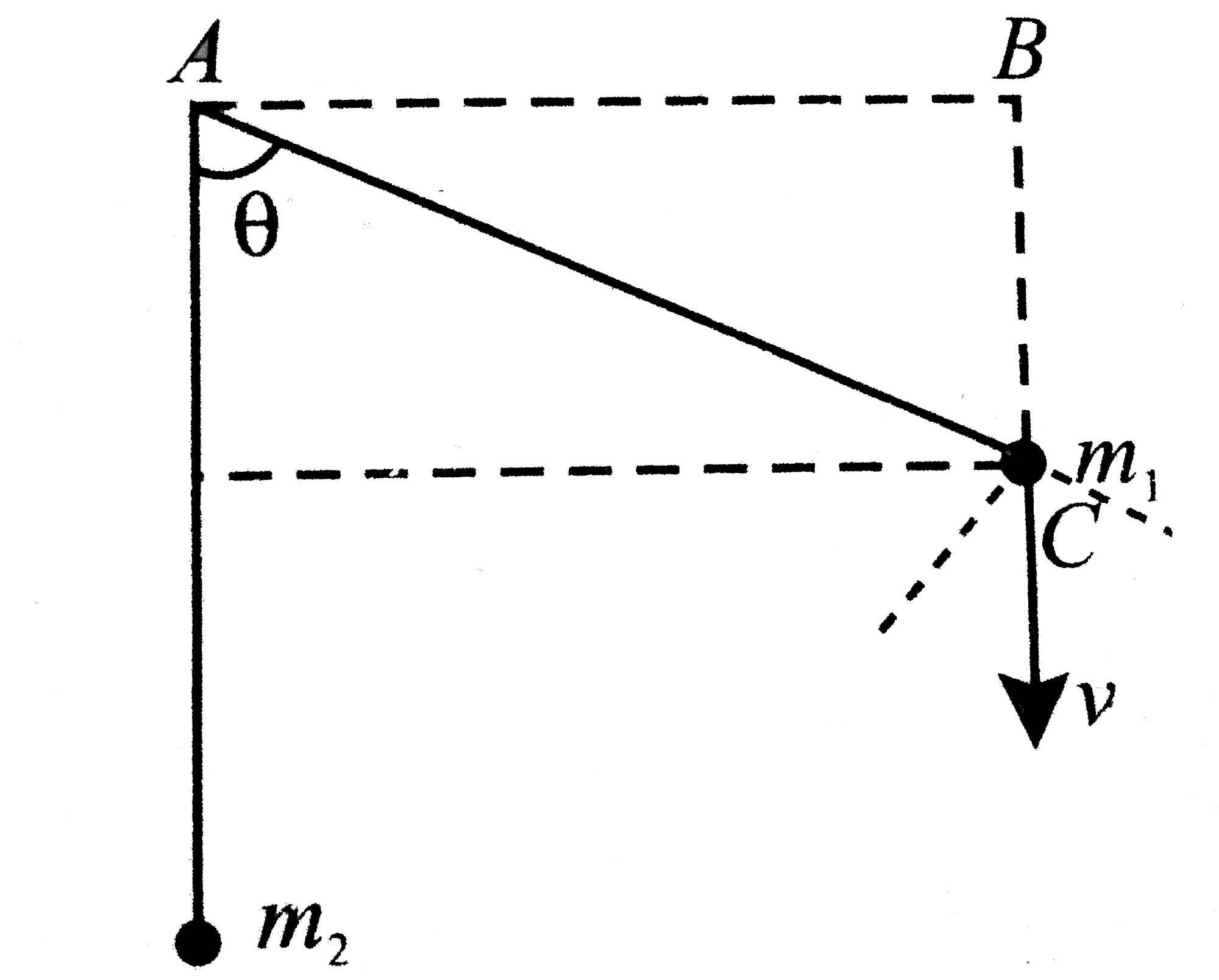 Velocity of this ball at this instant is `v=sqrt(2gxxl/2)=sqrt(gl)` It can be resolved into two components. i. `v cos theta`, along the thread. But thread is inextensible, hence this component decreases to zero (due to tension developed in the thread). ii. `v sin theta`, perpendicular to the thread. Due to this component ball STARTS to move along a circle whose centre is at `A`. According to law of conservation of ENERGY, Kinetic energy of ball `m_(1)` just before collision `=` Its kinetic energy at `AC +` Further loss of its potential energy `1/2m_(1)u_(1)^(2)=1/2m_(1) (sqrt(gl)sintheta)^(2)+m_(1)g(l-lcostheta)` `u_(1)=4m//s` According to law of conservation of momentums `m_(1)v_(1)+m_(2)v_(2)=m_(1)u_(1)+m_(2)u_(2)` and coefficient of restitution `e=(v_(2)-v_(1))/(u_(2)-u_(1))=1` substituting `u_(1)=4 m//s, u_(2)=, m_(1)=0.1 kg` and `m_(2)=0.3kg, v_(2)=2m//s,` the height to which it rises is `h=v_(2)^(2)/(2g)=0.20m` |
|
| 22. |
Two balls of masses m_(1)=100 g and m_(2)=300 g are suspended from point A by two equal inextensible threads, each of length l=32/35m. Ball of mass m_(1) is drawn aside and held at the same level as A but at a distance (sqrt(3)/2)l from A, as shown in Fig. When ball m_(1) is released, it collides elastically with the stationary ball of mass m_(2). Velocity u_(1) with which the hall of mass m_(1) collides with the other ball is |
|
Answer» `1m//s` `sintheta=(((sqrt(3))/2l))/l=(sqrt(3))/2` or `theta=60^(@)` Ball of mass `m_(1)` falls freely through height. 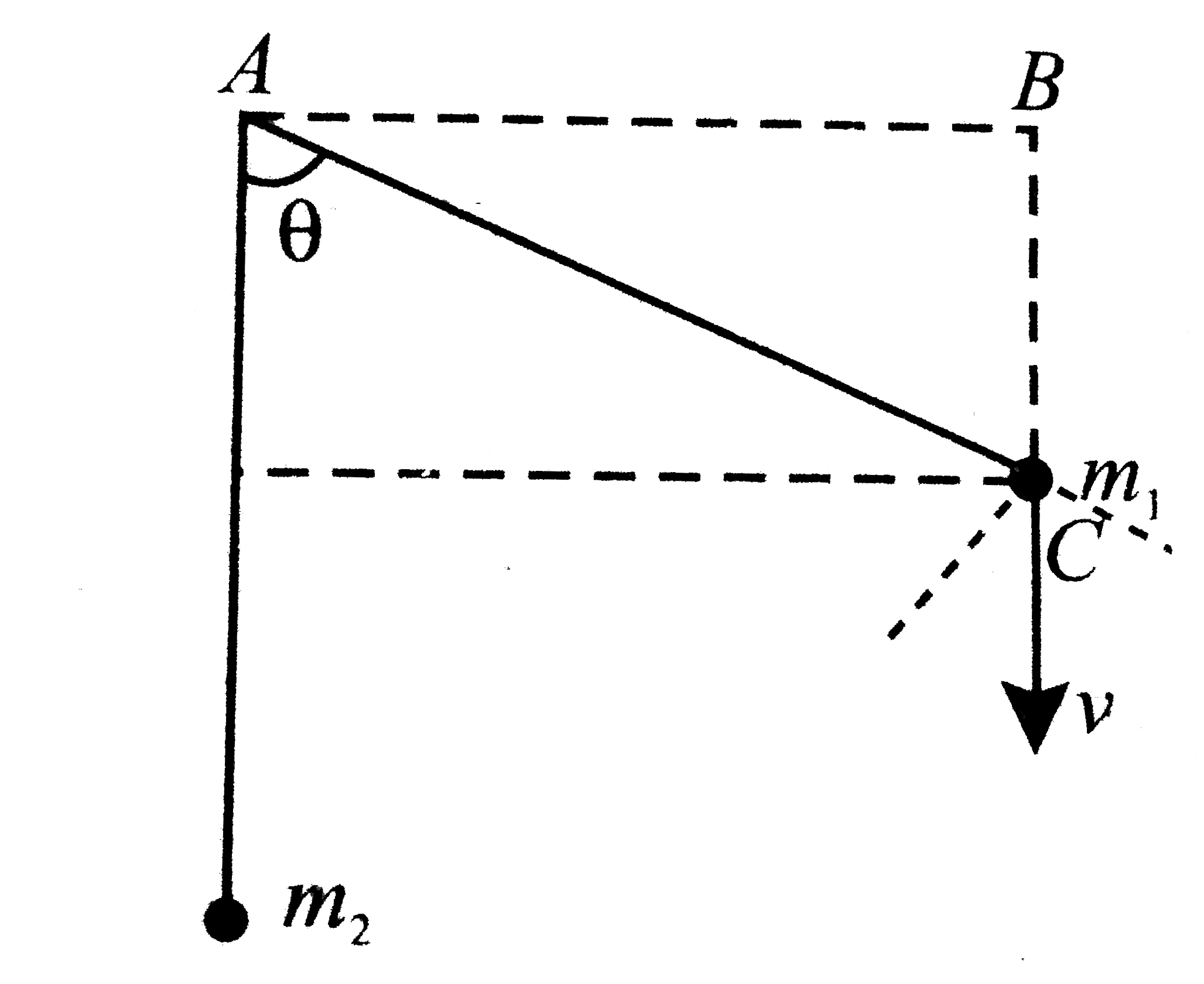 Velocity of this ball at this instant is `V=sqrt(2gxxl/2)=sqrt(gl)` It can be resolved into two components. i. `v cos theta`, along the thread. But thread is inextensible, hence this component decreases to zero (due to tension developed in the thread). ii. `v sin theta`, perpendicular to the thread. Due to this component ball starts to move along a circle whose centre is at `A`. According to law of conservation of energy, Kinetic energy of ball `m_(1)` just before collision `=` Its kinetic energy at `AC +` Further loss of its potential energy `1/2m_(1)u_(1)^(2)=1/2m_(1) (sqrt(gl)sintheta)^(2)+m_(1)G(l-lcostheta)` `u_(1)=4m//s` According to law of conservation of momentums `m_(1)v_(1)+m_(2)v_(2)=m_(1)u_(1)+m_(2)u_(2)` and coefficient of restitution `e=(v_(2)-v_(1))/(u_(2)-u_(1))=1` substituting `u_(1)=4 m//s, u_(2)=, m_(1)=0.1 kg` and `m_(2)=0.3kg, v_(2)=2m//s,` the height to which it rises is `h=v_(2)^(2)/(2g)=0.20m` |
|
| 24. |
An aircraft is flying at a heightof 3400 m above the ground . Iftheangle subtended ataground observation point by the aircraft positions10.0 s apart is30^(@) , what is thespeed of the aircraft ? |
|
Answer» |
|
| 25. |
A horizontally oriented copper rod of length / is rotating about a vertical axis passing through its middle. Calculate the rotation frequency at which the rod ruptures. Breaking or rupture strength of copper is sigma and density of copper is rho. |
|
Answer» |
|
| 26. |
P-V diagram of a diatomic gas is a straightline passing through origin. What is the molar heat capacity of the gas in the process |
|
Answer» Solution :P-V DIAGRAM of the gas is a straight line passing through origin. HENCE, `P prop V or PV^(-1)=` constant Molar heat capacity in the process `PV^(N)=` constant is `C=(R )/(gamma-1) +(R )/(1-n)` Here, `gamma=1.4` (for diatomic gas) & n = -1 `:.C =(R )/(1.4-1) +(R )/(1+1)or C = 3R` |
|
| 27. |
(A) In optical fibre, the diameter of the core is kept small. ( R) Light ray going form denser to rarer mediun is incident at an angle more than the critical angle required for total internal reflection |
|
Answer» Both A and R are TRUE and R is the correct EXPLANATION of A |
|
| 28. |
The potential energy of a system increases, if work is done |
|
Answer» by the SYSTEM against a CONSERVATIVE FORCE |
|
| 29. |
There are two wires of same material. Their radii and lengths are both in the ratio 1:2. If the extensions produced are equal, what is the ratio of the loads? |
|
Answer» `1:2` |
|
| 30. |
A ball is thrown vertically downwards from a height of 20 m with an initial velocity v_(0) It collides with the ground , loses 50 percent ofits energyin collision and reboundsto the same height .the initial velocity v_(0) is : (Take g = 10 ms^(-2)) |
|
Answer» `10ms^(-1)` ` :. "In" v^(2) -v_(0)^(2) =2gh ,v_(0) = 0 ` ` :. V= sqrt(2gh) =sqrt(2xx10xx20) = 20 m//s ` ENERGY just after rebound `E =1/2 mv^(2) =1/2 m xx m xx (20)^(2)` ` = 1/2 m xx400` = 200 m Joule 50 % energy LOSES in COLLISION means just before collisionenergyis 400 m By using energy conservation `1/2 mv_(0)^(2) +mgh = 400 m ` ` :. v_(0)^(2) = 800 - 2gh` ` :. v_(0)^(2) = 800 - 400` ` :. v_(0)^(2) = 400 ` ` :. v_(0) = 20 ms^(-1)` |
|
| 31. |
A specific gravity bottle is completely filled with mass m of a liquid at 0^(@)C. If it is heated to t^(@)C, then what mass of the liquid will be expelled? Coefficient of real expansion of the liquid =gamma and coefficient of linear expansion of the material of the bottle =alpha. |
|
Answer» |
|
| 32. |
Calculate the speed of efflux of kerosene oil from an orifice of a tank in which pressure is 4 atmosphere. Density of kerosene oil = 0.72 kg /lite. |
|
Answer» <P> ` v = sqrt( 2gh )= 0. 335 ms ^(-1)` |
|
| 33. |
The angular frequency of a spring block system is omega_(0). This system is suspended from the ceiling of an elevator moving downwards with a constant speed v_(0). The block is at rest relative to the elevator. Lift is suddenly stopped. Assuming the downward as a positive direction. Then |
|
Answer» The AMPLITUDE of the block is `v_(0)/(omega_(0)` |
|
| 34. |
A 2 kg stone is swung in a vertical circle by attaching it at the end of a string of length 2m. If the string can with stand a tension 140.6 N, the maximum speed with which the stone can be rotated is |
|
Answer» `22 MS^(-1)` |
|
| 35. |
From a point on the ground at a distance 2m from the foot of a vertical wall, a ball is thrown at an angle of 45^(@)of which just clears the top, of the wall and afterward strikes the ground at a distance 4m on the otherside The height of the wall is |
|
Answer» `2//3m` |
|
| 36. |
Estimate the total number of molecules inclusive of oxygen, nitrogen, water vapour and other constituents in a room of capacity 30m^(3) at a temperature of 30^(@)C and 1 atmosphere pressure. |
|
Answer» SOLUTION :At Boltzmann.s CONSTANT, `k_(B)=R/N,R=k_(B)N` Now, `PV=nRT=nk_(B)NT` `THEREFORE` The number of molecules in the room, `nN=(PV)/(k_(B)T)=(1.013xx10^(5)xx25)/(300xx1.38xx10^(-23))` The number of molecules in the room `=6.117.xx10^(26)` |
|
| 37. |
If a body is projected with speed less than escape velocity, then (a) the body can reach a certain height and may fall down following straight line path (b) the body can reach a certain height and may fall down following a parabolic path (c) the body may orbit the earth in a circular path (d) the body may orbit the earth in an elliptical path. |
|
Answer» only a & B are true |
|
| 38. |
A solid sphere of radius R is made of a material of density rhoand specific heat c. The sphere is initially at 220 K and is later suspended inside a chamber whose walls are at 0K. What time is required for the temperature of the sphere to drop to 160 K? |
|
Answer» Solution :The energy radiated by the sphere is given by Stefan.s law , ` (dQ)/(dt) = sigma AT^4 = sigma (4pi R^2) T^4` ` = 4pi sigma R^2 T^4`.....(i) Due to energy loss, the temperature of the sphere is reduced. Rate of energy loss due to rate of decrease of temperature is `(dQ)/(dt) = mc (dT)/(dt)` `m= V rho = 4/3 pi R^3 rho ` ` therefore (dQ)/(dt) =- 4/3 pi R^3rho c ( (dT)/(dt) )`..(ii) Comparing (i) and (ii) ` 4pi sigma R^2 T^4 = - 4/3 pi R^3 rho c ((dT)/(dt) )` `rArr 3 sigma T^4 = - rho RC ((dT)/(dT))` ` rArr (rho R c)/(T^4) dT= -3sigma dt` INTEGRATING both sides, we get `rho Rc int_(T_1)^(T_2) T^(-4) dT = - 3 sigma int_(0)^(t) dt` where `T_1` and `T_2`are initial and final temperature of the sphere, respectively, and t is the time taken for the sphere to drop its temperature from ` T_1 "to" T_2` ` rArr t = (rho Rc)/(9 sigma) [ (1)/(T_2^3) - (1)/(T_1^3) ]` ` =(rho Rc)/(9 (5.67 XX 10^(-8)) ) [ (1)/(160^3) - (1)/(220^3) ]` = 0.3`rhoRc` |
|
| 39. |
A steel wire is stretched by 5 kg wt. If the radius of the wire is doubled its Young.s modulus |
|
Answer» REMAINS unchanged |
|
| 40. |
The distance between the inner and outer wheels of a car is 1.75 m and its centre of gravity is 0-50 m above the ground. What is the maximum speed with which the car can negotiate a curve of radius of 40 m without overturning ? |
|
Answer» Solution : Distance between the inner and outer wheels of CAR = 2s = 1 -75 m Height of the C.G of the car from the ground = `h=0.5 m` Maximum SPEED = `v_("MAX") = ?` RADIUS of the circular road = r= 40 m `v_("max") = sqrt((gsr)/h) = sqrt((9.8 xx 0.875 xx 40)/0.5)` = 26.2 m/s |
|
| 41. |
The shells of carbs found around a particular coastal location in Japan seem mostly to resemble the lengendary face of a Samurai. Given below are two explanation of this observed fact. Which of these strikes you as a scintific explanation? (a) A tragic sea accident several centuries ago drowned a young Samurai. As a tribute to his bravery, nature through its inscrutable ways immortalized his face by imprinting it on the carb shells in that area. (b) After the sea tragedy, fishermen in that area, in a gesture of honour to their dead hero, let free any crab shell caught by them which accidentally had a shape resembling the face of a Samurai. Consequently, the particular propagated. This is an example of evolution by artificial selection. |
| Answer» SOLUTION :Explanation (B)is a SCIENTIFIC explanation of the OBSERVED fact. | |
| 42. |
(A) : To unscrew a rusted nut, we need a wrench with longer arm. (R) : Wrench with longer arm reduces the torque of the arm. |
|
Answer» Both 'A' and 'R' are TRUE 'R' is the CORRECT EXPLANATION of 'A' |
|
| 43. |
In a legend the hero kicked a baby pig so that he is projected with a speed greater than that of his cry. If the weight of the baby pig is assumed to be 5 kg and the time of contact 0.01 sec, the force with which the hero kicked him was: |
|
Answer» `5xx10^(-2)N` |
|
| 44. |
What is an echo ? |
| Answer» SOLUTION :An echo is a repetition of SOUND PRODUCED by the reflection of sound waves from a WALL, muntaion or other OBSTRUCTING surface. | |
| 45. |
A bullet of mass m strikes a block of mass M connected to a light spring of stiffness k, with a speed v_(0) and gets into it. Find the loss of K.E. of the bullet. |
|
Answer» |
|
| 46. |
Degree of freedom of a polyatomic gas is : |
|
Answer» `ge5` So, ` f ge 6` |
|
| 47. |
The SI unit of magneitc flux is |
|
Answer» `Wb//m^2` |
|
| 48. |
(I) Gravitational force is a central force. (II) Energy of the satellite is negative sometimes. Which one of Incorrect? |
|
Answer» I only |
|
| 49. |
A vertical U tube of uniform cross-section contains water up to a heightof 0.3m. Show that if water on one side is depressed and then released it motion up and down the two sides of the tube is SHM and calculate its time period. |
|
Answer» Solution :Refer to are `T=2pisqrt((H)/(G))=2XX(22)/(7)sqrt((0.3)/(9.8))=1.089s` |
|
| 50. |
A particleof mass 10 kg is kept on the surface of a uniform sphere of mass 100 kg and radius 10 cm. Find the work to be done against the gravitational force between them to take the particle far away from the sphere is (G = 6.67 xx 10^(-11) Nm^(2)kg^(-2)) |
|
Answer» `6.67 XX 10^(-10)J` |
|