

Saved Bookmarks
This section includes 7 InterviewSolutions, each offering curated multiple-choice questions to sharpen your Current Affairs knowledge and support exam preparation. Choose a topic below to get started.
| 1. |
A sphere of radius 6 cm weighs 2 kg in air. It is held with its lower half immersed in water. What will be its appent weight? ( Surface tension of water =72.5xx10^(-3) N m^(-1) "and " g=9.81 m s^(-2)) |
|
Answer» |
|
| 2. |
A sphere of mass M and radius r shown in figure slips on a rough horizontal plane. At same instant it has translational velocity v_(0) and rotational velocity about the centre v_(0)//2r. Find the translational velocity (in m/s) after the sphere start pure rolling (Take v_(0)=7 m/s) |
|
Answer» |
|
| 3. |
The centre of mass of a rigid body ………… the rigid body. |
|
Answer» is INSIDE |
|
| 4. |
What should be minimum distance between listener and reflecting surface ? |
|
Answer» 28m Now, when sound is reflected from reflector at distance x from its source and echo is heard at the end of t time. `v = (2x)/(t) implies x = (vt)(2) implies x_(min) = (v)/(2)xx t _(min)` `therefore x_(min) = (332)/(2) xx 0.1 = 16.6 m` |
|
| 5. |
Centre of mass of two particle with masses 2 kg and 1 kg locsted at (1, 0, 1) and (2, 2, 0) has the co - ordinates of |
|
Answer» `(4)/(3),(2)/(3),(2)/(3)` |
|
| 6. |
A solid sphere is rotating with an angular velocity omega. It is of moment is inertia 'I' about its diametrical axis and is of linear expansion coefficient alpha. When temperature is increased by DeltaT, the fractional change in its angular velocity is |
|
Answer» `2alphaDeltaT` |
|
| 7. |
In an experiment to determine the thermal conductivity of copper with Searle's apparatus, 100 gm of water flowed in 4.2 minutes past the cold end of the copper bar, its initial and final temperatures being 25°C and 52°C respectively. If the temperature difference between two points in the bar 10 cm apart is 23°C and the area of cross-section of the bar is 5 "cm"^2,calculate the coefficient of thermal conductivity of copper. Specific heat capacity of water 4,200 "J kg"^(-1) "K"^(-1) |
|
Answer» SOLUTION :HEAT gained by water `= Q = "m c d T"` `= 100 XX 10^(-3) xx 4200 xx (52 - 25) = 11340` J `A = 5 xx 10^(-4) m^(2) , theta_1 - theta_2 = 23^(@) C = 23 "K", d = 0.10 m, t = 4.2 xx 60 = 252 s`, `K= (Q d)/( A ( theta_1 - theta_2 ) t ) = ( 11340xx 0.10)/( 5 xx 10^(-4) xx 23 xx 252)= 292.3 "Wm"^(-1) "K"^(-1)` |
|
| 8. |
In a stationary wave |
|
Answer» PRESSURE CHANGE is MAXIMUM at nodes |
|
| 9. |
In the question number 91, if a force Fis applied to 20 kg block, then the tension in the string is |
|
Answer» 100N  When a force F is applied on 20kg block, then the TENSION in STRING is T=m_(1)=(10kg)(20ms^(-2))=200N |
|
| 10. |
A syring containing water is held horizontally with its nozzle at a height, h = 1.25 m above the ground as shown in Fig. 3.42. The diameter of the piston is 5 times that of the nozzle. The ispushed with a constant speed of 20 cm. s^-1.If g= 10m . s^-2. |
|
Answer» the speed of water emerging from the nozzle is 5m . `s^-1` |
|
| 11. |
A gun weighing 25 kg fires a bullet weighing 30 g with the speed of 200 ms^(-1). What is the speed of recoil of the gun? |
|
Answer» Solution :Mass of the GUN M = 25 kg Mass of the bullet `m = 30g = 30 xx10^(-3) kg` Speed of bullet `v = 200 ms^(-1)` Speed of gun V = ? The motion is in one dimension. As per law of conservation of momentum, `MV = mv = 0` `V=(-mv)/(M)` ` V = (-30 xx 10^(-3) xx 200)/(25)= - 240 xx 10^(-3) ms^(-1)` The negative sign SHOWS that the gun moves in the OPPOSITE direction of the bullet. Further the magnitude of the recoil speed is very small compared to the bullet.s speed. |
|
| 12. |
What is meant by free oscillation ? |
| Answer» Solution :When the oscillator is allowed to oscillate by displacing its position from equilibrium position, from equilibrium position, it oscillates with a frequency which is EQUALTO the NATURAL frequency of the oscillator. Such an OSCILLATION or vibration is KNOWN as free oscillation or free vibration. | |
| 13. |
A cylinder of radius R made of material of thermal conductivity K_1 is surrounded by a cylindrical shell of inner radius R and outer radius 3R made of material of thermal conductivity K_2. The two ends of the combined system are maintained at two different temperatures. There is no loss of heat across the cylindrical surfaceand the system is in steady state. The effective thermal conductivity of the system is |
|
Answer» `K_1 + K_2` |
|
| 14. |
State and prove Pascal's law in fluids. |
Answer» Solution : Pascal's law states that if the effect of GRAVITY can be generated then the pressure in a fluid in equilibrium is the same EVERYWHERE. Let us consider any two points A and B inside the fluid imagined. A cylinder is such that points A and B lie at the centre of the CIRCULAR surface at the top and bottom of the cylinder. Let the fluid inside this cylinder be in equilibrium under the action of FORCES from OUTSIDE the fluid. The forces acting on the circular, top and bottom surfaces are perpendicular to the forces acting on the cylindrical surface. Therefore the forces acting on the faces at A and B are equal and opposite and hence add to zero. As the areas of these two faces are equal, pressure at A = pressure at B. This is the proof of Pasccal's law when the effect of gravity is not taken into account. |
|
| 15. |
How do insects run on the surface of water? |
| Answer» Solution :Water has a tendency to reduce its SURFACE AREA. Surface of water BEHAVES LIKE a STRETCHED membrane. So, when insects touch water, it can easily run over it. It can run even with greater speed due to less aggressive force between water and insects. | |
| 16. |
A gardener is watering plants at the rate 0.1 litre/sec using a pipe of cross - section 1 cm^(2). What additional force he has to exert if he desires to increasethe rate of watering two times ? |
|
Answer» Solution :`F=Adv^(2)=((Av)^(2)d)/(A)` If rate of watering plant (Av) is doubled, it means amount of water poured / sec is doubled which is possible only if velocity is doubled. Hence force is to be made 4 TIME. `THEREFORE` additional force = 3 TIMES initial force `= 3Adv^(2)=3((Av)^(2))/(A)d` `= (3xx0.1xx0.1xx10^(3))/(10^(-4))=3xx10^(5)N` |
|
| 17. |
"A solid sphere of copper of radius R and a hollow sphere of the same material of inner radius r and outer radius R are heated to the same temperature and allowed to cool in the same environment. Which of them starts cooling faster ?'' |
| Answer» Solution :Rate of loss of HEAT = mass x SPECIFIC heat x rate of cooling. The surface AREA of HOLLOW and solid sphere are equal. But mass is LESS for hollow sphere. So rate of cooling of holow sphere is faster. | |
| 18. |
The dimensional formula of (1)/(2) in_(0)E^(2)is (in_(0) is permittivity of free space and E is electric field ) |
|
Answer» `ML^(2) T^(-2)` |
|
| 19. |
There are two incline planes AO and OB inclined at 45^(@) and60^(@) respectively with the horizontal as shown in the figure. When a man moves on the incline plane AO with speed 10 m/s. he oberves that the rain drops are falling45^(@) with the vertical. When the man moves on the inclined plane OB with speed 20 m/s. he observes that the raindrops are falling vertically downward. Then actual speed of rain is |
| Answer» Answer :C | |
| 20. |
A man walking briskly in rain with speed v must slant his umbrella forward making an angle theta with the vertical. A student derives the following relation between theta and v: tantheta = v and checks that the relation has a correct limit : as vtoo, thetato0, as expected , (we are assuming there is no strong wind and that the rain falls vertically for a stationary man.) Do you think this relation can be correct ? If you, guess the correct relation. |
| Answer» Solution :tan `THETA` must be dimensionless . The CORRECT formula is tan`theta = v//v.` where v. is the SPEED of RAINFALL. | |
| 21. |
A particle of mass 10 g is kept of the surface of a uniform sphere of mass 100 kg and radius 10 cm. Find the work to be done against the gravitational force between them to take the particle far away from the sphere. (Take G = 6.67 xx 10^(-11) Nm^(2)//kg^(2) ? |
|
Answer» `6.67 XX 10^(-9) J` `W- (GMm)/(oo) - (-(GMm)/R)` `=0+(6.67 xx 10^(-11) xx 100 xx 10 xx 10^3 )/(10 xx 10^(-2))` ` [ :. (GMm)/(oo) = 0]` `:. W = 6.67 xx 10 ^(-10) J` |
|
| 22. |
A steel wire of length 20 cm is stretched to increase its length by 0.2 cm. Find the lateral strain in the wire if the Poissin's ratio for steel is 0.19. |
|
Answer» 0.0019 |
|
| 23. |
A simple pendulum is swinging in vertical plane. The ratio of its potential energies when it is making angles 45^(@) and 90^(@) with the vertical is |
|
Answer» `1 : 1` |
|
| 24. |
The relation between time t and distance x is t=ax^(2)+bx where a and b are constants. The acceleration and velocity relation is acceleration = - k av^(3). The value of 'k' is |
|
Answer» |
|
| 25. |
Two cylinders A and B of equal capacity areconnected to each other via a stop cock. A contains a gas at standard temperature T and pressure P.B is completely evacuated. The entire system is thermally insulated. The stop cock is thermally insulted. The stop cock is suddenly opened. The find pressure of the gas in A and B is |
| Answer» ANSWER :B | |
| 26. |
If three vectors along coordinate axes represent the adjacent sides of a cubie of length b, then the unit vector alongits diagonal passing through the origin will be |
|
Answer» `(hati+hatj+hatk)/(sqrt(2))` or `A=sqrt(b^(2)+b^(2)+b^(2))=sqrt(3)b` ltbrrgt `:. hatA=A/A=(hati+hatj+hatk)/(sqrt(3))` |
|
| 27. |
Obtained an expression for efflux velocity of a liquid through a small hole in a vessel |
| Answer» SOLUTION :According to Bernoulli.s theorem VELOCITY v =`SQRT(2gh)` | |
| 28. |
Explain this statement clearly : "To call a dimensional quantity 'large' or 'small' is meaningless without specifying a standard for comparison". In view of this, reframe the following statements wherever necessary: (a) atoms are very small objects (b) a jet plane moves with great speed (c) the mass of jupiter is very large (d) the air inside this room contains a large number of molecules (e) a proton is much more massive than an electron (f) the speed of sound is much smaller than the speed of light. |
|
Answer» SOLUTION :(a) Compared to size of tip of pin, atoms are very small. (b) SPEED of jet plane is MUCH more than a speed of superfast train. (c) Mass of jupiter is very large compared to mass of the earth. (d) No. of MOLECULES in AIR contained in room is very large compared to no. of molecules in one mole air. (e) This statement is correct. (f)This statement is correct |
|
| 29. |
(A) : Sudden fall of pressure at a place indicates storm. (R ) : Air flows from higher pressure to lower pressure. |
|
Answer» Both (A) and (R ) are true and (R ) is the CORRECT EXPLANATION of (A) |
|
| 30. |
When a steel rod of length 2m is compressed its length decreases by 0.1cm. Find the work done per unit volume against the compressive stress. |
|
Answer» `2.5xx10^(4)JM^(-3)` |
|
| 31. |
A sealed tank containing a liquid of density rho moves with a horizontal acceleration a, as shown in the figure. The difference in pressure between the points A and B is |
|
Answer» `H RHO G` |
|
| 32. |
A heavy mass is attached to a thin wire and is whirled in a vertical circle. The wire is most likely to break |
|
Answer» When the mass is at the lowest POINT |
|
| 33. |
(A): Increasing the number of observations minimizes random errors (R ): positive and negative random errors occur with equal probability |
|
Answer» Both (A) and (R ) are TRUE and (R ) is the CORRECT EXPLANATION of (A) |
|
| 34. |
A wooden block is floating on water in a closed vessel. What will happen (i) if the air above the water is compressed, (ii) if all the air above the water is removed from the closed vessel? |
|
Answer» Solution :(i) If the air above the water in the closed vessel is compressed, the block will float UPWARDS some more. Here, WEIGHT of the wooden block = weight of displaced water + weight of displaced air. If the air is compressed, then its DENSITY increases and hence the weight of the displaced air increases while the weight of the displaced water decreases. Hence, the block will float upwards some more. (ii) If all the air above the water is REMOVED from the closed vessel, then the wooden block sinks more. This happens because when the air is removed, the buoyancy due to air is absent. Consequently, the apparentweight of the body increases, and the block sinks some more. |
|
| 35. |
When the temperature of a liquid is raised by 100^(@)C, 0.01% of the liquid is expelled. Calculate the coefficient of apparent expansion of the liquid. |
|
Answer» Solution :INITIAL mass of the liquid `(m _(1) = 100 gm,` Mass of the expelled liquid `(m _(1) - m _(2)) = 0.01 gm (0.01%)` Remaining liquid `= m _(2) =10- -0.01 = 99.99 gm , t _(2) -t _(1) = 100^(@)C` From `gamma _(a) = (m _(1) - m _(2))/( m _(2) (t _(2) -t _(1)) ) = ( 0.01)/(99.99 XX 100) = (1)/( 999900) = 0.00001//^(@)C` `thereore` COEFFICIENT of apparent expansion of the liquid `= 10 xx 10 ^(-) //^(@)C` |
|
| 36. |
A body is dropped from a height of 16m. The body strikes the ground and losses 25% of its velocity. The body rebounds to a height of |
|
Answer» 12m |
|
| 37. |
A body of mass 10kg is placed on foxed rough horizontal surface. Coefficient of static friction is 0.6 and coefficient of kinetic friction is 0.6 and coefficient of kinetic friction is 0.4. If horizontal force 20Nis applied on the body find out the frictional force (g=10ms^(-2)) |
|
Answer» Solution :Limiting friction `f_(S)=mu_(S)N=0.6xx10xx10=60N` Kinetic friction `=0.4xx10xx10=40N` The force applied on the body is F=20N. SINCE the body remains at REST, frictional force is static in nature and its value is `f_(s)=20N`.If we extend the discussion and make F=40N. `f_(s)` will be 40 N and the body remains at rest. If F=59N then `f_(s)` will be 59N and the body remains at rest. Static frictional force can take any volue between zero and 60N. Please note that in the formula `f_(s)=mu_(s)N,f_(s)` is maximum static frictional force or limiting friction. Its important to understand that the term static friction and limiting friction are not exactly the same. One should note that limiting friction is static in nature, but every static friction is not limiting friction. If `Fgt60N` the body slides on the surface, Hence the friction force involved will be kinetic frictional force and its magnitude will be `f_(k)=mu_(k)N`.`f_(k)=0.4xx10xx10=40N` In Fig. 1.4 (a) (b), the BLOCK is subjected to three forces mg, `P and R^(.) (R^(.)` is the resultant of normal reaction N and frictional force f) and hence they must be concurrent. `R^(.)=sqrt(f^(2)+N^(2)), tanphi_(s)=f_(max)/N=(mu_(s)N)/N, tanphi_(s)=mu_(s).........(1.2)` where `phi_(s)` is known as the angle of friction which represents the angle between the resultant `R^(.)` and the normal reaction N. It is to be remembered that as long as `thetaltphi_(s)`, the block is in equilibrium and when `thetaltphi_(s)`, the motion is about to begin. 
|
|
| 38. |
A particle is released from a height h. At a certain height, its kinetic energy is two times its potential energy. Height and speed of the particle at that instant are |
|
Answer» `h/3 sqrt((2gh)/(3))` As `(KE)/(PE) = 2/1` `:. `KE = `2/3 mgh and PE = 1/3 mgh` Height from the ground at that INSTANT is `h. = h/3` and speed of particle at that instant is `V = sqrt(2G(h - h.)) = sqrt(2h((2h)/(3))) = 2sqrt((gh)/(3))`. |
|
| 39. |
In the above problem its displacement after 3 seconds is |
|
Answer» 78.4m |
|
| 40. |
A trolley of mass 360 kg is lying on a horizontal frictionless surface. A man of mass 40 kg runs with uniform speed on the trolley by a distance of 2m in 0.5 second. What is the velocity of the trolley relative to earth? |
|
Answer» 0.8 m/s |
|
| 41. |
Study of which motion is required to understand many physical phenomena? |
| Answer» SOLUTION :The STUDY of OSCILLATORY MOTION. | |
| 42. |
The spring has a force constant k. The pulley is light and smooth while the spring and string are light figure. If the block of mass m slightly displaced vertically and released, find the period of verticall oscillations. |
|
Answer» Solution :Let `x_(0)` be the extension in the spring in EQUILIBRIUM position and `F_(0)` be the tension in the spring. Then `F_(0)=kx_(0)` If `T_(0)` is the tension in the string, then `T_(0)=mf or 2T_(0)=F_(0)=kx_(0)`…(i) Let mass m be pulled downward through distnace x, then tension in spring and string be F and T respectively. Now `F=2T=k(x_(0)=x//2)=kx_(0)KX//2` or `2T=2T_(0)+kx//2`[from (i)] or `T-T_(0)=kx//4` Restoring force on the mass m is `f=T-mg=T-T_(0)=kx//4`...(ii) From (ii) , `fpropx and f` is a restoring force, therefore, if mass m is left FREE, it will execute SHM. Here, spring factore`=k//4,` inertia factore `=`m. TIME period, `T=2pisqrt((m)/(k//4))=4pisqrt((m)/(k))` 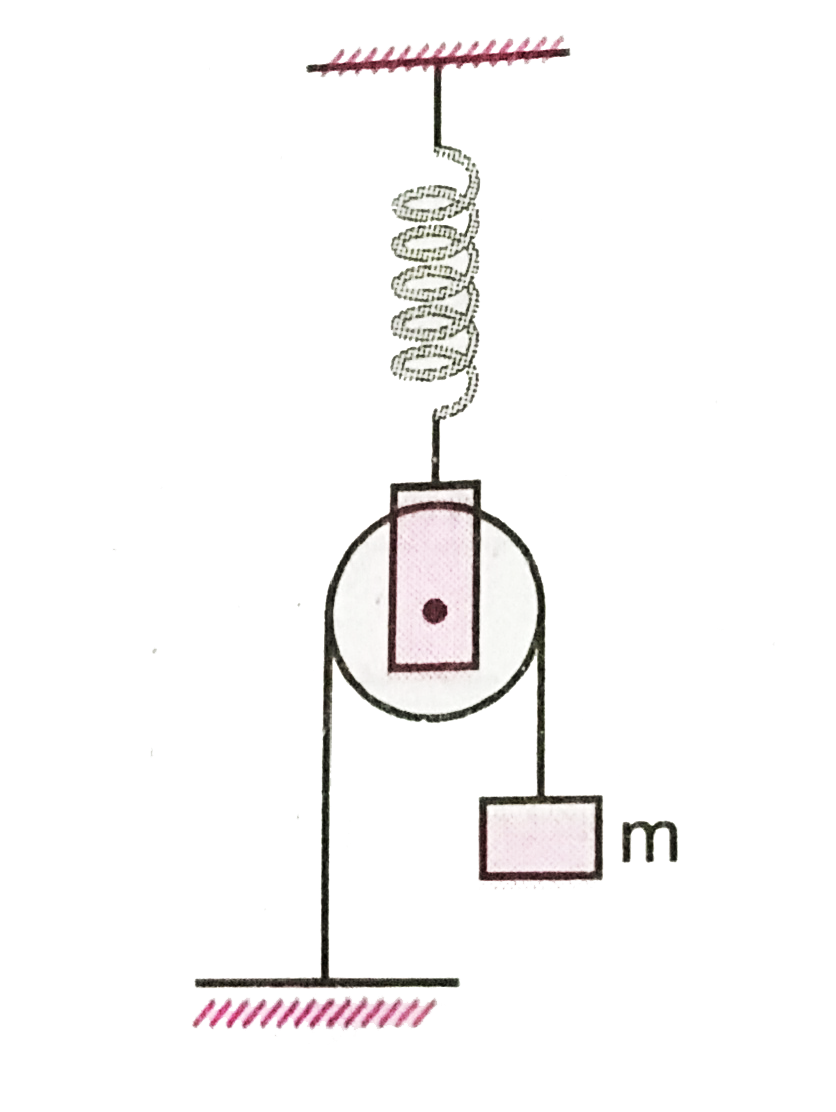
|
|
| 43. |
A person in lift which ascents up with acceleration 10ms^(-2) drops a stone from a height 10 m. The time of decent is [g=10ms^(-2)] |
| Answer» Answer :A | |
| 44. |
What is acoustics ? |
| Answer» SOLUTION :It is the study of the PRODUCTION and propagation of SOUND waves. | |
| 45. |
Iceberg floats in water with part of it submerged .What is the fraction of the volume of inceberg submerged if the density of ice is rho_(i)=0.917g//cm^(3). |
|
Answer» Solution :Density of ice `rho_(ice)=0.17g//cm^(3)` Density of water `rho_(w)=1g//cm^(3)` Let volume of ICEBERG =V Let volume of water displaced by iceberg =.V. For body FLOATS on LIQUID, WEIGHT of iceberg = weight of water displaced by the submerged part by ice `thereforeVrho_(i)thetag=Vrho_(w)g` `therefore(V)/(V)=(rho_(ice))/(rho_(w))=(0.917)/(1)=0.917` |
|
| 46. |
A particle of a small mass m is joined to a very heavy body by a light string passing over a light pulley. Both bodies are free to move. The total downward force on the pulley is |
| Answer» ANSWER :C | |
| 47. |
People often say for every action there is an equuivalent opposite reaction here they meant action of a human is it correct to apply newton third lawto human action ?What is meant by action in newton third law given your argument based on newton 's laws |
| Answer» SOLUTION :Newton'sthirdlawis applicableto onlyhuman'sactionswhichinvolve physicalforce. THIRDLAW is notapplicbleto humanpsychologicalactionsor THOUGHT | |
| 48. |
Which of the following is/are conservation forces(s)? |
|
Answer» `VECF=2r^(3)vecr` |
|
| 49. |
Figures 10.23(a) and (b) refer to the steady flow of a (non-viscous) liquid. Which of the two figures is incorrect? Why |
| Answer» Solution :Fig(a) is incorrect [Reason: at a CONSTRUCTION (i.e., where the area of cross section of the tube is smaller). Flow SPEED is larger due to mass conservation. Consequently PRESSURE there is smaller ACCORDING to Bernoulli.s equation. We assume the fluid to be incompressible]. | |
| 50. |
Two equal spheres B and C, each of mass m, are in contact on a smooth horizontal table. A third sphere A of same size as that of B or C but mass m//2 impinges symmetrically on them with a velocity u and is itself brought to rest. The loss of KE during collision is |
|
Answer» `("mu"^(2))/8` Let `v` be the speed ofthe balls `B` and `C` after impact. MOMENTUM conservationgives `(m/2)u=mvcos30^(@) +mvcos30^(@)` `u=2sqrt(3)vimpliesv=u/(2sqrt(3))`.......i From Newton's experimental law, for an oblique collision, we have take components along NORMAL, i.E. along `AB` for balls `A` and `B`. `v_(B)-v_(A)=-e(u_(B)-u_(A))` `v-0=-e(0-ucos30^(@))` `v=eucos30^(@)`.........ii Combining eqn i and ii we get `e=1/3` Loss in `KE =1/2 m/2 u^(2)-2(1/2mv^(2))` `=1/4mu^(2)-m(u/(2sqrt(3)))^(2)=1/6mu^(2)` |
|
