

Saved Bookmarks
This section includes 7 InterviewSolutions, each offering curated multiple-choice questions to sharpen your Current Affairs knowledge and support exam preparation. Choose a topic below to get started.
| 1. |
A round disc of moment of inertia I_(2) about its axis perpendicular to its plane and passing through its centre is placed over another disc of moment of inertia I_(1) rotating with an angular velocity omega about the same axis. The final angular velocity of the combination of disc is............. |
|
Answer» `((I_(1)+I_(2))omega)/(I_(1))`  According to CONSERVATION of momentum, `L=L.` `therefore I_(1)omega=(I_(1)+I_(2))omega.` `therefore omega.=(I_(1)omega)/(I_(1)+I_(2))` |
|
| 2. |
A boat at anchor is rocked by waves whose crests are 100 m apart and velocity is 25 m/sec. The boat bounces up once in every |
|
Answer» 2500 s |
|
| 3. |
Two chambers, one containing m_1g of a gas at P_1 pressure and other containing m_(2)g of a gas at P_2 pressure are put in communication with each other. If temperature remains constant, the common pressure reached will be |
|
Answer» `(P_1 P_2 (m_1 + m_2) )/( P_1 m_2 + P_2 m_1)` |
|
| 4. |
An optical microscope uses visible light of wavelength ranging from ………….. To …………. |
|
Answer» |
|
| 5. |
A particle (A) of mass m_(1) elastically collides with another stationary particle (B) of mass m_(2). Then : |
|
Answer» `(m_(1))/(m_(2)) = (1)/(2)` and the particles fly a part in the opposite direction with equal velocities. From kinetic ENERGY CONSERVATION `(1)/(2)m_(1)u^(2) = (1)/(2)m_(1)v^(2) + (1)/(2)m_(2)v^(2)`………..(2) 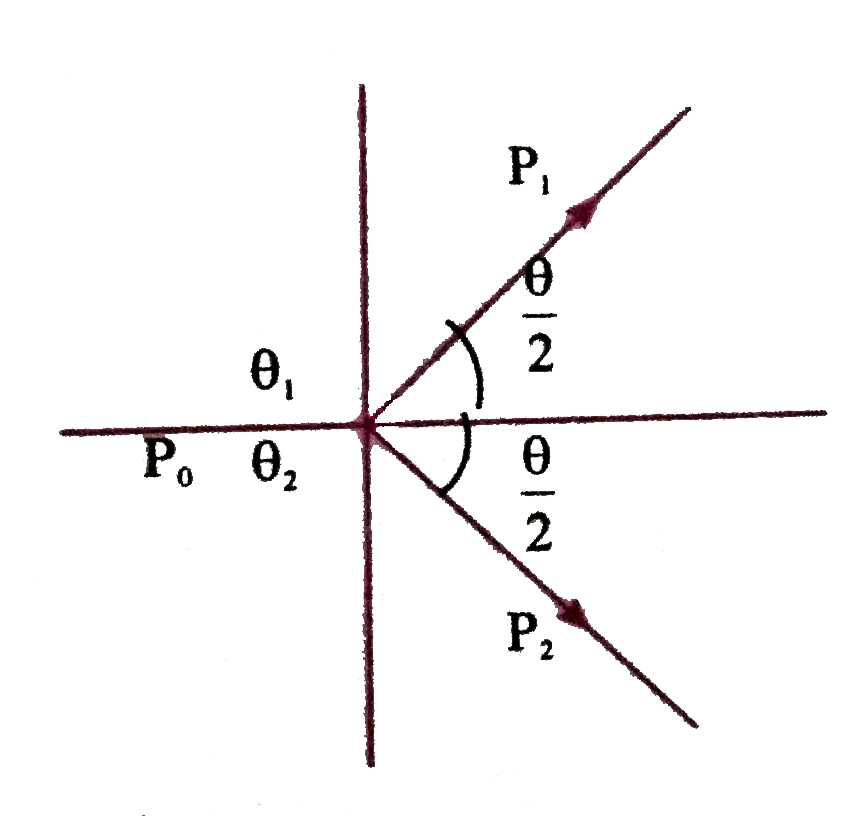 From eq. (1) and and eq. (2) we get , `(m_(1))/(m_(2)) = (1)/(3)` So, choice (b) is correct. `P^(2) = P_(1)^(2) + P_(2)^(2)+2P_(1)P_(2) COS theta`.........(1) Also from conservation of kinetic energy `(P^(2))/(2m_(1)) = (P_(1)^(2))/(2m_(1)) + (P_(2)^(2))/(2m_(2))`............(2) Since particles fly symmetrically `P_(1) sin "(theta)/(2) = P_(2) sin "(theta)/(2)`..........(3) Solving eq. (1), (2) and (3) we get `(m_(1))/(m_(2)) = (2)/(1)` |
|
| 6. |
A man sitting on a swing which is moving to an angle of 60^(@) from the vertical is blowing a whistle which has frequency of 2.0 KHZ. The whistle is 2.0 m from the fixed support point of the swing. A sound detector which detects the whistle sound is kept in front of the swing. The maximum frequency the sound detector detected is : |
|
Answer» `2.027 kHz` Velocity of whistle (SOURCE) `v_(s)=2m` Velocity of sound `v=332m/s` Maximum frequency `v_("max")=((V+V_(s))/(V))v` `=((332+2)/(332))xx2` `=((334)/(332)xx2` `1.006xx2` `2.012 kHz` |
|
| 7. |
The mathematical operation in which the accuracy is limited to least accurate term is |
|
Answer» addition |
|
| 8. |
During an experiment an ideal gas is found to obey an additional law VP^(2)= constant. The gas is initially at a temperature 'T' and volume 'V'. When it expands to a volume 2V, the temperature becomes |
|
Answer» T |
|
| 9. |
An unhappy mouse of mass m_(0) moving on the end of a spring of spring constant p is acted upon by a damping force F_(X)= -b vartheta_(X). For what value of b the motion is critically damped? |
|
Answer» <P>`B= sqrt((p)/(m_0))` |
|
| 10. |
The periods of a pendulum on two planets are in the ratio 3:4. The acceleration due to gravity on the mare in the ratio |
|
Answer» `9:16` |
|
| 11. |
A ball of mass .m. is rotated in a vertical circle with constant speed. The difference in tension at the top and bottom would be |
| Answer» Answer :C | |
| 12. |
Derive an expression for excess of pressure (pressure difference) inside the drop and bubble. |
Answer» Solution :In figure (a) a gas BUBBLE in LIQUID is shown and in figure (b) this bubble is shown spherical and in figure (c ) a soap bubble in air is shown . Suppose , bubble formed by this way radius of bubble is r and inside pressure is `P_(i)`and outside pressure is `P_(0)`. Letus obtain `P_(i)-P_(0)` for bubble in liquid or drop of liquid . The pressure insidethe drop is `P_(i)` and outsideis `P_(0).P_(i)` is slightly higher than `P_(0)`. When bubble increase by `Deltar`, new radius becomes `r+Deltar`. Area of this surface `A_(2)=4pi(r+Deltar)^(2)` `A_(2)=4pi(r^(2)+2r*Deltar+Deltar^(2))` `Deltar^(2)`is very small comparedto others terms `thereforeA_(2)=4pi(r^(2)+2rDeltar)` ....(2) The change inarea of surfaceof drop `DeltaA=A_(2)-A_(1)` `DeltaA=4pi(r^(2)+2rDeltar)-4pir^(2)` `=4pi(r^(2)+2rDeltar-2r^(2))` =`4pi(2rDeltar)` `Deltar=8pirDeltar` ...(3) The work done for increase area `DeltaA` of free surface of drop. `W=S_(la)(DeltaA)` `W=S_(la)(8pirDeltar)` ....(4) In the process of blowing bubble the force due to pressure DIFFERENCE `(P_(i)-P_(0)` on the inside surface of area `4pir^(2)` is `(P_(i)-P_(0))4pir^(2)` . Under the EFFECT of this force , surface moved by `Deltar` displacement , hence work done on the surface, `W=("force")XX("Displacement")` `W=("pressure difference")xx("area")xx("displacement")` `W=(P_(i)-P_(0))(4pir^(2))(Deltar)`...5 Comparing equation (4) and (5), `(P_(i)-P_(0))(4pir^(2)Deltar)=S_(la)(8pirDeltar)` `thereforeP_(i)-P_(0)=(2S_(la))/(r)`.....(6) Bubble in liquid and drop of liquid has one free surface . For them equation of pressure difference ontain according to equation (6). Bubble in air have two free surface . For them formula for pressure difference obtained as below. `P_(i)-P_(0)=(4S_(la))/(r)` ....(7) From this it can be said that for drop or bubble `P_(i)-P_(0)prop(1)/(r)` |
|
| 13. |
A particle is moving with shm in a-straight line. When the distance of the particle from the equilibrium position has the values 2 cm and 4 cm, the corresponding values of velocities are 5 cms^(-1)and 3 cms^(-1)respectively. Find the length of the path and the period. |
|
Answer» |
|
| 14. |
A capillary tube of diameter 0.20 mm is lowered vertically into water in a vessel. What should be the pressure inN//m^(2)to be applied on the water in the capillary tube so that water level in the tube is same as that in the vessel ? (surface tension of water is 0.07 N/m and atm pressure is10^(5)N//m^(2)) |
|
Answer» <P>`10^(3)` `P_(i)=P_(o)+(2T)/(R)` `=10^(5)+(2xx0.07)/(0.1xx10^(-3))` `=10^(5)+14xx10^(2)` `=1,00,000+1400` `=10.1.4xx10^(3)Nm^(-2)` |
|
| 15. |
Radius of a glass capillary is 0.5 mm . Find the height of the column of water when it is held vertical in water . The density of wateris 10^(3)kgm^(-3) and the the angle of contact between glass and water is 0^(@),g=9.8ms^(-2) and the surface tension of water T=0.0727Nm^(-1). |
|
Answer» Solution :`r=0.5mm=5xx10^(-4)m` `rho=10^(3)KGM^(-3)` `theta=0 "" thereforecos0^(@)=1` `g=9.8ms^(-2)` `T=0.0727Nm^(-1)` `T=(rhrhog)/(2costheta)` `thereforeh=(2Tcostheta)/(rrhog)` `=(2xx0.0727xx1)/(5xx10^(-4)xx10^(3)xx9.8)` `thereforeh=0.0296m` `thereforeh=2.96cm` |
|
| 16. |
The density of the atmosphere at sea level is 1.29kg//m^(3) . Assume that it does not change with altitude . Then how high would the atmosphere extended ? (g=9.8ms^(-2)) |
|
Answer» Solution :We use Eq.10.7 `pgh=1.29 kg m^-3 times 9.8 ms^2 times h m=1.01 times 10^5 Pa` `therefore h=7989 m=8km` In REALITY the density of air decreases with HEIGHT. So does the value of g. The atmospheric cover extends with decreasing pressure over 100km. we should also NOTE that the SEA level atmospheric pressure is not always 760 nm of Hg. A drop in the Hg level by 10mm or more is a sign of an approaching STORM. |
|
| 17. |
State and explain equation of continuity. |
| Answer» Solution :For ideal fluid RATE of FLOW CONSTANT `A_(1)v_(1)A_(2)v_(2)` | |
| 18. |
When an external force is applied at the centre of mass of a system of particles, then it undergoes |
|
Answer» Only TRANSLATORY motion |
|
| 19. |
A pipe in the form of a half ring is placed on a horizontal surface. If it is rotated through a small angle, and then released, assuming that it rolls without sliding determine the period of oscillations. The center of gravity of such a body is at distance (2r)/pi) from the center where r is the radius of the ring. Hint: (vec_(c) = alpha rhat(i) and vec(a_(c)) = vec(a_(c)) +(veca_(G//c))_("tangent") +(veca_(G//c))_("normal") |
|
Answer» |
|
| 20. |
A bullet is projected upwards from the top of a tower of height 90 m with the velocity 30 ms^(-1) making an angle 30^(@)with the horizontal. Find the time taken by it to reach the ground is (g=10 ms^(-2)) |
|
Answer» 2s |
|
| 21. |
If a person enters a room at 25^(@)C, will thermal equilibrium be established? |
| Answer» Solution :NORMAL body temperature of a HUMAN being is `37^(@)C`. The human body maintains this temperature, generating energy through food intake. Hence, thermal equilibrium will not be established UNLESS the temperature of the room rises to `37^(@)C` due to some external reasons. | |
| 22. |
Round - off the following numbers as indicated. (a) 17.234 to 3 digits(b) 3.996 xx 10^(5) to 3 digits (c) 3.6925 xx 10^(3) to 2 digits(d) 124783 to 5 digits. |
| Answer» SOLUTION :(a) 17.2 (b) `4.00 XX 10^(5)` (C) `3.7 xx 10^(3)` (d) 124780 | |
| 23. |
(i) Consider an infinitesimally thin triangular strip having mass M and length L. Find the moment of inertia of the strip about on axis passing through its tip and perpendicular to the plane. Compare the result with moment ofinertia of a uniform disc of mass M and radius L about an axis passing through its centre and perpendicular to the plane the disc. Why the two expressions are same? (ii)A circular fan made of paper is in shape of a disc of radius R. The fan can be folded (various stages shown in figure (a) through (f))to the shape of a thin stick. The moment of inertia of the circular fan about an axis passing through centre O and perpendicular to the plane of the figure is I_(0) = (1)/(2) MR^(2) where M = mass of the fan. (a) How does the moment of inertia (I), about an axis perpendicular to the plane of the figure passing through O, change as the fan is folded through stage a to b to c to d to e? (b) When the fan is completely folded in the shape of a stick (fig. (f)), write its moment of inertia about the above mentioned axis. Note : Moment of inertia of a uniform rod about an axis through its end and perpendicular to it is(ML^(2))/(3) |
|
Answer» (ii) (a) MOI does not CHANGE (b) `I = I_(0) = (1)/(2) MR^(2)` |
|
| 24. |
In Qunick's acoustic interferometer , it is found that the sound intensity has a minimum value of 100 units at one position of the sliding tube , and cocontinuously climbs to a maximum of 900 units at a second position 1.65 cm from the first . Find (a) the frequency of the sound emitted by the source and (b) the relative amplitudes of the two waves arriving at the detector. Velocity of sound in air= 340 m//s. |
|
Answer» Solution :a. Let `d_(1)` be the length of the FIXED path and `d_(2)` be the length of other path that can be varied . Then for minimum SOUND ` d_(2) - d_(1)= ( N + 1) lambda`. When the adjustable tube is MOVED out by `x` , the length of the path becomes ` d_(2) + 2 x`. For the next maximum sound `( d_(2) + 2 x ) - d_(1) = ( n + (1)/( 2)) lambda + ( lambda)/(2) = n lambda+ lambda` Subtracting ` 2 x= ( lambda)/( 2) orx = ( lambda)/( 4)` Here `x = 1.65 cm`. `:. lambda = 4 xx 1.65 = 6.6 cm = 6.6 xx 10^(-2) m` `C = n lambda or n = ( c)/( lambda) = (340)/( 6.6 xx 10^(-2)) = 5152 Hz` b. If `a and b`are the amplitudes of the waves , then minimum amplitude ` = a - b` and maximum amplitude ` = a + b` . ` :. (I_(MIN))/(I_(max)) = (( a - b)^(2))/(( a + b)^(2)) or (100)/(900) = (( a - b)^(2))/(( a + b)^(2))` or ` (a)/(b) = (2)/(1)` |
|
| 25. |
One can easily weighs the earth by calculating the mass of the earth by using the formula (in usual notation) |
|
Answer» `(G)/(g)R_(E )^(2)` |
|
| 26. |
A thin uniform rod of mass M and length L is hinged at end released from rest in the horizontal position. The tention at a point located at a distance L/3 from the hinge point, when the rod becomes vertical, will be |
| Answer» Answer :D | |
| 27. |
Two wires A and B of the same material have their length in the ratio 1:2 and diameters in the ratio 2:1.If they stretched by the same force the ratio of their elongation is |
|
Answer» 1:8 |
|
| 28. |
If Earth completes one revolution in 24 hours, what is the angular displacement made by Earth in one hour?Express your answer in both radian and degree. |
|
Answer» Solution :Given , One REVOLUTION of earth i 24 hours t = 1 hour `theta = ? ? ` 24 haur`= 360^(@)` In DEGREES ` 1 hour = (360^(@))/(24^(@)) = 15^(@) (or)` In radian1 hour`= (2pi)/(24^(@)) = (PI)/(12)`rad |
|
| 29. |
A mass m is attached to a thin wire and whirled in a verticle circle. The wire is most likely to break when |
|
Answer» inclined at an ANGLE of `60^@` from VERTICAL |
|
| 30. |
Find the natural frequency of the system as shown in the figure. The pulleys are massless and frictionless. (Take k=9pi^(2)N//m and m=4kg) |
|
Answer» Solution :To find frequency we have to first calculate the acceleration of the block as a function of displacement. In such type of COMPLICATED systems we can find this by USING the equation of energy conservation and then DIFFERENTIATING it. One important point is to be noted is that the spring is already stretched by some amount and beyond this EXTENSION we can not take energy to be equal to `(1//2)kx^(2)` so we have to first find out the initial extension. `mg=T_(1)`, `T_(1)=2T_(2)` `T_(2)=2T_(3)`, `T_(3)kx_(0)` `rArr x_(0)=(mg)/(4k)` If suppose the block is further pulley down by `x`, spring stretches by `4x` `U`(Total energy of system) `=(1)/(2)k(x_(0)+4x)^(2)-mgx+(1)/(2)mv^(2)` `(dU)/(dt)=0` `k(x_(0)+4x)4(dx)/(dt)-mg"(dx)/(dt)+mv(dv)/(dt)=0` `(dv)/(dt)=(d^(2)x)/(dt^(2))=-16(k)/(m)x` `rArr f=(1)/(2pi)sqrt((16k)/(m))rArrf=3`. 
|
|
| 31. |
Assertion : In simple harmonic motion the velocity is maximum when the acceleration is minimum. Reason : In simple harmonic motion the phase difference between velocity and acceleration is (pi)/(2) Select the correct option form the following. |
|
Answer» Both assertion and reason are true and reason is the CORRECT EXPLANATION of assertion |
|
| 32. |
A spherical shell of inner radius R_(1) and outer radius R_(2) is having variable thermal conductivity given by K=a_(0)Txxr, where a_(0) is constant and T is temperature in kelvin and r is the distance from the centre. Two surface of the shell are maintained at temperature T1 (inner surface) and T_(2) (outer surface), respectively (T_(1)gt T_(2)). The heat current flowing through the shell would be |
|
Answer» `(4PI a_(0)(T_(1)^(2)-T_(2)^(2)))/(R_(2)-R_(1))xxR_(1)R_(2)` |
|
| 33. |
A reference frame attached to the earth (a) is an inertial frame by definition (b) can not be an inertial fram because the earth is revolving around the sun(c ) is an inertial frame because Newton's laws are applicable in this frame(d) cannot be an inertial frame because the earth is rotating about its axis |
|
Answer» a, B, C are CORRECT |
|
| 34. |
Two limbs of a manometer consist of uniform capillary tubes of radii r_(1)andr_(2) respectively (r_(1)gtr_(2)). If the level of liquid in narrower tube stands at a height .h. above that in the broader tube then the exact pressure difference will be |
|
Answer» <P> Solution :If `P_(1)andP_(2)` are the pressures in broader and NARROWER TUBESThen `P_(A)=P_(B)+hrhog` `P_(1)-(2S)/r_(1)=P_(2)-(2S)/r_(2)+HDG` `P_(1)-P_(2)=hrhog-2S[1/r_(2)-1/r_(1)]` |
|
| 35. |
A spring has spring constant k and l. If it cut into piece spring in the proportional to alpha : beta : gamma then obtain the spring constant of every piece in term of spring constant of original spring (Here, alpha, beta " and "gamma are integers). |
|
Answer» Solution :Suppose length of `ALPHA, BETA" and "gamma" are "l_(1), l_(2)" and "l_(3)` respectively and total length `l= alpha+beta + gamma= l_(1), l_(2), l_(3)` `THEREFORE l_(1)=` spring constant of `alpha` length `k_(1) = (kl)/(l_1)= (K(alpha+beta+gamma))/(alpha)` ` l_(2)=` spring constant of `beta` length `k_(2) = (kl)/(l_2)= (k(alpha+beta+gamma))/(beta)` and ` l_(3)=` spring constant of `gamma` length `k_(3) = (kl)/(l_3)= (k(alpha+beta+gamma))/(gamma)`. |
|
| 36. |
An infinite number of particles each of mass m are placed on the positive x-aris at lm, 2m, 4m, 8m, ----- from the origin. The magnitude of the resultant gravitational force on mass .m. kept at the origin is |
Answer» SOLUTION : The resultant gravitational force `F = (Gm^2)/1+(Gm^2)/4+(Gm^2)/16 +........` `=Gm^(2)(1/1+1/4+1/16+ .........)= Gm^(2)(1/(1-(1)/4))` ( `:. ` SUM of the INFINITE terms in G.P is `S_(prop) = a/(1-r))=4/3Gm^2` |
|
| 37. |
Which is more accurate 8.0 or 8.00? |
| Answer» SOLUTION :Since 8.00 is correct to second PLACE of decimal as COMPARED to 8.0, which is correct only to first place of decimal, 8.00 is more accurate. | |
| 38. |
The lengthof a rod is 5 xx 10^(2) m , theorder ofmagnitudeof the lengthof the rod is |
|
Answer» `10^(3)m` |
|
| 39. |
A constant torque acting on a uniform circular wheel changes its angular momentum from A to 4 A in 4S. The torque acted on it is |
|
Answer» `(3A)/(4)` |
|
| 40. |
Even if the average velocity of a body is zero, its average speed may be non-zero-is it possibIe? |
|
Answer» Solution :Displacement of a particle BECOMES zero if the particle returns to its starting POINT after completion of the journey. Then the average velocity =`("total displacement ")/("total TIME") = 0 ` Again average speed = `("total distance COVERED ")/("total time")`, as the total distance covered is non-zero here the average speed is not equal to zero. |
|
| 41. |
Bernoulli's Principle |
|
Answer» SOLUTION :The wings of an airplane (aerofoil) are so designed that its UPPER surface is more curved than the lower surface and the front edge is broader than the real edge. As the aircraft moves, the air moves faster above the aerofoil than at the bottom as SHOWN in Figure. According to Bernoulli's Principle, the PRESSURE of air below is greater than above, that creates an upthrut called the DYNAMIC lift to the aircraft. 
|
|
| 42. |
Velocity of particle at time t = 0 is 2ms^(-1) . A constant acceleration of 2ms^(-2) acts on the particle for 1 second at an angle of 60^@ with its nitnial velocity. Find the magnitude of velocity at the end of 1second. |
|
Answer» `SQRT3 m//s ` |
|
| 43. |
(A) : The maximum horizontal range of projectile is proportional to square of velocity. ( R) : The maximum horizontal range of projectile is equal to maximum height at tained by projectile. |
|
Answer» Both (A) and ( R) are TURE and ( R) is the correct explanation of (A) |
|
| 44. |
A constant torque of 1000 N-m, turns á wheel of moment of inertia 200 kg-m^(2)about an axis through its centre. Its angular velocity after 3 s is, (in rad/s) |
|
Answer» `15"RAD"s^(-1)` |
|
| 45. |
What is the meaning by pseudo force ? |
| Answer» SOLUTION :Pseudo FORCE is an apparent force which has no origin. It arises DUE to the non-inertial NATURE of the frame considered | |
| 46. |
A shell in flight explodes into n equal fragments, k of the fragments reach the ground earlier than the other fragments. The acceleration of their centre of mass subsequently will be |
|
Answer» G |
|
| 47. |
A person standing between two parallel hills fires a gun and hears the first echo after t_(1) sec and the second echo after t_(2) sec. The distance between the two hills is |
|
Answer» `(V(t_(1)-t_(2)))/(2)` Distance b/w man and hill 2, `d_(2)= (vt_(2))(2)` Distance b/w the two hills, `d =d_(1)+ d_(2)` `d= (v(t_(1)+t_(2)))/(2)` |
|
| 48. |
If M is the magnetic moment, B is the magnetic induction and T is the time, then MBT^2has the dimensions of |
|
Answer» INTENSITY of MAGNETIZATION |
|
| 49. |
A vessel contains 7g of nitrogen and 11g of carbon dioxide at a temperature of T=290K and pressure of 1 atm. Find the density of this mixture, assuming the gases to be ideal. |
|
Answer» |
|