

Saved Bookmarks
This section includes 7 InterviewSolutions, each offering curated multiple-choice questions to sharpen your Current Affairs knowledge and support exam preparation. Choose a topic below to get started.
| 1. |
A body with mass 5 kg is acted upon by a force F = (3i + 4 hatj) N. If its initial velocity at t = 0 is v = 6i - 12hatj ms^(- 1) , the time at which it will just have a velocity along the Y-axis is |
|
Answer» never mass m = 5 kg force= F= `(3hat(j )+ 4hat(j )) N` Initialvelocityat t=0 ACCELERATION`vec( a ) = (vec( F))/(m )= ((-3hat(j)+ 4hat(j ))/( 5)` `v= u + at ` `=(6HAT(j)-12hat(j))+ ((-3)/( 5) hat(j ) + (4)/( 5)hat(j )) t` Finalvelocityis ALONG y -directionx - compof finalvelocity= 0 `(3t)/( 5 ) =6` `t= (5 xx 6)/(3 ) = 10 SEC` |
|
| 2. |
A body cools in 10 min from 60^(@)C to 40^(@)C in 5 min and to 42.5^(@)C in 7.5 min. Find the temperature of the surroundings. |
|
Answer» Solution :According to Newton's LAW of cooling. `((T_(1)-T_(2))/(t))= K[((T_(1)+T_(2))/2)-T_(0)]` For the given conditions, `(60-40)/(10) = k[(60-40)/(2)-10]`.....................(i) Let T be the temperature after next 10 min. Then, `(40-T)/(10)=K[(40+T)/(2)-10]`..............(ii) SOLVING Eqs. (i) and (ii), we get T=`28^(@)`C |
|
| 3. |
A train approaches a stationary observe at a speed of 75 kilometres per hour sounding a whistle of frequency 1000 Hz. What will be the apparent frequency of the whistle to the observes? Velocity of sound = 332 m s^(-1) |
|
Answer» |
|
| 4. |
Obtain the relation between the units of some physical quantity in two different systems o units. |
|
Answer» Solution :The unit of work in MKS system is Joule and that in CGS system is erg. The relation between Joule and erg can be obtained as FOLLOWS. DIMENSIONAL FORMULA for work, `W=M^(1)L^(2)T^(-2)` in MKS syste = in CGS system `m(kg)=10^(3)m(GM)` `L(m)=10^(2) L (cm)` `T(s)=10^(0)T(s)` `L^(1)L^(2)T^(-2)=(10^(3)M^(1))(10^(2)L)^(2)(10^(0)T)^(-2)` `=10^()xx10^(4)M^(1)L^(-2)T^(-2)` `=10^(7)M^(1)L^(2)T^(-2)` So, MKS unit of work =`10^(7)` CGS unit of work `:. 1J=10^(7)` erg |
|
| 5. |
A particle of mass m is doing horizontal circular motion with the help of a string (conical pendulu) as shown in the figure. If speed of the particle is constant then, |
|
Answer» the ANGULAR momentum of the particle about O is changing |
|
| 6. |
What is Echo? |
| Answer» Solution :An echo is a REPETITION of SOUND produced by the reflection of sound WAVES from a wall, muntaion or other obstructing SURFACE. | |
| 7. |
Consider a cylinder of mass M resting on rough horizontal rug that is pulled out from under it with acceleration 'a' perpendicular to the axis of the cylinder. What is F_'("friction") at point P ? It is assumed that the cylender does not slip. |
| Answer» Answer :A | |
| 8. |
Which of the following statements are correct ? (i) Light waves can be polarised (ii) Longitudinal wavescannot be polarised (iii) Sound waves in gas can be polarised (iv) Transverse waves in a string can be polarised |
|
Answer» STATEMENT (i) and (iii) are correct |
|
| 9. |
At what temperature, hydrogen molecules will escape from the earth's surface ? (Take mass of hydrogen molecule = 0.34 xx 10^(-6) kg, Boltzmann constant = 1.38 xx 10^(-23) KJ^(-1), Radius of earth = 6.4 xx 10^(6)m and acceleration due to gravity = 9.8 ms^(-2)) |
| Answer» Answer :C | |
| 10. |
In the above problem if we assume that gravity disappears instead of getting reversed ,the body |
|
Answer» CONTINUES to FALL down with UNIFORM velocity |
|
| 11. |
The binding energy of a satellite of mass m in a orbit or radius r is (R = radius of earth, g= acceleration due to gravity) |
|
Answer» `(mgR^(2))/(r )` |
|
| 12. |
If Y and B represent Young's modulus and bulb modulus for a material, then in partice |
|
Answer» `Y LT 3B` But `sigma`, in practice LIES between zero and `(1)/(2)`, so `0 lt 1 - 2sigma lt 1` Hence, `(Y)/(3B) lt 1 or Y lt 3B` |
|
| 13. |
The rms velocity of nitrogen molecule in a cylinder containing nitrogen gas at 17^(@)C is 5xx10^(12) m/s. If the diameter of the nitrogen molecule roughly 2.0 A^(@) then the time taken for the collision between two nitrogen molecules |
| Answer» Answer :B | |
| 14. |
Nmolecules each of mass of gas A and 2N molecules each of mass 2m of gas B are contained in the same vessel at temeperatue T.The mean square of the velocity of molecules of gas B is v^(2) and the mean square of x component of the velocity of molecules of gas A is w^(2) .The ration (w^(2))/(v^(2)) is |
| Answer» ANSWER :D | |
| 15. |
Orbital velocity of earth satellite does not depend on: |
|
Answer» MASS of Earth |
|
| 16. |
A ball of mass m is pushed with a horizontal velocity v_(0) from one end of a sledge of mass M and length l. if the ball stops after is first collision with the sledge, find the speeds of the ball ad sledge after the second collision of the ball with the sledge. |
|
Answer» Solution :a. Using C.O.L.M, `Mv_(2)=mv_(0)` ………..i Using Newton's restitution equation 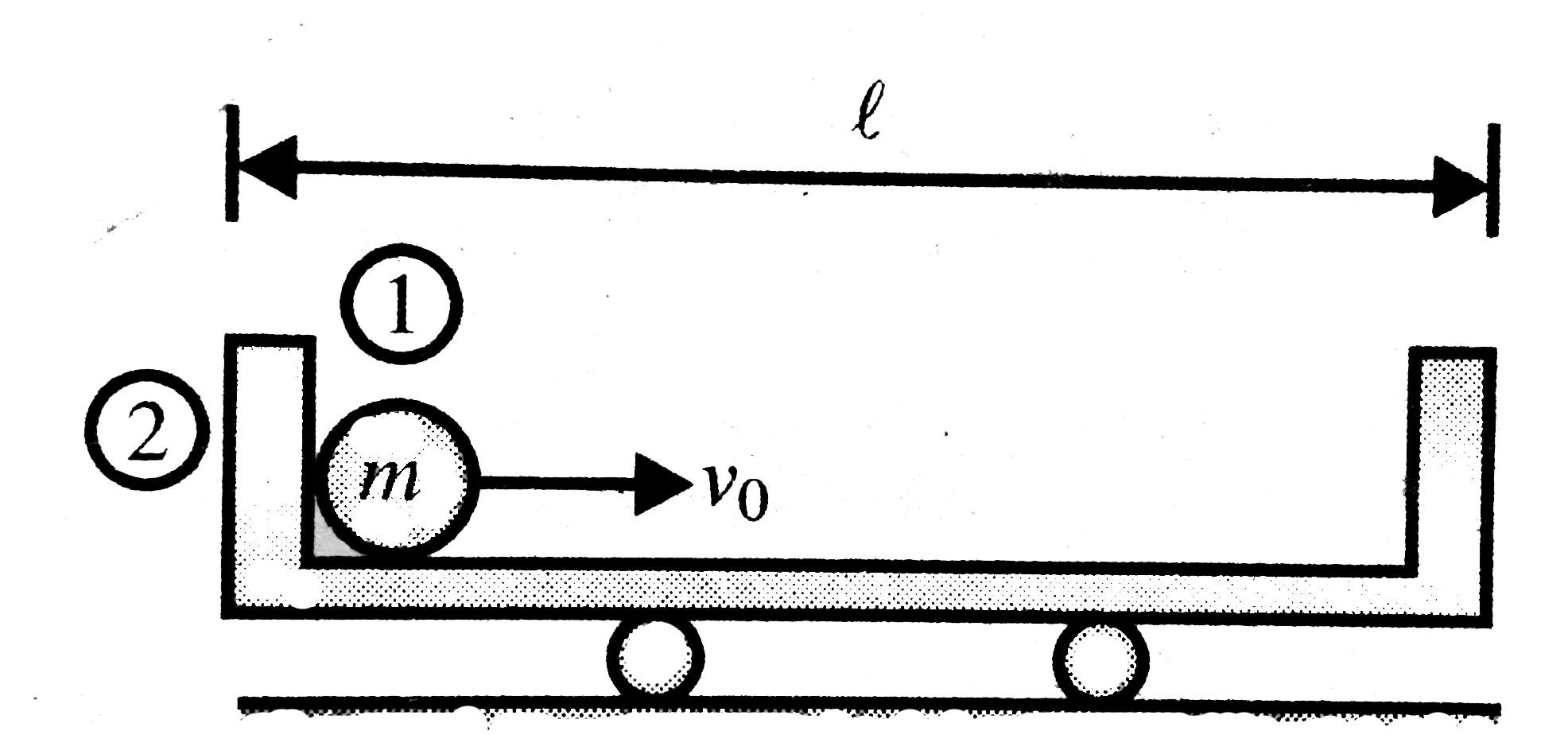 `v_(2)-0=ev_(0)` Here `m/Mv_(0)=ev_(0)` which gives `e=m/M` ……….ii Now the 2nd collisiion left wall the sledge and ball C.O.L.M. `0+Mv_(2)=mv_(1)+MV_(2)^(')` `M(m/Mv_(0))=mv_(1)+Mv_(2)^(')` `implies mv_(1)+Mv_(2)^(')=mv_(0)` 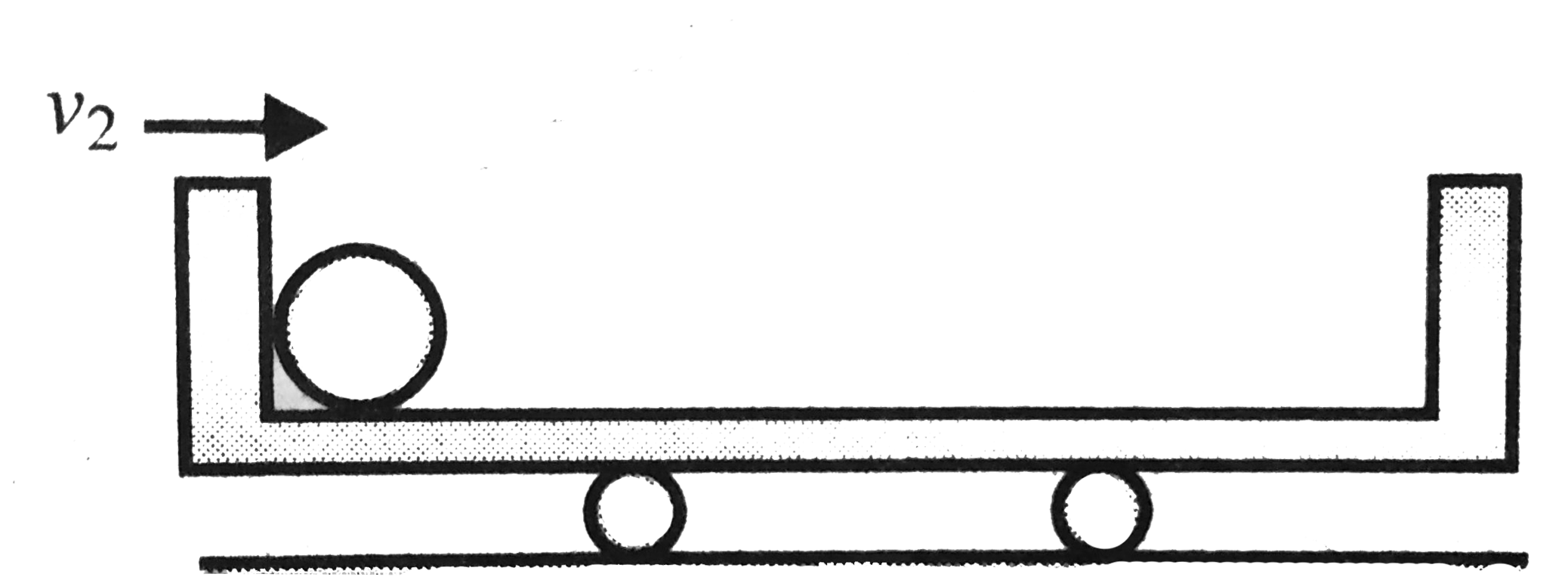 Again using Newton's restitution LAW `v_(2)^(')-v_(1)=e(0-m/Mv_(0))` `v_(2)^(')-v_(1)=m/M(-m/Mv_(0))` `v_(1)-v_(2)^(')=(m/M)v_(0)`..........IV From eqn iii and iv we get `v_(1)=(2v_(0))/((M+m))` and `v_(2)^(')=(mv_(0))/M((M-m)/(M+m))` |
|
| 17. |
(A) : A rocket moves forward by pushing the surrounding air backwards.(R ) : Rocket derives the necessary thrust to move forward according to Newton's third law of motion |
|
Answer» Both (A) and (R ) are true and (R ) is the CORRECT explanation of (A) |
|
| 18. |
An object moves width 5m//s towards right while the mirror moves 1 m//s towards the left as shown. Then the velocity of image is |
|
Answer» Solution :We know `(vec V_(1//m))_(BOT)= (vec V_(o//M))_(bot)` TAKE `to` as + direction, `v_i-v_m=v_m-v_0` `v_i -(-1)=(-1)-5` `because v_i=-7m//s` (direction towards LEFT) |
|
| 19. |
Liquid drops acquire spherical shape due to |
|
Answer» GRAVITY |
|
| 20. |
The viscous force acting between 2 layers of a liquid is given by (F)/(A) = eta(dv)/(dz) = This F/A may be called |
|
Answer» pressure |
|
| 21. |
A sonometer wire has a length of 115 cm between its two fixed ends. Determine the positions where the two bridges can be placed so that the fundamental frequencies of the three segments so formed are in the ratio of 1 : 4 : 20. |
|
Answer» Solution :Given, total length of the SONOMETER wire, L = 115 cm `v_(1) : v_(2) : v_(3) = 1 : 4 : 20` If `L_(1), L_(2) and L_(3)` are the lengths of three parts and `v prop (1)/(L)` Then, `L_(1) : L_(2) : L_(3) = (1)/(1) : (1)/(4) : (1)/(20) = 20 : 5 : 1` Sum of ratios = 20 + 5 + 1 = 26 `therefore""L_(1) = (20)/(26) xx 115 = 88.46` cm `L_(2) = (5)/(26) xx 115 = 22.12` cm `L_(3) = (1)/(26) xx 115 = 4.42` cm So, the bridges should be placed at 88.46 cm and 110.58 cm from ONE end. |
|
| 22. |
If L_(1)= (2.02 +- 0.01)m and L_(2) = (1.02 +- 0.01)" then " L_(1) + 2L_(2) is (in m) |
|
Answer» `4.06 +- 0.02` |
|
| 23. |
A ball is dropped from a building of height 45 m. Simultaneously another ball is thrown up with a speed 40 m/s. The relative speed of the balls varies with time as |
|
Answer» `t^(0)` |
|
| 24. |
When a source of frequency f_(0) moves away a stationary observer with a certain velocity an apparent frequency f' is observed. When it moves with same velocity towards the observer, the observed frequency is 1.2 f'. If velocity of sound in v, then the speed of source is - |
|
Answer» `(V)/(6)` `therefore1.2=(v+u)/(v-u)rArru=(v)/(11)` |
|
| 25. |
Uranium has two isotopes of masses 235 and 238 units. If both are present in Uranium hexafluoride gas which would have the larger average speed ? If atomic mass of fluorine is 19 units, estimate the percentage difference in speeds at any temperature. |
|
Answer» Solution :At a fixed temperature the AVERAGE energy `= 1//2 m v^(2)` ` is constant. So smaller the mass of the molecule, faster will be the speed. The ratio of speeds is inversely proportional to the square root of the ratio of the masses. The masses are 349 and 352 UNITS. So `V_(349)// V_(352)= (352// 349)^(1//2) = 1.0044` .Hence difference `(DeltaV)/(V) = 0.44 %.` = [ `""^(235)U,`is the isotope needed for nuclear fission. To separate it from the more abundant isotope `""^(238)U`, the mixture is surrounded by a porous cylinder. The porous cylinder must be thick and narrow, so that the molecule wanders through INDIVIDUALLY, colliding with the walls of the LONG pore. The faster molecule will leak out more than the SLOWER one and so there is more of the lighter molecule (enrichment) outside the porous cylinder . The method is not very efficient and has to be repeated several times for sufficient enrichment.) |
|
| 26. |
In uniform circular motion |
| Answer» SOLUTION :No, The centripetal force is directed towards the centre of the CIRCLE along the RADIUS and is independent of the sense of rotation. | |
| 27. |
Derive the expression for the work done in a volume change in a thermodynamic system. |
|
Answer» Solution :Work DONE in volume changes: Consider a gas contained in the cylinder fitted with a movable piston. Suppose the gas is expanded quasi-statically by pushing the piston by a small distance dx. Since the expansion occurs quasi-statically the pressure, temperature and internal energy will have UNIQUE values at every instant. The small work done by the gas on the piston `dW = Fdx"….(1)"` The force exerted by the gas on the piston `F= PA`. Here A is area of the piston and P is pressure exerted by the gas on the piston. Equation (1) can be rewritten as `"dW = PAdx…(2)"` But Adx = dV= change in volume during this expansion process. So the small work done by the gas during the expansion is given by dW = PdV Note here that dV is POSITIVE since the volume is increased. Here, dW is positive. In general the work done by the gas by increasing the volume from `V_(i)` to `V_(f)` is given by `W=int_(V_(i))^(V_(f))PdV` Suppose if the work is done on the system, then `V_(i) gt V_(f)`, Then, W is NEGATIVE. Note here the pressure Pis INSIDE the integral in equation (4). It implies that while the system is doing work, the pressure need not be constant. To evaluate the integration we need to first express the pressure as a function of volume and temperature using the equation of state. 
|
|
| 28. |
A solid sphere, disc and hollow sphere of same masa and radius are placed at the top of an inclined plane. Surface is sufficiently rough to provide pure rolling. All the objects are released from a state of rest. |
|
Answer» Solid sphere reaches the BOTTOM FIRST |
|
| 29. |
A unifrom chain of length .L. is placed on a smooth table of height .h. (h > L) with a length . L . hanging from the edge of the table. The chain begins to slide down the table. When the end of the chain is about to leave the edge of the table its velocity is |
|
Answer» `SQRT((g(L+ l))/L)` |
|
| 30. |
When a force acts on a body of mass 0.1 kg, the change in its velocity is 20 cm s^(-1) per second. The magnitude of this force is ..... N |
|
Answer» 0.02 |
|
| 31. |
When a body is suspended from a spring its time period .T.. If the spring is cut into equal parts and the body is suspended from one part, its time period will be |
|
Answer» `T"/"SQRT(2)` |
|
| 32. |
When 0.15 kg of ice of "0 "^(@)C mixed with 0.30 kg of water at "50 "^(@)C in a container, the resulting temperature is 6.7" "^(@)C. Calculate the heat of fusion of ice. (s_("water")=4186" J Kg"^(-1)K^(-1)) |
|
Answer» Solution :MASS of ICE `m_(1)=0.15` kg Temperature of ice `t_(1)=0^(@)C` Mass of water `m_(2)=0.30` kg Temperature of water `t_(2)=50^(@)C` Temperature of mixture of water and ice `t_(3)=6.7^(@)C` Specific HEAT of water `S=4186" Jkg"^(-1)K^(-1)` Expose latent heat of fusion of ice is `L_(f)` `rArr` Heat required to MELT the ice, `Q_(1)=m_(1)L_(f)` `:.Q_(1)=0.15L_(f)J". . . (1)"` `rArr` Heat loss by water, `Q_(2)=m_(2)S(t_(2)-t_(3))` `=0.30xx4186(50-6.7)` `=0.30xx4186xx43.3` `:.Q_(2)=54376.14J`. . .(2) Heat required to make temperature of water of ice `6.7^(@)C`, `Q_(3)=m_(1)S(t_(3)-t_(1))` `=0.15xx4186(6.7-0)` `=0.15xx4186xx6.7` `:.Q_(3)=4206.93J`. . . (3) {Heat LOST by water} = {Heat required to melt the ice} + {Heat required to make temperature of water to ice `t_(3)`} `Q_(2)=Q_(1)+Q_(3)` `:.54376.14=0.15L_(f)=4206.96""` [from equation (1), (2) and (3)] `:.0.15L_(f)=54376.144206.96` `=50xx169.21` `:.L_(f)=(50xx169.21)/(0.15)=334461.4" Jkg"^(-1)~~3.34xx10^(5)" Jkg"^(-1)` |
|
| 33. |
A ball is thrown with velocity u making an angle thetawith the horizontal. Its velocty vector is normal to initial velocity (u) vector after a time interval of |
|
Answer» `( u SIN THETA)/(G)` |
|
| 34. |
The length, breadth the thickness of rectangular sheet of wood are 3.230 m, 1.49 m and 1.99 cm respectively. Give the total surface area and volume of the sheet correct to the significant figures. |
|
Answer» |
|
| 35. |
The speed of 5 molecules of a gas (in arbitrary units) are as follows:2,3,4,5,6 the root mean square speed for these molecule is |
|
Answer» 2.91 |
|
| 36. |
A police in a siren car moving with a velocity 20 ms^(-1) chases a thief who is moving in a car with a velocity v_(0)ms^(-1). The police car sounds at frequency 300 Hz, and both of them move towards a stationary siren of frequency 400 Hz. Calculate the speed in which thief is moving. (Assume the thief does not observe any beat). |
|
Answer» Solution :The velocity of car`=20 ms^(-1)` The frequency of car = 300 Hz The frequency stationary siren = 400 Hz The speed in which thief MOVING = ? `V_(1) = 300((330-V_(0))/(330-20))` `V_(2) = 400((330 + V_(0))/330)` Both are moving towards stationary siren `THEREFORE V_(1) =V_(2)` `300((330-V_(0))/(310)) = 400 (((330 + V_(0)))/(330))` Simpliying, we GET `V_(0) = 36.99 ms^(-1)`. |
|
| 37. |
During an adiabatic process, the the pressure of a mixture of monatomic and diatomic gases is found to be proportional to the cube of the temperature . Find the value of gamma=(C_P//C_V) |
|
Answer» Solution :In adiabatic PROCESS , `T^(gamma)P^(1-gamma)="conatant"` `PT^(-3)="CONSTANT" ` .....(1) `gamma/(PT^(1-gamma))="constant"` ....(2) `gamma/(PT^(1-gamma))=PT^(-3)` Comparing the powres, `gamma/(1-gamma)=-3=-3+3gamma` `2gamma=3,gamma=3/2` |
|
| 38. |
Ball A is dropped from the top of a building and at the same instant that a ball B is thrown vertically upward from the ground. When the balls collide, they are moving in opposite directions and the speed of A is twice the speed of B. At what fraction of the height of the building did the collisionoccur? |
|
Answer» Solution :Given `V_(A)=2V_(B)` `impliesg t=2(u-G t)impliest=(2u)/(3g)` Displacement of A is `S_(A)=(1)/(2)g t^(2)=(2u^(2))/(9g)` Displacement of B is `S_(B)=ut-(1)/(2)g t^(2)=(4u^(2))/(9g)` Now fraction of hight of the BUILDING where collision OCCUR is `(h_(B))/(H)=((4u^(2))/(9g))/((4u^(2))/(9g)+(2u^(2))/(9g))=(2)/(3)` |
|
| 39. |
In a three dimensionaI space of zero gravity, the equation of motion of a partical is |
|
Answer» one-dimensional |
|
| 40. |
Draw the P-T and V-T diagrams for an isothermal process, corresponding to one mole of an ideal gas at an initial pressure and volume P_(0) and V_(0) respectively, expanding to a volume 2V_(0). |
|
Answer» SOLUTION :The TEMPERATURE T during the PROCESS is, evidently, given by `T=(P_(0)V_(0))/R` (for one mole) Also, for an isothermal process PV=constant ` :.P_(0)V_(0)=P_(2)(2V_(0)) or P_(2)=P_(0)/2` (a) The P-T graph is a straight line parallel to the presure axis, with pressure decreasing from `P_(0) " to " P_(0)//2` as shown in figure.  (b) The V-T graph is also a straight line parallel to the volume axis, with volume increasing from `V_(0) "to" 2V_(0)` as shown in figure. 
|
|
| 41. |
In steady state : |
|
Answer» TEMPERATURE does not CHANGE with TIME |
|
| 42. |
y=x^(2)r+M^(1)L^(1)T^(-2) is dimensionally correct. If r represent displacement, then write dimension of x^(2) |
|
Answer» SOLUTION :By principle of HOMOGENEITY, Here `x^(2)r=M^(1)L^(1)T^(-2)` `:.x^(2)=(M^(1)L^(1)T^(-2))/(r)=(M^(1)L^(1)T^(-2))/(L^(1))` `=M^(1)L^(0)T^(-2)` |
|
| 43. |
A one litre flask contains some mercury. It is found that at different temperatures, the volume of air inside the flask remains the same. What is the volume of mercury in this flask ? Given alpha for glass 9.0 xx 10^(-6)//""^(@) C and gamma for mercury = 1.8 xx 10^(-4)//^(@) C. |
|
Answer» |
|
| 44. |
According to Boyle's law, PV=C when the temperature of the gas remains constant. The value of C depends on |
|
Answer» TEMPERATURE of the GAS |
|
| 45. |
A particle at the end of a spring executes SHM with a period t_(1), while corresponding period for another spring is t_(2). If the period of oscillation when the two springs are connected in series is T, then prove that, t_(1)^(2)+t_(2)^(2)=T^(2). |
|
Answer» Solution :LET the mass of the particle be m and SPRING constants of the SPRINGS be `k_(1)andk_(2)`. In first case, `t_(1)=2pisqrt(m/k_(1))or,t_(1)^(2)=4pi^(2)(m/k_(1))""...(1)` In second case, `t_(2)=2pisqrt(m/k_(2))or,t_(2)^(2)=4pi^(2)(m/k_(2))""...(2)` In series the equivalent spring CONSTANT is k, Then, `1/k=1/k_(1)+1/k_(2)or,k=(k_(1)k_(2))/(k_(1)+k_(2))` `therefore` Time PERIOD of the combination, `T=2pisqrt(m/k)=2pisqrt((m(k_(1)+k_(2)))/(k_(1)k_(2)))` or, `T^(2)=(4pi^(2)m(k_(1)+k_(2)))/(k_(1)k_(2))` adding (1) and (2) we get, `t_(1)^(2)+t_(2)^(2)=4pi^(2)(m/k_(1)+m/k_(2))=4pi^(2)m(1/k_(1)+1/k_(2))` `=4pi^(2)m((k_(1)+k_(2))/(k_(1)k_(2)))` `therefore" "t_(1)^(2)+t_(2)^(2)=T^(2)` (Proved). |
|
| 46. |
A reference frame attached to the earth with respect to an observer in space |
|
Answer» is an INERTIAL frame because Newton's laws of MOTION are applicable in it |
|
| 47. |
Two pendulums of lengths 16l and I are in phase at the mean position at a certain time. If 'T' is the time period of shorter pendulum, the minimum time after which they will be again be in phase is |
|
Answer» `1/3 T` |
|
| 48. |
The length of the mercury column in a mercury-in- glass thermometer is 5.0 cm at triple point of water. The length is 6.84 cm at the steam point. If length of the mercury column can be read with a precision of 0.01 cm, can this thermometer be used to distinguish between the ice point and the triple point of water? |
|
Answer» |
|
| 49. |
Discuss briefly the methods used for the measurement of small and large time intervals. |
| Answer» SOLUTION : 1(C ).9 | |
| 50. |
A thin uniform rod of mass M and length l is rotating about a frictionless axis passing through one of its ends and perpendicular to the rod. The rod is heated uniformly to increases its temperature by Deltatheta. Calculate the percentage change in rotational kinetic energy of the rod. Explain why the answer is not zero. Take coefficient of linear expansion of the material of the rod to be alpha. |
|
Answer» |
|