

Saved Bookmarks
This section includes 7 InterviewSolutions, each offering curated multiple-choice questions to sharpen your Current Affairs knowledge and support exam preparation. Choose a topic below to get started.
| 1. |
A triangular prism of glass is shown in the figure A ray incident normally to one face is totally reflected, IF theta=45^@ the refractive index of glass is |
|
Answer» `GT 1.41` |
|
| 2. |
A system of two particles is having masses m_(1) and m_(2). If the particle of mass m_(1) is pushed towards the centre of mass of particles through a distance d, by what distance the particle of mass m_(2) should be moved so as to keep the centre of mass of particles at the original position ? |
|
Answer» `d'=(m_(1))/(m_(2))d` |
|
| 3. |
A car covers 60 km at a uniform speed of 120 kmph and the next 60 km at a uniform speed of 80 kmph. Find the total time taken . |
|
Answer» Solution :For uniform speed, we have `v=S/t"or"S=vt` It the car takes time `t_(1)` to cover the FIRST 60KM,` t_(1)=S/v=(60km)/(120km//h)=1/2h=30 `minutes similarly , if it takes time` t_(2)`to cover the next `60km, t_(2)=S/v(60km)/(80km//h)=3/4h=45`minutes The TOTAL time taken is `t_(1)+t_(2)=30+45=75`minutes |
|
| 4. |
Passage - I : In the given figure F = 10N, R = 1 m, mass of the body is 2 kg and moment of inertia of the body about an axis passing through O and perpendicular to plane of body is "4 kgm"^(2). O is the centre of mass of the body. If ground is sufficiently rough what is kinetic energy of the body now in the given time interval. |
|
Answer» `10.33` |
|
| 5. |
Passage - I : In the given figure F = 10N, R = 1 m, mass of the body is 2 kg and moment of inertia of the body about an axis passing through O and perpendicular to plane of body is "4 kgm"^(2). O is the centre of mass of the body. If the ground is smooth what is total kinetic energy of the body after 2 s : |
| Answer» Answer :B | |
| 6. |
If vec(a)_(1) and vec(a)_(2) are two non collinear unit vectors and if |vec(a)_(1) + vec(a)_(2)| = sqrt3 then the value of (vec(a)_(1) - vec(a)_(2)).(2vec(a)_(1) + vec(a)_(2)) is: |
|
Answer» 2 |
|
| 7. |
(A): Internal energy of an ideal gas sample is total kinetic energy of the gas (R ): There is no interaction force between gas molecules hence potential energy is not defined |
|
Answer» Both (A) and(R ) are TRUE and (R ) is the CORRECT EXPLANATION of (A) |
|
| 8. |
A body having natural frequency v_(0) is executing oscillations under driving force of frequency v. The system will vibrate |
|
Answer» With the frequency of driving FORCE v |
|
| 9. |
An infinte number of particles each of mass kg are placed on the resultant gravitational force on 1kg mass kept at the origin is |
|
Answer» 0 |
|
| 10. |
What do the area under a tot graph represent? |
| Answer» SOLUTION :It REPRESENTS the MAGNITUDE of CHANGE in VELOCITY. | |
| 11. |
Thermodynamics processes are indicated in the following diagram Match the following {:("Column -I","Column -II"),((P)"Process ",(a) Adiabatic),((Q)"Process II",(b) "Isobaric"),((R)"process III ",(c) "Isochoric"),((S)" process IV",(d)Isothermal):} |
|
Answer» `Prarrd, Qrarrb, Rrarra, Srarrc` |
|
| 12. |
A foot - ball player hits tha ball with speed 20ms^(-1)with angle 30^(@)with respect to horizontal direction as shown in the figure. The goal post is at distance of 40 m from him. Find out whether ball reaches the goal post |
|
Answer» Solution :Given: `u = 20 m//s` `theta = 30^(@)` Formula :`R = (u^(2) SIN 2 theta)//g` `R = ((20)^(2)sin 2 (30))/(9 . 8)` `= (400xx sqrt(3))/(2 xx 9 . 8)= (400 xx 1.732)/(19.6)` R = 35 . 34 m In the problem it is given that R = 40 m and the found value less than 40 m . Therefore BALL cannot reach the GOAL post . |
|
| 13. |
In C.G.S system the magnitude of the force is 100dyne. In another system where fundamental physical quantities are kg, m, min, the magnitude of the force is |
|
Answer» 0.036 |
|
| 14. |
A spherical ball of mass 20 kg is stationary at the top of the hill of height100 m . Itrollsdownsmooth surfaceto ground then climbup anotherhill of height40 mand finally rollsdownto a horizontal base at a height of 15 m abovethe ground . The maximum velocity attainedby a ball is ....... ( g = 9.8 m//s^(2)) |
|
Answer» `40 ms^(-1)` `:. Mgh_(1)-mgh_(2)=1/2mv_(2)^(2) -1/2mv_(1)^(2)` ` :. MG(h_(1) - h_(2)) = 1/2 mv_(2)^(2) "" [ :. v_(1) = 0 ] ` ` :. 20 XX 9.8 [100-15] = 1/2 xx2v xxv_(2)^(2)` ` :.(20 xx 9.8 xx85 xx2)/20 = v_(2)^(2)` ` :. 40.816 ms^(-1) = v_(2)` ` :. v_(2) = 40.8 ms^(-1)` |
|
| 15. |
An open pipe resonates with frequency 100Hz and a closed pipe resonates with frequency 50Hz. If they are joined to form a longer tube then it will resonate with frequency of (neglect end corrections) |
|
Answer» `25Hz` 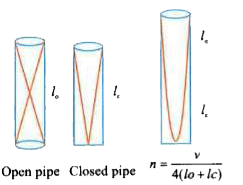 `n_(1)=(V)/(2l_(0))`, `n_(2)=(V)/(4l_(c ))` `impliesl_(0)=(V)/(2n_(1))`, `L_(c )=(V)/(4n_(2))` `:.l_(0)+l_(c )=(V)/(4n)` `(V)/(2n_(1))+(V)/(4n_(2))=(V)/(4n)impliesn=(n_(1)n_(2))/(n_(1)+2n_(2))` |
|
| 16. |
A 2kg block lying on smooth table which is connected by a body of mass 1kg by a string which passes through a pulley . Take 1kg mass hanging vertically . Find the acceleration of block & tnsion in string . |
|
Answer» |
|
| 17. |
The possible value of Poission's ratio is |
|
Answer» 0.9 |
|
| 18. |
What is molar specific heat capacity of a substance ? Write its unit. |
|
Answer» Solution :If the amount of substance is specified in terms of MOLES `mu`, instead of mass m in kg, we can define heat capacity per MOLE of the substance by `:.C=(S)/(mu)=(1)/(mu)(DeltaQ)/(muDeltaT)` where C is known as molar specific heat capacity of the substance C depends on the nature of the substance and its temperature. The SI unit of molar specific heat capacity is `"J mol"^(-1)K^(-1)`. We can get molar specific heat for gases in two ways. (i) Molar specific heat at constant pressure `(C_(P))`: If the gas is held under constant pressure during the heat transfer, then it is called the molar specific heat capacity at constant pressure and is denoted by `C_(P)`. (ii) Molar specific heat at constant volume `(C_(V))`: If the volume of the gas is maintained during the heat transfer, then the corresponding molar specific heat capacity is called molar specific heat capacity at constant volume and is denoted by `C_(v)`  Water has the highest specific heat capacity compared to other substances. For this reason water is used as a coolant in automobile radiators as well as a heater in hot water BAGS. Owing to its high specific heat capacity, the water WARMS up much more slowly than the land during summer and consequentyly wind from the sea has a cooling effect. That is why in desert areas, the earth surface warms up quickly during the DAY and cools quickly at night. |
|
| 19. |
What is Brownian motion? |
| Answer» SOLUTION :The motion of the PARTICLES in a random and zig-zag mannear in a FLUID is CALLED Brownian motion. | |
| 20. |
Water flows at the rate of 2ms-1 through a pipe of radius 2 cm and emerges from a nozzle of radius 1 cry. If the nozzle is directed vertically upwards, water rises to a maximum height of (g=10 ms^(-1)) |
|
Answer» `3.2m` |
|
| 21. |
If x longitudinal strain is produced in a wire of Young's modulus Y, then potential energy stored in a material of the wire per unit volume is .......... |
|
Answer» `YX ^(2)` `U =1/2 xx ` stress `xx` strain `=1/2 xx Yxx` strain `xx` strain `[ because Y= ("Stress")/("Strain") ]` `= (Yxx ("strain") ^(2))/(2)` `= (Yx ^(2))/(2)` |
|
| 22. |
A large shallow wooden container is filled with water. But the container does not crack. A hole is then made on the surface of the container and a long narrow tube is inserted vertically into the container through this hole. The tube is now filled with water. It is seen that the container now cracks. Explain why. |
Answer» Solution :The thrust EXERTED by the liquid on the bottom of the container depends on the base and the depth of the liquid in, it but not on the quantity of liquid kept in that vessel. In the present PROBLEM, INITIALLY the depth (h) of water in the container was not large before the inclusion of the tube, ALTHOUGH the amount of water in it was large enough. It produced less thrust on the bottom of the container hence the container did not crack. When the narrow tube is filled with water, up to the height (h + H), the water column increases CONSIDERABLY. It exerts a large thrust on the base of the container, and so the container cracks. 
|
|
| 23. |
The radius of earth is 6347km. Its rounded off value up to two significant figures is |
|
Answer» 6400KM |
|
| 24. |
A simple pendulum made of a bob of mass m and a metallic wire of negligible mass has time period 2s at T= 0^(@)C. If the temperature off the wire is increased and the corresponding change in its time period is plotted angainst its temperature, the resulting graph is a line of slope S. If the coefficient of linear expansion of metal is alpha then the value of S is : |
|
Answer» `(ALPHA)/(2)` |
|
| 25. |
A ball of mass 'm' kg hangs from a spring of constant 'k'. The ball oscillates with a period of 'T' seconds. If the ball is removed the spring is shortened by |
|
Answer» SOLUTION :`T= 2pisqrt((m)/(k))` we get `(1)/(k)= (T^(2))/((2pi)^(2)m) implies k= (4pi^(2))/(T^(2))m` …….(1) For equilibrium `KX= MG implies X= (mg)/(k)`…….(2) substitute (1) and (2) `implies x= (gT^(2))/(4pi^(2))` |
|
| 26. |
At a given temperature, equal masses of monatomic and diatomic gases are supplied equal quantities of heat. Which of the two gases suffer a larger temperature rise? |
| Answer» Solution :For MONATOMIC gas `C_V` = 3/2 R. In the case of a rigid diatomic gas `C_V = 5/2 R`. Compared to diatomic gas lesser heat is required to RAISE the temperature of a monatomic gas. HENCE when equal quantities of heat are given to both, monatomic gas (helium) will UNDERGO greater rise in temperature. | |
| 27. |
Obtain the expression for the velocities of the two bodies after collision in the case of one dimensional elastic collision ond discuss the specical cases. |
Answer» Solution :Consider two elastic bodies of massesm `m_(1) and m_(2)` moving in a straight line (along positive x direction) on a frictionless horizontal surface as shown in figure.  In order to have collision, we assume that the mass `m_(1)` moves faster than mass `m_(2) i.e, u_(1) gt u_(2)`. For elastic collision, the total linear momentum and kinetic energy of two bodies before and after collsiion must remain the same.  From the law of conservation of linear momentum, Total momentum before collision `(p_(i))`= Total momentum after collision `(p_(f))` `m_(1)u_(1)+m_(2)u_(2)=m_(1)v_(1)+m_(2)v_(2) ........(1)` `m_(1) (u_(1)-v_(1))=m_(2) (v_2)-u_(2)).......(2)` Further,  For elastic collision Total kinetic energy before collision `KE_i` - Total kinetic energy after collision `KE_f` `1/2 m_(q)u_(1)^(2)=1/2 m_(1)v_(1)^(2)+1/2 m_(2)v_(2)^(2)......(3)` After simplifying and rearranging the terms, `m_(1) (u_(1)^(2)-v_(1)^(2)) =m_(2) (v_(2)^(2)-u_(2)^(2))` Using the formula `a^(2)-b^(2)=(a+b)(a-b)`, we can rewrite the above equations `m_(1) (u_(1)+v_(1)) (u_(1)+v_(1))=m_(2) (v_(2)+u_(2)) (v_(2)-u_(2)) ....(4)` Dividing equation (4) by (2) gives `(m_1(u_1 _ v_1)(u_1-v_1))/(m_1(u_1-v_1)) = (m_(2)(v_2+u_2)(v_2 -u_2))/(m_2(v_2-u_2))` `u_(1)+v_(1)=v_(2)+u_(2)` `u_(1)-u_(2)=v_(2)-v_(1) ......(5)` Rearranging. Equation (5) and it can be rewritten as `u_(1)-u_(2)=-(v_(1)-v_(2))` This means that for any elastie head on collision, the relative speed of the two elastic bodies after the collision has the same MAGNITUDE as before collision but in opposite direction. Further note that this result is independent of mass. Rewriting the above equation for `v_(1) and v_(2)`, `v_(1)=v_(2)+u_(2)-u_(1) ......(6)` `(or) v_(2)=u_(1)+v_(1)-u_(2) ......(7)` To find the final velocities `v_(1) and v_(2):` Substituting equation (7) in equation (2) gives the velocity of `m_(1)` as `m_(1) (u_(1)-v_(1))=m_(2) (u_(1)+v_(1)-u_(2)-u_(2))` `m_(1) (u_(1)-v_(1))=m_(2) (u_(1)+v_(1)-2u_(2))` `m_(1)u_(1)-m_(1)v_(1)=m_(2)u_(1)+m_(2)v_(1)-2m_(2)u_(2)` `m_(1)u_(1)-m_(2)u_(1)+2m_(2)u_(2)=m_(1)v_(1)+m_(2)v_(1)` `(m_(1)-m_(2))u_(1)+2m_(2)u_(2)=(m_(1)+m_(2))u_(1)` `or v_(1) ((m_(1)-m_(2))/(m_(1)+m_(2)))u_(1)+((2m_(2))/(m_(1)+m_(2))) u_(2)` Similarly, by substituting (6) in equation (2) or substituting equation (8) in equation (7) get the final velocity of `m_(2)` as `v_(2)=((2m_(1))/(m_(1)+m_(2)))u_(1)+ ((m_(2)-m_(1))/(m_(1)+m_(2)))u_(2) ..........(9)` Case 1: When bodies has the same mass i.e., `m_(1)=m_(2)`, equation (8)` rArr v_(1) (0) u_(1)+((2m_(2))/(2m_(2))) u_(2)` equation (9) `rArr v_(2)=((2m_(1))/(2m_(1)))u_(1)+(0)u_(2)` `v_(2)=u_(1) ......(11)` The equations (10) and (11) show that in one dimensional elastic collision, when two bodies of EQUAL mass collide after the collision their velocities are exchanged. Case 2: When bodies have the same mass i.e.,`m_(1)=m_(2)` and SECOND body (usually called target) is at rest `(u_2 = 0),` By substituting `m_(1)m_(2)= and u_(2)= 0` in equations (8) and equations (9) we get, from equation (8) `rArr v_(1)=0` .........(12) from equation (9) `rArr v_(2)=0` .........(13) Equations (12) and (13) show that when the first body comes to rest the second body moves with the initial velocity of the first body. Case 3: The first body is very much lighter than the second body `(m_(1) lt lt m_(2), m_(1)/m_(2) lt lt 1)` then the ratio `m_(1)/m_(2)=0` and also if the target is at the rest `(u_(2)=0)` Dividing NUMERATOR and denominator of equation (8) by `m_2,` we get `v_(1)=((m_(1)/m_(2)-1))/((m_(1)/m_(2)+1)))u_(1)+((2)/((m_(1)/m_(2)+1))) (0)` `v_(1)=((0-1)/(0+1))u_(1), v_(1)=-u_(1)` `v_(2)=((2""m_(1)/m_(2))/(m_(1)/m_(2)+1))u_(1)+ ((1-m_(1)/m_(2))/(m_(1)/m_(2)+1)) (0)` `v_(2) =(0) u_(1)+((1-m_(1)/m_(2))/(m_(1)/m_(2)+1)) (0)` `v_(2)=0 ..........(15)` The equation (14) implies that the first body which is lighter returns tank (rebounds) in the opposite direction with the same initial velocity as it has a negative sign. The equation (15) implies that the second body which is heavier in mass continues to remain at test event collision. For example, if a ball is thrown at a fixed wall, the ball will bounce back from wall with the same velocity with which it was thrown but in opposite direction. Case 4: The second body is very much lighter than the first body `(m_(2) lt lt m_(1), m_(2)/m_(1) lt lt 1)` then the ratio `m_(2)/m_(1)=0`and also if the target is at rest `(u_(2)=0)` Dividing numerator and denominator of equation (8) by `m_(1)` we get `v_(1)=(((1-m_(2)/m_(1)))/(1+m_(2)/m_(1)))u_(1)+((2"" m_(2)/m_(1))/(1+m_(2)/m_(1))) (0)` `v_(1)=((1-0)/(1+0))u_(1)+((0)/(1+0)) (0)` `v_(1)=u_(1)` Similarly, Dividing numerator and denominator of equation (13) by `m_(1)` we get `v_(2)=((2)/(1+m_(2)/m_(1))) u_(1)+((m_(2)/m_(1)-1)/(1+m_(2)/m_(1))) (0)` `v_(2)=((2)/(1+0))u_(1)` `v_(2)=2u_(1)` The equation (16) implies that the first body which is heavier continues to move with the initial velocity. The equation (17) suggests that the second body which is lighter will with twice the initial velocity of the first body. It means that the lighter body is throw from the point of collision. |
|
| 28. |
A body of mass 5 kg has linear momentum of 20 kgm/s. If a constant force of 5N acts on it in the direction of its motion for 10s. The change in kinetic energy of the body is |
|
Answer» 320J |
|
| 29. |
The potential energy of a projectile at its highest point is3/4 of the value of its initial kinetic energy. Therefore its angle of projection is .......... |
|
Answer» `45^(@)` AtmaxheightU = K `K= K_(0) cos^(2) theta ` `(1)/(4) K_(0)= k_(0)cos^(2) theta` `:. , (1)/(4) =cos^(92)theta` `:. , (1)/(2) = cos theta` `:. , thetacos ^(-1)((1)/(2))` `theta= 60^(@)` |
|
| 30. |
Then correct order in which the dimensions of 'Length' increases in the following physical quantities is (A) Permittivity (B) Resistance (C ) Magnetic permeability (D) Strees |
| Answer» Answer :C | |
| 31. |
Two similar beads each of mass m slide smoothly along a uniform rod mass M and length l. the rod can rotate along an axis passing through its centre and normal to its length. Initially the rod is rotated with angular speed omega_(i) when beads are at centre C of the rod. The engular speed omega_(f) of the rod when beads slide to the two ends of the rod without any external force is given by (Momega_(i))/((xm+M)) where 'x' is |
|
Answer» |
|
| 32. |
A child stands at the centre of a turn table with his two arms outstretched. The turn table is set rotating with an angular speed of 40 rpm. How much is the angular speed of the child, if he folds his hands back reducing the moment of inertia to (2/5) times the initial value? Assume that turntable rotates without friction.(b) Show that the child's new K.E of rotation is more than the initial K.E. of rotation. How do you account for this increase in K.E.? |
| Answer» SOLUTION :a) 100rpm, b) K.E. of ROTATION increases. This is because the CHILD spends internal energy in folding back his hands. | |
| 33. |
A solid cylinder of mass 'm' is attached to a horizontal spring with a force constant K. The cylinder can roll without slipping along the horizontal plane as shown in the figure. Find the time period of centre of mass of the cylinder |
|
Answer» `a_(cm) = R alpha , V_(cm) = R omega and x = R theta` Total energy of the disc is `E= 1/2 MV_c^2 + 1/2 I omega^2 + 1/2 Kx^2 ` constant `(dE)/(DT) =0 ` as E is constant `impliesMV_c a_c + I omega alpha + Kx V_c = 0 impliesMR^2 alpha omega + (MR^2)/(2) omega alpha + KR^2 omega theta = 0 ` `(3MR^2)/(2) alpha + K theta = 0 , alpha =-((2K)/(3M)) theta impliesT = 2pi sqrt((alpha)/(theta)) = 2pi sqrt((3M)/(2K))` |
|
| 34. |
Earth is continuously pulling the moon towards its centre, still it does not fall to the earth, why? |
| Answer» Solution :Gravitational FORCE of attraction due to the earth PROVIDES the CENTRIPETAL force, which keeps the moon in ORBIT. | |
| 35. |
A gas is heated first keeping the pressure constant and then keeping the volume constant through the same range of temperature. Heat supplied in the first process to that of supplied in the second process is |
|
Answer» More |
|
| 36. |
At a height H from the surface of the earth, the total energy of a satellite is equal to the potential energy of a body of equal mass at a height of 3R from the surface of earth (R-Radius of the earth). The value of H is |
| Answer» Answer :B | |
| 37. |
The physical quantity of the following that is not conserved in case of a planet revolving in an orbit is |
|
Answer» ANGULAR momentum |
|
| 38. |
A spaceship is launched into a circular orbit of radius R close to the surface of the earth. The additional velocity to be imparted to the spaceship in the orbit to overcome the earth.sgravitationalpull is (g to accelerationdue to gravity) |
|
Answer» `1.414 RG` |
|
| 39. |
The period of a simple pendulum suspended from the ceiling of a car is T when the car is at rest. If the car moves with a constant acceleration, the period of the pendulum |
|
Answer» REMAINS same |
|
| 40. |
A particle moves in X-direction with acceleration f from rest. This acceleration changes according to f = f _(0) (1- (t)/(T)). and T are constant. t = 0 and for if any negative time interval if f = 0, then velocity of particle is ...... |
|
Answer» `1/2 f _(0) T` `f = 0 because f _(0) [1 + (t)/(T)] =0` `IMPLIES t = T` Now `f = (dV)/(dt)` `therefore(dV)/(dt) = f _(0) [1 - (t)/(T)]` `INT _(0) ^(V _(x)) dV = int _(t =0) ^(t =T) f _(0) [1- (t)/(T)]dt` `v _(x) = f _(0) [t - (t ^(2))/(2T) ] _(0) ^(T) ` `V_(x) = f_(0) [T- (T ^(2))/(2T)]` `V_(x) = f _(0) [T- (T)/(2)]` `V_(x) = 1/2 f_(0)T` |
|
| 41. |
The velocity of a particle is zero at t=0 a) The acceleration at t=0 must be zero. b) The acceleration at t=0 may be zero. c) If the acceleration is zero from t=0 to t=10s, the speed is also zero in this interval. d) If the speed is zero from t=0 to t=10 s the acceleration is also zero in this interval. |
|
Answer» a, B & d are correct |
|
| 42. |
Calculate the efficiency of a petrol engine if the compression ratio is 9. y=1.4. If the power of the engine is 30 kW, what is its input power ? |
|
Answer» Solution :`eta =1 - (1// rho ) 6( gamma - 1) , rho = 9, gaamma = 1. 4` Solving `eta = 0. 5846= 58.46%` (Input = OUTPUT `//eta = 30 xx 10 ^(3) //0.5846 = 5.13 xx 10 ^(4) W)` |
|
| 43. |
A man of mass 60kg lifts a 15kg mass to the top of a building of height 10m is 5minutes. H is efficiency is |
|
Answer» 0.1 |
|
| 44. |
The velocities of light in two different media are 2 times 10^8 m//s and 2.5 times 10^8 m//s respectively, the critical angle for these media is |
|
Answer» `sin^-1 (1/5)` |
|
| 45. |
Two bodies of masses 7 kg and 5 kg are connected by a light string passing over a smooth pulley at the edge of the table as shown in the figure. The coefficient of static friction between the surfaces (body and table) is 0.9. Will the mass m_1= 7 kg on the surface move? If not what value of m_2should be used so that mass 7 kg begins to slide on the table? |
Answer» Solution :As shown in the figure, there are four forces acting on the mass `m_1` (a) Downward GRAVITATIONAL force along the negative y-axis `(m_1 g) ` (b) Upward normal force along the positive y-axis (N) (c) Tension force due to mass `m_2` along the positive x axis (d) Frictional force along the negative x-axis Since the mass m, has no vertical motion, `m_1g=N` Free body diagram for mass `m_1` To determine whether the mass m, MOVES on the surface, calculate the maximum static friction exerted by the table on the mass m. If the tension on the mass m, is EQUAL to or GREATER than this maximum static friction, the object will move. `f_(s)^(max)= mu_s m_1 g` `f_(s)^(max) = 0.9 xx 7 xx 9.8 = 61.74 N` The tension T ` = m_2g= 5 xx 9.8 xx 49N` ` T lt f_(s)^(max)` The tension acting on the mass `m_1= T gt f_(s)^(max), " when " T= mg ` `m_2 = (mu_s m_1 g)/(g) = mu_s m_1` `m_2 = 0.9 xx 7 = 6.3 kg ` If the mass `m_2`is greater than 6.3 kg then the mass `m_1`will begin to slide. Note that if there is no friction on the surface, the mass `m_1`will move for `m_2`even for just 1 kg. The values of coefficient of static friction for pairs of materials are given. Note that the ice and ice pair have very low coefficient of static friction. This means a block of ice can move easily over another block of ice. |
|
| 46. |
The pressure and density of a given mass of a diatomic gas (gamma = (7)/(5))change adiabatically from (p,d) to (p',d'). If (d')/(d) =32, then (p')/(p) is (gamma = ration of specific heat). |
|
Answer» `1//128` |
|
| 47. |
A solid sphere of radius r made of a soft material of bulk modulus K is surrounded by a liquid in a cylinderical container. A massless piston of area a floats on the surface of the liquid, convering entire cross section of cylindrical container. When a mass m is placed on the surface of the piston to compress the liquid, the fractional decrement in the radius of the sphere , ((dr)/r) is |
|
Answer» `(mg)/(3Ka)` or, `(dV)/V=(dP)/K` or,`(-3dr)/r=((mg)/a)/K[becauseV/3pir^3]` or,`(DR)/r=-(mg)/(3Ka) therefore |(dr)/r|=(mg)/(3Ka)` |
|
| 48. |
A motorcyclist goes round a circular race curve at 162 kmh^(-1). To keep his balance he leans inward 40° from the vertical. What is the radius of the circular path ? |
|
Answer» |
|
| 49. |
A molecule in a gas container hits a horizontal wall with speed 200 ms^(-1)" and angle "30^(@) with the normal, and rebounds with the same speed. Is momentum conserved in the collision ? Is the collision elastic or inelastic ? |
| Answer» Solution :Yes, momentum of the molecule + wall system is CONSERVED. The wall has a recoll momentum such that the momentum of the wall + momentum of the outgoing molecule equals momentum of the incoming molecule, assuming the wall to be stationary INITIALLY. However, the recoll momentum produces negligible VELOCITY because of the large mass of the wall. Since KINETIC ENERGY is also conserved, the collision is elastic. | |