Saved Bookmarks
This section includes 7 InterviewSolutions, each offering curated multiple-choice questions to sharpen your Current Affairs knowledge and support exam preparation. Choose a topic below to get started.
| 1. |
The potential energy of a projectile at its maximum height is equal to its kinetic energy there. If the velocity of projectile is 20ms^(-1), its time of flight is ""(g = 10 ms^(-2)) |
|
Answer» 2S |
|
| 2. |
a vectorvecAmakeson angle30^@withthey- axisin anticlockwisedireaction. AnothervectorvecB makes onangle30^@with thex- axisin clockwisedirectionfindanglebetweenvectorsvecAand vecB |
Answer» SOLUTION :  From the DIAGRAM the ANGLE between `vecA "and " VECB "is " 30^(@)+90^(@)+30^(@)=150^(@)`. |
|
| 3. |
(A): If a hole were drilled through the centre of earth and ball dropped into the hole at one end, it will oscillate. (R): The ball will comes out of other end if passed through centre hole in earth. |
|
Answer» Both 'A' and 'R' are TURE and 'R' is the CORRECT explanation of 'A' |
|
| 5. |
A man moving in rain holds his umbrella inclined to the vertical even though the rain drops are falling vertically downwards. Why? |
|
Answer» Solution :Let us consider a person moving horizontally with velocity `vec(V)_(m)`. Let rain falls vertically with velocity `vec(V)_(R)`. An umbrella is held to avoid the rain.Then the relative velocity of the rain with RESPECT to the person is , `vec(V) _(RM)= vec(V)_(R)- vec(V)_(M)` Its magnitude is given by `V_(RM) = sqrt(vec(V)_(R)^(2)+vec(V)_(M)^(2))` Its direction is given by `theta = tan^(-1) ((V_(M))/(V_(R)))`With the vertical . In order to SANE himself from the rain, he should hold an umbrella at an angle `theta`with the vertical. |
|
| 6. |
10 gm of oxygen at a pressure 3 xx 10^5 N//m^2 and temperature 10^@C is heated at constant pressure and after heating it occupies a volume of 10 litres.The energy of thermal motion of gas molecules before heating. |
| Answer» SOLUTION :`1.8 XX 10^(-3) J` | |
| 7. |
10 gm of oxygen at a pressure 3 xx 10^5 N//m^2 and temperature 10^@C is heated at constant pressure and after heating it occupies a volume of 10 litres.Find the amount of heat received by the gas |
| Answer» SOLUTION :`7.9 X 10^(-3) J` | |
| 8. |
A drop of oil placed on the surface of water spreads out. But a drop of water place on oil contracts to a spherical shape. Why ? |
| Answer» Solution :The SURFACE tension of the water is more than that of oil. Therefore, when oil is POURED over water, the greater VALUE of surface tension of water pulls oil in all directions, and as such it spread on the water. On other hand, when water is poured over oil, it does not spread over it because the surface tension of oil being LESS than that of water, it is not able to pull water over it. | |
| 9. |
If a disc of mass m and radius r is reshaped into a ring a radius 2r,the mass remaining the same, the radius of gyration about centroidal axis perpendicular to plane goes up by a factor of sqrt(x) . Find the value of x. |
|
Answer» |
|
| 10. |
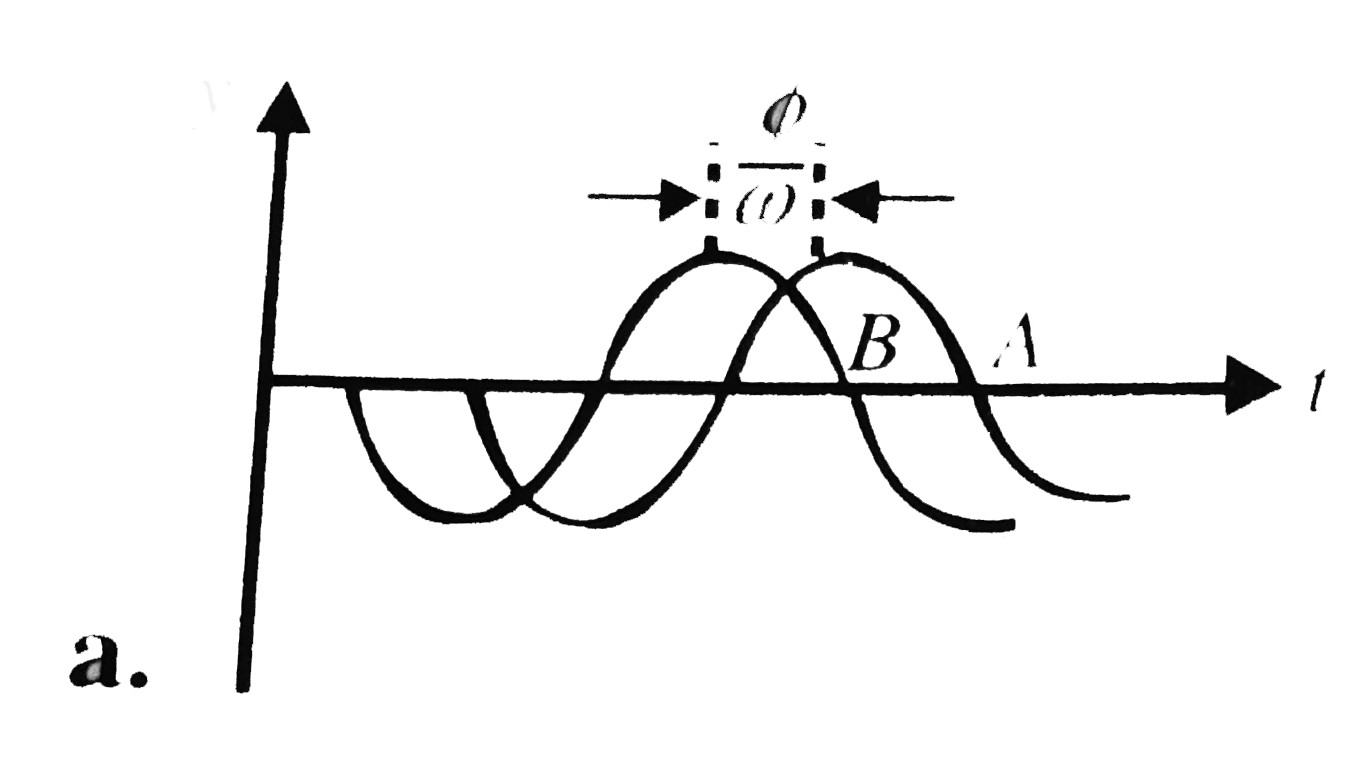
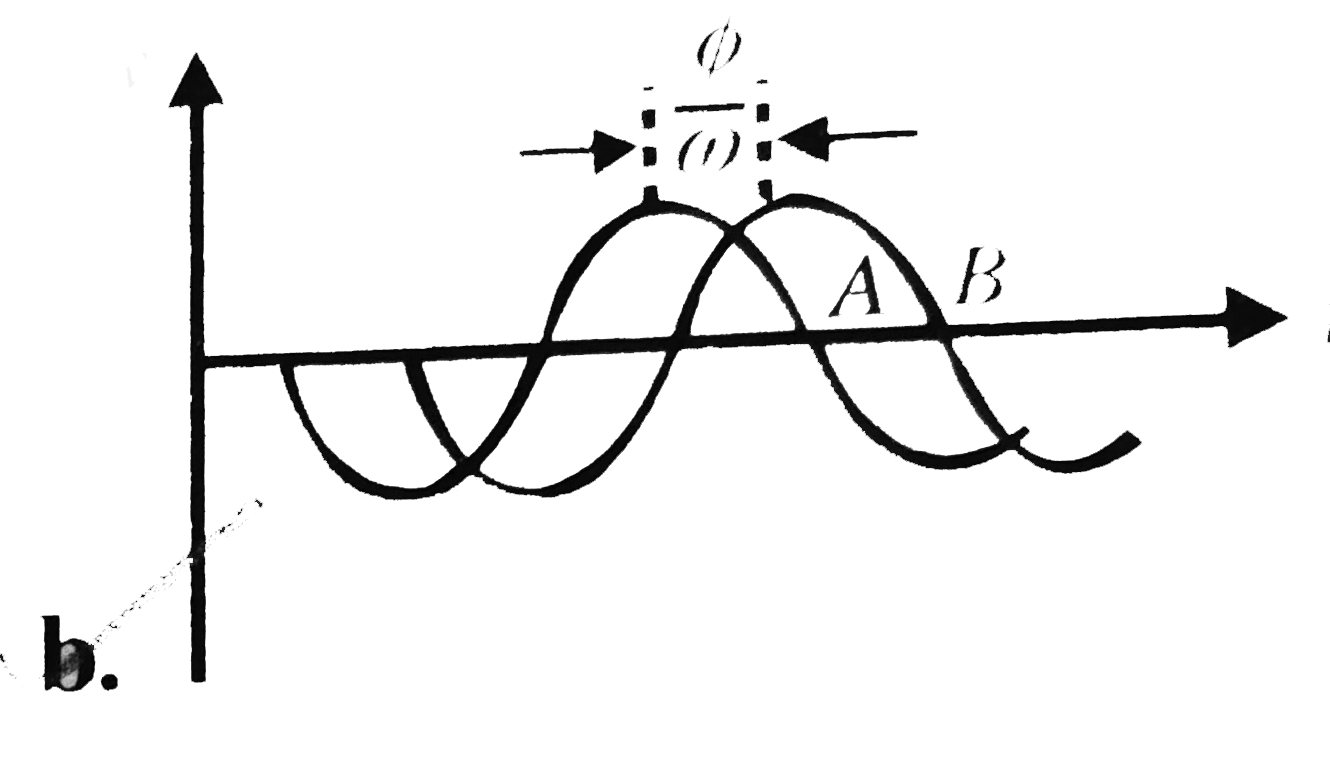
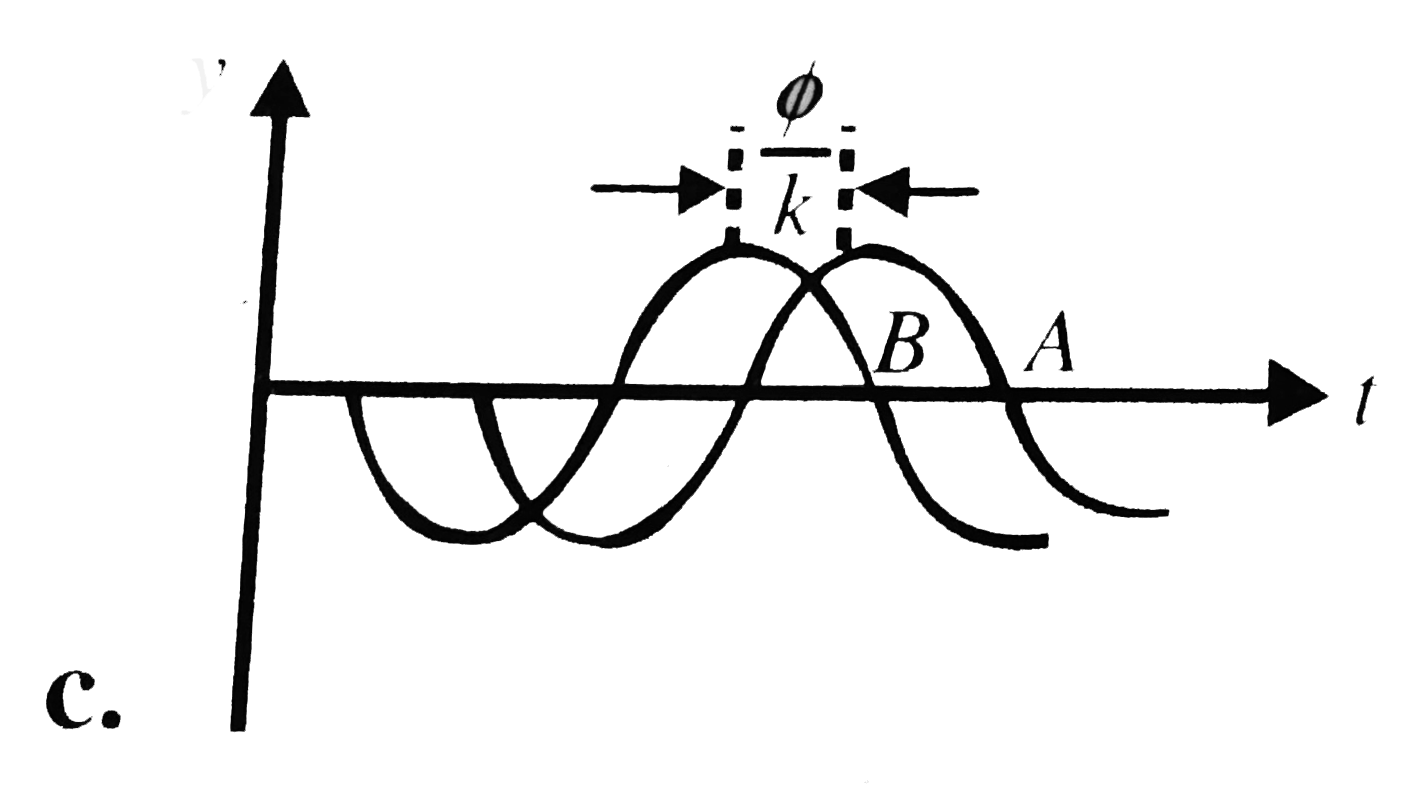
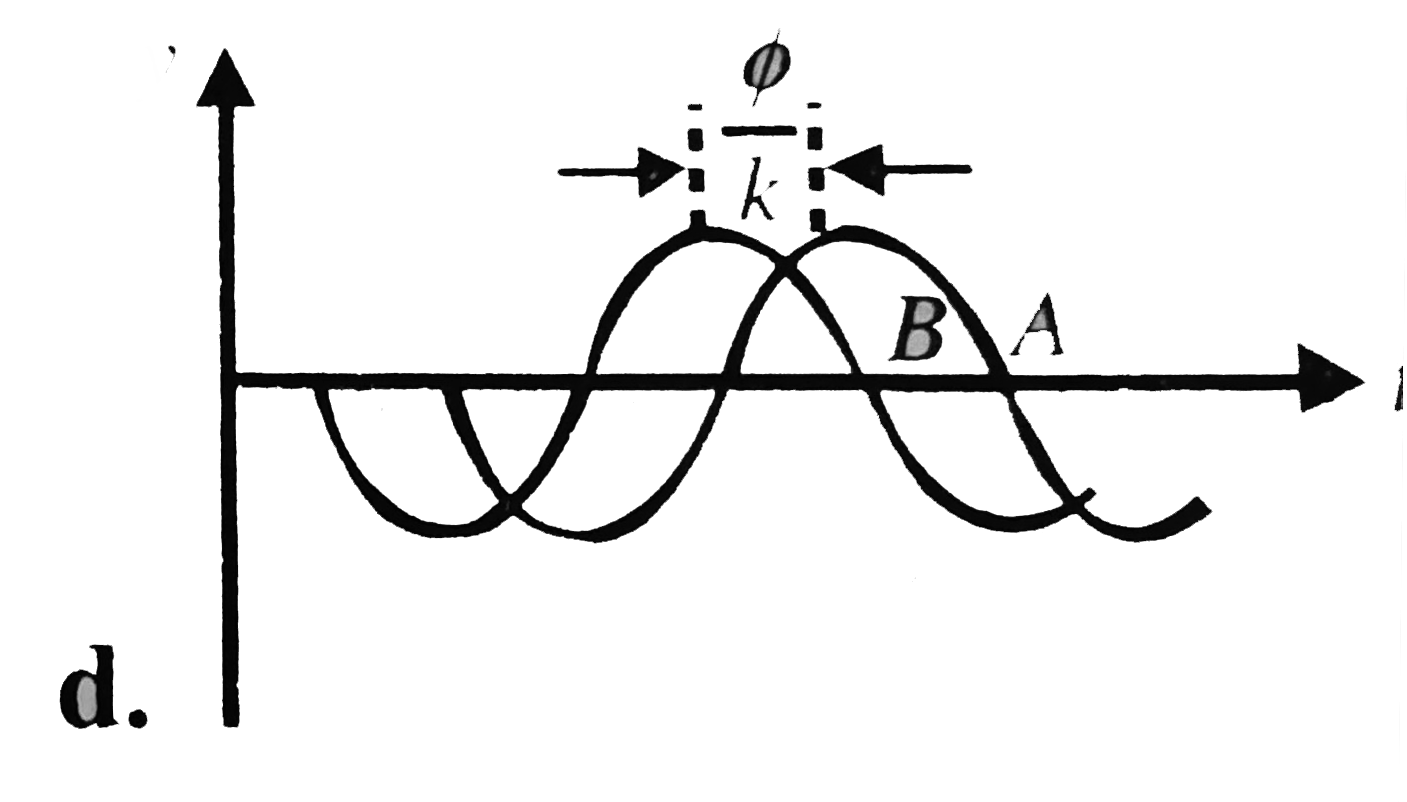
A particle falls from rest under the action of gravity . Variation of kinetic energy (KE) and potential energy (PE) of the particle , with timet is represented by the graph |
|
Answer»
|
|
| 11. |
The rms speed of molecules of a gas in a vessel is 400 ms^-1.If half of the gas leaks out at constant temperature. The rms speed of the remaining gas molecules will be |
|
Answer» 800 `ms^-1` |
|
| 12. |
When two bodies are saparated by certain distance the gravitational force between then is F. If distance is increased by 100%,then gravitational force becomes -- |
|
Answer» `F/4` |
|
| 13. |
Consider one mole of perfect gas in a cylinder of uniform cross section with a piston attached (Fig). A spring (spring constant k) is attached (unstretched lengthL) to the piston and to the bottom of the cylinder. Initially the spring is unstretched and the gas is in equilibrium. A certain amount of heat Q is supplied to the gas causing an increase of volume from V_(0)" to " V_(1). a) What is the initial pressure of the system b) What is the final pressure of the system c) Using the first law of thermodynamics, write down a relation between Q,P_(a),V,V_(0) and K . |
|
Answer» Solution :a) `P_(i)=P_(a)` b) `P_(F)=P_(a)+K/A[(V-V_(0))/A]=P_(a)+K/A^(2)(V-V)_(0)` C) `DeltaQ=P_(a)(V-V_(0))+1/2K[(V-V_(0))/A]^(2)+C_(V)(T-T_(0))` where `T_(0)=P_(a)V_(0)//R` `T=[PA+(K//A^(2)).(V-V_(0))]V//R` |
|
| 14. |
The length of metallic wire is l. The tensin in the wire is T_(1) for lengthl_(1) and tension in the wire is T_(2) for length l_(2). Find the original length. |
|
Answer» Solution :Increase in LENGTH under tension `T_(1) = l _(1) - l` Increase in length under tension `T_(2) =l_(2) -l` `Y = (T_(1))/(A) xx (l )/( l _(1) - l) and Y = ( T_(2))/( A) xx (l)/(l _(2) -l)` SINCE material of wire is same HENCE Y is same. `therefore ( T_(1))/(A) xx ( l)/( l _(1) xx) = (T_(2))/( A ) xx (l )/( l _(2) - l)` `therefore T_(1) ( l _(2) - ) = T_(2) (l_(1) - l)` `therefore T_(1) l _(2) -T_(1) l = T_(2) l _(1) - T_(2) l` `therefore T_(1) l _(2) - T _(1) l _(1) = (T_(1) - T _(2)) l` `therefore l = (T_(1) l_(2)- T_(2) l _(1))/( T_(1) - T_(2)) or (T _(2) l _(1) -T_(1) l _(2))/( T_(2)- T_(1))` |
|
| 15. |
Internal forces can change |
|
Answer» KINETIC ENERGY |
|
| 16. |
Passage - II A cylinder rolls on the plank A and B without relative sliding. C and Q are the points on the axis and surface respectively and line CQ is horizontal. The planks move with velocities -2Vhat(i),Vhat(i) respecticely Ifoverline(V)_(C) and overline(V)_(Q) are the velocities at the points C & Q then overline(V)_(C)-overline(V)_(Q) is |
|
Answer» `V(+HAT(J))` |
|
| 17. |
Passage - II A cylinder rolls on the plank A and B without relative sliding. C and Q are the points on the axis and surface respectively and line CQ is horizontal. The planks move with velocities -2Vhat(i),Vhat(i) respecticely The instantaneous axis of rotation of cylinder is |
|
Answer» `R/3` from B |
|
| 18. |
The terminal velocity of a iron ball of radius 2.0 mm talling through a tank of oil at 20^(@)C is 6.5cms^(9-1) .Compute the viscosity of the oil at 20^(@)C . Density of oil is 1.5xx10^(3)kgm^(-3).Density of iron is 7.8xx10^(3)kgm^(-3). |
| Answer» SOLUTION :`eta=8.3PI` | |
| 19. |
The far point of a myopic eye is 10cm from the eye.What must be the focal length of a lens for reading at normal distance (25 cm)? |
|
Answer» `-8.35 CM` |
|
| 20. |
A solid sphere of mass 2 kg rolls up a 30^(@) incline with an initial speed of 10 ms^(-1). The maximum height reached by the sphere is (g = 10 ms^(-2)) |
|
Answer» 3.5 m `:.` Total kinetic energy `= 7//5` TIMES the translational kinetic energy. At highest point, whole of the kinetic energy will be convered into potential energy `:. mgh=(7)/(5)((1)/(2)mv^(2))or h=(7v^(2))/(10g)=(7(10)^(2))/(10g)=(7(10)^(2))/(10xx10)=7m` |
|
| 21. |
Two forces are in the ratio of 3:4. The maximum and minimum of their resultants are in the ratio is |
|
Answer» `4:3` |
|
| 22. |
A driver of train A, moving at a speed 30 ms^(-1), sights another train B going on the same track and in the same direction with speed 10 ms^(-1). He immediately applies brake that gives his train a constant retardation of 2 ms^(-2). What must be the minimum distance between trains in order to avoid a collision ? |
|
Answer» Solution :The initial velocity of the train, `v_(0) = v_(AB) = v _(A) -v _(B) = 30 - 10 = 20 ms ^(-1)` Now `v ^(2) -v _(0) ^(2) = 2ax,` here, `v =0, v _(0) = 20 , a =- 2MS ^(-2)` `therefore (0) ^(2) - (20) ^(2) = 2 (-2) x` `therefore (-400)/(-4) =x` `therefore x = 100 m` ACCIDENT can be avoided if the minimum DISTANCE 100 m is kept between two trains. |
|
| 23. |
A 50 kg girl wearing high heel shoes balances on a single heel . The heel is circular with a diameter 1.0 cm . What is the pressure exerted by the heel on the horizontal floor ? |
|
Answer» Solution :`P=(F)/(A)=(MG)/(PIR^(2))` `=(50xx9.8)/(3.142xx(5XX10^(-3))^(2))` `=6.24xx10^(6)Nm^(-2)` |
|
| 24. |
Refer to plot of temperature and time showing temperature change and state, changes in ice on heating, Which of the following are correct? |
|
Answer» Region OB represents ICE and WATER in thermal equilibrium |
|
| 25. |
A block of mass M is held against a rough vertical wall by pressing it with a finger. If the coefficient of friction between the block and the wall is mu and the accelerationdue to gravity is g calculate the minimum force required to be applied by the finger to hold the block against the wall ? |
|
Answer» SOLUTION :Let `F` be the force APPLIED by the finger on the block `N` is NORMAL REACTION of the wall on the block `Mg` is weight of block acting vertically downwards. `F` is the force of friction between the wall and the block which acts upwards as shown in The block will not fall, if `f = mg ` ` MU N = mg , or mu F = mg , or F = (Mg)/(mu) `  . |
|
| 26. |
A body is moving at a distance parallel to X - axis with a constant velocity Its angular momentum about the origin |
| Answer» Answer :A | |
| 27. |
A stone of mass m tied to the end of a string revolves in a vertical circle of radius R. The net forces at the lowest and highest points of the circle directed vertically downwards are : [Choose the correct alternativeT_1 and v_1 denote the tension and speed at the lowest point. T_2 and v_2denote corresponding values at the highest point. |
|
Answer» Solution :ALTERNATIVE (a) is correct , note mg ` + T_2 = mv_2^2 // R , T_1 - mg = mv_1^2 // R` The moral is : do not CONFUSE the actual MATERIAL forces on a body (TENSION, gravitational FORCE, etc) with the effects they produce : centripetal acceleration `v_2^2//R or v_1^2//R` in this example. |
|
| 28. |
A mass of 2kg oscillates on a spring with force constant 50 N/m. By what vector does the frequency of oscillation decrease when a damping force with constant b = 12 is introduced ? |
|
Answer» decreases by `10%` |
|
| 29. |
Find the equilibrium temperature, when 150g of water at 92^(@)C is thoroughly mixed with 250g of water at 28^(@)C |
|
Answer» |
|
| 30. |
A mass of 1 kg is suspended by a thread. It is (i) lifted up with an acceleration of 4.9mcdot s^(-2). |
|
Answer» `3:1` Tension on the thread = T (upwards) `THEREFORE` Resultant force acting on the body = T - mg (UPWARD) If a si the upward acceleration then from F = ma we get. T - mg = MAOR, T = m(g + a) |
|
| 31. |
Conversion of 1 MW power in a new system of units having basic units of mass length and times as 10 kg, 0.1 m and 1 minute respectively is |
|
Answer» `2.16 XX 10^10` UNIT |
|
| 32. |
The phase difference between velocity and acceleration of simple harmonic oscillator. |
| Answer» ANSWER :B | |
| 33. |
Two bodies of mass m_(1)andm_(2) are suspended from a weightless spring. The force constant of the spring is k. When the bodies are in equilibrium position, the body of mass m_(1) is taken away from the system such that the equilibrium condition of the system is not disturbed at that very moment. Determine the angular frequency and the amplitude of motion for the body of mass m_(2). |
|
Answer» Solution :If increase in length of the spring DUE to the two masses `m_(1)andm_(2)` is l, then `k=((m_(1)+m_(2))g)/lor,l=((m_(1)+m_(2))g)/k` SIMILARLY for the mass `m_(2)`, increase in length, `l_(2)=(m_(2)g)/k`. This `l_(2)` is the increase in length for the final equilibrium position. So with the mass `m_(1)`, displacement from the equilibrium position = amplitude of motion = `l-l_(2)=((m_(1)+m_(2))g)/k-(m_(2)g)/k=(m_(1)g)/k` Since only the mass `m_(2)` vibrates, the angular FREQUENCY `omega` is GIVEN by, `omega^(2)=k/m_(2)or,omega=sqrt(k/m_(2))`. |
|
| 34. |
Staement I: pressure and density change do not occure in a transverse stationary wave. Statement II: the average distance between any two particles of the wave remains the same. |
|
Answer» Statement I is true, statement II is true and statement II is the correct explaination for statement I. |
|
| 35. |
A police van moving on a highway with a speed of 30 kmh^(-1) fires a bullet at a thief's car speeding away in the same direction with a speed of 192 kmh^(-1). If the muzzle speed of the bullet is 150 ms^(-1) with what speed does the bullet hit the thief's car ? (Note: Obtain that speed which is relevant for damaging the thief's car). |
|
Answer» <P> Solution :Velocity of thief.s car `v _(t) =192 KM//hr = (192 XX 1000)/(3600) ms ^(-1) ``v _(t) = (160)/(3) ms ^(-1)` Velocity of police.s car `v _(p) = 30 km //h` `= (30 xx 1000)/(3600) ms ^(-1) = (25)/(3) ms ^(-1)` Muzzle velocity of bullet, `v _(b). = 150 ms ^(-1)` `THEREFORE` velocity of bullet `v _(b) = v _(p) + v _(b) = (25)/(3) + 150 ` `v _(b) = (475)/(3) ms ^(-1)` Velocity of bullet while striking thief.s car= velocity of bullet w.r.t. their `v_(bt)` But `v _(bt) =v_(b) -v_(t)` `= (475)/(3) - (160)/(3) = (315)/(3) ` `v _(bt) = 105 ms ^(-1)` Second method: `v _(t) =192 km //h = (160)/(3) ms ^(-1)` `v _(p) = 30 km//h = (25)/(3) ms ^(-1)` Velocity of theif.s car w.r.t. olice.s car `v _(tp) =v_(t) - v _(p)` `=(160)/(3) - (25)/(3)` `v _(rp) = 45 ms ^(-1)` Muzzle velocity of bullet `v _(b). = 150 ms ^(-1)` = velocity of bullet w.r.t. police.s car = `v_(bp)` Velocity of bullet while striking thief.s car, `= v _(bp) - v _(tp)` `= 150 -45` `= 105 ms ^(-1)` |
|
| 36. |
A cylinder rolls up an inclined plane, reaches some height and then rolls down (without slipping through out these motions). The directions of frictional force acting on the cylinder are |
|
Answer» up the incline while ASCENDING and down the incline while DESCENDING |
|
| 37. |
A body is in motion and it is stopped by applying retarding force. Initial speed magnitude of force applied are as given below (1) {:("Speed","Force"),(V,F):} (2) {:("Speed","Force"),(2V,F//2):} (3) {:("Speed","Force"),(V//2,2F):} If S_(1), S_(2), S_(3) are the distances travelled before coming to rest, those can be arranged in ascending order as given below |
|
Answer» `S_(1), S_(2), S_(3)` |
|
| 38. |
Adjoining figureshows the snapshot of two waves A and B at any time t. the equation for A is y=Asin (kx-omegat-phi),and for B it is y=A sin (kx-omega t). It is clearly shown in the figure that wave A is ahead of B by a distance phi//k. |
|
Answer»
`y=A sin[kx-omegat-phi]` `=A sin[k(X-phi//k)-omegat]` `A sin[kx-omega(t+(phi)/(k))]` while equation of wave `B` is `y= A sin (kx-omegat)`. Comparing above equation, we can easily conclude that `A` is at a distance ahead of `phi//k` from `B` or wave `A` is ahead of `B` by a TIME DIFFERENCE of `phi//omega`.So, (b) is the correct option. Remember `!` In y versust'ahead of means to the left of' while in `y` VERSUS `x` 'ahead of means to the right of' if the wave travels in positive `x-`direction and VICE versa. |
|
| 39. |
A progressive wave gets reflected at a boundary such that the ratio of amplitudes of the reflected and incident wave is 1 :2. Find the percentage of energy transmitted . |
|
Answer» Solution :Given `(A_(r))/( A_(i)) = (1)/(2) rArr` RATIO of INTENSITIES is `(I_(1))/(I_(2)) = ((1)/(2))^(2)` Hence the fraction of energy transmitted `E_(1) = 1 - ((1)/(2))^(2) = (3)/(4)` The PERCENTAGE of energy transmitted ( of course PER unit time) is `3 //4 xx 100 = 75%`. |
|
| 40. |
The position of a particle moving in the XY-plane at any time 't' is given by x=(3t^(2)-6t)m,y=(t^(2)-2t)m. Selectthe correct statement about the moving particle from the following |
|
Answer» The accleration of the PARTICLE is zero at `t=0` SECOND |
|
| 41. |
What is the condition for setting up an artificial satellite at a height h from the earth's surface ? (Radius of the earth=R , mass of the earth =M) |
|
Answer» Solution :Suppose height of the artificial satellite from the EARTH.s surface is h . Hence, the radius of the ORBIT is (R+h) . If V is the orbital SPEED, the centripetal force necessary to keep the satellite in that orbit is `(mv^2)/((R+h))` ( m= mass of the stellite ). if the mutual force of gravitation between the earth and the satellite can supplythis centripetal force, the satellite WOULD be in the orbit. Gravitational force between the satellite and the earth is `(GMm)/((R+h)^2)`. Hence, the necessary condition is `(mv^2)/(R+h)=(GMm)/((R+h)^2) or, v=sqrt((GM)/(R+h))` |
|
| 42. |
Emissive power and Absorptive power of a body depend upon |
|
Answer» Nature of the surface |
|
| 43. |
A source and observer are approaching one another with the relative velocity 40ms^(-1). If the true source frequency is 1200 Hz, deduce the observed frequency under the following conditions: (i) All velocity is in the source alone. (ii) All velocity is in the observer alone. (iii) The source moves in air at 100ms^(-1) towards the observer, but the observed also moves with the velocity v_(0) in the same direction. (Velocity of sound 340 m/s) |
|
Answer» Solution :Here V=1200Hz, `v=340ms^(-1)` Relative VELOCITY `=40MS^(-1)` (i) Here source move towards the stationary observer, `v_(s)=+40ms^(-1),v_(0)=0`  `"Train"overset(S""+ve""v_(s))tooverset(*)"Observer "v_(0)=0` `v'=((v-v_(0)))/((v-v_(0)))xxv=(340-0)/(340-40)xx1200` `=(340xx1200)/(300)=1360Hz`. (II)Here observer MOVES towards the stationary source, `v_(0)=-40ms^(-1),v_(s)=0` `S*v_(s)=0""overset(-ve""v_(0)""O)to` `v'=(v-v_(0))/(v-v_(s))xxv=(340+40)/(340-0)xx1200` `=(380)/(340)xx1200=1341Hz`.  (iii)Here observer and source move in the same direction, `v_(s)=100ms^(-1),v_(0)=100-40=60ms^(-1)` `overset(S""+ve""v_(s))to""overset(S""+ve""v_(s))to` `v'=(v-v_(0))/(v-v_(s))xxv=(340-60)/(340-100)xx1200` `=(280)/(240)xx1200=1400Hz`. 
|
|
| 44. |
Which of the following is a necessary and sufficient condition for simple harmonic motion |
|
Answer» Constant PERIOD |
|
| 45. |
Three pieces of silver have masses 2.3 kg, 41.15g and 30.19g. The total mass of correct significant figures is |
|
Answer» 2.37032 kg |
|
| 46. |
One end of a string of length l is connected to a particle of mass m and the other to a small peg on a smooth horizontal table. If the particle moves in a circle with speed v the net force on the particle (directed towards the centre) is : (i) T, (ii) T - (mv^2)/(l) , (iii) T + (mv^2)/(l) , (iv) 0T is the tension in the string. [Choose the correct alternative]. |
|
Answer» SOLUTION :(i) T Forparticlemovingon CIRCULARPATH withconstantvelocitytension(T )providenecessarycentripetal FORCE. |
|
| 47. |
The ratio of moment of inertia about axis of a ring to a axis of disc of same mass and radius is ……………. |
|
Answer» `1:1` Moment of inertia disc about on axis passing through its center and perpendicular to its plane `I_("disc")=(1)/(2)MR^(2)` `therefore (I_("ring"))/(I_("disc"))=(MR^(2))/((1)/(2)MR^(2))=2:11` |
|
| 48. |
Explain “Momentum gives more information than velocity alone” |
|
Answer» SOLUTION :Example1 : if apebbleand a stoneare thrownwithsamevelocityto hitaman.Thenit isveryas thevelocityof boththe objectis same . Wecan knowthe forceon OBJECT bystudyingthechangein momentumof the object Byknowingthe mass we can say thatmomentumof stoneis greaterthanpebblehence stoneis goingto causemoredamage EXAMPLE2 :LETUS assumethata carandtruckare stati on horizontalroad.To bringthemintervalcarrequiredvelocityin equaltimeintervalcarrequiredlessforceand truckrequiredmoreforce.Alsoit theyare movingwithsamevelocityto bringthemto restcarrequires lessretardingforcethan tobringtruckto restin sametimeinterval THUS todetermineeffectof forcemomentumgivesmoreinoformationthanvelocityalone |
|
| 49. |
A man with a writs on his hands fall from te top of a tower. Does the watch give correct time ? |
| Answer» Solution :YES, Because the WORKING of writs (springs wound) watch is INDEPENDENT of 'g' but depends UPON the potential ENERGY stored in the spring. | |
| 50. |
(A) : Horizontal range is same for angle of projection theta and (90-theta). Fro same speed of projection ( R) : Horizontal range is independent of angle of projection. |
|
Answer» Both (A) and ( R) are TURE and ( R) is the CORRECT explanation of (A) |
|