

Saved Bookmarks
This section includes 7 InterviewSolutions, each offering curated multiple-choice questions to sharpen your Current Affairs knowledge and support exam preparation. Choose a topic below to get started.
| 1. |
What are the medical problems an astronaut will face when in space for long time while orbiting around a planet in a satellite. |
|
Answer» Solution :When an astronaut remains for a long time in SPACE in a satellite, he will be in weightlessness saate for a long time. Due to it he will face the following medical problems : (i) He becomes longer when lying down. It is so because the weight of upper part of BODY of astronaut is taken off the discs in the spine. Due to it, the discs expand making the astronaught longer. (ii) When an astronaut has spent weeks or more in space, his heart is weekened, becouse the blood is not pulled downwards and the heart does not have to pump as hard to push the blood into upper part of body. If an astronaut is in an ornit in space for `7` to `10` days only, he can recover from this wekness quickly but is stays more, then the heart problem arises. (iii) If an astronaut TAKES exces fluids in space, the face of astronaut becomes puffy because fluids are not pulled downwards in weightlessness state and thus redistribute themselves in the face of astronaught. |
|
| 2. |
If velocity of light C, acceleration due to gravity g and density d are the fundamental quantities in a system of measurement, then mass has |
|
Answer» DIMENSIONS 3 in C |
|
| 3. |
A body is dropped from the top a towar 150 m, and sumultaneously, another body is dropped from rest from rest from a point 100m above the gorund. What is their differnece in heightafter they have fallan (i) 2 s(ii) 3s.how does the difference inheight vary with time ? take g 10 ms^(-2) |
|
Answer» |
|
| 4. |
What will be the velocity of sound in a perfectly rigid rod ? Given reason. |
| Answer» Solution :The VELOCITY of sound in a perfectlly RIGID rod will be infinite. This is because the VALUE of Young's modulus of elesticity is infinite for a PERFECTLY rigid rod. | |
| 5. |
A steel wire 4 m in length and 2.4*10^(-7)m^2in cross - section is stretched by a force of 36N . Calculate the stress and strain . |
| Answer» SOLUTION :1.5*10^8N/m^2, 8.33*10^(-4) | |
| 6. |
Two particles execute SHM of same amplitude and frequency on parallel lines. They cross each another when moving in opposite directions each time their displacement is half their amplitude. What is the phase difference between them ? |
|
Answer» Solution : If we assume that the particles are INITIALLY at the mean position, their equation for displacement `x= Asinomegat` But `x= -(A)/(2) "" ":. (A)/(2)= Asinomegat` (or ) `SINOMEGAT= (1)/(2)` `"Phase" = OMEGAT= 30^(@), 150^(@)` `( :. sin(180^(@)-theta)= sintheta, sin(180^(@)-30^(@)= sin30^(@))` One of the particles has phase of `30^(@)`and the other has phase of `150^(@)` Phase difference between them = `120^(@)= (2pi)/(3)` radian |
|
| 7. |
If a tunnel is cut at any orientation through earth, then a ball released from one end will reach the other end in time (neglect earth rotation) |
|
Answer» `84.6` MINUTES `F_(R )=-mg_(d) rArr F_(R )=-(mg)/(R )x` `T=2pi sqrt((MR)/(mg)) rArr T=2pi sqrt((R )/(g)) Ϸ T = 84.6` min `t = (T)/(2) rArr t = 42.3` min 
|
|
| 8. |
A man is standing on a spring platform. Reading of spring balance is 60 kg wt. If man jumps outside the platform, then the reading of the spring balance |
|
Answer» REMAINS same |
|
| 9. |
Chossethe correctaltarnatives |
|
Answer» <P>Fora generalrotationalmotion , angular momentumL andangularvelocity`OMEGA` neednotbeparallel . |
|
| 10. |
A uniform rod AB of mass m and length l is suspended by two massless and inextensible strings AC and BD whose ends C and D are fixed as shown. Find the tension in the string BD immediately after the string at A is cut. |
|
Answer» `:. a_(x)=(4T)/(5m)`…..i `mg-Tsin37^@=ma_(y)` `:. a_(x)=g-(3T)/(5m)`……ii and taking torque about CM of rod, `Tsin37^@ (l/2)=(3l^(2))/12alpha` `:. al=(18T)/(5m)`…..iii  Now, since the sting `BD` neither slacks nor breaks, therefore the acceleration of end `B` ALONG the a string must be ZERO. `i.e. a_(y)cos37^@+(al)/2cos53^@-a_(y)cos53^@=0`  From eqn i, ii and iii `(4T)/(5m).4/5+(18T)/(5mxx2).3/5-(g-(3T)/(5m))3/5=0` `(52T)/(25m)(3G)/5` `:. T(15mg)/52` |
|
| 11. |
Assertion : In radiation, heat transfers in form of electromagnetic waves. Reason : For electromagnetic waves medium is not required. |
|
Answer» Both are true and the REASON is the CORRECT EXPLANATION of the ASSERTION. |
|
| 12. |
When .n. number of particles of masses m, 2m, 3m, …….. nm are at distances x_(1)=1, x_(2)=2, x_(3)=3, ……………x_(n) =n units respectively from origin on the x-axis, then find the distance of centre of mass of the system from origin. |
|
Answer» SOLUTION :`X_(cm)=(m(1)+2m(2)+3M(3)+………+(nm)n)/(m+2m+3m+………+nm)` `X_(cm)=(m(1^(2)+2^(2)+3^(2)+……….+n^(2)))/(m(1+2+3+………..+n))` `X_(cm)=(((n(n+1)(2n+1))/(6)))/(((n(n+1))/(2)))=(2n+1)/(3)` |
|
| 13. |
The work done in carrying a body from A to B is 20 J and from B to C is 15 J. The work done in moving the body from A to C assuming the force involved in all the cases is conservative force is |
| Answer» ANSWER :A | |
| 14. |
A package is at rest on a conveyor belt which is initially at rest. The belt is started and moves to the right for 1.3s with a coonstant acceleration of 2m//s^(2). The belt then moves with a constant deceleration and comes to stop after a total displacement of 2.2m. The coefficient of friction between the package and the belt are mu_(s)=0.35 and mu_(k) = 0.25 . The displacement of the package relative to the belt as the belt comes to stop is 317 xx 10^(-x) The value of x is (g = 10 m//s^(2)) |
|
Answer» |
|
| 15. |
Power applied to a particle varies with time as P= (3t^(2)-2t+1) wait, where t is an second. The change in its kinetic energy between time t= 2 sec and t= 4 sec. is |
| Answer» ANSWER :B | |
| 16. |
A disc of mass m and radius R moves in the x-y plane as shown If the angular momentum of the disc about the origin O at the instant shown is x/2"mR"^(2)"w" then find x. [omega=(V)/(R )] |
|
Answer» |
|
| 17. |
The length of a brass wire is 1m. The strain produced by a load is 0.001. The change in its length is |
| Answer» ANSWER :2 | |
| 18. |
There arefour forces acting at a point O produced by strings as shown in which is at rest. Find the forces F_(1) and F_(2) . |
|
Answer» SOLUTION :resolving force of `1N` ALONG `OA` into two rectangular components: `1//sqrt2` along `F_1` and `1//sqrt2` opp to `F_(2)` Similarly , two rectangular components of `2N` force along `OB` are ` sqrt2` opp to `F_(2)` and `sqrt2` opp to `F_(1)` In equilibrium (i) `F_(1) + (1)/sqrt2 = sqrt2` or `F_(1) = sqrt2 - (1)/sqrt2 = (2-1)/sqrt2 =0.707 N` (ii) `F_(2) = sqrt2 + (1)/sqrt2 = (2+1)/sqrt2= (3)/sqrt2 = (3xx1.414)/(2) = 2.121 N` . 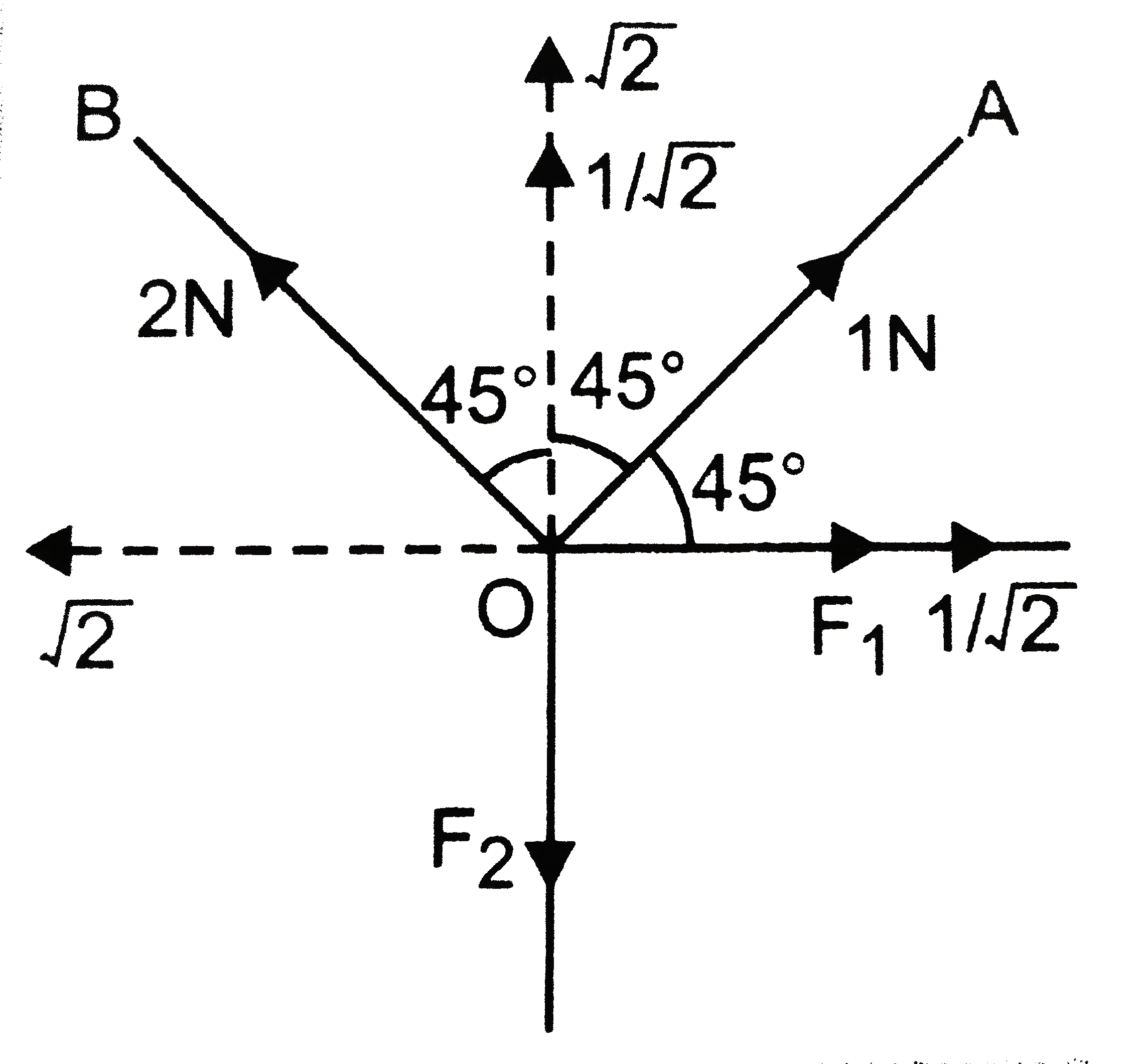
|
|
| 19. |
A particle of-mass m moves along a circular path of radius r with velocity v. What is its instantaneous angular momentum about apoint on the plane of the orbit at a distance x from the centre of the axis of rotation. |
| Answer» SOLUTION :Here DISTANCE `=(r-x), L =m(r-x)^(2)OMEGA` | |
| 20. |
A horizontal force F is applied on a riing of mass m_(1)constrained to move on a horizontal smooth wire the hanging mass m_(2) is constant angle with |
|
Answer» Force on `m_(1)` by wire is LESSTHAN `(m_(1)+ m_(2))g` |
|
| 21. |
When the temperature of a black body increases, it is observed that the wavelenght corresponding to maximum energy changes from 0.26 mum to 0.13 mum. The ration of the emissive power of the body at the respective temperature is |
|
Answer» `16//1` |
|
| 22. |
A man turns on rotating table with an angular speed omega. He is holding two equal masses at arms length. Without moving his arms, he just drops the two masses. How will his angular speed change ? |
|
Answer» less than `omega` |
|
| 23. |
As astronaut tries to fill ink in an ink pen in an aritficial satellite. The ink |
|
Answer» Will be FILLED into the pen |
|
| 24. |
A cylinder of capacity 20 liters is filled with hydrogen gas . The total average K.E. of translatory motion of its molecules is 1.5 xx10 _(5) J. The perssure of hydrogen in the cylinder is ....... . |
|
Answer» `2xx10^(6)Nm^(-2)` |
|
| 25. |
When a mass is suspended from the end of a wire the top end of which is attached to the roof of the lift the extension is 'e' when the lift is stationary. If the lift moves up with a constant acceleration g/2 the extension of the wire would be .... |
| Answer» ANSWER :B | |
| 26. |
For object moving on circular path centripetal force (F) depend on mass (m), velocity (v) and radius (r). Derive equation of centripetal force F. |
|
Answer» |
|
| 27. |
A projectile is thrown in the upward direction making an angle of 60^(@) with the horizontal direction with a velocity of 147 ms^(-1). Then the time after which its inclination with the horizontal is 45^(@), is: |
|
Answer» 15s `v cos 45^(@)=u cos 60^(@) =u=147m//s` Now, `v SIN 45^(@)=u sin 60^(@)-gt` |
|
| 28. |
A sphere is rolled on a rough horizontal surface. It gradually slows down and stops. The force of friction tries to |
|
Answer» INCREASE the LINEAR VELOCITY |
|
| 29. |
2 Kg of water of 60^(@)C is mixed with 1 kg of water at 30^(@)C kept in a vessel of heat capacity "220 J K"^(-1). The specific heat of water is "4200 J Kg"^(-1)K^(-1). Then the final temperature is nearly. |
|
Answer» (a) `35^(@)C` `2xx4200xx(60-THETA)=(14200+200)(theta-30)RARR theta =50^(@)C` |
|
| 30. |
What is the minimum possible temperature on the basis of Charle's Law. |
|
Answer» |
|
| 31. |
A motor is pumping water with a velocity of 20 ms^(-1) from a pump of area of cross section 10cm^2. Its average power is, |
| Answer» ANSWER :A | |
| 32. |
A cylinder of mass 10 kg and radius 15 cm is rolling perfectly on a plane of incli-nation 30°. The coefficient of static friction mu_(k) = 0.25. If the inclination 9 of the plane is increased, at what value of theta does the cylinder begin to skid, and not roll perfectly? |
|
Answer» `37^(@)` |
|
| 33. |
A flywheel of mass 400 kg and one metre radius makes 600 rev/minute. Assuming its mass to be concentrated at the rim, calculate the angular velocity, M.I. and energy of the flywheel. |
| Answer» Solution :`omega = 2pin = 2pi XX 10 = 62.8 rad/s K.E. (1//2) lomega^(2) , omega = V//r, m_(1)gh =7v^(2) , v= 23.66 MS^(-1), omega =v//r = 118.3 rad s^(-1)` | |
| 34. |
At what temperature will the rms speed of oxygen molecules become just sufficient for escaping from the Earth's atmosphere ? (Given : Mass of oxygen molecule (m) = 2.76 xx 10^(-26) kg , Boltzmann's constant k_B = 1.38 xx 10^(-23) JK^(-1) ) |
|
Answer» `1.254xx10^(4)K` `:. v_e^2=(3k_BT)/m` `:. T = (v_E^2)/(3k_B)` `:. T = ((11.2xx10^3)^2 xx2.76 xx10^(-26))/(3xx1.38 xx 10^(-23))` `:. T = 83.626 xx10^3` `= 8.363 xx10^4 K` `:. T ~~ 8.360 xx 10^4 K` (Approx) |
|
| 35. |
A man is travelling at 10.8 kmph in a topless car on a rainy day. He holds an umbrella at an angle of 37^(0) with the vertical so that he does not wet. If rain drops falls vertically downwards, what is the rain velocity ? |
|
Answer» `1ms^(-1)` |
|
| 36. |
If the potential energy of a gas molecule is U= M/(r^6) - N/(r^12) M and N being positive constants, then the potential energy at equilibrium must be |
|
Answer» ZERO In equilibrium POSITION , `F = 0` `:. (6M)/(r^7) - (12N)/(r^13) = 0 " or " r^6 = (2N)/(M)` `:.` Potential energy at equilibrium position `U = M/((2N//M)) - N/((2N//M)^2) = (M^2)/(2N) - (M^2)/(4N) = (M^2)/(4N)` |
|
| 37. |
When a body slides down an inclined plane with coefficient of friction as mu_(k) then its acceleration is given by |
|
Answer» `g(mu_(K)sin theta+COS theta)` `a=g(sin theta-mu_(k)cos theta)` |
|
| 38. |
An object suspended from a spring exhibits oscillations of period T. Now the spring is cut in two halves and the same object is suspsended with two halves as shown in figure. The new time period of oscillation will become |
| Answer» ANSWER :C | |
| 39. |
A piece of wire is bent in the shape of a parabola y = kx^2 (y axis vertical) with a bead of mass mon it. The bead can slide on the wire without friction. It stays at the lowest point of the parabola when the wire is at rest. The wire is now accelerated paralle to the x-axis with a constant acceleration a. The distance of the the new equilibrium position of the bead. Find the x-coordinate where the bead can stay at rest with respect to the wire ? |
|
Answer» |
|
| 40. |
A helicopter of mass 2000 kg rises with a vertical acceleration of 15 m//s^2 . The total mass of the crew and passengers is 500 kg. Give the magnitude and direction of the : (i) Force on the floor of the helicopter by the crew and passenger. (ii) Action of the rotor of the helicopter on the surrounding air (iii) Force on the helicopter due to the surrounding air (g =10 m//s^2) |
|
Answer» Solution : (a) FORCE on the floor of the helicopter by the crew and passengers = apparent weight of crew and passengers = 500 (10 + 15) = 12500 N (b) Action of ROTOR of helicopter on SURROUNDING air is obviously vertically downwards, because helicopter rises on account of reaction of this force. Thus force of action = (2000 + 500) (10 + 15) `= 2500 xx 25` = 62,500 N (c) Force on the helicopter due to surrounding air is obviously a reaction. As action and reaction are equal and opposite, therefore Force of reaction F. = 62,500 vertically upwards. |
|
| 41. |
Assertion : A force of 1kg f produces an acceleration of 1m//s^(2) in a body of mass 1kg Reason : It follows from a = f//m . |
|
Answer» If both, ASSERTION and Reason are true and the Reason is the correct explanation of the Assertion |
|
| 42. |
An electron and a proton are detected in a cosmic ray experiment, the first with kinetic energy 10 keV and the second with 100 keV. Which is faster, the electron or the proton? Obtain the ratio of their speeds, (electron mass =9.11 xx 10^(-31) kg) proton mass =1.67 xx 10^(-27) kg, 1 eV = 1.60 xx 10^(-19) J) |
|
Answer» 13.53 |
|
| 43. |
Motion in two simenstions, in a plane can be studied by expressing position, velocity and acceleration as vectors in Cartestion co-ordinatesvec A = A_x hat I +A_y + A_x hat j wherehat I and hat j are unit vector alongx and y directions, respectively andA_x and A_y are corresponding compnents ofvec A (Fig. 1 (EP) .34). Motion can also also be studied by expressing vectors in circular polarco-ordinates as vec A = A_r hat r + A_(theta) hat theta wherevec r = (vec r0/r = cos hat i = sin hat j and hat theta =- in hat i + cos hat j are unti vectors along direction in which r andtheta are increasing. . (a) Expresshat i and hat j in terms ofhat r and theta (b) Show that bothhat r and hat theta are unit vectors and are perpendicular to each other. (c ) Show thatd/9dt) (hat r) = omegahat theta whereomega (dtheta0/(dt) and d/(dt)(hat theta) =- omega hat r (d) For a particle moving along a spiral given byvec r = alpha theta hat r, wherealpha =1(unit), find dimensions ofalpha. (e) Find velocity and acceleration in polar vector representation for particle moving along speral described in (d) above. |
|
Answer» Solution :(a) ` hat r = cos theta + sin theta JHAT j` ` hat theta =- sin theta hat I + cos atheta hat j` ….(i) Multipluing (i) by ` sin theta ` and (ii) with ` cos theta ` and adding, we get ….(ii) ` hat e =- sin theta + hat theta cos hteta = (sin^2 theta + cos^@ theta ) hat j = hat j` or hat r sin theta + hat theta cos theta = hat j` ....(III) Mjultiplying (i) by cos theta and (ii) b y sin theta and subtracting, we get ` LTBR. ( hat r cos theta - hat theta sin theta ) = hat i` ....(iv) (b) ` hat i. hat theta = ( hat i + sin theta hat j). (- sin theta hat i + cos theta hat j)` (1) (1)` cos theta =- cos theta sin theta + sin theat cos theta =0= cos 90^@` or ` theta = 90^@` (c ) d/( dr) hat r) = d/(dr) cos theta hat i _+ sin theta hat j) =- sin theta (d theta)/(dt) hat i cos tehta (d theta )/(dt) hat i + cos theta (dtheta )/(dt) hat j = omega [- sin hat i + cos theta hat j ] = omega hat i theta` ltBrgt (d) ` vec r = alpha theta hat r ` or ` | vec r | = alpha theta ` or alpha = (|vec r|)/(theta)` Dimensions of ` alpha L/1 = L = [M^0 L^1 T^0 ]` ltBrgt (E) Given, ` alpha =1 ` unit, from above, we have ` vec r = theta hat r = theta [ cos theta hat i + sin theta hat j]` velocity , ` vec r = (d vec r)/(dt) = ( d theta )/( dt) vec r + theta [ - sin theta hat i + cos theta hat j] ( d theta)/(dt) vec r + theta hat i theta omega` [ :. (d theta )/(dt) = moega]` ` omega hat r + omega hat theta ` ACCELRATION, ` vec a = d/ (dt) [ omega theta hat theta ] = d/(dt) [ (d theta )/(dt) xx ( theta hat theta) ] = ( d^2 theta )/( dt^2)hat r + (d theta )/(dt)(d hat r)/(dt) + (d^2 theta )/( dt^2) xx (d theta )/(dt) d/(dt) ( theta hat theta)` ` = (d^2 theta )/(st^@) hat r + omega d/(dt) [ cos theta hat i + sin theta hat j ] + (d^2 theta )./( dt^2) theta hat theta + omega d/(dt) ( theta hat theta)` `= (d^2 THEA)/(dt^2) hat r omega [- sin heta hat i + cis theta hat j ] (d theta )/( dt) + (d^2 theta )/( dt^2) theta hat theta + omega [(dtehta )/(dt) hat theta + theta )d hat theta)/(dt)]` ` = (d^2 theta )/( dt^2 ) hat r + omega 2 hat theta + (d^2 theta )/(dt^2) xx theta hat theta + omega ^2 hat theta + omega^2 theta (- hat e)``[ :. (d hat theta) /(dt) =- omega hat r]` ` =(d^2 theta )/(dt^2) - omega ^2 theta ) hat r + (2 omega^2 + (d^2 theta )/(dt^2) theta )hat theta`. |
|
| 44. |
A solid sphere of mass m and radius r is released from rest at the top of smooth inclined plane of inclinationtheta. The ratio of acceleration when it rolls down the plane without slipping and when it slipping down the plane is |
|
Answer» `7/5` `a_(1)=(g sin theta)/(1+K^(2)//R^(2))=(g sin theta)/(1+(2//5r^(2))/(r^(2))` `=(g sin theta)/(((5+2)/4))` `=5/7 g sin theta [:' K^(2)=2/5r^(2)]` When the sphere SLIDES down the plane, the acceleration is `a_(2)=g sin theta` `:. (a_(1))/(a_(2)0=5/7 XX(g sin theta)/(g sin theta)=5/7` |
|
| 45. |
Two bodies of masses m_1 and m_2 are separated by certain distance. If vecF_12 is the force on m_1 due to m_2 and vecF_21 is the force on m_2 due tom_1 , then |
|
Answer» `F_12=F_21` |
|
| 46. |
A vectors 3hat(i) + 4hat(j) rotates about its tail through an angle 37^(@) in anticlockwise direction then the new vector is |
|
Answer» `-3HAT(i)+4hat(J)` |
|
| 47. |
In a flywheel , most of the mass is concentrated at the rim . Why ? |
| Answer» SOLUTION :CONCENTRATION of the mass at the RIM increases the moment of inertia of the flywheel. | |
| 48. |
When a steady torque is acting on a body, the body: |
|
Answer» continues in its state of rest or UNIFORM motion along a STRAIGHT line |
|
| 49. |
Two identical spheres P and I lie on a smooth horizontal circular groove at opposite ends of diameter. Pis projected along the groove and at the end of time t, impinges on Q. If e is coefficient of restitution, the second impact will occur after a shortest time of |
|
Answer» `(2 pi t)/(e )` As P and Q lie at opposite ends of diameter, therefore, distance covered = `1/2 (2 pi r) =pi r` `:.` Speed of P before impact , `u = (pir)/t` Speed of Q before impact = 0 Let v and v. be velocities of P and Q respectively after impact. `:. v. - v = e(u = 0) = eu` Thus velocity of Q relative to P after frist impact = eu Let the next impact occur after time t. s. This would happen when Q completes one round more than P in time t.. Distance travelled in one round = `2 pi r` `:. t. = ("Relative distance")/("Relative velocity") = (2 pi r)/(v. - v) = (2 pi r)/(v. - v) = (2 pi r)/(eu) = (2(UT))/(eu) = (2t)/e` . |
|
| 50. |
(A) : Ampere is a standard unit of electric current. (R) : It is independent of physical conditions like temperature, pressure etc. |
|
Answer» Both (A) and (R) are true and (R) is the correct EXPLANATION of (A) |
|