

Saved Bookmarks
This section includes 7 InterviewSolutions, each offering curated multiple-choice questions to sharpen your Current Affairs knowledge and support exam preparation. Choose a topic below to get started.
| 1. |
Why does a flag flutter, when strong winds are blowing on a certain day? |
| Answer» SOLUTION :The KINETIC energy of the WIND at the top is more. Hence PRESSURE decreases. Due to difference in pressure, the FLAG flutters. | |
| 2. |
Which of the following has the highest number of significant figures? |
|
Answer» `0.007 m^(2)` |
|
| 3. |
In a circular motion of a particle the tangential acceleration of the particle is given by a_(1)= 2m//s^(2). The radius of the circle described is 4 m. The particle is initially at rest. Time after which total acceleration of the particle makes 45^(@) with radial acceleration is : |
|
Answer» 1 sec |
|
| 4. |
When a body does some work, we can say that work done by the body is |
|
Answer» WORK |
|
| 5. |
A cube of side 4 cm is just completely immersed in a liquid A. When it is put in a liquid B, it floats with 2 cm outside the liquid. Calculate the ratio of densities of the two liquids. |
|
Answer» |
|
| 6. |
The speed of the electron in the hydrogen atom is approximately 2.2 xx 10^(6) m//s.What is the centripetal force acting on the electron ifthe radius of the circular orbit is 0.53 xx 10^(-10) m?Mass of the electron is 9.1 xx 10^(-31) kg |
|
Answer» |
|
| 7. |
Calculate the change in weight of a 20 kg body, when it is taken from equator to pole of earth. |
|
Answer» SOLUTION :At EQUATOR `g_(e) = g - R omega^(2)` At pole `g_(P) = g` THEREFORE, `mg_(e) - mg_(P) = m(g_(e) - g_(P))` `=20(g - R omega^(2) - g)` `= 20 R omega^(2)` (IGNORING negative sign) `mg_(e) - mg_(P) = 20 xx R omega^(2) = 20 xx R xx (4pi^(2))/(T^(2))` `= (20 xx 6,400 xx 1,000 xx 4 xx 3.14 xx 3.14)/((24 xx 3,600)^(2))` = 0.676 N |
|
| 8. |
A force of 25 N acts on a body at rest for 0.2s and a force of 70 N acts for the next 0.1s in opposite direction. If the final velocity of the body is 5ms^(-1), the mass of the body is |
| Answer» ANSWER :D | |
| 9. |
A monoatomic gas at a pressure P, having a volume V expands isothermally to a volume 2V and then adiabatically to avolume 16 V. The final pressure of the gas is (Take gamma = 5//3) |
|
Answer» 64 P |
|
| 10. |
Two blocks of masses 10kg and 4kg are connected by a spring of negligible mass and placed on a frictionless horizontal surface. An impulse gives a velocity of 14 ms^(-1)to the heavier block in the direction of the lighter block. The velocity of the centre of mass is |
| Answer» Answer :C | |
| 11. |
Assertion : Compared to winter, sound travels faster in summer. Reason: Speed of sound is proportional to square of absolute temperature of air. |
|
Answer» Assertin and reason both are correct and reason is the correct EXPLANTION of assertion. (Where , T = absolute temperature of aire) Sound will travel faster in summer. |
|
| 12. |
The potential energy of a projectileat maximum height is 3/4 times kinetic energy of projection. Its angle of projection is |
| Answer» Answer :C | |
| 13. |
What is the change in the time period of simple pendulum if its length changes by 1%? |
|
Answer» SOLUTION :Expression for the time period of a SIMPLE pendulum is `T= 2pisqrt((L)/(G))` ………..(1) Differentiating w.r.t l `(dT)/(DL)= ((2pi)/(sqrt(g))(1)/(2l^(1//2)))` `dT=((2pi)/(sqrt(g)))(1)/(2)(dl)/(2l^(1//2))` ……….(2) Dividing (2) with (1) `(dT)/(T)=(((2pi)/(sqrt(g)))(1)/(2)(dl)/(2l^(1//2)))/(((2pi)/(sqrt(g)))l^(1//2))` `((dT)/(T))%= (1)/(2)((dl)/(l))%` In this problem, % change in l =1% `:.` % change in `T= (1)/(2)(1)= 0.5%` |
|
| 14. |
The following bodies have same mass and radius. The body with large moment of inertia about geometric axis is |
| Answer» Answer :D | |
| 15. |
Calculate the excess pressure inside a soap bubble of radius 1.0mm. (Given surface tension of soap solution =0.040 Nm^(-1)). |
|
Answer» <P> Solution :Given `T=0.040 Nm^(-1)``r=1 xx 10^(-3)m` We KNOW that excess pressure INSIDE SOAP bubble, `P=(4T)/(R)=(4 xx 0.04)/(1 xx 10^(-3))=160Nm^(-2)` |
|
| 16. |
Masses 1 kg, 1.5 kg, 2 kg and M kg are situated at (2, 1, 1) (1, 2, 1) (2, -2, 1) and (-1, 4, 3). If the their centre of mass is situated at (1, 1, 3/2), the value of M is |
| Answer» ANSWER :C | |
| 17. |
A sphere of radius 5 cm at 1027^(@)C is suspended in a vaccum in an enclosure at 127^(@)C. Assuming the sphere to be a black body calculate the rate of loss of heat. |
|
Answer» |
|
| 18. |
The position of an object moving along x axis is given by x =a+ bt^2here a= 8.5 m, b = 2.5 ms^(-2)and t is timein second. Calculate the velocity at t = 0 and t = 2 s and also calculate average velocity between t = 2 s and t = 4 s. |
|
Answer» SOLUTION :`v = (dx)/(DT) = (d)/(dt) (a +bt^2) = 2bt = 5.0 t ms^(-1)` At , `t = 0 , v = 0 ms^(-1)` and at `t = 2 s v = 10ms^(-1)` average VELOCITY` = ( x (4) - x(2) )/(4 - 2) = (a + 16b - a - 4b)/(2) = 6b = 6 xx 2.5= 15.0 ms^(-1)` |
|
| 19. |
If the gravitational force has varied as r^(-5//2) instead r^(-2) , then the P.E. of a particle at a distance.r. from the earth would be propositionalto |
|
Answer» `R^(-1)` |
|
| 20. |
The position of a particle is given by x = 4 sin 2t, where x is in meters and is in seconds. What is the maximum value of x? What is the first time after t=0 at which this maximum value occurs ? |
| Answer» SOLUTION :`4M , t= (PI)/4 s` | |
| 21. |
A 1kg stone at the end of a 1m long string is whirled in a vertical circle at a constant speed of 4ms^(-1). The tension in the string is 16N, When the stone is at (g= 10 ms^(-2)) |
|
Answer» The bottom |
|
| 22. |
Aparticle of mass .m. is moving in a horizontal circle of radius .r. under a centripetal force equal to -(k)/(r^(2)), where k is a constant. The potential energy of the particle |
|
Answer» `(K)/(R )` |
|
| 23. |
An organ pipe of length L open at both ends is found to vibrate in its first harmonic when sounded with a tuning fork of 480 Hz. What should be the length of a pipe closed at one end, so that it also vibrates in its first harmonic with the same tuning fork ? |
|
Answer» Solution :Initially, first HARMONIC of open pipe is equal to 480 Hz. Hence `(V)/(2L) =480 ""…(1)` (Where v = volocity of SOUND in air) Finally, first harmonic of CLOSED pipe is equal to 480 Hz. Hence, `(v)/(4L)=480""…(2)` From `(v)/(2L) = (v)/(2L) implies L. = (L)/(2)` |
|
| 24. |
What is the effect of lubrication on coefficient of friction? |
|
Answer» SOLUTION :COEFFICIENT of FRICTION DECREASE. |
|
| 25. |
Velocity of a particle at time t is given by v=at+(b)/(t+c)a,b, care constant. The dimension of a b, c will be ...... |
|
Answer» `L^(2),T and LT^(-2)` Hence both term on RIGHT hand SIDE should have dimension of velocity. `:.v=at` `:.a=(v)/(t)` `:.[a]=([v])/([t])` `=(LT^(-1))/(T)` `=LT^(-2)`By homogeneity indicate, and `v=(b)/(t+c)=(b)/(t) "" t+c`(has dimension of time) `:.b=vt "" c=t` `:.[b]=[v][t] :. [c]=[t]` `=(LT^(-1))(T) "" :. c=T` `=L` `:.[a],[b],[c]=LT^(-2), L and T` |
|
| 26. |
State true or false. “Some conservation laws are true for one fundamental force, but not for the others". |
|
Answer» |
|
| 27. |
If a wire is stretched to double of its original length, then the strain in the wire is |
|
Answer» 1 |
|
| 28. |
Is it possible to increase the temperature of a gas without adding heat to it ? Explain. |
|
Answer» Solution :YES, during adiabatic compression the temperature of a gas increases while no heat is given to it. In an adiabatic compression `DeltaQ = 0` According to the FIRST law of thermodynamics, `DeltaU=dU+dW` `therefore` 0=dU+dW `therefore` dU=-dW In compression work is done on the gas, i.e., work done is NEGATIVE . `therefore` dU=-(-dW)=dW `therefore` dU `gt` 0 positive Hence , INTERNAL energy of the gas increases because `U PROP T`. |
|
| 29. |
The frequency of a sound wave is f and its velocity is v. If the frequency is increased to 4 f , the velocity of the wave will be: |
|
Answer» v |
|
| 30. |
Point A moves uniformly with velocity v so that velocity v is continually "aimed" at point B which in its turns moves rectilinearly and uniformly with velocity u lt v. At the initial moment of time v _|_ u and the points are separated by a distance l. The time at which the two points will converge ( if v=2u ) is kl/3u.The value of 'k' is |
|
Answer» |
|
| 31. |
Kepler's 2^(nd) law for constant areal velocity is result of law of conservation of …... . |
|
Answer» |
|
| 32. |
Select the correct alternative: The rate of change of total momentum of a many-particle system is proportional to the external force/sumof the internal force on the system. |
| Answer» SOLUTION :EXTERNAL FORCE | |
| 33. |
A unifrom cubeof massm andsidea isplacedon africtionlesshorizontalsurface.Avertical forceF is appliedto the edgeasshowninfigure,matchthe following(most appropriate choice ) |
|
Answer» Solution :Considerthe belowdiagram Momentof theforce FaboutpointA `tau_(1)=Fxxa` (anti - clockwise ) MOMENT ofweightmg of thecubeaboutpointA , `tau_(2)=mg xx(a)/(2)` (clock wise )  Cubewill not exhibitmotion,if ` tau_(1)= ta_(2)` (`:'` in thiscase , boththe torquewill cancel the EFFECT the effectof each other ) `thetefore "" fxxa= mg xx(a)/(2)implies F=(mg)/(2)` Cubewillroateonlywhen ,`tau_(1)gt tau_(2)` `Fxxa gt mgxx(a)/(2)implies Fgt(mg)/(2)` Let normalreactionis actingat `(a)/(3)` frompoint A , then `mgxx(a)/(3)=Fxxa or F=(mg)/(3)` when`F=(mg)/(4)` whichis lessthan`(mg)/(3)`""`(FLT(mg)/(3))` therewill be no motion . `therefore(a) to (ii)(b) to (III)(c ) to (i)(d) to (iv)` |
|
| 34. |
What is periodic motion? Give its examples. |
|
Answer» Solution :If a body repeats its motion along a certain path, about a fixed point, at a definite interval of time it.s motion is said to have periodic motion. For examples : (1) An insect climbs up a ramp and falls down it comes back to the initial point and repeats the process identically. If we draw a graph of its height above the ground versus time, it would look like below figure (a).  (2) If a CHILD climbs up a step, comes down and repeats the process, its height above the ground look like that in below figure (b).  (3) When one play the game of BOUNCING a ball of the ground, between your palm and the ground, its height versus time graph would look like as in below figure (c).  Both the curved parts in figure (c) are sections of a parabola given by the Newton.s EQUATION of motion. `H= ut +(1)/(2)g t^(2)` for downward motion, and `h= ut - (1)/(2)g t^(2)` for upward motion. Here in both different value of U in each case. Moreover following are also the examples of periodic motion. Motion of needle of sewing machine. Motion of piston of railway engine. Revolution of moon around the earth (motion along uniform cirular path). motion of the wings of flying birds etc. Hence, simple defination of periodic motion is as below : ..A motion that repeats itself at regular intervals of time is called periodic motion... For such type of motion no restoring force is porduced on body (system) hence for continuing such motion external force is constantly NEEDED. All the periodic motion need not to be oscillatory motion. For example : Circular motion is a periodic motion but it is not oscillatory. |
|
| 35. |
The pitch of a screw gauge is 1mm and there are 50 divisions on its cap. When the two studs are firmly in contact, the zero of the circular scale lies 6 divisions below the line of graduation. When a wire is held firmly in between the studs, 3 pitch scale divisions are clearly visible, while 31^(st) division on the circular scale coincide with the reference line. The diameter of the wire is. |
|
Answer» 3.62 MM |
|
| 36. |
The maximum height attained by a projectile when thrown at an angle theta with the horizontal is found to be half the horizontal range.Then theta = |
|
Answer» Solution :Letus consider an object thrown with initial velocity `vec(u)`an angle`THETA`with the horizontal as in figure `vec(u) = u_(z) hat(i) +u_(y) hat(j)` The horizontal component of velocity`u_(x) = u cos theta`. Thevertical component of velocity`u_(y) = u sin theta`. Since the acceleration due to gravity is in the direction opposite to the direction of vertical component `u_(y)`this component will gradually reduce to zero at the maximum height of the projectile. At this maximum height, the same gravitational force will push the projectile to move downward . It falls to the ground.there isno acceleration along the x direction throughout the motion. Hence, the horizontal component of the velocity `(u_(x)=u cos theta)`remains the same till the object reaches the ground . Hence after the time t , the velocity along horizontal motion `v_(x) = u_(x) + a_(x) t`[ `:' u_(x) = u cos theta` ] The horizontal distance travelled by projectile in time t is`s_(x) = u_(x) t + (1)/(2) a_(x) t^(2)` Here, `s_(x) = x, u_(x)= u cos theta, a_(x)=0` Thus , x ` = u cos theta t or t = (x)/(u cos theta ) "". . . (1)` For the vertical motion `v_(y) = u_(y) + a_(y) t` Here `u_(y) = u sin theta, a_(y) = - g`(acceleration due to gravity acts opposite to the motion) . Thus `v_(y) = u sin theta - g t "". . . (2)` the vertical distance travelled by the projectile in the same time t is `s_(y) = u_(y) t + (1)/(2) a_(y) t^(2)` Here , `s_(y) = y, u_(y) = u sin theta , a_(x) = - g. `Then `y = u sin theta t - (1)/(2) g t^(2)"". . . (3)` Substitute the value of t from equation (1) in equation (3) , we have `y = u sin theta (x)/(u cos theta) - (1)/(2) g (x^(2))/(u^(2) cos^(2) theta)` `y = x tan theta -(1)/(2) g (x^(2))/(u^(2) cos^(2) theta) "". . . (4)` Thus the path followed by the projectile is an INVERTED parabola. Maximum height `(h_("max"))` : The maximum vertical distance travelled by the projectile during its JOURNEY is called maximum height For the vertical partof the motion, `v_(y)^(2) = u_(y)^(2) + 2a_(y^(s))` Here, `u_(y) = u sin theta, a = - g, s = h_("max")`, and at t he maximum height `v_(y) = 0` `:. (0) = u^(2) sin ^(2) theta = 2 gh_("max")` or`h_("max") = (u^(2) sin^(2) theta)/(2g)` Horinontal range (R) : The maximum horizontal distance between the point of projection and the point on the horizontal plane where the projectile hits the ground is called horizontal range (R) . It is found EASILY. Since the horizontal component of initial velocity remains the same.We can write `"Range R" = {{:("Horizontal component"),("of velocity" xx "time of flight"):}` `= u cos theta xx T_(f)` `R = u cos theta xx (2 u sin theta)/(g)` ` = (2 u^(2) sin theta cos theta)/(g)` `rArr :. R = (u^(2) sin 2 theta)/(g)` 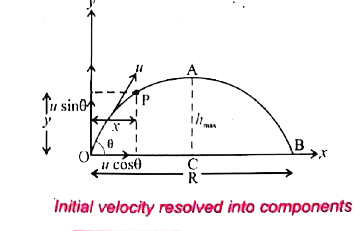
|
|
| 37. |
Can you give any situation where Gauss.s law cannot be helpful ? |
| Answer» SOLUTION :Consider an electric DIPOLE. The field does have axial SYMMETRY about the dipole axis but there is no SIMPLE surface over which normal componentof `bar E`is constant. So, practically it is difficult to apply Gauss.s law to such a system even though the law is valid in this SITUATION. | |
| 38. |
A projectile is fired with a pseed u atan angle theta above a hoerizontal fiedl. The coeffiient of restitution of collisiion between the projectile and the field is e. How far from the starting point does the projectile makes its second collision with the field? |
|
Answer» The ANGLE of prjection `=theta` Whentehprojectilehits the ground for the 1st time, The velocity would be the same i.e u Here the component of velocity paralel to ground `u costheta` should remain constant But teh verticla component of the PROJECTILE under goes. 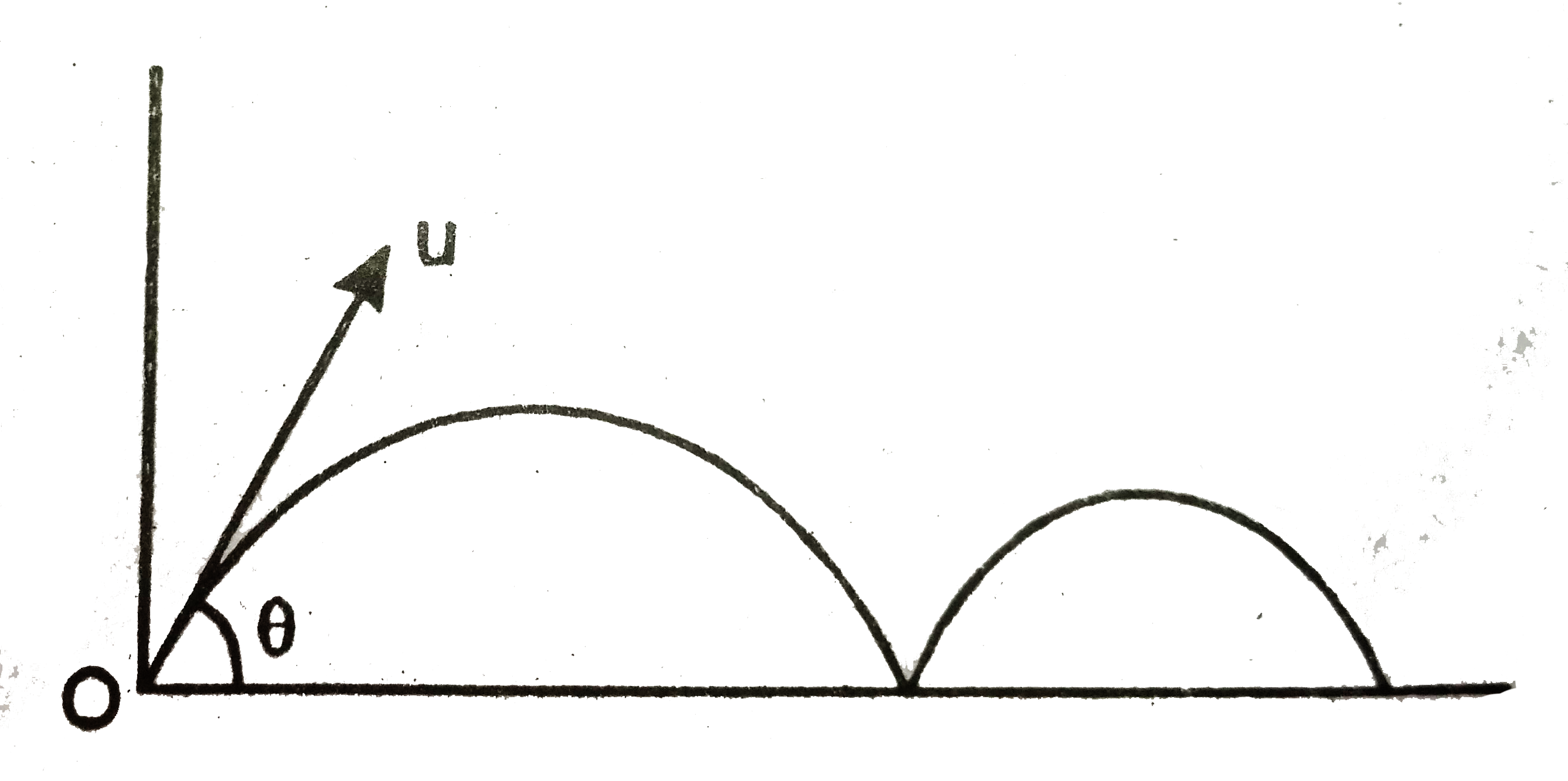 `rarr v=eusintheta` Now for the 2nd projectile motion. `u=velocity of projection `=sqrt((ucostheta)^2+(eusintheta)^2)` and Angle of projection `=alpha=tan^I-1((eusintheta)/(ucostheta))` `=tan^-1 (etantheta)` `or taN/Alpha=etantheta`..............2 Because `y=xtaN/Alphatan^-1(gx^2sec^2alpha)/(2u^2)`............e `Here y=0, taN/Alpha` `=etantheta` `sec^2alha=1+e^2tan^2theta` and `u^2=u^2cos^2theta+e^2u^2sin^2theta` putting the above VALUES in the equation 3 `xetantheta=(gxx^2(1+e^2tan^2theta))/(2u^2(cos^2theta+e^2sintheta))` or x=(2eu^2tantheta(cos^2theta+e^2sin^2theta))/(G(1+e^2tan^2theta))` `=(2eu^2tantheta.cos^2theta)/g` `(eu^2sin2theta)/g` `rarr So, from the starting point O it will fasll at a distance `(u^2sin2theta)/g+(eu^2.sin2theta)/g` `(u^2sin2theta)/g(1+e)` |
|
| 39. |
It is easier break a wooden bar by bending it as compared to pulling it. To break a rigid wooden bar a man holds the bar in his fists and then tries to twist his fists as shown in the figure. In the figure, b is width of his fists and l is the distance between places where he holds the bar. To break the bar most easily, the best strategy is to |
|
Answer» increase l and keep B unchanged |
|
| 40. |
What is the angle between frictional forceand isntantaneous velocity of a body moving over a rough surface |
| Answer» SOLUTION :forceof frictionalwaysopposethe relativemotion `=THETA = 180^(@)` | |
| 41. |
Calculate the period of oscillation of a block of mass 0.5 kg attached to a spring (spring constant 100Nm^(-1)) at one end. |
| Answer» SOLUTION :`T=2pi SQRT((m)/(K)).`i.e. `T=2xx3.142sqrt((0.5)/(100))=0.44s`. | |
| 42. |
A particle of mass 120g moving at speed of 750cm/s is acted upon by a variable forrenpposite to its direction of motion as shown in figure. If the velocity of the particle becomes 250cm/s along the direction of force, fund the value of time't' for which force acted. |
| Answer» Answer :C | |
| 43. |
A body projected up with a velocity of 39.2 m/s reaches a point in its path after t_(1)andt_(2) sec from start. Then (t_(1)+t_(2)) is |
|
Answer» 3 sec |
|
| 44. |
A steel wire of mass 3. l 6Kg is stretched to a tensile strain of 1 xx 10^(-3). The elastic deformation energy if density rho= 7.9g//cc and Y=2 xx 10^(11) N//m^(2) |
|
Answer» 4KJ |
|
| 45. |
A cannon is fixed with a smooth massive trolley car at an angle theta as shown in the figure.The trolley car slides from rest down the inclined plane of angle of inclination beta. The muzzle velocity of the shell fired at t=y_(0) from the cannon is u,such that the shell moves perpendicular to the inclined just after the firing. the difference in range of the shell relative to the trolley car and ground is: |
|
Answer» `(u^(2)sin 2theta)/(G COS BETA)` `t=(2U sin theta)/(g cos beta)` on SOLVING `X=(2U^(2) sin theta)/(g cos^(2) beta)cos(theta-beta)` |
|
| 46. |
A cannon is fixed with a smooth massive trolley car at an angle theta as shown in the figure.The trolley car slides from rest down the inclined plane of angle of inclination beta. The muzzle velocity of the shell fired at t=y_(0) from the cannon is u,such that the shell moves perpendicular to the inclined just after the firing. after what time should the shell be fired such that it will go vertically up? |
|
Answer» `(u cos theta)/(G SIN BETA)` `g sin beta cos betat=U cos (theta+beta),t=(U cos (theta+beta))/(g sin beta cos beta)` |
|
| 47. |
Why are wheels of automobile made circular |
| Answer» SOLUTION :Circularwheelsrool on the roadand rollingfrictioncomesintoplayduringthe motionofautomobile . Rollingfrictionis LESSTHAN theslidingfriction. It ISDUE tothisreason thatwheelsof automobilesare madecircular. | |
| 48. |
What is the coefficient of kinematic viscosity? Mention its units and dimensional formula . |
| Answer» Solution :The co-efficient of VISCOSITY per unit density of a LIQUID is called the co-efficient of kinematic viscosity and is given by `mu = (eta)/(rho)` . UNITS are `m^2 s^(-1) , DF : L^2 T^(-1)` | |
| 49. |
Simple pendulum attached to the ceiling of a stationary lift, has a time period T. If the lift moves upward with distance covered as y=(1m//s^2)t^2, the period of the pendulum will be take g = 10.0m//s^2) |
|
Answer» `0.6 T` |
|
| 50. |
Consider the pervious situation with V_(R) gt V_(bR) Let V_(R)=V_(1):V_(bR)=V_(2) For the drift (x- displacement to be minimum, the angletheta at which the person should swim from O is |
|
Answer» `sin^(-1) ((V_(BR))/(V_(R)))` |
|