

Saved Bookmarks
This section includes 7 InterviewSolutions, each offering curated multiple-choice questions to sharpen your Current Affairs knowledge and support exam preparation. Choose a topic below to get started.
| 1. |
A man wishes to estimate the distance of a nearby tower from him. He stands at a point A in front of the tower C and spots a very distant object in line with AC. He then walks perpendicular to AC up to B, a distance of 100 m, and looks at O and C again. Since O is very distant, the direction BO is practically the same as AO, but he finds the line of sight of C shifted from the original line of sight by an angle = 40^@ (thetais known as 'parallax') estimate the distance of the tower C from his original position A. |
|
Answer» Solution :Parallax angle `THETA = 40^(@) , AB = AC tan theta` `AC= AB // tan theta = 100m//tan 40^(@)` `= 100 m// 0.8391= 119 m`. |
|
| 2. |
A passenger in a Bus moving towards east, observes a man moving towards north. What is the actual direction of man w.r.t ground. |
|
Answer» Solution :Velocity of bus w.r.t ground `=OVERSET(VEC)V_(BG)` (east) Velocity of man w.r.t bus `=overset(vec)u_(MB)` (NORTH)  Velocity of man w.r.t ground `=overset(vec)V_(Mg)=?"":.` `overset(vec)V_(MB)=overset(vec)V_(Mg)-overset(vec)V_(Bg)""RARR overset(vec)C_(Mg)=overset(vec)V_(MB)+overset(vec)V_(Bg)` i.e. man is going toward North-East direction and at an angle of  `theta=tan^(-1)((|overset(vec)V_(MG)|)/(|overset(vec)V_(Bg)|))` w.r.t. east. |
|
| 3. |
velocity of B with respect to A |
|
Answer» Solution :VELOCITY of B with respect to A, `v_(BA) =v_B-v_A=-25-15=-40m//s` TOWARDS south |
|
| 4. |
A ball thrown horizontally with velocity v from the top of a tower of height h reaches the ground in t seconds. If another ball of double the mass is thrown horizontally with velocity 3v from the top of another tower of height 4h it reaches the ground in (seconds) |
|
Answer» 3t/4 |
|
| 5. |
Two wires are made of the same material and have the same volume. The area of cross sections of the first and the second wires are A and 2A respectively. If the length of the first wire is increased by Delta l on applying a force F, how much force is needed to stretch the second wire by the same amount ? |
|
Answer» 2 Length of wire 1 = l, AREA of wire 1 = A Length of wire 2 = `l/2`, Area of wire `2 = 2A` Wire 1 : `Y_1 = (F/A)/((Deltal)/(l)) "" Y_1 = Y_2"Wire" 2 : Y_2 = ((F.)/(A))/((Deltal)/((l//2)))` `F/A XX l/(Delta l) = (F.)/(2A) xx l/(2Delta l)` `F = (F.)/4 implies F. = 4F`. |
|
| 6. |
A capillary tube is lowered into a vessel with a liquid whose vapour pressure may be neglected. The density of the liquid is rho. The vessel and the tubes are in a vacuum under the bell of air pump (fig). Find the pressure inside the liquid in the capilary tube at a height h above the level of the liquid in the vessel |
|
Answer» `1.25 = (2T)/(rhog)[(2)/(0.1)-(2)/(0.2)]` `rho = (2 xx 49 xx 2)/(0.2 xx 980 xx 1.25)` `rho = (1)/(1.25) = 0.8 gm//cm^(3)` 
|
|
| 7. |
Discuss the variation of pressure with depth or pressure produced due to fluid depth h and density of fluid rho. |
Answer» Solution :Suppose a fluid of density `rho` is in a static equilibrium in a container as shown in figure. Consider a cylindrical element of fluid having area of base A and height H. The pressure at points 1 and 2 are `P_(1)andP_(2)` respectively. The force ACTING on liquid column is as below : (1) The forces on point `-1F_(1)=P_(1)A` (downward) (2) The force on point `-2F_(2)=P_(2)A` (upward) (3) Weight of fluid column `W=mgW=Ahrhog` (downward) Fluid column is in equilibrium hence downward forces = upward forces `F_(1)+W=F_(2)` `thereforeF_(2)-F_(1)=W` `thereforeP_(2)A-P_(1)A=Ahrhog`....(1) `thereforeP_(2)-P_(1)=hrhog` `thereforeP_(2)=P_(1)+hrhog` ...(2) Equation (1) shows that pressure difference depends on the vertical distance (h) between the points (1and 2),mass density of the fluid `(rho)` and acceleration due to gravity (g) but it does not depends on the area of cross SECTION. If the effect of gravitation is neglected `P_(2)-P_(1)=hrhog=0` `thereforeP_(2)=P_(1)` It indicates that if the effect of gravitationis neglected , the pressure at every point in fluid is same. Let there be point 1 on the surface of container. The pressure on the surface is atmospheric pressure `P_(a).P_(1)=P_(a)andP_(2)=PthereforeP-P_(a)=hrhogorP=P_(a)+hrhog` ... (3) Pis CALLED absolute pressure. Equation (3) shows that the pressure P at depth below the surface of liquid OPEN to the atmosphere is greater than atomspheric pressure by an amount `hrhog`. The excess of pressure , `P-P_(a)`, at depth h is called a gauge pressure at that point. |
|
| 8. |
A lift of mass 200 kg is ascending with an acceleration of 4 mcdot s^(-2). What is the tension on the lift cable? |
|
Answer» |
|
| 9. |
A small coin is kept on a horizontal platform. The platform is oscillating vertically with a time period of 0.5s. What should be the maximum amplitude of vibration so that the coin always remains in contact with the platform? |
|
Answer» Solution :The coin will always remain in CONTACT with the platform if the downward acceleration of the platform does not exceed the acceleration of the coin due to gravity. If A is the maximum amplitude of VIBRATION, then `OMEGA^(2)A=g` or, `A=g/omega^(2)=g/(((2pi)/T)^(2))=(gT^(2))/(4PI^(2))` = `(9.8xx(0.5)^(2))/(4xx(3.14)^(2))=0.06205m~~0.06m`. |
|
| 10. |
block of mass m slips down an inclined plane as shown in the figure. When it reaches the bottom it presses the spring by a length (spring length ltlth and spring constant = K) - (A) (2mgh/K)1/2 |
|
Answer» `(2mgh//K)^(1//2)` |
|
| 11. |
A parallel beam of molecules moving with velocity v impinges on a wall at an angle theta to its normal. Find the pressure exerted by the beam on the wall assuming perfect elastic collisions. The concentration of the molecules in the beam is n. |
|
Answer» |
|
| 12. |
Find angle alpha made by the vectors with the positive direction of X-axis |
Answer» 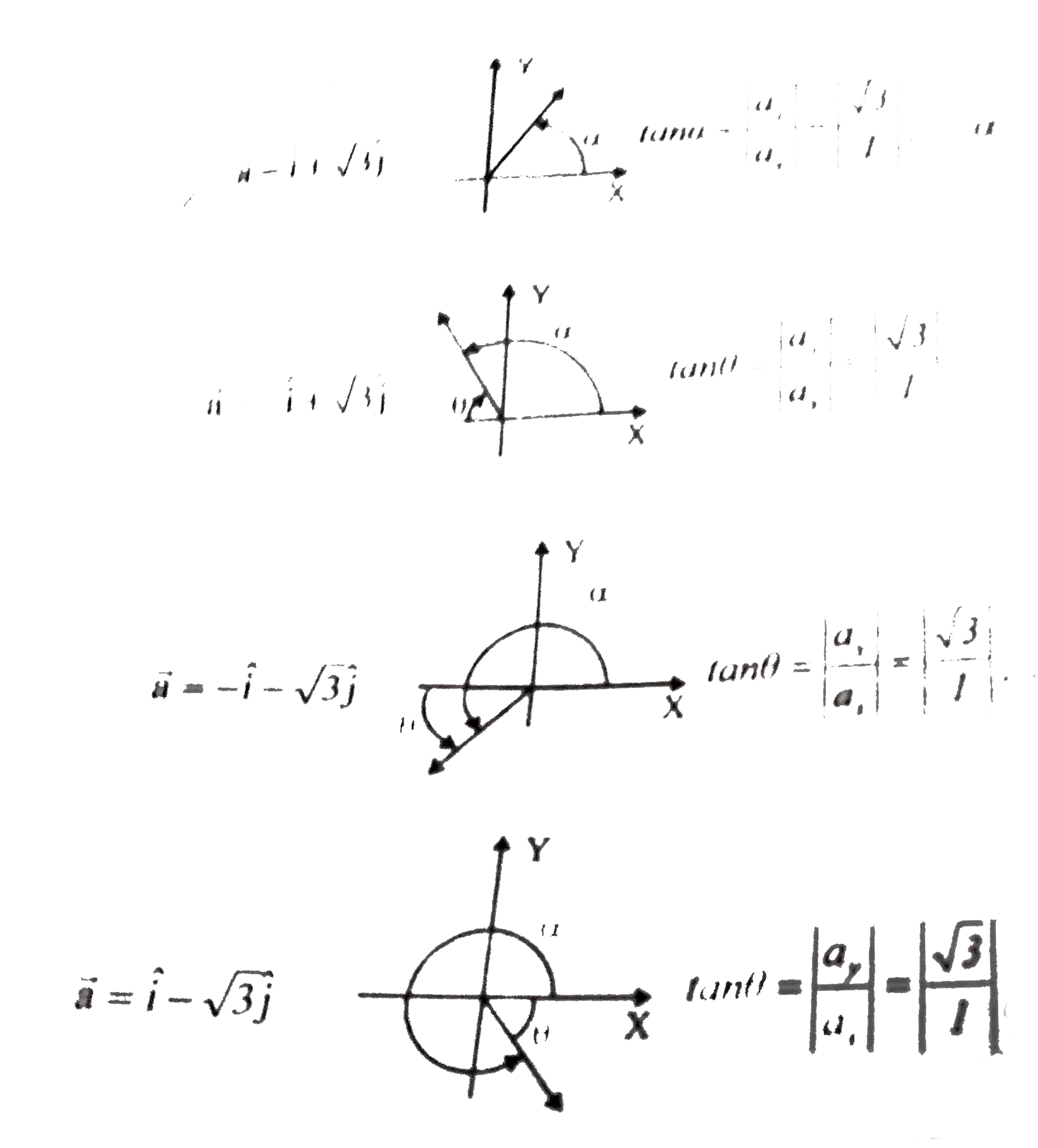
|
|
| 13. |
The bob A of pendulum of length 1 m released from 30^(@) to the vertical hits another bob B of same mass at rest on the table. How high does the bob A rise after the collision and find the velocity of B. |
|
Answer» Solution :The bob of pendulum acquires a VELOCITY `V=SQRT(2gl(1-cos theta))`, on reaching the LOWER most position and makes elastic collision with the bob B of same mass.  Hence the bodies simply EXCHANGE their velocities after collision. The bob of pendulum does not rise at all and velocity of B is `V = sqrt(2gl(1-cos theta))=1.62 ms^(-1)` |
|
| 14. |
The position of centre of mass of a system of particles does not depend upon |
|
Answer» masses of particles |
|
| 15. |
The volume of a gas is reduced adiabatically to 1/4of its volume at 27^@C , if the value of gamma = 1.4, thenthe new temperature will be |
|
Answer» `350 xx 4^(0.4)K` |
|
| 16. |
A uniform circular disc of radicu R lies in the XY -plane with its centre at the orgin of co-oridinate system. Its moment of inertia about an axis, lying in the xy-plane, parallel to the x-axis and passing through a point on the y-axis at a distance y - 2R is I_(1) . Its moment of inertia about an axis lying in a plane perpendicular to xy-plane passing through a point on the x-axis at a distance x - d is I_(2) . If I_(1)= I_(2)the value of .d. is: |
|
Answer» `sqrt(19)/2 R` |
|
| 17. |
Why a body weighs less at the equator than at the poles? |
|
Answer» SOLUTION :WEIGHT = MG At the poles `g_(p)gtg_(e)`, hence `mg_(p)gtmg_(e)`. |
|
| 18. |
Calculate the effective spring constant in each case and hence write the expression for period of oscillation. Ignore the masses of the spring. |
|
Answer» Solution :CASE (1) : `(1)/(K)=(1)/(k_(1))+(1)/(k_(2)+k_(3))+(1)/(k_(4))` `"i.e."(1)/(k)=((k_(2)+k_(3))k_(4)+k_(1)k_(4)+k_(1)k_(4)+k_(1)(k_(2)+k_(3)))/(k_(1)(k_(2)+k_(3))k_(4))` `"&period of oscillation "T=2pisqrt((m)/(k))` Case (II) : `(1)/(k_(eq))=(1)/(2k)+(1)/(k)+(1)/(3k)=(3+6+2)/(6k)=(11)/(6k)` `T.=2pisqrt((11m)/(6k))` |
|
| 19. |
A mass of 2 kg is suspended with thread AB. Thread CD of the same type is attached to the other end of 2 kg mass. (i) Lower end of the lower thread is pulled gradually, hander and hander is the downward direction so as to apply force on AB. Which of the thread will break & why? (ii) If the lower thread is pulled with a jerk, what happens? |
| Answer» SOLUTION : (i) Thread AB breaks down. (II) CD will break. | |
| 20. |
If the mass of a bob of a pendulum increased by 9 times, the period of pendulum will? |
| Answer» SOLUTION :Does not CHANGED. Because the value of period does not DEPEND on the mass. | |
| 21. |
Inter - molecular forces are |
|
Answer» SHORT range |
|
| 22. |
The speeds of air flow on the upper and lower surfaces of a wing of an aeroplane are v_(1) and v_(2) respectively, It A is the cross sectional area of the wind and rho is the densit of air, then the upward lift is |
|
Answer» `1//2rho A (V_(1)-V_(2))` |
|
| 23. |
A boat is contaiing leaves. When they are thrown into the water, the level of water in the lake |
|
Answer» REMAINS same |
|
| 24. |
The initial and final temperatures of a liquid in a container are observed to be 75.4 pm 0.5^(@)C and 56.8 pm 0.2^(@)C. Find the fall in the temperature of the liquid. |
|
Answer» Solution :`t_(1) = (56.4 PM 0.5)^(@)C , t_(2) = (56.8 pm 0.2)^(@)C` FALL in temperature = `(75.4 pm 0.5^(@)C) - (56.8 pm 0.2^(@)C)` `t = (18.6)^(@)C` |
|
| 25. |
A particle is released from a height S. At certain height its kinetic energy is three times its potential energy. The height and speed of the particle at that instant are respectively |
|
Answer» `S/4, (3gS)/(2)` `v^2 = 0 + 2g(S - x)""..(i)` or `v^2 = 2g(S - x)` potential energy at `B = mgx` `:. ` Kinetic energy = `3 xx "potential energy"` `:. 1/2 m xx 2 g (S - x) = 3 xx mgx` or `S - x = 3x " or " S = 4x " or " x = S/4` Putting this value of x in EQN. (i), we get `v^2= 2g (S - S/4) = (2g xx 3S)/(4) = (3gS)/(2) "or" v= sqrt((3gS)/(2))` Hence, `x = S/4` and `v = sqrt((3gS)/(2))` 
|
|
| 26. |
A block of mass m = 1 kg , moving on a horizontal surface with speed v_(i) = 2 ms^(-1) enters a rough patch ranging from v_(i) = 2 ms^(-1) enters a rough patch ranging from x = 0.10 m tox = 2.01m The retarding force F_(r ) on the block in this rangeis inversely proportional to x over this range , F_(r) =(-k)/x "for " 0.1 lt x lt 2.01 m = 0 " for " x lt 0.1 m and x gt 2.01where k 0.5 J .What is the final kinetic energy and speed v_(f) of the block as it crosses this patch ? |
| Answer» Solution :`K_(f) = 2.8 J , v_(f) = 2.37 ms^(-1)` | |
| 27. |
A cannon shell moving along straight line bursts into two parts.Just after the burst one part moves with momentum 40 Ns making an angle 30^(@) with the original line of motion. The minimum momentum of the other part of shell after the burst is (in Ns) |
|
Answer» `20sqrt(3)` |
|
| 28. |
The two thigh bones (femurs) each of cross - sectional area 10cm^(2) support the upper part of a human body of mass 40 kg . Estimate the average pressure sustained by the femurs. |
|
Answer» Solution :Total cross SECTIONAL are of the FEMURS is `A=2 TIMES 10^-4 m^2`. The force acting on them is F=40 kg wt =400n . This force is acting vertically down, and hence, NORMALLY on the femurs. That the average pressure is `P_(av)=F/A=2 times 10^ N m^-2` |
|
| 29. |
For square and rectangular objects center of mass lies at |
|
Answer» the POINT where the DIAGONALS meet |
|
| 30. |
A particle starts from the origin at t = 0s with a velocity cf 10.0hat(j)m//s and moves in the xy - olane with a constant acceleration of (8.0hat(i) + 2.0hat(j))ms^(-2). What time is the x-coordinate of the particle 16m ? |
|
Answer» t = 2s |
|
| 31. |
Two identical trains A and B move with equal speeds on parallel tracks along the equator. A moves from east to west and B, from west to east. Which train will exert greater force on the tracks? |
|
Answer» A |
|
| 32. |
A and B are two moving parallel to each other. If a ball is thrown vertically up from the train A, the path of the ball is |
|
Answer» parabola for an observer standing on the ground |
|
| 33. |
A long horzontal pipe is fitted with a piston of mass 10 kg which is connected to another mass 10.5 kg by a string passing over a frictionless pulley. A source of sound of frequency 512 Hz is placed in front of the piston. Initially the piston is almost in touch with the source and it moves away form the source when the hanging mass is released. Find the time/s when maximum sound is heard. Assume the string horizontal between pulley and piston. There is no friction. Velocity of sound = 340 m//s |
|
Answer» |
|
| 34. |
State and explain Charle's law. |
|
Answer» Solution :It states that if the pressure remains const, then the `V_(0)` of a `g_(n)` mass of a gas increases or decreases by `(1)/(273.15)` of its volume at `0^(@)C` for each `1^(@)C` rise or fall of temperature `V_(0)` - volume of the `g_(n)` mass of a gas at `0^(@)C` Accumulate to CHARLE's law, its volume at `1^(@)C` is `V_(1)=V_(0)+(V_(0))/(273.15)=V_(0)(1+(1)/(273.15))` Volume of the gas at `t^(@)C` `V_(t)=V_(0)(1+(t)/(273.15))` If `T_(0)` and T are temperature on kelven scale corresponding to `0^(@)C&t^(@)C`, then `T_(0)=273.15+0=273.15` `T=273.15+t` `THEREFORE V_(t)=V_(0)((T)/(T_(0)))or (V_(1))/(T)=(V_(0))/(T_(0))` `(V)/(T)` = constant i.e. `VpropT`. So, the law states that at constant pressure the volume of a `g_(n)` mass of a gas is directly PROPORTIONAL to its absolute temperature. The graph between V and T for a `g_(n)` mass of a gas at constant pressure is a STRAIGHT line. 
|
|
| 35. |
Find the power of an electric motor, if it lifts 200 kg of water in 5 minutes from a well of 120 m depth. |
|
Answer» Solution :MASS of water m = 200 KG Depth of well =HEIGHT lifted = 120 m Time `t = 5 XX 60` sec = 300 sec `power = ("Work done against gravitational force")/("time")` power = `(mgh)/(t)=(200xx9.8xx120)/(5xx60)=784W.` |
|
| 36. |
(i) For the wave on a string described iny(x,t)=0.06sin((2pi)/(3))xcos(120pit), . Do all the points on the string oscillate with the same (a) frequency , (b) phase , (c ) amplitude? Explain your answers. (ii) What is the amplitude of a point 0.375 m away from one end? |
| Answer» SOLUTION :(a) All the points except the nodes on the string have the same frequency and PHASE, but not the same AMPLITUDE. (B) 0.042m | |
| 37. |
A car is travelling at 30 km/ h in acircle of radius 60 m what is the minimum value of mu_(s)for the car to make the turn without skidding |
|
Answer» Solution :Given `v=(30 km)/(H ) = (30 xx 1000)/(3600)` `=(m)/(9s ) = (25)/(3) m//s` `r=60 m` `g=10` formulaMinimumvalue of `mu_(s)= (v^(2))/( r g)` `:., mu_(s)= (25)/(3) xx (25)/(3) xx (1)/(60 xx 10)` `mu_(s) = 0.115` |
|
| 38. |
A 76 cm long sonometer wire is stretched by a4 xx 10^(6)dyn force and an alternating current is passed through it . A horse-shoe magnet is placed at the mid-point of the wire in such a way that the wire passes between the poles of the magnet . Resonant vibration is observed due to the force acting on the wire in this arrangement.The densityofthe material of the wire is8 . 8 g* cm^(-3) and radius of the wire is 0 . 5 mm . Determine the frequency of the alternating current . |
|
Answer» |
|
| 39. |
A circular racetrack of radius 300 m is banked at an angle of 20^(@). If the coefficient of friction between the wheels of the race car and the road is 0.2, what is the approximate maximum permissible speed of the race car ? |
|
Answer» `88.2 MS^(-1)` `=sqrt(2940(0.608))` `=42 .28m//s` `=42.3m//s` |
|
| 40. |
A copper block of mass 2.5 kg ts heated in a furnace to a temperature of500 ^(@) C and then placed on a large ice block. What is the maximum amount of ice that can melt? (Specific heat of copper = 0.39 J g^(-1) K^(-1), "heat of fusion of water " = 335 J g^(-1)). |
| Answer» SOLUTION :`1.5 KG` | |
| 41. |
The direction of angular acceleration of a body moving in a circle in the plane of the paper is |
|
Answer» ALONG the tangent |
|
| 42. |
Amount of heat conducted through a metal rod is directly proportional to |
|
Answer» AREA of CROSS SECTION |
|
| 43. |
A solid sphere of radius 'r' is rolling on a horizontal surface. The ratio between the rotational kinetic energy and total energy |
|
Answer» `(5)/(7)` |
|
| 44. |
The length of a rod as measured in an experiment was found to be 2.48 m, 2.46 m, 2.49 m, 2.50 m and 2.48 m. Find the average length, absolute error and percentage error. Express the result with error limit. |
|
Answer» Solution :AVERAGE length `= (2.48+2.46+2.49+2.50+2.48)/(5) = (12.41)/(5) = 2.48` m Mean absolute ERROR `= (0.00+0.02+0.01+0.02+0.00)/(5) = (0.05)/(5) = 0.01` m Percentage error = `(0.01)/(2.48) XX 100% = 0.04 xx 100% = 0.40%` Correct length = `(2.48 PM 0.01)` m Correct length `= (2.48 m pm 0.40%)` |
|
| 45. |
Two iron blocks of masses 20 kg and 10 kg are kept adjacent on a smooth horizontal table. A force of 30 N is applied on the blocks such that, the system starts moving in the direction of the force. What force acts at the surface of contact of the blocks? |
|
Answer» |
|
| 46. |
If the radius of earth is reduced without changing the mass of earth then magnitude of g increases or decrease ? |
| Answer» SOLUTION :INCREASES | |
| 47. |
How does resolve a vector into its component? Explain. |
|
Answer» Solution :component of a resolve: In the Cartesian coordinate system any vector `vecA`can be resolved into three components along x, y and Z directions. This is shown in figure. CONSIDER a 3-dimensional coordinate system. With RESPECT to this a vector can be WRITTEN in component form as`vecA = A_x HATI + A_y hatj + A_z hatk` Components of a vector in 2 dimensions and 3 dimensions  Here Ax is the x-component of `vecA` , Ay is the y-component of `vecA` and `A_z` is the z component of `vecA` . In a 2-dimensional Cartesian coordinate system (which is shown in the figure) the vector A is given by `vecA = A_x hati + A_z hatj` If `vecA`makes an angle `theta`with x axis, and `A_x`and `A_y`are the components of `vecA`along x-axis and y-axis respectively, then as shown in figure,  where ‘A’ is the magnitude (length) of the vector `vecA, A = sqrt(A_x^2 + A_y^2)` |
|
| 48. |
In the Atwood's machine shown in Fig.m_1 = 7 kg and m_2 = 12 kg are connected at the two ends of a light inextensible string that goes over a frictionless pulley of radius 5 cm. When the system is released from rest the heavier mass is found to fall 1 m in 2 s. Calculate the moment of inertia of the pulley ? |
|
Answer» Solution :`m_(1) = 7 kg, m_(2) = 12 kg` Radius of the pulley `=r = 5cm = 0.05` m Moment of intertia of the pulley = l = ? Displacement of the block =s =1 m Time =t =2s LINEAR acceleration a= ? `s= ut+ 1/2 at^(2)` `a = (2s)/t^(2) (2 xx 1)/22 = 0.5 m//s^(2)` DECREASE in P.E. of the system = Increase in K.E. of the system `(m_(2)gs ~ m_(1)s) =1/2m_(1)v_(1)^(2) + 1/2m_(2)v^(2) + 1/2 I omega^(2)` `v_(1)^(2) = v_(2)^(2) =2 as` Final angular velocity of the pulley `omega = omega_(0) + alpha l =0 + a/r t` `m_(2)gs - m_(1)gs = 1/2 m_(1) xx 2as + 1/2 m_(2) xx 2as +1/2I xx (a^(2)t^(2))/r^(2)` `(m_(2)-m_(1))gs = (m_(1) + m_(2))as + (I a^(2)t^(2))/(2r^(2))` `I =[(m_(2) - m_(1))gs -(m_(1) + m_(2))as] =(2r^(2))/(a^(2)t^(2))` `=[(12-7)9.8 xx 1 -(12 + 7) xx 0.5 xx 1] xx (2 xx 0.0^(2))/(0.5^(2) xx 2^(2)) = 3.95 kg m^(2)` |
|
| 49. |
Explain this common observaion clearly. IF you look out of thej window of a fast moving train, the nearby trees, housees etc. seem to move rapidly in a direcion to the train's motion, but the distant objects (hill tops, the moon, the stars etc.) seem to be stationary. |
|
Answer» Solution :The line JOINING the object to the eye is called the line of sight. When a train moves rapidly, the line of sight of a near bytree changes its direction of motion rapidly. Therefor, the TREES appear to run in opposite direction. On the contrary, the line of sight of far off OBJECTS (hill tops, the moon, the STARS etc.) does not change its direction so much due to extremely large distance from the eye. HENCE, distant hill tops. moon, the stars etc. appear stationary. |
|
| 50. |
Mass of the earth is 81 times that of the moon . If the distance between their centers is d, then the point on the line joining their centers at which the gravitational field due to them is zero is |
|
Answer» `d/10` from the center of moon |
|