

Saved Bookmarks
This section includes 7 InterviewSolutions, each offering curated multiple-choice questions to sharpen your Current Affairs knowledge and support exam preparation. Choose a topic below to get started.
| 1. |
The temperature compensated pendulum is designed to compensate for the change in length due to temperature rise. Figure shows one such pendulum. It consists of an isosceles triangular frame as shown in the figure. The pendulum is supported at mid-point of side AB, and it remains horizontal. Determine the ratio (l_(1) //l_(2) )^(2), so that the length of the pendulum remains same at all temperatures. |
|
Answer» `(alpha_1)/( alpha_2)` |
|
| 2. |
Show with example how an accelerating body can have zero velocity. |
| Answer» Solution :A particle executing SHM has its velocity o at the position.of maximum DISPLACEMENT, although ACCELERATION acting on it at that moment is• a = - (k/m).R, where r is its AMPLITUDE of OSCILLATION | |
| 3. |
If the time period (T) of vibration and liquid drop depends on surface tension (S), radius ( of the drop and density (rho) of the liquid, then the cxpression of T is |
|
Answer» `T = K (SQRT(RHO r^3))/(S)` |
|
| 4. |
A liquid can easily change its shpae but a solid can not because |
|
Answer» the DENSITY of a liquid is SMALLER than that of a solid |
|
| 5. |
A gas is enclosed in a vessel of volume V at a pressure P. It is being pumped out of the vessel by means of a piston-pump with a stroke volume v. What is the final pressure in the vessel after n strokes of the pump ? Assume temperature remains constant. |
|
Answer» Solution :According to ideal gas equation PV = `mu` RT, at CONSTANT temperature for a given MASS, `PV=P^(1)V^(1)` Now as STROKE volume is VM during 1st stroke for constant mass (say m) volume changes from V to (V + v) and so if pressure changes from P to `P_(1)`, the above equation yields `PV=P_(1)(V+v)," i.e., "P_(1)=P[V/(V+v)]"....(1)"` After the FIRST stroke the gas left in the vessel has again volume V but at pressure `P_(1)` (with mass `m_(1) lt m`). Now the second stroke will take place from these initial conditions and if `P_(2)` is the pressure of the gas in the cylinder at the end of 2nd stroke, `P_(1)V=P_(2)(V+v), " i.e., "P_(2)=P_(1)[V/(V+v)]` Substituting the value of `P_(1)` fromequation (1) in the above `P_(2)=P[V/(V+v)]^(2)` Repeatingthe same for n stroks, the pressure of the gas in the vessel after `n^(th)`stroke will be, `P_(n)=P[V/(V+v)]^(n)=P[1/(1+(v//V))]^(n)`. 
|
|
| 6. |
A structural steel rod has a radius of 10 mm and a length of 1.0 m. A 100 KN force stretches it along its length. Calculate a stress, (b) elongation and (c) strain on the rod. Young's modulus of structural steel is2.0xx 10 ^(11) Nm^(-2). |
|
Answer» Solution :We assume that the ROD is held by a clamp at one end, and the force F is applied at the other end, parallel to the LENGTH of the rod. Then the stress on the rod is given by Stress `=(F)/(A)=(F)/(pir^(2))` `=(100xx10^(3)N)/(3.14xx(10^(-2)m)^(2))` `=3.18xx10^(8)" N m"^(-2)` The elongation, `Delta=((F//A)L)/(Y)` `=((3.18xx10^(8)" N m"^(-2))(1m))/(2xx10^(11)"N m"^(-2))` `=1.59xx10^(-3)` m `=1.59` mm The STRAIN is given by STR ain `=DeltaL//L` `(1.59xx10^(-3)m)//(1m)` `=1.59xx10^(-3)` `=0.16%` |
|
| 7. |
Ratio of the radius of a planet A to that of planet B is .r.. The ratio of accele-ration due to gravity on the surface of the two planets is x. The ratio of the escape velocities from the two planets is: |
|
Answer» `SQRT(RX)` |
|
| 8. |
A force barf=(hati-3hatj+2hatk)N moves a particle from bar r_(1)=2hati+7hatj+4hatk)m to (barr_(2)=(5hati+2hatj+8hatk)m. The work done by the force is |
|
Answer» 18J |
|
| 9. |
In a situation the contact force by a rough horizontal surface on a body placed on it has constant magnitude. If the angle between this force and the vertical is decreaed, the frictional force between the surface and the body will |
|
Answer» increase |
|
| 10. |
When are the displacement and velocity in the same direction in SHM? |
| Answer» SOLUTION :When a PARTICLE moves from mean position to EXTREME position,its DISPLACEMENT and velicity are in the same direction. | |
| 11. |
In a process on a system, the initial pressure and volume are equal to the final pressure and volume a) The initial temperature must be equal to the final temperature b) The initial internal energy must be equal to the final internal energy c) The net heat given to the system in the process must be zero |
|
Answer» Only a, B are CORRECT |
|
| 12. |
Statement A : When an iron sphere on the ground is heated its centre of mass rises slightlyStatement B : Centre of mass of system of particles depends on mass of the particles and their relative positions. |
|
Answer» only a is correct |
|
| 13. |
Two identical blocks A and B each of mass 2 kg move with velocities v _(1) = 10 m//sand v _(2) = 5m//salong a smooth horizontal plane. The block B has a spring, attached to its rear end of spring constant k = 500 N/m. Find the maximum compression undergone by the spring. |
Answer» Solution :At the instant of maximum compression, the velocities of the two vlocks are EQUAL. LET their common velocity be v.  Since no FORCE acts o the system horizontally, by the principle of conservation of momentum along hte horizontal direction. `m (10) + m (5) = mv + mv,` where m is the mass of each block` implies v = 7.5 m//s.` By conservation of total mechanical energy, INITIAL K.E.= Final K.E. + elastic P.E. of the spring. `1.2m (10) ^(2) + 1/2 m (5) ^(2) = 1/2 (m+m) v ^(2) + 1/2 kx _(0) ^(2) , 1/2 (2) (10) ^(2) + 1/2 (2) (5) ^(2) = 1/2 xx2 xx (7.5) ^(2) xx 2 + 1/2 xx 500 xx _(0) ^(2)` Solving for `x _(0),` we get `x_(0) = 0.22 m` |
|
| 14. |
The objective of a compound microscope is essentially |
|
Answer» A CONCAVE LENS of small LENGTH and small aperture |
|
| 15. |
What voltage must be applied to an electron microscope to produce electrons of lambda=1.0 Å |
|
Answer» 190 volt |
|
| 16. |
Five moles of Hydrogen initially at STP iscompressed adiabatically so that its temper ature becomes 673K. The increase in internal energy of the gas in Kilo Joules is (R-8.3j/mole-K, gamma = 1.4 for diatomic gas) |
|
Answer» 80.5 |
|
| 17. |
A glass capillary tube sealed at both ends is 100cm long. It lies horizontally with the middle 10cm containing mercury. The two ends of the tube which are equal in length contain air at 27^(@)C at a pressure of 76cm of Hg. Now the air column at one end of the tube is kept at 0^(@)C and the other end is maintained at 127^(@)C. Calculate the length of the air column which is at 0^(@)C and its pressure. (Neglect the change in volume of Hg and glass). |
|
Answer» Solution :`2L+10=100," "i.e., L=45cm""...(1)` Now when end A is cooled while B is heated, the Hg COLUMN will be displaced towards A until the pressures on two sides of it again becomes equal, i.e.,  `P_(1)=P_(2)=P""...(2)` Now applying gas EQUATION to the air enclosed in side A, `(45AP_(0))/300=((45-x)AP_(1))/273,` i.e., `P_(1)=(273xx45xxP_(0))/(300(45-x))""...(3)` while for air on side B, `(45AP_(0))/300=((45+x)AP_(2))/400`, i.e., `P_(2)=(400xx45xxP_(0))/(300(45+x))""...(4)` SUBSTITUTING the values of `P_(1)andP_(2)` from equation (3) and (4) in (2), we get `(273xx45xxP_(0))/(300xx(45-x))=(400xx45xxP_(0))/(300xx(45+x))` Which on solving gives `x=(127xx45)//673=8.49cm` SO the length of air column which is at `0^(@)C=45-8.49=36.51` cm and from equation (3) with `P_(0)=76cm` of Hg (given), `P_(1)=(273xx45xx76)/(300xx36.51)=85.25cm` of Hg |
|
| 18. |
Choose the correct option: |
|
Answer» MOMENTUM is conserved in x-direction |
|
| 19. |
At some instant, velocity and acceleration of a particle of mass 'm' in SHM are 'a' and 'b' respectively. If its angular frequency is omega, then its maximum K.E is |
|
Answer» `1/2 m [a^2 + (b^2)/(OMEGA)]` |
|
| 21. |
The initial speed of a body of mass 2.0 kg is 5.0 ms^(-1) a force fro 4s in the direction of motion of the body the force timegraph is shown in the diagram calculate the impulse of the forceand the finalspeed of the body |
|
Answer» SOLUTION :Givenmass = 2.0 KG Initialspeed =5.0 `ms^(-1)` 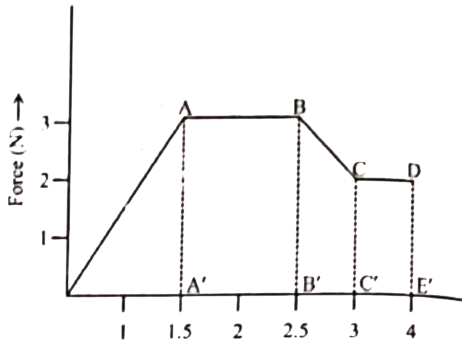 Formula IMPULSE of a force 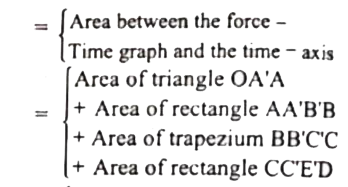 `=(1)/(2) xx 1.5 xx 3 + 1 xx 3 + (1)/(2)` `=(1)/(2) xx 4.5+ 3 + (1)/(2)xx 5 xx 0.5 +2` `=2.25 + 3+ 1.25 + 2= 8.50 Ns` As Impulse = changein momentum `=mDelta v` Changeinvelocity `Delta v = ("impulse")/( m ) = (8.50)/(2) ` Finalspeedof thebodyInitialspeed`+Delta v = 5.0+ 4.25 = 9.25 ms^(-1)` |
|
| 22. |
A particle describes a horizontal circle on the smooth surface of an inverted cone. The plane of that circle is at a height of 9.8cm above the vertex. Then the speed of the particle is |
|
Answer» `0.49 MS^(-1)` |
|
| 23. |
Find the weight of water supported by surface tension in a capillary tube with a radius of 0.2 mm. Surface tension of water of 0.072 Nm^(-1) and angle of contact of water is 0^(@). |
|
Answer» Solution :Assume the weight of water to be F weight of water in capillary TUBE = upward FORCE DUE to surface tension i.e. `F=2pir(SCOS theta)` Surface tension of water `S=0.072Nm^(-1)` Angle of contact`theta=0^(@)` Radius of capillary tube `(r)=0.2/1000m=0.2xx10^(-3)m` `F=2pir(Scos theta)=2xx22/7xx0.2xx10^(-30xx0.072xx1` `=90.51xx10^(-6)NimpliesF=90.51xx10^(-6)N` |
|
| 24. |
The function y = log (inftyt). The displacement y increases monotonically with time t, is it periodic function or non-periodic function. |
| Answer» SOLUTION :NON - PERIODIC FUNCTION. | |
| 25. |
An aluminimum rod 1.60 m long is held at its centre. It is stroked with a rosin - coated cloth to set up a longitudinal vibration. The speed of sound in thin rod of aluminium is 5100 m//s. (a) What is the fundamental frequency of the waves established in the rod ? (b) What harmonics are set up in the rod held in this manner ? (c ) What would be the fundamental frequency if the rod were copper , in which the speed of sound is 3650 m//s? |
|
Answer» Solution :Standing waves are important because any wave CONFINED to a restricted region of space will be reflected bak onto itself by the boundaries of the region . Then the travelling waves moving in opposite directions constitute a standing wave . The rod can sing a few HUNDRED hertz and at integer - multiple higher harmonics . The frequency will be proportionately lower with copper . We must identify where nodes and antinodes are used use the fact that antinodes are SEPARATEDBY half a wavelength with ` v = f lambda`. a. Since the central clamp established a node at the centre,the fundamental node of vibration will be ANA. Thus , the rod length is `L = d_(AA) = lambda//2`. Our first harmonic frequency is `f_(1) = (v)/( lambda_(1)) = (v)/( 2L) = ( 5100 m//s)/( 3.20 m) = 1.59 Hz` b. Since the rod is free at each end , the ends will be antinodes . The next vibration state will not have just one more node and one more antinode , reading ANANA, as shown in the diagram , with a wavelength and frequency of `lambda = (2 L)/( 3) and f = (v)/( lambda) = ( 3v)/( 2L) = 3 f_(1)` Since `f_(2) = 2f_(1)` was bypasses as having an antinode at the centre rather than the node required , we know that we get only odd harmonics . ` f = ( nv)/( 2L) = n ( 1.59 KHz)` for` n = 1 , 3 , 5 , ....` c. For a copper rod , the density is higher , so the speed of sound is lower , and the fundamental frequency is lower . ` f_(1)= (v) /( 2L) = ( 3560 m//s)/( 3.20 m) = 1.11 kHz` The second is not at just a few hertz , but is a sqeak or a squeal at over a THOUSAND hertz . Onlya few higher harmonics are in the audible range . Sound really moves fast in materials that are stiff against compression . For athin rod , it is young's modulus that determines the speed of a longittudinal wave . 
|
|
| 26. |
The energy required to accelerate a body from 30ms^(-1) to 60 ms^(-1) is three times the energy required to accelerate it from 10 ms^(-1) to .v.. The value of .v. is |
|
Answer» `30 MS^(-1)` |
|
| 27. |
Two parallerrail tracks run north south . Train A moves north with a speed of 54 km//h and train B moves south with a speed of 90 km/h. Whatis the |
|
Answer» SOLUTION :LET us CONSIDER south to NORTH direction to be positive. Here, `v_A =+54 km//h=15 m//s` `v_B=-90km//h=-25m//s` |
|
| 28. |
A satellite is an elliptic orbit around the earth with aphelion of 6R and perihelion of 2R wherer R = 6400 KM is the radius of the earth. Find the eccentricity of the orbit. |
|
Answer» SOLUTION :We know that Perigee `(r_p) = a (1-e)=2R ""....(1)` APOGEE `(r_a)=a(1+e)=6R ""....(2)` DIVIDING (1) and 2 we get eccentricity `(e) =1/2` |
|
| 29. |
A heat -proof envelope contains 100g of ice at 1^(@)C. It is compressed to 1200atm. Find the mass of the melted ice if the melting point of ice is lowered by 1^(@)C when the pressure is increased by 138 atm. (L of ice =336xx10^(3)Jkg^(-1) and specific heat capacity of ice =2100J kg^(-1) K^(-1)) |
|
Answer» |
|
| 30. |
In a thermodynamic process helium gas obeys the law TP^(-2//5) = constant. If temperature of2 moles of the gas is raised from T to 3T, then : |
|
Answer» HEAT given to the gas is 9RT |
|
| 31. |
Fundamental forces in nature have been classified as : Gravitational forces, weak forces, electromagnetic forces and nuclaer forces. Gravitational forces are weakest of all forces and nuclear forces are the stronges of all. Whereas gravitational forces operate over very long distance, the nuclear forces are confined only within the nucleus.Read the above passage and answer the following questions : (i) Which forces are central forces ? (ii) Which forces are non conservative forces ? (iii) What value of life do you learn from this study ? |
|
Answer» Solution :(i) Gravitational foces and electromagnetic FORCES are central forces. (ii) Weak forces and nuclear forces are NON conservative forces. (iii) We find that gravitational forces which are weakest have the longest range, and nuclear forces, which area strongest, have the shortest range. in DAY to day life, it implies that whenyou spend energy at a slow rate `(i.e., (dU)/(DR) = F ="small")`, you last longer `(i.e., "range is longer")`. And when you spend energy at a much faster rate `(i.e., (dU)/(dt) = F = "large")`, you become extinct much sooner `("i.e., over a short distance")`. it also implies that slow and steady wins the race. |
|
| 32. |
Define torque. State its units. |
|
Answer» Solution :Torque or MOMENT of FORCE about a point is defined as the product of the force and the perpendicular distance of the point of application of the force from that point. Torque=`vectau=vecrxxvecF` Torque is a vector quantity. It REPRESENTS the turning effect of force.Unit: N-m, Dimensional FORMULA:`ML^(2)T&(-2)` |
|
| 33. |
A locomotive of mass m starts moving so that its velocity varies as v= K sqrts, where K is a constant and 's' is the distance traversed. The total work done by all the forces acting on the locomotive during the first t second after the start of motion is |
|
Answer» `(1)/(2) mK^(4)t^(2)` |
|
| 34. |
Two capacitors C_(1) and C_(2) are charged to same potential V, but with opposite polarity as shown in the figure. The switches S_(1) and S_(2) are then closed |
|
Answer» Potential difference across TWO capacitors are same and is GIVEN by`((C_1 - C_(2)) V)/(C_(1) + C_(2))` |
|
| 35. |
findthe resultantoftwoforceseachhavingmagnitudeF_0and anglebetweenthemistheta . |
|
Answer» Solution :`F_("Resultant")^(2)=F_(0)^(2)+F_(0)^(2)+2F_(0)^(2) cos theta=2F_(0)^(2)(1+costheta)=2F_(0)^(2)(1+2"cos"^(2)( theta)/2-1)=F_(0)^(2)xx2"cos"^(2)(theta)/2` `F_("resultant")=2F_(0)"cos" (theta)/2` |
|
| 36. |
A ball thrown up from the ground reaches a maximum height of 20m Find : Its initial velocity, the time taken to reach the highest point,its velocity just before hitting the ground ,its displacement between 0.5s"and"2.5s, time when displacement is 15m |
|
Answer» Solution :Using `v^(2)=U^(2)+2as ` for upward MOTION , we get `0^(2)=u^(2)+2(-G)(+20) rArr u=19.8m//s`. `t=((v-u))/a=(0-19.8)/(-9.8)=2.02s` For the complete up - down trip. `v^(2)=u^(2)+2a(0)rArr v^(2)u^(2)rArrv=-u=-19.8m//s` Height at `t=0.5s "is" y_(1)=19.8(0.5)-4.9(0.5)^(2)=8.68m`. Height at `t=2.5s "is " y_(2)=19.8(2.5)-4.9(2.5)^(2)=18.9m` `:.` Displacement `=y_(2)-y_(1)` `=18.9m-8.68m=+10.2m`. `15=19.8t-4.91t^(2)rArrt=1.01s, 3.03s.` at `t=1.01s.` BALL is GOING up and at `t=3.03s,` it is coming down . |
|
| 37. |
Two similar iron and copper strips are riveted together at 20^(@)C. What will be the nature of curvature of this bimetallic strip at 0^(@)C and 100^(@)C? (coefficient of linear expansion of copper is more than that iron) |
|
Answer» at both the temperatures the COPPER plate will be on the convex side |
|
| 38. |
Two boys weighting 25kg and 35kg sit on either end of a light pole. Find the point about which the pole remains horizontal if the pole is 6m long. (march-2006 North) |
Answer» Solution : `F_1bar(AO)=F_2bar(BO)` `25xxcancel(9.8)(6-x)=35xxcancel(9.8)(x)` `150-25x=35x` `150=60x` `x=((150)/(60))=2.5m` Fulcrum should be at 2.5m AWAY from 'B' |
|
| 39. |
One vertex of a parallelopiped is at the point (1, -1, -2) of rectangular cartesian coordinates. If three adjacent vertices are at (0, 1, 3), (3, 0 -1) and (1, 4, 1) the volume of the parallelopiped is |
|
Answer» 400 unit |
|
| 40. |
The radii of two drops of the same liquid are in the ratio 3:2. Their terminal velocities are in the ratio |
|
Answer» 9:4 |
|
| 41. |
When a system is taken from state I to a state f along path iaf, Q=50J and W=20J. Along path fbi, Q=35J. If w=-13J for the return path fi, Q for this path is |
| Answer» ANSWER :D | |
| 42. |
An object is moving with a uniform acceleration which is parallel to its instantaneous direction of motion. The displacement velocity (v) graph of this object is |
|
Answer»
|
|
| 43. |
One mole of oxygen gas in made to undergo a process in which its molar heat capacity C depends on its absolute temperature T as C = alpha T (where alphais a positive constant). Work done by it when heatedform an initial temperature T_0 to a final temperature 2T_0, will be (3 alpha T_0 - x R)(T_0)/(2)then find x = ? |
|
Answer» |
|
| 44. |
The speed v of a particle moving along a straight line, when it is at a distance (x) from a fixed point on the line, is given by v^2 = 144-9x^2. |
|
Answer» Displacement of the particle distance moved by it. |
|
| 45. |
(A) : The path followed by one projectile as observed by another projectile is a straight line in uniform gravitation field. ( R) : The relative velocity between two projectiles at a given place doesn.t change with time. Because their relative acceleration is zero. |
|
Answer» Both (A) and ( R) are TURE and ( R) is the CORRECT EXPLANATION of (A) |
|
| 46. |
The planet Mars has two moons . Phobos and delmos. (i) phobos has a period 7 hours , 39 minutes and an orbital radius of 9.4xx10^3 km . Calculate the mass . (ii) Assume that earth and mars move in circular orbits around the sun. with the martian orbit being 1.52 times the orbital radius of the earth. What is the length of the martian year in days? |
|
Answer» Solution :i) We know that `T^(2)=(4pi^2)/(GM_m)R^3` `M_(m)=(4pi^2)/G (R^3)/T^2 = (4xx(3.14)^(2)xx(9.4)^3xx10^(8))/(6.67xx10^(-11)xx(459xx60)^2)` `M_(m) =(4xx(3.14)^2(9.4)^(3)xx10^(18))/(6.67xx(4.59xx6)^(2)xx10^(-5))=6.48 xx10^(23)kg`. (II) According to Kepler.s third law `T_M^2/T_E^2=(R_(MS)^3)/(R_(ES)^3)` where `R_(MS)`is the mars - SUN distance `R_(ES)` is the earth - sun distance. `:. T_(M) = (1.52)^(3//2) xx365 = 684` days |
|
| 47. |
The acceleration due to gravity on moon is only one sixth that on earth. Ratio of moon radius (R_m)to earth.s radius (R_e)should be: a) 6/1 if bothare assumed to have same density b) 1/6 if both are assumed to have same density c) 5//18 if rho_e/rho_m is given as 5/3 d) 9//5 if rho_m/rho_e is given as 3//5 |
|
Answer» only a & B are TRUE |
|
| 48. |
A block of Ag of mass x kg hanging from a string is immersed in a liquid of relative density 0.72. If the relative density of Ag is 10 and tension in the string is 37.12 N then compute the mass of Ag block. |
|
Answer» Solution :From the terminal velocity condition, `F_G - U= F "" F = T , m = X` `MG - mg ((rho_w)/(rho)) = T` `mg[1 - (0.72)/10] = 37.12` `9.8x [1 - 0.072] = 37.12` `9.0944 x = 37.12` `x = 4KG` |
|
| 49. |
A 3 cm long copper wireis stretchedto increase its length by 0.3 cm. findthe lateralstrainin the wire, if the Poisson.s ratio for copper is 0.26. |
|
Answer» Solution : L = 3cm, `DELTA L = 0.3cm, SIGMA= 0.26`. Longitudinal STRAIN `(DELTAL)/(L) = (0.3)/(3) = 0.1` `sigma ` =Lateral Strain /Longitudinal Strain The Lateral Strain ` = sigma xx `Longitudinal Strain `= 0.26 xx 0.1 = 0.026` |
|
| 50. |
A bullet of mass 10xx10^(-3)kgmoving with a speed of 20ms^(-1)hits an ice block (0^@C)of 990g kept at rest on a frictionless floor and gets embedded in it. If ice takes 50% of K.E, the amount of ice melted (in grams) approximately is (J = 4.2J/cal) (Latent heat of ice = 80cal/g) |
| Answer» ANSWER :D | |


