

Saved Bookmarks
This section includes 7 InterviewSolutions, each offering curated multiple-choice questions to sharpen your Current Affairs knowledge and support exam preparation. Choose a topic below to get started.
| 1. |
Statement A : Position of C.M depends on acceleration due to gravity where as position of C.G independent on aceeleration due to gravity.Statement B : Centre of gravity of a body is defined to know the amount of stability of the body and the center of mass of the body is defined to describe the nature of motion of the body. |
|
Answer» a is TRUE, B is FALSE |
|
| 2. |
When the potential energy of a particle executing simple harmonic motion is one-fourth of its maximum value during the oscillation, the displacement of the particle from the equilibrium position in terms of its amplitude a is……………… |
|
Answer» `(a)/(4)` |
|
| 3. |
A gas mixture consists of 2 moles of O_2 and 4 moles of Ar at temperature T. Neglecting all vibrational modes, the total internal energy of the system is : |
|
Answer» 9 RT `U_(O_2)=(n_1f_1)/2RT=2xx5/2xxRT` `U_(O_2)=5RT.` The internal energy of 4 moles of Ar atom is `U_(Ar)=(n_2f_2RT)/2=4xx3/2xxRT` `:.` The TOTAL internal energy of the SYSTEM is `U= U_(O_2)+U_(Ar)` `= 5 RT + 6RT = 11 RT.` |
|
| 4. |
A car Ais travelling on a straight level road with a uniform speed of 60km hr^(-1) . It is followed by another car B which is moving with a speed of 70km hr^(-1). When the distance between them is 2.5km., the car B is given a deceleration of 20 km hr^(-2) . After what distance and time will B catch up with A ? |
|
Answer» Solution :SUPPOSE the CAR B catches up the car A in t hours. the distance travelled by the car A moving with a velocity of `60km HR^(-1) ` in time t hours is given by , `S_(1)=60T km` For motion of car B The distance travelled by the car B moving with an intrial velocity `u=70km hr^(-1)` anddecelerated at the rate of `20km hr^(-2)` in time t hour is given by, `S_(2)=ut+at1/2at^(2)=70t+1/2(-20)t^(2),S_(2)=70t-10t^(2)"(or)But" S_(2)-S_(1)=2.5km` `:. 70t-10t^(2)-60t=2.5` i.e., `10t^(2)-10t+2.5=0"or"4t^(2)-4t+1=0 "(or)" (2t-l)^(2)=0`i.e.,`2t-l=0, t=1//2=0.5 hr^(-1)` using relative velocity concept, `u=70-60=10km hr^(-1), v=60-60=0,a=-20km hr^(-1)` `t=(v-u)/a=(0-10)/(-20)=0.5 hr^(-1), ` Since `S_(2)=70t-10t^(2)` Putting value of t, we GET , `S_(2)=70xx0.5-10xx(0.5)^(2)=35-3.5:. S_(2)=32.5km` |
|
| 5. |
The resultant of two vectors vecP and vecQ is vecR. If the magnitude of vecQ is doubled, the new resultant becomes perpendicular to vecP, then the magnitude of vecR is |
|
Answer» <P>`(P^(2) - Q)/(2PQ)` |
|
| 6. |
A body covers 100cm in first 2 seconds and 128cm in the next four seconds moving with constant acceleration. Find the velocity of the body at the end of 8 sec? |
|
Answer» Solution :In first 2 seconds `100=2u+(1)/(2)a.4……(1)` In first 6 seconds `228=6u+(1)/(2)a.36rarr(2)` `(1)xx3-(2)" gives "72=-12a` `a=-6cm//s^(2)......(3)` `100=2u-(1)/(2)xx6xx4` `2u=112` `u=56cm//s......(4)` Now VELOCITY of body at the end of 8 SEC is `V=u+at=56-6xx8` `THEREFORE V=8cm//s`. |
|
| 7. |
A screen is placed at a distance 40cm away from an illuminated object. A converging lens is placed between the source and the screen and it is attempted to form the image of the source on the screen. IF no position could be found, the focal length of the lens |
|
Answer» MUST be LESS than 10cm |
|
| 8. |
The orbital velocity of an artificial in a circular orbit justabove the earth's surface v. For a satellite orbiting at an altitude of half the earth's radius the orbital velocity is |
|
Answer» `(3)/(2)` v `(v_(2))/(v_(1))=sqrt((r_(1))/(r_(2)))` `:. v_(2)=sqrt((r_(1))/(r_(2))).v=sqrt((R)/(R+(R)/(2))).v=sqrt((2)/(3))v`. |
|
| 9. |
A refrigerator works between 4^(@)C and 30^(@)C. It is required to remove 600 calories of heat every second in order to keep the temperature of the refrigeratord space constant. The power required is (take 1 cal=4.2 Joule) |
|
Answer» 2.365 W |
|
| 10. |
A bomb of mass 9 kg explodes into two pieces of masses 3 kg and 6 kg. The velocity of mass 3 kg is 16 m s^(-1). The kinetic energy of mass 6 kg in joule is |
|
Answer» 96 `0 = m_1 v_1+ m_2v_2 " or " m_2v_2 = -m_1v_1` Taking only the magnitude, `m_2v_2 = m_1v_1` `:. K_2 = 1/2 m_2v_2^2 = 1/2 (m_2^2 v_2^2)/(m_2) = (m_1^2 v_1^2)/(2m_2) "(Using (i))"` `= ((3)^2 xx (16)^2)/(2 xx 6) = 192 J` |
|
| 11. |
When two displacements represented by y_(1)= a sin(omega t)" and "y_(2)= b cos (omega t) are superimposed the motion is……. |
|
Answer» not a simple harmonic motion. Amplitude `A= sqrt(A_(1)^(2)+A_(2)^(2)+2A_(1)A_(2) cos phi)` Here, `A_(1)= a, A_(2)= b" and "cos phi = (pi)/(2)` `therefore A= sqrt(a^(2)+b^(2)+2ab cos (pi)/(2))` `therefore A= sqrt(a^(2)+b^(2))""[therefore cos (pi)/(2)=0]`. |
|
| 12. |
A gas bubble of radius 1 cm rises at a constant rate of 3 mm/s through a solution of density 4.16 g/cm""^(3). Determine the coefficient of viscosity of the solution. Neglect the density of the gas. |
|
Answer» Solution :Given, r=1 cm, v=-3 mm/s =-0.3 cm/s (TAKING downward direction as positive) Terminal velocity is given by) `v=2/9 r^(2)/ETA (p-p.)g` `rArr eta=2/9 r^(2)/v (p-p.) g` `=(2 xx (1)^(2) xx (0-2.15) xx 980)/(9 xx (-0.3))` =1560.74 poise |
|
| 13. |
Two rods, one of iron and another of aluminium of equal length and equal cross-sections are connected with each other. The free end of the iron rod is kept at 100" "^(@)C and the free end of aluminium rod is kept at 0" "^(@)C. If thermal conductivity of aluminium is four times that of iron, find the temperature of their contact surface in the thermal steady state. |
|
Answer» Solution :`((DQ)/(dt))_(Fe)=((dQ)/(dt))_(Al)` `:.(KA[100-T_(x)])/(L)=(4KA[T_(x)-0])/(L)` `:.100-T_(x)=4T_(x)` `:.5T_(x)=100` `:.T_(x)=20" "^(@)C` |
|
| 14. |
A steel sphere of mass 100gm moving with a velocity of 4m/s collides with a dust particle elastically moving in the same direction with a velocity of 1m/s. The velocity of the dust particle after the collision is (dust partical is of mass neglisiable |
|
Answer» 8m/s |
|
| 15. |
What is elasticity ? |
| Answer» Solution :The property of a deformed BODY by VIRTUE of which it regains its original STATE when the deforming force is removed is CALLED elasticity . | |
| 16. |
One mole of an ideal gas is taken from state A to state B as shown in the V-T diagram (Fig) Which of the following is true? The gas pressure: |
|
Answer» CONTINUOUSLY increases |
|
| 17. |
A shell flying with velocity v= 500 m/s bursts into three identical fragments so that kinetic energy of the system increases 1.5 times. What maximum velocity can one ofthe fragments obtain ? |
|
Answer» |
|
| 18. |
The distance of the eye lens from the retina is x. For a normal eye, the maximum focal length of the eye lens |
| Answer» ANSWER :A | |
| 19. |
A solid sphere is moving and it makes an elastic collision with another stationary sphere of half of its own radius. After collision it comes to rest. The ratio of the densities of the materials of second sphere and first sphere is |
|
Answer» 2 |
|
| 20. |
State whether the values of Young's moduli for thin and thick iron wires of equal length will be different. |
| Answer» Solution :YOUNG. moduli of TWO IRON wires of the same LENGTH but of different thickness cannot be different because it depends only on the material of the wire. | |
| 21. |
A hot liquid is kept in a big room. Its temperature is plotted as a function of time. Which of the following curves may present the plot ? |
|
Answer» a 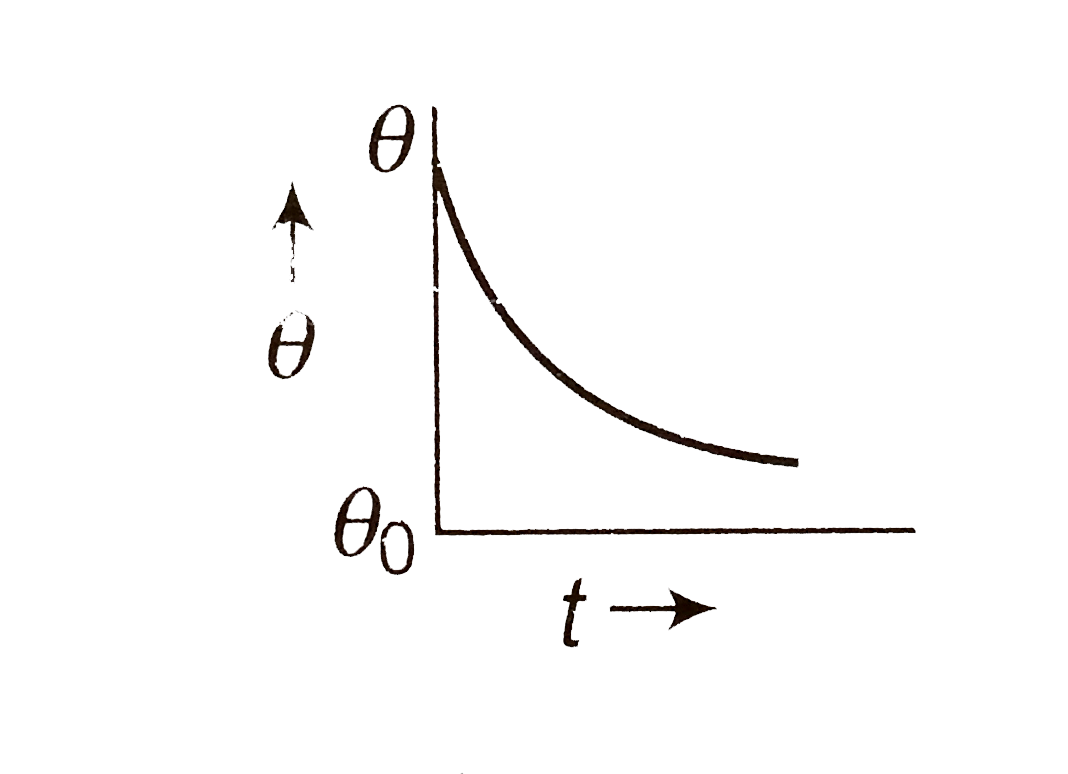
|
|
| 22. |
The resultant of two vectors vec(A) & vec(B) is vec(C). If direction of vec(B) is reversed the resultant is vec(D). Then which of the following is true ? |
|
Answer» `C^(2) + D^(2) = A^(2) + B^(2)` |
|
| 23. |
A disc of mass radius R lies in the x-y plane with its centre at a distance a from the origin on the x-axis. Which of the following statements are correct ? |
|
Answer» M.I. of the disc about x-axis `"MR"^(2)//4` |
|
| 24. |
The distance travelled by a particle in n^(th) second is S_n =u+a/2 (2n-1) where u is the velocity and a is the acceleration. The equation is |
|
Answer» dimensionally true |
|
| 25. |
The quantity of heat which can rise the temperature of x gm of a substance through t_(1),""^(@)C can rise the temperature of y gm of water through t_(2),""^(@)C is same. The ratio of specific |
|
Answer» `yt_(1)//xt_(2)` |
|
| 26. |
Obtain an expression for the apparent frequency of sound for a sourcemoving away and towards a stationary observer. |
|
Answer» Solution :Let `S_(1)` be the position of the source at t= 0. Let L be the distance `b//w`the observed and the source at S, Let v be the velocity of sound in air. Time taken for sound ( say crest ) to REACH the observer `t_(1) =( L)/( v)`......(1) Let the source travel further from` S_(1) `,and OCCUPY the position `S_(2)` AWAY from a stationary observer. distance `S_(1)S_(2) = v_(s) T_(0)` For a crest at `S_(2)` to reach the observer, it takes the time `t_(2) = T_(0) + (L+v_(s) T_(0))/( v)`....(2) At time nT, the source emits its `(n+1)^(TH)` crest and this reaches the observer at time. `t_(n+1) = n T_(0) + ( L+ v_(s) ( nT_(0)))/(v_(0))` Time of observation of n crests by an observer will be nT. `nT = ( nT_(0) + ( L + nv_(s) T_(0))/(v))-((L)/( v))` Time for I crest = `( nT_(0) + ( Lnv_(s) T_(0))/( v) - ( L)/( v)) + n ` `T = ( nvT_(0)+L+nv_(s) T_(0)-L)/(nv)` i.e, `T= T_(0)+ (v_(s) T_(0))/( v)` 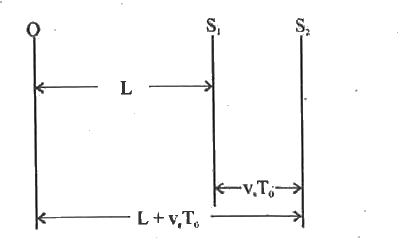 or `T = T_(0) ((v+ v_(s))/(v))` Apparent frequency of soundheard by a stationary observer for a source of sound moving away from him. `f =f_(0)((v)/(v+v_(s)))` and apparent wavelength `lambda =( v+ v_(s))/(f_(0))` , change ( increase ) in wavelength. `Deltalambda = ( v+ v_(s))/( f_(0))- ( v)/(f_(0)) = ((1)/( f_(0))) ( v+ v_(s)-v)= (v_(s)) /(f_(0))` Percentage increase in `lambda = ( Delta lambda)/( lambda ) xx 100 = ( v_(s))/( f_(0) lambda)xx100` For a source moving TOWARDS the observer , change `v_(s)` to `- v_(s)` Then `f= f_(0) ((v)/(v-v_(s)))` Apparentwavelength `=( v- v_(s))/( f_(0))`, here `lambda lt lambda_(0)` |
|
| 27. |
The radius of curvature of a railway line at a place when the train is moving with a speed of 36kmh^(-1) is 1000m, the distance between the two rails being 1.5m. The elevation of the outer rail above the inner rail is |
|
Answer» `1.5 //98` |
|
| 28. |
A steel wire of cross section 1 mm2 is heated at 60^(@) C and tied between two ends family. Calculate change in tension when temperature becomes 30^(@) C coefficient of linear expansion for steel is alpha = 1.1 xx 10 ^(-5) "”^(@)C ^(-1), Y =2 xx 10 ^(11) Pa.(Change in length of wire due to change in temperature (Delta t) is Delta l= alpha l Delta t) |
|
Answer» Solution :Here `A = 1 mm ^(2) = 10 ^(-6) m ^(2)` `theta _(1) = 60 ""^(@)C, theta _(2) = 30 ""^(@) C` `therefore Delta theta = 60-30 = 30 "^(@)C` `therefore ALPHA = 1.1 xx 10 ^(-5) ""^(@)C ^(-1)` `therefore Y = 2 xx 10 ^(11) PA` here TEMPERATURE change `= Delta theta` Due to `Delta theta` change in temperature chang ein length of wire `(Delta l)/(l) = alpha xx Delta theta ` `=1.1 xx 10 ^(-5) xx 30 ^(@)` `= 3.3 xx 10 ^(-4)` Now Young.s Modulus `Y=(A )/(( Delta l )/( l ))` `therefore F = ( YA Delta l )/(l )= 2 xx 10 ^(11) xx 10 ^(-6) xx 3.3 xx 10 ^(-4)` `=6.6 xx 10 ^(1) ` `therefore F = 66 N` |
|
| 29. |
A spring of force constant k is cut into two parts such that length of one part is double to another part. What will be the force constant of larger part? |
|
Answer» `(2)/(3)k` `therefore k propto (1)/(l)` `therefore kl = 1"""…….."(1)` Given that `l_(1)= 2l_(2)` and `l= l_(1)+l_(2)` `=2l_(2)+l_(2)` `l= 3l_(2)` and `l= l_(1)+(l_1)/(2)= (3l_1)/(2)"""........."(2)` Now, `k_(1)l_(1)= k_(2)l_(2) = kl` `therefore k_(1)l_(1) = kl` `k_(1)l_(1)= k xx (3l_1)/(2)` [From equation (1)] `therefore k_(1)= (3)/(2)k`. |
|
| 30. |
A man of 50 kg is standing at one end on a boat of length 25m and mass 200 kg. If he starts running and when he reaches the other end, has a velocity 2ms^(-1) with respect to the boat. The final velocity of the boat is |
|
Answer» `(2)/(3)ms^(-1)` |
|
| 31. |
Angle (in rad) made by the vector sqrt(3)hat(i) + hat(j) with the x-axis is |
|
Answer» `pi//6` |
|
| 32. |
The average density and time period of a planet are rho and T. A satellite is revolving just above the surface of planet. If the universal gravitational constant is G, then T^(2) is equal to |
|
Answer» `(3pi)/(G RHO)` `T = (2PI R)/(v_(0)) = (2pi R)/(sqrt((GM)/(R )))` `= 2pi sqrt((R^(3))/(GM)) = 2pi sqrt((R^(3))/(G.(4)/(3)pi R^(3) rho))` `T^(2) = 4pi^(2)(3)/(G xx 4 pi rho)` `T^(2) = (3pi)/(G rho)` |
|
| 33. |
What is doppler effect ? Write its example and how its analysis can be done ? |
|
Answer» Solution :It is an everyday experience that the pitch (or frequency) of the whistle of a fast moving train decreases as it recedes away. When we approach a stationary source of sound with high speed, the pitch of the sound heard appears to be higher than that of the source. As the observer recedes away from the source, the observed pitch (or frequency) becomes lower than that of the source. This motion-related frequency change is called Doppler EFFECT. The AUSTRIAN physicist Johann CHRISTIAN Doppler first proposed the effect in 1842. Buys Ballot in Holland tested it experimentally in 1845. Doppler effect is a wave phenomenon, it holds not only for sound WAVES but also for electromagnetic waves. However, here we shall consider only sound waves. We shall analyses changes in frequency under three different situations : (1) Observer is stationary but the source is moving (2) Observer is moving but the source is stationary and (3) both the observer and the source are moving. |
|
| 34. |
A particle of mass m executes SHM with amplitude 'a' and frequency 'v'. The average kinetic energy during motion from the position of equilibrium to the end is: |
|
Answer» `2pi^(2)ma^(2)V^(2)` |
|
| 35. |
Arrive at Einstein's mass-energy relation by dimensional method (E = mc^(2)). |
|
Answer» Solution :Let us assume that the Energy E depends on mass m and velocity of light c. `E prop m^(a)c^(B)` `E = km^(a)c^(b)` where k is a constant Dimensions of E = `[ML^(2)T^(-2)]` Dimensions of m = [M] Dimensions of c = `[LT^(-1)]` Substituting the values in the above EQUATION `[ML^(2)T^(-2)] = K[M]^(a)[LT^(-1)]^(b)` By EQUATING the dimensions a = 1 , b = 2 -b = -2 `E = k.mc^(2)` The value of constant k = 1 `E = mc^(2)`. This is Einstein.s mass energy relation. |
|
| 36. |
The center of mass for a uniform rod of mass M and length (1)/(2) i.e., 0.5 l lies at the |
|
Answer» l |
|
| 37. |
Statement I: If V-T graph is rectangular hyperbola,with increase in T, volume will decrease and hence,pressure will increase Statement II: IF V-T graph is rectangular hyperbola,with increase in T,volume will decrease and hence,pressure will increase. |
|
Answer» STATEMENT I is TRUE,statement II is true,statement II is a correct EXPLANATION for statement I |
|
| 38. |
The P-V curves in two cases are shown as a smaller circle x and a bigger circle y, in the figure, Indicate whether the net work done is positive or negative. |
|
Answer» Solution :The cyclic PROCESS x is clockwise. HENCE the work done `W_(1)` is positive. The cyclic process y is anticlockwise. Hence the work done `W_(2)` is negative. `because` Area of `y gt` Area of x `:. W_(2) gt W_(1)` `:.` Net work done will be negative. |
|
| 39. |
Under what condition the sum and difference of two vectors will be equal in magnitude ? |
|
Answer» Solution :`|VEC(A) + vec(B)| = |vec(A) - vec(B)|` Squaring both sides `A^(2) + B^(2) + 2vec(A) * vec(B) = A^(2) - 2vec(A) * vec(B) + B^(2)` `4 vec(A) * vec(B) = 0 (or)` `vec(A) * vec(B) = 0i.e., vec(A) bot vec(B)` THUS , when the two vectors are equal in magnitude and perpendicular to each other. then the SUM and DIFFERENCE of two vectors will be equal in magnitude . |
|
| 40. |
A particle is projected with velocity 2sqrt(ag) so that it just clears two walls, of equal height a, at a distance 2a from each other . Show that the velocity of projection is 60^@ and that the latus rectum of the path is 2a. |
|
Answer» |
|
| 41. |
A light rod of length l has two masses m_(1)andm_(2) attached to its two ends. The moment of inertia of the system about and axis perpendicular to the rod and passing through the centre of mass is ……… |
|
Answer» `(m_(1)+m_(2))l^(2)`  Position vector of centre of mass `r_(cm)=(m_(1)-r_(1)+m_(2)r_(2))/(m_(1)+m_(2))` `0=(-m_(1)r_(1)+m_(2)r_(2))/(m_(1)+m_(2))` `therefore m_(1)r_(1)=m_(2)r_(2)` `therefore (m_(1))/(m_(2))=(r_(2))/(r_(1))...(1)` Now, `(m_(1)+m_(2))/(m_(2))=(r_(1)+r_(2))/(r_(1))` `therefore (m_(1)+m_(2))/(m_(2))=(l)/(r_(1)) [because r_(1)+r_(2)=l]` `therefore r_(1)=(m_(2)l)/(m_(1)+m_(2)),r_(2)=(m_(1)l)/(m_(1)+m_(2))` `therefore` Moment of inertia about an axis passing through centre of mass and perpendicular to it for this arrangement `I_(cm)=m_(1)r_(1)^(2)+m_(2)r_(2)^(2)` `=m_(1)XX(m_(2)^(2)l^(2))/((m_(1)+m_(2))^(2))+m_(2)xx(m_(2)^(2)l^(2))/((m_(1)+m_(2))^(2))` `=m_(1)m_(2)l^(2)[(m_(2)+m_(1))/((m_(1)+m_(2))^(2))]` `=(m_(1)m_(2)l^(2))/(m_(1)+m_(2))` NOTE : `(m_(1)m_(2))/(m_(1)+m_(2))mu` is known as REDUCE mass `therefore I=mur^(2)` |
|
| 42. |
A body is suspended at the end of a spring hanging verticaly and it oscillates with a time periodof 1.414 s. The spring is then cut into two equal parts and the same body attached to one of the pieces is made to oscillate. What be the time period of oscillation? |
|
Answer» Solution :The TIME period of oscillation of the SPRING -mass system is given by `T=2pi sqrt(m/k)`………1 When the spring is CUT two pieces the forces constant of each piece is gives by `k^(1)=2k`. ………..2 `:.` Period of oscillation `T^(1)=2pisqrt(m/(k^(1))`.................3 From 1 & 3 we get `T/(T^(1))=sqrt((k^(1))/k)` But `T=1.414s, T^(1)=?` `:.1.414/(T^(1))=sqrt((2k)/k)=sqrt(2):.T^(1)=1S` |
|
| 43. |
A point moves the plane xy according to the law x=k sin wt and y=K(1-cos wt) where K and w are positive constants. Find the distance s traversed by athe particle during time t |
|
Answer» Solution :`x=K SIN wt , v_(x)=(dx)/(dt)=Komega cos omegat` Distance =`"speed"xx"time" =(Komega)t` |
|
| 44. |
As in known, the pressure exerted by a gas is due to continuous bombardment of gas molecules against the walls of the container. The expression for pressure is P= (1)/(3) (roh) C^(2), where (roh) is density of the gas and C is root mean square velocity of the gas molecules. Read the above passage and answer the following questions : (i) What is the root mean square velocity of hydrogen molecules at STP? Given density of hydrogen at STP is 0.09 kg // m^(3). How is this concept related in day to day life ? |
|
Answer» Solution :(i) Here, `C =?Rho = 0.09 kg//m^(3), P=1 atm o s phere = 1.01 xx 10^(5) N//m^(3)` From `P = 1/3 rho C^(2)` `C = sqrt((3P)/(rho)) = sqrt((3 xx 1.01 xx 10^(5))/(0.09)) = 1837.5 m//s`. (ii) You must have heard of pressure group which often influence the policy making of nations. the influence exerted by them depends on NUMBER of people forming the pressure group (which CORRESPONDS to density `rho`) and the force with which they put forth their ARGUMENTS (which corresponds to `C^(2)` ). This is how the concept of pressure is related to day to day life. |
|
| 45. |
To measure distance between rock …... Method is used. |
|
Answer» |
|
| 46. |
According to newton’s low of motion, the force depends on the rate of change of r momentum Name the law that helps to measure force. |
| Answer» SOLUTION :NEWTON’s SECOND LOW of MOTION | |
| 47. |
A blocklying on a rough horizontal surfaces as show in figure . Its mass is M and it is dispalced through a distanced bya force vec(F )actingat an anglethetawith horizontal. If mu is thecoefficientof friction between a blockandthesurface and mass of block is M . then workdone is ........... |
|
Answer» `W = [ F(sin theta + mu cos theta) - mu Mg] d` FBD of a blockis shown in figure below :  As there is no displacement in Y - DIRECTION , `N + F in theta = Mg = 0 ` ` :. N + F sin theta = Mg` ` :. N = Mg - F sin theta......(i)` Force RESPONSIBLE for displacement in X direction , `F_(1) = F cos theta - f ` where , f = frictional force = `muN` ` = F co theta - mu N ` ` :. F_(1) = F cos theta - mu (Mg - F sin theta)` ( From eq.(1) )`.....(ii)` Now , work `W = F_(1)d` ` = [ F cos theta - mu Mg + Fmu sin theta ] d ` [ From wq. (2)] ` = [ F cos theta +F mu sin theta - mu Mg ] d ` ` :. W = [F(cos theta +mu sin theta) - mu Mg ] d ` |
|
| 48. |
Which of the following statements wrong for a real object? |
|
Answer» The MAGNIFICATION produced by a convex mirror is ALWAYS less than one |
|
| 49. |
Amout of heat required to raise the temperature of unit mass of the substance through unit degree is called……..of the substance. |
| Answer» SOLUTION :SPECIFIC HEAT | |
| 50. |
A block of a mas m kg lies on block of mass m kg. B in turn lies on smooth horizontal plane. Considering the time inverval from t=0 second at which force F is applied till the time lower block B undergoes a displacement of magnitude L match statements in column I with results in column II. |
|
Answer» |
|