

Saved Bookmarks
This section includes 7 InterviewSolutions, each offering curated multiple-choice questions to sharpen your Current Affairs knowledge and support exam preparation. Choose a topic below to get started.
| 1. |
A foot ball is kicked of with an initial speed of 19.6 m/sec at a projection angle 45^(@). A receiver on the goal line 67.4 m away in the direction of the kick starts running to meet the ball at that instant. What must his speed be if he is to catch the ball before it hits the ground ? |
|
Answer» Solution :`R = (u^(2) SIN 2 theta)/(g) = ((19.6)^(2) xx sin 90)/(9.8)` or `R = 39.2` metre. MAN must run 67.4m - 39.2 m = 28.2 m in the time taken by the ball to come to ground. Time taken by the ball. `t = (2u sin theta)/(g) = (2 xx 19.6 xx sin 45^(@))/(9.8) = (4)/(sqrt(2))` `t = 2sqrt(2) = 2 xx 1.41 = 2.82` sec. Velocity of man `= (28.2m)/(2.82 sec) = 10m//sec`. |
|
| 2. |
In anelectricclockthe extremityof thehourhandmovesonetwentiechas fastas thatof theminutehand. Whatis thelengthof thehourif the minutehandis 10cm long ? |
|
Answer» Solution :The angular speed of the HOUR hand ,`omega^(H) = (2pi)/(3600 xx 12)` rad /SEC The angular speed of the minute hand , `omega_(M) = (2pi)/(3600)` rad/sec . LET `r_(H)` be the length of the hour hand . `therefore` The LINEAR speed of the extremity of the hour hand is given by V = `r omega` `therefore v _(H) = r_(H) omega_(H)` Similary , for the minute hand , `V_(M) = r_(M) omega_(M)` Now , by problem , `v_(H) = (1)/(20) v_(M) or r_(H) omega_(H) = (1)/(20) r_(M) omega_(M)` `therefore r_(H) xx (2pi)/(3600 xx 12) = (1)/(20) xx 10 xx (2pi)/(3600) or r_(H) = 6` cm |
|
| 3. |
Statement - A : Heat energy required for burning a case of rocket in flight is obtained from the rocket itself and not from the atmosphere Statement - B : work done by the gravitational force (conservative force) of the sun over a closed path in every complete highly elliptical orbit of the comet is zero |
|
Answer» Both A and B are FALSE |
|
| 4. |
Two wooden disc , one with radius 2 cm and mass 1 kg and the other with radius 4 cm and mass 2 kg , are welded together coaxially and mounted on a frictionless axis through their common centre. Alight string is wrapped around the edge of the smaller disc, and a 3 kg block is suspended from the free end of the string.What is the acceleration of the block after it is released? Repeat the above process if the stringi swrapped around the edge of the larger disc. |
|
Answer» |
|
| 5. |
A car A is traveling on a straight level road with a uniform speed of 60 km/h. It is followed by another car B which is moving with a speed of 70 km/h. When the distance between them is 2.5 km, the car B is given a deceleration of 20km//h^(2). After what distance and time will B catch up with A |
| Answer» Answer :A | |
| 6. |
Figure shows a composite rod of cross-sectional area 10^(-4) m^(2) made by joining three rods AB, BC and CD of different materials end to end. The composite rod is suspended vertically and an object of 10 kg is hung by it. L _(AB) =0.1 m,_(BC) =0.2 m and L _(CD) =0.15 m. Calculate displacement of B,C and D Y_(AB) =2.5 xx 10 ^(10) Pa, Y_(BC) = 4 xx 10 ^(10) Pa and Y_(CD) = 1 xx 10 ^(10) Pa. |
|
Answer» Solution :`M = 10 kg` Young.s Modulus `Y = ( Mg //A)/(Delta l //l)` `L _(AB) = 0.1 m THEREFORE Delta l ( Mg l)/( AY) " m"...(1)` `L _(BC) = 0.2m` `L _(CD) = 0.15 m` `A = 10 ^(-4) m ^(2)` (1) Let INCREASE in length of rod `AB= Delta L _(AB)` `therefore Delta L _(AB) = (MgL _(AB))/(AY _(AB))= (10 xx 9.8 xx 0.1)/( 10^(-4) xx 2.5 xx 10^(10))` `Delta L _(AB) = 3.92 xx 10 ^(-6) m` `therefore ` Displacemtn of end `B = 3.92 xx 10 ^(-6) m` (2) For rod BC `Delta L _(BC) = (Mg L _(BC))/( AY _(BC))` ` = (10 xx 9.8 xx 0.2)/( 10 ^(-4) xx 4 xx 10 ^(10)) ` `Delta L _(BC) = 4.9 xx 10 ^(-6) m` `therefore` Displacement of and C `=Delta L _(AB)+ Delta L _(BC)` `= 3.92 xx 10 ^(-6) + 4.9 xx 10 ^(-6) = 8.82 xx 10 ^(-5) m` (3) For rod CD, `Delta L _(CD) = (Mg L_(CD))/( AY _(CD)) = (10 xx 9.8 xx 0.15)/(10 ^(-4) xx 1 xx 10 ^(10))= 14.7 xx 10 ^(-6) m` `therefore` Displacement of point D `= Delta L_(AB) +Delta L _(BC) +Delta L _(CD)` `= 8.82 xx 10 ^(-6) + 14.7 xx 10 ^(-6)` `= 23.52 xx 10 ^(-6) m` |
|
| 7. |
Dimensional formula of 'ohm' is same as |
|
Answer» `(H)/(E)` |
|
| 8. |
The rectangular components of a vector lying in xy plane are 1 and p + 1. If co-ordinate system is turned by 30^(@), they are p & 4 respectively the value of .p. is |
|
Answer» 2 |
|
| 9. |
Two blocks of masses M and 3M are placed on a horizontal, frictionless surface. A light spring is attached to one of them and the blocks are pushed together with the spring between them. A cord initially holding the blocks together is burned, after that, the block of mass 3M moves to the right with a speed of 2.00 m//s. (a) What is the velocity of the block of mass M. (b) Find the system's original elastic potential energy, taking M = 0.350 kg. (c) Is the original energy in the spring or in the cord? Explain your answer. (d) Is momentum of the system conserved in the bursting apart process? How can it be with large forces acting? How can it be with no motion beforehand and plenty of motion afterward? |
|
Answer» <P> Solution :a. For the system of two blocks `/_\p=0`or `p_(i)=p_(F)` therefore `0=Mv_(M)+(3M)(2.00m//s)` 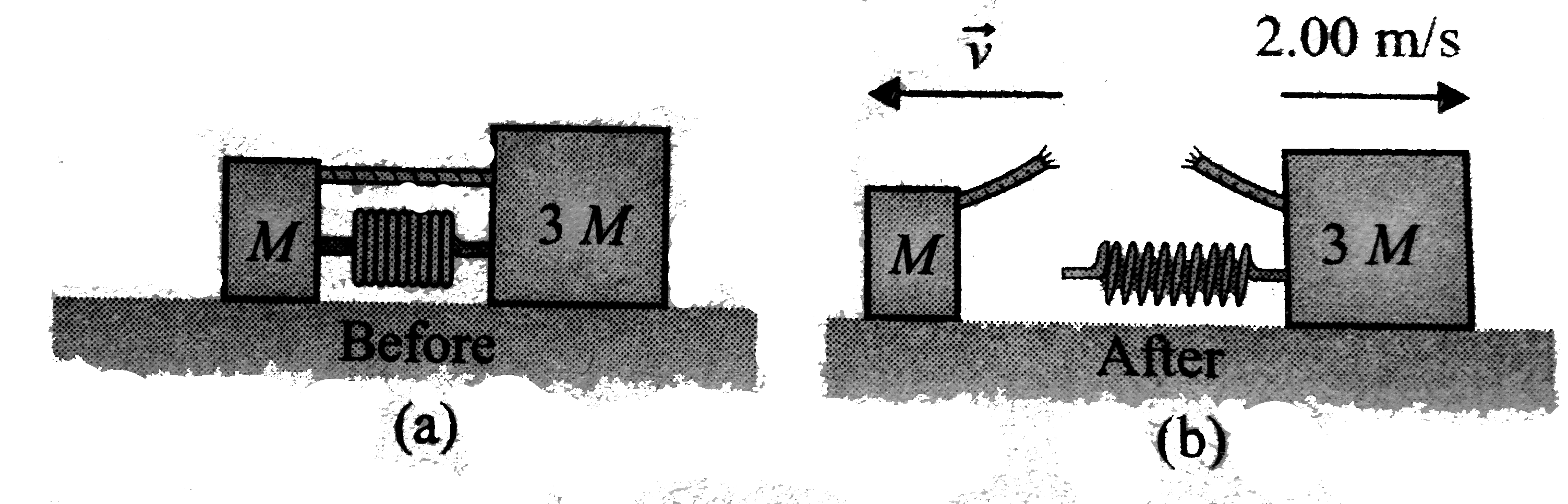 Solving `v_(M)=-6.00m//s` (motion toward the left) b. `1/2kx^(2)=1/2Mv_(M)^(2)+1/2(3M)v_(3M)^(2)=8.40J` c.The original energy is in the spring. A force had to be exerted over a distance to compress the spring, transferring energy into it by work. d. Momentum of the system is conserved with the value zero. The forces on the two blocks are of equal magnitude and opposite directions. Their impulses add to zero. The FINAL momenta of the two blocks of are of equal magnitude of nd OPOSITE directions. plenty of motion afterward is due to the fact that energy STORED in the spring converts into the kinetic energy of blocks. |
|
| 10. |
The molecular weights of two gases are M_(1) and M_(2) ,then at a temperature the ratio of root mean square velocity v_(1) and v_(2) will be |
|
Answer» `SQRT(M_1/M_2)` |
|
| 11. |
A uniform rectangular block is moving to the right on a rough horizontal floor (the block is retarding due to friction). The length of the block is L and its height is h. A small particle (A) of mass equal to that of the block is stuck at the upper left edge. Coefficient of friction between the block and thefloor is mu = (2)/(3). Find the value of h (in terms ofL) if the normal reaction of the floor on the block effectively passes through the geometrical centre (C) of the block. |
|
Answer» |
|
| 12. |
If a resonance tube is sounded with a tuning fork of frequency 256 Hz, resonance occurs at 35 cm and 105 cm. The velocity of sound is about |
|
Answer» 358 m/ s |
|
| 13. |
A machine rated as 150W, changes the velocity of a 10kg mass from 4 ms^(-1)to 10ms^(-1)in 4s. The efficiency of the machine nearly is |
|
Answer» 0.7 |
|
| 14. |
One end of a copper rod of uniform cross - section and of length 1.5 m is kept in contact with ice and the other end with water at 100^(@)C. At what point along its length should a temperature of 200^(@)C be maintained so that in steady state, the mass of ice melting be equal to that of the steam produced in the same interval of time ? Assume that the whole system is insulated from the surroundings. |
Answer» Solution : If the POINT is at a distance x from water at `100^(@)C`, heat conducted to ice in time t, `Q_("ice")=KA((200-0))/((1.5-x))xxt` So ice melted by this heat `m_("ice")=Q_("ice")/L_(F)=(KA)/80((200-0))/((1.5-x))xxt` SIMILARLY heat conducted by the rod to the water at `100^(@)C` in time t, `Q_("water")=KA((200-100))/xt` SO steam formed by this heat `m_("steam")=Q_("water")/L_(v)=KA((200-100))/(540xxx)t` According to GIVEN problem, `m_("ice")=m_("steam"),i.e.` `200/(80(1.5-x))=100/(540xxx)rArrx=6/58m=10.34cm` i.e., `200^(@)C` temperature must be maintained at a distance 10.34 cm from water at `100^(@)C` |
|
| 15. |
A metal wire of length L, area of cross-section A and Young.s modulus Y behaves as a spring of spring constant k. |
|
Answer» `K= YA//L` |
|
| 16. |
Two wires of diameter 0.25 cm, one made of steel and the other made of brass are loaded as shown in Fig. 9.13. The unloaded length of steel wire is 1.5 m and that of brass wire is 1.0 m. Compute the elongations of the steel and the brass wires. |
|
Answer» 1.5 |
|
| 17. |
If the excess of pressure inside a spherical soap bubble of radius lcm is balanced by that due to a column of oil of density 0.9gm/cm^3 and 1.36mm height, the surface tension is found to be given by (T+0.06)xx 10^(-2) N//m. Find T. Take g = 10m//s^2?. |
|
Answer» |
|
| 18. |
At what maximum height with respect tothe lowest point of a hollow sphere of radius r can a particle stay at rest inside it? Given the coefficient of friction between the sphere and the particleis mu. |
|
Answer» SOLUTION :Let m = mass of the particle, h =AC = maximum height of the point B where the particle can stay at REST Fig. Normal force of the shpere on the particle, R = mg COS `theta` = component of the particle.s weight in the radial direction. 
|
|
| 19. |
Calculate the amount of work done in spliting a water droplet of radius 0.5 mm into 8 million identical droplets. Given surface tension of water =0.072 Nm^(-2). |
|
Answer» Solution :Given, `R=0.5 xx 10^(-3)m""n=8 xx 10^(6)` From the law of CONSERVATION of mass, mass of single big drop=mass of 8 million SMALL droplets. i.e, `(4/3piR^(3))rho=8 xx 10^(6) (4/3pir^3rho)` i.e. `R^(3)=8 xx 10^(6) r^(3)` i.e, `r=(R)/(2 xx 10^(2))m` Increase in S.A. `=8 xx 10^(6) (4pir^(2))=4pi (8 xx 10^(6) (R^(2))/(4 xx 10^(4)) -R^(2))` `=4pi R^(2)(200-1)=4 xx 3.142 xx 199 xx (5 xx 10^(-4))^(2)` `DeltaA=6.252 xx 10^(-4)m^(2)` Hence work done=(SURFACE tension) `(DeltaA)` `=0.072 xx 6.252 xx 10^(-4) =4.50 xx 10^(-5)J` |
|
| 20. |
A black coloured solid sphere of radius R and mass M is inside a cavity with vacuum inside. The walls of the cavity are maintained at temperature T_(0). The initial temperature of the sphere is 3T_(0). If the specific heat of the material of the sphere varies as alphaT^(3) per unit mass with the temperature T of the sphere, where alpha is a constant, then the time taken for the sphere to cool down to temperature 2T_(0) will be (sigma is Stefan Boltzmann constant) (Hint : sigma(T^(4)-T_(0)^(4))xx4piR^(2)=Ms(dT)/dt&sigma=alphaT^(3)) |
|
Answer» `(Malpha)/(16piR^(2)SIGMA)LN(16/3)` |
|
| 21. |
In day of summer the glass of water of ice becomes hot on table with respect to time and the cup of heat tea becomes cold on table with respect to time. Write its reason. |
| Answer» Solution :When the temperature of cold water and hot TEA are different than their SURROUNDINGS, then the heat is EXCHANGED between SYSTEM and surrounding until their temperature BECOMES same. Hence the cold water is heated and cup of tea cooled. | |
| 22. |
Find the distance travelled by the particle during the time t = 0 to t = 3 second from the figure . |
|
Answer» SOLUTION :Given : Formula : Distance s = Area of` Delta OAB` `= (1)/(2) xx OA xx BA` `= (1)/(2) xx 3 xx 6 = 9 m` If the speed varies with the time : Then ,`v = (ds)/(dt) rArr ds = v dt` `rArr int ds = int v dt` or`s = int c dt` |
|
| 23. |
A tiger chases a deer 30 m ahead of it and gains 3m in 5 second after the chase began . The distance gained by the tiger in 10 second is : |
|
Answer» 18m Whent = 5S, s = 3 `3 = (1)/(2) xx axx (5)^(2)` 6 = 25 a `:. a = (6)/(25) m//s^(2)` when ` t = 10s, a = (6)/(25) m//s^(2) , s = ?` `s = (1)/(2) xx (6)/(25) xx (10)^(2)` `= (1)/(2) xx (6)/(25) xx 100 = 12m` `:.`The DISTANCE gained = 12 m |
|
| 24. |
The 747 being plane is landing at a speed of 70 ms^(-1). Before touching the ground, the wheels are not rotating. How long a skid mark do the wing wheels leave (assume their mass is 100 kg which is distributed uniformly, radius is 0.7 m, and the coefficient of friction with the ground is 0.5)? |
|
Answer» Solution :the tyres of the plane will leave a SKID mark if the speed of the tyres in contact with ground is lesser than the velocity of the plane. The condition for this is `v gt omega` (When the tyre attained an ANGULAR velocity of V/R) The tyres will stop the skidding and starts the rolling. The forces acting on the wheel after the plane touches down are, N - Normal force W-weigh The wheel is not accelerating means `N=omega` The torque about the centre of the wheel is `tau=RF= mu omegaR` The angular acceleration is `ALPHA=(tau)/(1)=(mu omegaR)/((1)/(2) mR^(2))=(2MU omega)/(mR)` ACCORDING to equation of motion, time taken to stop the skidding by the wheel is, `omega= omega_(0)+alphat+alphat=(V)/(R)` `:.t=(V)/(alphaR)=(V)/(R)((mR)/(2mu omega))=(mV)/(2mu omega)` `t=(mV)/(2mu omega)=(100xx70)/(2xx0.5xx232xx10^(3))=0.03s` The six mark will have a length of `l=vt=70xx0.03=2.1m` ote: The 747 is resting on the runway, supported by 16 wheels under the wing, and 2 under the nose total length is 68.63 m. The normal force experienced by plane through its 16 wheels is c = 232 KN |
|
| 25. |
Pendulum beating seconds at the equatio (g=978cm//sec^(2)) is taken to Antarctica (g=983cm//sec^(2)) its lengthis to be increased by |
|
Answer» 0.1 cm |
|
| 26. |
Two open pipes have lengths l and l + trianglel. Beat frequency in their first mode would be, |
|
Answer» `(V)/(2l)` `therefore f _(1) - f _(2) = (v)/(2) [ (1)/(l) -(1)/( l+ Delta l )]` `=(v)/(2) [ (1 + Delta l -l)/(l ( l + Delta l ))]` `= (v)/(2) [(Delta l )/(l ^(2) + l Delta l )]` When `Delta l` is extremely small, `l Delta l lt lt lt lt l^(2)` ans so it can be neglected from the DENOMINATOR on R.H.S. HENCE, beat frequency is, `f _(1) -f _(2) = (v)/(2l ^(2)) (Delta l)` |
|
| 27. |
A circular coil of radius 8.0 cm and 20 turns is rotated about its vertical diameter with an angular speed of 50 rad s^(-1) in a uniform horizontal magnetic field of magnitude 3.0 xx 10^(-2) T. Obtain the maximum and average emf induced in the coil. If the coil forms a closed loop of resistance 10Omega, calculate the maximum value of current in the coil. Calculate the average power loss due to Joule heating. Where does this power come from ? |
|
Answer» Solution :Letbeadmove oncircular PATHOF radiusRwithangularvelocity `epsilon ` Let NBE normalreaction At anyinstantpositionof beadbe A Directionof normalforceis towarddirection AOTwocomponentof N are N cos `theta`and N sin `theta `  Considerequilibrium of beadat point A N cos `theta` =mg N sin `theta = m Repsilon ^(2) sinepsilon` m R `epsilon^(2) sintheta`is horizontalcomponentofcentripetalforce N cos`theta` = mg cos `theta= ( g)/( R epsilon^(2))` Whenbead is atlowermostposition`theta=0 ^ (@)` `g= R epsiloon ^(2)` `epsilon= sqrt((g )/( R))` If`=sqrt((2 g)/( R ))` thenfrom EQUATION(4 ) `cos theta= (g )/( R epsilon ^(2)) = (g ) /(R ) xx (R ) /(2G)` `cos theta= (1)/( 2)` `theta = 60^(@)` |
|
| 28. |
Draws the P-Tand V-T diagrams for an isobaric process of expansion, corresponding to n moles of an ideal gas at a pressure P_0from V_0to 2V_0From the equation state PV = nRT |
|
Answer» <P> SOLUTION :we have` V = ((nR )/(P_n))T ORV prop T ``AtV=V_0 =T_1 =(P_0 V_0)/( nR )andatV=2V_0 , T_1 = ( 2P_0 V_0 )/(nR )` For the graph of P versus T the variation is a straight line normal to the pressure axis, the temperature varying from `T_1 ` to `T_2`as shown figure. From the graph of V versus T, the equation `V=((nR)/(p_0) )T ` (or) V = KT shows that the volume varies directly, as the temperature (Charles. law). So, the graph is a straight line inclined to the (V T) axis, and passingthrough the ORIGIN (when produced) as shown in figure. 
|
|
| 29. |
Two particles 1 and 2 move with constant velocities vecV"and "vecV_(2). At the initial moment (t=0sec). Their position vectors are equal to vecr_(1)"and"vecr_(2) . How must these four vectors be interrelated for the paticles to collide. |
|
Answer» |
|
| 30. |
A motor boat, with its engine on in a running river and blow n over by a horizontal wind is observed to travelat 20 kph in a direction 53^(@)East of North. The velocity of the boat with its engine on in still water & blown over by the horizontal wind is 4kph East ward and the velocity of the boat with its engine on over the running river, in the absence of wind is 8 kph due south. Find: (a) The velocity of the boat in magnitude and direction, over still water in the absence of wind. (b) The velocity of the wind in magnitude and direction. |
|
Answer» |
|
| 31. |
(A) : An object may have verying speed without having varying velocity. ( R) : If the velocity is zero at an instant, the acceleration also zero at that instant. |
|
Answer» Both (A) and ( R) are TURE and ( R) is the correct explanation of (A) |
|
| 32. |
A sphere can roll on a surface inclined at an angle theta if the friction coefficient is more than (1)/(7) g tan theta. If a sphere is released from rest on the incline |
|
Answer» it will stay at rest |
|
| 33. |
A solid sphere of mass 1.5 kg rolls on a frictionless horizontal surface, its centre of mass moving at a speed of "5ms"^(-1). Then it rolls up an incline of 30^(@) to horizontal. If the height attained by the sphere before it stops is (g=10"ms"^(-2))7/xm then find x. |
|
Answer» |
|
| 34. |
Water rises in a capillary tube to a certain height such that the upward force due to surface tension is balanced by 75xx10^(-4)N force due to the weight of the liquid. If the surface tension of water is 6xx10^(-2)Nm^(-1), the inner circumference of the capillary must be |
|
Answer» `1.25xx10^(-2)m` |
|
| 35. |
When a radius of earth is reduced by 1% without changing the mass, then change in the acceleration due to gravity will be |
|
Answer» INCREASED by 2% |
|
| 36. |
Choose the corect answer from the brackets:(deg98 F)=–----K(a)36.7(b)40(c)309.7(d)391 |
|
Answer» `36.7` |
|
| 37. |
Two identical vessels A and B contain masses m and 2m of same gas. The gases in the vessels are heated keeping their volumes constant and equal. The temperature-pressure curve for mass 2m makes angle alpha with T-axis and that and for mass m makes an angle beta with T-axis then |
|
Answer» `tanalpha=tan beta` |
|
| 38. |
Define specific heat capacity |
|
Answer» SOLUTION :Specific heat capacity of a substance is DEFINED as the amount of heat ENERGY required to raise the temperature of 1 kg of a substance by 1 Kelvin or `1^(@)C` `DeltaQ= msDeltaT` Therefore`s= (1)/(m)(DeltaQ)/(DeltaT)` The SI unit for specific heat capacity is J `kg^(-1)K^(-1)` |
|
| 39. |
Two rectangular blocks A and B are placed on a horizontal surface at a very small separation. The masses of the blocks are m_(A) = 4 kg and m_(B) =5 kg. Coefficient of friction between the horizontal surface and both the blocks is mu = 0.4. Horizontal forces F_(1) and F_(2) are applied on the blocks as shown. Both the forces vary with time asF_(1) = 15 + 0.5 tF_(2) = 2tWhere ‘t’ is time in second. Plot the variation of friction force acting on the two blocks (f_(A) "and" f_(B)) vs time till the motion starts. Take rightward direction to be positive for B and leftward direction to be positive forf_(A). |
|
Answer» |
|
| 40. |
Lord Rama and Arjuna were skilled in archery. As we apply more action (tension) to the string, the faster an arrow flies. After reading about Rama and Arjuna, Raju asked his friend Bhaskar is there any scientific facts behind Archery. He also asked Bhaskar about how to find force of the arrow. (i) Is there any physics concept behind this archery? |
|
Answer» Solution :Yes, the physics conceptbehind this is, Parallelogram law of vectors. When we pull the arrow the string forms two forces as A & B. The direction of arrow is the resultant force here, `(A=F_(1), B=F_(2), R=F)` To find direction of force `tan B=(B sin THETA)/(A+B cos theta)`. |
|
| 41. |
A stone is thrown horizontally from a height with a velocity v_(x) = 15m//s. Determine the normal and tangential acceleration of the stone in 1 second after it begins to move. |
|
Answer» Solution :The HORIZONTAL component of acceleration is ZERO. The net acceleration of the stone is directed vertically downward and is equal to the acceleration due to gravity g. Thus `a = g = SQRT(a_(t)^(2) + a_(N)^(2))` from figure we can see that `cos theta = (v_(x))/(v) = (a_(c))/(a) = (a_(c))/(g)` and `sin theta = (v_(y))/(v) = (a_(t))/(a) = (a_(t))/(g)` HENCE `a_(1)g(v_(y))/(v) = (g^(2)t)/(sqrt(v_(x)^(2) + g^(2)t^(2))` and `a_(c) = g(v_(x))/(v) = (g v_(x))/(sqrt(v_(x)^(2) + g^(2)t^(2)))` on substituting numerical values, `v_(x) = 15m//s, g = 9.8 m//s^(2)` we get `a_(t) = 5.4 m//s^(2)` and `a_(n) = 8.2 m//s^(2)`. |
|
| 42. |
A pendulum has length L = 1.8 m. The bob is released from position shown in the figure. Find the tension in the string when the bob reaches the lowest position. Mass of the bob is 1 kg. |
|
Answer» |
|
| 43. |
The displacement of particle is represented by the equation y=3cos((pi)/(4)-2omegat). The motion of the particle is |
|
Answer» SIMPLE harmonic with particle is `(2pi)/(OMEGA)` |
|
| 44. |
One end of a light spring of spring constnat k is fixed to a wall and the other end is tied to a block placed on a smooth horizontal surface. In a displacement, the work done by the spring is (1)/(2)kx^(2). The possible cases area) the spring was initially compressed by a distance x and was finally in its natural length b) it was initially streched by a distance x and finally was in its natural length c) it was initially in its natural length and finally in a compressed position d) it was initially in its natural length and finally in a stretched position. |
|
Answer» a, B are CORRECT |
|
| 45. |
'Gulab Jamuns' (assumed to be spherical) are to be heated in an oven. They are available in two sizes, one twice bigger (in radius) than the other. Pizzas (assumed to be discs) are also to be heated in oven. They are also in two sizes, one twice big (in radius) than the other. All four are put together to be heated to oven temperature. Choose the correct option from the following : |
|
Answer» Both size gulab jamuns will get heated in the same TIME. SIMILARLY, smaller pieces have area than larger, they become hot earlier. Because they emit less heat. |
|
| 46. |
The displacement of a particle along the x-axis is given by x = a sin^2 omega t.The motion of the particle corresponds to |
|
Answer» SHM of FREQUENCY`OMEGA/pi` |
|
| 47. |
When heat is added to a system, which of the following is not possible? |
|
Answer» INTERNAL energy of the SYSTEM INCREASES |
|
| 48. |
A spherical cavity of radius(R )/(2)is removed from a solid sphere of radius R as shown in fig. The sphere is placed on a rough horizontal surface as shown. The sphere is given a gentle push. Friction is large enough to prevent slippage. Prove that the sphere perform SHM and find the time period. |
|
Answer» |
|
| 49. |
In a given process on a ideal gas, dW=0 and dQ lt 0. Then for the gas ………… . |
|
Answer» The TEMPERATURE will DECREASE. |
|
| 50. |
(A) : A force acts on the earth revolving in a circular orbit about the sun and work should be done on the earth. (R) : The centrifugal force for circular motion of earth, comes from the gravitational force between earth and sun. |
|
Answer» Both (A) and (R) are TRUE and (R) is the correct explanation of (A) |
|