

Saved Bookmarks
This section includes 7 InterviewSolutions, each offering curated multiple-choice questions to sharpen your Current Affairs knowledge and support exam preparation. Choose a topic below to get started.
| 1. |
A 10kg mass is resting on a horizontal surface and horizontal force of 80N is applied. If mu = 0.2, the ratio of acceleration without and with friction is (g = 10ms^(-2)). |
|
Answer» `(3)/(4)` |
|
| 2. |
The percentage change in the time period of a simple pendulum when it’s a |
|
Answer» 0.75 |
|
| 3. |
A flexible chain of length 2m and mass 1 kg initially held in vertical position such that its lower end just touches a horizontal surface, is released from rest at time t=0. Assuming that any part of chain which strikes the plane immediately comes to rest and that the portion of chain lying on horizontal surface does not from any heap, the height of its centre of mass above surface at any instant t=(1)/(sqrt(5)) (before it completely comes to rest) is |
|
Answer» |
|
| 4. |
A pair of stars rotates about a common centre of mass. One of the stars has a mass M which is twice as large as the mass m of the other. Their centres are a distance apart, d being compared to the size of either star. (a) Derive an expression for the period of rotation of the stars about their common centre of mass in terms of d, m, G. (b) Compare the angular momentum of the two stars about their common centre of mass by calculating the ratio L_(m)//L_(M). (c ) Compare the kinetic energies of the two stars by calculating th eratio K_(m)//K_(M). |
|
Answer» `0=(2m(-x)+m(d-x))/(2m+m)` `x=(d)/(3)` 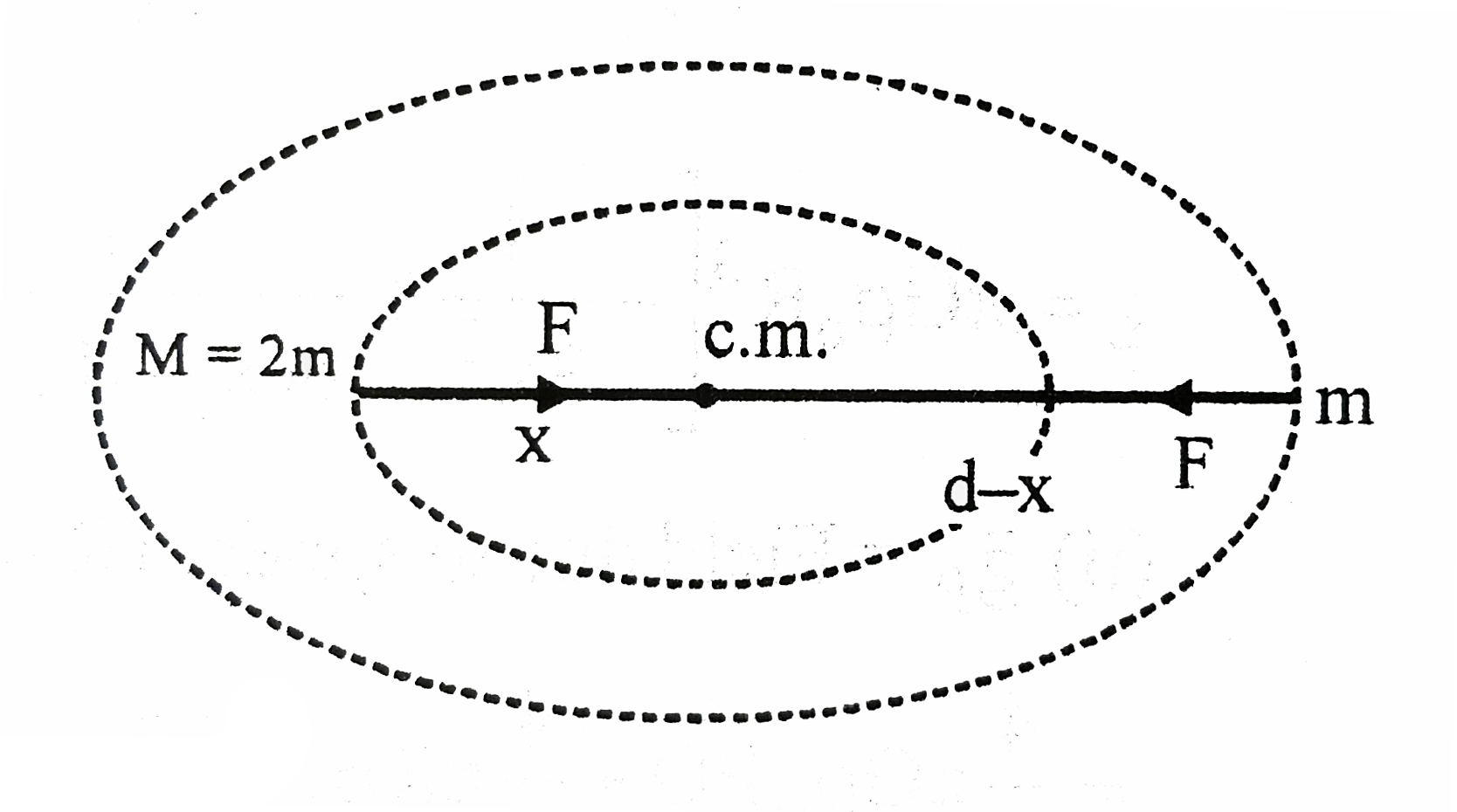 (a) These force of atraction willprovide required centripetal force `((2m)v_(M)^(2))/(d//3)=(G2m.m)/(d^(2)) RARR v_(M)=sqrt((1)/(3)(GM)/(d))` `T = (2pi(d//3))/(v_(M)) rArr T = (2pi d)/(3). sqrt((3d)/(GM))` `T = 2pi sqrt((d^(3))/(3GM)) rArr T = (2pi d^(3//2))/(sqrt(3Gm))` |
|
| 5. |
A block A of mass 8 kg is placed on a frictionless horizontal table. A thread tied to it passes over a frictionless pulley and carries a body B of mass 2 kg at the other end. Find the acceleration of the system. Also find the tension in the thread. If the thread is cut into two and tied to the ends of a spring of forceconstant 1600N/m, find the amount of stretching of the spring. Neglect the mass of thread and of spring (g = 9.8 m//s^(2)) |
|
Answer» Solution :Figure(a) represents the arrangement of the first PART of the problem Here `m_1 = 8kg , m_2 = 2kg ` If a is acceleration of system and T the tension in STRING  then we have for the motion of block B , `m_2 g - T = m_2 a ` ....... (1) and for the motion of blockA , T = ` m_1 a ` ....... (2) ( since weight `m_1g` is BALANCED by normal reaction R ) Adding (1) and (2) , we get ` m_2 g = (m_1 + m_2) a ` `:. ` acceleration ` a=(m_2)/(m_1 + m_2) g` ...... (3) Substituting this is (2) , we get , Tension `T=(m_1 m_2)/( m_1 + m_2 ) g `.......... (4) In second part the spring is introducedand the arrangement is shown in figure (b) . The spring is pulle by Tension `T=(m_1 m_2)/( m_1 + m_2) g ` If x is the streching of spring , then we have `T= Kx (or ) x =(T)/(K) = (m_1 m_2 g)/( (m_1 + m_2)K)` substituting ` m_1 = 8 kg , m_2 = 2kg ` . K= 1600 N/m in (3), (4)and (5) , we get acceleration ` a= ( m_2)/( m_1 +m_2)g= (2) /( 2 + 8 ) xx 9.8 = 1.96 m//s^(2)` Tension `T= (m_1 m_2)/( m_1 + m_2)g = (2 xx8)/(2 + 8) xx 9.8 = 15.68` N and stretching ` x= (T)/(K) = (15.68)/(1600) = 0.0098 m` . |
|
| 6. |
A body moving radially away from a planet of mass M, when at distance r from planet, explodes in such a way that two of its many fragments move in mutually perpendicular circular orbits around the planet. What will be |
|
Answer» `(m_(1)V^(2))/r=(GMm_(1))/(r^(2))` `v=sqrt((GM)/r)` (ii) Maximum distance `=sqrt(2)r` (iii) RELATIVE VELOCITY just before collision maximum distance `=sqrt(2)v` maximum distance `=sqrt((2GM)/r)` 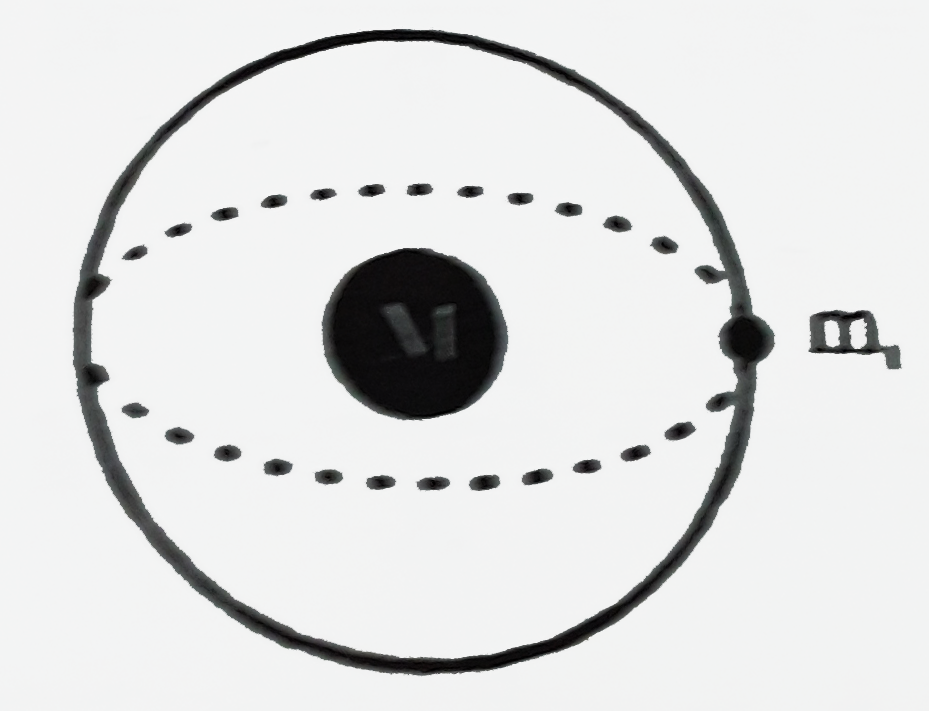
|
|
| 7. |
A cylinder is released from rest from the top of an incline of inclination theta and length 'l'. If the cylinder roles without slippling its speed at the bottom |
|
Answer» `sqrt((4glsintheta)/(3))` |
|
| 8. |
The net work done by conservative forces in moving an electron of charge e and mass m from A to B along the circular path shown by figure very slowly, in the vertical plane in the field of charge Q is |
| Answer» Answer :B | |
| 9. |
Forthe same force heavier mass experience lesser acceleration explain |
| Answer» SOLUTION :Whenan applefallsit experiencesEarthgravitationalforce.Accordingto Newton'sthirdlawthe APPLE exertsequalandoppositeforceon THEEARTH. Eventhoughboth theappleand Earthexperiencethesameforcetheiraccelerationis diefferent . the MASSOF Earthis enormouscomparedto thatofan apple. so an appleexperienceslargealmostnegligibleacceleratin .DUT to thenegligibleaccelerationEarthappears to bestationarywhen anapplefalls. | |
| 10. |
Acar ofweight 1000 kg moves with a uniform speed of 36Km/hr up an inclined road.The inclined road makes an angle of 30°with the horizontal.Neglecting friction,Calculate the power of the engine of the car. |
| Answer» SOLUTION :`4.9*10^4` WATT | |
| 11. |
A system consists of two cubes of masses m_(1) and m_(2) connected by a spring of spring constant k. Force F applied on m-(1) along its weight and removed, such that m_(2) is just lifted. Find F? |
|
Answer» `m_(1)G` |
|
| 12. |
A spring balance carries a load. When the load is pulled aside so that the balance makes an angle of 30^@ with the vertical, the balance reads 4 kg wt. The mass of the load is |
| Answer» Solution :`2 sqrt(3) Kg` | |
| 13. |
A particle is projected at an angle alpha with the horizontal from the foot of an inclined plane making an angle beta with horizontal . Which of the following expressions holds good if the particle strikes the inclined plane normally? |
|
Answer» `COT beta=-tan (alpha-beta)` `v_(x)=u_(x)-g cos BETAT` `T=(2 u sin (alpha-beta))/(g cos beta)` 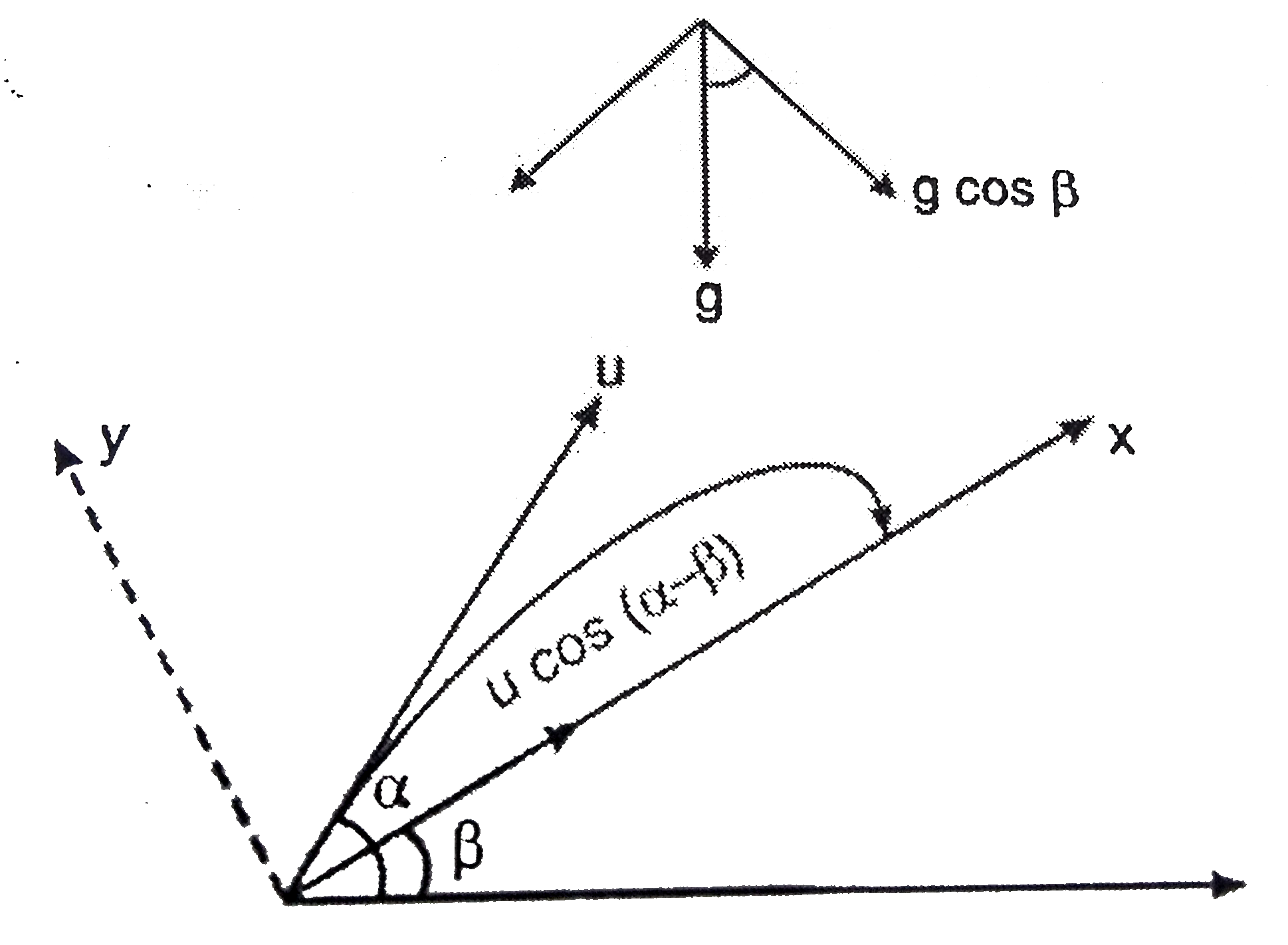
|
|
| 14. |
How does an object supposed to be at rest and in motion are considered to be relative ? |
| Answer» Solution :A person SITTING in a MOVING but is at rest with RESPECT to a FELLOW passenager but is in motion with respect to a person OUTSIDE the bus . The concepts of rest and motion have meaning only with respect to some fram of reference. | |
| 15. |
A dimesnsionless quantity |
|
Answer» NEVER has a UNIT |
|
| 16. |
(I) Kepler's law is not derived from Newton's law of gravitation. (II) Motion of planets is explained by copernicus. Which one is correct statement? |
|
Answer» I only |
|
| 17. |
Can a motion be periodic and not oscillatory ? |
| Answer» SOLUTION :YES. For INSTANCE, uniform circulat motion is periodic but not oscillatory. | |
| 18. |
Which of the following instrument is used to measure the blood pressure in humans? |
|
Answer» SPHYGMOMANOMETER |
|
| 19. |
A diatomic ideal gas is heated at constant volume until the pressure is doubled and again heated at constant pressure until volume is doubled. The average molar heat capacity for whole process is - |
|
Answer» `(13R)/(6)`  Total heat ABSORBED 1 mole of gas `DELTAQ= C_(V)(2P_(0) -T_(0)) +C_(P) (4T_(0) -2T_(0))` `=(5)/(2) RT_(0) +(7)/(2) R xx 2T_(0) =(19)/(2) RT_(0)` Total change in temperature from state A to C is `DeltaT=3T_(0)` molar heat capacity `=(DeltaQ)/(DeltaT)= ((19)/(2)RT_(0))/(3T_(0)) = (19)/(6)R`. |
|
| 20. |
The direction of torque acts |
|
Answer» ALONG `vecF` |
|
| 21. |
Experimental values of specific heats are usually more than predict values because |
|
Answer» In predict VALUES we USUALLY don't consider rotational mode |
|
| 22. |
What is the accuracy of metre defined in terms of wavelength of light radiation ? |
| Answer» SOLUTION :The ACCURACY of standerd METRE so DEFINED is 1 PART in `10^9.` | |
| 23. |
The system shown consists of two springs. If the temperature of the rod is increased by Delta T. the compression in the left spring is (assume the thermal stress in the rod is zero) |
|
Answer» `( L alpha( DELTA T) )/( 4)` |
|
| 24. |
State and explain right hand screw rule. |
Answer» Solution :It STATES that if a right handed screw placed with its axis perpendicular to the plane direction of `veca` to the direction of `vecb` through smaller angel, then the sense of the advancement of the tip of the screw gives the direction of `(VECAXXVECB)or(vecc)`  Screw is rotated in such a WAY that direction of its tip advancement is the direction of `vecc`. If screw is rotated in anti-clockwise direction the direction of `vecc` is negative and if rotated clockwise direction then the direction of `vecc` will be positive. Moreover the direction of `vecc` can be obtained by another way. In figure (b) shows that if we curl the finger of right hand, KEEPING the thumb erect, in such a way that the fingers POINT in the direction of rotation from `veca` to `vecb` through angle `theta`, then the thumb points in the direction of `vecaxxvecb or vecc`. It can be said by another way. Open the right hand palm and fingers be curl from `veca` to `vecb` then erect thumb indicates the direction of `vecc` |
|
| 25. |
A body of mass 10 kg at rest is subjected to a force of 16N. Find the kinetic energy at the end of 10 s |
|
Answer» Solution :Mass m=10 KG FORCE F=16N time t=10s `a=F/m=16/10=1.6ms^(-1)` we KNOW that `v=u=+t=0+1.6xx10=16ms^(-1)` KINETIC energy `K.E=1/2mv^(20=1/2xx10xx16xx16=1280J` |
|
| 26. |
A uniform cylinder of length L and mass M having cross-sectional area A is suspended, with its length vertical, from a fixed point by a massless spring such that it is half submerged in a liquid of density sigma at equillibrium position. The extension x_(0) of the spring when it is equillibrium is |
|
Answer» `(Mg)/(K)(1-(LA SIGMA)/(2M))` |
|
| 27. |
A solid sphere and a hollow sphere of the same mass and diameter, both initially at rest , roll down the same inclined plane. Which reaches the bottom first? |
|
Answer» SOLID cylinder |
|
| 28. |
Physical independence of force isa consequence of |
|
Answer» third LAW of MOTION |
|
| 29. |
An earth.s satellite is moved form one stable circular orbit to another larger and stable circular orbit. The quantities that change for the satellite are |
|
Answer» GRAVITATIONAL POTENTIAL energy |
|
| 30. |
The law which is valid in both inertial and non-inertial frame is |
| Answer» Solution :Newton.s third law | |
| 31. |
A perfect gas undergoes the following three separate and distinct processes to execute a cycle (i) constant volume process during which 80 kJ of heat is supplied to the gas, (ii) constant pressure process during which 85 kJ of heat is lost to the surroundings and 20 kJ of work is done on it. (iii) adiabatic process which restores the gas back to its initial stage. Evaluate the work done during adiabatic process and the value of internal energy at all the state points if initially its value is 95 kJ. |
Answer» SOLUTION :This example illustrates the application of nonflow ENERGY equation and the 1st law applied to a cyclic process. Process 1 -2 : `Q_(1-2) = 80KJ, W_(1-2)=0` `U_(2)-U_(1)=Q_(1-2) -W_(1-2) ` `=80-0=80kJ` `U_(2)=80+95=175kJ` Process 2-3: `Q_(2-3)=-85kJ, W_(2-3)=-20kJ` `U_(3)-U_(2)=Q_(2-3)-W_(2-3)= -85-(-20)=-65kJ` `U_(3) = -65 +175 =110kJ` For the complete cycle : `oint delta Q = oint deltaW`. That is `Q_(1-2)+Q_(2-3) +Q_(3-1) =W_(1-2) +W_(2-3) +W_(3-1)` `80-85 +0=0 +(-20) +W_(3-1)` `:.` Work done during ADIABATIC process, `W_(3-1)=15kJ` |
|
| 32. |
What is the torque acting on the bob of mass m of a simple pendulum Of length l, when the string of the pendulum makes an angle thetawith the vertical ? When is the torque (i) zero and (ii) maximum. |
| Answer» SOLUTION :`TAU =rF =l.sintheta xx mg, tau_("min") = 0`, when `theta =0, tau_("MAX") = MGL` when `theta = 90^(@)` | |
| 33. |
The frequency of oscillation of a simple pendulum suspended in a satellite that revolve around the earth is |
|
Answer» 1 Hz |
|
| 34. |
The mass of a disc is 700 gm and its radius of gyration is 20 cm. What is its moment of inertia if it rotates about an axis passing through its centre and perpendicular to the face of the disc? |
|
Answer» Solution :Mass = m = 700 gm = 0.7 KG Radius of GYRATION = K = 20 CM = 0.2 m Moment of inertia = `I= MK^(2) = 0.7 xx 0.2 = 0.028 kg m^(2)` |
|
| 35. |
The displacement of a body is proportional to t3, where t is What is tinc nature of acceleration -time graph of the body? |
|
Answer» SOLUTION :As `aalphat^(2)implies""s=kt^(3)` Velocity, `V=(ds)/(DT)=3kt^(2)` Acceleration, `a=(dv)/(dt)=6kt` i.e., `apropt` `implies` motion is uniform, acceleration motion, a-t graph is straight-line. |
|
| 36. |
If the speed of light c(=3xx10^(8) m//s), Planck's contant h(=6.6xx10^(-34) J-s) and gravitational constant G(=6.67xx10^(-11)MKS" units") are chosen as the fundamental quantities, find out the dimensions and value of units of (a) mass, and (b) time in this system. |
|
Answer» `[M]=[M^(-1)L^(3)T^(-2)]^(x)[LT^(-1)]^(y)[ML^(2)T^(-1)]^(Z)` Equating the EXPONENTS of similar QUANTITIES `-x+z=1` `3x+y+2z=0` `-2x-y-z=0` `x=-1/2"",""y=1/2"",""z=1/2` `Q = ((cn)/a)^(1//2)` |
|
| 37. |
In the figure, what will be the sign of the velocity of the point P_1, which is the projection of the velocity of the reference particle P. P is moving in a circle of radius R in anti-clockwise direction. . |
Answer» Solution :As the particle on reference CIRCLE MOVES in anti-clockwise direction. The projection on x-axis will COME from `P_1` to O towards left. Means from right to left, hence sign is negative.  . .
|
|
| 38. |
A hunter aims his gun fires a bullet directly at monkey on a tree. At the instant the bullet leaves the barrel of the gun, the monkey drops. Will the bullet hit the monkey ? |
|
Answer» Solution :Horizontal distance travelled `OB = x = u COS theta t` or `t = (x)/(u cos theta)` For motion of bullet from O to B, the vertical height `AB = u sin theta t - (1)/(2)g t^(2)` Also from figure `MB = x tan theta` Now the height through which monkey falls `y = MA = MB - AB` `= x tan theta - (x tan theta - (g t^(2))/(2)) = (1)/(2) g t^(2)`  THUS, in TIME t the bullet passes through A a vertical distance `(1)/(2) g t^(2)` below M. The vertical distance through which the monkey fall in time t. `s = (1)/(2)g t^(2)` Thus, the bullet and the monkey will always reach at point A at the same time. |
|
| 39. |
A stone tied to the end of a string 80 cm long is whirled in a horizontal circle with a constant speed. If the stone makes 14 revolutions in 25 seconds, what is the magnitude and direction of acceleration of the stone? |
|
Answer» SOLUTION :`=(88)/(25)" RAD "s^(-1),=(2pi)/(T)=(2piN)/(t)` `a=991.2cms^(-2)` |
|
| 40. |
A car moving on astringt road accelerates from a speed of 4.1 m//sto a speed of 6.9 m//s in 5.0s. What its average acceleration ? |
|
Answer» |
|
| 41. |
How is the period of a pendulum affected when its point of suspension is (a) moved vertically upwards with acceleration a. |
| Answer» Solution :When the point of SUSPENSION of pendulum is moved vertically upward with acceleration a, G is replaced by (g + a). Hence its PERIOD T DECREASES. | |
| 42. |
An ideal gas is taken through the cycle A rarr B rarr C rarr A, as shown in figure. If the net heat supplied to the gas in the cycle is 5J, the work done by the gas in the process C rarr A is |
|
Answer» `-5 J` `:. W_(AB) = PDELTA V = P(V_(2) - V_(1))` `= 10 XX (2-1) = 10 J` Process `B rarr C`, occurs at constant volume, `:. W_(BC) = 0` For a cyclic process, `Delta Q = W` `:. Delta Q = W_(AB) + W_(BC) + W_(CA)` or `5 = 10 + 0 + W_(CA)` or `W_(CA) = - 5J` 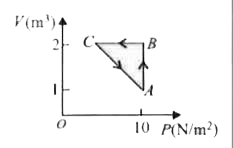
|
|
| 43. |
If |vec(A)| = |vec(B)| and vec(A) ne +- vec(B) then angle between the vectors (vec(A) + vec(B)) and (vec(A) - vec(B)) is: |
|
Answer» 0 |
|
| 44. |
A boat is moving with a velovity vbw= 5km/hr relative to water. At time t=0, the boat passes through a piece of cork floating in water while moving downstream. If it turns back at time t_(1)=30min, (a) when the boat meet the cork again? (b) The distance travelled by the boat during this time. |
Answer» SOLUTION :t=0  CONSIDER an observer attached with cork. The boat has same speed upstream and DOWNSTREAM realtive to cork. Hence, if the boat TRAVELS for 30min. While moving away from cork, t travels the same time while approaching the cork. THEREFORE the boat meet the cork at `T=2t=60min.` = 1h The distance travelled by boat in this time, `S=V_(BW)xxT=5xx1=5km` |
|
| 45. |
For measuring temperature in the range of 2000^(@)C " to" 2500^(@)C, we should employ |
|
Answer» GAS thermometer |
|
| 46. |
Moon has no atmosphere because |
|
Answer» The r.m.s. velocity of all GASES is more than the ESCAPE velocity from moon's surface |
|
| 47. |
If a tunnel is dig along the diameter of earth and a body is dropped freely in it. The motion of this body is……….., if there is no frictional force of medium acting on it. (Fill in the blank). |
| Answer» SOLUTION :`IMPLIES SHM`. | |
| 48. |
A uniform sphere is placed on a smooth horizontal surface and a horzontal force F is applied on it at a distance .h. above the surface. The acceleration of the centre |
|
Answer» is MAXIMUM when H = 0 |
|
| 49. |
A river of width 'a' flows due North with speed 'u'. The points O and A are on opposite banksand A is due east of 'O' . Co-ordinate axes OXand OY are takenin the east the north directions respectively . A boat, whose speed is V relative to water, starts from 'O' and crosses the river. If the boat is steered due east and U varies with x as U=x(a-x)V//a^(2) then a) Equation of trajeetory of the boat b) Time take to cross the river c) Absolute velocity of boat man when the reaches the opposite bank d) The displacement of boat man when he reaches the opposite bank are a) y=(x^(2))/(pa) - (x^(3))/(3a^(2)), b) t= (a)/(qV), c) rV, d) s= a hat(i) + a/k hat(j). The value of p,q , r, k are |
|
Answer» |
|
| 50. |
A three wheeler starts from rest, accelerates uniformly with 1 ms-2 on a straight road for 10 s and then moves with uniform velocity. Plot the distance covered by the vehicle during the nth second (n = 1, 2, 3, ...) versus n. What do you expect this plot to be during accelerated motion : a straight line or a parabola ? |
| Answer» Solution :A straight LINE INCLINED with the TIME-axis for uniformly accelerated motion, parallel to the time- axis for uniform motion. | |