

Saved Bookmarks
This section includes 7 InterviewSolutions, each offering curated multiple-choice questions to sharpen your Current Affairs knowledge and support exam preparation. Choose a topic below to get started.
| 1. |
A cylindrical metallic rod 0.5 m long conduct heat at the rate of 50 "Js"^(-1) when its ends are kept a 400^(@) C and 0^(@) C respectively. Coefficient of thermal conductivity of metal is 72 "Wm"^(-1) "K"^(-1). What is the diameter of rod? |
|
Answer» |
|
| 2. |
A spring of force constant .k. is stretched by a small length .x.. The work done in stretching it further by a small length .y. is |
|
Answer» `1/2k(X^(2) + y^(2))` |
|
| 3. |
When an ideal diatomic gas is heated at constant pressure, the fraction of the heat energy supplied which increases the internal energy of the gas is ……….. |
|
Answer» `2/5` `THEREFORE gamma=C_P/C_V=7/5` Now `DELTAQ=muC_P DeltaT` `DeltaU=muC_VDeltaT` `therefore (DeltaU)/(DeltaQ)=C_V/C_P` `=1/(7/5)` `=5/7` |
|
| 4. |
The top of al smooth inclined plane of length 20sqrt(2)m is connected to the edge of a well of diameter 40 m making an angle 45^(@) as shown in figure. A body is projected along the inclined plane with a velocity .u.. If the body crosses the well without falling in it then the minimum value of .u. is (g = 10 ms^(-2)) |
|
Answer» `20 ms^(-1)` |
|
| 5. |
At iwo particular closest instants of time and the displacements of a particle performing SHM are equal. At these instants |
|
Answer» Instantaneous speeds are equal |
|
| 6. |
(a)Soft iron is a conductor of electricity. (b) It is a magnetic material. (c) It is an alloy of iron. (d) It is used for making permanent magnets. State whether: |
|
Answer» a and C are true |
|
| 7. |
If C the velocity of light, h Planck's onstant and G Gravitational constant are taken as fundamental quantities, then the dimensional formula of mass is |
|
Answer» `H^(-1//2) G^(1//2) C^(0)` |
|
| 8. |
Funcation x=A sin^(2) omegat+B cos^(2) omegat+ C sin omegat cos omegat Represents SHM. |
|
Answer» For any VALUE of A, B and C (except C = 0). |
|
| 9. |
Characteristic of rotational motion. |
Answer» Solution :In rotation of a rigid body about a fixed axis, every particle of the body moves in a circle which lies in a plane perpendicular to the axis and has its centre on the axis.  In figure, rotational motion of a rigid body shows about the Z-axis of the frame of reference. Let `P_(1)` be a particle of the rigid body, arbitrarily chosen and at a distance `r_(1)` from the fixe axis. The particle `P_(1)` describe a circle of radius `r_(1)` with its centre `C_(1)` on the fixed axis. The circle lies in a plane perpendicular to the axis. An another particle `P_(2)` of the rigid body, `P_(2)` is at a distance `r_(2)` from the fixed axis. The particle `P_(2)` moves in a circle of radius `r_(2)` and with centre `C_(2)` on the axis. The circles described by `P_(1)andP_(2)` may lie in different planes, both these planes are perpendicular to the fixed axis. For any particle on the axis like `P_(3),r_(3)=0`. Any such particle remains stationary while the body rotates.  In rotation of a SPINNING TOP, the axis may not be fixed as SHOWN in figure. Assume that spinning top rotates at a fixed place. The axis of such a spinning top moves around the vertical through its point of contact with the ground, sweeping out a cone as shown in figure. This movement of the axis of the top around the vertical is termed as precession. Here, the point of contact of the top with ground is fixed. The axis of rotation of the top at any instant passes through the point of contact. Another example of this kind of rotation is the oscillating table fan or a pedestal fan.  The axis of rotation of such a fan has an oscillating (sidewise) movement in a horizontal plane about the vertical through the point at which the axis is pivoted (point O in figure). While the fan rotates and its axis moves sidewise, this point is fixed. Hence is CASE of a top or a pedestal fan, one point and not one line of the rigid body is fixed. In this case, the axis is not fixed though it always passes through the fixed point. |
|
| 10. |
Consider a uniform square plate of side .a. and mass .m.. The moment of inertia of this plate about an axis perpendicular to its plane and passing through one of its comer is |
|
Answer» `(5)/(6)ma^(2)` |
|
| 11. |
A man wishes to estimate the distance of a nearby tower from him. He stands at a point A in front of the tower C and spots a very distant object O in line with AC. He then walks perpendicular to AC up to B, a distance of 100 m, and looks at O and C again. Since O is very distant , the direction BO is practically the same as AO, but he finds the line of sight of C shifted from the original line of sight by an angle theta = 40^(@) (theta is known as 'Parallax') estimate the distance of the tower C from his original position A. |
|
Answer» Solution :We have, PARALLAX angle `THETA = 40^(@)` From fig.2.3. AB=AC TAN`theta` AC=AB/tan`theta` = 100m/tan`40^(@) = 100m//0.8391 = 119` |
|
| 12. |
A sphere, a cube and circular plate of same material and same mass are heated to same temperature. Then cooling of |
|
Answer» SPHERE is slowest |
|
| 13. |
A ball of mass m hits a wedge of mass M vertically with speed u, which is placed, on a smooth horizontal surface. Find the maximum compression in the spring, if the collision is perfectly elastic and no friction any where. Spring constant of spring is K. |
Answer» 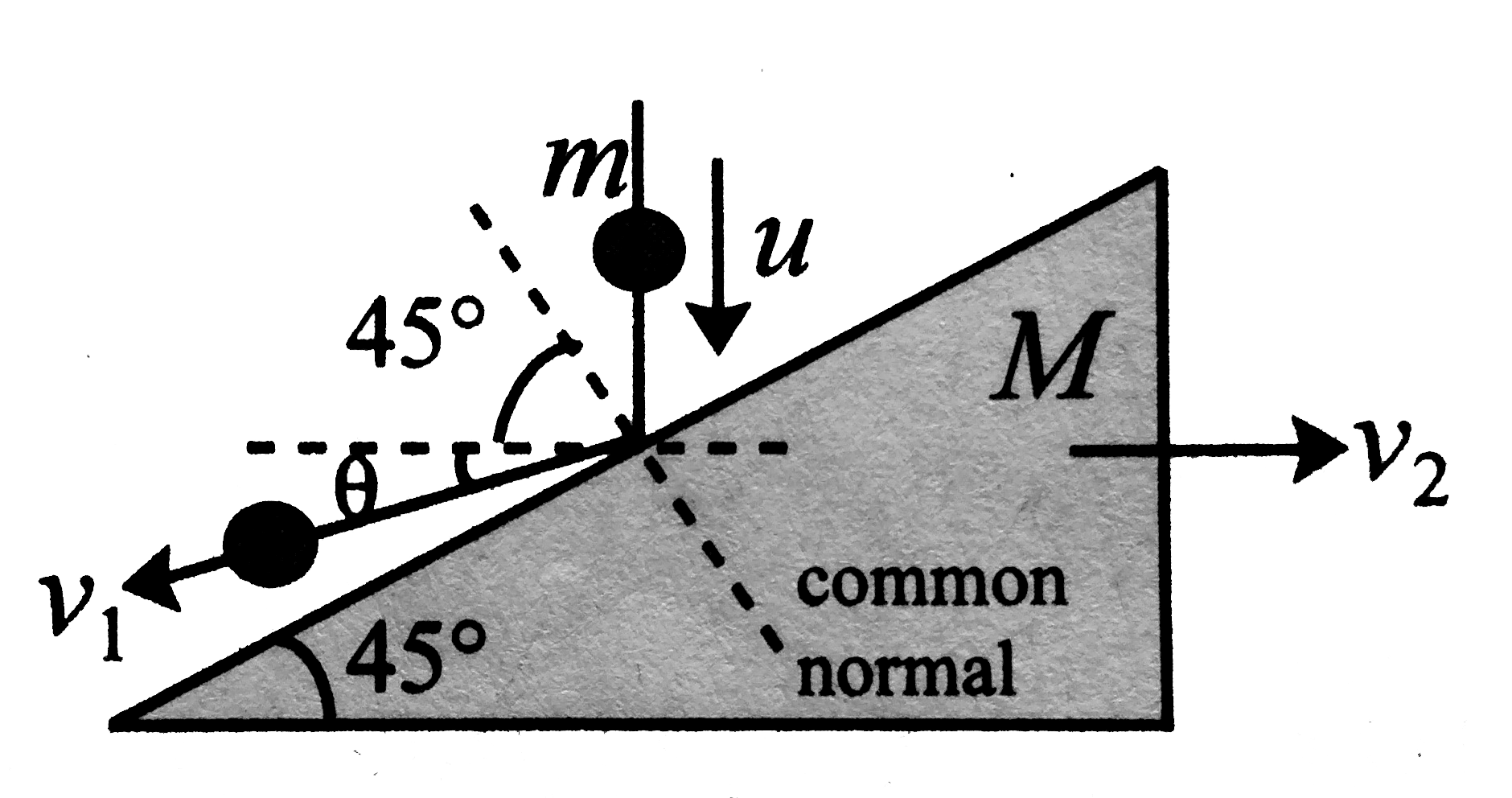 Aplying conservation of momentum in horizontal direction `mv_(1)costheta=Mv_(2)` ……….i From Newton's experimental LAW: `e=1=(v_(2)sin45^(@)-[-v_(1)cos(45+theta)])/(ucos45^(@))` `implies u=v_(2)+v_(1)costheta-v_(1)theta` ...........ii Velocity component of the ball along the surfasce of wedge will remain the same as during collision there is no force on the ball in this direction So `usin45^(@)=v_(1)cos(45-theta)impliesu=v_(1)costheta+v_(1)sintheta`...iii From i and ii and iii `v_(2)=(2"mu")/(m+2M)` To find maximum compression in the sprig, after collision apply conservation of energy for the SYSTEM of wedge and spring. `1/2 Mv_(2)^(2)=1/2Kx^(2)` `implies X=sqrt(M/x)v_(2)implies x((2"mu")/(m+2M))sqrt(M/K)` |
|
| 14. |
Calculate the amount nof heat required to change 5.0 kg of a ice to -20°Cinto steam at 100°C . |
| Answer» SOLUTION :`365*10^4 CAL` | |
| 15. |
A particle in a circular path speeds up with a uniform rate between two diametrically opposite points of a circle of radius R. If its time of motion between these two points is equal to T, find the accelertaion of the particle averaged over the time T. |
|
Answer» Solution :The average acceleration of the particle when it revolves HALF of the circle is : `a_(a v) = (|vec v - vec v_0|)/(DELTA T)` where `vec v = -v hat j, vec v_0= v_0 hat j`, and `Delta T = T` (given). Then `a_(a v) = (v + v_0)/(T)` Let US express `v + v_0` in terms of `R and T`. As the particle moves with constant angular acceleration its average angular velocity is `omega_(a v) = (Delta theta)/(Delta t) = (omega + omega_0)/(2)` where `omega = (v)/(R). omega_0 = (v_0)/( R), Delta theta = pi, and Delta t = T` Then, `v + v_0 = (2 pi R)/(T)` Sunstituting the value of `v + v_0` from Eq. (II) in Eq. (i), we have `a_(a v) = (2 P)/(T^2)`. 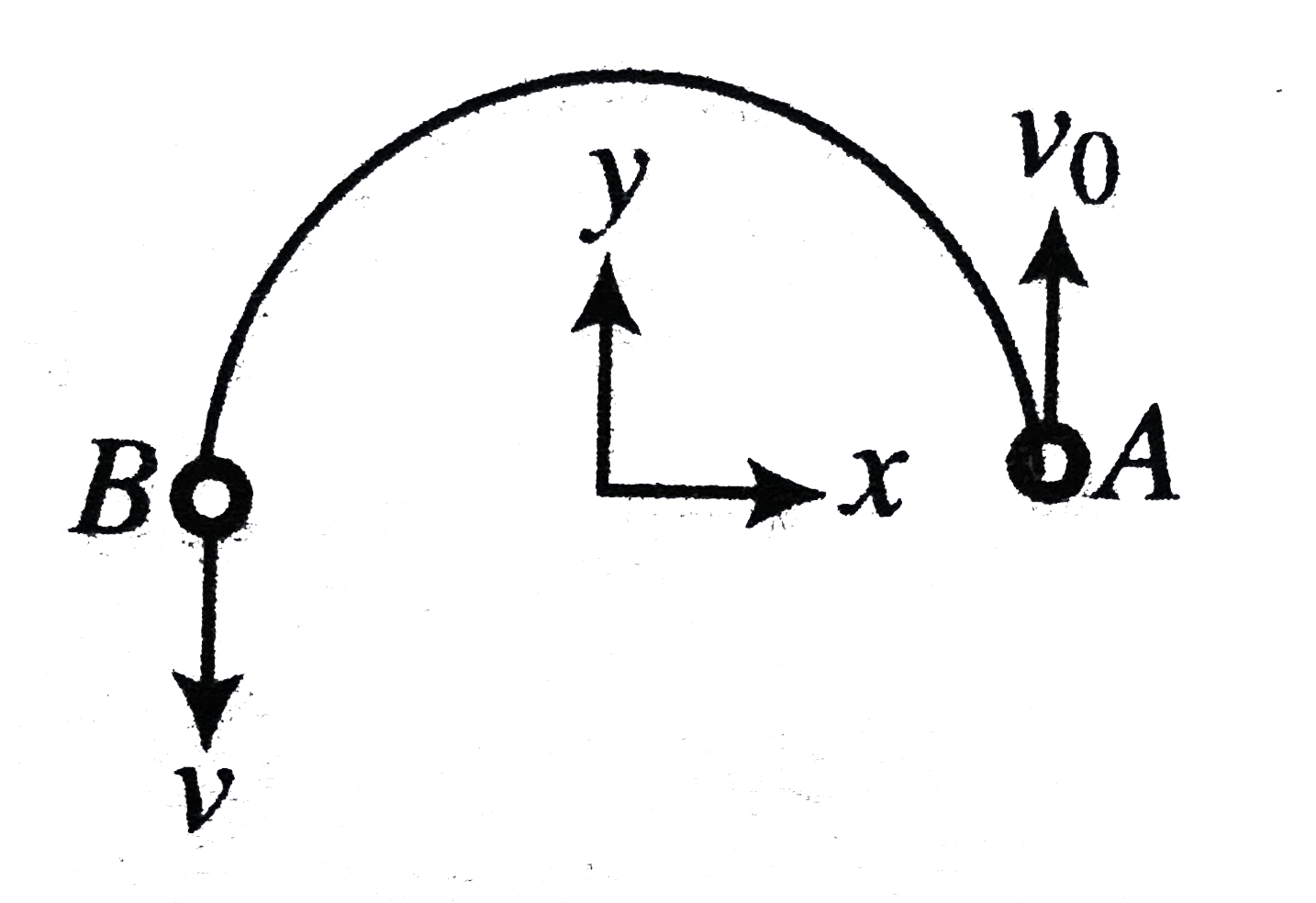 . .
|
|
| 16. |
A projectile of 2kg was velocities 3m/s and 4m/s at two points during its flight in the uniform gravitational field of the earth. If these two velocities are bot to each other then the minimum KE of the particle during its flight is |
|
Answer» Solution :`V_(1) cos alpha = V_(2) cos (90 - alpha)` `3 cos alpha = 4 SIN alpha` `tan alpha = (3)/(4)` `KE_("min") = (1)/(2)mv_(1)^(2) cos^(2) alpha` `= (1)/(cancel(2)) xx cancel(2) xx 3 xx ((4)/(5))^(2) = (9 xx 16)/(25) = 5.76 J` 
|
|
| 17. |
Explain the principle of homogeneity of dimensions. What are its uses? Given example. |
|
Answer» Solution :The principle of homogeneity of dimensions states that the dimensions of all the terms in a physical expression should be the same. For example, in the physical expression `v^(2)=u^(2) + 2as`, the dimensions of `v^(2),u^(2)` and 2 as are the same and equal to `[L^(2)T^(-2)]`. (i) To convert a physical quantity from one system of UNITS to another: This is based on the fact that the product of the numerical values (n) and its CORRESPONDING unit (u) is a constant. i.e, `n_(1),[u_(1)]` = constant (or) `n_(1)[u_(1)]= n_(2)[u_(2)]`. Consider a physical quantity which has dimension .a. in mass, .b. in length and .c. in time. If the fundamental units in one system are `M_(1), L_(1), "and" T_(1)` and the other system are `M_(2), L_(2) "and" T_(2)` respectively, then we can WRITE, `n_(1), [M_(1)^(a)L_(1)^(b)T_(1)^(c)]=n_(2)[M_(2)^(a)L_(2)^(b)T_(2)^(c)]` We have thus converted the numerical value of physical quantity from one system of units into the other system. Example: Convert 76 cm of mercury pressure into `Nm^(-2)` using the method of dimensions. Solution: In cgs system 76 cm of mercury pressure = `76 xx 13.6 xx 980` dyne `cm^(-2)` The dimensional formula of pressure P is `[ML^(-1)T^(-2)]` (ii) To check the dimensional correctness of a given physical EQUATION: Example: The equation `1/2 mv^(2)` = mgh can be checked by using this method as follows. Solution: Dimensional formula for `1/2 mv^(2) = [M][LT^(-1)]^(2) = [ML^(2)T^(-2)]` Dimensional formula for mgh = `[M][LT^(-2)][L] = [ML^(2)T^(-2)]` `[ML^(2)T^(-2)] = [ML^(2)T^(-2)]` both sides are dimensionally the same, hence the equation `1/2 mv^(2)` = mgh is dimensinally correct. (iii) To establish the relation among various physical quantities: Example: An expression for the time period T of a simple pendulum can be obtained by using this method as follows. Let true period T depend upon (i) miss m of the bob (ii) length l of the pendulum and (iii) ACCELERATION due to gravity g at the place where the pendulum is suspended. Let the constant involved is K = `2pi`. Solution: `Talpha m^(a) l^(b) g^(c)` `T = k. m^(a) l^(b) g^(c)` Here is the dimensionless constant. Rewriting the above equation with dimensions. `[T^(1)]=[M^(a)][L^(b)][LT^(-2)]^(c)` `[M^(0)L^(0)T^(1)] = [M^(a)][L^(b+c)][T^(-2c)]` Comparing the powers of M, L and T on both sides, a = 0, b + c = 0, -2c = 1 Solving for a, b and c a = 0, b = `1//2`, and c = `-1//2` From the above equation `T = k. m^(0) l^(1//2) g^(-1//2)` `T = k(l/g)^(1//2) = k sqrt(l/g)` Experimentally k = `2pi`, hence `T = 2pi sqrt(i=l/g)` |
|
| 18. |
For a car not to turn safely on a curved raod |
|
Answer» SPEED is slow |
|
| 19. |
Derive an expression for the kinetic energy, potential energy and pressure energy per unit mass of a liquid in a steady flow. |
|
Answer» Solution :When a liquid is in a steady flow can possess three kinds of energy. They are (i) Kinetic energy, (ii) Potential energy, and (iii) Pressure energy, respectively. (i) Kinetic energy:The kinetic energy of a liquid of mass m moving with a velocity v is given by `KE=(1)/(2)mv^(2)` The kinetic energy per unit mass `=(KE)/(m)` `=((1)/(2)mv^(2))/(m)=(1)/(2)v^(2)` The kinetic energy per unit volume `=(KE)/("volume")=((1)/(2)mv^(2))/(V)=(1)/(2)((m)/(v))v^(2)` `=(1)/(2)rhov^(2)` (ii) Potential energy:The potential ENERG of a liquid of mass m at a heighth above the ground LEVEL is given by `PE=mgh` The potential energy per unit mass `=(PE)/(m)=(mgh)/(m)=gh` The potential energy per unit `"volume"=(PE)/("volume")=(mgh)/(V)=((m)/(V))gh` `=rhogh` (iii) Pressure energy:The energy acquired by a fluid by APPLYING pressure of the fluid. We know that `"Pressure"=("Force")/("Area")` `RARR"""Force"="Pressure"xx"Area"` `Fxxd=(PA)xxd=P(Axxd)` `rArr""Fxxd=W=PV="pressure energy"` Therefore, pressure energy, `E_(p)=PV` The pressure energy per unit mass `=(E_p)/(m)` `=(PV)/(m)` `=(P)/(m//V)` `=(P)/(rho)` Similarly, the potential energy per unit `"Volume"=(E_p)/("volume")=(PV)/(V)=P` |
|
| 21. |
The period of a simple pendulum suspended from the ceiling of a car is T when the car is at rest. If the car moves with a constant acceleration the period of the pendulum |
|
Answer» UNALTERED |
|
| 22. |
A 4g bullet is fired horizontally with a speed of 300 m/s into 0.8kg block of wood at rest on a table and gets embedded in the block. If the coefficient of friction between the block and the table is 0.3, how far will the block slide approximately? |
|
Answer» 0.19 m |
|
| 23. |
If the coefficient of real expansion gamma_(r)is 1 % more then coefficient of apparent expansion, linear expansion coefficient of the material is |
|
Answer» `(gamma_(r))/(303)` |
|
| 24. |
When a steel pipe is hammered at one end, we hear two sounds at another end. Why ? |
| Answer» Solution :Because here one sound propagates in the SOLID medium of WALL of pipe and ANOTHER aound propagates in the air medium in the holow part of pipe with different speeds. Hence, we can HEAR them separately. | |
| 25. |
A quantity X is given by epsilon_(0)u(DeltaV) where epsilon_(0) is the permittivity of free space, DeltaV is potential difference and u is speed. The dimensional formula for X is the same as that of |
|
Answer» resistance |
|
| 26. |
Is the solar system n thermal equilibrium? |
| Answer» Solution :No, the solar system is not in thermal equilibrium. The sun continuously radiates HEAT energy in all directions. Every planet, satellite or object in the solar system absorbs this RADIATED heat. If the solar system is in thermal equilibrium, no heat FLOW will occur. This will CAUSE the thermal death of the solar system. | |
| 27. |
If lifeguard sitting outside a swimming pool observes a boy drowning in water, hastravel with maximum possible speeds in air and water to reach the boy in shortest time |
|
Answer» along strongest path from his initial position |
|
| 29. |
A flywheel of radiiis 10 cm mounted so as to rotate about a horizontal axis through its centre. A string of negligible mass wrapped round its' circumference carries' a mass of 200 gm attached to its free end, when let fall the mass descends through 100 cm is 5 s. Calculate the angular acceleration and the moment of inertia of the flywheel. |
| Answer» Solution :`F = 0.2 XX 9.8 = 1.96 N, tau =rF 0.1 xx 1.96 = 0.196 NM , alpha =2s//t^(2) =2 xx 1/25=0.08 ms^(-2),a=a//r =0.8 "RADS"^(-2), I=tau//alpha=0.245 kg m^(2)` | |
| 30. |
Explain why (a) Two bodies at different temperatures T_(1) and T_(2) if brought in thermal contact do not necessarily settle to the mean temperature (T_(1) + T_(2))//2. (b) The coolant in a chemical or a nuclear plant (i.e., the liquid used to prevent the different parts of a plant from getting too hot) should have high specific heat. (c) Air pressure in a car tyre increases during driving. (d) The climate of a harbour town is more temperate than that of a town in a desert at the same latitude. |
|
Answer» a and C are CORRECT |
|
| 31. |
How many amplitudes of SHO covers the distance in the half period? |
| Answer» SOLUTION :As MUCH as TWO AMPLITUDES. | |
| 32. |
Read the following two statements below carefully and state, with reasons, if it is true or false, (a) The Young's modulus of rubber is greater than that of steel, |
|
Answer» Solution :False : ? Young.s modulus`= ("Stress")/("Strain")= ("Stress")/(Delta L//L)` For given stress there is more strain in rubber than steel and modulus of ELASTICITY is INVERSELY proporational to strain. Hence, Young.s modulus of steel is more than that or rubber: (b) Stretching of a coil is determined by its SHEAR modulus. When equal and oppositte FORCES are applied at opposite ends of a coil, the DISTANCE as well as shape of helicals of the coil change and it involves shear modulus. Hence there is relation between stretching of a coil shear modulus. So, given statement is correct. |
|
| 33. |
A body of mass 0.3 kg is taken up an inclined plane of length 10 m and height 5 m, and then allowed to slide down the bottom again. The coefficient of friction between the body and the plane is 0.15. What is the (i) work done by the applied force over the upward journey? (ii) work the by gravitational force over the round trip? (iii)work the by the frictional force over the round trip? Which of the above forces (except applied force )is/are conservative forces? |
Answer» Solution :Upward journey - Let us calculate work done by different forces over upward journey. Work done by gravitational force, `W_(1)=(mg SIN theta)"s " cos 180^(@)` `W_(1)=0.3xx10" sin " 30^(@)xx10(-1)` `W_(1)=-15 J` Work done by force of FRICTION, `W_(2)=(mu " mg cos"theta)s cos 180^(@)` `W_(2)=0.15xx0.3xx10" cos"30^(@)xx10[-1]` `W_(2)=-3.879 J` Work done by external force, `W_(3)=F_(ext)xx s xxcos0^(@)` `W_(3)=[mg" sin"theta + mu "mg cos"theta]xx10xx1` `W_(3)`=18.897 J Downward journey Work done by the gravitational force, `W_(4)=mg" sin"30^(@)xx"s " cos0^(@)` `W_(4)=0.3xx10xx(1)/(2)xx10=-15 J` Work done by the FRICTIONAL force , `W_(5)=mu" mg " cos30xx"s cos" 180^(@)` `=0.5xx0.3(10sqrt3)/(2)xx10xx(-1)` =-3.897 (i) Work done by appllied force over upward journey, `W_(3)`=18.897 J (ii) Work done by gravitational force over the round trip `=W_(1)+W_(4)=0 J` (iii) Work done by the frictional force over the round trip, `W_(2)+W_(5)`=-3.897+(-3.897)=-7.794 J Work done by gravitational force over a closed path is zero but DUE to frictional force, it is non zero.Therefore,gravitational force is conservative and frictional force is non-conservative. |
|
| 34. |
You work in materials testing lab and your boss tell you to increase the temperature of a sample by 40.0°C. The only thermometer you can find at you workbench reads in °F. If the initial temperature of the sample is 68.2°F. The temperature in F, when the desired temperature increase has been achieved is |
| Answer» ANSWER :B | |
| 35. |
The two fermurs each of cross sectional area 10cm^(2) support the upper part of a human body of mass 40 kg. The average pressure sustained by the femurs is (Take g=10m^(2)) |
|
Answer» `2XX10^(3)Nm^(-2)` |
|
| 36. |
The displacement x and time for a particle are related to each other as t = sqrt(x) + 3. What is work done in first six seconds of its motion? |
|
Answer» Solution :From `sqrt(x) + 3 = t, x = (t - 3)^2` Now, `v = (DX)/(dt) = 2(t -3)` At `t = 0, v_1 = 2(-3) = -6` At `t = 6 , v_2 = 2(6 - 3) = 6` Work done = Change in KE = `1/2 m (v_2^2 - v_1^2)` = zero. |
|
| 37. |
A force F= 4x + 8 (in N) is acting on a block where x is the position of block in metre, The energy of oscillation is 32J, The block oscillates between two points, out of which value of position of one point (in metre) is an integer from 0 to 9. Find it. |
|
Answer» |
|
| 38. |
Air is streaming past the wings of an acroplane with a speed of 90ms^(-1) below and 120ms^(-1) above the surface. If the wing is 15 m long and has an average width of 2m, then: Density of air =1.2kg//m^(3)] |
|
Answer» Pressure difference between the BOTTOM and top of he wing is4090 Pa |
|
| 40. |
If a disc of mass m and radius R totates with an angular acceleration a, of the torque acting on the disc is |
|
Answer» `14.29"RADS"^(-1)` |
|
| 41. |
Dimcnsional analysis of the relation (Energy) = ("Pressure difference")^(3//2) ("Volume")^(3//2)gives the value of n as |
|
Answer» 3 |
|
| 42. |
A copper block of mass 500 gm and specific heat 0.1 "cal/gm"^@C is heated from 30^@C" to " 290^@C , the thermal capacity of the block is |
|
Answer» `50"CAL/"^@C` |
|
| 43. |
A quillof 0.100 gm is falling with a velocity of (-0.05hatj)m//s. When blown from lower side, its velocity changes to (0.2hati+0.15hatj)m//s. The change in its momentum will be……..kg m/s. |
|
Answer» `2xx10^(-2)hati+2xx10^(-2)hatj` `=m[vec(v_(2))-vec(v_(1))]` `=0.1xx10^(-3)[0.2hati+0.15hatj-(-0.05)hatj]` `=10^(-4)[0.2hati+0.20hatj]` `=[2xx10^(-5)hati+2xx10^(-5)hatj]kgm//s` |
|
| 44. |
A tank full of water has a small hole at its bottom. If one fourth of the tank is emptied in t_(1) seconds and the remaining three-fourths of the tank is emptied in t_(2) seconds. Then the ratio (t_(1)//t_(2)) is |
|
Answer» `SQRT(3)` |
|
| 45. |
A gas at 10^@C temperature and 1.013xx10^5 Papressure is compressed adiabatically to half of itsvolume. If the ratio of specific heats of the gas is 1.4, what is its final temperature? |
| Answer» Answer :A | |
| 46. |
Consider the following A and B, and identify the correct choice in the given answers. (A) For a body resting on a rough horizontal table, it is easier to pull at angle that push at the same angle to cause motion(B) A body sliding down a rough inclined plane of inclination equal to angle of friction has nonzero acceleration |
|
Answer» Both A and B are TRUE |
|
| 47. |
The Young's modulus of a wire of length L and radius r is Y. If the length is reduced to L/2 and radius to r/2, its Youn's modulus will be …………. . |
|
Answer» `Y/2` |
|
| 48. |
0.75 gram of petroleum was burnt in a bomb calorimeter which contains 2 kg of water and has a water equivalent 500 gram. The rise in temperature was 3^(@)C. Determine the calorific value of petroleum. |
|
Answer» |
|
| 49. |
Through the law gives women equal status in india, many people hold unscientific views on a woman's innate nature, capacity and intelligence, and in pracitce give them a secondary status and role. Demolish this view using scientiffc arguments, and by quoting examples of great women in science and other spheres , and persuade yourself and others that, given equal opportunity, women are on par with men. |
|
Answer» Solution :GIVEN equal opportunity, WOMEN are at par with men. Development of human mind depends basically on nutrition content of PRENATAL and postnatal DIET, and also on the care and use of mind. There is no gender bias involved. Anything which can be achieved by man's mind can also be achieved by woman's mind. Madam Curies won Nobel prize in physics. Mother Teresa proved herself a saint. In politics, Mrs. Indira Gandhi, Mrs. Margaret Thatcher, Mrs. Bhandrnika excelled others. |
|
| 50. |
The acceleration due to gravity at a height h above the surface of the earth is the same as its value at a depth d below the earth's surface . Find the relationship between d and h. |
|
Answer» SOLUTION :Acceleration due to GRAVITY at a height , `g_1=g(1-(2H)/R),` where R=radius of the EARTH ALSO, the value of acceleration due to gravity at a depth d. `g_2=g(1-d/R)` Given `g_1=g_2 or, g(1-(2h)/R)=g(1-d/R) or, d=2h`. |
|