

Saved Bookmarks
This section includes 7 InterviewSolutions, each offering curated multiple-choice questions to sharpen your Current Affairs knowledge and support exam preparation. Choose a topic below to get started.
| 1. |
A particle is projected from the ground with velocity u making an angle theta with the horizontal. At half of its maximum heights, |
|
Answer» its horizontal VELOCITY is `ucos theta` |
|
| 2. |
As shown in figure, S is a point on a uniform disc rolling with uniform angular velocity on a fixed rough horizontal surface. The only forces acting on the disc are its weight and contact forces exerted by horizontal surface. Which graph best represents the magnitude of the acceleration of point S as a function of time |
|
Answer»
|
|
| 3. |
The acceleration due to gravity on moon is only one sixth that on earth. Ratio of moon radius (R_m) to earth.s radius (R_e) should be: (a)6/1 if both are assumed to have same density (b)1/6 if both are assumed to have same density (c)5/18 if rho_e/rho_m is given as 5/3 (d)9/5 if rho_m/rho_e is given as 3/5 |
|
Answer» only a & B are true |
|
| 4. |
Give examples of dimensional constants and dimensionless constants. |
|
Answer» Solution :DIMENSIONAL Constants : GRAVITATIONAL CONSTANT and Planck.s constant. Dimensionless Constants : `pi` and E. |
|
| 5. |
A wet ball is projected horizontally at a speed of u = 10 m//s from the top of a tower h = 31.25 mhigh. Water drops detach from the ball at regular intervals of Deltat = 1.0 s after the throw. (a) How many drops will detach from the ball before it hits the ground. (b) How far away the drops strike the groundfrom the point where the ball hits the ground? |
|
Answer» |
|
| 6. |
(A) : When n liquid drops combine to form large drop energy is released. (R ) : When n liquid drops combine the total surface area decreases. |
|
Answer» Both (A) and (R ) are true and (R ) is the CORRECT explanation of (A) |
|
| 7. |
The ratio of energy required to accelerate a car from rest to 20 ms^(-1) to the energy needed to accelerate from 20ms^(-1) to 40 ms^(-1) is |
| Answer» ANSWER :B | |
| 8. |
A train 100 m long is moving with a speed of 60kmh^(-1). In how many seconds will it cross a bridge of 1 km long? |
|
Answer» SOLUTION :Total distance to be covered `=1km+100m=1100m` (including both BRIDGE and time) Then, Speed `=60kmh^(-1)=60xx(5)/(18)MS^(-1)=(50)/(3)ms^(-1)` Then, time taken to COVER this distance `(1100)/(150//9)s=66s` |
|
| 9. |
A man stands on a frictionless horizontal ground. He slides a 10 kg block on the surface with a speed of 3 m/s relative the ground, towards a vertical massive wall. The wall itself it moving towards the man at a constant speed of 2 m/s. The block makes a perfectly head on elastic collision with the wall, rebounds and reaches back to the man 3 second after the throw. At the moment the block was thrown, the wall was at a distance of10 m from the man. (a) Find the mass of the man. (b) Find the ratio of work done by the man in throwing the block to the work done by the wall on the block. |
|
Answer» (B) `(1)/(4)` |
|
| 10. |
The potential energy U of a particle varies with distance x from a fixed origin as U = (Asqrt(x))/(x^(2)+B)where A and B are dimensional constants. The dimensional formula for AB is |
|
Answer» `[M^(1)L^(7//2)T^(-2)]` B must have the dimensions of `A= [(UX^(2))/(sqrt(x))]= ([ML^(2)T^(-2)][L^(2)])/([L^(1//2)])= [ML^(7//2)T^(-2)]` `:.`the DIMENSIONAL FORMULA for `AB = [ML^(7//2)T^(-2)][L^(2)]= [M^(1)L^(11//2)T^(-2)]` |
|
| 11. |
Give the difference between elastic and inelastic collision. |
Answer» SOLUTION :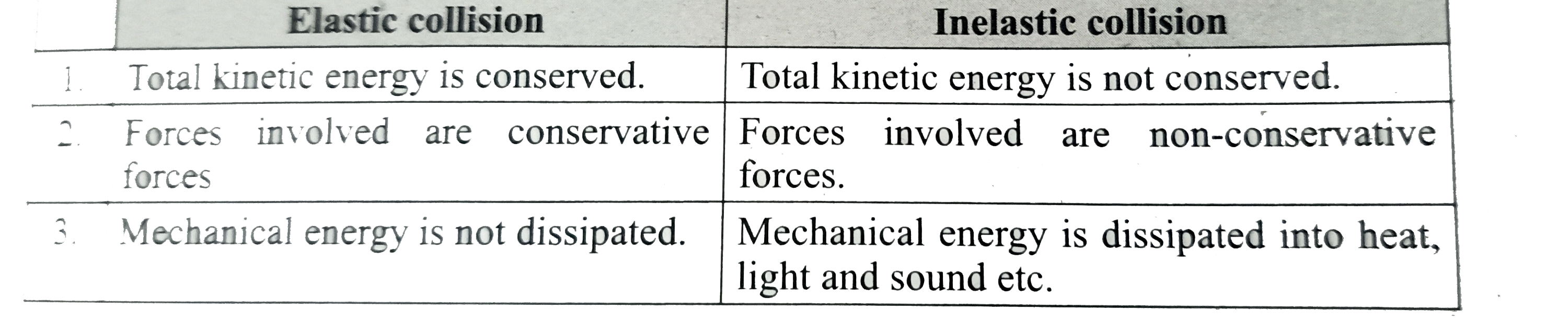
|
|
| 12. |
A truck and a car are moving with the same kinetic energy on a streight road. Their engines are simultaneously switched off. Which one will stop at a distance? |
|
Answer» Solution :CHANGE in KE = work done by the force of FRICTION = Fs = `mu Ns = mu mgs` `therefore s = "change in KE"/(mumg)` For a constant change in KE, stopping distance `s= prop 1/m`. Since the TRUCK is more massive, it will STOP in a lesser distance. |
|
| 13. |
A ray of light is incident at an angle of 60^@ on one face of prism which has an angle of 30^@. The ray emerging out of the prism makes an angle of 30^@ with the incident ray. Show that the emergent ray is perpendicular to the face through which it emerges and calculate the refractive index of the material of the prism? |
|
Answer» Solution :According to given problem `A=30^@, i_1=60^@ and DELTA=30^@` and as in prism, `delta=(i_1+i_2)-A` `30^@=(60^@+i_2)-30^@ i.e., i_2=0^@` So the emergent RAY is perpendicular to the FACE from WHICHIT EMERGES Now as `i_2=0,r_2=0` But as `r_1+r_2=A, r_1=A=30^@` So at first face `1 sin 60^@=mu sin 30^@` i.e. `mu=sqrt3` 
|
|
| 14. |
A satellite is orbiting in an orbit with a velocity 4km/sThen find acceleration due to gravity at that height . |
|
Answer» Solution :As centripetal acceleration equals to acceleration due to GRAVITY at that HEIGHT, then `a=V^2/R= g_(H) and V^2 =(GM)/r = (gR^2)/r` `implies r = (gR^2)/V^2 = (10xx6400 xx10^(6))/(16xx10^(6))(G= 10m//s^2)` `=25600Km` `:.g_(h)=a=V^2/r = (16xx10^6)/(25600xx10^3) = 10/16 m//s^2` |
|
| 16. |
Two wheels of M.I. 3 kg m^(2) and 5 kg m^(2) are rotating at the rate of 600 rpm and 800 rpm respectively in the same direction. If the two are coupled so as to rotate with the same axis of rotation, the resultent speed of rotation will be (in rpm). |
|
Answer» 725 |
|
| 17. |
According to the kinetic theory of gases, gas molecules are always in random motion. Write the average value of energy of a molecule for each vibrational mode. |
| Answer» SOLUTION :E = `k_BT` | |
| 18. |
Two blocks are in contact on a frictionless table . A horizontal force is applied to one block as shown in fig . If m_(1)=10kg "and" m_(2)=5kg "and" F=15N. Find the force of contact between the two bodes. |
|
Answer» |
|
| 19. |
Which of the following figures cannot be speed-time graph ? |
|
Answer»
|
|
| 20. |
A cricketer bowler releases the ball in two differnet ways (a) giving it only horizontal velocity and (b) giving it horizotal velocity and a small downward velocity The speed upsilon_(s) at the time of release is the ball hits the ground ? Neglect air resistance . |
|
Answer» Solution :(a) When horizontal velocity = `upsilon_(s)` and there is no DOWNWARD velocity given , As SHOWN in `upsilon_(z) = sqrt(2 g H)` `:.` velocity on hitting the ground `upsilon sqrt(upsilon_(s)^(2) + upsilon_(z)^(2)) = sqrt(upsilon_(s)^(2) + g H` (B) When horizontal velocity= `upsilon_(s)` and downward velocity= u as shown Then `u_(z) = sqrt(u^(2) + 2 gH` velocity on hitting the ground `upsilon = sqrt(upsilon_(s)^(2)+upsilon_(z)^(2)) = sqrt(upsilon_(s)^(2) + u^(2) + 2 gh)` CLEARLY `upsilon' gt upsilon` Note If u is taken as negligibly small then `upsilon = upsilon` 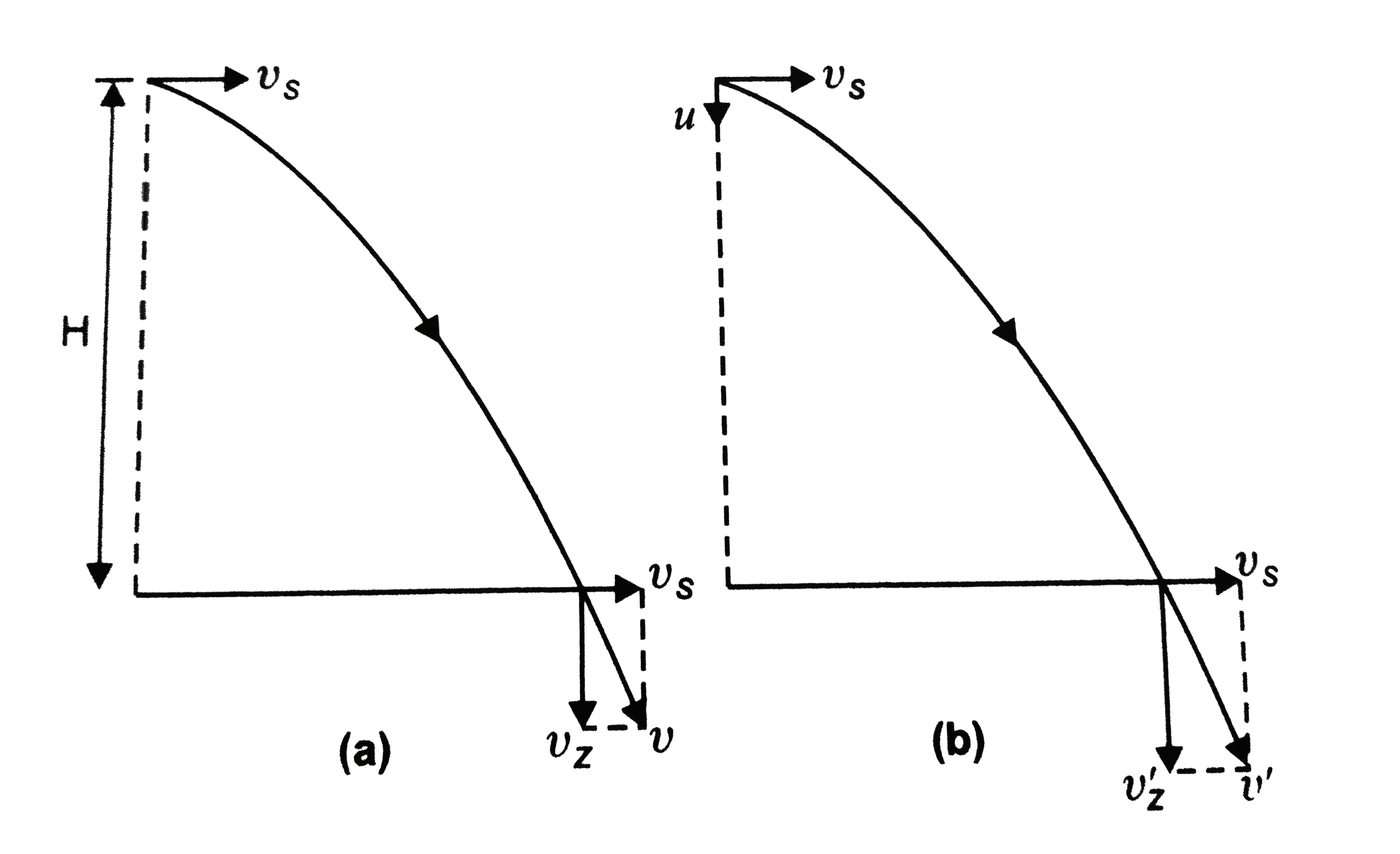 . .
|
|
| 21. |
Two identical cars A and B are moving at 36 kmph. A goes on a bridge, convex upward and .B. on concave upward. If the radius of curvature of bridge is 20 m, the ratio of normal forces exerted on the cars when they are at the middle of bridges (g=10 ms^(-2)) |
|
Answer» `1:3` |
|
| 22. |
In the figure-4.133 shown A is a ball of mass 2kg fixed at its position and S_(1), S_(2) are the walls facing A. Another ball B of mass 4 kg incident on the wall at an angle of incidence 60^(@) and then successively it collides elastically with wall and as shown in figure-4.132. Trace the locus of centre of mass of the two balls during the motion of the ball B |
|
Answer» |
|
| 23. |
The length of a brass rod at 0^(@)C is 10m. Find its length at 100^(@)C if alpha of brass is 18xx10^(-6)""^(0)C^(-1). |
|
Answer» |
|
| 24. |
The displacement of a SHM doing oscillation when KE=PE(amplitude=4cm) is |
| Answer» Answer :A | |
| 25. |
Which one has not the same unit as other? |
| Answer» Solution :Watt sec, kilowatt hr, and eV all are the UNITS of energy | |
| 26. |
A uniform disco of mass M and radius R, is resting on a table on its rim. The coeffecient of friction between disc and table is mu. Now the disc is pulled with a force F as shown in the figure. What is the maximum value of F for which the disc rolls without slipping? |
|
Answer» `F_("max")=3 muMg` Frictionalforce (f)is actingin theoppositedirectionof F Lettheacceelerationofcentre of massof discbe a then `F-F=Ma` where M ismass of thedisc 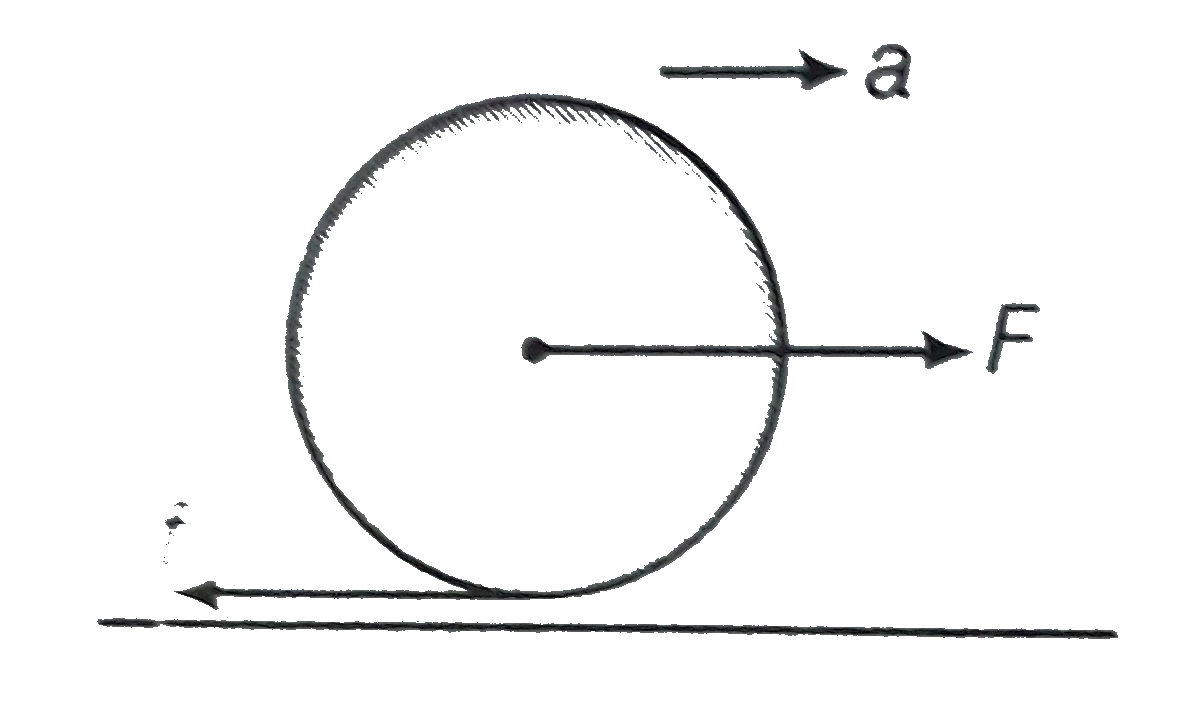 theangularaccelerationof thediscis `alpha=a//R ""("for pure rolling")` from`tau=//alpha` `implies fR=((1)/(2)MR^(2))alphaimpliesfR=((1)/(2)MR^(2))((a)/(R))` `implies Ma = 2F` ....(ii) from Eqs. (i) and (ii)we get `f=F//3[:' N=mg]` `:'fle MU N =mu mg` ` (F)/(3)lemuMgimpliesF le3mu Mg` `implies F_("max")=3 muMg` |
|
| 27. |
When a particle moving in a vertical circle the variable is are |
|
Answer» VELOCITY of the PARTICLE |
|
| 28. |
Electric charge is uniformly distributed along a long straight wire of radius 1 mm. The charge per cm length of the wire is Q coulomb. Another cylindrical surface of radius 50 cm and length 1 m symmetrically enclosed the wire as shown in the figure. Find the total electric flux passing through the cylindrical surface. |
| Answer» SOLUTION :`(100Q)/in_0` | |
| 29. |
Discuss the motion of an object under free fall. Neglect air resistance. |
|
Answer» Solution :An object RELEASED near the surface of the Earth is ACCELERATED downward under the influence of the force of gravity. The MAGNITUDE of acceleration due to gravity is represented by g: If air resistance is neglected, the object is said to be in free fall. If the height through which the object falls is small compared to the earth.s radius, g can be taken to be constant, equal to 9.8 `ms^(-2.)` Free fall is THUS a case of motion with uniform acceleration. We assume that the motion is in y-direction, more correctly in - ydirection because we choose upward direction as POSITIVE. Since the acceleration due to gravity is always downward, it is in the negative direction and we have a = - g = - 9.8 `ms^(-2)` The object is released from rest at y = 0. Therefore, `v_(0) = 0` and the equations of motion become : `v =0 - g t =- 9.8 t ms ^(-1)` `y =0 -1/2 g t ^(2) =- 4.9 t ^(2) m` `v ^(2) =0 - 2 gy =- 19.6 ym ^(2)s ^(-2)` These equations give the velcity and the distance travelled as a functino of time and also the variation of velocity with distance. The variation of acceleration, velocity and distance with time have been plotted in (a), (b) and (c) 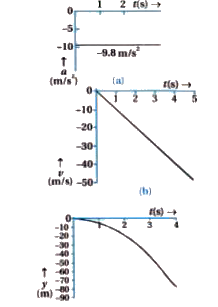
|
|
| 30. |
A train of mass 800 metric tons is moving with a velocity of 72 KMPH. If the resistive force acting on the train is 10N per metric ton, the power of the engine is |
|
Answer» 16 KW |
|
| 31. |
A bar with a crack at its centre buckles as a result of temperature rise of 32^(0)C. If the fixed distance L_(0) is 3.77m and the coefficient of linear expansion of the bar is 25xx10-6//0C find the rise x of the centre. |
|
Answer» Solution :Consider one half of the bar, its initial length `l_(0)=(L_(0))/(2)` Its length after increase in temperature`DELTAT , l=l_(0) (1+alpha DeltaT)` By Pythogoras theorem `X^(2)=l^(2)-l_(0)^(2)` `= l_(0)^(2)(1+2alphaDeltaT-1) or x=l_(0) sqrt(2alpha DeltaT)` `=(3.77)/(2) sqrt(2(25xx10^(-6) XX 32))=7.5xx10^(-2)m` |
|
| 32. |
In the above question 63 distance between the man and the block 'A', when man reaches the pulley is: |
|
Answer» 10 m |
|
| 33. |
For particle in SHM, the displacement x of the particle as a function o time t is given as x=A sin (2pi t). Here x is in cm and t is in second. Let the time taken by the particle to travel from x=0to x=(A)/(2) be t_(1) and the time taken to travel from x=(A)/(2) to x=A be t_(2) find (t_(1))/(t_(2)) |
|
Answer» SOLUTION :Here x=0 at t=0 Also `omega =(2pi)/(T)= 2pi, "":. T=1s` At `t=t_(1), x=(A)/(2)` `(A)/(2)=A sin (2pi t_(1))` (or) `(1)/(2)= sin (2pi t_(1))` `:. 2pi t_(1)=(pi)/(6) (or) t_(1)=(1)/(12) s` TIME taken from x =0 to `x=A` is `(T)/(4)=(1)/(4)s` (or) `t_(1)+t_(2)=(T)/(2)=(1)/(4)s` Hence `(t_(1))/(t_(2))=(1//12)/(1//6)=(1)/(2)` |
|
| 34. |
SI unit of Stefan's constant is ____ . |
|
Answer» WATT `m^(2)K^(4)` |
|
| 35. |
Two masses 8 kg and 12 kg are connected at the two ends of a light inextensible string that goes over a frictionless pulley. Find the acceleration of the masses and the tension in the string when the masses are released. |
|
Answer» Solution :Let `m_(1)= 8 kgm_(2)= 12 KG` Lettensionin stringbe T  Let commonaccelerationof systemisa Accelerationof `m_(1)`is inupwarddirectionaccelerationof `m_(2)`is indownwarddirectionequationof motionof `m_(1)` Bytakingadditionof equation(1) and(2) we getcommonaccelerationof SYSTEM `(m_(2)- m_(1))g= (m_(1) + m_(2))a` `=((12-8)/( 8+12))xx 10` `T = m_(1)g + m_(1)((m_(2)-m_(1))/( m_(1)+ m_(2))) g` `T= ((2m_(1)m_(2))/( m_(1)+m_(2)))g` Substitutingvalue `T=(2xx 8 xx 12)/( 8+ 12)xx 10` `T= (2xx960)/(20)` `:. T = 96 N` Letmass ofnucleusis mandinitialvelocityv= 0 initialmomentum`vec(p )_(1)=- mV =0` Afterdisintergrationit isdividedintotwopartlet mass be `m_(1)`and `m_(2)`and velocitybe `vec( V ) _(1)`and`vec(2)` respectively By lawof conservationof linearmomentum `vec(p )_(1)= vec( p)_(f)` `:.,m_(2)v_(2)= -m_(1) m_(1)` Negativesighshowsthatvelocityof bothfragmentare inmutuallyoppositedirection |
|
| 36. |
Whena metal rod is cooled from 500^(0)Cto 0^(0)C, its density increases by1.027times. Determine the coefficient of linear expansion of this metal. |
|
Answer» SOLUTION :`t_(2)=500^(@)C, t_(1)=0^(0)C, d_(0)=1.027 d_(t)` `gamma =(d_(0)-d_(t))/(d_(t)(t_(2)-t_(1)))=((1.027-1))/((500)) = (0.027)/(500), alpha=(gamma)/(3)=(0.027)/(3xx500) = 0.000018//""^(0)C`. |
|
| 37. |
A mixture of n_(1) moles of monoatomic gas and n_(2) moles of diatomic gas has C_(P)/C_(V)=gamma=1.5 |
|
Answer» `n_(1)=n_(2)` |
|
| 38. |
The correct graph betweenn surface tension T and temperature thetais low temperature range is |
|
Answer» |
|
| 39. |
Two particles 1 and 2 move along the x axis. The position (x) - time (t) graph for particle 1 and velocity (v) - time (t) graph for particle 2 has been shown in the figure. Find the time when the two particles collide. Also find the position (x) where they collide. It is given that x_(0) = ut_(0), and that the particle 2 was at origin at t = 0. |
|
Answer» |
|
| 40. |
The frequency of a radar is 780 MHz. When it is reflected from an approaching aeroplane the opponent frequency is more than the actual frequency by 2.6 kHz. The speed of the aeroplane is ……………. . |
|
Answer» 0.25 KM/ s `implies Delta v = (2vf)/(c - f) ~~ (2vf)/(c) implies v = (2 Delta v)/(2V) = (3 xx 10^(8) xx 2.6 xx 10^(3))/(2 xx 780 xx 10^(6)) = 0.5 xx 10^(3)` m/s |
|
| 41. |
By which number the elastic collision if the body be measured ? |
| Answer» SOLUTION :By COEFFICIENT of RESTITUTION | |
| 42. |
The freezing point of the liquid decreases when pressure is increased, if the liquid |
|
Answer» Expands while FREEZING |
|
| 43. |
A small block of mass m is projected horizontally from the top of the smooth and fixed hemisphere of radius r with speed u as shown. For values of uleu_(0)(u_(0)=sqrt(gr)) it does not slide on the hemisphere (i.e leaves the surface at the top itself) For u=2u_(0) it lands at point P on ground. Find OP. |
| Answer» ANSWER :D | |
| 44. |
A small block of mass m is projected horizontally from the top of the smooth and fixed hemisphere of radius r with speed u as shown. For values of uleu_(0)(u_(0)=sqrt(gr)) it does not slide on the hemisphere (i.e leaves the surface at the top itself) For u=u_(0)//3, find the height from the ground at which it leaves the hemisphere. |
|
Answer» `(19r)/9` |
|
| 45. |
When a motor car moves speedily on a convex path, how do the passengers inside the car feel? |
|
Answer» |
|
| 46. |
In Carnot cycle at the end of the cycle, the teperature of working substance is : |
|
Answer» less than INITIAL temperature |
|
| 47. |
If a liquid is heated in weightlessness, the heat is transmitted through |
|
Answer» Conduction |
|
| 48. |
Shearing stress causes change in |
|
Answer» Length |
|
| 49. |
Distinguish between streamlined and turbulent flow. |
Answer» SOLUTION :
|
|
| 50. |
A container carrying some liquid shown in the diagram is given some acceleration veca. |
|
Answer» <P>if `veca` is directed upwards, `P_(A)-P_(B)` increases |
|


