

Saved Bookmarks
This section includes 7 InterviewSolutions, each offering curated multiple-choice questions to sharpen your Current Affairs knowledge and support exam preparation. Choose a topic below to get started.
| 1. |
When 1 N forceis applied increase in length ofthe springis 1 cm . Find elastic potential energystoredduringthis in it . |
|
Answer» `10 xx10^(-3)J ` (neglectingnegativesign ) ` U = 1/2 kx^(2) = 1/2 xx10^(2) XX (10^(-2))^(2)` ` = 5xx10^(-3) J ` . |
|
| 2. |
The mass of a planet is 1/25th of the mass of the earth. The distance between the planet and the earth is 6xx 10^8 m. At what distance from the earth, the gravity becomes zero |
|
Answer» `1xx10^8` m |
|
| 3. |
The bulbs of two identical thermometers A and B are coated, one with lamp black and the other with silver. Both are exposed to Sun. Then |
|
Answer» Initial reading of A is more than that of B |
|
| 4. |
Obtain an ideal gas law from Boyle's and Charles' law. |
|
Answer» Solution :Boyle.s law: When the gas is kept at CONSTANT temperature, the pressure of the gas is inversely proportional to the VOLUME `P PROP (1)/(V)` Charles. law: When the gas is kept at constant pressure, the volume of the gas is DIRECTLY proportional to absolute temperature `V prop T.` |
|
| 5. |
The velocity at the maximum height of aprojectile is sqrt(3)/2times the initial velocity of projection. The angle of projection is |
| Answer» Answer :C | |
| 6. |
A train is moving with a speed of 72 kmh^(-1) on a curved railway line of 400 m radius. A spring balance loaded with a block of weight 5 kg is suspended from the roof of the train. What would be the reading of the balance? Take g = 10 ms^(-2). |
|
Answer» |
|
| 7. |
In the previous problem, if unstretched length of the spring is I, find the distance of the mean position of SHM from the block of mass m_1 |
|
Answer» `(m_1l)/((m_1 + m_2))` |
|
| 8. |
Give various applications of viscosity |
| Answer» Solution :(i) The oil used as a LUBRICANT for HEAVY machinery parts should have a high viscous coefficient. To select a suitable lubricant, we should know its viscosity and how it varies with temperature. [Note: As temperature increases, the viscosity of the liquid decreases]. Also, it helps to choose oils with low viscosity used in car engines (LIGHT machinery). (ii) The highly viscous liquid is used to damp the motion of some instruments and is used as brake oil in hydraulic brakes. (iii) BLOOD circulation through arteries and veins depends UPON the viscosity of fluids (iv) Millikan conducted the oil drop experiment to detennine the charge of an electron. He used the knowledge of viscosity to determine the charge . | |
| 9. |
System shown in figure is released from rest. Pulley and spring are massless and friction is absent every where. The speed of 5 kg block when 2 block leaves a contact with ground is [k=40N/m"and" g=10ms^(-2)] |
|
Answer» `SQRT(2)MS^(-1)` |
|
| 10. |
(A) : In elastic collision, kinetic energy is conserved.(R ) : Energy is always conserved. |
|
Answer» Both (A) and (R ) are TRUE and (R ) is the correct explanation of (A) |
|
| 11. |
100 g of ice at 0^(@)C is mixed with 100 g of water at 80^(@)C. The resulting temperature is 6^(@)C. Calculate heat of fusion of ice. |
|
Answer» Solution :`overset("ICE")(at0^(@)C)rarroverset(water)(at0^(@)C)rarroverset(water)(at6^(@)C)` `m_(1)c_(1)(80-6)=m_(2)L+m_(2)c_(2)(6-0)` `100xx1xx74=100L+100xx1xx6` `L=(1xx74)-6` `=68cal//g.` |
|
| 12. |
What is the maximum speed with which a cylist can turn around curved path of radius 10.0 m, if the coefficient of friction between the tyre and the road is 0.5 ? If the cyclist wants to avoid overturning by what angle the cyclist must lean from the vertical ? |
|
Answer» Solution :Radius = r=10.0 m MU = 0.5` MAXIMUM speed `=V= sqrt(murg) = sqrt(0.5 xx 10.0 xx 9.8) = 7`m/s For no overturning, `tan theta = v^(2)/(rg) = (murg)/(rg) = mu = 0.5` `therefore = 26.8^(@)` |
|
| 13. |
A particle describes a horizontal circle on the smooth inner surface of conical funnel whose vertex angle is 90^(@). If the height of the plane of the circle above the vertex is 9.8cm, the speed of the particle is |
|
Answer» `SQRT(9.8)m//sec` |
|
| 14. |
What amount of heat must be supplied to 2.0 × 10^(–2) kg of nitrogen (at room temperature) to raise its temperature by 45 °C at constant pressure ? (Molecular mass of N_(2) = 28, R = 8.3 J mol^(–1) K^(–1).) |
|
Answer» 933 J |
|
| 15. |
A ball of mass M and a pan of mass m (m lt M) are attached to the ends of a light inextensible string, passing over a smooth light pulley. The ball rests on a horizontal surface, with the pan hanging. A small particle of mass m collides elastically with the pan, falling from above, with a velocity v. Determine the instantaneous velocity of the ball, as it leaves contact with the surface. Find also the velocity with which the particle rebounds. |
Answer» Solution :Let `v _(1)` be the VELOCITY ofthe pan (DOWNWARDS) as well as the ball (upwards)and `v _(2)` be the velocity (UPWARD) of the particle just after the collision.  If J be the impulse transmitted through the string, then, CONSERVING the momentum during the IMPACT, `mv = mv _(1) - mv _(2) + J ...(1) and J = Mv _(1) ...(2) mv (M +m) v _(1) - mv _(2) ...(3)` Since the collision is elastic, e =1 i.e., velocity of separation = velocity of approach. `implies v _(1) + v _(2) =v ....(4)` Solving (3) and (4), `v _(1) = (2 mv )/( M + 2m) and v _(2) = (Mv)/( M + 2m)` |
|
| 16. |
The value of acceleration due to gravity on the surface of earth is x. At altitude of 'h' from the surface of earth, its value is y. If 'R' is the radius of earth, then the value of h is |
|
Answer» `(SQRT((X)/(y))-1)R` |
|
| 17. |
Two particles having position vectors vecr_(1) = (3vec(i) + 5 vec(j))m and vecr_(2) = (-5vec(i) + 3vec(j))m are moving with velocities V_(1) = (4vec(i) - 4vec(j))ms^(-1) and V_(2) = (avec(i) - 3vec(j))ms^(-1). If they collide after 2 seconds the value of .a. is |
|
Answer» 2 |
|
| 18. |
In a compound microscope cross wires are fixed at the point |
|
Answer» Where the image is FORMED by the objective |
|
| 19. |
200 gm of water and 7.5 gm of ice are in thermal equllibrium at atmospheric pressure in a copper calorimeter of mass 150 gm. If lead shots of mass 100 gm heated to 180^(@)C are dropped into the calorimeter. Find the resultant temperature and the quantity of ice left (neglect the heat lost due to radiation). Specific heat of copper = 0.1 "cal/gm"-^(@)C, specific heat of lead = 0.03 "cal/gm"-^(@)C |
|
Answer» |
|
| 20. |
The equation of motion of a projectile is y=ax-bx^(2) , where a and b are constants of motion. Match the quantities of column I with the relations of column II. |
|
Answer» A-p, B-q, C-r, D-s |
|
| 21. |
A transverse wave of amplitude 0.5m, wavelength 1m and frequency 2Hz is propagating in a string in the negative x direction. The equation of this wave is ……………… . |
|
Answer» y = 0.5 sin `(2pi x - 4PI t)` Here `A = 0.5` m `K = (2pi)/(lambda) = (2pi)/(1) = 2 pi m^(-1) , omega = 2pi f = 4pi ` rad/s `implies y = 0.5 sin (2pi x + 4 pi t)` |
|
| 22. |
(A^(2))/("mass")has the dimensions of kinetic energy. Then A has the dimensions of |
|
Answer» pressure `:.` A has the DIMENSIONS of `mv= [MLT^(-1)]`which are the dimensions of impulse `(F xx t)`. |
|
| 23. |
Hailstones fall from a certain height. If they melt completely on reaching the ground, find the height from which they fall.(g = 10 ms-2, L = 80 calorie/g and J = 4.2J/calorie). |
|
Answer» Solution :On reaching the ground a hailstone of MASS M loses potential energy which is CONVERTED into heat energy REQUIRED to melt it. In SI, potential energy lost = heat energy required for MELTING the hailstone `Mgh=ML rArr g h=L` `h=(L)/(g) , h=(80xx4.2xx1000)/(10)` `=33.6 xx1000m=33.6km`. |
|
| 24. |
Figure Show plot of PV//T versus P for 1.00xx10^(-3) kg of oxygen gas at two different temperatures. (a) What does the dotted plot signify? (b) Which is true: T_(1) gt T_(2) or T_(1) lt T_(2)? (c) What is the value of PV//T where the curves meet on the y-axis? (d) If we obtained similar plots for 1.00xx10^(-3) kg of hydrogen, would we get the same value of PV//T at the point where the curves meet on the y-axis? If not, what mass of hydrogen yields the same value of PV//T (for low pressure high temperature region of the plot) ? (Molecular mass of H_(2) = 2.02 u, of O_(2) = 32.0 u, R= 8.31Jmol^(-1)K^(-1).) |
| Answer» Solution :(a) The dotted plot corresponds to .ideal gas behaviour, (b) `T_(1) gt T_(2)`: (c) `0.26 J K^(-1)`, (d) No, `6.3 XX 10^(-5)` kg of `H_(2)` would yield the same value | |
| 25. |
A square plate of moment of inertia .T. is pivoted at its centre. It has a small projection of neglegible mass to one of its sides. A particle of mass .m. moving with a velocity v parallel to the side having projection strikes to projection and stricks to it. If ? is the side length, the angular velocity of plate is |
|
Answer» `(MVL)/(2[I+(ml^(2))/(4)])` |
|
| 26. |
A 1 kg block attached to a spring vibrates with a frequency of 1 Hz on a frictionless horizontal table. Two springs identical to the original spring are attached in parallel to an 8 kg block placed on the same table. So, the frequency of vibration of the 8 kg block is: |
|
Answer» `1/4 HZ` |
|
| 27. |
Two balls of masses 2M and 6M have radii 2R and 3R. Their centre of masses are separated by 10R. They move towards each other under their gravitational force. The distance moved by the centre of smaller sphere when the spheres touch each other is |
|
Answer» 5/4 R |
|
| 28. |
Explain the special caes of elastic collision in one dimension . |
|
Answer» Solution :Case 1 . If the TWO mases are equal `(m_(1)=m_(2)) v_(1f)=0, v_(2f)=v_(1i)` The first mass comes to rest and pushes off the second mass with its initial SPEED on collision . `:. ` Velocity of first mass after collision , `v_(1f)=((m_(1)-m_(2))/(m_(1)+m_(2)))v_(1i)` `= (0/(2m_(1)))v_(1i)` = 0 and velocity of second mass `v_(2f) =((2m_(1)v_(1i))/(m_(1)+m_(2)))` `=(2mv_(1i))/(m+m) ""[ :. m_(1)=m_(2)=m " supposed"] ` `v_(2f) =v_(1i)` ` :. ` The velocity of first ball after collision . Case 2: If `m_(2) gt gt m_(1)` then second ball is more HEAVIER then first one . ` :. ` The velocity of first after collision , `v_(1f) =((m_(1)-m_(2))/(m_(1)+m_(2)))v_(1i)` Neglecting the `m_(1)` compared to `m_(2)` `v_(1f) =((0-m_(2)))/((0+m_(2)))v_(1i)`. ` :. v_(1f) =-v_(1i)` `:. ` First ball having same velocity after collision and `v_(2f) =(2m_(1)v_(1i))/(m_(1)+m_(2)),` here `m_(1)=0` ` = (2xx0xxv_(1i))/(0+m_(2))=0` Hence, there is no effect in velocityof heavier ball and so it REMAIN static at its POSITION . Case 3 : If `m_(1) gt gt m_(2)` The velocity after collision of first ball , `v_(if) = ((m_(1)-m_(2))/(m_(1)+m_(2)))v_(1i)` here `m_(2) = 0 ` `v_(1f) =((m_(1)-0)/(m_(1)+0))v_(1i) = v_(1i)` velocity of second ball , `v_(2f) = (2m_(1)v_(1i))/(m_(1)+m_(2)) `,here `m_(2) = 0 ` `v_(2f) = 2v_(li)` |
|
| 29. |
(A) The sun looks bigger in size at sunrise and sunset than during day. ( R) the phenomenon of diffraction bends light rays at sharp edges. |
|
Answer» Both A and R are TRUE and R is the CORRECT explanation of A |
|
| 30. |
The dimension of angular momentum is |
|
Answer» `M^0L^1T^-1` |
|
| 31. |
A body of mass M is placed on a rough inclined plane of inclination theta and coefficient of friction mu_(k). A force of (mg sin theta+ mu_(k) mg cos theta) is applied in the upward direction,the acceleration of the body is |
|
Answer» |
|
| 32. |
A body of mass 5 kg at rest is acted upon by two mutually perpendicular forces 6N and 8N two mutually perpendicular forces 6N and 8N simultanecusly. Its kinetic enerhy after 10s is, |
| Answer» Answer :D | |
| 33. |
What is more elastic - water or air ? |
| Answer» SOLUTION :Air is more COMPRESSIBLE than water , the bulk modlus of elasticicty isreciprocal of comoressibility . Hemce water is more ELASTIC than air . | |
| 34. |
A particle of mass m experienced an elastic collision with a stationary particle of mass 2m . What fraction of the kinetic energy does the striking particle lose if recoils at the right angles to its original motion direction. |
|
Answer» Solution :Since the total momentum before the collision is along the `x`-axis , the total momentum after the collision should be along the `x`-axis, for this particle of mass `2M` should make at angle so that the net momentum along the `y`-axis is ZERO. Fractional loss of `K.E.` of striking particle is `((1)/(2) m U^(2) - (1)/(2) mv_(1)^(2))/((1)/(2) m u^(2)) = 1 - ((v_(1))/(u))^(2)` By the momentum conservation: Along the `x`-axis: `mu = 2m v_(2) cos theta rArr v_(2) cos theta = (u)/(2)`(i) Along the `y`-axis: `0 = mv_(1) - 2mv_(2) sin theta rArr v_(2) sin theta = (v_(1))/(2)`(ii) ELIMINATING `theta` from (i) and (ii) , we get `(v_(2) cos theta)^(2) + (v_(2) sin theta)^(2) = (u^(2) + v_(1)^(2))/(4)` `v_(2)^(2) = (u^(2) + v_(1)^(2))/(4)` Since the collision is elastic `K_(i) = K_(f)` `(1)/(2) m u^(2) = (1)/(2) mv_(1)^(2) + (1)/(2) xx 2m v_(2)^(2)` `u^(2) = v_(1)^(2) + 2v_(2)^(2) = v_(1)^(2) + 2((u^(2) + v_(1)^(2))/(4)) rArr ((v_(1))/(u))^(2) = (1)/(3)` Fractional loss `= 1 - ((v_(1))/(u))^(2) = 1 - ((1)/(3)) = (2)/(3)` 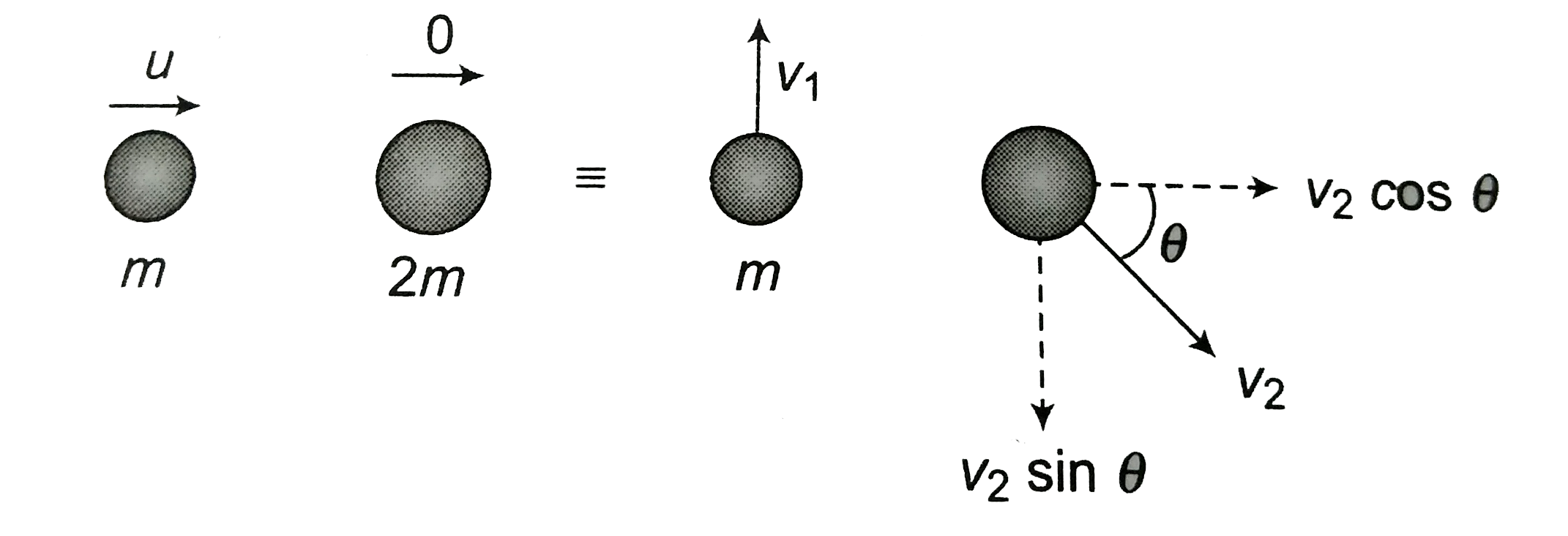
|
|
| 35. |
Moon and an apple are accelerated by the same gravitational force due to Earth. Compare the acceleration of the two. |
|
Answer» Solution :The gravitational FORCE experienced by the apple due to Earth `F = - (GM_(E )M_(A))/(R^(2))` Here `M_(A)-` Mass of the apple , `M_(E ) - ` Mass of the Earth and R - Radius of the Earth Equating the above EQUATION with Newton.s 2nd law `M_(A) a_(A) = - (GM_(E)M_(A))/(R^(2))` Simplifying the above equation we get , `a_(A) = - (GM_(E))/(R^(2))` Here`a_(A)` is the acceleration of applethat is equal to.g.. Similarly the forceexperienced byMoon due toEarthis given by `F = - (GM_(E )M_(m))/(R_(m)^(2))` Here`R_(m)- ` distanceof the Monn from the `M_(m) ` - Mass of the Moon. The acceleration experienced by the Moon is givenby `a_() = - (GM_(E ))/(R_(m)^(2))` The ratiobetween the apple.s acceleration to Moon.sacceleration is given by `(a_(A))/(a_(m))=(R_(m)^(2))/(R^(2))` From Hipparchrus measurements , the distanceto the moon is 60 times thatof earth radius . `R_(m) = 60 R ` `(a_(A))/(a_(m)) = ((60R)^(2))/(R^(2)) = 3600 ` The apple.s acceleration is 3600times the acceleration of the Moon . The sameresult was obtained by Mewton using his gravitational formula . The apple.s acceleration is measuredeasily and it `9.8 "ms"^(-2)` . Moon orbitsthe Earthonce in 27.3 DAYS and by using the centripetal acceleration formula , `(a_(A))/(a_(m)) = (9.8)/((0.00272)) = 3600` which is EXACTLY what he got through his law of gravitation . |
|
| 36. |
Four springs of force constants K_1=1000N//m, K_2=1500 N//m, K_3=2500 N//m and K_4=2000 N//mare subjected to different loads producing same extension. Arrange the springs with work done in descending order |
|
Answer» 1,2,3,4, |
|
| 37. |
You feel enjoy by having bath in shower in summer but not in winter. Why ? |
| Answer» SOLUTION :In summer water COMING from shower becomes cold due to ADIABATIC expansion so one can ENJOY it but in winter water becomes more cold so one cannot enjoy it. | |
| 38. |
A ball is given velocity u = sqrt(3 gd) at an angle 45^(@) with horizontal. It strikes a wall at distance d and returns to its original position. Find the coefficient of restitution e. |
|
Answer» Solution :The velocity remains same in the vertical direction (along the SURFACE) and the velocity BECOMES `e` times and opposite in the horizontal direction (`_|_^(ar)` to the surface) Time from O to `A_(1) , t_(1) = (d)/( u cos 45^(@))` (uniform MOTION) Time from A to `O, t_(2) = (d)/( e u cos 45^(@))` TOTAL time `t = t_(1) + t_(2) = (d)/( u cos 45^(@)) (1 + (1)/(e))` Time for vertical motion (O to O) `0 = u sin 45^(@) T - (1)/(2) g T^(2) rArr T = ( 2 u sin 45^(@))/(g)` `t = T` `(d)/( u cos 45^(@)) (1 +(1)/(e)) = ( 2 u sin 45^(@))/(g)` `d(1 + (1)/(e)) = ( 2u^(2) sin 45^(@) cos 45^(@))/(g)` `= (u^(2))/(g) sin 90^(@) = ( 3 gd)/(g) = 3d` `1 + (1)/(e) = 3 rArr (1)/(e ) = 2 rArr e = (1)/(2)`  
|
|
| 39. |
A block of mass 1 kg is connected with a massless spring of force constant 100 N/m. At t = 0, a constant force F = 10 N is applied on the block. The spring is in its natural length at t = 0. The speed of particle at x = 6 cm from mean position is : |
|
Answer» 4 cm/s |
|
| 40. |
In order to stop a car in shortest distance on a horizontal road, one should |
|
Answer» apply the brakes very hard so that the wheels stop rotating |
|
| 41. |
Assertion : When a body is projected from the surface of the earth with a velocitygreater than the escape velocity , its total mechanical energy is negative . Reason : The body is not under the influence of the earth. |
|
Answer» Both Assertion and REASON are TRUE and Reason is the CORRECT explanation of Assertion |
|
| 42. |
In a resonance pipe the first and second resonance are obtained at lengths 22.7 cm and 70.2 cm respectively. What will be the end correction - |
|
Answer» `1.05cm` `e=(70.2-3xx22.7)/(2)=(70.2-68.1)/(2)=(2.1)/(2)` `=1.05cm` |
|
| 43. |
The vertical component of a vector is equal to its horizontal component . What is the angle made by the vector with X-axis. |
| Answer» SOLUTION :`45^(0)` | |
| 44. |
Which of the following has th same dimensional formula as that of surface tension |
|
Answer» FORCE constant |
|
| 45. |
Two blocks of masses 3kg and 6kg rest on a horizontal smooth surface. The 3kg block is attached to a spring with a force constant k=900 Nm^(-1) which is compressed 2m from beyond the equilibrium position. 3kg mass strikes the 6kgmass and two stick together- |
|
Answer» velocity of the combined MASSES immediately arter the collision is `10 ms^(-1)` |
|
| 46. |
Instantaneous profile of a rope carrying a progressive wave moving from left to right is shown, Find the correct option: |
|
Answer» Both P and Q are moving UPWARDS Slope at `P` is positive, `V_p` at `P` is NEGATIVE Slope at `Q` is negative `V_P` at `Q` is positive. So, `P` is moving downwards and `Q` is moving upwards. |
|
| 47. |
In the continuous flow method of Callender and Barnes the the potential difference across the wire was 3 volts and the current 2 amperes. The temperature of in flowing water was 20^(@)C and that of out flowing water 22.7^(@)C and 300g of water were collected in 10 minutes. When the p.d. was increased to 3.75 volts and the current to 2.5 amperes, the flow was adjusted to maintain the same temperature difference and 240g of water were collected in 5 minutes. Calculate the mean specific heat capacity of water at the mean temperature 21.35^(@)C. |
|
Answer» |
|
| 48. |
An artificial satellite is revolving around theearth in a circular orbit. Its velocity is half the value of the escape velocity from the earth. (ii) If its revolution around the earth is stopped and the satellite is allowed to fall freely towards the earth, what will be the velocity with which it will strikethe earth's surface ? (Radius of the earth =6.4 xx10^6 m, g=9.8 m*s^(-2)) |
|
Answer» Solution :When thesatellite stops revolving and falls FREELY TOWARDS the earth, its initial velocity of fall =0 . Hence , its initial kinetic energy =0 . Since at this stage the distance of the SATELLITE from the centre of the earth is r=R+h=2R, its initial potential energy `=(GMm)/(2R)` (M=mass of the earth ,m=mass of the satellite). Hence, the total initial energy of the satellite `=0-(GMm)/(2R)=-(GMm)/(2R)`. Let the velocity of the satellite be v, just before touching the earth.s surface . So its kinetic energy `=1/2 mv^2`. At the same TIME , its distance from hte centre of the earth is r=R and its potential energy `=-(GMm)/R` Hence , total energy of the satellite `=1/2 mv^2-(GMm)/R` From the law of conservation of energy , `-(GMm)/(2R)=1/2mv^2-(GMm)/R` or, `1/2 mv^2=(GMm)/R-(GMm)/(2R)=(GMm)/(2R)` or,` v^2=(GM)/R=(gR^2)/R=gR` `or, v=sqrt(gR)=sqrt(9.8xx6.4xx10^6)` `=7.9xx10^3m*s^(-1)=7.9 km*s^(-1)`. |
|
| 49. |
State and prove Pascal's law. |
Answer» Solution :Law : The pressure in a fluid at rest is the same at all points  PROOF of Pascal.s law. ABC-DEF is an element of the interior of a fluid at rest , This element is in the form of a right angled PRISM . The element is SMALL sothat the effect of gravity can be ignored, but it has been enlarged for the sake of clarity .  Figure shows an element in the interior of a fluid at rest . This element ABC- DEF is in the form of a right - angled prism. Area of surface ADFC is `A_(b)`. The force on this surface is `F_(b)` and hence pressure is `P_(b)`. Area of surface BEFC is `A_(a)` . The PERPENDICULAR force on this surface is `F_(a)` and hence pressure is `P_(a)`. Area of surface ABCD is `A_(c)` .The perpendicular force on this surface is `F_(c)` and hence pressure is `P_(c)` `F_(a)=F_(b)costheta` (For equilibrium position) `A_(a)=A_(b)costheta` (by geometry )and `F_(c)=F_(b)SINTHETA` (for equilibrium position) `A_(c)=A_(b)sintheta` (by geometry) The pressures on rectangular surfaces are as below as shown in figure. `P_(b)=(F_(b))/(A_(b))`....(1) `P_(a)=(F_(a))/(A_(a))=(F_(b)costheta)/(A_(b)costheta)=(F_(b))/(A_(b))`....(2) `P_(c)=(F_(c))/(A_(c))=(F_(b)sintheta)/(A_(b)sintheta)=(F_(b))/(A_(b))`....(3) It is clear from equation1,2 and 3 `P_(a)=P_(b)=P_(c)` .... (4) Equation (4) shows that pressure exerted is same in all directions is a fluid at rest . |
|
| 50. |
Define coefficient of viscosity of a liquid. |
| Answer» SOLUTION :The COEFFICIENT of viscosity of a liquid is the VISCOUS force acting tangentially per UNIT area of a liquid layer having a unit velocity gradient in a direction PERPENDICULAR through the direction of flow of the liquid. | |