Saved Bookmarks
This section includes 7 InterviewSolutions, each offering curated multiple-choice questions to sharpen your Current Affairs knowledge and support exam preparation. Choose a topic below to get started.
| 1. |
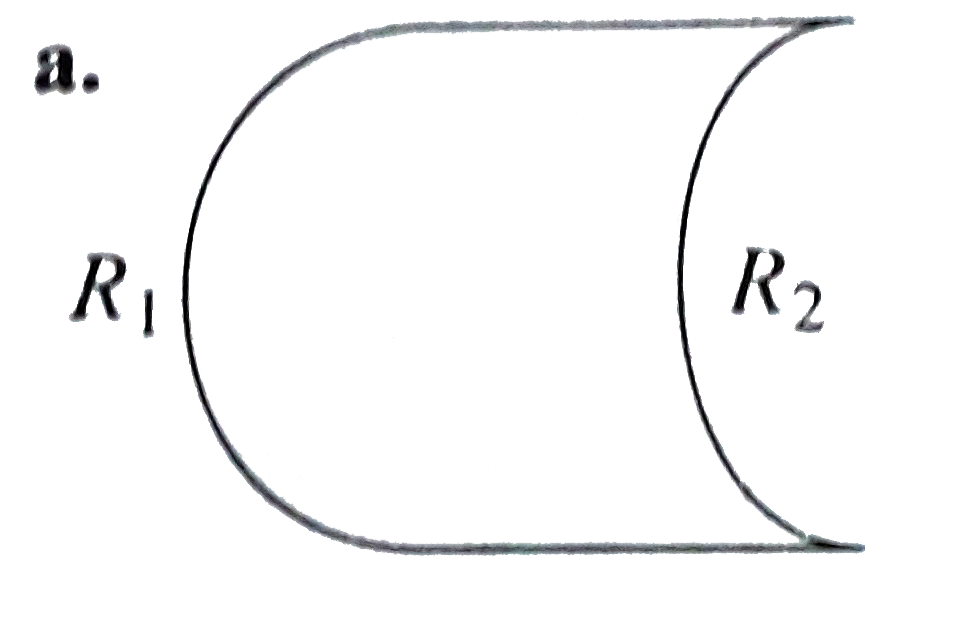
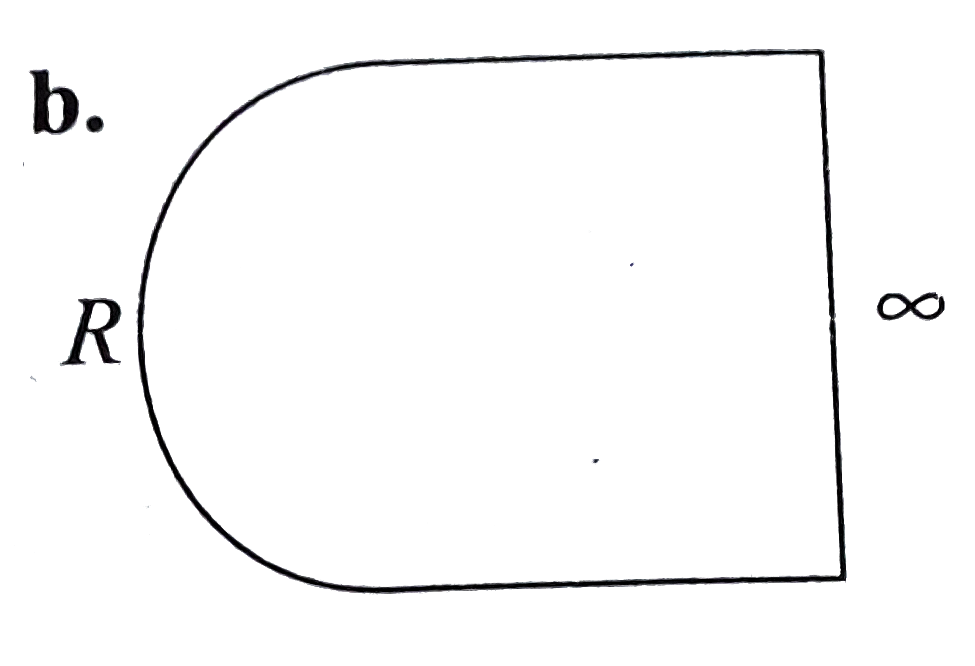
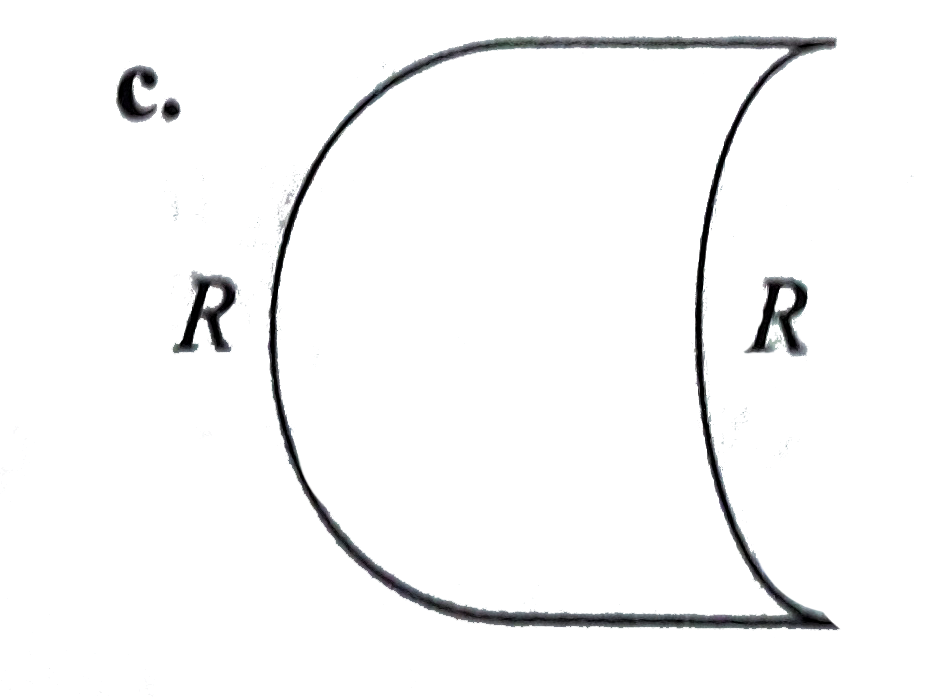
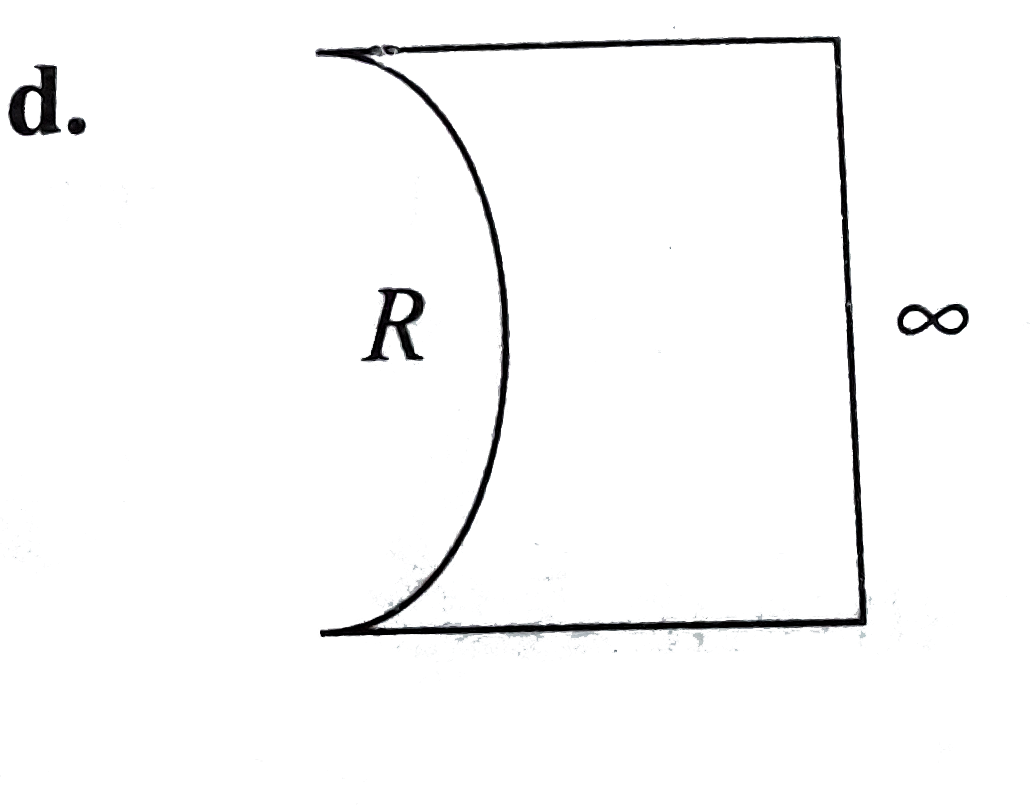
Which one of the following sperical lenses does not exhibit dispersion? The radii of curvature of the surfaces of the lenses are as given in the diagrams. R_(1)!=R_(2) |
|
Answer»
|
|
| 2. |
Findthe magnetic induction at the origin in the figure shown. |
| Answer» SOLUTION :`(mu_0 I)/(4R) (3/4 HAT K + 1/pi hat J)` | |
| 3. |
Which of the following physical quantities represent the dimensions of (b)/(a) in the relaction P=(x^(2)-b)/(at ) , where p is poweris distance and t is time |
|
Answer» POWER |
|
| 4. |
Two parallel long smooth conducting rails separated by a distance l=10 cm are connected by a movable conducting connector of mass m=4mg.Terminals of the rails are connected by the resistor R=2Omega & the capacitor C=1muF as shown.A uniform magnetic field B=20T perpendicular to the plane of the rails is swiched on.The connector is dragged by a constant force F=10N.The speed of the connector as function of time if the force F is applied at t=0 is equal to v-5(1-e^(-x xx 10^(4) xx t)m//s).Find the value of x. |
|
Answer» |
|
| 5. |
Two opposite and equal charges 4 xx10^(-8) coulomb when placed 2 xx 10^(-2) cm away, from a dipole. If this dipole is placed in an external electric field 4 xx 10^8 newton/coulomb, the value of maximum torque and the work done in rotating it through 180^@ will be |
|
Answer» `64 xx 10^(-4)`Nm and `64 xx 10^(-4)J` |
|
| 6. |
Avoltage source is connected to an electrical component X as shown in figure. ( ## EXP_SPS_PHY_XII_C07_E04_010_Q01 .png" width="80%"> :Identify the device X. |
| Answer» SOLUTION :RESISTOR | |
| 7. |
How many significant figures are there in 6.005 |
|
Answer» 4 |
|
| 8. |
(a) In Problem 53, using energy techniques rather than the techniques of Chapter 4, find the speed of the snowball as it reaches the ground below the cliff. What is that speed (b) if the launch angle is changed to 41.0^(@) below the horizontal and (c)if the mass is changed to 3.00 kg ? |
|
Answer» |
|
| 9. |
Which of the following option(s) is correct? |
|
Answer» A positively charged BODY can attract another positively charged body |
|
| 10. |
Describe qualitatively the acceleration acting on a body which moves inward with constant speed along a spiral ? |
| Answer» Solution :The body would EXPERIENCE INCREASING tangential as well as centrepetal acceleration as it moves ALONG the spiral inwardlly with CONSTANT speed. | |
| 11. |
Two beams, A and B, of plane polarized light with mutually perpendicular planes of polarization are seen through a polaroid. From the position when the beam A has maximum intensity (and beam B has zero intensity), a rotation of Polaroid through 30^(@) makes the two beams appear equally bright.If the initial intensities of the two beams are I_(A) and I_(B) respectively, then (I_(A))/(I_(B)) equals : |
|
Answer» `1/3` 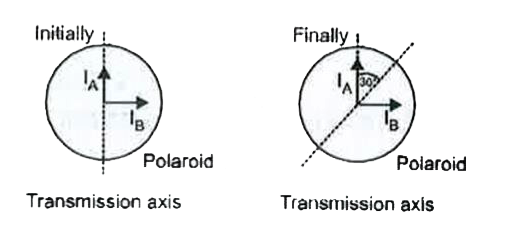 `I_(A) COS^(2) 30^(@) = I_(B) cos^(2)60^(@)` `I_(A) 3/4 = I_(B) (1)/(4)``(I_(A))/(I_(B)) = 1/3` |
|
| 12. |
A small telescope has an objective lens of focal length 144 cm and eyepiece of focal length 6.0 cm. What is the magnifying power of the telescope ? What is the separation between the objective and the eyepiece? |
|
Answer» Solution :`f_(0) = 144 cm, f_(E) = 6 cm "" THEREFORE m = (f_(0))/(f_(e)) = (144)/(6) = 24 ` `L = f_(0) + f_(e) = 144 + 6 = 150 cm ` |
|
| 13. |
In what way is plane polarised light different from an unpolarised light ? |
| Answer» Solution :In plane polarised light the VIBRATIONS of electric vector are CONFINED only in one PARTICULAR plane perpendicular to the direction of the propagation of light. However, there is no such restriction in an UNPOLARISED light. | |
| 14. |
A cylinder isotropic solid of coefficient of thermal expansion alpha and density rho (at STP) floats in a liquid of coefficient of volume expansion gamma and density d (at STP) as shown in the diagram. |
|
Answer» (B) `(V_("solid")-V_("sub"))="constant"rArr(V_("solid")-(M_("solid"))/(rho_("liquid")))="constant"Vxx3alphaxxDeltaT=(MgammaDeltaT)/(d)rArr3alpha(d)/(rho)` (C ) `Ah_("in")d_("lquid")=A(h_("in")+h_("out"))rho_("solid")=M`(mass of soild) `h_("out")=-(M)/(Arho_("soild")),h_("in")=(M)/(Arho_("soild"))-(M)/(Ad_("liquid"))=`constant `(M(1+3alphaDeltaT))/(A(1+2alphaDeltaT)rho)-(M(1+gammaDeltaT))/(A(1+2alphaDeltaT)d)=(M)/(Arho)-(M)/(Ad),gamma=2alpha+alpha(d)/(rho)` (D)`Ah_("in")d_("liquid")g=`Buoyant force = constant = Mg `A_(0)(1+2alphaDeltaT)h_("in ")(d)/(1+gammaDeltaT)"constant",h_("in")=(M)/(A_(0)d)(1+(gamma-2alpha)DeltaT)gamma=2alpha` |
|
| 15. |
Magnetic field intensity H at the centre of a circular loop of radius r carrying current I e.m.u. is |
|
Answer» `(R )/(I)` OERSTED Here N= 1 or `H= (2pi I)/(r )` oersted |
|
| 16. |
A disc is rotating with angular velocity vecomega. A force vecF acts at a point whose position vector with respect to the axis of rotation is vecr. The power associated with the torque due to the force is given by : |
|
Answer» <P>`(vecrxxvecF)xxvecomega` `THEREFORE P=(vecrxxvecF).vecomega` |
|
| 17. |
The displacement of a particle performing linear S.H.M. at any instant t is give by x=6sin(3pit+{:5pi)/6) meter. The frequency of the motion is |
|
Answer» 5 Hz |
|
| 18. |
Explain the formation of energy bands in solids. On the basis of energy bands distinguish Vetween a metal, a semiconductor and an insulator. |
|
Answer» Solution :Formation of energy bands : In an isolated (free) atom, the energy levels of ELECTRONS are WELL defined. In SOLIDS, nucleus of each atom INTERACTS with the electrons of the neighbouring atoms. Also valence electrons of different neighbouring atoms interacts with each other. Due to this, energy levels are slightly altered. These different energy levels with continuous variation are called energy bands, Mainly there are two types of energy bands. They are valence band(VB) and conduction band(CB). The gap between the top of VB and bottom of CB is the energy band gap `(E_g)` . 
|
|
| 19. |
When a magnetic is inserted into a coil, the e.m.f. is induced in it depends upon: |
|
Answer» RESISTANCE of the coil |
|
| 20. |
If the earth did not have atmosphere, would its average surface temperature be higher or lower than what it is now? Explain |
| Answer» SOLUTION :Average surface TEMPERATURE will be lower. This is because there will be no GREEN house effect in absence of atmosphere. | |
| 21. |
Ozone layer absorbs ….. |
|
Answer» INFRARED radiation |
|
| 22. |
Areal image of a distant object is formed by a plano-convex lens on its principal axis. Spherical abberration |
|
Answer» is absent 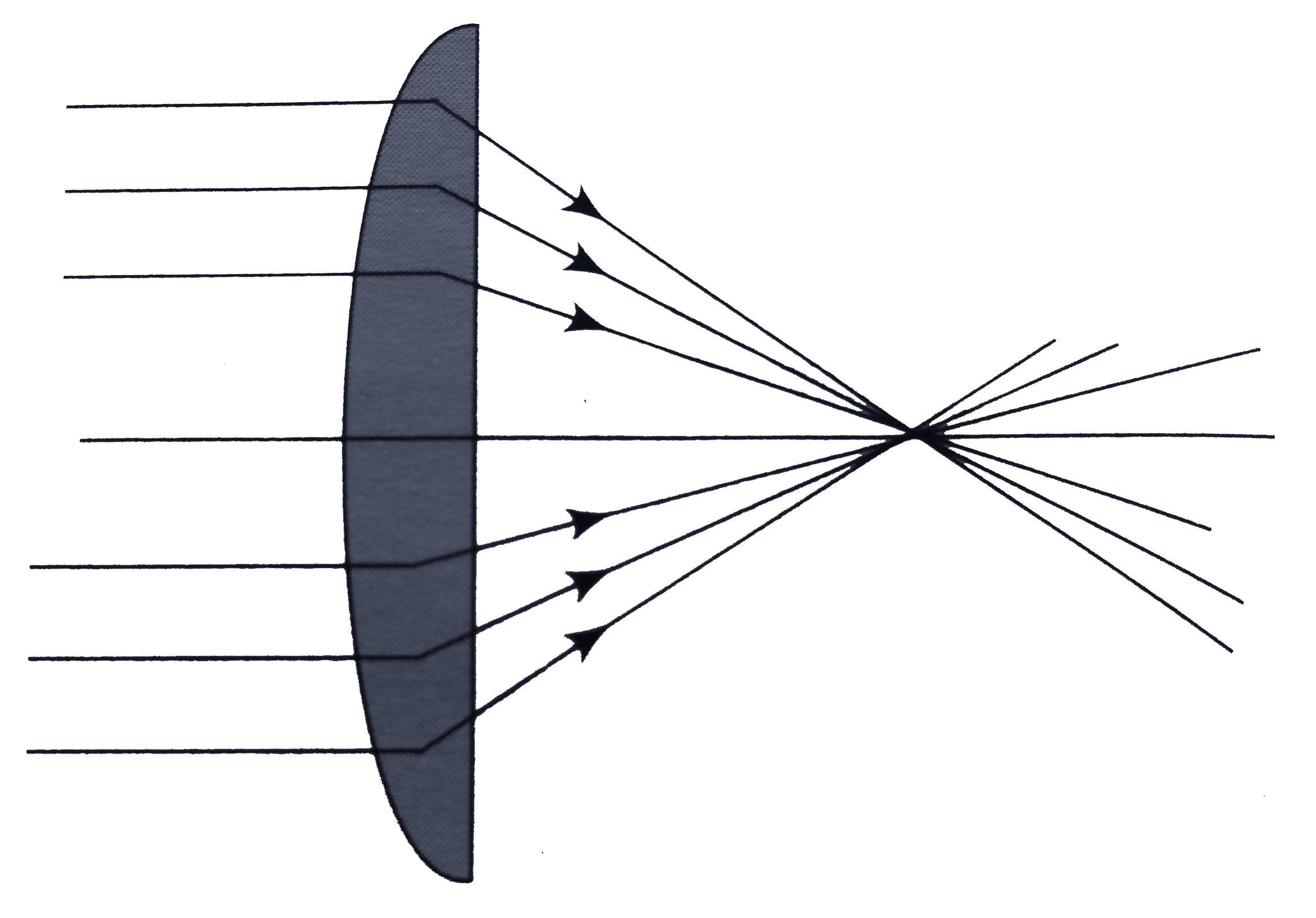 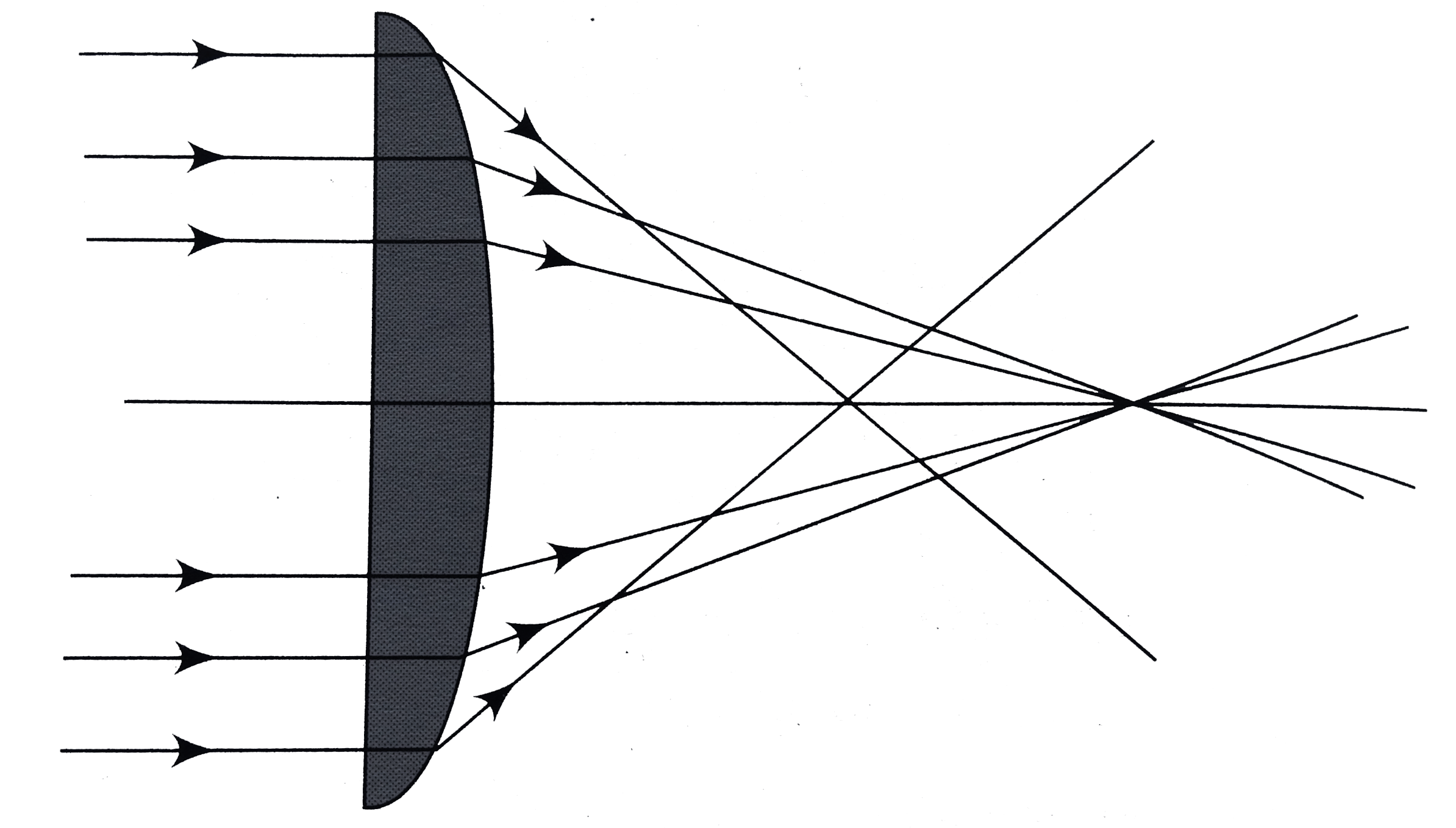
|
|
| 23. |
The modes of energy transfer can be classified as __ mode and ___ mode. |
| Answer» SOLUTION :PARTICLE, WAVE | |
| 24. |
Determine electric field intensity near an infinitely long straight uniformly charge wire. Or. Using Gauss' law expression for electric field intensity at a point situated at a distance 'r' from an infinitely long, uniformly charged straight wire. |
|
Answer» Solution :Gauss law states that total eneric FLUX over the closed surface S in vacuum is `(1)/(epsi_(0))` times the total charge contained inside surface S. `phi_(E)=ointvec(E).vec(dS)=(q)/(epsi_(0))` ELECTRIC field intensity due to a line charge. COnsider a thin charged rod with uniform linear charge density `lamda`. we wish to find an expression for electric intensity at point P at a perpendicular distance r, from the rod. consider a right circular cylinder of radius r and length l with the infinite long line of charge as its axis. In surface I and III, `VECE and vec(dS)` are `bot` to each other. in case of surface II, `vecE and vec(dS)` are parallel to each other and hence `theta=0^(@)` 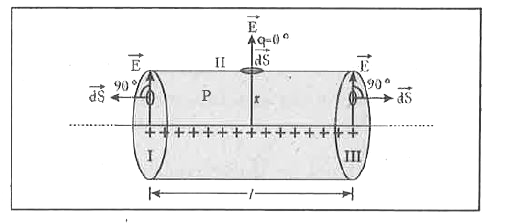 From Gauss.s theorem, we have `ointvec(E).vec(dS)=(q)/(epsi_(0))` or `oint_(I)vec(E).vec(dS)+oint_(II)vec(E).vec(dS)+oint_(III)vec(E).vec(dS)=(q)/(epsi_(0))` or `int_(I)EdScos90^(@)+int_(II)EdScos0^(@)+int_(III)EdScos90^(@)` `=(q)/(epsi_(0)0` or `0+Eint_(II)dS+0=(q)/(epsi_(0))` or `E(2pirl)=(q)/(epsi_(0))` or `E=(q)/(2pirlepsi_(0))` But `q=lamdal` `therefore E=(lamdal)/(2pirlepsi_(0))` or `E=(lamda)/(2pirepsi_(0))` |
|
| 25. |
The focal length of the objective of a compound microscope is f_o and its distance from the eyepiece is L . An object is placed at a distance u from the objective. For proper working of the instrument which of the following options are suitable ? |
| Answer» Answer :A::D | |
| 26. |
The mass of an electron is 9.109 381 88xx10^(-31) kg. To eight significant figures, find the following for the given electron kinetic energy: (a) gamma and (b) beta for K = 1.000 000 0 keV, (c ) gamma and (d) beta for K = 1.000 000 0 MeV, and then (e ) gamma and (f) beta for K = 1.000 000 0 GeV. |
|
Answer» |
|
| 27. |
Out of the following statements which is not true? |
|
Answer» Infrared RADIATIONS arise due to minor electron TRANSITION in ATOMS. |
|
| 28. |
A thin prism of angle 6.0^@, omega=0.07 and mu_y=1.50 is combined with another thin prism having omega = 0.08 and mu_y = 1-60. The combination produces no deviation in the mean ray. (a) Find the angle of the second prism. (b) Find the net angular dispersion produced by the combination when a beam of white light passes through it. (c) If the prisms are similarly directed, what will be the deviation in the mean ray ? (d) Find the angular dispersion in the situation described in (c). |
|
Answer» |
|
| 29. |
A 3m long copper wire is stretched to increase its length by 0.4 cm . Poisson's ratio for copper is 0.26. Find the lateral strain produced in the wire |
|
Answer» a)`0.26 xx 10^(-3)` |
|
| 30. |
Direction of magnetic moment is from _____ to _____ inside the magnet. |
| Answer» SOLUTION :SOUTH, NORTH | |
| 31. |
A concave mirror of radius of. curvature '10 cm' whose principal axis co-incides with x-axis and its centre of curvature at origin. A point object 'O' with its initial co-ordinates (-2, 0), is moving witha constant speed sqrt2 cm/ sec making an angle 45^@ with the x-axis as shown figure. The time after which, the magnification of the mirror is unity |
|
Answer» 1s |
|
| 32. |
Match the following. At a certain moment in time the angle between the velocity vecv of a particle and the acceleration vector a of that particle is 0. Match the type of motion of the particle at this moment for different theta is |
|
Answer» <P> |
|
| 33. |
A concave mirror of radius of. curvature '10 cm' whose principal axis co-incides with x-axis and its centre of curvature at origin. A point object 'O' with its initial co-ordinates (-2, 0), is moving witha constant speed sqrt2 cm/ sec making an angle 45^@ with the x-axis as shown figure. After time t = 2sec, the magnitude of relative velocity between object and its image along the x-axis is |
|
Answer» zero |
|
| 34. |
A concave mirror of radius of. curvature '10 cm' whose principal axis co-incides with x-axis and its centre of curvature at origin. A point object 'O' with its initial co-ordinates (-2, 0), is moving witha constant speed sqrt2 cm/ sec making an angle 45^@ with the x-axis as shown figure. The image co-ordinates at time t=0 |
|
Answer» `(10/7, 0)` |
|
| 35. |
Analternating voltage E= E_0 sin omegat is applied to a circuit containıng a resistor R connected in series with a black box. The current in the circuit is found to be =I_(0) sin (omegat+pi//4). Draw the corresponding phasor diagram and find the impedance in tems of R. |
Answer» SOLUTION :PHASOR DIAGRAM 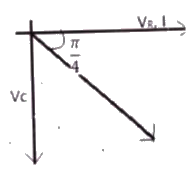
|
|
| 36. |
Analternating voltage E= E_0 sin omegat is applied to a circuit containıng a resistor R connected in series with a black box. The current in the circuit is found to be =I_(0) sin (omegat+pi//4). State whether the element in the black box is a capacitor or inductor. |
| Answer» SOLUTION :As the CURRENT leads the voltage by ,`pi/4` the ELEMENT used in black box is a ‘CAPACITOR’. | |
| 37. |
Two batteries of emf epsilon_(1) and epsilon_(2) (epsilon_(2) gt epsilon_(1)) and internal resistances r_(1) and r_(2) respectively are connected in parallel as shown in figure. |
|
Answer» TWO equivalent emf `epsilon_(EQ)` of the two cells is between `epsilon_(1) and epsilon_(2) `, i.e . `epsilon_(1) LT epsilon_(eq) lt epsilon_(2)` . Equivalent emf of two cell with emf ` epsilon_(1) and epsilon_(2)` in parallel is given by ` epsilon_(eq) = (epsilon_(2) r_(1) + epsilon_(1)r_(2))/(r_(1) + r_(2))` `therefore epsilon_(eq)` value will be between `epsilon_(1) and epsilon_(2)` `therefore epsilon_(1) lt epsilon_(eq) lt epsilon_(2)` |
|
| 38. |
A car moving at 40 km/h passes a factory which is sounding a siren of frequency 500 Hz. What does the frequency appear to the driver of the carbefore and after passing by the fartory ? |
|
Answer» |
|
| 39. |
Potentiometer measures the potentialaccurately than a voltmeter. Why? |
|
Answer» does not draw CURRENT from EXTERNAL circuit. |
|
| 40. |
Four rays of light parallel to optic axis, .and their path after passing through an optical system are shown in the following two columns. Match List - I with List - II and select the correct answer using the codes given below the lists: |
| Answer» Answer :B | |
| 41. |
In Young's double slit experiment, the two slits act as coherent sources of equal amplitude A and wavelenth lambda. In another experiment with the same setup the two slits are sources of equal amplitude A and wavelength lambda but are incoherent. The ratio of the intensity of light at the midpoint of the screen in the first case to that in the second case is |
|
Answer» `1:1` |
|
| 42. |
(i) Name the type of a diode whose characteristics are shown in figure (1) and figure (2). (ii) What does the point P in figure (1) represent? (iii) What does the points P and Q in figure (2) represent? |
|
Answer» Solution :Figure-1 is the characteristics of zener diode and figure-2 is the characteristics of solar cell. (II) Point P in figure-1, indicates reverse voltage at zener breakdown (which is also known as zener voltage). (iii) Point P in figure-2, indicates such positive voltage on the solar cell, current OBTAINED due to which is equal and opposite to current obtained by the INCIDENCE of light on solar cell. Hence, resultant current passing through solar cell becomes I = 0. Such voltage is called "open circuit voltage". Point O in figure-2 indicates the current obtained in solar cell when light with frequency equal to threshold frequency is made incident on it, when voltage applied to solar cell by the BATTERY is zero. This current is opposite to current sent by the battery. Such current is known as "short circuit current". |
|
| 43. |
in our daily life, modulation plays an Important role. Discuss the amplitude modulation. |
| Answer» Solution :In amplitude MODULATION, the amplitude of high AL frequency carrier WAVE is VARIED in accordance with modulating signal (Information signal). | |
| 44. |
(a) Draw a labelled diagram of a.c. generator. Derive the expression for the instantaneous value of the emf induced in the coil. (b) A circular coil of cross-sectional area 200 cm^(2) and 20 turns is rotated about the vertical diameter with angular speed of 50 rad s^(-1) in a uniform magnetic field of magnitude 3.0 xx 10^(-2)T. Calculate the maximum value of the current in the coil. |
|
Answer» Solution :(a) See SHORT Answer Question Number 53. (b) Here cross-sectional area `A = 200 cm^(2) = 200 xx 10^(-4)m^(2)`, number of turns N = 20, ANGULAR speed `omega = 50 "rad s"^(-1)` and magnetic field `B = 3.0 xx 10^(-2)T`. `therefore` Maximum VALUE of the induced emf `varepsilon_(m) = NABomega = 20 xx (200 xx 10^(-4))xx(3.0 xx10^(-2))xx50 = 0.6 V`. If R be the resistance of the coil then maximum value of the current `(I_(m))` flowing in the coil is given as : `I_(m) = (varepsilon_(m))/R=(0.6)RA` |
|
| 45. |
The circuit shows a resistance R=0.01Omega and inductance L=3 mH connected to a conducting rod PQ of length I=2m which can side on a perfectly conducting circular arc of radius I with its centre at P. Assume that friction & gravity are absent and a constant uniform magnetic field B=0.1T exists as shown in the figure. At t=0 the circuit is switched on and simultaneously an external torque is applied on the rod so that it rotates about P with a constant angular velocity omega=2 rad/sec. Find the magnitude of this torque (in N-m) at t=0 (0.3 In2) second |
|
Answer» The torque at this instant` =(B^(2)omegaI^(4))/(8R)=4N-m` |
|
| 46. |
An electromagnetic wave emitted by source travels 21 km to arrive at a receiver. The wave while travelling in another path is reflected from a surface at 19 km away and further travels 12 km to reach the same receiver. If destructive interference occurs at the receiving end, the mximum wavelength of the wave is |
| Answer» ANSWER :D | |
| 47. |
A block of mass m is attached to two unstretched springs of spring constant k_(1) and k_(2) as shown in figure. The block is displaced towards right through a distance 'x' and is released. Find the speed of the block as it passes through a distance x//4 from its mean position. All the surfaces are smooth. |
|
Answer» Solution :Applying CONSERVATION of energy `1/2k_(1)x^(2)+1/2 k_(2)x^(2)=1/2 mv^(2)+1/2 k_(1)(x//4)^(2)+1/2 k_(2)(x//4)^(2)` `v=(x)/(4M) SQRT(15(k_(1)+k_(2)))`. |
|
| 48. |
A small square loop of wire of side l is placed inside a large square loop of wire of side L (L gt gt l ). The loops are coplanar and their centres coincide. Find the mutual inductance of the system. |
|
Answer» Solution :Let a current I pass through the LARGE square LOOP of SIDE L. Magnetic field at the centre O of the loop. B = 4 x magnetic field due to each side `therefore B=4xx(mu_0I)/(4PI(L/2)) [ sin 45^@+ sin 45^@]` `therefore B=4xx(mu_0I)/(4pixxL/2)[1/sqrt2+1/sqrt2]` `=(2mu_0I)/(piL)(1/sqrt2+1/sqrt2)` `therefore B=(2sqrt2mu_0I)/(piL)`....(1) Since l is very small compared to L, VALUE of B can be considered uniform over the area `A =pil^2`of the inner loop. `therefore` magnetic flux linked with small square loop `phi=AB` `therefore phi=l^2 xx (2sqrt2mu_0I)/(piL)`...(2) [`because` From equation (1)] Mutual inductance of the system of two loops `M=phi/I` `therefore M=(2sqrt2mu_0l^2)/(piL)` [`because` From equation (2)] `therefore M prop l^2/L` |
|
| 49. |
A parallel plate capacitor has plates of area 0.080m^2 and a separation of 1.2 cm . A battery charges the plates to a potential difference of 120V and is then disconnected . A dielectric slap of thickness 4.0mm and dielectric constant 4.8 is then placed symmetricallybetween the plates (a) What is the capacitance with the slab in place ? What is the free charge q (c) before and (d) after the slap is inserted ? What is the magnitude of the electric field (e) in the space between the plates and dielectric and (f) in the electric itself? (g) with the slab in place, what is the potential difference across teh plates (h) How much external work is involved in inserting the slab? |
| Answer» SOLUTION :`a) 59 pF B) 80 pF c)7.1 nC d)7.1 nC e)10kV//m F)2.1 kV//m G)88V h) 0.11 MU F` | |
| 50. |
Stellar system Q_(1) moves away from us at a speed of 0.800c. Stellar system Q_(2), which lies in the same direction in space but is closer to us, moves away from us at speed 0.400c. What multiple of c gives the speed of Q_(2) as measured by an observer in the reference frame of Q_(1)? |
|
Answer» |
|