

Saved Bookmarks
This section includes 7 InterviewSolutions, each offering curated multiple-choice questions to sharpen your Current Affairs knowledge and support exam preparation. Choose a topic below to get started.
| 1. |
Resolving power of a microscope depend on the wavelength (lamda) of the light used to illuminate the object to be viewed as |
|
Answer» `R.P.proplamda` |
|
| 2. |
An inductor and a resistor are connected in series to an AC source. The current in circuit is 500 mA, if the applied AC voltage is 8sqrt2 V at a frequency of 175/(pi) Hz and the current in the circuit is 400 mA, if the same AC voltage at a frequency of (225)/(pi)Hz is applied . The values of the inductance and the resistance are respectively |
|
Answer» 60 m H ,71 `Omega` `implies""R^(2)+L^(2)omega^(2)=(V/I)^(2)` Here,`""I_(1)=500xx10^(-3)A` `""omega_(1)=175/(pi)xx2pi(rad)/s=350(rad)/s` `""V_(1)=8sqrt2` `implies""R^(2)+L^(2)(350)^(2)=((8sqrt2)/(500xx10^(-3)))^(2)` `implies""R^(2)L^(2)(350)^(2)=512""...(i)` `implies""R^(2)L^(2)(550)^(2)=800""...(ii)` Solving , we GET `R=sqrt71Omega" and "L=60 mH` |
|
| 3. |
A glass slab of thickness 8 cms contains the same number of waves as 10 cms long path of water when both are traversed by the same monochromatic light. If the refractive index of water is 4/3, the refractive index of glass is |
|
Answer» `5/3` |
|
| 4. |
Two particles having position vec(r_(1))=(3hat(i) + 5hat(j)) meter and vec(r_(2))=(-5hat(i)-3hat(j)) metre are moving with velocities vec(V_(1))=(4hat(i)+hat(j))m/s and vec(V_(2))=(ahat(i) + 7hat(j)) m/s. If they collide after 2 seconds, the value of a is : |
|
Answer» Solution :Here `Deltavec(r)=vec(r_(2))-vec(r_(1))=-8hati-8hatj` As the particles are moving in the same DIRECTION, the relative velocity is GIVEN by the difference of two velocities. `vec(v_(R))=(a-4)hati + 4hatj` `|vec(v_(R))|=sqrt((a-4)^(2)+(4)^(2))` Also `|vec(v_(R))|=|Deltavec(r)|/t` `sqrt((a-4)^(2)+16)=(8sqrt(2))/2` `(a-4)^(2)=16` or a - 4 = 4 and a = 8 |
|
| 5. |
A concave lens forms the image of an object such that the distance between the object and image is focal length of the lens will be |
|
Answer» `-6.2 CM` |
|
| 6. |
What do you mean by angle of dip at a place? At what place on the earth's surface will the horizontal and vertical components of earth's magnetic field be equal? |
| Answer» Solution :At a PLACE where the ANGLE of dip is `45^(@)`, horizontal and VERTICAL components are H = I cos`45^(@) = (I)/(sqrt(2)) and V = I SIN 45^(@) = (I)/(sqrt(2))`. So V = H. | |
| 7. |
Mention the factors on which the resonant frequency of a series LCR circuit depends. Plot a graph showing variation of impedance of a series LCR circuit with the frequency of the applied a.c. source. |
|
Answer» Solution : In a series LCR circuit the resonant frequency depends on the value of inductance L and capacitance C present in the circuit. A graph SHOWING VARIATION of IMPEDANCE Z of a series LCR circuit with the frequency v of the applied a.c. SOURCE is shown in Fig. 7.23. 
|
|
| 8. |
The temperature coefficient of resistivity for two materials A and B are 0.0031//""^@C , and 0.0068//""^@Crespectively. Two resistors R_1 and R_2, made from material A and B respectively, have resistances of 200 Omega and 100 Omega at 0^@C . Show the colour code of a carbon resistor that would have a resistance equal to the series combination of R_1 and R_2at a temperature of 100^@C(Neglect the ring corresponding to the tolerance of the carbon resistor). |
Answer» Solution :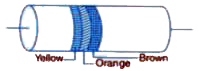 Here `(R_1)_0 = 200Omega , (R_2)_0 = 100 Omega , alpha_1 = 0.0031//""^@C , alpha_2 = 0.0068//""^@C " and" T = 100^@C` ` therefore (R_1)_T = (R_1)_0 [ 1+ alpha_1 (T - T_0) ]` ` = 200 [1 + 0.0031 xx 100] = 200 xx 1.31 = 262 Omega` and `(R_2)_T = (R_0)_0 [ 1+ alpha (T - T_0) ]` `= 100 [ 1+ 0.0068xx 100] = 100 xx 1.68 = 168 Omega` ` therefore ` Resistance of series combination at `100^@C` Hence as per colour CODE of carbon RESISTORS the code is as shown in Fig |
|
| 9. |
If F_(p-p),F_(p-n),F_(n-n) are nuclear forces given two p-n n-n protons, a proton and a neutron, two neutrons respectively inside a nucleus, then |
|
Answer» `F_(p-p) LT F_(p-n) lt F_(n-n)` |
|
| 10. |
A nichrome wire 50 cm long and one square millimeter cross section carries a current of 4A when connected to a 2V battery. The resistivity of nichrome wire in ohmmeter is |
|
Answer» `1 XX 10^(-6) ` |
|
| 11. |
ML^(2) T^(-2) I^(-2) is the dimensional formula for |
|
Answer» SELF inductance |
|
| 12. |
Explain qualitative dependence of resistivity with temperature. |
|
Answer» Solution :`rArr` Conductivity of material `sigma= ("ne"^(2) TAU)/(m)` resitivity `rho = (1)/(sigma)` `therefore rho = (m)/("ne"^(2) tau)` If m and e are CONSTANT then, `rho PROP (1)/(n) and rho = (1)/(tau)` Thus, RESISTIVITY is inversely proportional to number density and inversely proportional to relaxation time. ` rArr` With INCREASE in temperature (average ) speed of electron increase hence relaxation time `tau` decrease and resistivity increase. `rArr` IN a metal number density (n ) is not dependent on temperature. `rArr` In semiconductor and insulator number density .n. increase with temperature. Hence, in such material with increase in temperature resistivity decreases. |
|
| 13. |
The velocity of electromagnetic wave is parallel to |
|
Answer» `vecBxxvecE` |
|
| 14. |
Shown below is a distribution of charges. The flux of electric field due to these charges through the surface S is |
|
Answer» `3 Q // epsi_0` |
|
| 15. |
A : The film which appear bright in reflected system will appear dark in the transmitted system and vice-versa. R : The condition for film to appear bright or dark in reflected light are just reverse to those in the transmitted light. |
|
Answer» Both A and R are TRUE and R is the correct EXPLANATION of A |
|
| 16. |
How conductors and non-conductors are different ? Why are they not charged b rubbing them with our hands ? |
|
Answer» Solution :1- Those which allow electricity to PASS througl them easily are called conductors. 2- They have free electrons to move inside th. material. A 3- E.g. : Metals, human and animal bodies ant earth are conductors. 4- Those which doesn.t allow electricity to pas, through them are called INSULATORS. Most of the non-metals like glass, porcelain plastic, nylon, wood offer high resistance to the passage of electricity through them. 5- When some charge is transferred to a conductor it readily gets distributed over the entire surface of the conductor. In contrast, if some charge ii put on an insulator, it stays at the same place 6- When metal rod is rubbed with hand, no ELECTRIC charge is obtained because charges on meta leak through our body to Earth. |
|
| 17. |
Two point charges 20muC and 80muC are placed 18 cm apart. Find the position of the point where the electric field is zero. |
|
Answer» Solution :DATA supplied, `q_(1)=20 xx 10^(-6)C,""q_(2)=80 xx 10^(-6) C, "AP=xcm "=x xx 10^(-2)m` `BP=(18-x) cm=(180x) xx10^(-2)m` 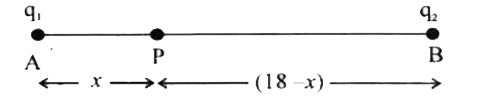 Let .P.be the point where electric field is vero, then `E_(PA)=E_(PB)` `(1)/(4PI epsi_(0)) q_(1)/x^(2)=(1)/(4pi epsi_(0)) q_(2)/((18-x)^(2)) ie, (20 xx 10^(-6))/((x xx 10^(-2))^(2))=(80 xx 10^(-6))/([(18-x) xx 10^(-2)])^(-2)` `1/x^(2)=4/((180 -x)^(2))""(18-x)^(2)=4x^(2)=18 -x=2x therefore x=6` Hence for x=6cm, the field at P is zero. |
|
| 18. |
How much energy is required to separate the typical middle mass nucleus ""_(50)^(120)Sninto its constituent nucleons. (Mass of ""_(50)^(120)Sn= 119.902199 u , mass of proten = 1.007825 u and mass of neutron = 1.008665 u) |
|
Answer» 1021 MEV |
|
| 19. |
In a region, steady and uniform electric and magnetic fields are present. These two fields are parallel to each other. A charged particle is released from rest in the region. The path of the particle will be a....... |
|
Answer» Circle 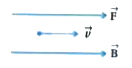 Here `vecv || vecB, therefore F_(m) =qvBsin0^(@), therefore vecF_(m) =0` So if the charge is positive then it is mov opposite to electric field and if it is negative move in straight line in the DIRECTION of elect: field. |
|
| 20. |
Find the magnetic induction of the field at the point O at a loop with current I, whose shape is illustrated in figure (a)In figure a the radii a and b, as well as the angle varphi are known (b)In figure b,the raidus a and the side b are known. (c)A current I=5.0 A flows along a thin wire shaped as shown in figure.The radius of a curved part of the wire is equal to R=120 mm,the angle 2varphi=90^(@).Find the magnetic induction of the field at the point O. |
|
Answer» `B_("due to curved part AD")=((2pi-phi)/(2pi))((mu_(0)i)/(2a))` Into the plane of PAPER. `B_("due to curved part BC")=(phi)/(2pi)((mu_(0)i)/(2b))` Into the plane of paper. `B_(Net)=(mu_(0)i)/(4PI)[(2pi-phi)/a+phi/b]` Into the plane of paper. (b)`B_("due to BC")=B_("due to EA")=0` `B_("due to curved part AB")=((3pi)/2)/(2pi)(mu_(0)I)/(2a) rArr =3/8(mu_(0)l)/a` Into the plane of paper `B_("due to CD")=(mu_(0)i)/(4pib)[cos 90^(@)+cos 45^(@)]rArr=(mu_(0)I)/(4sqrt2pib)` Into the paper `B_("due to DE")=(mu_(0)I)/(4sqrt2pib)` Into the plane ofpaper `vecB_(Net)=(mu_(0)I)/(4pi)[(3pi)/(2a)-sqrt2/b]` Into the plane of paper. (c) `B=B_("due to st.part")+B_("due to curved part")` both into the plane of paper `=((2pi-2phi)/(2pi))(mu_(0)i)/(2R)+(mu_(0)i)/(4pid)[SIN phi+sin phi]` `=((2pi-2phi)/(2pi))(mu_(0)i)/(2R)+(mu_(0)i)/(4pi R cos phi)[2 sin phi]` `(mu_(0)i)/(2piR)[pi-phi+tanphi]=28muT`  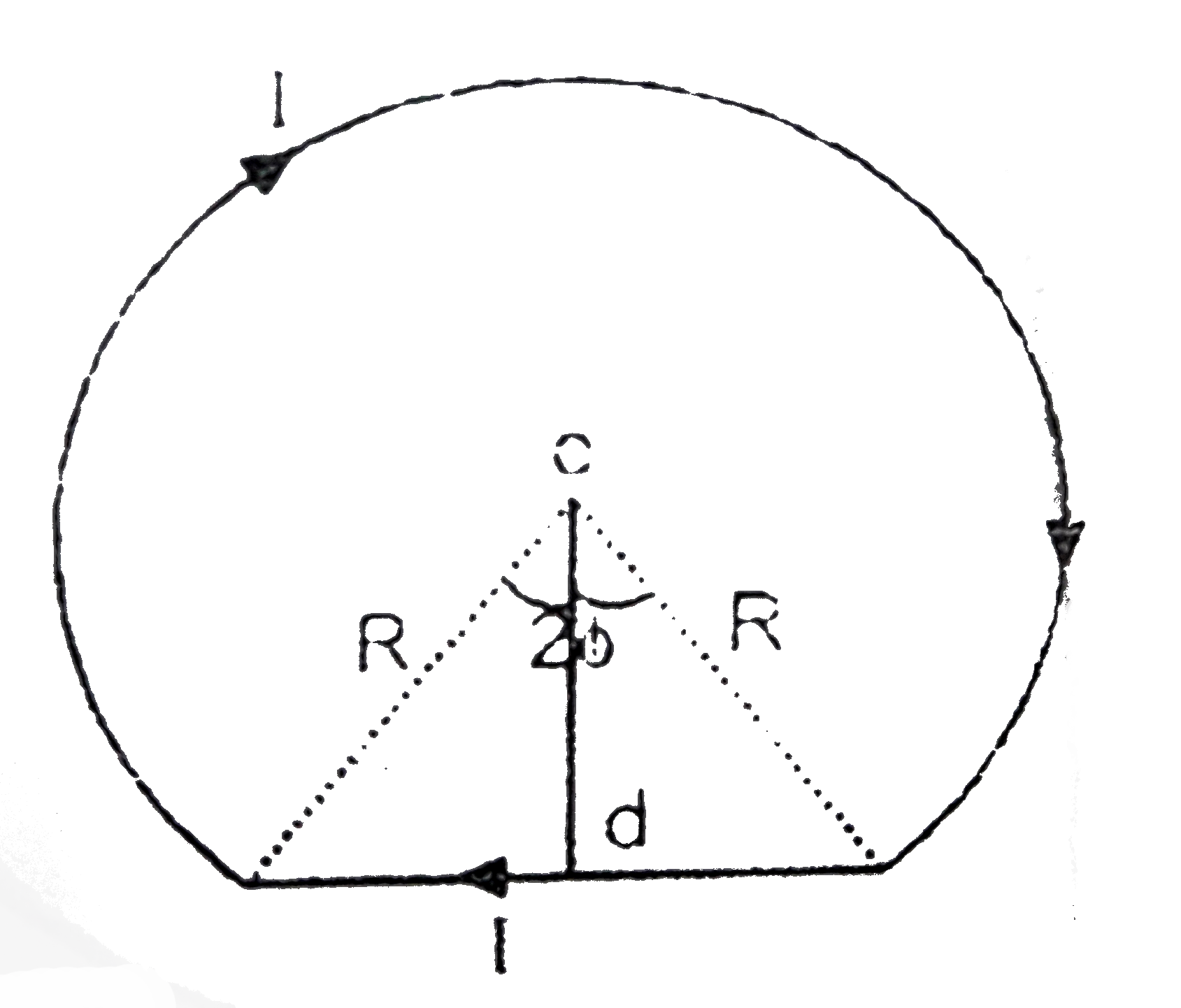
|
|
| 21. |
What is the difference between an elemental semiconductor and a compound semiconductor ? |
| Answer» SOLUTION :An elemental semiconductor CONSISTS of single species of ATOMS. But in a compound semiconductor, there are more than one ELEMENT e.g.: GaAsR. | |
| 22. |
A student performs meter bridge experiment to determine specific resistance of a conducting wire of length 10cm and diameter 1mm. When a standard 6 Omega resistance is connected on left gap and the given conducting wire is connected on the right gap, the balance points obtained for 60cm length of the meter bridge wire. The specific resistance in Omega-m for material of the given wire is: |
|
Answer» `3.14 XX 10^(-2)` |
|
| 23. |
(a)Explain the meaning of the statement 'electric charge of a body is quantized ' (b) Why can one ignore quantisation of electric charge when dealing with macroscopic , i.e. large scale charges ? |
| Answer» Solution :(b)On the ONE hand, it is a fact that the net charge of a system is always INTEGRAL multiple of theelectronic charge, but on the other hand, we should also be aware that an electron is verysmall particle and its number in a macroscopic system is usually in billions or trillions, One Coulomb of charge is equivalent to `6.25 xx 10^18` electrons. When the charge in a system becomes significant, then it is not useful to think of the charge in terms of the electronic charge. In such cases we talk about continuousdistribution of charge. For continuous charge distribution, we use LINEAR charge DENSITY(`lambda`-charge per unit length), surface charge density (`density`-charge per unit surface area) and VOLUME charge density (`rho`-charge per unit volume). | |
| 24. |
6g of a mixture of napthalene (C_10H_8) and anthracene (C_14H_10) is dissolved in 300 gram of benzene. If the depression in freezing point is 0.70 K, the composition of napthalene and anthracene in the mixture respectively in g are (molal depression constant of benzene is 5.1 K mol^-1) |
|
Answer» 2.60,3.40 `Molarity=(mol es of solute)/(weight of solvent(kg))` `K_J=5.1K kg//mol` Depression in FREEZING point, `DELTA T_j=K_j times m` `0.70=5.1times m` `0.70/5.1=(Total moles of solute)/(Total weight ofsolvent (kg))` Let, assume x G napthalene is present, `0.137=(x/w_(c_10H_8)+(6-x)/W_(c_14H_10) times100)/300` `0.041=x/(128G)+(6-x)/(178g)implies25x=84.211` x(napthalene)=34 Now, anthracene =6-x=6-3.4=2.6 g Hence option (b) is correct. |
|
| 25. |
The surface density of charge on the earth's surface 2.65 xx 10^(-9) c//m^2 , radius of the earth is 6400 km.If the radius of the earth is 6400 km, then the charge carried by the earth is : |
|
Answer» `1.363 XX 10^6C` |
|
| 26. |
What amount of heat will be genarated in the circuit shoenin figure 6.29 after the switch is shifted from position 1 to position2? [Hint: Heat produce = change in stored energy + extra energy drawn from the battery.] |
|
Answer» |
|
| 27. |
When only carrier is transmited antenna current observed is 8A. When it is modulated with 500 Kz sine wave antenna current becomes 9.6 A. What is percentage of modulation? |
|
Answer» SOLUTION :`(I_t/I_c)=SQRT(1+mu^2/2` or`mu=sqrt(2[(I_t/I_c)^2-1]= sqrt(2[(1.20)^2-1)]` `=94.26%` |
|
| 28. |
In Fig. , the two light waves that are represented by the rays have wavelength 550.0 nm before entering media 1 and 2. They also have equal amplitudes and are in phase. Medium 1 is now just air, and medium 2 is a transparent plastic layer of index of refraction 1.600 and thickness 2.600 mum. If the waves reached the same point on a distant screen, what type of interference would they produce? |
| Answer» SOLUTION :Reasoning: We need to COMPARE the effective phase difference of the waves with the phase differences that give the extreme types of interference. Here the effective phase difference of 0.84 wavelength is between 0.5 wavelength (for fully destructive interference, or the DARKEST possible result) and 1.0 wavelength (for fully constructive interference, or the brightest possible result), but closer to 1.0 wavelength. Thus, the waves would produce intermediate interference that is closer to fully constructive interference - they would produce a relatively BRIGHT SPOT. | |
| 29. |
In Fig. , the two light waves that are represented by the rays have wavelength 550.0 nm before entering media 1 and 2. They also have equal amplitudes and are in phase. Medium 1 is now just air, and medium 2 is a transparent plastic layer of index of refraction 1.600 and thickness 2.600 mum. What is the phase difference of the emerging waves in wavelengths, radians, and degrees? What is their effective phase difference (in wavelengths)? |
|
Answer» Solution :KEY IDEA The phase difference of TWO light waves can change if they travel through different media, with different indexes of refraction. The reason is that their wavelengths are different in the different media. We can calculate the change in phase difference by counting the number of wavelengths that fits into each medium and then subtracting those numbers. Calculations: When the path lengths of the waves in the two media are IDENTICAL, Eq. 35-9 gives the result of the SUBTRACTION. Here we have `n_(1)= 1.000` (for the air), `n_(2) = 1.600`, L = 2.600 MM, and `lambda = 550.0 nm`. Thus, Eq. 35-9 yields `N_(2)-N_(1)=(L)/(lambda)(n_(2)-n_(1))` `=(2.600 xx 10^(-6)m)/(5.500 xx 10^(-7) m)(1.600-1.000)` = 2.84. (Answer) Thus, the phase difference of the emerging waves is 2.84 wavelengths. Because 1.0 wavelength is equivalent to `2pi` rad and `360^(@)`, you can show that this phase difference is equivalent to phase difference = 17.8 rad `~~ 1020^(@)` (Answer) The effective phase difference is the DECIMAL part of the actual phase difference expressed in wavelengths. Thus, we have effective phase difference = 0.84 wavelength. (Answer) You can show that this is equivalent to 5.3 rad and about `300^(@)`. Caution: We do not find the effective phase difference by taking the decimal part of the actual phase difference as expressed in radians or degrees. For example, we do not take 0.8 rad from the actual phase difference of 17.8 rad. |
|
| 30. |
A ray of light, incident on an equilateral glass prismmu_(g) = sqrt(3)) moves parallel to the base line of the prims inside it. Find the angle of incidence for this ray. |
Answer» SOLUTION :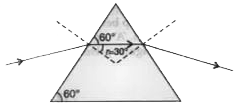 From the diagram, `r = 30^(@)` Also `n_(21) = ( sin i) /( sin r )` `rArrsqrt(3) = ( sin i)/(sin 30)` `RARR sin i=(sqrt(3) xx (1)/(2)` `rArr i = 60^(@)` |
|
| 31. |
Consider an electron travelling with a speed V_(0) and entering into a uniform electric field vecE which is perpendicular to vecV_(0) as shown in the Figure. Ignoring gravity, obtain the electron 's acceleration velocity and position as functions of time. |
Answer» SOLUTION : 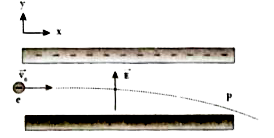 Speed of an electron `= V_(0)` Uniform electric FIELD = `VECE` (a) Electron.s acceleration : Force on electron due to uniform electric F = Ee Downward acceleration of electron due to electric field a =` (F)/(m) = -(eE)/(M)` Vector form `veca= -(eE)/(M)HATJ` (b) Electron.s velocity : Speed of electron in horizontal direction u = `V_(0)` From the equation of motion V= `mu` +at `V= V_(0)-(eE)/(M)t` vector form `vecV=V_(0)hatj- (eE)/(M)t hatj` (C ) Electron.s position : Position of electron s=r From equation of motion `r= V_(0)t+(1)/(2)(-(eE)/(M))t^(2)` `r= V_(0)t= (1)/(2)(eE)/(M) t^(2) hatj` Vector form `vecr= V_(0)t hati -(1)/(2) (eE)/(M) t^(2)hatj` |
|
| 32. |
The maximum value of index of refraction of a material of a prism which allows the passage of light through it when the refracting angle of prism is A is : |
|
Answer» `SQRT(1+sin^(2)a//2)` `r_(1) + r_(2) = A` `2C = A, C = (A)/(2)` `THEREFORE "" mu = (1)/(sin C) = (1)/(sin((A)/(2)))` `=sqrt((sin^(2)""(A)/(2)=cos^(2)""(A)/(2))/(sin^(2)""(A)/(2)))=sqrt(1+cot^(2)(A)/(2))` |
|
| 33. |
A metallic rod of length l and resistance R is rotated with a frequency v, with one end hinged at the centre and the other end at the circumference of a circular metallic ring of radius l, about an axis passing through the centre and perpendicular to the plane of the ring. A constant and uniform magnetic field B parallel to the axis is present everywhere. (a) Derive the expression for the induced emf and the current in the rod. (b) Due to the presence of the current in the rod and of the magnetic field, find the expression for the magnitude and direction of the force acting on this rod. (c) Hence obtain the expression for the power required to rotate the rod. |
|
Answer» Solution :(a) In one revolution Change of area, `DA = PI l^(2)` `:.` change of magnetic flux `d phi = VEC(B)* vec(dA)= B.d A cos 0^(@)` `= B pi l^(2)` (i) Induced emf, `epsilon= B pi l^(2)//T = B pi l^(2)v` (ii)Induced current in the rod, `I = epsilon/R= ( pi v B l^(2))/(R)` (b) Force acting on the rod, `F = I l B` `= ( pi v B^(2)l^(3))/(R)` The externalforce required to rotate the rod opposes the Lorentz force acting on the rod/ external force acts in the direction opposite the Lorentz force. (c) Powerrequired to rotate the rod Power `= ` Force `XX` velocity `P= F xx v` `= (pi v B^(2)l^(3))/(R) xx v` |
|
| 34. |
Consider a tightly wound 100 turn coil of radius 10cm, carrying a current of 1A. What is the magnitude of the magnetic field at the centre of the coil? |
| Answer» SOLUTION :`B=(mu_0NI)/(2A)=(4PI xx10^-7 xx100xx1)/(2xx10xx10^-2)=6.28xx10^-4T` | |
| 35. |
Differentiate between Fresnel and Fraunhofer diffraction. |
Answer» SOLUTION : 
|
|
| 36. |
Draw the output waveform across the resistor. |
Answer» Solution : Here, current passing through the closed path given in the STATEMENT, `I=(v_(i))/(R+R_(D))""…(1)` (where `R_(D)=` RESISTANCE of diode) During negative HALF cycle of input voltage, SINCE diode is reverse biased, `R_(D)=OO` and so from equation (1), I = 0 and so output voltage `v_(0)=IR=0 ""(because I=0)` During positive half cycle of input voltage, since diode is forward biased , `R_(D)=0` and so from equation (1), `I=(v_(i))/(R )` and so output voltage `v_(0)=IR =((v_(i))/(R ))R=v_(i)=1`volt. (from figure) |
|
| 37. |
In a uniform magnetic field of induction B a wire in the form of a semicircle of radius r rotates about the diameter of the circle with angular frequency omega. The axis of rotation is perpendicular to the field. If the total resistance of the circuit is R, the mean power generated per period of rotation is ...... |
|
Answer» `(Bpir^2omega)/(2R)` `=AB cos omegat` `=(pir^2 B cos omegat)/2` ( `because` Area of SEMICIRCLE `A=(pir^2)/2`) INDUCED emf `epsilon=-(dphi)/(dt)` `=-d/(dt)[(pir^2 B cos omegat)/2]` `=+1/2 pi Br^2omega sin omegat` Power `P=epsilon^2/R=(pi^2B^2r^4 omega^2 sin^2 omegat)/(4R)` `therefore lt sin^2 omegat gt =1/2` `therefore` Average power = `(piBr^2omega)^2/(4R)xx1/2` `=(Bpir^2omega)^2/(8R)` |
|
| 38. |
A 50MHz sky wave takes 4.04 ms to reach a receiver via retransmission from a satellite 600km above earht's surface. Assuming re-transmission time by satellite negligible, find the distance between source and reciever. |
|
Answer» 606km Total time taken (t)`=("Total distance travelled"(2x))/("Speed of electromagnetic waves"(c))` ` therefore x=(CT)/(2)=((3xx10^(8))(4.04xx10^(-3))/(2)=6.06xx10^(5)m=606km` `therefore x=(ct)/(2)=((3xx10^(8))(4.04xx10^(-3)))/(2)=6.06xx10^(3)m=606km` Let T be the source of electromangetic waves (i.e. transmitter), R be receiver and S be sate as shown in FIGURE.  `d^(2)xxx^(2)-h^(2)=(606)^(2)-(600)^(2)` `therefore d= 85.06km` Distance between source and receiver `=2d=2xx85.06=170km ` |
|
| 39. |
Equal weight are suspended from two wires of same metal. One if these wires is of length 2m and diameter 1mm while the other is of length 1 meter and dia 0.5mm. In which wire there will be large extension. |
| Answer» SOLUTION :in the SECOND WIRE. | |
| 40. |
In a magnetic field of 0.05T, area of a coil changes from 101 cm^2 to 100 cm^2 without changing the resistance which is 2Omega . The amount of charge that flow during this period is |
|
Answer» `2.5 XX 10^(-6) C` |
|
| 41. |
Chose the correct statement: |
|
Answer» Number of COLLISIONS per second between free electrons in a wire is a measure of ELECTRIC resistance of the wire |
|
| 42. |
Answer the following: (i) Statethe principleof workingof a potentiometer. (ii)In thefollowingpotentiometercircuitABis a uniformwireof length1 mandresistance10Omega Calculatethe potential gradientalongthe wireandbalancelengthAO (=l) |
| Answer» Solution :When a CONSTANT current flows through a conductor of uniform area of cross-section, the potential drop ACROSS any length of the wire is directly PROPORTIONAL to the length, i.e., V `alpha`l | |
| 43. |
In Exercises 3 and 4, what is the net power absorbed by each circuit over a complete cycle. Explain your answer. |
|
Answer» Solution :In EXERCISE 3 Average power `P = V_("rms")` `I_("rms").cos phi` As we KNOW that the PHASE DIFFERENCE between current and voltage in case of inductor is `90^(@)`. `P = V_("rms").I_("rms").cos 90^(@)=0` In Exercise 4 Average power `P = V_("rms").I_("rms").cos phi` We know that the phase difference between current and voltage in case of capacitor is `90^(@)` `P=V_("rms").I_("rms").COS90^(@)=0` |
|
| 44. |
The charged currents in the outer conducting regions of the earth's core are thought to be responsible for earth's magnetism. What might be the battery' (i.e., the source of energy) to sustain these currents? |
|
Answer» Solution :(c) Due to very high TEMPERATURE, magnetic ORES in the core of Earth are in the molten state which is found to be quite good conductor of electricity. The ions in this matter, revolve along with axial rotation of Earth and thereby form large current loops which are believed to be source of geomagnetism. If this argument is correct then a planet with less ANGULAR speed of axial rotation (e.g. Venus) should have WEAK magnetic field, a planet with more angular speed of axial rotation (e.g. Jupiter) should have strong magnetic field and it a planet does not have molten metal in its core (e.g. Moon) should not have any magnetic field. Experimentally all of these arguments are found to be true. Hence, scientists all over the world believe that large current loops formed by the circular motions of ions in the molten state of magnetic ore in the core of Earth behave like magnetic dipoles giving rise to Geo-magnetism. Another guessing is for circular motion of charged particles, emitted by RADIOACTIVE elements in the interior part of Earth. But still researches are going on to find out the correct reason and explanation for geo-magnetism. |
|
| 45. |
What is the only true morality? |
|
Answer» To have consent |
|
| 46. |
Deficiency of how many electrons will produce a positive charge of 8xx10^(-19)C.? |
|
Answer» Solution :We know that `Q=+- "ne"` `rArr8xx10^(-19)=nxx1.6xx10^(-19)` `N=(8XX10^(-19))/(1.6xx10^(-19))=5` `THEREFORE`Dificiency of 5 electrons will produce `+8xx10^(19)C`. |
|
| 47. |
Water is boiled in flat bottom kettle placed on a stove. The area of the bottom is 3000 "cm"^(2) and the thickness is 2 mm. If the amount of steam produced is 1 g "min"^(-1) , the difference of temperature between the inner and outer surfaces of the bottom is (Given : Thermal conductivity of the material of kettle is 0.5 cal ""^@C^(-1) s^(-1) "cm"^(-1) and latest heat of steam is 540 cal g^(-1)) |
|
Answer» `2.1xx10^(-3)""^@C` `(dm)/(DT) = 1/60 G s^(-1)` Heat transferred per second , `(DQ)/(dt)=L (dm)/(dt)` `rArr (dQ)/(dt)=540xx1/60 "cal s"^(-1)` Also `(dQ)/(dt)=(KA DeltaT)/d` `therefore DeltaT=(dQ)/(dt)xxd/(KA)=(9xx0.2)/(0.5xx3000)=1.2xx10^(-3) ""^@C` |
|
| 48. |
A circular coil of wire of radius 'r' has 'n' turns and carries a current T. Find the magnetic induction (B) at a point on the axis of the coil at a distance sqrt(3)r from its centre ? |
| Answer» SOLUTION :`(mu_0 NI)/(16 R)` | |
| 49. |
The optical path of a monochromatic light is same if it goes through 4.0cm of glass of 4.5cm of water. If the refractive index of glas is 1.53, the refractive index of the water is |
|
Answer» `1.30` i.e. `mu_(1)x_(1)=mu_(2)x_(2)implies1.53xx4=mu_(2)xx4.5` `IMPLIES mu_(2)=(1.53xx4)/4.5=1.36` |
|