

Saved Bookmarks
This section includes 7 InterviewSolutions, each offering curated multiple-choice questions to sharpen your Current Affairs knowledge and support exam preparation. Choose a topic below to get started.
| 1. |
When the temperature of a metal cylinder is raised from 47.4^@C " to " 100^@C , its lengthincreases by 0.10% (a) Find the percent change in density .(b) What is the metal ? Use Table 18-2 |
|
Answer» |
|
| 2. |
The dc common emitter current gain of a n - p - ntransistor is 50 . The potential difference applied across the collector and emitter of a transistor used in CE configuration is V_(CE)= 2 V . If the collector resistance R_C = 4KOmega, the base current and the collection current (I_B) and the collector current (I_C) are |
|
Answer» `I_(B)=10MUA,I_(C)=0.5mA` `BETA=I_(C)/I_(B)rArrI_(B)=I_(C)/beta=(0.5xx10^(-3))/50=10^(-5)A=10muA` |
|
| 3. |
Explain plane wave refraction from denser to rarer medium using Huygen's principle. |
|
Answer» Solution :Let speed of light in denser medium is `v_(1)` and in rarer medium is `v_(2)` and `v_(2)gtv_(2)`. Refracted ray moves away from the perpendicular when it goes from the denser medium to rarer medium. At certain incident angle, angle of refraction becomes `90^(@)`. This angle is called critical angle `i_(e)`. From Snell.s law, `n_(1)SINI=n_(2)SINR` If `i=i_(c),` then `r=90^(@)` hence `sin90^(@)=` `:.sini_(c)=(n_(2))/(n_(1))` We will not find any refraction ray for all the angles GREATER than the critical angle. Rarer medium for which `v_(2)gtv_(1)` the refraction of incident plane on it refracted away from perpendicular of plane wave. This is shown in FIGURE. 
|
|
| 5. |
The electron in the hydrogen atom circles around the nucleus with a speed of 2.0 xx 10^6 ms^(-1)in an orbit of 5.3 xx 10^(-11) m. What is the magnetic field at the centre of the nucleus? |
| Answer» SOLUTION :`11.39 T` | |
| 6. |
In an n-type semiconductor, the fermi energy level lies |
|
Answer» in the forbidden ENERGY gap NEARER to the CONDUCTION BAND |
|
| 7. |
What is fundamental difference between electric dipole and magnetic dipole. |
|
Answer» Solution :1. A fundamental difference between ELECTRIC dipole and magnetic dipole is an electric dipole is built up of two elementary units. The charges (or electric monopoles). 2. In magnetism, a magnetic dipole (or a current loop) is the most elementary ELEMENT. 3. The EQUIVALENT of electric charges i.e. magnetic monopoles are not known to exist. |
|
| 9. |
Television is basically a system for reproducing____________ |
|
Answer» sound |
|
| 10. |
The mobility of electrons is greater than that of holes. Because they |
|
Answer» are lighter |
|
| 11. |
The length of potentiometer wire is 1m and its resistance is 4Omega. Acurrent of 5mA is flowing in it. An unknown emf is balanced on 40 cm length of this wire. The unknown emf is x mv. What is the value of .x. ? |
|
Answer» |
|
| 12. |
Electric charge Q is uniformly distributed around a thin ring of radius a. find the potential a point P on the axis of the ring at a distance x from the centre of the ring . |
|
Answer» <P> Solution :Since the ENTRIE charge is at distance R = `sqrt(x^(2) + a^(2)) ` from the point P, therefore, the potential at p due to the total charge Q is |
|
| 13. |
Which one between space wave and sky waves, used in distant communication through atmopsphere, has a higher frequency? |
|
Answer» |
|
| 14. |
A transformer works on the principle of |
Answer» Solution : Construction : A TRANSFORMER consists of two coils insulated from each other. They are wound on a soft-iron CORE, on separate limbs of the core or either one on top of the other). They are called primary and secondary coils. In a step up transformer, the primary coil consists of few turns when compared to turns of secondary coil. It is just OPPOSITE in step down transformer. PRINCIPLE : Transformer works on "mutual induction". |
|
| 15. |
In a nuclear reaction, which of the following options are conserved? |
|
Answer» mass only |
|
| 16. |
How will the saturation current in a diode with a caesium-coated tungsten cathode change, if the cathode temperature is raised from 1000 K to 1200 K? |
|
Answer» For the computation one should find LOG x. |
|
| 17. |
In the above question if the inital velocity of projection above the plane is u, the distance up to which the block can rise up is: |
|
Answer» `(u^(2))/(4g SIN THETA)` `0-u^(2) =2(-2g sin theta).S or S=(u^(2))/(4g sin theta)` (a) is the CHOICE. |
|
| 18. |
A sinusoidal wave is sent along a string with a linear density of 5.0 g/m. As it travels, the kinetic energies of the mass elements along the string vary Figure 10-49a gives the rate dk/dt at which kinetic energy passes through the string elements at a particular instant, plotted as a function of distance x along the string. Figure 1649b is similar except that it gives the rate at which kinetic energy passes through a particular mass element at a particular location) plotted as a function of time. For botle figures the scale in the vertical (rate) axis is set by R_s=10W. What is the amplitude of the wave? |
|
Answer» |
|
| 19. |
In a series resonant LCR circuit, the voltage across R is 100 volts and R=1 k Omega with C = 2 uF. The resonant frequency w is 200 rad s^(-1). At resonance the voltage across L is |
|
Answer» `2.5 xx 10^(-2)` V At RESONANCE `I = V/R = 100/(1000) = 0.1 A` `therefore` Voltage across L = voltage across `C = IX_( C) = (0.1)/(2 xx 10^(-6) xx 200) = 250 V` |
|
| 20. |
A potentiometer wire of length 1000 cm has a resistance of 10 Omega It is connected in series with a resistance and fa cell of emf 2 V and of negligliable internal resistance. A sourece of emf 10 mVis balanced against 40 cm of the potentiometer wire. What is the value of the external resistance? |
|
Answer» |
|
| 21. |
A neutral pion decays into two gamma-photons: pi^(0)togamma+gamma Why cannot a single photon be born? What conservation law is in contradiction with it? What is the energy of the photon? |
|
Answer» The energy of each photon is `epsi_(gamma)=135//2=67.5MeV`. |
|
| 22. |
Two long parallel conductors carry currents i_1, = 3A and i_2 = 3A both are directed into the plane of paper. The magnitude of resultant magnetic field at point 'P, is |
|
Answer» `12 mu T ` |
|
| 23. |
What's modulation? |
| Answer» Solution :The PROCESS of SUPERIMPOSING a low frequency signal on high frequency wave, which acts as a CARRIER wave for LONG distance TRANSMISSION is known as modulation. | |
| 24. |
A nonconducting ring of radius R has uniformly distributed positive charge Q. A small part of the ring.of length d, is removed (d lt lt R). The electric field at the centre of the ring will now be |
|
Answer» directed TOWARDS the gap, inversely PROPORTIONAL to `R^(3)` |
|
| 25. |
How did the duck feel and where was he from? |
|
Answer» He felt HAPPY and he was from COLD north |
|
| 26. |
Derive the expression for the electricpotential at any point along the axial line of an electric dipole. |
Answer» Solution :Deivation of expression of electric FIELD on the equatoral line of the DIPOLE.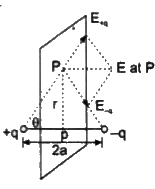 Both are equal and their DIRECTION are as shwon in the figure. Hence net electric field `E_(+q)=q/(4piepsilon_(0)(r^(2)+a^(2)))` `E_(-q)=q/(4piepsilon_(0)(r^(2)+a^(2)))` Let the point P be the at a distance r form the mid point of the dipole. `VEC(E)=[-(E_(+q)+E_(-q)cosq]hatp` `=-(2qa)/(4piepsilon_(0)(r^(2)+a^(2))^(3//2))hatp` |
|
| 27. |
Two circular coils A and B of radius (5)/(sqrt(2)) cm and 5 cm respectively carry current 5 Amp and (S)/(sqrt(2)) AmP respectively . The plane of B is perpendicular to plane of A nd their centres coicide. Find the magnetic field at the centre. |
| Answer» SOLUTION :`SQRT(5)/(2sqrt(2)) 4 pi xx 10^(-5) T` | |
| 28. |
A spherical capacitor has an inner sphere of radius 12cm and an outer sphere of radius 13cm. The outer sphre is earthed the inner sphere is given a charge of 2.5muC. The space between the concentric spheres is filled with a liquid of dielectric constant 32. a. Determine hte capacitance of the capacitor. b. What is the potential of hte inner sphere? c. Compare the capacitance of this capacitor with that of an isolated sphere of radius 12cm. Explain why the latter is much smaller. |
|
Answer» Solution :`r_(1)=12 xx 10^(-2)m ""r_(2)=13 xx 10^(-2) m ""Q=2.5muC"k=32"` `C=(4PI epsi_(0) r_(1)r_(2))/((r_(2)-r_(1))) xx k =(1 xx 12 xx 10^(-2) xx 13 xx 10^(-2) xx 32)/(9 xx 10^(9) xx 10^(-2))=(4 xx 13 xx 32 xx10^(-11))/(3)=5.5 xx 10^(9)F` `V=1/(32) [(9 xx 10^(9) xx 2.5 xx 10^(-6))/(12 xx 10^(-2))-(9 xx 10^(9) xx 2.5 xx 10^(-6))/(13 xx 10^(-2))]` `=(9 x 2.5 xx 10^(5))/(32) {1/(12)-(1)/(13)}=(9 xx 2.5 xx 10^(5))/(12 xx 13 xx 32)=450.7V` `C=4pi epsi_(0) r=(12 xx 10^(-2))/(9 xx 10^(9))=1.33 xx 10^(-11)F` Ratio `=(5.5 xx 10^(-9))/(4/3 xx 10^(-4))=(5.5 xx 300)/(4)=412.5` |
|
| 29. |
The velocity and time graph for a particle moving in a straight line s shown in the figure. Then, the average velocity between t=4 s and t=6 s is _____ |
|
Answer» `10.5ms^(-1)` |
|
| 30. |
5 In a Zener regulated power supply a Zener diode with V_(Z) = 6.0 Vis used for regulation. The load current is to be 4.0 mA and the unregulated input is 10.0 V. What should be the value of series resistor R_(S)? |
| Answer» Solution :The value of `R_(S)`should be such that the current through the Zener diode is much larger than the LOAD current. This is to have good load REGULATION. Choose Zener current as five times the load current, i.e.`I_(Z) =20mA` ,The total current through RSis, therefore, 24 mA. The voltage drop across `R_(S)`is 10.0 – 6.0 = 4.0 V. This gives`R_(S) = 4.0V//(24 xx 10^(-3))A = 167 OMEGA`.The nearest value of carbon resistor is 150 Ω. So, a series resistor of `150 Omega`is appropriate. Note that slight variation in the value of the resistor does not matter, what is important is that the current `I_(Z)`should be SUFFICIENTLY larger than `I_(L)`. | |
| 31. |
Using Bohr's atomic model, derive the expression for the radius of nth orbit of the revolviting electron in a hydrogen atom. |
|
Answer» Solution :We know that when an electron revolves in a STABLE ORBIT, the centripetal force is provided electrostatic force of attraction acting on it due to a portion present in the nucleus. `therefore (m v_(N)^(2))/(r_(n))=(1)/(4pi epsi_(0)). (e^(2))/(r_(n)^(2)) rArr v_(n)^(2) =(e^(2))/(4pi epsi_(0) m r_(n))` and form Bohr.s quantum condition, we have `m v_(n). r_(n) =(nh)/(2pi) or v_(n)=(nh)/(2pi m r_(n))` Squaring (ii) and then equating it with (i), we get `(n^(2) h^(2))/(4pi^(2) m^(2) r_(n)^(2))=(e^(2))/(4pi epsi_(0), m. r_(n)) rArr r_n =(n^(2) h^(2))/(4pi^(2) m^(2)) xx (4pi epsi_(0) m)/(e^(2)) =(epsi_(0) h^(2))/(PI me^(2)) .n^(2)` |
|
| 32. |
The Gaussian surface for a line charge will be |
|
Answer» Sphere |
|
| 33. |
In an intrinsic semiconductor, the density of conduction electrons is 7.07 xx 10^(15)m ^(-3) . When it is doped with indium, the density of holes becomes 5xx 10^(22)m^(-3). Find the density of conduction electron is doped semiconductor |
|
Answer» ZERO |
|
| 34. |
द्विजगत प्रणाली में जीव को बाँटा गया है |
|
Answer» पादप व जन्तु में |
|
| 35. |
(a) A circular diaphragm 50 cm in diameter oscillates at a frequency of 25 kHz as an underwater source of sound used for submarine detection, Far from the source, the sound intensity is distributed as the diffraction pattern of a circular hole whose diameter equals that of the diaphragm. Take the speed of sound in water to be 1450 m // s and find the angle between the normal to the diaphragm and a line from the diaphragm to the first minimum. (b) Is there such a minimum for a source having an (audible) frequency of 1.0 kHz? |
| Answer» SOLUTION :(a) 8.1, (b) SINCE `SIN theta` cannot exceed 1 there is no minimum | |
| 36. |
A wire oriented in the east-west direction carries a current eastward. Direction of the magnetic field at a point south of the wire is |
|
Answer» South-east |
|
| 37. |
Human eye is most sensitive to 5550Å and diameter of pupil is 1.8 mm. The greates distance at which a person can see clearly the milimetre marks on a scale is approximately |
|
Answer» 1.7m |
|
| 38. |
A string of length 0.4 m and mass 10^(-2) kg is rigidly clamped at its ends. The tension in the string is 1.6 N. Identical wave pulses are produced at one end at equal intervals of time Delta t. The minimum value of Delta t which allows constructive interference between successive pulses is : |
|
Answer» 0.05 s |
|
| 39. |
Find out the amount of the work done to separate the charges at infinite distance . |
|
Answer» Solution :Potential ENERGY of charge system. `U = (1)/(4 pi in_(0)) [ (q_(A) q_(B))/(AB) + (q_(A) q_(B))/(AC) + (q_(B) q_(C))/(BC)] = (1)/(4 pi in_(0)) [ (q(-4q))/(l) + (q(2Q))/(l) + ((-4q) (2q))/(l)]` `= - (1)/(4 pi in_(0)) * (10 q^(2))/(l)` `therefore` Work done to separate the CHARGES at infinite distance ` W = U_(oo) + U = + (1)/(4 pi in_(0)) * (10 q^(2))/(l)` |
|
| 40. |
In the figure shown an observer O_(i)floats (static) on water surface with ears in air while another observer O_(2)is moving upwards with constant velocity v_(1) = v//5 in water. The source moves down with constant velocity v_(2) = v//5 emits sound of frequency /. The velocity of sound in air is v and that in water is 4v. For the situation shown in figure: |
|
Answer» The wave LENGTH of the sound RECEIVED by `O_(1)` is4v/5f |
|
| 41. |
Draw p-n junction with reverse bias. |
Answer» SOLUTION :
|
|
| 42. |
In a simple harmonic motion, when the displacement is one - half the amplitude, what fraction of the total energy is kinetic |
|
Answer» ZERO |
|
| 43. |
A winding wire which is used to frame a solenoid can bear a maximum 10 A. current If length of solenoid is 80 cm and its corss sectional raedius is 3 cm , then required length of winding wire is (B =0.2T) |
|
Answer» `1.2xx10^(2)`m |
|
| 44. |
A cube is arranged such that its length, breadth and height are along X,Y and Z directions. One of its corners is situated at the origin Length of each side of the cube is 25 cm. The components of electric field are E_(x) = 400 sqrt(2) N//C, E_(y) = 0 and E_(z) = 0 respectively. The flux coming out of the cube at one end will be |
|
Answer» `25sqrt(2)NM^(2)//C` |
|
| 45. |
Zener breakdown occurs |
|
Answer» Under FORWARD biased condition |
|
| 46. |
The figure shows a schematic diagram showing the arrangement of Young.s Double Slit Experiment Identify the correct statement (s) if the source slit S moved closer to S_(1)S_(2) i.e the distance l decreases |
|
Answer» nothing happens to fringe pattern |
|
| 47. |
The example of an ohmic conductor is |
|
Answer» diode |
|
| 48. |
What are i. Magnetic declination ii. Magnetie dip iii. Horizontal component of earth.s magnetic field at a place? |
|
Answer» Solution :Magnetic DIP : The angle made by the earth.s magnetic FIELD with its HORIZONTAL component is CALLED magnetic dip. Magnetic DECLINATION : The angle between magnetic meridian and geographic meridian is called magnetic declination. |
|
| 49. |
A body is acted on by a force given by F = (10+2t) N. The impulse received by the body during the first four seconds is |
| Answer» ANSWER :B | |
| 50. |
Light enters from air into a medium of R.I 1.5. What is the percentage change in its wavelength? |
|
Answer» 0.25 |
|