

Saved Bookmarks
This section includes 7 InterviewSolutions, each offering curated multiple-choice questions to sharpen your Current Affairs knowledge and support exam preparation. Choose a topic below to get started.
| 1. |
The gravitational attraction between electron and proton in a hydrogen atom is weaker than the coulomb attraction by a factor of about 10^(40). An alternative way of looking at this fact is to estimate the radius of the first Bohr orbit of a hydrogen atom if the electron and proton were bound by gravitational attraction. You will find the answer interesting, |
|
Answer» Solution :By thelawof gravition ,`(m_ev^2 )/(r )= (Gm _e m_p ) /(r^2)` `i.E.,m_e v^2 r= gm_e m_p `………(1) Bybohr.scondition`m_e vr =(nh )/( 2 pi)` `m_(e)^(2) V^2 r^2=(n^2 h^2)/( 4 pi ^2) `………(2) for ` 1^(ST)` ORBIT ,`n=1 , h=6.626xx 10^(-34) Js` ` G= 6.67 xx 10^(-11) Nm ^2 // kg ^2` ` m_e= 9xx 10^(-11) Kg , m_p= 1.67 xx 10^(-27 ) kg` Eq (2)`div `(1) ` impliesm_e r = (n^2 h^2)/( 4 pi ^2 Gm_e m_p)` ` r=(n^2 h^2)/( 4 pi ^2Gm_e^(2) m_p)` Substitingthesevaluesweget`r= 1.21 xx 10^(29)` m this value of .r. is much greaterthanthe SIZEOF the universe . |
|
| 2. |
The bond that exists in a semi conductor is |
|
Answer» COVALENT BOND |
|
| 3. |
Statement I : An external circuit can draw a maximum power of 9 W from a source of emf V and internal resistance1Omega . Statement II : The condition , for which an external circuit of resistance R draws the maximum power from a source of internal reistance r , is R =r |
|
Answer» STATEMENT I is TRUE , Statement II is true , Statement II is a correct explanation for Statement I |
|
| 4. |
Solve Problem 28.1 for a muon. What are its speed and kinetic energy? |
|
Answer» <P> The rest energy of a muon is 207 times that of an ELECTRON, i.e. `= 207 xx 0.511 =100 MEV` (see Problem 8.1). The total energy is `epsi=(epsi_(0))/sqrt(1-beta^2)` and the kinetic energy is `K= epsi-epsi(0)` |
|
| 5. |
The capacitive reactance in an A.C. circuit is |
|
Answer» EFFECTIVE resistance DUE to CAPACITOR |
|
| 6. |
(a) What is linearly polarised light ? Describe briefly using a diagram how sunlight is polarised (b) Unpolarised light is incident on a polaroid. How would the intensity of transmitted light change when the polaroid is rotated ? |
|
Answer» Solution :(a) The light, in which vibrations of electric vectors are confined only in one particular PLANE perpendicular to the direction of propagation of light, is called plane polarised light. The sunlight is ORDINARY unpolarised light. However, when the sunlight is SCATTERED on encountering the molecules of Earth.s atmosphere, the scattered light as seen by an observer looking at `90^(@)` to the direction of sun is found to be plane polarised as shown in figure. (b) The intensity of transmitted light, when unpolarised light of intensity `I_(0)` is incident on a polaroid, is `I=(I_(0))/(2)`. however, this intensity remains unchanged EVEN when the polaroid is rotated about its own axis. |
|
| 7. |
Energy gap in p - n photodiode is 2.8 eV. Can it detect a wavelength of 6000 nm ? Justify your answer. |
|
Answer» Solution :Here energy gap `E_(g)=2.8eV and lambda=6000 n =6000xx10^(-9)m=6xx10^(-6)m` `therefore"Energyof radiation PHOTON E"=(hc)/(elambda)eV=((6.63xx10^(-34))xx(3xx10^(8)))/((1.6xx10^(-19))xx(6xx10^(-6)))=0.207eV` As `E lt E_(g)`, the photodiode cannot detect the radiation. |
|
| 8. |
Do the same exercise as above with the replacement of the earlier transformer by a 40,000-220 V step-down transformer (Neglect, as before, leakage losses though this may not be a good assumption any longer because of the very high voltage transmission involved). Hence, explain why high voltage transmission is preferred? |
|
Answer» Solution :(a) Hence 800 kW power is delivered at town sub station by two way TRANSMISSION line at 40,000 V. Hence, current through this line is, `I = ( P )/( V )` `= ( 800 xx 10^(3))/( 40,000)` = 20 A Power loss in the line wires is, `P. = I^(2) R` `= ( 20 )^(2) ( 15)` `:. P . = 6000 W = 6 kW` (b) Total power supplied by the PLAIN shouldbe, `P_(t ) = P + P.` `= 800 kW+ 6kW` = 806 kW (c ) Voltage drop across two way line, = IR ( 20) ( 15) = 300 V Voltage across secondary coil of a TRANSFORMER at power plant should be, = 300 + 40,000 = 40,300 V `rArr` Thus, at power station we should use a step-up transformer ( 440V - 40,300V ) Explanation about why power transmission is always preferred at very high voltage. (i) Power loss in the form of heat in exampleno. 7.25 is, `= ( 600)/( 1400) xx 100%` = 42.86 % (ii) Power loss in the form of heat in example no. 7.26 is, `= ( 6)/( 806) xx 100%` = 0.7444% Thus, when a GIVEN ELECTRICAL power is transmitted at very high voltage, power loss in the form of heat can be reduced considerbly. Hence, it is always preferred. |
|
| 9. |
Derive the expression for refractive index of the material of the prism in terms of angle of the prism and angle of minimum deviation. |
Answer» Solution :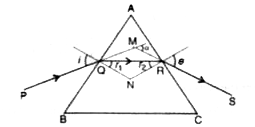 From `Delta MQR, ( i- r_(1)) + ( e - r_(R)) = delta` So `( I + e ) - ( r_(1) + r_(2)) = delta ` From`Delta PQN , r_(1) + r_(2) + /_ QNR = 180^(@)` Also `/_ A + /_N = 180^(@)` Thus `/_ A = r_(1) + r_(2)` So, `i + e - A = delta ` At minimum deviation, `i = e, r_(1) = r_(2) = r `and `delta = dleta _(m)` `RARR i = ( A + delta_(m))/( 2)` And `r = ( A )/( 2)` Also `mu = ( sin i )/( sin r )` Hence`mu = ( sin ((A + delta_(m))/( 2)))/( sin ((A)/(2)))` |
|
| 10. |
A wire under tension vibrates with a fundamental frequency of 600 Hz. If the length of the wire is doubled, the radius is halved and the wire is made to vibrate under one ninth the tension . Then the fundamental frequency will become : |
|
Answer» Solution :`v = (1)/(2l) sqrt((T)/(m))` `therefore 600 = (1)/(2l) sqrt((T)/(m)) ` v. = `(1)/(2l.) sqrt( (4 T.)/(rho PI D^(2).))` ` therefore v. = (1)/(2.2l) sqrt( (4 T//9)/(rho pi. (D^(2))/(4))) = (1)/(l)sqrt( ( T)/(9 rho pi D^(2))) = (1)/(3l) sqrt( (T)/(rho pi D^(2)))` ` therefore (v.)/(v) = (2l)/(3l)sqrt( ( T)/(rho pi. D^(2))) XX sqrt((rho pi D^(2))/(4T))= (1)/(3) ` so correct choice is a. |
|
| 11. |
Decay constants of two radio-active samples A and B are 15x and 3x zospectively. They have equal number of initial nuclci. The ratio of the number of nuclei left in A and B after a time 1/(6x) is : |
|
Answer» Solution :`N_(1)=N_(01e^(-lambda_(1)t))=N_(0)e^(-15 XX 1/(6x)=N_(0)e^(-5//2)` `N_(2)=N_(02e^(-lambda_(2)t)=N_(0)e^(-3x xx 1/(6x)=N_(0)e^(-1//2)` `N_(1)/N_(2)=e^(-2)` |
|
| 12. |
Name the physical quantity whose SI unit is Coulomb volt^-1 |
|
Answer» |
|
| 13. |
Light of wavelength 520 nm is falling normally on a plane diffraction grating having 5000 lines per cm. The maximum number of orders of diffracted images seen is : |
|
Answer» 2 Here (a + b) = `1/5000` CM. For maxima, `sin theta_(n) = 1` `(1)/(5000) xx 1 = m 520 xx 10^(-9) xx 10^(-2) n = 3`. |
|
| 14. |
Out of the following functions representing motion of a particle which represents SHM : (A)y=sin omega t-cos omegat (B) y=sin^(3)omegat ( C ) y=5cos((3pi)/(4)-3omegat) (D) y=1+omegat+omega^(2)t^(2). |
|
Answer» Only (A) represent SHM Correct choice is ( c ). |
|
| 15. |
Diodec is be semiconducting device made up of p-n junction.Diode can be used to convert AC into DC.This process is called-------- |
| Answer» SOLUTION :Rectifaction | |
| 16. |
Two blocks A and B of masses 3m and m respectively are connected by a massless and inextensible string. The whole system is suspended by a massless spring as shown in figure. The magnitudes of acceleration of A and B immediately after the string is cut, are respectively: |
|
Answer» `G/3, g/3` |
|
| 17. |
(b) Obtain the expression for the capacitance of a parallel plate capacitor. |
|
Answer» Solution :Each PLATE of the capacitor has area A and the plates are separated by distance d. If V is potential DIFFERENCE between two plates, then V=Ed If `sigma` is surface charge DENSITY then `E=(sigma)/(epsi_(0))` `impliesV=(sigma)/(E_(0))d` Now, `s=q//\AimpliesV=(sigma)/(E_(0)A)d` 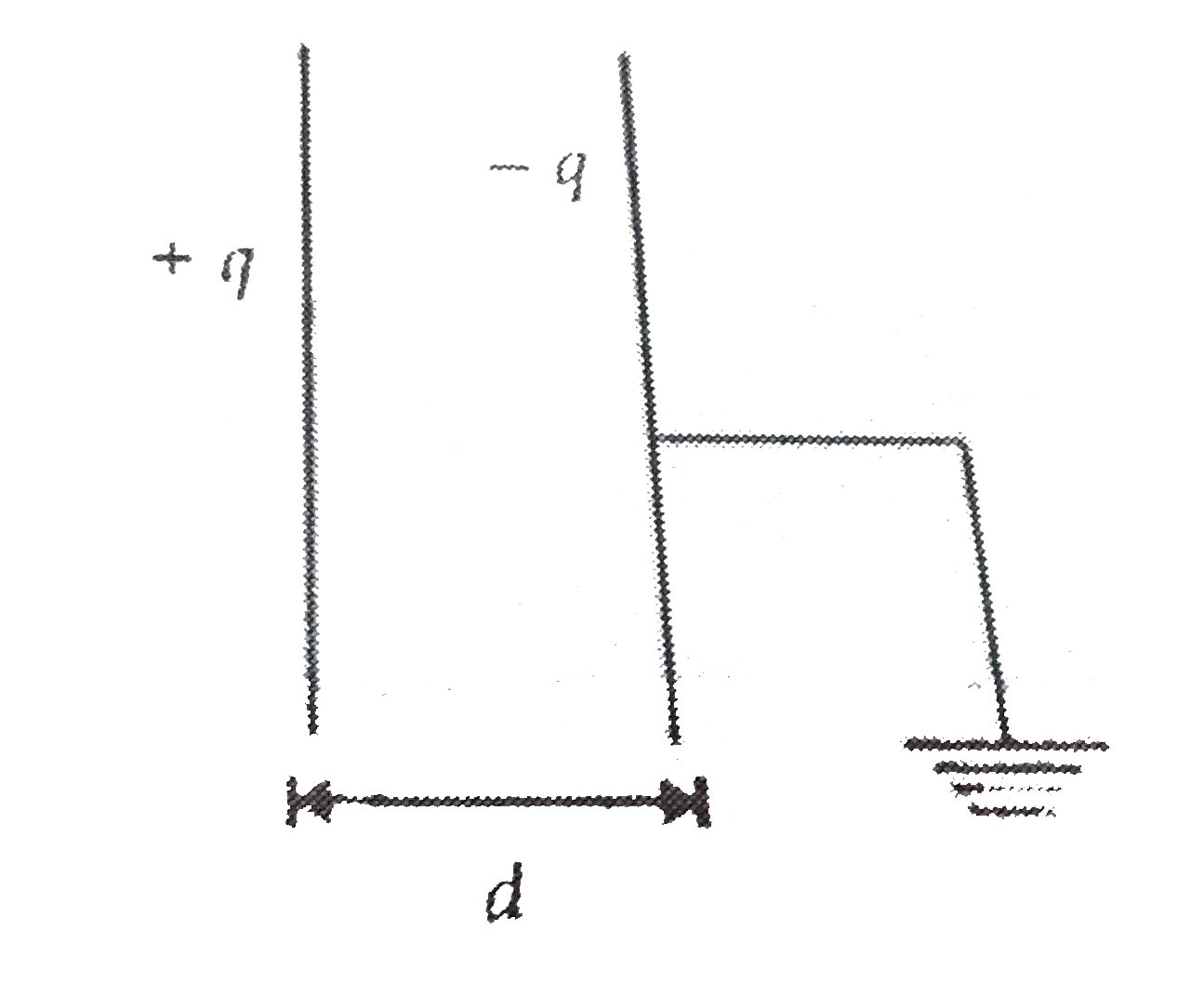 If C is capacitance then `C=(q)/(V)=((q)/(QD))/(in_(0)A)impliesC=(in_(0)A)/(d)`. |
|
| 18. |
Select wrong statement of the following. |
|
Answer» Radiation has DUAL NATURE |
|
| 19. |
In order to obtain a real image of magnification 2using a converging lens of focal length 20 cm , where should an object be placed |
|
Answer» `50 CM` |
|
| 20. |
A coil of inductance 62 mH and unknown resistance and a 0.94 muF capacitor are connected in series with an alternating emf of frequency 930 Hz. If the phase constant between the applied voltage and the current is 82^@, what is the resistance of the coil? |
|
Answer» |
|
| 21. |
The width of a depletion region is 400 nm. The intensity of the electric field at the depletion region is 5xx10^(5)V/m. Then calculate the following quantities: (1) The value of the potential barrier. (2) The minimum energy required by an electron to move from the n-type to the p-type region of the diode. |
|
Answer» SOLUTION :`d=400 nm = 400xx10^(-9)m` `E=5xx10^(5)V//m` `1eV=1.6xx10^(-19)J` (1) `E=(V)/(d)` `THEREFORE V=E.d=5xx10^(5)xx400xx10^(-9)` `therefore V = 0.2V` (2) Kinetic energy`(1)/(2)mv^(2)=Ve` `=0.2xx1.6xx10^(-19)` `=3.2xx10^(-20)J` ` =(3.2xx10^(-20))/(1.6xx10^(-19))` Kinetic energy `=0.2eV` |
|
| 22. |
An object is placed at a distance 20 cm from the pole of a convex mirror of focal length 20 cm. The image is produced at |
|
Answer» 13.3 cm |
|
| 23. |
A sonometre wire of length 1.5 m is made of steel. The tension in it produces an elastic strain of 1% . What is the fundamental frequency of steel if density and elasticity of steel are 7.7 xx 10^(3) kg/m^(3) and 2.2 xx 10^(11) N/m^(2) respectively ? |
|
Answer» 178.2 Hz = `(1)/(2l ) sqrt((T)/(A rho ))` ` (1)/(2l ) sqrt(("Stress")/(rho))` ` (1)/(2l ) sqrt((Y XX "Strain")/(rho)) ` ` = (1)/(2xx 1.5)sqrt( (2.2 xx 10^(11) xx 10^(-2))/(7.7 xx 10^(3)))` = 178.2 Hz So, Correct choice is a. |
|
| 24. |
Explain the minimum deviation angle for prism by graph of deviation angle versus incidence angle. |
Answer» Solution :The graph of experimentally measured values of the angle of deviation against the values of angle of incidence i is shown in the figure.  From the graph it is clear that the value of the angle of deviation becomes minimum for only one particular value of the angle of incidence i. Also we can see that for two values of angle of incidence angle of deviation is same. It has been experimentally established that for any given prism the ray for which the angle of incidence and angle of emergence are equal the angle of deviation is minimum for that ray. This angle is called the angle of minium deviation of the given prism for the incident monochromatic light. Note that, when `i=e implies delta=delta_m` For prism `i+e=A+delta` ...(1) the condition for minimum deviation angle. i=e then `delta=delta_m` `thereforei+i=A+delta_m` `therefore2i =A=delta_m` `therefore i=(A+delta_m)/(2)` ...(2) According to Snell.s Law for AB SURFACE, `n_1sin i=n_2sin r_1` ... (3)  From equation (3) & (4) `n_1sine=n_2sinr_2` ... (4) (i=e) `therefore` sin i =sin e `thereforen_2sinr_1=n_2sinr_2` `r_1=r_2=r` (Suppose) `r_1+r_2=A` r+r=A `r=A/2` ... (5) Using this result in equations (3) and (4) `n_1sin i =n_2sin r` `n_1sin i =n_2sinA/2` ... (6) [`because` From eqn.(5)] Using this result in equation (6) `n_1sin((A+delta_m)/(2))=n_2sinA/2` `(sin((A+delta_m)/(2)))/(sin(A/2))=(n_2)/(n_1)` If prism is kept in air then, `n_1`, = 1 and `n_2` = 1 So, above equation is, `n=(sin((A+delta_m)/(2)))/(sin(A/2))` This equation shows that for a given prism value of `delta_m` depends on the angle of prism and th refractive index of the material of prism and th medium in which the prism is kept. Remember : When `delta` is minium ray QR passin through the prism travels parallel to the base B of the prism. |
|
| 25. |
A cubical container is filled with a liquid whose refractive index increase linearly from top to bottom. Which of the followingrepresents the path of a ray of light inside the liquid: |
|
Answer» |
|
| 26. |
A spherical conductor of radius 12 cm has a charge of 1.6 xx 10^(-7) C distributed uniformly on its surface. What is the electric field (a) inside the sphere (b) just outside the sphere (c) at a point 18 cm from the centre of the sphere? |
|
Answer» SOLUTION :(a) ZERO (b) `10^(5) NC^(-1)` ( C) `4.4 XX 10^(4) NC^(-1)` |
|
| 27. |
The saturation current in an ionization chamber of 0.51 capacity is 0.02muA. Find the ion generation rate per second. |
|
Answer» |
|
| 28. |
In a hydrogen atom which of the following electronic transitions would involve the maximum energy change. |
|
Answer» from n=2 to n=1 |
|
| 29. |
The angular resolution of a 1m diameter telescope at a wavelength of 500 nm is of the order of _____. |
| Answer» SOLUTION :`10^(-7)` RADIAN. | |
| 30. |
The potential of the point O is . |
|
Answer» 3.5 V 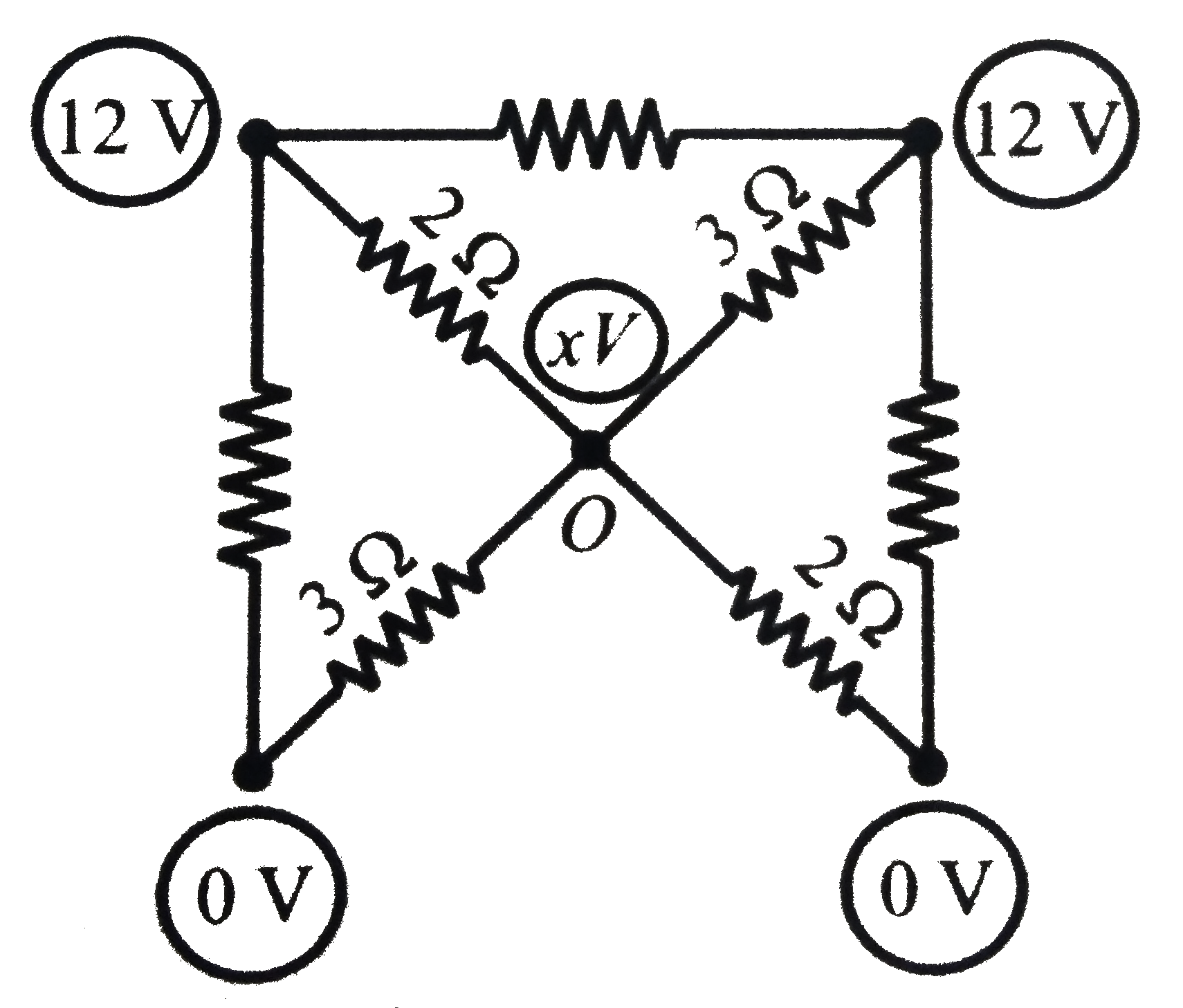 At junction O, let POTENTIAL of this POINT is x. `(12-x)/2 + (12-x)/3 = (x-0)/3 + (x-0)/2 or x=6V` . |
|
| 31. |
A hollow sphere of radius r is put inside another hollow sphere of radius R. The charges on the two are +Q and -q as shown in the figure. A point P is located at a distance x from the common centre such that r lt x lt R. The potential at the point P is |
|
Answer» `1/(4pi epsi_(0)) ((Q-q)/X)` |
|
| 32. |
An under water swimmer is at a depth of. 12 m below the surface of water. A bird is at a height of 18 m from the surface of water, directly above his eyes. For the swimmer the bird appears to be a distance from the surface of water equal to |
|
Answer» 24m |
|
| 33. |
Determine the magnitude of the magnetic fielf if ion A travels in a semicircular path of radius 0.50 m at a speed of 5.0xx10^(6) m//s. |
|
Answer» `1.0` T |
|
| 34. |
A fly wheel having a moment of inertia of 10^(7) g cm^(2) and revolving at the rate of 120 rpm is stopped by a brake in course of 5 seconds. Find the controlling torque. |
|
Answer» `2.51 xx 10^(7)` DYNE-cm Initial angular speed of the fly wheel, `omega_(1)=(2pir)/60=(2pixx120)/60=4PI"rad"//"sec"` Final angular speed = `omega_(2) = 0`, time= t = 5 sec. Now, applying the FORMULA `omega_(2) = omega_(1) - alphat`, we get `0=4pi-alphaxx5` or `alpha=(4pi)/5` rad/se`c^(2)` We know, torque = moment of Inertia (I) `xx alpha` `therefore` Torque, `tau=10^(7)xx(4pi)/5=2.51xx10^(7)` dyne cm |
|
| 35. |
A solution of camphor in alcohol in a tube 20cm long is found to effect a rotation of the plane of viberation of light passing is of 33^(@). What must be the indentify of camphor in g//cm^(2) in solution? The specific rotation of camphor is +54^(@). |
|
Answer» |
|
| 36. |
Mercury thermometers can be used to measure temperature upto |
|
Answer» a)`100^@C` |
|
| 37. |
A small coin is placed on a flat, horizontal turbtable. The turnable is observed to make three revolutions is 3.14 s. (a) What is the speed of the coin when it rides without slipping at a distance of 5.0 cm from the center of the turntable? (b) What is the acceleration (magnitude and direction) of the coin? (c) What are the magnitude and direction of the frictional force acting on the coi if the coin hasa mass of 2.0 g? (d) What is the coefficient of static friction between the coin and the turntable if the coin is observed to slide off the turntable when it is more than 10 cm from the center of the turntable? |
|
Answer» |
|
| 38. |
A uniform wire when connected directly across a 220 V line produces heat H per second. If wire is divided into n parts and all parts are connected in parallel across a 200 V line, then the heat produced per second will be |
|
Answer» `H_(s)` ` H=i^(2)RT "" (because i=V//r)` `H_(s)=(V^(2))/(nR_(eq))t` In parallel, equivalent resistance of n PARTS is ` R_(eq)=(r )/(n)` where, r is the resistance of each PART. `H=(V^(2))/((r//n))t=(nV^(2))/(t)t` `THEREFORE "" H=n^(2)H_(s)` |
|
| 39. |
The refractive indices of the crown glass for blue and red light are 1.51 and 1.49 resp. and those of flint glass are 1.77 and 1.73 respectively. Two isoscles prisms, one of crown glass and other of flint glass are combined to produce dispersion withoutdeviation. If angle of crown glass prism is 6^(@), what should be the angle of other prism ? Also calculatenet dispersion of the combination. |
|
Answer» Solution :Here, for crown glass, PRISM, `mu_(b) = 1.51, mu_(r) = 1.49, A = 6^(@)` and for flint glass prism, `mu'_(b) = 1.77 and mu'_(r ) = 1.73, A' = ?` Now, `mu = (mu_(b) + mu_(r ))/(2) = (1.51 + 1.49)/(2) = 1.50`, and`mu' = (mu'_(b) + mu'_(r ))/(2) = (1.77 + 1.73)/(2) = 1.75` For no deviation, the CONDITIONS is `delta + delta' = 0` `(mu - 1) A + (mu' - 1) A' = 0` `:.A' = (-(mu - 1)A)/((mu' - 1)) = (-(1.50 -1)6^(@))/((1.75 - 1))` `= (-0.50 XX 6^(@))/(0.75) = -4^(@)` Negative sign implies that the two prisms must be COMBINED in opposition. NET dispersion `= (mu_(b) - mu_(r ))A + (mu'_(b) - mu'_(r))A'` `= (1.51 - 1.49) 6^(@) + (1.77 - 1.73)(- 4)` `= 0.02 xx 6 + 0.04 (- 4)` `= 0.12 - 0.16 = - 0.04^(@)` |
|
| 40. |
The wavelength of light from the spectral emission line of sodium is 589 nm.Find the kinetic energy at which an electron . |
|
Answer» Solution :Wavelength of radiation of SODIUM, `lambda`=589 nm `therefore lambda =589xx10^(-9)m` Mass of electron `m_(e)=9.1xx10^(-31)kg` Mass of neutron `m_(n)=1.67xx10^(-27) kg` `h=6.63xx10^(-34)JS` 1eV `=1.6xx10^(-19)J` `implies`de-Beoglie.s wavelength of particle. `lambda=(h)/(p)` but `p=sqrt(2mK)` `therefore lambda.=(h)/(sqrt(2mK))` `therefore lambda.=(h^(2))/(2mK)` `therefore lambda.(h^(2))/(2MK)` `therefore K=(h^(2))/(2mlambda^(2))` (a)Kinetic energy of electron, `K_(e)=(h^(2))/(2m_(e)lambda^(2))` `therefore K_(e)=((6.63xx10^(-34))^(2))/(2xx9.1xx10^(-31)xx(589xx10^(-9))^(2)` `=(43.9569xx10^(-68))/(6313962.2xx10^(-49))` `=0.00000696185xx10^(-19)` `=9.96xx10^(-25)J` `=(6.96xx10^(-25))/(1.6xx10^(-19)) eV` `=4.35xx10^(-6)eV` `~~4.35 mueV` (b)Kineic energy of neutron, `K_(n)=(h^(2))/(2m_(n)lambda^(2))` `K_(n)=((6.63xx10^(-34))^(2))/(2xx1.67xx10^(-27)xx(589xx10^(-9))^(2))` `=(43.9569xx10^(-68))/(1158716xx10^(-45))` `therefore K_(n)=0.00003793xx10^(-23)` `therefore K_(n)=3.79xx10^(-28)`J `therefore K_(n)=(3.79xx10^(-28))/(1.6xx10^(-19))J` `therefore K_(n)=2.36895xx10^(-9)`eV `therefore K_(n)~~2.37 NEV` |
|
| 41. |
A particle in a box has quantum states with energies E= E_(0) n^(2), with n = 1, 2, 3, 4, . . . and E_(0) =1 eV. Which of these photons could in principle be absorbed? |
| Answer» Answer :D | |
| 42. |
In double-slit Experiment using light of wavelength 600 nm, the angular width of a fringe formed on a distance screen is 0.1^(@). What is the spacing between the two slits? |
|
Answer» Solution :Here wavelength of light `l=600nm=6XX10^(-7)m` and ANGULAR width of fringe a`=0.1^(@)` As angular width `ALPHA=(lamda)/(d)`, hence spacing between the two slits `d=(lamda)/(alpha)` `therefore d=(6xx10^(-7)m)/((0.1xx(pi)/(180))rad)=3.43xx10^(-4)mcong3.4xx10^(-4)m`. |
|
| 43. |
A steady current is passing through a linear conductor of nonuniform cross-section. The drift velocity of electrons |
|
Answer» same at any cross-section |
|
| 44. |
The mean distance between the atoms of iron is 3xx10^(-10) m and interatomic force constant for iron is 7 N/m. The Young's modulus of elasticity for iron is : |
|
Answer» `2.33xx10^(5)" N"//"m"^(2)` |
|
| 45. |
What work has to be performed to make a hoop out of a steel band of length l=2.0m, width h=6.0cm, and thickness delta=2.0mm? The process is assumed to proceed within the elasticity range of the material. |
|
Answer» <P> Solution :The work done to make a loop out of a steel band appears as the elastic energy of the loop and may be calculated from the same.If the length of the band is `l`, the radius of the loop `R=(l)/(2pi)`. Now consider an element ABCD of the loop. The elastic energy of this element can be calculated by the same sort of arguments as used to derive the formula for internal bending moment. Consider a fibre at a distance z from the neutral surface PQ. This fibre experiences a force p and undergoes an extension `ds ` where `ds=Zdvarphi`, while `PQ=s=Rdvarphi`. Thus strain `(ds)/(s)=Z/R`. If `alpha` is the cross sectional area of the fibre, the elastic energy associated with it is `1/2E(Z/R)^2Rdvarphialpha` SUMMING over all the fibres we get `(EIvarphi)/(2R)sumalphaZ^2=(Eldvarphi)/(2R)` For the whole loop this gives, USING `INT dvarphi=2pi`, `(Elpi)/(R)=(2EIpi^2)/(l)` Now `I=underset(-delts//2)overset(delta//2)intZ^2hdZ=(hdelta^3)/(12)` So the energy is `1/6(pi^2Ehdelta^3)/(l)=0*08kJ` 
|
|
| 46. |
A magnetic field that varies in magnitude from point to point but has a constant direction (east to west) is set up in a chamber. A charged particle enters the chamber and travels undeflected along a straight path with constant speed. What can you say about the initial velocity of the particle? |
| Answer» SOLUTION : INITIAL V is either parallel or anti-parallel to B. | |
| 47. |
The minimum wavelength of the X -rays produced by electrons accelerated through a potential difference of V volts is directly proportional to |
| Answer» Solution :`(HC)/(lambda) = EV or lambda = (hc)/(eV), i.e., lambda infty (1)/(V)` | |
| 48. |
Frequencies of UHF ranges normally propagated by means of |
| Answer» Answer :D | |
| 49. |
Find radius of electron in first orbit when hydrogen atom in ground state is excited by mean of light of =975Å |
|
Answer» `1.1 xx 10^(-11)m` `rArr r_(0)=5.3 xx 10^(-11) m` `r=5.3 xx 10^(-11) xx 1^(2)/5=1.1 xx 10^(-11) m` |
|
| 50. |
If the energy of photon if sodium light(lambda=580nm)equal the band gap of semiconductor,the minimum energy required to create hole electron pair |
|
Answer» 1.1eV |
|


