

Saved Bookmarks
This section includes 7 InterviewSolutions, each offering curated multiple-choice questions to sharpen your Current Affairs knowledge and support exam preparation. Choose a topic below to get started.
| 1. |
(a) Draw a labelled ray diagram to obtain the real image formed by an astronomical telescope in normal adjustment position. Define its magnifying power. (b) You are given three lenses of power 0.5 D, 4 D and 10 D to design a telescope, (i) Which lenses should be used as objective and eyepiece ? Justify your answer. (ii) Why is the aperture of the objective preferred to be large ? |
|
Answer» SOLUTION :(a) N/A (b) (i) (i) Three given lenses are having powers (focal lengths) as :  For higher VALUE of magnification focal length of objective lens should be as large as possible and of eyepiece as small as possible. Therefore, we shall use lens `L_(1)` (power 0.5 D or/= 200 cm) as the objective and lens `L_3` (power = 10 D or/= 10 cm) as the eyepiece. (ii) The aperture of the objective of telescope is preferred to be large due to following TWO REASONS : 1. It increases the resolving power of telescope. 2. It increases the light gathering power of telescope, thereby increasing the effective range of telescope. |
|
| 2. |
A moving coil galvanometer has resistance 50Omegaand it indicates full deflection at 4 mA current. A voltmeter is made using this galvanometer and a 5kOmegaresistance. The maximum voltage, that can be measured using this voltmeter, will be close to: |
|
Answer» 10V |
|
| 3. |
(A): A bar magnet is dropped into a long vertical copper tube. Even taking air resistance as negligible, the magnet attains a constant terminal velocity. If the tube is heated, the terminal velocity gets increased.(R) : The terminal velocity depends on eddy current produced in bar magnet. |
|
Answer» Both .A. and .R. are TRUE and .R. is the CORRECT EXPLANATION of .A. |
|
| 4. |
Two batteries, one of emf 18 V and internal resistance 2 Omegaand theother of emf 12 V and internal resistance 1Omega , are connected in parallel as shown in Fig. The voltmeter V will record a reading of |
|
Answer» 15V |
|
| 5. |
A shunt is to be applied to a galvanometer of 99Omega so that only 10% of the total current passes through it. Find the shunt required. What additional shunt will be required to send 1% of the total current through the galvanometer? |
|
Answer» |
|
| 6. |
Statement-I : Internal energy is a state function. Statement-II: Intemal energy of an isolated system does not change. |
|
Answer» STATEMENT-I is TRUE, statement-II is true and So, correct CHOICE is (b). |
|
| 7. |
A plane mirror is placed 22.5 cm in front of the concave mirror of focal length 10 cm. Find where an object a can be placed between the two mirrors, so that the first image in both the mirrors coincides. |
|
Answer» 15 CM from the CONCAVE mirror |
|
| 8. |
Total number of meiotic division required for forming 100 grains of wheat is- |
|
Answer» 100 |
|
| 9. |
A metal sphere A of radius 'a' is charged to potential V. What will be its potential if it is enclosed by a spherical conducting shell B of radius 'b' and the two are connected by a wire. |
|
Answer» `(a^(2))/(B) (V)` |
|
| 10. |
What is meant by resonance in a series LCR circuit? Write the expression for the current through LCR series circuit at resonance. Mention any one application of resonant circuits. |
|
Answer» Solution :In a series LCR circuit for a particular frequency of the APPLIED a.C.the current in the circuit BECOMES maximum. This is known as electrical RESONANCE. At resonance, inductive reactance `(X_(L))` = capacitive reactanmce `(X_(C))` `rArr omega_(0)L = (1)/(omega_(0)C)` Thus resonant angular frequency `omega_(0) = (1)/(sqrt(LC))` |
|
| 11. |
A glass wedge of angle 0.01 radian is illuminated by monochromatic light of wavelength 6000 Å falling normally on it. At what distance from the wedge will 10th dark fringe be observed by reflected light ? (mu = 1.5) : |
|
Answer» `0.1 MM` `lambda = 6000 Å = 6000 xx 10^(-10) m` `x_(n) = ? , n = 10` Now `t = x_(n) theta= x_(n) xx 0.01`...(i) `mu = 1.5` Condition for maxima is `2 mu t = n lambda` `t = (n lambda)/(2MU) = (10 xx 6000 xx 10^(-10))/(2 xx 15) = 2 mu m`...(ii) From EQN.(i), `x_(n) = (t)/(theta) = (2)/(0.01) = 200 mu m = 0.2 mm` `THEREFORE x_(n) = 0.2 mm`. |
|
| 12. |
In order to rectify an alternating current one uses a |
|
Answer» thermocouple |
|
| 13. |
The units and dimensions of impedance in |
|
Answer» ohm, `ML^(2) T^(-2) Q^(-2)` |
|
| 14. |
To demonstrate the phenomenon of interference, we require |
|
Answer» two source which emit radiation of the same FREQUENCY |
|
| 15. |
An EM wave from air enters a medium. The electric fields arevec(E )_(1)=E_(01)hat(x)cos[2pi v((z)/(c )-t)] in air and vec(E )_(2)=E_(02)hat(x)cos [k(2z-ct)] in medium, where the wave number k and frequency v refer to their values in air. The medium is non - magnetic. If in_(r_(1)) and in_(r_(2)) refer to relative permittivities of air and medium respectively, which of the following options is correct ? |
|
Answer» `(in_(r_(1)))/(in_(r_(2)))=4` `vec(E )_(2)=_(02)hat(x)cos [k(2z-(ct)]` Equation (1), `vec(E )_(1)=E_(01)hat(x) cos [(2pi c)/(lambda)((z)/(c )-t)]` `=E_(01)hat(x)cos[kc ((z)/(c )-t)]` `= E_(01)hat(x)cos [k (z-ct)] ""`....(1) and`vec(E )_(2)=E_(02)hat(x)cos [K (2Z-ct)]` `= E_(02) hat(x) cos [2K(Z-(c )/(2)t)] ""`....(2) From equation (1),`k_(1)=k`,From equation (2), `k_(2)=2k` but`k = SQRT(in_(4))` `((k_(1))/(k_(2)))^(2)=((in_(r_(1)))/(in_(r_(2))))` `therefore ((k)/(2k))^(2)=(in_(r_(1)))/(in_(r_(2)))` `therefore ((1)/(2))^(2)=(in_(r_(1)))/(in_(r_(2))) "" therefore (in_(r_(1)))/(in_(r_(2)))=(1)/(4)` |
|
| 16. |
Two masses m_(1) and m_(2) (m_(1)gt m_(2)) are falling from the same height when same air resistance acts on them |
|
Answer» `m_(1)` has more ACCELERATION |
|
| 17. |
A solid sphere of mass M and radius R spins about an axis passing through its centre making 600 r.p.m. What is its kinetic energy of rotation? |
|
Answer» `(2)/(5)PIM^(2)R^(2)` `therefore"Rotational K.E. of the sphere "=(1)/(2)IOMEGA^(2)` `=(1)/(2).(2)/(5)MR^(2).(20pi)^(2)` `=(1)/(5)MR^(2)xx400pi^(2)` `=80pi^(2)MR^(2)` |
|
| 18. |
A photo electric cell converts |
|
Answer» LIGHT energy into HEAT energy |
|
| 19. |
An inductor of inductance 100mH is connected in series with a resistance, a variable capacitance and an AC source of frequency 2.0 kHz. The value of the capacitance so that maximum current may be drawn into the circuit. |
| Answer» Answer :C | |
| 20. |
When a charged particle moving with velocity vecv is subjected to a magnetic field of induction vecB, the force on it is non-zero. This implies that |
|
Answer» and between `vecv` and `VECB` can have any VALUE other than 90° |
|
| 21. |
In a uniform electric field barEan electric dipole moment barPexperience |
|
Answer» a)a FORCE PARALLEL to the direction of `BARE` |
|
| 22. |
The angle between polariser and analyser is 30^(@). The ratio of intensity of incident light and transmitted by the analyser is |
|
Answer» `3:4` |
|
| 23. |
An object of size 3.0 cm is placed at 14 cm in front of a concave lens of focal length 21 cm. Describe the image produced by the lens. What happens if the object is moved further away from the lens? |
| Answer» SOLUTION :ERECT, VIRTUAL at 8.4 CM | |
| 24. |
A galvanometer coil has a resistance of 15Omega and the metre shows full scale deflection for acurrent of 4 mA. How will you convert the metre into an ammeter of range 0 to 6 A ? |
|
Answer» Solution :1. Here, current capacity of GALVANOMETER is, `I_(g)=4xx10^(-3)A` 2. SHUNT resistance required to convert above galvanometer into an ammeter of current capacity I = 6 A is, `S=((4xx10^(-3))(15))/((6)-(4xx10^(-3)))` `thereforeS=0.01Omega` 3. THUS, we should connect `0.01Omega` resistance in parallel with above galvanometer and then we should calibrate its scale from 0 to 6 A in order to prepare required ammeter. |
|
| 25. |
What is relative refractive index? |
| Answer» SOLUTION :Snell.s law, the term `(n_2/n_1)` is CALLED relative REFRACTIVE index of second MEDIUM with respect to the first mediunm which is denoted as `(n_21).n_21 = n_2/n_1` | |
| 26. |
किसी बिंब का वास्तविक तथा समान आकार का प्रतिबिंब प्राप्त करने के लिए बिंब को उत्तल लेंस के सामने कहाँ रखे। |
|
Answer» लेंस के मुख्य फोकस पर |
|
| 28. |
An electric toaster uses nichrome for its heating element. When a negligibly small current passes through it, its resistance at room temperature (27.0^(@)C) is found to be 75.3 Omega . When the toaster is connected to a 230 V supply, the current settles, after a few seconds, to a steady value of 2.68 A. Whatis the steady temperature of the nichrome element ? The temperature coefficient of resistance of nichrome averaged over the temperature range involved , is 1.70 xx 10^(-4) ""^(@) C^(-1). |
|
Answer» Solution :Initially when extremely small current PASSES through nichrome filament, its temperature can be taken equal to room temperature `T_(1) = 27^(@) `C. At this temperature its resistance is `R_(1) = 75.3 Omega. ` Now when given toaster is connected across V = 230 volt steady current passing through it (after very SHORT TIME) is I = 2.68 A and its temperature increases to `T_(2)`, which is to be found out. At this temperature resistance of nichrome filament is given by formula `R_(2) = R_(1) { 1 + alpha (T_(2) - T_(1))} ` ( where `alpha ` = temperature coeffeicient of resistance ) `therefore (V)/(I) = R { 1 + alpha (T_(2)- T_(1) ) } ` (` because R_(2) = (V)/(I) `= resistance of hot filament ) `therefore (230)/(2.68)= 75.3{ 1 + 1.7 xx 10^(-4) (T_(2) - 27)} ` `therefore 1.1397 = 1 + 1.7 xx 10^(-4) (T_(2)- 27)` `therefore T_(2) - 27 = (0.1397)/(1.7 xx 10^(-4))` `therefore T_(2) - 27 = 821.76` `therefore = 848.76^(@)` C |
|
| 29. |
The plate current in a triode is given by I_(p)=0.004(V_(p)+10V_(g))^(3//2)mA where I_(p), V_(p) and V_(g) are the values of plate current, plate voltage and grid voltage, respectively. What are the triode parameters mu r_(p) and g_(m) for the operating point at volt V_(p)=120 volt and V_(g) =-2 volt ? |
|
Answer» `10,16.7 K OMEG, 0.6 m MHO` |
|
| 30. |
(A) : A galvanometer can be used as an ammeter and Voltmeter. (R) : A galvanometer cannot be used in electric circuit to detect the direction of electric current. |
|
Answer» Both 'A' and 'R' are true and 'R' is the CORRECT EXPLANATION of 'A'. |
|
| 31. |
How are the figure of merit and current sensitivity of galvanometer related with each other ? |
| Answer» SOLUTION :RECIPROCAL. | |
| 32. |
2g ice is dropped in 10g water at 60^(@)C present in a container having water equivalent 20g. Find final temperature of the mixture (neglect any energy loss from ice water system to the environment. |
|
Answer» `40.5^(@)C` |
|
| 33. |
Draw a plot of potential energy of a pair of nucleons as a function of their separations. Mark the regions where thenuclear force is (i)attactive and (ii)repulsive . Write any two characteristic features of nuclear forces. |
Answer» Solution :The shows the required plot .  (i)In region AB, nuclear force is ATTRACTIVE (ii)The nuclear force is NOWHERE REPULSIVE . The repulsive force corresponding to the region DF is ACTUALLY the repulsive coulomb force between protons. |
|
| 34. |
A proton and a deuteron having the same kinetic energies enter a region of uniform magnetic field perpendicularly, Deuteron's mass is twice that of proton. Calculate the ratio of the radii of their circular paths. |
|
Answer» Solution :1. The trajectory of a charged particle ENTERING perpendicular to magnetic field is circular. Cetripetal force required for circular motion of particle is provided by magnetic force QVB. `THEREFORE(mv^(2))/r=qvB` `therefore(mv)/r=qB=p/r` 2. For a motion of proton, `(m_(p)v_(p))/r_(p)=Bq=p_(p)/r_(p)""...(1)` For a motion of DEUTERON `(m_(d)v_(d))/r_(d)=B_(q)=p_(d)/r_(d)""...(2)` From equation (1) and (2), `thereforep_(p)/r_(p)=p_(d)/r_(d)` `thereforer_(d)/r_(p)=p_(d)/p_(p)""...(3)` but, `E=p^(2)/(2m)""thereforep=SQRT(2mE)` `thereforep_(p)=sqrt(2m_(p)E_(p))andp_(d)=sqrt(2mE_(d))` From equation (3), `thereforer_(d)/r_(p)=sqrt((2m_(d)E_(d))/(2m_(p)E_(p)))` But kinetic energy of both are equal so `E_(d)=E_(p)andm_(d)=2m_(p)` `thereforer_(d)/r_(p)=sqrt((2m_(p))/m_(p))=sqrt2` |
|
| 35. |
A semiconducting device is connected in a series circuit with a battery and a resistance.A current is found to pass through the circuit .If the polarity of the battery is reversed, the current drops to almost zero.The device may be |
| Answer» SOLUTION :P-N JUNCTION. | |
| 36. |
(i)Draw the type of wave-front that corresponds to a beam of white light coming from a very far off source (ii) What is the relation of a wave-front with a ray of light? |
|
Answer» `(##FIITJEE_PHY_MB_06_C02_E01_031_A01##)` |
|
| 37. |
Thecoercivity of a small magnet where the ferromagnet gets demagnetized is 3xx10^(3) am^(-1)the current required to be passed in a solenoid of length 10 cm and number of turns100 so that the magnet gets demagnetized when inside the solenoid is |
|
Answer» 6A and `B=mu_(0)NI` from EQUATION 1 and 2 `H=n l rarr 3xx10^(3)=100/0.1 XXI` `I=3A` |
|
| 38. |
In a region of constant potential |
|
Answer» the electric field is uniform `E = -(DV)/(dr)` E =0 then V = constant Here `(dV)/(dr)` =0 hence E =0 , so according to `E = (kq)/(r^(2)), Q =0` `:. ` True options are (B) and ( C ). |
|
| 39. |
(a) The peak voltage of an ac supply is 300 V. What is the rms voltage? (b) The rms value of current in an ac circuit is 10 A. What is the peak current? |
|
Answer» SOLUTION :(a) `(300)/(SQRT(2))=212.1V` (B) `10sqrt(2)=14.1A` |
|
| 40. |
Monochromatic radiation of wavelength "640.2 nm "(1nm = 10^(-9) m) from a neon lamp irradiates photosensitive material made of caesium on tungsten. The stopping voltage is measured to be 0.54 V. The source is replaced by an iron source and its 427.2 nm line irradiates the same photo-cell. Predict the new stopping voltage. |
| Answer» Solution :Use `E V_(0) = h v-phi_(0)` for both sources. From the data on the first source, `phi_(0) = 1.40eV`. Use this VALUE to OBTAIN for the SECOND source `v_(0) = 1.50 V.` | |
| 41. |
Of the following which is perferred modulation scheme for digital communication ? |
|
Answer» pulse CODE MODULATION (PCM) |
|
| 42. |
In defining electric field due toa point charge, the test charge, the test charge has to be vanishinglysmall. How this conditioncan be justified, when we knowthat chargeless than of electronor a protonis not possible. |
| Answer» SOLUTION :This is TRUE that CHARGELESS than electronor protonis not possiblebut in macrosopic SITUATIONS,sourcecharge is muchlarger than charge onelectron or proton, so the limit `q_(0) rarr 0` for the test charge is JUSTIFIED. | |
| 43. |
Define drift velocity of charge carriers in a conductor. Mention the units of drift velocity. |
| Answer» SOLUTION :Drift velocity : The speed with which an electron gets DRIFTED in a METALLIC conductor under the application of an external ELECTRIC FIELD is called the drift velocity `(V_d)`. | |
| 44. |
Assertion: A transistor amplifier is common emitter configuration has a low input impedence. Reason: The base to emitter region is forward biased. |
|
Answer» If both the assertion and reason are true and reason is a true explantion of the assertion. The following shows the circuit of a common-emitter amplifier circuit using an `n-p-n` transistor. The INPUT (base-emitter) circuit is forward biased by a low voltage battery `V_(BE)`, so that the resistance of the resistance of the input circuit is small. 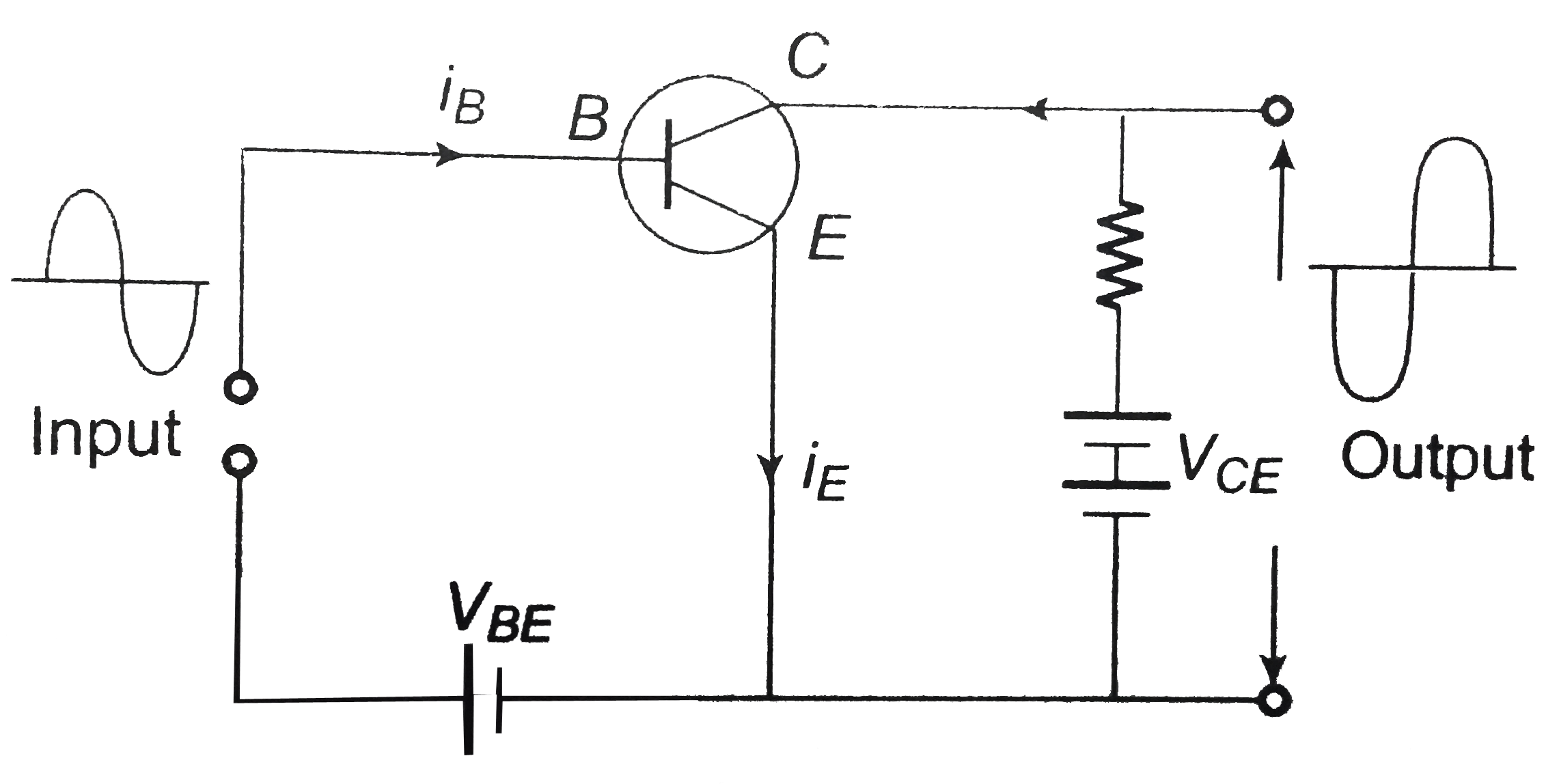 The output(collector -emitter) circuit is reverse biased by means of a high voltage battery so that resistance of output is high. The weak input `AC` signal is APPLIED across the base-emitter circuit and the amplified output signal is OBTAINED across the collector-emitter circuit. Input IMPEDENCE of common-emitter configuration `=((DeltaV_(BE))/(DeltaI_(B)))V_(CE)`=constant Here, `DeltaV_(BE)`=voltage across base and emitter, `DeltaI_(B)`=base current of the order of few micro ampere. |
|
| 45. |
Two particles undergo SHM along the same line with the same time period (T) and equal amplitude (A). At a particular instant one particle is at x = -A and the other is at x = 0. They move in the same direction. They will cross each other at |
|
Answer» t = 4T/3 |
|
| 46. |
Estimate the fastest bit rate capable of being carried by light of wavelength 1.3 mu m. How many phone calls could be carried at this bit rate ? Band width of optical fibre = 2 GHz. |
|
Answer» `2.9xx10^(7)` `v=(c)/(lambda)=(3xx10^(9))/(1.3xx10^(-6))=2.3xx10^(14)Hz` Max bit rate `=2U=2xx2.3xx10^(14)=4.6xx10^(14)Hz` For optical fibre, band width =2GHZ=`2XX10^(2)Hz` `therefore` No. of PHONE calls `=(4.6xx10^(14))/(2xx10^(4))=2.3xx10^(3)` |
|
| 47. |
A wheel with 10 spokes each of length L m is rotated with a uniform angular velocityomega in a plane normal ti the magnetic fieldB. The emf induced between the axle and the rim of the wheel |
|
Answer» `(1)/(2)NomegaBL^(2)` |
|
| 48. |
A sinusoidal voltage of peak value 283 V and frequency 50 Hz is applied to a series LCR circuit in which R = 3Omega, L = 25.48 mH, and C = 796 muF. Find (a) the impedance of the circuit, (b) the phase difference between the voltage across the source and the current, (c) the power dissipated in the circuit, and (d) the power factor. |
|
Answer» Solution :(a) To FIND the impedance of the circuit, we first calculate `X_(L) and X_(C )`. `X_(L)=2pi vL` `=2xx3.14xx50xx25.48xx10^(-3)Omega=8Omega` `X_(C )=(1)/(2pi vC)` `=(1)/(2xx3.14xx50xx796xx10^(-6))=4Omega` Therefore, `Z=sqrt(R^(2)+(X_(L)-X_(C ))^(2))=sqrt(3^(2)+(8-4)^(2))` `=5Omega` (b) Phase difference, `phi="tan"^(-1) (X_(C )-X_(L))/(R )` `=tan^(-1)((4-8)/(3))= -53.1^(@)` SINCE `phi` is negative, the current in the circuit lags the voltage across the source. (c) The power dissipated in the circuit is `P=I^(2)R` Now, `I= (i_(m))/(sqrt(2))=(1)/(sqrt(2)) ((283)/(5))=40A` Therefore, `P=(40A)^(2)xx3Omega=4800W` (d) Power factor `=cosphi=cos(-53.1^(@))=0.6` |
|
| 49. |
Where does fermi level lie in a conductor and semiconductor. |
| Answer» SOLUTION :The fermilevel in CONDUCTORS lies in the CONDUCTION band, in insulators it lies in the. VALENCE band and in semiconductors. It lies in the gap between the conduction and valence band. | |
| 50. |
Electric field produced due to an infinitely long straight uniformly charged wire at perpendicular distance of 2 cm is 3 xx 10^8 NC^(-1). Then linear charge density on the wire is....... |
|
Answer» `333 (muC)/m` `lambda =(Er)/(2k) =(3 xx 10^(8) xx 0.02)/(2 xx 9 xx 10^(9))` `therefore lambda =3.33 xx 10^(-6)` `therefore lambda =333 (muC)/m` |
|
