

Saved Bookmarks
This section includes 7 InterviewSolutions, each offering curated multiple-choice questions to sharpen your Current Affairs knowledge and support exam preparation. Choose a topic below to get started.
| 1. |
If a vector 2 hati + 3 hat j + 8 hat k is perpendicular to the vector 4 hat j - 4 hati + alpha hat k, then value alpha is |
|
Answer» 44198 |
|
| 2. |
A choke is preferred to a resistance for limiting the current in an a.c. circuit because : |
|
Answer» the CHOKE is very cheap |
|
| 3. |
Between the primary and secondary rainbows, there is a dark band known as Alexandar.s dark band. This is because |
|
Answer» light scattered into this region interfere destructively. When we observe primary and secondary rainbows at a time, we find that primary rainbow gets finished at `42^@` whereas secondary rainbow starts at `50^@`(approximately). Hence region between these two rainbows appears to be dark which is known as Alexandar.s dark band. Thus option (D) is also correct. |
|
| 4. |
A short - circuited coil is placed in a time varying magnetic field. Electrical power is dissipated due to the current induced in the coil. If the number of turns were to be quadrupled and the radius of the wire is to be halved, then find the electrical power dissipated. |
|
Answer» <P> SOLUTION :Current is induced in the short-circuited coil due to the imposed time - varying magnetic field.POWER `P = (e^(2))/(R)`, Here `e= -(d phi)/(dt)` where `phi= NBA` and `R=(RHO l)/(pi r^(2))` where l and r are length and radius of the wire. `:. P=(pir^(2))/(rho l)[(d)/(dt)(NBA)]^(2)` or `P= (pi r^(2))/(rho l)N^(2)A^(2)((dB)/(dt))^(2)` or P=(constant)`(N^(2)r^(2))/(l)`, when `r_(2)=(r_(1))/(2)` then `l_(2)=4l_(1)` `:. (P_(2))/(P_(1))=((4N)^(2))/(N^(2)) xx ((r)/(2r))^(2) xx ((l)/(4l))` `:. (P_(2))/(P_(1))=(16N^(2) xx r^(2) xx l)/(N^(2) xx 4R^(2) xx 4l)` or `(P_(2))/(P_(1))=(1)/(1)` `:.` Power dissipated is the same. |
|
| 5. |
A popular web video shows a jet airplane, a car, and a motorcycle racing from rest along a runway (Fig 2-10 ). Initially themotorcycle takes the lead, but then the jet takes the lead, and finally the car blows past the motorcycle. Here let's focus on the car and motorcycle and assign some reasonable values to the motion. The motorcycle first takes the lead because its ( constant) acceleration a_(m)=8.40 m//s^(2) is greater than the car's ( constant) acceleration a_(c) = 5.60 m//s^(2), but it soon loses to the car because it reaches its greater speed v_(m)= 58.8m//s before the car reaches the greatest speed v_(c) = 106 m//s. How long does the car take to reach the motorcycle ? |
|
Answer» Solution :KEY IDEA We can APPLY the equations of constant acceleration to both vehicles, but for the motorcycle we must consider the motion in two stages: (1) First it travels through distance `x_(m l)` with zero initial velocity and acceleration `a_(m)=8.40m//s^(2)`, reaching speed `v_(m)=58.8m//s.` (2) Then it travels through distance `x_(m2)` with constant velocity `v_(m)= 58.8m//s` and zero acceleraton ( that, too, is a constant acceleraton). Note that we symbolized the distance even though we do not know their values, Symbolizing unknown quantities is often helpful in solving physics problems.) Calculations: So that we can draw figures and do caculatons, let.s assume that the vehicles race along he positive DIRECTION of an x axis, starting from `x=0` at time `t=0`. (We can choose any initial numbers because we are looking for the elapsed time, not a particular time in, say, the afternoon, but let.s stick with these easy numbers.) We 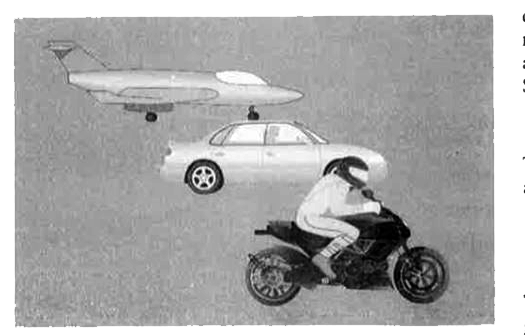 want the car to pass the motorcycle, but what does that mean mathematically ? It means that at some time t, the side-by-side vehicles are at the same coordinate: `x_(c)` for the car and the sum `x_(m1)+x_(m2)` for the motorcycle. We can write this statement mathematically as `x_(c)= x_(m1)=x_(m2)`, (2-19) Now let.s fill out both sides of Eq. 2-19, left side first. To reach the passing point at `x_(c)`, the car accelerates from rest . From Eq. 2-15 `(x-x_(0)= v_(0)t+1/2 a t^(2))`, with `x_(0)` and `v_(0)=0`, we have `x_(c)= 1/2 a_(c)t^(2)` (2-20) To write an expression for `x_(m1)` for the motorcycle, we first find the time `t_(m)` it takes to reach its maximum speed `v_(m)`, USING Eq. 2-11 `(v=v_(0)+ a t)`. Substituting `v_(0)=0, v= v_(m)=58.8m//s`, and `a=a_(m)=8.40 m//s^(2)`, that time is `t_(m)= (v_(m))/(a_(m))= (58.8 m//s)/(8.40 m//s^(2))=7.00s`. (2-21) To get the distance `x_(m1)`traveled by the motorcycle during the firststage, we again use Eq. 2-15 with `x_(0)=0` and `v_(0)=0`, but we also substitute from Eq. 2-21 for the time. We find `x_(m1)= 1/2 a_(m) t_(m)^(2) = 1/2 a_(m) ((v_(m))/(a_(m)))^(2)=1/2 (v_(m)^(2))/(a_(m))`. (2-22) For the remaining time of `t-t_(m)`, the motorcycle travels at its maximum speed with zero acceleration. To get the distance, we use Eq. 2-15 for this second stage of the motion, but now the initial velocity is `v_(0)=v_(m)`( the speed at the end of the first stage) and the acceleration is `a=0`. So, the distance traveled during the second stage is `x_(m2) = v_(m)(t-t_(m))= v_(m)(t-7.00s)`. (2-23) To finish the calculation, we substitute Eqs. 2-20, 2-22, and 2-23 into Eq. 2-19, obtaining `1/2 a_(c) t^(2)= 1/2 (v_(m)^(2))/(a_(m)) + v_(m) (t-7.00s)` (2-24) This is a quadratic equation. Substituting in the given data, we solve the equation ( by using the usual quadratic-equation formula or a polynomial sovler on a calculator), finding `t=44.4s` and `t=16.6s`. But what do we do with two ANSWERS? Does the car pass the motorcycle twice? No, of course not, as we can see in the video. So, one of the answers is mathematically correct but not physically meaningful. Because we know that the car passes the motorcycle after the motorcycle reaches its maximum speed at `t=7.00`s, we discard the solution with `t lt 7.00s` as being the unphysical answer and conclude that the passing occurs at `t=16.6s`. Figure 2-11 is a graph of the position versus time for the two vehicles, with the passing point marked. Notice that at `t=7.00`s the plot for the motorcycle switches from being curved ( because the speed had been increasing ) to being straight ( because the speed is thereafter constant). 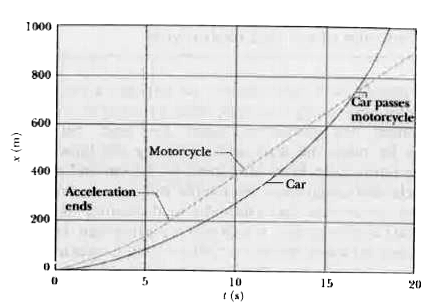
|
|
| 6. |
A horizontal straight wire 10m long extenting east and west is falling at right to the horizontal component of the earth's magnetic field 0.30xx10^-4Wb/m^2. If the induced e.m.f. is 1.5xx10^-3V. The velocity of wire is: |
|
Answer» `5xx10^3m/sec` |
|
| 7. |
Transverse wave nature is established by |
|
Answer» interference |
|
| 8. |
Calculate the smallest angular separation resolved by the human eye, given : aperature =2.5mm and effectived lambda= 5500 dotA. If a scale with mm markings is viewed by the unaided eye, deduce the largest distance to which the markings will be visible. |
|
Answer» Solution :Here, `lambda 5500 DOTA= 5500xx 10^(-10)m` `a= 2.5mm= 2.5xx 10^(-3)m` `triangle THETA = 1.22(lambda)/(a)= 1.22((5500xx10^(-10)m)/(2.5xx 10^(-3)m))= 2.7xx 10^(-7)rad""(i)` angle subtended by 1mm markings from a distance D (in metres) `i.e., theta= (d)/(D)= (1xx 10^(-3)m)/(D)= (1)/(D)xx 10^(-3)"""........"(II)` From eqns. (i) and (ii), `(1)/(D)xx10^(-3)= 2.7xx 10^(-4)"(or) "D= (10^(-3))/(2.7xx 10^(-4))= 3.7m`. |
|
| 9. |
In case of normal focussing of an astronomical telescope the final image is formed at |
|
Answer» FOCUS of the EYEPIECE |
|
| 10. |
Assertion: In practical application, power rating of resistance is not important. Reason: Property of resistance remains same even at high temperature |
|
Answer» If both ASSERTION and REASON are TRUE and the reason in the correct explanation of the assertion. |
|
| 11. |
A Circular metal of are 0.03 m^(2) rotates in a uniform magnetic field of 0.4 T.The axis of rotation passes through the centre and perpendicular to its plane and is also parallel to the field .If the disc completes.20 revolution in one second and the resistance of the disc is 4 Omega .calculate the induced between the axis and the rim and induced curent flowing in the disc. |
|
Answer» Solution :`A-0.3 m^(2)`,B-0.4T:,f=20 rps:`R=4 Omega` Area covered in 1 sec =Area of the dis `xx` frequency =`0.3xx20=0.6 m^(2)` induced emf, `EPSILON=` Rate of CHANGE flux `=(dPhi_B)/(dt)=(d(BA))/(dt)=(0.4xx0.6)/1=0.24V` Induced current `i=(epsilon)/R=(0.24)/4=0.06A` |
|
| 12. |
Three thin prisms are combind as shwon in figure. The refractiveindicesof the crown glass for red, yhelwo and violet rays are mu_(r), mu_(y) and mu_(v) respectively and those for the flint glassare mu'_(r), mu'_(y) and mu_(v) respectively . Find the ratio A'//A for which (a) systemproducesdeviationwithoutdispersion (achromatic combination ) and (b) systemproducesdispersion withoutdeciation (directvision arrangement). |
|
Answer» |
|
| 13. |
The emitter current in a transistor is 2.2mA and the collector current is 2mA. The base current is |
| Answer» Answer :B | |
| 14. |
A battery if internal resistance 4Omega is connected to the network of ressitances as shown. What must be the value of R so that maximum power is delivered to the network? Find the maximum power? |
|
Answer» SOLUTION :i) According to MAXIMUM power transfer theorem `R_("ext")=R_("INT")` `(3Rxx6R)/(9R)=4rArr R=(4)/(2)=2Omega` II) `P_("max")=i^(2)R_("ext")=((E)/(4+4))^(2)xx4=(E^(2))/(16)` |
|
| 15. |
The work function of a substance is 4.0 eV. The longest wavelength of light that can cause photoelectric emission for it will be : |
|
Answer» 400 mm `:.lambda_(0)=(hc)/(OMEGA)=(6.02xx10^(-34)xx3xx10^(8))/(4xx1.6xx10^(-19))` `=310xx10^(-9)m` `rArr lambda_(0)=310 NM` |
|
| 16. |
Ordinary light is incident on the upper surface of a glass slab at theh polarizing angle. Then |
|
Answer» the reflected ray is completely PLANE polarized with VIBRATIONS perpendicular to the plane of incidence |
|
| 17. |
Two balls are projected simultaneously in the same vertical plane from the same point with velocities v_1 and v_2 with angle theta_1 and theta_2 respectively with the horizontal. If v_1 cos theta_1 =v_2 cos theta_2, the path of one ball as seen from the position of other ball is : |
|
Answer» parabola |
|
| 18. |
The radioactivity of a uranium specimen with mass number 238 is 2.5 xx10^(4)s^(-1), the specimen's mass is 2.0 g. Find the half-life. |
|
Answer» |
|
| 19. |
State the conditions of total internal reflection. Refractive indices of the given prism material for Red, Blue and Green colours are respectively 1.39, 1.48and 1.42 respectively. Trace the path of rays through the prism. |
|
Answer» SOLUTION :Critical angle for a light ray is given by `SIN i_(C)=(1)/(n) or i_(c) =sin^(-1)((1)/(n))` `therefore"Critical angle for red ray "(i_(c))_("red")=sin^(-1)((1)/(1.39))` `-46^(@)` `"Critical angle for green ray "(i_(c))_("green")=sin^(-1)((1)/(1.44))` `=44^(@)` `"and Critical angle for blue ray "(i_(c))_("blue")=sin^(-1)((1)/(1.47))` `=42^(@)52.` On the basis of above data, the paths of different coloured RAYS will be as shown in figure. Blue and green rays are totally INTERNALLY reflected from the diagonal face of prism but red ray is refracted. 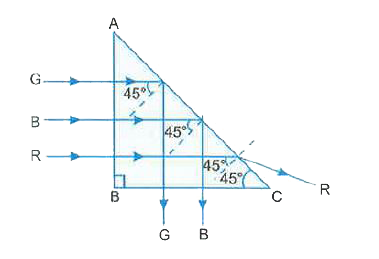
|
|
| 20. |
When a p-n junction diode is reverse biased |
|
Answer» Flow of a minority CHARGE CARRIER from p - SIDE of n - side |
|
| 21. |
20Omega,2mA full scale deflection galvanometer will be converted to a 2 V full scale deflection voltmeter by connecting a ____Omegaresistance in _____ with it : |
|
Answer» 9800,series |
|
| 22. |
A block having mass m and charge q is resting on a frictionless plane at distance L from the wall as shown in Fig. Discuss the motion of the block when a uniform electric field E is applied horizontally towards the wall assuming that collision of the block with the wall is perfectly elastic. |
|
Answer» Solution :The situation is SHOWN in Fig. Electric force `VEC(F)= q vec(E )` will accelerate the block towards the wall producing an acceleration `a= ( F)/(m) = (qE)/(m) L = (1)/(2) "at"^(2)` i.e., `t= sqrt((2L)/(a)) = sqrt((2mL)/(qE))` As collision with the wall is perfectly elastic, the block will rebound with same speed and as now its motion is opposite to the acceleration, it will come to rest after travelling same distance L in same time t. After stopping it will be again ACCELERATED towards the wall and so the block will execute OSCILLATORY motion with .span. L and time period `T=2t = 2 sqrt((2mL)/(qE))` However, as the restoring force F(=qE) when the block is moving away from the wall is CONSTANT and not proportional to displacement x, the motion is not simple harmonic. 
|
|
| 23. |
A circuit has a resistance of 12omega. The power factor of the circuit will be |
|
Answer» 0.125 |
|
| 24. |
A metallic rod of mass m and resistance R is sliding over the 2 conducting frictionless rails as shown in Fig. An infinitely long wire carries a current I_(0). The distance of the rails from the wire are b and a respectively. Find the value of current in the circuit if the rod slides with constant velocity v_(0) |
|
Answer» `1/R{E-(mu_(0)I_(0)v_(0))/(2 pi) 1N|(b)/(a)|}` |
|
| 25. |
Velocity-time graph for the motion of a certain body is shown in fig.Explain the nature of this motion.Find the initial velocity and acceleration andwrite the equation for the variation of disaplacement with time.What happens to the moving body at point B?How does the body move after this movement ? |
Answer» Solution :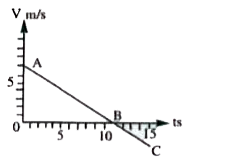 The VELOCITY-time graph is a straight line with -ve slope.The motion is uniformly retarding up to point B and there after uniformly accelerated up to C. At point B the body stops and the its direction of velocity reversed. The intital velocity at point A is `V_(0)=7ms^(-1)` `thereforea=(v_(f)-v_(0))/(Deltat)=(0-7ms^(-1))/(11s)=(-7)/(11) ms^(-2)=0.64 ms^(2)` The EQUATION of motion for this body which gives variation of displacement with time is `S=7t-(1)/(2)0.64 t^(2)=7t-0.32t^(2)`. |
|
| 26. |
The slowest mode of transfer of heat is |
|
Answer» conduction |
|
| 28. |
Deduce an expression for the mutual inductance of two long coaxial solenoids but having different radii and different number of turns. Or Obtain the expression for the mutual inductance of two long coaxial solenoids S_(1) and S_(2) wound one over the other, each of length I and radii r_(1) and r_(2), and number of turns per unit length n_(1) and n_(2) respeetively, when a current I is set up in the outer solenoid S_(2). |
|
Answer» Solution :Consider two long coaxial solenoids each of length l. Let radius of inner solenoid `S_(1), be r_(1)`, for cross SECTION area be `A_(1)` and `n_(1)` be the number of turns per unit length in it. The corresponding quantities for outer solenoid `S_(1) be r_(1), A^(2) and n_(2)`. Total number of turns in two solenoids are `N_(1) = n_(1)l` and `N_(2) = n_(2)l` RESPECTIVELY. Let a current `I_(2)`, is set up through outer solenoid `S_(2)` so that magnetic field developed along its axial line `B = mu_(0)n_(0)I_(2)` `therefore` Magnetic flux linked per unit turn of solenoid coil `S_(1), phi_(1) = BA_(1) = mu_(0)n_(2)I_(2)A_(1)` and total magnetic flux linked with solenoid `S_(1),N_(1) phi_(1) = N_(1)mu_(0)n_(2)A_(1)I_(2) = mun_(1)n_(2)l.pir_(1)^(2)I_(2)` As per definition of mutual inductance `Nphi_(1) = M_(2)I_(2)` `therefore` mu_(0)n_(1)n_(2)l.pir_(1)^(2)I^(2)` `implies M_(12) = mu_(0)n_(1)n_(2)l.pir_(1)^(2) = mu_(0)n_(1)n_(2)lA_(1) = (mu_(0)N_(1)N_(2)A_(1))/l` For a pair of two solenoid coils `M_(12) = M_(21) = M`, HENCE mutual inductance of pair of solenoid coil is `M = mu_(0)n_(1)n_(2)l.pir_(1)^(2) = (mu_(0)N_(1)N_(2)A_(1))/l` If a soft iron core of relative permeability `mu_(r)`, is also INSERTED `S_(1)`, turns inside the solenoid coil S, the mutual inductance becomes `M = mu_(0)n_(1)n_(2)l pir_(1)^(2) = (mu_(0)N_(1)N_(2)A_(1))/l` 
|
|
| 29. |
The graph shows thevariation in magnetic flux phi(t) with time through a coil. Which of the statements given below is not correct? |
|
Answer» There is a change in the DIRECTION as well as magnitude of the induced EMF between B and D |
|
| 30. |
There is a very thin straight pipe of a large length. A transparent insulating material is used to make this pipe. The inner radius of pipe is r and the outer radius is R. Both R and are very small and the difference between them is very less. The pipe is fixed in a vertical orientation. The upper end of the pipe is open and its lower end is closed. There is a large number of small insulating spheres of radius r each carrying charge Q. These small spheres are inserted from the upper end of the pipe one after another and pushed down further so that entire pipe is filled with closely spaced insulating charged sphere. Electric field due to this system is observed for points outside the pipe and towards the midpoint of large vertical length of pipe. If there is a mall insulating sphere of same radius r and charge of magnitude Q and the polarity of charge is opposite. This small sphere is moving in a circular path around the charged system that we have described in passage. Speed of the small sphere going in a circular path is found to be proportional to the Q^n. |
|
Answer» n=1 `QE=(mv^2)/x rArr Qxx1/(4piepsilon_0x) (Q/r) =(mv^2)/x` `rArr 1/(4piepsilon_0) (Q^2/r) =(mv^2)/1 rArr v=Q sqrt(1/(4piepsilon_0mr))` `v PROP Q^n` `rArr` n=1 |
|
| 31. |
There is a very thin straight pipe of a large length. A transparent insulating material is used to make this pipe. The inner radius of pipe is r and the outer radius is R. Both R and are very small and the difference between them is very less. The pipe is fixed in a vertical orientation. The upper end of the pipe is open and its lower end is closed. There is a large number of small insulating spheres of radius r each carrying charge Q. These small spheres are inserted from the upper end of the pipe one after another and pushed down further so that entire pipe is filled with closely spaced insulating charged sphere. Electric field due to this system is observed for points outside the pipe and towards the midpoint of large vertical length of pipe. If we compare the given system with a line charge then what will be the equivalent value of linear charge density. |
|
Answer» Q/r |
|
| 32. |
An L-C-R series circuit with 100 2 resistance is connected to an A.C source of 200V and angular frequency 300 rads^(-1). When only the capacitor is removed, the current lags behind the voltage by 60^(@). When only inductor is removed, the current leads the voltage by 60^(@). If all elements are connected, the current in the circuit is |
|
Answer» 0.5A |
|
| 33. |
In the above problem , which wavelength (s) will have a strong intensity ? |
| Answer» Answer :B | |
| 34. |
Figure shows a long straight wire of a circular cross - section (radius a) carrying steady current I. The current I is uniformly distributed across this cross - section . Calculate the magnetic field in the region r lt aand r gt a |
|
Answer» Solution :Consider the case `r gt a `. The Amperian loop labelled 2, is a CIRCLE concentric with the cross -section . For this loop , `L = 2pi r` `I_(e) =` Current ENCLOSED by the loop = I We have `B(2 pi r ) = mu_(0) ` `B= (mu_0 I)/(2 pi r)` `B prop 1/r ( r gt a )` b. Consider the case `r LT a ` . The amperian loop is a circle labelled 1. For this loop, taking the radius of the circle to be r, =`2ir` Now the current enclosed `I_e` is not I, but is less than this VALUE, Since the current distribution is uniform, the current enclosed is, `I_e = I ((pir^2)/(pia^2)) =(Ir^2)/(a^2)` Using Ampere.s law , `B(2pir) = mu_0 (Ir^2)/(a^2)` `B= ((mu_0I)/(2pia^2))r` `B prop r "" (r lta)` Figure shows a plot of the magnitude of B with distance r from the centre of the wire. The direction of the field is TANGENTIAL to the respective circular loop (1 or 2) and given by the right-hand rule 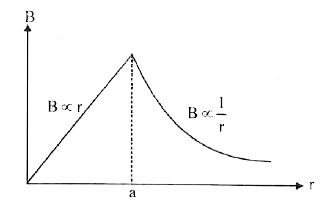
|
|
| 35. |
Unit of line integration of electric field is ...... |
|
Answer» <P>`Vm^(-1)` `=int_(P)^(Q)vecE.dvecl` `= int_(P)^(Q)(vecF.dvecl)/(Q)[because vecE= (vecF)/(Q)]` `= int_(P)^(Q) (W)/(Q) [ because vecF . d vecl` = W Work] Unit `=(1)/(C)` |
|
| 36. |
The flux linked with a large circular coil, of radius R, is 0.5 xx 10^(-3) Wb when a current of 0.5 A flows through a small neighbouring coil of radius'r'. Calculate the mutual inductance for the given pair of coils. If the current through the small coil suddenly falls to zero, what would be its effect in the larger coil ? |
|
Answer» Solution :Here I= 0,5 A and `phi_(2) = 0.5 xx 10^(-3) Wb` `therefore M = (phi_(2))/I_(1) = (0.5 xx 10^(-3) Wb)/(0.5A) = 10^(-3)` H or 1 mH If current through the smaller coil suddenly FALLS to zero, an instantaneous EMF is produced in the larger coil on account of MUTUAL inductance. |
|
| 37. |
A thin beam of n identical positively charged particle are constrained to move in a circular orbit of radius R in a particle accelerator. Each particle has charge q and mass m and the current in the circular orbit is I_(0). The magnetic flux through the circular path is made to increases at a constant rate of beta Wb s^(–1). Calculate the current after the particles complete one turn. |
|
Answer» |
|
| 38. |
An electron is moving in a circular path under the influence of a transverse magnetic field of 3.57xx10^(-2)T. If the value of e/m is 1.76xx10^(11)C/(kg), the frequency of revolution of the electron is |
|
Answer» 62.8 MHz `thereforev=(BER)/m` `thereforeromega=(Ber)/m""[becausev=romega]` `thereforeomega=(Be)/m` `therefore2pif=(Be)/m""[becauseomega=2pif]` `thereforef=B/(2pi)xxe/m=(3.57xx10^(-2)xx1.76xx10^(11))/(2xx3.14)` `thereforef=10^(9)Hz=1GHz` |
|
| 39. |
Two plane mirrors are arranged at right angles to each other as shown in figure. A ray of light is incident on the horizontal mirror at an angle theta . For what value of thetathe ray emerges parallel to the incoming ray after reflection from the vertical mirror ? |
|
Answer» `60^@` |
|
| 40. |
Image of the fish in a spherical aquarium Assume that a boy views a fish in a spherical aquarium of radius 10cm kept at a distance of 2cm from the center toward the left of center. The boy is viewing from the left (Fig.34-27). Where will the image of fish be formed? |
|
Answer» Solution :The positive direction is decided by the incident rays. Since the rays incident on the boundary of the aquarium is incident are from right to left so that they reach the eyes of the boy sitting to the left of the center, the positive direction will b from right to left. Here, the boundary of the aquarium will be the origin. All the distances to the left of this boundary will be positive and the distances to the right will be negative. So, here we can see that the center of the surface is to the negative side and so the radius R will b taken as negative . Similarly, the distance of the object from the optical center is to the right side and hence it will be negative. Obviously, the REFRACTION if from a spherical surface, so Eq. 34-11 will be used Calculations : Rays are incident from water to air. So, in Eq 34-11, `n_(2)=1`, `n_(1)=4//3` , `R=-10cm`, `u=-8cm`. Substituting values in the formula, we get 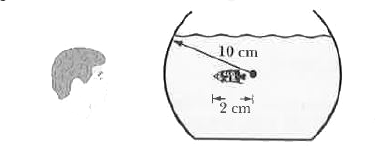 `(1)/(v)-((4)/(3))/(-8)=(1-((4)/(3)))/(-10)` So, `v=-7.5cm` LEARN : Here, the image formed is VIRTUAL. Students OFTEN tend to mistake that since the image is formed behind the water refraction will occur again. Here, we should understand that if image is at `-7.5cm` it MEANS the refracted rays have to be traced to meet at that point. It does not mean that rays have reversed and met at that point. |
|
| 41. |
The number of lenses in terrestrial telescope is |
|
Answer» 2 |
|
| 42. |
The magnitude of the vector product of two vectors is 4. The magnitude of their scalar product is 4sqrt(3). The angle between the two vectors is : |
|
Answer» `30^(@)` |
|
| 43. |
Two capacitors of equal capacitance (C_(1)=C_(2)) are as shown in the figure. Initially, while the swithc is open (as shown) one of the capacitors is uncharged and the other carries charge Q_(0). The energy stored in the charged capacitor is U_(0). Sometime after the switch is closed, the capacitors C_(1)"and" C_(2) carry charged Q_(1)"and"Q_(2) respectively, the energy stored in the capacitors are U_(1)"and"U_(2) respectively. Which of the following expression is correct? |
|
Answer» `Q_(0) =1/2(Q_(1)+Q_(2))` |
|
| 44. |
What are eddy currents ? Mention two applications of eddy currents. |
|
Answer» Solution :EDDY currents are induced currents in BULK pieces of conductors when they aresubjected to changing MAGNETIC flux. Applications : Eddy currents are used in 1. Electro magnetic DAMPING 2. Magnetic brakes in trains 3. INDUCTION furnace 4. Electric power meters. |
|
| 45. |
The potential at a point 0.1 m from an isolated point charge is + 100 volt. The nature of the point charge is |
| Answer» Answer :A | |
| 46. |
When a tiny circular obstacle is placed in the path of light from a distance source, a bright spot is seen at the centre of the shadow of the obstacle. Explain. Why? |
| Answer» Solution :WAVES diffracted from the edge of the circular obstacle interfere constructively at the centre of the SHADOW of circular obstacle. As a result, the centre point is a BRIGHT SPOT. | |
| 47. |
If radius of first orbit in hydrogen atom is 0.53Å, then what will be the radius of fourth orbit? |
|
Answer» Solution :`r_(N)propn^(2)` `:.(r_(1))/(r_(2))=(n_(1)^(2))/(n_(2)^(2))` `:.r_(2)=(n_(2)^(2))/(n_(1)^(2)).r_(1)=(4^(2))/(1^(2)).(0.53)` `:.r_(2)=(16)/(1)(0.53)=8.48Å` |
|
| 48. |
On an average, the number of neutrons and the energy of a neutron released per fission of a uranium atom are respectively |
|
Answer» 2.5 and 2 keV |
|
| 49. |
A cylindrical rod of some laser material 5xx10^(-2)m long and 10^(-2)m diameter contains 2xx1025^(25) ions per m^(3). If on excitation all the ions in the upper energy level de-excite simultaneously emitting photons in the same direction, calculate the maximum energy contained in a pulse of radiation of wavelength 6.6xx10^(-7)m |
|
Answer» `3xx10^(-17)J` `=3.14((1)/(2)xx10^(-2))^(2)xx5xx10^(-2)m^(3)` `=3.925xx10^(-6)m^(3)` Total number of ions, `N=2xx10^(25)xx3.925xx10^(-6)` `=7.85xx10^(19)` ENERGY of pulse `=(HC)/(lambda)=(6.6xx10^(-34)xx3xx10^(8))/(6.6xx10^(-7))` `=3xx10^(-19)J` |
|