Saved Bookmarks
This section includes 7 InterviewSolutions, each offering curated multiple-choice questions to sharpen your Current Affairs knowledge and support exam preparation. Choose a topic below to get started.
| 1. |
Four resistances 10Omega, 5Omega 7Omega and 3Omega are connected so that they form the sides of rectangles AB, BC, CD and DA respectively. Another resistance of 10Omega is connected across the diagonal AC. The equivalent resistance between A and B is: |
|
Answer» `2Omega` |
|
| 2. |
A string of length l' fixed at both ends vibrates in resonance with a tuning fork of frequency 'f' at two successive values of tension T_(1) and T_(2) inthe string. Findthe specificmass (mass per unit length) ofthe string: |
|
Answer» `(T_(1)T_(1))/(F^(2)l^(2)(sqrt(T_(1)) - sqrt(T_(2)))^(2))` `f = (n+1)/(2l) sqrt((T_(2))/(mu))` `f = (n+1)/(2l) sqrt((T_(2))/(mu))` fromequation (1) and (2) eliminate 'n' to get `mu`. `mu = (T_(1)T_(2))/(4f^(2)l^(2)(sqrt(T_(1)) - sqrt(T_(2)))^(2))` |
|
| 3. |
Define a wavefront. Use huygen's principle to verify the laws of defraction. |
|
Answer» Solution :A wavefront is defined as a surface of constant phase. Consider a PLANE surface XY separating a rarer medium of refractive index `n_(1)` from a denser medium of refractive index `n_(2)` Let `c_(1)` and `c_(2)` be the values of speed of light in the two media. AB is a plane wavefront incident on XY at an angle `i`. Let at a given instant the end A of wavefront just strikes the surface XY but the other end B has still to COVER a path BC. if it takes time t, then `BC=c_(1)t`. According to Huygen.s principle point A meanwhile BEGINS to emit secondary wavelets which will cover a distance `c_(2)t` in second medium in time t. draw a circular arc with A as centre and `c_(2)t` as radius and draw a tangent CD from point C on this arc. then CD is the refracted wavefront, which advances in the direction of rays 1.2.. the refracted wavefront subtends an angle r from surface XY.  Now in `DeltaABC" "sini=(BC)/(AC)=(c_(1)t)/(AC)` and in `DELTAADC" "sinr=(AD)/(AC)=(c_(2)t)/(AC)`. `therefore (sini)/(sinr)=` `(c_(1)t//AC)/(c_(2)t//AC)=(c_(1))/(c_(2))=`a constant`=(n_(2))/(n_(1))=n_(21)`. which is snell.s law of refraction. |
|
| 4. |
The wavelength of the first line of Lyman series for hyrogen atom is equal to that of the second line of Balmer series for a hydrogen like ion. The atomic number Z of hydrogen like ion is |
|
Answer» 2 |
|
| 5. |
In question number 3, which of the two receivers picks up the larger signal when Bis turned off? |
|
Answer» `R_(1)` `R_(1)` picks up `y=a" cos"WT` ` :. lt I_(R_(1))GT =(1)/(2)a^(2)` `R_(2)` picks up `y=a" cos"wt` ` :. lt I_(R_(2))gt =(1)/(2)a^(2)` THUS `R_(1)` and `R_(2)` pick up the same signal. |
|
| 6. |
The Lyman series of hydrogen spectrum lies in which of the following regions ? |
|
Answer» ULTRAVIOLET |
|
| 7. |
A hot gas emites radition of wavelength 46.0nm ,82.8nm and 103.5nmonly Assume that the atoms have only two excited state and the difference between consecutive energy levels decrease as energy is increased Taking the energy of the higest energy state to be zero find the energies of the ground state and the first excited state |
|
Answer» `E= (hc)/(lambda_1)=(4.14 XX 10^-15 xx 10^8)/(46 xx 10^-9)` `=1242/46 = 27eV` Again energy in the first excitation state `E=(hc)/(lambda_n)` `=(4.14 xx 10^-15 xx 10^8)/(103.5)` `=12.eV` |
|
| 8. |
Lenard concluded from his experiment that the particles emitted in photoelectric effect are _____ |
|
Answer» |
|
| 9. |
Assertion : Electron microscope has more resolving power than optical microscope. Reason :We can control the energy of electron. |
|
Answer» If both assertion and reason are TRUE and reason is the CORRECT explanation of assertion. |
|
| 10. |
Matter waves are associated with protons but not with neutrons. |
| Answer» Solution :FALSE: Matter WAVES are associated with all PARTICLE WHETHER charged or uncharged. | |
| 11. |
The wave forms A and B given below are given as input to a NAND gate . Then its logic output y is |
|
Answer» for `t_1` to `t_2` , y = 0 |
|
| 12. |
A microscope is arranged to observe a mark on a piece of paper clearly. Now if a cube of refractive index 1.5 and thickness 3 cm is placed on this mark, then now what should be the displacement given to microscope to observe the mark clearly again ? |
|
Answer» <P>4.5 CM downward  In first case, microscope is focussed at P. In second case, it is focussed at P.. Now, APPARENT DEPTH, Real depth of P - Apparent depth of P `=3-(3)/(1.5)` `(because MU=("real depth")/("apparent depta")` =3-2`(therefore`Apparent depth =`("real depth")/(mu))` =1 cm |
|
| 13. |
A change of 200mV in base-emitter voltage causes a change of 1004A in the base current. Find the input resistance of the transistor |
| Answer» SOLUTION :2K `OMEGA` | |
| 14. |
Name The poet of the poem "The Tiger". |
| Answer» Answer :A | |
| 15. |
When 16 wires which are identical are connected in series, the effective resistance exceeds that when they are in parallel by 31 (7)/(8) Omega Then the resistance of each wire is |
|
Answer» `0.5 OMEGA ` |
|
| 16. |
An infinite nonconducting sheet of charge has a surface charge density of 10^(7) C//m^(2). The separation between two equipotential surfaces near the whose potential differ by 5V is |
|
Answer» 0.88 cm |
|
| 17. |
Find the mechanical force per unit area of a charged metal plate having a charge of10 muC/m^2. What would be the force per unit area be if the charged plate is kept in a medium of dielectric constant 6 ? |
| Answer» SOLUTION :`E=(asigma)/(epsilon_0r)=(0.1xx5xx10^-6)/(8.85xx10^-12xx0.1)=5.65xx10^5V//m`. | |
| 18. |
The equation of the alternating voltage applied to our houses is e= (311sin 100pit) volt. A hot wire instrument is used to measure the alternating voltage. The rms value of emf is |
|
Answer» 219.9V |
|
| 19. |
Which of the following statement is/are correct ? I . The ligand thiosulphate , S_(2)O_(3)^(2-) can give rise to linkage isomers . II. In metallic carbonyls the ligand CO molecule acts both as donor and acceptor . III. The complex [Pt(Py)(NH_(3))(NO_(2))ClBrI] exists in eight different geometrical isomeric forms . IV. The complex ferricyanide ion does not follow effective atomic number (EAN) rule . |
|
Answer» I and II only |
|
| 20. |
The two ends of a rod of length L and a uniform cross-sectional area A are kept at two temperatures f_(1) and T_(2) rod in a steady state is given by : |
|
Answer» `(DQ)/(DT)=(k(T_(1)-T_(2)))/(LA)` Correct CHOICE is (c ). |
|
| 21. |
The breaking stress of a cylindrical rod is 10^6 N/m^2. If the maximum possible height of the rod is 10 m then what is the density of the material of the rod ? |
|
Answer» Solution :BREAKING stress = `F//A = (mg)/A = (Vrhog)/A` `= (A hrhog)/A = hrhog` `THEREFORE RHO = "Breaking stress"/(hg) = 10^6/(10 xx 10) = 10^4 (KG)/m^3` |
|
| 22. |
A rectangular coil of 20 turns and area of cross section 25 cm^(2) has a resistance of 100 ohm. If the magnetic field which is perpendicular to the plane of coil changes at the rate of 1000 "tesla"//"sec", the current in the coil is |
| Answer» Answer :B | |
| 23. |
Write down the applications of photodiodes? |
|
Answer» Solution :• Alarm system • COUNT items on a conveyer BELT . Photoconductors • COMPACT DISC players, smoke detectors • Medical applications such as detectors for computed tomography etc. |
|
| 24. |
Give the sign of the work done by the field in moving a small positive charge from Q to P. |
|
Answer» <P> SOLUTION :In MOVING a small positive charage from Q to P, work has to be done by an external agency against the electric field. Therefore , work done by the field is negative. |
|
| 25. |
A glass tube sealed at one end and containing a quantity of air is immersed in mercury until the sealed end is 10 cm from the surface of mercury. At 0^(@)C the level of mercury in the tube is 5 cm above the level of mercury in the vessel. The length of the tube is 15 cm. To what temperature should the air in the tube be raised as to fill the tube completely? The atmospheric pressure is 75 cm of Hg. Neglect any change in the level of mercury in the vessel. |
| Answer» SOLUTION :`663^(@)C` | |
| 26. |
For a spherical mirror if the linear magnification of the image be m what will be its lateral magnification ? |
|
Answer» |
|
| 27. |
At the place, on the surface of the earth, ratio of horizontal and vertical component of the magnetic field is sqrt3 then angle of dip at this place is…………rad |
|
Answer» `pi/3` |
|
| 28. |
Two charged particles having charge 2.0 xx10^(-8)C. each are joined by an isolating string of length 1 m and the system is kept on a smooth horizontal task. The tension in the string. |
|
Answer» `36 XX 10^(-6)N` |
|
| 29. |
Which of the following statements is true for nuclear forces? |
|
Answer» They OBEY the inverse SQUARE LAW of distance. |
|
| 30. |
A particle P moves with speed 'v' along AB and BC, sides of a square ABCD. Another particle Q also starts at A and moves with the same speed but along AD and DC of the same square ABCD. Then their respective changes in velocities are |
|
Answer» EQUAL in MAGNITUDE but DIFFERENT in DIRECTION |
|
| 31. |
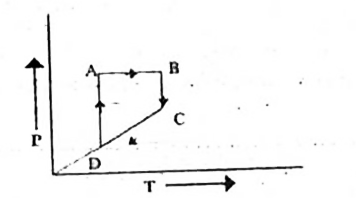
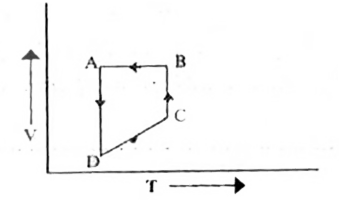
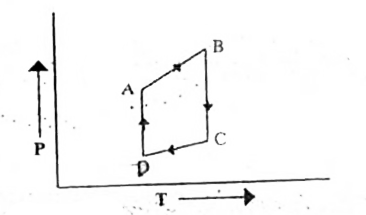
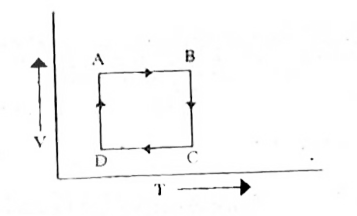
A cyclic process ABCD is shown in the figure P-V diagram. Which of the following curves represent the same process? |
|
Answer» |
|
| 32. |
State Huygens's principle of a wave propagation ? |
|
Answer» Solution :(a) All the point on PRIMARY wave front are secondary sources which can send disturbance. (b) The tangential envelop to all the secondary wavelets GIVE the POSITION of new wavefront . |
|
| 33. |
A plano-convex lens of focal length 40cm and refractive index =1.5 is silvered at plane surface. (a) What will be its focal length in air ? (b) What will be the equivalent mirror behave like ? (c ) What will be its focal length when it is silvered at curved surface instead of being silvered at the plane surface ? |
|
Answer» |
|
| 34. |
A young boy can adjust the power of his eye-lens between 50 D and 60 D. His far points is infinity. (a) What is the distance of his retina from the eye-lens? (b) What is his near point? |
|
Answer» Solution :a) When the EYE is fully relaxed, its focal length is largest and the power of the eye-lens in minimum. This power is 50 D according to the GIVEN data. The focal length is `1/50`m = 2cm. As the far point is at INFINITY, the parallel rays COMING from infinity are focused on the retina in the fully relaxed condition. Hence, the distance of the retina from the lens equals the focal length which is 2 cm. When the eye is focused at the near point, the power is maximum which is 60 D. The focal length in this case is `f=1/60m=5/3cm`. The image is formed on the retina and thus v = 2 cm We have, `1/v-1/u=1/f` or, `1/u=1/v-1/f=1/(2cm)-3/(5cm)` or, u = -10 cm. The near points is at 10 cm. |
|
| 35. |
(a)Describe briefly three factors which justify the need for modulation of audio frequency signals over long distances in communication .(b)Draw the waveforms of (i) carrier wave , (ii) a modualating signal and, (iii) amplitude modulated wave. |
|
Answer» Solution :(a)(i) For efficient transmission and reception , the size of the antenna should be atleast`(lambda)/(4)`, where`lambda` is wavelength of the signal to be transmitted . Due to thisrequirement , an audio signal of15kHz rquires an antenna of 5 km height , which is not feasible. (ii) The effective power radiated by a linear antenna isdriectly PROPORTIONAL to the square of the frequency of signal being transmitted . HENCE , for audiofrequencies the power radiated and consequently thetransmission range is extremely SMALL . (iii)All audio waves are CONTAINED within a small range of frequency from 20Hzto 20kHz .If these waves are transmission is made at high frequency , different channels can be allotted different frequencies and mix up of channels will be AVOIDED. (b) 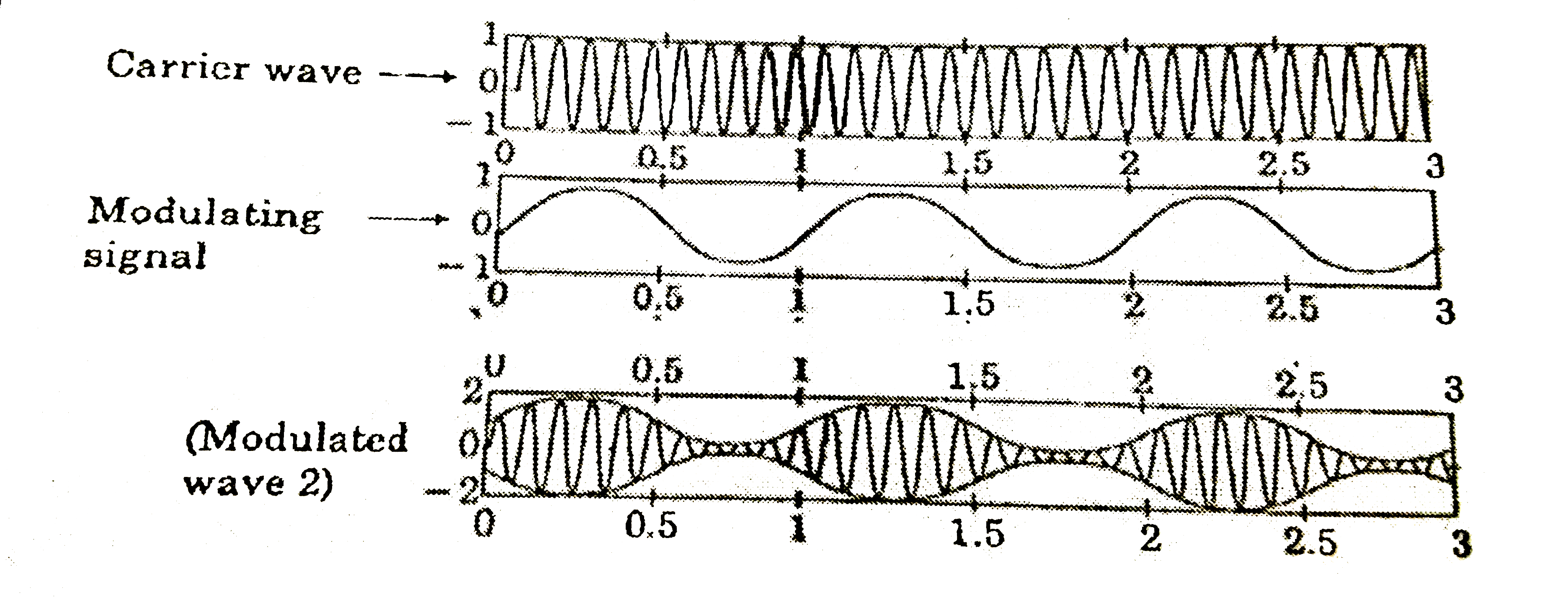
|
|
| 36. |
The ratio of slope of adiabatic to that of an isothermal process is: |
|
Answer» `(1)/(GAMMA)` PdV + VdP =0 `therefore (dP)/(dV) =-(P)/(V)` Thus, slope of isothermal process `((dP)/(dV))=-PV" ….(i)"` For ADIABATIC process `PV^(gamma)=` constant differentiating both sides `P. gamma. V^(gamma-1)+V^(gamma). dP=0` `(dP)/(dV)=(gamma P)/(V)` `therefore` slope of adiabatic process `((dP)/(dV))=(-gamma P)/(V)` Dividing EQN. (ii) and (i) `("Slope of adiabatic process")/("Slope of isothermal process")=gamma` Hence, correct choice is (b). |
|
| 37. |
A ray of light on passing through an equilateral glass prism, suffers a minimum deviation equal to the angle of the prism. The value of refractive index of the material of the prism is....... |
|
Answer» |
|
| 38. |
Explain Heisenberg's uncertainty principle. |
|
Answer» Solution :Position of particle (electron or other) and momentum cannot be MEASURED simultaneously at a time. There is always uncertainty in position `(Deltax)`and in momentum `(Deltap)`. `therefore Deltax.Deltap~~h` `Deltax.Deltap~~(h)/(2pi)`…..(1) Where `h=(h)/(2pi)` Fromequation (1) if `Deltaxto0` then `Deltapto"Infinity"` and when `Deltapto0` then `Deltaxto"infinity"` By MAKING on quantity definite another quantity became undefinite.This is REALITY of microscopic particles. If electron posses definite momentum p (i.e. `Deltap`=0) then it ha definite wavelength `LAMBDA`. `lambda=(h)/(p)` A wave of definite (single) wavelength EXTENDS all over space. That is its position uncertainty is infinite `(Deltaxtooo)` which is consistentwith the uncertainty principle. |
|
| 39. |
A balloon with its contents weighing 160 N is moving down with an acceleration of g/2 ms^(-2). The mass to be removed from it so that the balloon moves up with an acceleration of g/3 ms^(-2)? Is |
| Answer» Answer :B | |
| 40. |
The acceleration 'a' in m//s^(2) of a particle is given by a = 3t^2 + 2t + 2 where t is the time. If the particle starts out with a velocity u = 2m//s at t = 0 , then the velocity at the end of 2 second is |
|
Answer» `12m//s` |
|
| 41. |
If X stands for the magnetic susceptibility of a given material, identify the class of materials for which (i) -1le X lt 0,(ii) 0 ltX lt epsi (epsi stands for a small positive number). (a) Write the range of relative magnetic permeability of these materials. (b) Draw the pattern of the magnetic field lines when these materials are placed in an external magnetic field. |
|
Answer» Solution :(i) Material for which `-1 le X lt 0` is a diamagnetic material (ii) Material having `0 lt X lt epsi` is a paramagnetic material. (a) RELATIVE magnetic PERMEABILITY `mu_r =1 + X`. Hence, for diamagnetic MATERIALS `0 le mu_r lt 1` and for paramagnetic materials `1lt XLT(epsi + 1)`. (b) Pattern of magnetic FIELD lines for dia-and paramagnetic materials . |
|
| 42. |
Plates A and B constitute an isolated charged parallel plate capacitor. The inner surface (I and IV) of A and B have charges +Q and -Q respectively. A third plate C with charge +Q is now introduced midway between A and B which of the following statements is not correct ? |
|
Answer» The SURFACE I and II will have equal and opposite charges. |
|
| 43. |
Consider a uniform square plate of side 'a' and mass 'm'. The moment of inertia of the plate about an axis perpendicular to its plane and passing through one of its corners is : |
|
Answer» `(5)/(6)ma^(2)` Also `DO=(DB)/(2)=SQRT(2a)/(2)=(a)/(sqrt(2))` According to parallel axis theorem `I_(mm.)=I_(n n.)+M((a)/(sqrt(2)))^(2)` `=(Ma^(2))/(2)+(Ma^(2))/(2)` `=(Ma^(2)+3MA^(2))/(6)=(2)/(3)Ma^(2)` |
|
| 44. |
What element has the atom whose K,L, and M shells and 4s subshell are filled completely and 4p subshell is half-filled? |
|
Answer» SOLUTION :The order of filing is `K,L,M` shells, then `4s^(2),3d^(10)` then `4p^(3)`. Theelectronic configuration of the element will `1s^(2)2S^(2)2p^(6)4s^(2)3d^(10)2p^(3)` (There must be three `4p` electrons) The number of ELECTRON is `Ƶ=33` and the element is As (The `3d` subshell must be FILLED before `4p` fills up.) |
|
| 45. |
If an electron and a photon propagate in the form of waves having the same wavelength, it implies that they have the same |
|
Answer» energy |
|
| 46. |
Some energy levels of a molecule are shown the figure. The ratio of the wavelength r=(lamda_(1))/(lamda_(2)) is given by ………….. |
|
Answer» `r=(3)/(4)` `:.E=(hc)/(lamda_(1))""......(1)` and `-E-(-(4)/(3)E)=(hc)/(lamda_(2))` `:.(E)/(3)=(hc)/(lamda_(2))""......(2)` DIVIDING equation (2) by equation (1). `(1)/(3)=(lamda_(1))/(lamda_(2))` `:.(1)/(3)=r` 
|
|
| 47. |
The displacement y of a particle in a medium can be expressed as y = 10^(-6) sin (100t + 20x+ pi/4)m where 't' is in second and x in metre. The speed of wave is |
|
Answer» `2000ms^(-1)` |
|
| 48. |
Through which mode of propagation, the radio waves can be sent from one place to another ? |
|
Answer» GROUND WAVE PROPAGATION |
|
| 49. |
An alternating current is the current in which magnitude as well as direction of current changes continuously with time. |
| Answer» Solution : FALSE - In an a.c. magnitude CHANGES continuously and the direction changes PERIODICALLY after EVERY half cycle. | |
| 50. |
You have been provided with four 400 ohm resistors each. The number of ways in which these can be combined to have different equivalent resistances is |
|
Answer» seven different combinations and seven different equivalent RESISTANCES 
|
|