

Saved Bookmarks
This section includes 7 InterviewSolutions, each offering curated multiple-choice questions to sharpen your Current Affairs knowledge and support exam preparation. Choose a topic below to get started.
| 1. |
In the determination of Young's modulus (Y=(4MLg)/(pi//d^(2))) by using Searle's method, a wire of length L =180cm and a diametre d=0.6 mm is used. For a load M =4 kg, an extension l= 0.2 mm in the length of the wire is observed. Quantities d and I are measured using a respectively. They have the same pitch of 0.5 mm. The number of divisions on their circular scale is 100. The contributions to the maximum probable error of the measurement are |
|
Answer» due to the errors in the MEASUREMENTS of d and L are the same. |
|
| 2. |
An ideal carnot engine, whose efficiency is 40%, receives heat from the source at 500 K. The efficiency is to be increased to 50% by keeping the same temperature of the sink. What should be the temperature of the source ? |
|
Answer» 900K |
|
| 3. |
A protom (or an electron) is moving in a uniform magnetic field. What is the path of the proton (or an electron) if it enters (i) parallel to the field, (ii) perpendicular to the field, and (iii) at an angle to the field? |
| Answer» SOLUTION :(i) Striaght line path (II) A CIRCULAR path (III) A HELIX. | |
| 4. |
The dimensions of kinetic energy is same as that of |
|
Answer» force |
|
| 5. |
If X and Y are two sets such that X has 40 elements,Y has 60 elements,and XnnY has 10 elements,Howmany elements does Y have? |
|
Answer» 30 |
|
| 6. |
In a biprism experiment , the two virtual images of the slit is 1.2 mm and the wavelength of light used in 4000 Å. If the distance of the 3rd bright band from the central bright band is 1 mm and the distance between the biprism and the focal plane of the eyepiece is 0.9 m , find the distance between the slit and the biprism . |
|
Answer» |
|
| 7. |
A ray of light travels from amediumof refractive index mu to air. Its angle of incidencein the mediumis I, measured from the normal to the boundary, and its angle fo deviation is delta. delta is ploltted agains i which of the following best represents the resulting curve |
|
Answer» |
|
| 8. |
A long straight wire of a curcular cross-section of radius 'a' carries a steady current 'l'. The current is uniformly distributed the across- section . Apply Amphere's circuital law to calculate the magnetic field at a point 'r' in the region for (i) r lt a and (ii) r gt a. |
|
Answer» Solution :Consider an infinite long thick wire of radius 'a' with axis XY. Let I be the current flowing through the wire. A mangnetic field is set up due to current through the cylinder in the FORM of circular magnetic lines of force,with their centres lying on the axis of the cylinder. (i) When the pointP lines OUTSIDE the wire : Let r be the perpendicular distance of point P form the axis of the cylinder, where `r gt a` .Let `vecB` be the magnetic field induction at P. Here `vecB and vecdl` are acting in the same direction. Applying Amphere's Circuital Law, we have, `ointvecB.vecdl=mu_0I` `oint Bdl cos 0^@=mu_0I` `B.2pir.1=mu_0I rArr B=(mu_0I)/(2pir)rArr Balpha(1)/(r)` (II) When the point P lies INSIDE the wire. Here `r le a`. We have two possibilities : (a) If the current is only along the surface of the wire, then the current through the closed path L is Zero. Using Amphre Circuital Law, we have `B=0` (b) If the current is uniformaly distributed throughout the cross-section of the conductor. THen, the current through closed path L is given by ` I'=(I)/(pia^2).pir^2=(Ir^2)/(a^2)` Applying Amphere's Circuital Law, we have, `oint vecB.vecdI=mu_0 mu _r I`' ` 2pir B=mu_0mu_r I '=mu_0mu_r (Ir^2)/(a^2)` ` rArr B=(mu_0mu_r Ir)/(2pia^2)` `therefore B alpha r`. 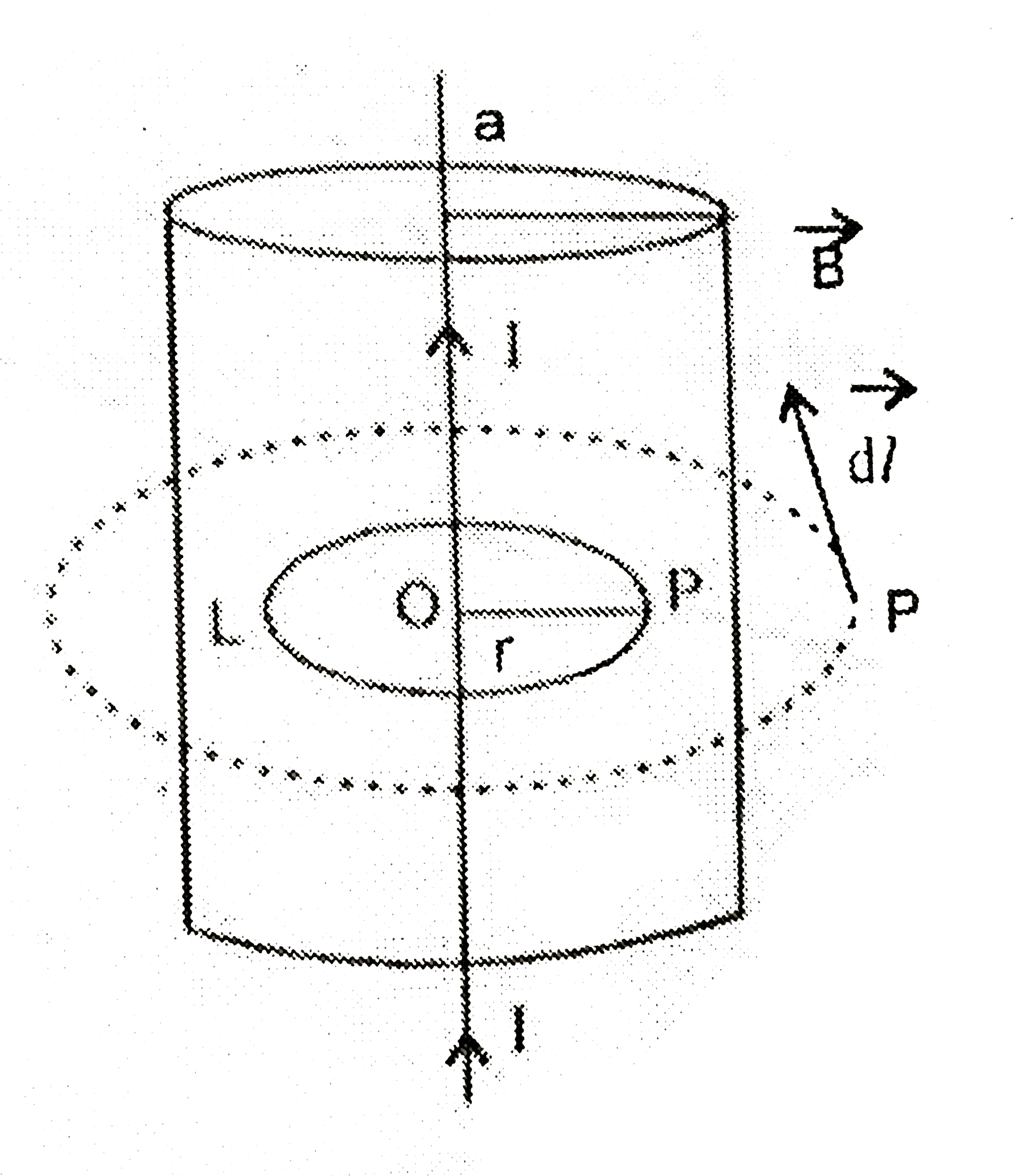
|
|
| 9. |
The co-efficient of static & kinetic friction are 0.6 & 0.3 The minimum horizontal force required to start the motion is applied and if it is continued, the distance travelled by the body in 4 sec is (g=10 ms^(-2)) |
| Answer» ANSWER :B | |
| 10. |
A long wire having linear charge density lambda moving with constant velocity v along its length. A point charge moving with same speed in opposite direction and at that instant it is at a distance r from the wire. The net force acting on the charge is given by |
|
Answer» `(lambdaq)/(2pir)[(1)/(epsilon_(0))+v^(2)mu_(0)]` `EPSILON[E(4pir^(2))]=underset(0)overset(r )(int) (kr) (4pir^(2))dr` `E=(kr^(2))/(2epsilon_(0))` Electrostatic energy within `=underset(0)overset(R )(int)(1)/(2)epsilon_(0)E^(2)4pir^(2)dr=(2piepsilon_(0))underset(0)overset(R )(int)(k^(2)r^(6))/(16epsilon_(0)^(2))PROP(R^(7))` Total charge within `=underset(0)overset(R )(int)4pikr^(3)dr=pikR^(4)` ELECTRIC field at `r GT R = (1)/(4piepsilon_(0))((pikR^(4))/(r^(2)))` Electric energy for `oo gt r ge R = underset(R )overset(oo)(int)(((1)/(4piepsilon_(0))(pikR^(4))/(r^(2)))^(2)4pir^(2)dr)/(2epsilon_(0))=("const")R^(8)underset(R )overset(oo)(int)(1)/(r^(2))dr=("const")R^(8)[(1)/(R )]="const"(R^(7))` Electrostatic energy inside and outside sphere is `propR^(7)`. So total `prop(R^(7))` |
|
| 11. |
What are radio isotopes ? |
| Answer» Solution :The isotopes of an element capable of emitting radiations, just as radioactive ELEMENTS do are CALLED RADIO isotopes. | |
| 12. |
A transverse wave traveling along an x axis has the form given by y=y_(m) sin (kx pm omegat +phi). Figure 16-10a gives the displacements of string elements as a function fo x, all at time t=0. Figure. 16-10b gives the displacements of the elements at x=0 as a function of t. Find the values of the quantities shown in Eq. 16-20. including the corret choice of sign. |
Answer» Solution :(1) Figure 16-10a is effectively a snapshot of reality (something that we can SEE), showing us motion spread 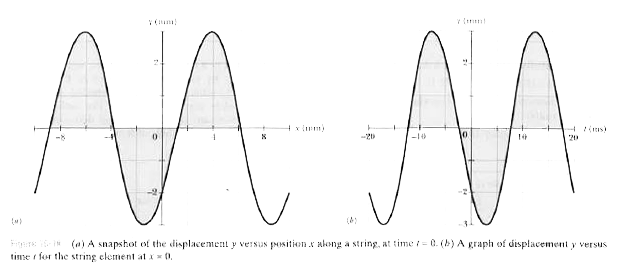 (a) A snapshot of the displacement y versus position x along a string, at time t=0. (b) A graph of displacement y versus time t for the string element at x=0. out over the x axis. From it we can determine the wavelength `lambda` of the wave along that axis, and then we can find the angular wave number `k (= 2pi//lambda)` in Eq. 16-20. (2) Figure 16-10b is an abstraction, showing us motion spread out over time. From it we can determine the period T of the string clement in its SHM and thus also of the wave itself. From T we can then find angular frequency `omega(=2pi//T)` in Eq. 16-20. (3) The phase constant is set by the displacement of the string at t= 0 and Amplitude : From either Fig 16-10 a or 16-10b we see that the maximum displacement is 3.0 mm. Thus, the wave.s amplitude `x_(m)= 3.0` mm. Wavelength: In Fig. 16-10a, the wavelength `lambda` is the DISTANCE along the x axis between repetitions in the pattern. The easiest way to measure A is to find the distance from one crossing point to the next crossing point where the string has the same slope. Visually we can roughly measure that distance with the scale on the axis. Instead, we can lay the edge of a paper sheet on the graph, mark those crossing points, slide the sheet to align the left-hand mark with the origin, and then recud oli the location of the right-hand mark Either way we find `lamda=10 nm.` From Eq. 16-7, we then have `k=(2pi)/(lambda)=(2pi)/(0.010 m)=200pi "rad/m"` Period : The period T is the time interval that a string element.s SHM takes to BEGIN repeating itself. In Fig. 16 10b, T is the distance along the t axis from one crossing point to the next crossing point where the plot has the same slope. Measuring the distance visually or with the aid of a sheet of paper, we find T=20 ms. From Eq 16-10, we have `omega=(2pi)/(T)=(2pi)/(0.020s)=100 pi "rad/s"` Direction of travel: To find the direction, we apply a bit of reasoning to the figures In the snapshot at 10 given in Fig 16-10a, note that it the wave is moving righiward, then just alter the snapshot, the depth of the wave at x =0 should increase (mentally slide the curve slightly rightward. then instead. The wave is moving leftward, then just after the snapshot, the depth at x=0 should decrease. Now let.s check the graph in Fig. 16-10b. It tells us that just after t=0, the depth increases. Thus, the wave is moving rightward, in the positive direction of x and we CHOOSE the minus sign in Eq 16-20. Phase constant: The value of `phi` is set by the conditions at x=0 at the INSTANT t=0. From either figure we see that at that location and time, y=-2.0mm. Substitting these three values and also `y_(m)=3.0mm` into Eq. 16-20 gives us `-2.0 mm=(3.0mm) sin (0+0+phi)` `or phi=sin^(-1) (-2/3)=-0.73"rad"`. Note that this is consistent with the rule that on a plot of y versus x, a negative phase constant shifts the normal sine function rightward, which is what we see in Fig 16-10a. Equation : Now we can fill out Eq 16-20 : `y=(3.0mm) sin (200pix-100 pi t-0.73rad),` with x in meters and t in seconds. |
|
| 13. |
Sketch the variation of electric circle potential on the x-axis with respect to x for x = - oo to x = + oo in the following cases. (a) |
|
Answer» Solution :(a) Electric potential at `P` : `V_(p) = (1)/( 4pi in_(0)).[(Q)/(x) + (Q)/(d - x)] = (Q)/(4 pi in_(0)) .(d)/(x(d - x))` `V_(p)` is minimum if `x(d - x)` is maximum. `x(d - x)` is maximum if `x = d - x rArr x = d//2`. At mid -point of `OA` , electric potential is minimum. At `O : x rarr 0 ,V rarr oo` At `A : x rarr d , V rarr oo` From `O` to `A` , electric potential decreases REACHING to minimum VALUE and then increases. Left of `O` : At DISTANCE `x` from `O` `V = (1)/( 4 pi in_(0)) [(Q)/(x) + (Q)/(d + x)]` `x rarr 0 , V rarr oo` `x rarr -oo , V rarr 0` Right of `A` : At distance `x` from `O` `V = (1)/(4pi in_(0)) [(Q)/(x) + (Q)/(x - d)]` `x rarr d , V rarr oo` `x rarr oo , V rarr 0` (B) At mid - point of `OA , V = 0` `0 lt x lt (d)/(2) , V is + ve` `(d)/(2) lt x lt d , V is - ve` `x rarr 0 , V rarr oo` `x rarr 0 , V rarr oo` `x rarr -oo , Vrarr 0` Right of `A : V is -ve` `x rarr d , V rarr oo` `x rarr oo , V rarr 0` 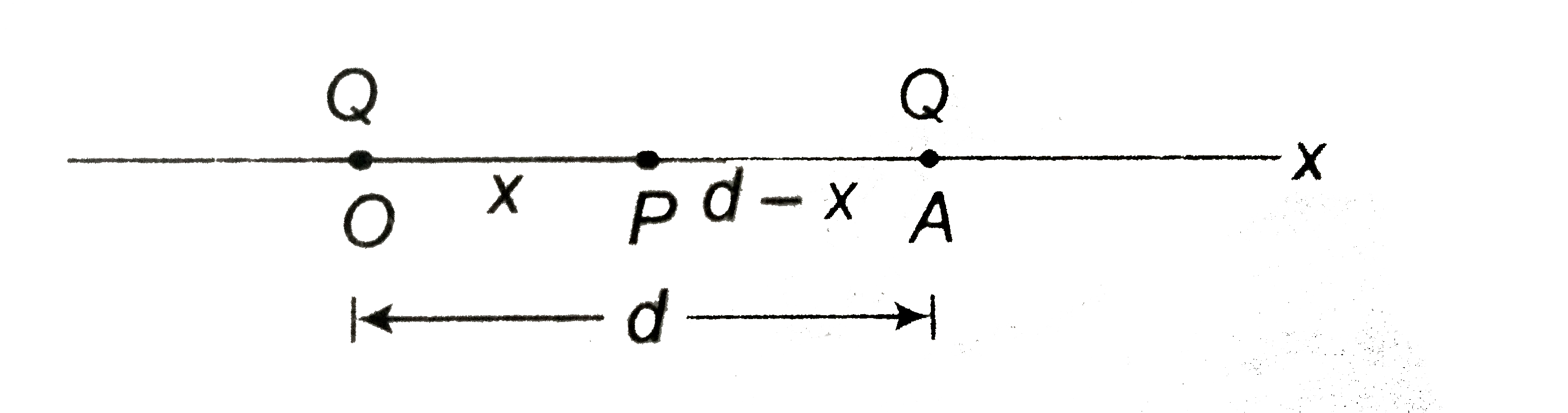 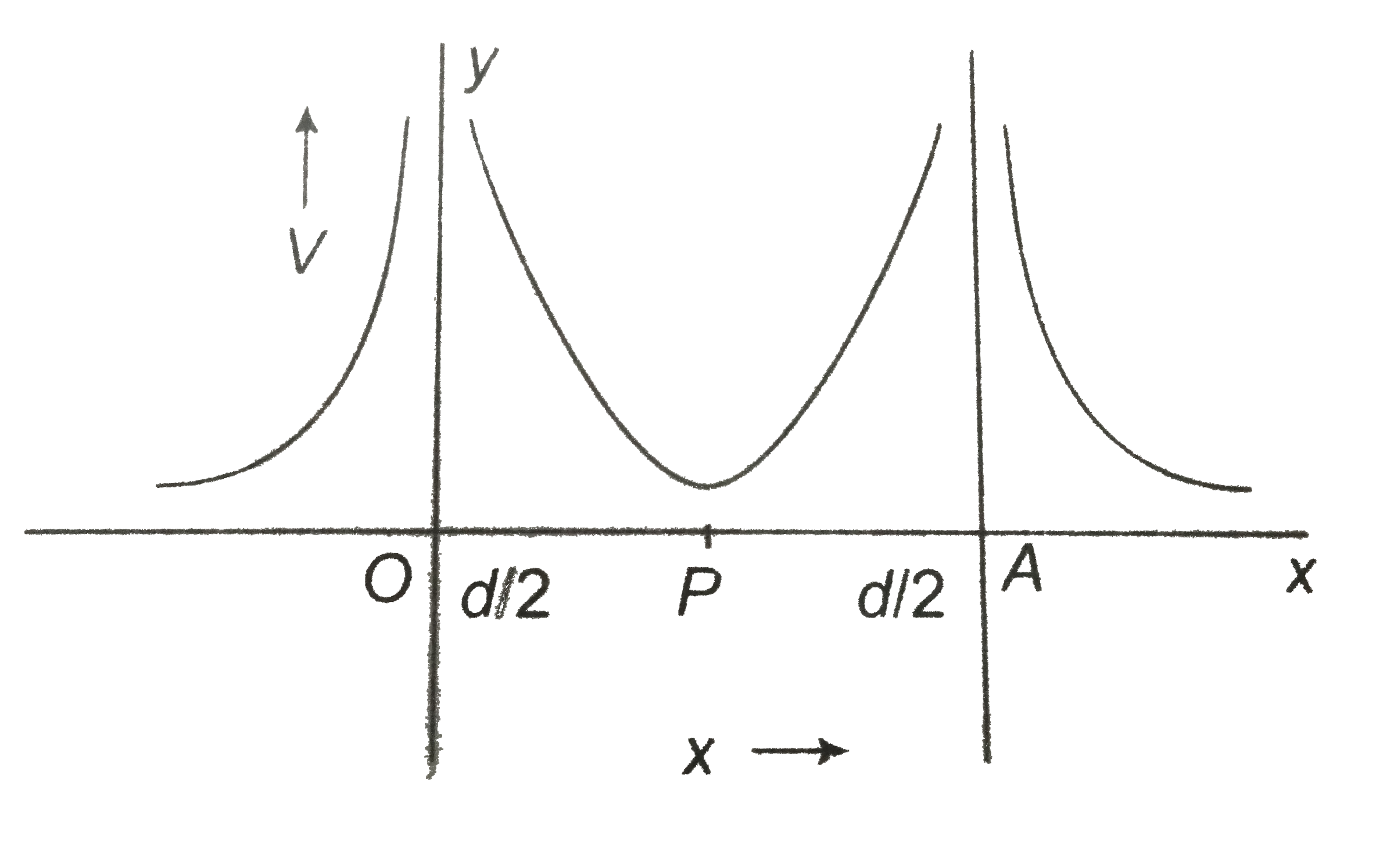 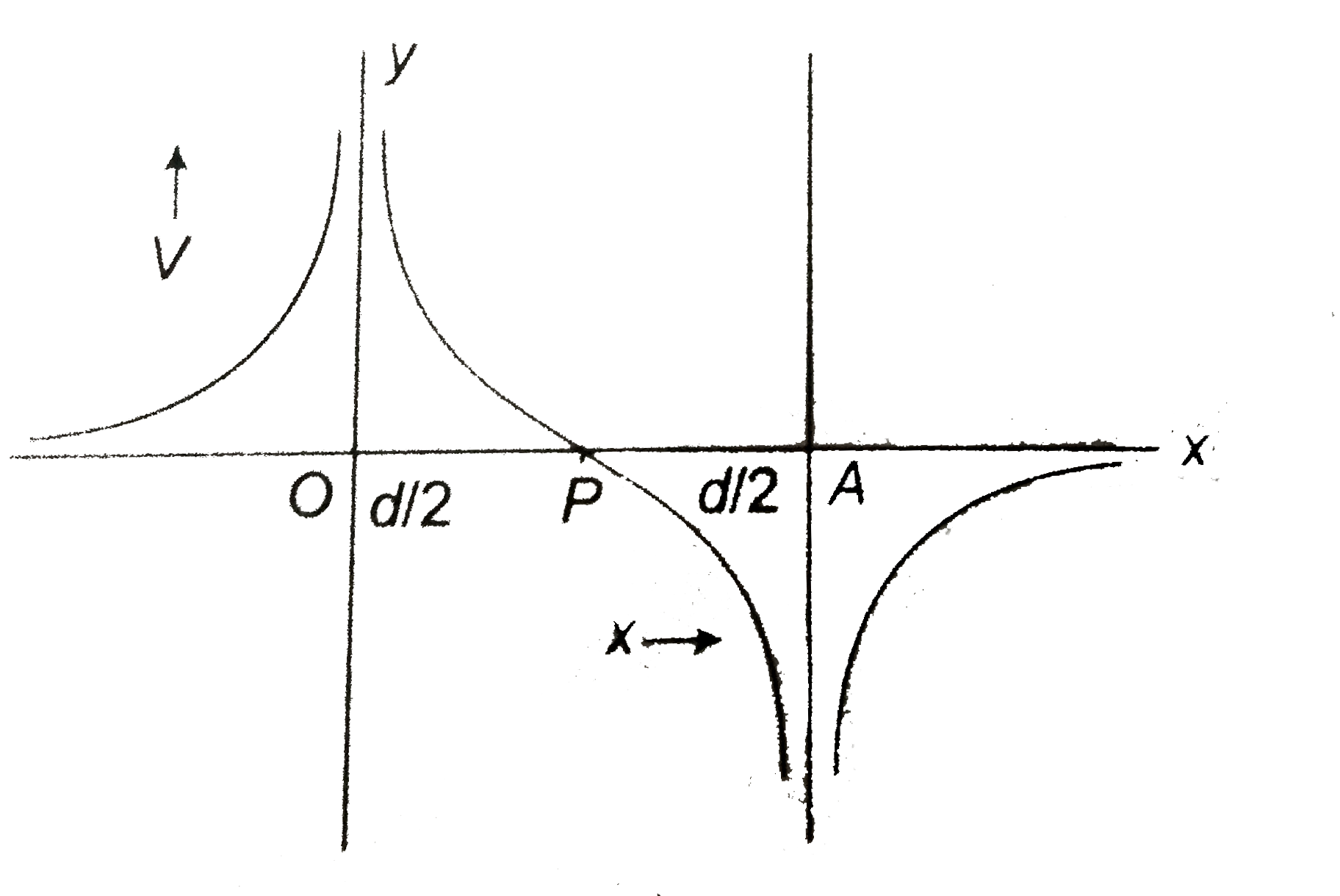
|
|
| 14. |
When the torque exerted on magnet place in magnetic field, would be maximum ? |
|
Answer» `THETA = 0^(@)` `sin theta = "max" = 1` `therefore theta = 90^(@) = (pi)/(2) "rad"` |
|
| 15. |
Demonstrate that Maxwell'sequations grad xx E = -del B //del t andgrad.B = 0 are compatible, i.e.,the firstone doesnot contradict the secound one. |
|
Answer» Solution :From`vec(grad) XX vec(E) = (del vec(B))/(del t)` we get on takingdivergence `0 = - (del)/(del t)` div `vec(B)` This is COMPATIBLE with div `vec(B) = 0` |
|
| 16. |
In the normal working of a transistor , the emitter is forward biased and collector is reverse biased. a. Comment on the above statement . b. Can we exchange emitter and collector of a transistor ? c. Base region of a transistor is made very thin and lightly doped. Why ? d. "Eventhough the collector - base is reverse biased, the current flow takes place with out experiencing much high resistance" , Give your explanation. |
|
Answer» Solution :a. The movement of electrons from emitter to collector in n-p-n and holes in p-n-p TAKES PLACE only if the connections are made with emitter FORWARD biased and collector - reverse biased . b. No c. A thin and lightly dopped base region will contain smaller NUMBER of majority charge carriers . This will reduce the recombination rate of electrons and holes whenmajority charge carriers move from emitter to collector. d The reverse potential value is higher than the forward biased potential so that the charges injected to the base region are pulled effectively to the collector region . |
|
| 17. |
A light wave, travelling at 3xx10^(8)m//s has a frequency of 6xx10^(15) Hz. What is its wavelength? |
|
Answer» `5xx10^(-8)m` `lamdaf=vimplies lamda=(c)/(f)=(3xx10^(8)m//s)/(6xx10^(15)Hz)=0.5xx10^(-7)m=5xx10^(-8)m`. |
|
| 19. |
Find the heat flux through a copper plate 5 cm thick, if a temperature difference of 100 K is maintained between its ends. |
|
Answer» |
|
| 20. |
A galvanometer has a resistance 118Omega and gives full scale deflection by a current 60 mA .If it required to convent this galvanometer into an ammeter upto 3 A, the shunt resistance should be : |
|
Answer» `0.2 OMEGA` |
|
| 21. |
The dimensional formula of angular velocity is, |
|
Answer» [MLT] |
|
| 23. |
Induction precedes attraction because |
|
Answer» an uncharged body can attract an uncharged body due to induction of OPPOSITE charge on |
|
| 24. |
Monochromatic light of frequency 6.0 xx 10^(14) Hz is produced by a laser. The power emitted is 2 xx 10^(-3) W. The number of photons emitted, on the average, by the source per second is |
|
Answer» Solution : POWER = NHV where n = NUMBER of photons per second `=2.0xx10^(-3)=nxx6.6xx10^(-34)xx6xx10^14` `n=(2.0xx10^(-3))/(6.6xx10^(-34)xx6xx10^14)` `=(2.0xx10^(-3))/(39.6xx10^(-20))` = 5 x 10 photons per second |
|
| 25. |
A small telescope has an objective lens of focal length 144cm and an eyepiece of focal length 6.0cm. What is the magnifying power of the telescope? What is the separation between the objective and the eyepiece? |
| Answer» SOLUTION :24, 150 CM | |
| 26. |
A uniform wire of resistance 12 Omegais cut into three pieces so that the ratio of the resistances R _(1) : R _(2) :R _(3) = 1 : 2 : 3and the three pieces are connected to form a triangle across which a cell of emf 8V and internal resistance 1Omega is connected as shown. Calculate the current through each part of the circuit. |
|
Answer» SOLUTION :`R _(1) =12 Omega` `R _(1) :R_(2) : R _(3) = 1:2:3` Let, `R _(1) = R ""R_(1) = 2 Omega` `R _(2) = 2 R "" R _(2) = 4 Omega` `R _(3) = 3 R "" R _(3) = 6 Omega` According to circuit: `((R _(1) + R _(2)) xx R _(3))/( R _(1 )+ R _(2) + R _(3))` `R _(eq) = 3 + 1 = 4 Omega` `I = 8/4 = 2 A` Current through each branch is 1 Ampere. 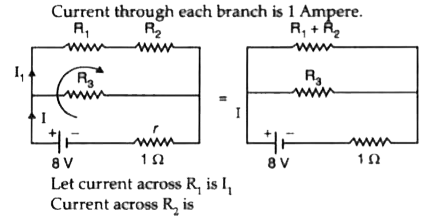 Let current ACROSS `R _(1) is I _(1)` Current across `R _(2)` is ` I _(2) = I _(1)` So current across `R _(3) = I _(3) = ( I - I _(1))` Taking current dividing RULE : `I _(1) = ( R _(3))/( (R _(1) + R _(2) + R _(3))) xx I ` `= (6)/( (2 + 4 + 6 )) xx 1 .` `I _(2) = I _(1) = 1 ` amp `I _(3) = I - I _(1)` = 1 amp |
|
| 27. |
What do you mean by frequency deviation ? |
| Answer» SOLUTION :FREQUENCY deviation means the maximum SWING of the frequency of modulated wave from the CARRIER frequency. | |
| 28. |
(a)Show that the ratio of velocity of an electron in the firstBohr orbit to the speed of light c is a dimensionless number. (b) Compute the velocity of electrons in ground state, first excited state and second excited state in Bohr atom model. |
|
Answer» Solution :(a) The velocity of an electron in `n^(th)` orbit is `v_(n) = (H)/(2pima_(0))(Z)/(n)` where `a_(0) = (epsilon_(0)h^(2))/(pi me^(2))` = Bohr radius .Substituting for `a_(0)` in `v_(n)`, `v_(n) = (e^(2))/(2epsilon_(0)^(h))(Z)/(n)= c ((e^(2))/(2epsilon_(0)hc))(Z)/(n) = (acZ)/(n)` where c is the speed of LIGHT in free space or vaccum and its value is ` c xx 3 xx10^(8) ms^(-1)` and `alpha` is called FINE structure constant. For a hydrogen atom, Z = 1 and for the first orbit , n = 1, the ratio of velocity of electron in first orbit to the speedof light in vaccum or free space is ` alpha = ((1.6 xx 10^(-19)C)^(2))/(2 xx (8.854 xx 10^(-12)C^(2) N^(-1) m^(-2))) = ((1.6 xx 10^(-19) C)^(2))/((6.6 xx 10^(-34) Nms) xx(3 xx10^(8) ms^(-1))` `(v_(1))/(c) = alpha = (e^(2))/(2 epsilon_(0)hc)` `approx (1)/(136.9) =(1)/(137)` which is a dimensionless number `Rightarrow alpha = (1)/(137)`. (B) Using fine structure constant, the velocity of electron in can be written as`v_(n) = (acZ)/(n)` For hydrogen atom (Z = 1) the velocity of electron in `n^(th)` orbit is `v_(n) = (c)/(137)(1)/(n) = (2.19 xx 10^(6))(1)/(n) ms^(-1)` For the first orbit (ground state), the velocity of electron is `v_(n) = 2.19 xx 10^(6) ms^(-1)` For the second orbit (first excited state), the velocity of electron is `v_(2) = 1.095 xx 10^(6) ms^(-1)` For the third orbit (second excited stae), the velocity of electron is `v_(3) = 0.73 xx 10^(6) ms^(-1)` Here, `v_(1) gt v_(2) gt v_(3)` |
|
| 29. |
What is parallel connections of cells? Derive the equivalent equation of parallel connections of two cells. |
Answer» Solution :`rArr` If positive terminal of given CELLS are connected at one POINT and negative terminal of cell connected with second point then such connection is called parallel connection of cells.  `rArr` As shown in figure, two cells with emf `epsilon_(1) and epsilon_(2)` and respectively internal resistance `r_(1) and r_(2)` are connected in parallel between `B_(1) and B_(2)` . `rArr` Current in cell with emf `epsilon_(1) " is " I_(1) ` and with emf `epsilon_(2)" is " I_(2)` . ` rArr` Total current at `B_(1)` be, `I = I_(1) + I_(2) ""` .... (1) `rArr` Let potential at `B_(1) and B_(2)` be `V(B_(1)) and V(B_(2))`respectively. `rArr` Potential difference between two cell `V(B_(1)) - V(B_(2))` will be equal , `V(B_(1)) - V(B_(2)) - epsilon_(1) - I_(1) r_(1)` `V(B_(1)) - V(B_(2)) - epsilon_(2) - I_(2) r_(2)` `V(B_(1))- V(B_(2)) = V ` ` V = epsilon_(1) - I_(1) r_(1)` `I_(1) = (epsilon_(1)- V)/(r_(1)) ""` ....(2) SIMILARLY, `I_(2) = (epsilon_(2) - V)/(r_(2)) ""`....(3) `I = I_(1) + I_(2)` `= (epsilon_(1) - V) /(r_(1)) + (epsilon_(2) - V)/(r_(2))` `= (epsilon_(1))/(r_(1)) - (V)/(r_(1)) + (epsilon_(2))/(r_(2)) - (V)/(r_(2))` `therefore I = (epsilon_(1))/(r_(1)) + (epsilon_(2))/(r_(2)) - V((1)/(r_(1)) + (1)/(2)) ` `V ((r_(1) + r_(2))/(r_(1) r_(2))) = ((epsilon_(1) r_(2) + epsilon_(2) r_(1))/(r_(1) r_(2)) )- 1 ` `therefore V ((r_(1) + r_(2))/(r_(1) r_(2))) = ((epsilon_(1) r_(2) + epsilon_(2) r_(1))/(r_(1) r_(2)) )- 1 ` `therefore V = ((epsilon_(1) r_(2) + epsilon_(2) r_(1))/(r_(1) r_(2)) xx (r_(1) r_(2))/(r_(1) + r_(2)) ) - I ((r_(1) r_(2))/(r_(1) + r_(2)) )` `therefore V = (epsilon_(1) r_(2) + epsilon_(2) r_(1))/(r_(1) r_(2))- I ( (r_(1) r_(2))/(r_(1) + r_(2)) ) "" `....(4) Let cell with emf `E_(eq)` and internal resistance req is connected between `B_(1) and B_(2) `then, `V= epsilon_(eq) - Ir_(eq) "" ` ... (5) Comparing equation (4) and (5), `epsilon_(eq) = (epsilon_(1) r_(2) + epsilon_(2) r_(1))/(r_(1) r_(2)) "" ` ..... (6) `r_(eq) = (r_(1) r_(2))/(r_(1) + r_(2)) "" ` (7) By using equation (6) and (7), `(epsilon_(eq))/(r_(eq)) = (epsilon_(1))/(r_(1)) + (epsilon_(2))/(r_(2)) ` `(I)/(r_(eq)) = (1)/(r_(1)) + (1)/(r_(2))` here we have CONSIDERED that positive terminal of both cell are joined together. If negative terminal of second cell is connected to positive terminal of first cell then in equation `epsilon_(2) ` should be REPLACED by `- epsilon_(2)` . `rArr` If .n. cell are connected in parallel then, equivalent internal resistance, `(1)/(r_(eq)) = (1)/(r_(1)) + (1)/(r_(2)) + .... + (1)/(r_(n))` and `(epsilon_(eq))/(r_(eq) )= (epsilon_(1))/(r_(1)) + (epsilon_(2))/(r_(2)) + ..... + (epsilon_(n))/(r_(n))` `rArr`Special case : When two cell having equal emf and equal resistance are connected in parallel equivalent emf will be equal to individual cell (one cell). `epsilon_(eq)= (epsilon_(1) r_(1) + epsilon_(2) r_(2))/(r_(1) + r_(2))` Let `epsilon_(1)= epsilon_(2) = epsilon and r_(1) = r_(2) = r ` `thereforeepsilon_(eq) = (epsilon r + epsilon r)/(r+ r)` = `(2 epsilon r )/(2 r)` `therefore epsilon_(eq) = epsilon` |
|
| 30. |
The time taken by A.C. voltage of frequency 50 Hz to change from zero to maximum is ……. ms. |
|
Answer» 5 If `V=V_m` then 1 = sin `omegat` `therefore omegat=pi/2` `therefore t=(pixxT)/(2xx2pi) [because OMEGA=(2pi)/T]` `therefore t=T/4` `therefore t=1/(50xx4) [ because T=1/f = 1/50]` `therefore t=1/200` `therefore t=5xx10^(-3)` s `therefore` t=5 MS |
|
| 31. |
In a series R-C circuit the supply voltage (Vs) is kept constant at 2V and the frequency f of the sinusoidal voltage is varied from 500 Hz to 2000 Hz. The voltage across the resistance R=1000 ohm is measured each time as V_(R). For the determination of the C student wants to draw a linear graph and try to get C from the slope. Then she may draw a graph of |
|
Answer» `F^(2)"against"V_(R)^(2)` |
|
| 32. |
A transmitting antenna is at a height of 40 m and the receiving antenna is at a height of 60 m. The maximum distance between them for satisfactory communication is nearly |
|
Answer» 22.5 km |
|
| 33. |
A copper wire of resistance R_(0) is strerched till its length is increased to n times of its original length. What will be its new resistance? |
|
Answer» SOLUTION :`R. = n^2 R ` `thereforeR. =RHO(nL)/( A//n) =rho n ^2 (I)/(A)=n^2 R ` |
|
| 34. |
An excited atoms has the electronic configuration 1s^(2)2s^(2)2p3d being in the state with the greatest possible total angular momentum, Find the magnetic moment of the atom in that state. |
|
Answer» SOLUTION :To get the GREATEST POSSIBLE angular momentum we must have `S=S_(max)=1` `L=L_(max)=1+2=3` and`J=L+S=4` Then `g=1+(4xx5+1xx2-3xx4)/(2xx4xx5)=1+(10)/(40)=(5)/(4)` and `mu=(5)/(4)sqrt(4xx5)mu_(B)=(5sqrt(5))/(2)mu_(B)` |
|
| 35. |
Light of wavelength 5000xx10^(-10)m is incident normally pattern is observed to lie atdistance of 5 mm from the central maximum onscreen place at a distance of 3 from the slit. Then the width of the slits is |
|
Answer» 3 CM `:.AXX(X)/(D)=nlamda` `:.a=(3xx5000xx10^(-10))/(5xx10^(-3))=0.3mm` |
|
| 36. |
The rate of incidence of the material is 60^(@) light the completely polarized .The intensity of the relected ray inside the material is . |
|
Answer» `3xx10^(8)` |
|
| 37. |
If the magnetic field linked with the coil is reduced to half, the e.m.f induced in coil will be________. |
|
Answer» half |
|
| 38. |
Positive and negative ions are produced in the atmosphere due to cosmic rays from space and also due to radioactive elements in the soil. In some region in the atmosphere, the electric field strength is 100 V//m in the vertically downward direction. This field exerts force on the positive and negative ions in the given region in atmosphere. As a result, positive ions, having a density 500//cm^(3) drift downward while negative ions, having a density 300//cm^(3) drift upward. All these ions are singly charged. It is observed that the conductivity in the given region is 4 xx 10^(-13)(Omega - m)^(-1). Find the average speed of ions, assuming it to be the same for positive and negative ions. |
|
Answer» 1.3`m//s` |
|
| 39. |
How many 220 V bulbs of 300 W power each may be installed in a building, if the mains voltage is 235 V and the wiring is done using aluininium wire of 6 mm diameter? The power line is a two-wire line, and the distance from the mains terminal to the building is 100 m. |
|
Answer» |
|
| 40. |
Photon is a quanta of light. Briefly explain the effect of intensity and energy of the incident radiation of the photo electric effect. |
| Answer» Solution :When the intensity of incident light increases, number of photons EMITTED from the metal SURFACE also Increases. When the frequency of incident light increases, KINETIC energy of emitted photon also increases | |
| 41. |
A Fe^(57) nucleus emits gamma-rays with an energy of 14.4 keV. Find the relative variation of the energy of gamma-photon due to the recoil of the nucleus. Compare this quantity with the natural width of a spectral line, if the lifetime of a nucleus in the excited state is 1.4xx10^(-7) s. |
|
Answer» `epsi=epsi_(gamma)+epsi_(R)=epsi_(gamma)(1+(epsi_(gamma))/(2Mc^(2)))` The relative change in energy is `delta=(Deltaepsi)/(epsi_(gamma))=(epsi_(gamma))/(2Mc^(2))`. The natural relative line width is `delta_(nat)=h//tauepsi_(gamma),"where "tau` is the lifetime of the nucleus in the excited state. |
|
| 42. |
The ratio of M.I. of the ring about an axis an passing through its rim and perpendicular to its plane and about the diameter is |
|
Answer» 1:4 |
|
| 43. |
Black soil is deficient in: |
|
Answer» CALCIUM carbonate |
|
| 44. |
Show that the force on each plate of a parallel plate capacitor has a magnitude equal to (1//2)QE, where Q is the charge on the capacitor, and E is the magnitude of electric field between the plates. Explain the origin of the factor 1//2. |
| Answer» Solution :Hint: Suppose we increase the separation of the plates by `Deltax` . Work done (by external agency) = F =`Deltax` . This goes to increase the potential ENERGY of the capacitor by u a`Deltax`where u is energy density. Therefore, F = u a which is easily seen to be (1/2) QE, USING `u = (1//2) epsilon_(0)E^(2)`. The physical origin of the factor 1/2 in the force formula lies in the fact that just OUTSIDE the conductor, field is E, and inside it is zero. So, the average value E/2 CONTRIBUTES to the force. | |
| 45. |
The ability of a junction diode to _______ an alternating voltage is based on the fact that it allows current current to pass only when it is forward biased . |
|
Answer» |
|
| 46. |
A battery of internal resistance 3Omega is connected to 20Omega resistor and the potential difference across the resistor is 10V. If another resistor 30Omega is connected in series with the first resistor and battery is again connectecl to the combination, then calculate the e.m.f and terminal potential difference across the combination.. |
|
Answer» SOLUTION :Case-I `I = ( EPSI )/( R +r) or V = ( epsi R)/( R+ r)` `epsi = 11.5 V` Case-II `I = ( epsi)/( R _(s ) + r ) or V =(epsi R _(S))/( R + r )` `R _(S) = 20 + 30 = 50 Omega` Substitution and OBTAINING `V = 10.849V` |
|
| 47. |
A body dropped from top of a tower falls through 40 m during last two seconds of its motion of its fall. The height of tower in m is : |
| Answer» ANSWER :A | |
| 48. |
A satellite is revolving in a circular orbit of radius r around the earth. The angular momentum of the satellite is proportional to : |
|
Answer» r `L=root(m)(GMr) rArr L prop sqrt(r )` So the correct choiceis (B). |
|
| 49. |
Assertion: For a non-uniformly charged thin circular ring with net charge zero, the electric field at any point on axis of the ring is non zero. Reason:For a non-uniformly charged thin circular ring with net charge zero, the electric potential at each point on axis of the ring is zero. |
|
Answer» Both Assertion and Reason are true and Reason is the correct EXPLANATION of Assertion |
|


