

Saved Bookmarks
This section includes 7 InterviewSolutions, each offering curated multiple-choice questions to sharpen your Current Affairs knowledge and support exam preparation. Choose a topic below to get started.
| 1. |
The indicator diagrams representing minimum and maximum amounts of work done are respectively |
| Answer» Answer :B | |
| 2. |
Drawings I and II show two samples of electric field lines |
|
Answer» The electric field in both I and II are PRODUCED by negative charge located somewhere on the left and positive CHARGES located somewhere on the right |
|
| 3. |
Electric field intensity (E) due to an electric dipole varies with distance (r ) from the point of the center of dipole as : |
|
Answer» `E PROP (1)/(r )` |
|
| 4. |
If unit vector is represented by 0.5 hati +0. 8 hat j + c hat k, then the value of c is |
|
Answer» 1 |
|
| 5. |
In which of the following case, attraction is maximum between two charged spheres separated by 2 mm distance ? |
|
Answer» +2q and -2q |
|
| 6. |
A light bulb is rated at 100W for a 220 V supply. Findthe resistance of the bulb |
|
Answer» Solution : (a) Rating of given is "100W, 220V". It means that maximum VOLTAGE that can beapplied to a given bulb is 220V and at that voltage maximum POWER consumed by that bulb will be 100W. Now, we have the FORMULAFOR average electrical power, `P = ( V^(2))/( R )`( Where R = electricalresistance of given bulb) `:. R = ( V^(2))/( P )` `:. R = ((220)^(2))/( 100)` `:. R = 484 Omega` |
|
| 7. |
A double convex lens (R_(1) = R_(2) = 10 cm) (mu = 1.5)having focal length equal to the focal length of a concave mirror. The radius of curvature of the concave mirror is |
| Answer» ANSWER :B | |
| 8. |
A ray of light is incident normally on one side of an isosceles right-angled prism and is totally reflected from the other side. (i) What is the value of minimum refractive index of the material of the prism? (ii) If the prism is immersed in water, draw the diagram showing the directing of the emergent ray. In the diagram, point out the values of the angles, mu of water =(4)/(3). |
|
Answer» Solution :(i) ABC is an isosceles right - angled prism and its sides AB = BC. The light ray PQ is incident on the face AB normally and enters the prism. The ray is incident at R on the face AC [Fig. 2.64(a)]. It is EVIDENT from the figure that angle of incidence of the ray at R is `45^(@)`. Now if the ray is to be totally reflected from R then this angle of incidence should be greater than the critical angle of the material of the prism i.e. maximum critical angle will be `theta_(c) = 45^(@)`. If `mu` be the minimum refractive index of the material of the prism then, `sintheta_(c) = (1)/(mu) or, sin45^(@) = (1)/(mu) or, mu = sqrt(2) = 1.414`.  If the prism is immersed in water, then refractive index of glass relative to water is, `W^(mu)G = (mu_(g))/(mu_(w)) = (sqrt(2))/((4)/(3)) = (3sqrt(2))/(4)` If the critical angle between the prism and water is `theta_(c)`. then, `theta_(c). = sin^(-1) = (1)/(w^(mu)g) = sin^(-1)((4)/(3sqrt(2))) = 70.53^(@)` But the angle of incidence at R is `45^(@)` [Fig. 2.64(b)] and it is less than the critical angle. So at R, light ray will not be totally reflected. It will be refracted and will enter water. If the angle of refraction is r, then `sqrt(2) sin45^(@) = (4)/(3) SINR` `therefore "" sinr = sqrt(2) XX (3)/(4) xx (1)/(sqrt(2)) = 0.75 = sin 48.59^(@)` `or, "" r = 48.59^(@)` |
|
| 9. |
An electric dipole s formed due to two particles fixed at the ends of a light rigid rod of length 1. The mass of each particle is m and charges are -q and +q The system is suspended by a torsionless thread in an electric field of intensity E such that the dipole axis is parallel to the filed if it is slightly displaced, the period of angular motion is |
|
Answer» `(1)/(2pi) sqrt((2qE)/(ml))` |
|
| 10. |
The correct curve between potential and distance near P-N junction is |
|
Answer»
|
|
| 11. |
Resistivity of metal …… and resistivity on semiconductor …… on temperature decreases |
|
Answer» INCREASES, DECREASES |
|
| 12. |
(a)explain the menaing ofthe statement electricchargeof a body is quantised (b) why can one ignorequantisation of electriccharge whendealing with macrosocpic large scale charges |
| Answer» Solution :Electric charge of a body is quantized . THISMEANS that only INTEGRAL (1,2,……,n) number of electrons can be TRANSFERRED from one body to the other , charges are not transferredin fraction . Hencea body possesses TOTAL charge only in integral multiples of electric charge. | |
| 13. |
For an n-p-n transistorpercentage of electronsemitted reaching the collector is 80% if th ecollectcurrentis 1 mA |
|
Answer» the EMITTER CURRENT is 1.5 mA `rArrI_(e) = (10)/(8)I_(c )` Given `I_(e) = 1 mA` `I_(b) = I _(e)- I_(e)` `=(1.25 -1) mA = 0 .25 mA` Henceoption (c ) and (d) are correct. |
|
| 14. |
A 1.0 m long metallic rod is rotated with an angular frequency of "400 rad s"^(-1) about an axis normal to the rod passing through its one end. The other end of the rod is in contact with a circular metallic ring. A constant and uniform magnetic field of 0.5 T parallel to the axis exists everywhere. Calculate the emf developed between the centre and the ring. |
|
Answer» Solution :Here EMF induced between centre and rim of ring is the emf induced across the given rod. This emf is, `EPSILON=1/2B omegaL^2` `=1/2xx0.5xx400xx(1)^2` `THEREFORE epsilon`=100 V |
|
| 15. |
SI unit of permeability is |
|
Answer» `(Am)/T` `thereforemu_(0)=(4pidBr^(2))/(Idlsintheta)` Since, `4piandsintheta` are UNITLESS, `THEREFORE` Unit of `mu_(0)=(Tm^(2))/(Am)=(Tm)/A` |
|
| 16. |
Two charged particles M and N enter a space of uniform magnetic field, with velocities perpendicular to the magneticfield. The paths are as shown in the figure. The possible reasons for different path may be : |
|
Answer» the CHARGE of M is greater than that of N |
|
| 17. |
The refractive indices of glass and water with respect to air are 3\2 and 4\3 respectively. The refractive index of glass w.r.t. water is given by : |
|
Answer» 1.5 |
|
| 18. |
A magnet is suspended so as to swing horizontally makes 50 oscillations/min at a place where dip is 30^(@), and 40 vibrations where dip is 45^(@). Compare the earth's total fields at the two places. |
| Answer» SOLUTION :`25:8 SQRT(6)` | |
| 19. |
A regular hexagon of side 10 cm has a charge 5 muCat each of its vertices. Calculate the potential at the centre of the hexagon. |
| Answer» SOLUTION :`2.2 XX 10^(6)` V | |
| 20. |
An electric dipole is put in north-south direction in a sphere filled with water. Which statement is correct : |
|
Answer» electric flux is COMING towards sphere |
|
| 21. |
The threshold frequency for a certain metal is v_(0). When a certain radiation of frequency 2v_(0) is incident on this metal surface the maximum velocity of the photoelectrons emitted is 2xx10^(6)ms^(-1). If a radiation of frequency 3v_(0), is incident on the same metal surface the maximum velocity of the photoelectrons emitted (in m.s^(-1) ) is |
|
Answer» `2XX10^(6)` |
|
| 22. |
A uniform thin bar is of mass 4 kg and length 2 m. the M.I. of bar about an axis passing through its centre and perpendicular to the length is |
|
Answer» `4/3kgm^2` |
|
| 23. |
A water tank is 4 meter deep. A candle flame is kept 6 meter above the level mu for water is 4//3. Where will the image of the candle be formed? |
| Answer» SOLUTION :6 m. below the WATER LEVEL. | |
| 24. |
What is non ohmic device? State one example of it. |
| Answer» SOLUTION :A DEVICE which does not obey Ohm.s law is called non OHMIC device. Ex. The resistance offered by a semi conductor DIODE. | |
| 25. |
Two equal masses of mass M each are attached to a string passing over a smooth pulley which is attached by a chain to the celiling. The tension in the chain is: |
|
Answer» 0 `T=(2MxxM)/(2M)g=Mg` TENSION in the chain `= 2T = 2Mg` (c) is the choice. |
|
| 26. |
The tubes of force that originate from a charge q are: |
|
Answer» `EPSILON` |
|
| 27. |
If particle is acted upon by the forces vecF_(1) = 2hati + 2hatj - 3hatk""vecF_(2) = 5hati + chatj - bhatk vecF_(3) = bhati + 5hatj - 7hatk, vecF_(4) = chati + 6hatj - ahatk. Find the values of the constant a, b, c in ordre that the particle will be in equilibrium. |
|
Answer» |
|
| 28. |
Derive relation between current gain in common base and common-emitter transistor amplifiers. |
|
Answer» Solution :Current gain `ALPHA` is DEFINED as the ratio of collector current to the emitter current at constant collector VOLTAGE. Current gain `beta` is defined as the ratio of the collector current to the base current at constant collector voltage. i.E. `beta=((I_(c))/(I_(b)))_(E_(ie))` Relation between `alpha` and `beta`. For n-p-n and p-n-p transistor, we have `I_(e)=I_(b)+I_(c)` or `(I_(e))/(I_(c))=(I_(e))/(I_(c))+1`......`(i)` Since current gain of common emitter amlifier, `alpha=(I_(c))/(I_(e))` And current gain of common base amplifier, `beta=(I_(c))/(I_(b))` So Eq. `(i)` becomes `(1)/(alpha)=(1)/(beta)+1` or `(1)/(beta)=(1)/(alpha)-1` or `beta=(alpha)/(1-alpha)` |
|
| 29. |
If N is number of closed packed structures, Then number of Tetrahedral Voids is |
|
Answer» N |
|
| 30. |
A plane electromagnetic wave travels in vaccum along z-direction . What can you say about the directions of its electric and magnetic field vectors ? If the frequency of the wave is 30 MHz. What is its wavelength ? |
| Answer» Solution :E and B in x-y PLANE and are MUTUALLY PERPENDICULAR, 10 m. | |
| 31. |
A cylindrical glass rod has its two coaxial ends of spherical form bulging outward. The front end has a radius of curvature 5 cm and the back end which is silvered has a radius of curvature 8 cm. The thickness of the rod along the axis is 10 cm Calculate the position of the image of a point at the axis 50 cm from front face n_(q) = 1.5) |
|
Answer» |
|
| 32. |
In the dispalcement method magnifications for two position of the lens are 3 and 2 and distance between the two position of lens is 30 cm . The focal length of the lens is |
| Answer» ANSWER :A | |
| 33. |
In young's double-slit experiment, both the slits produce equal intensities on a screen. A 100% transparent thin film of refractive index mu = 1.5 is kept in front of one of the slits, due to which the intensity at the point O on the screen becomes 75% of its initial value. If the wavelength of monochromatic light is 720 nm, then what is the minimum thickness (in nm) of the film? |
|
Answer» |
|
| 34. |
The figure shows two infinite parallel plates A mid B. The charge densities of the plates A and B aresigma_1=2.5muC//m^2 and sigma_2=0.50muC/m^2.calculate the electric intensity in (i) the space between the plates and (ii) outside the plates . |
|
Answer» <P> SOLUTION :The ELECTRIC INTENSITY at P is `E_R.E_R=(S_1-S_2)xx10^-6=1/(2xx8.85xx10^-2)XX(2.5-0.5)=1.13xx10^-5N//C.` |
|
| 35. |
A current i ampere flows in the loop having circular arc of radius r metre subtending an angle theta^@as shown in figure. The magnetic field at centre O of circle is |
|
Answer» `mu_(0)I THETA/4pi r` |
|
| 36. |
In the circuit shown, if a conducting wire is connected between point A and B, the current in this wire will |
|
Answer» flow from `A` to `B` Resistance `4 Omega` and `4 Omega` are connected in series, so their effective resistance, `R' = 4 + 4 = 8 Omega` Similarly, `1 Omega` and `3 Omega` are in series, `R" = 1 + 3 = 4 Omega` Now `R'` and `R"` will be in parallel, hence effective resistance `R = (R' xx R'')/(R' + R'') = (8 xx 4)/(8 + 4) = (32)/(12) = (8)/(3) Omega` Current through the circuit, from Ohm's LAW `i= (V)/(R ) = (3V)/(8) A` Let current `i_(1)` and `i_(2)` flow in the branches as shown `8 i_(1) = 4 i_(2)` `i_(2) = 2 i_(1)` .....(i) Also `i= i_(1) + 2 i_(1)` `i_(1) = (V)/(8) A` and `i_(2) = (V)/(4) A` Potential DROP at `A, V_(A) = 4 xx i_(1) = (4 V)/(8) = (V)/(2)` Potential drop at `B, V_(B) = 1 xx i_(2)= 1 xx (V)/(4) = (V)/(4)` Since, drop of potential is greater in `4 Omega` resistance. It will be at lower potential than `B`, hence, on connecting wire between points `A` and `B`, the current will flow from `B` to `A`. 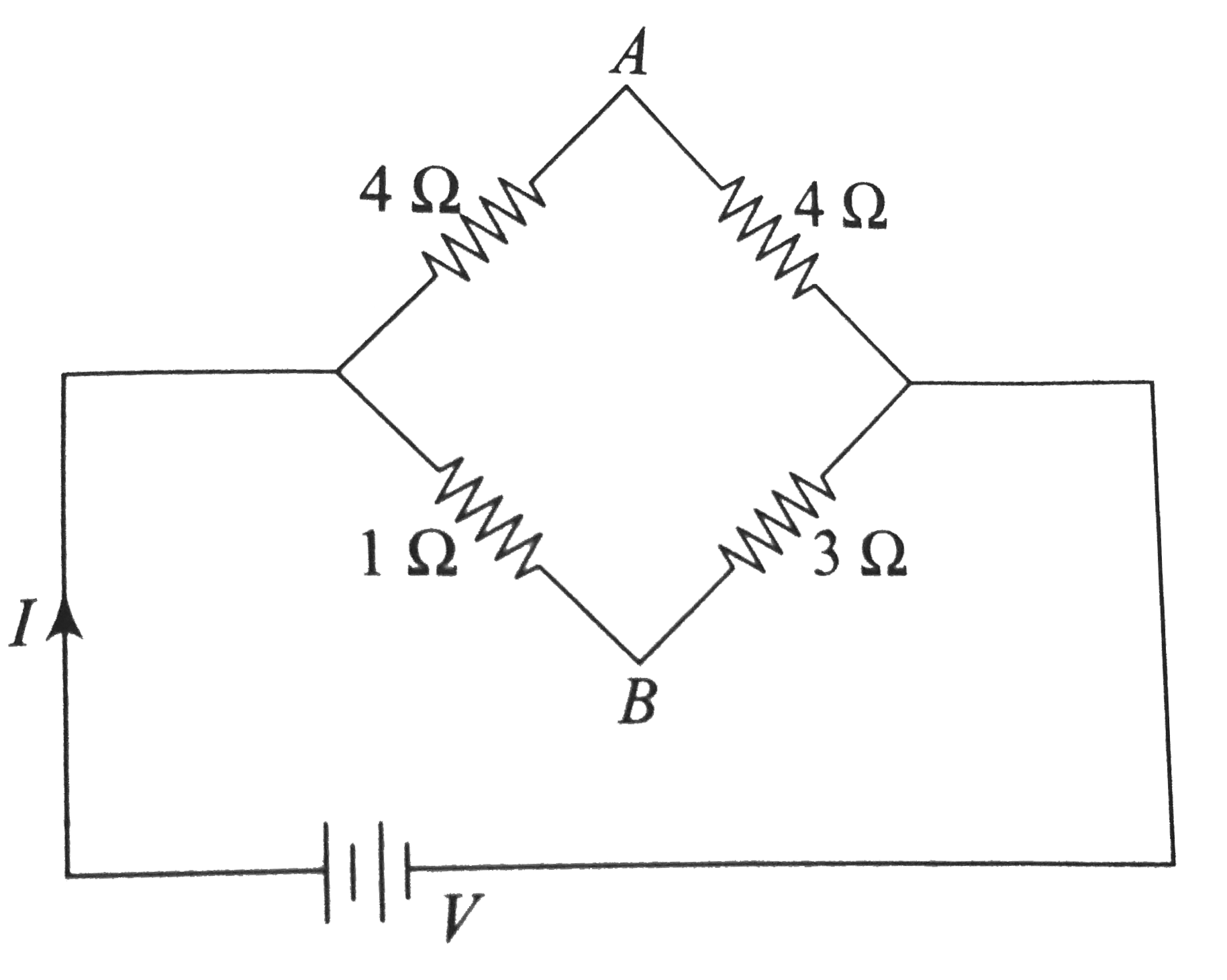
|
|
| 37. |
In the given circuit diagram, culculate: (i) The main current through the circuit and (i) Also current through 9 Omegaresistor . |
|
Answer» Solution :Given ` R_(1) = 6 Omega `, ` R_(2) = 12Omega ` ` R_(3) = 9Omega `, ` E = 3V ,R = 0.24Omega ` ` (##SPH_ABT_PHY_QB_XII_JUL_18_E04_009_S01.png" WIDTH="80%"> ` w.kt. (1) /(R_(eq)) = (1) /(R_(1)) + (1)/(R_(2)) + (1)/(R_(3)) ` ` i.e., (1)/(R_(eq)) = (1)/(6) + (1)/(12) + (1)/(9) = (13)/(36) ` ` therefore R_(eq) = (36)/(13) = 2.76 Omega ` `w.k.t ""I = (E) /(R_(eq) + r,) I = (3)/(2.76+ 0.24) ~~ 1 A ` P.d across resistance `V_(tau) = IR = 1 xx 0.24 = 0.24 V ` ` therefore `P.d across each resistors = 3 - 0.24 = 2.76 V ` therefore ` Current in ` 9 Omega = (2.76)/(9) = 0.31 A ~~ 0.3 A ` Hence Current in ` 9 Omega ~~ 0.3 A ` . |
|
| 38. |
An aluminium (alpha_(Al)=4xx 10^(-3)//^(0)C) wire resis-tance .R_(1). and carbon wire (alpha_(c)=0.5 xx 10^(-3)//^(0)C) resistance .R_(2). are connected in series to have a resultant resistance of 18 ohm at all temperatures The values of R_(1) and R_(2) in ohms |
|
Answer» 2, 16 |
|
| 39. |
A unit cube of copper |
|
Answer» Same R and same `SIGMA` |
|
| 40. |
The mass of the liquid flowing per second per unit area of cross section of the tupe is proportional to P^(x) and v^(y) where P is the pressure difference and v is the velocity, then the relation between x and y is: |
|
Answer» `x=y` `=M^(x)L^(-x+y)T^(-2x-y)` `x=1` `-x+y=-2` `y=-1` Thus `x=-y.` Hence CORRECT CHOICE is `(b).` |
|
| 41. |
The dimensionalformula of the product of two physical quantities P and Q is ML^(2)T^(-2) . The dimensional formula of P/Q is ML^(0)T^(-2) . Then what are the units of physical quantities P and Q. |
|
Answer» SOLUTION :Given `PXXQ ` has dimensions `ML^(2)T^(-2)` P/Q has dimensions `ML^(0)T^(-2)` Hence (PQ) `((P)/(Q))=(ML^(2)T^(-2))(ML^(0)T^(-2))` `P^(2)=M^(2)L^(2)T^(-4)"":. P= ML^(-1)T^(-2) = ` FORCE ..... (1) given `(P)/(Q)= M^(1)L^(0)T^(-2),(ML^(1)T^(-2))/(Q)=ML^(0)T^(-2)` `Q=(ML^(1)T^(-2))/(ML^(0)T^(-2))=L` = Displacement .........(2) |
|
| 42. |
A copper ring is held horizontally and a bar magnet is dropped through the ring with its length along the axis of the ring. The acceleration of the falling magnet while it is passing through the ring is |
|
Answer» Equal to that due to gravity |
|
| 43. |
Consider a film of thickness L as shown in four different cases belew. Notice the observation of film with perpendicularly falling light. Mark the correct statememt(S). |
|
Answer» For (1) and (2), the reflection at film interfaces CAUSES zero phase difference for two reflected rays. `{:(,UNDERSET("surfaces")("Top"),underset("surfaces")("Bottom"),"Due 2L","Total"),("Case I",0,0,6 pi,6 pi),("Case II",0,pi,6 pi,7 pi),("Case III",0,pi,6 pi,7 pi),("Case IV",pi,pi,6 pi,8 pi):}`. |
|
| 44. |
A student is asked to connected four cells of e.m.f of 1 V and internal resistance 0.5 ohm in series with a external resistance of 1 ohm. But one cell is wrongly connected by him with its terminal reversed, the current in the circuit is |
|
Answer» `(1)/(3)A` |
|
| 45. |
Energy transported by electromagnetic wave vecS = vecExxvecH = _____. |
| Answer» SOLUTION :`(1)/mu_0 (VECEXXVECB)` | |
| 46. |
Show that the radius of the orbit in hydrogen atom varies as n2, where n is the principal quantum number of the atom. |
|
Answer» Solution :de Broglie wavelength `lambda = (h)/(P)=(h)/(sqrt(2mqV))` Where, m = mass of charge particle, q = charge of particle, V = POTENTIAL DIFFERENCE (i)`lambda_(2)=(h^(2))/(sqrt(2mqV))` `V=(h^(2))/(sqrt(2mq lambda^(2)))` `THEREFORE (V_(P))/(V_(alpha))=(2m_(alpha)q_(alpha))/(2m_(p)q_(p))=(2xx4m2q)/(2mq)=(8)/(1)` `therefore V_(P) : V_(alpha)=8:1` (ii)`lambda = (h)/(mu), lambda_(P)=(h)/(m_(P)u_(P), lambda_(alpha))=(h)/(m_(alpha)V_(alpha))` `lambda_(P)=lambda_(alpha)` `(h)/(m_(P)u_(P))=(h)/(m_(alpha)u_(alpha))` `(u_(P))/(u_(alpha))=(m_(alpha))/(m_(P))=(4)/(1)=4:1` |
|
| 47. |
A900pFcapacitoris chargedby 100 V sources .Calculatethe electrostaticenergystoredin thecapacitor.Thecapacitoris thendisconnectedfromthe sourceandconnectedto anotheruncharged900pFcapacitor. Findthe commonpotentialof thesystem ? |
|
Answer» Solution :`C_I =900pF =900 XX 10^(-12)F,V_1 =100 V,C_2 =900 V,C_2 =900pF=900 xx 10^(-12) F,V_2=0` `q=CV =900 xx 10^(-12) xx 100= 9 xx 10^(-8)C ` The energystoredin thecapacitoris `U=1/2 CV^2 =1/2qV =1/2 9 xx 10^(-8) xx 100` ` U=4.5 xx 10^(-6) J` whenthe firstcapacitoris disconnectedfromthe SUPPLY andconnectedto antherunchargedcapacitorof capacitance`900^@ pF `potentialdifferenceis `V=(C_1 V_1 +C_2 V_2)/(C_1 +C_2)` `=((900 xx 10^(-12)xx 100)+0)/(900 xx 10^(-12) +900 xx 10^(-12))` `=(9 xx 10^(-8))/(1800 xx 10^(-12))` ` =(9xx 10^(-8))/(18 xx 10^(-10))` `=0.5xx 10^2` `=50 V` 
|
|
| 48. |
A man falls 50 m distance in one minute near the earth's surface, howmuch distance would he cover in one minute near the moon's surface?(g_(m)=(g_(e ))/(6)) |
|
Answer» `50xx6m` `therefore ` on EARTH `50=(1)/(2) g_(e )*(60)^(2) ….(i)` and on moon`h=(1)/(2) g_(m) (60)^(2)"" …(ii)` Dividing (ii) by (i) `therefore (h)/(50)=(g_(m))/(g_(e )) rArr h=50xx(1)/(6)=(50)/(6)m` So CORRECT choice is (c ). |
|
| 49. |
A car moves 30m/north, then 20 m east, then 30sqrt2 m south west. his displacement from the original position is |
|
Answer» 15 m east |
|
| 50. |
If Bohr’s quantisation postulate (angular momentum = nh/2pi) is a basic law of nature, it should be equally valid for the case of planetary motion also. Why then do we never speak of quantisation of orbits of planets around the sun? |
|
Answer» Solution :The angular momentum associated with planetory MOTION is largely relative to the value of H. For example the angular momentum of the Earth in its orbit is of the order of `10^(70)` h. According to acceptance of Bohr quantization, this leads to a very high value of quantum levels N of the order of `10^(70)` For large values of n, successive energies and angular momentum are relatively very small. HENCE, quantum levels for PLANETARY motion are considered continuous |
|


