

Saved Bookmarks
This section includes 7 InterviewSolutions, each offering curated multiple-choice questions to sharpen your Current Affairs knowledge and support exam preparation. Choose a topic below to get started.
| 1. |
In mu_e and mu_h are electron and hole mobility. E be the applied electric field, the current density tau for intristic semiconductor is equal to |
|
Answer» `n_i(mu_e+mu_h)E` |
|
| 2. |
A neutron with kinetic energy K=10MeV activates an endoergic nuclear reaction n+""_(6)^(12)Cto""_(4)^(9)Be+""_(2)^(4)He. Initially ""_(6)^(12)C was at rest. The threshold energy of this reaction is 6.5 MeV. Find the kinetic energy of the alpha- particle (in MeV) goingk at right to the direction of the incoming neutron. |
|
Answer» |
|
| 3. |
Energy is quantised and it can have any value between zero and infinity, is called. |
| Answer» SOLUTION :QUANTISATION of ENERGY | |
| 4. |
It is found that electromagnetic signals sent inside glass sphere from A towards B reach point C. Thespeed of electromagnetic signals in glass cannot be: |
|
Answer» `1.0 XX 10^8 m//s ` |
|
| 5. |
An astronomical telescope with objective of focal length 100 cm and eyepiece of focal length 10 cm is used by a shortsighted man whose far point is 33 cm from his eye, to form an image of an infinitely distant object at his far point. Find the separation of the lenses, and magnification obtained. |
|
Answer» |
|
| 6. |
A steel cable is made up of 120 wires each of 1 mm diameter.The rope's length is 4 m, the distance between the suspension points is 3.8 m (Fig.). A weight of 1 tonne mass is suspended in the middle of the rope. What will be the rope's elongation? What weight will cause the rupture of the rope? The rope is made of soft steel. |
|
Answer» `DELTA l - (FL)/(ES) = (mgl^2)/(4ESh)` The force capable of rupturing the cable is found from the breaking stress : `F_m = sigma_m S`. The load capable of rupturing the cable is `M = 4 sigma_m Sh//gl`. |
|
| 7. |
If e, E_(0), h and C respectively represents electronic change, permittivity of free space, planks constant and speed of light then (e^(2))/(E_(0)hC) has the dimensions of (a)angle(b) relative density (c) strain(d) current |
|
Answer» angle |
|
| 8. |
An excited He^(+) ion emits two photons in succession, with wavelength 108.5 nm and 30.4 nm, in making a transition to ground state. The quantum number n, corresponding to its initial excited state is (for photon of wavelength lamda, energy E=(1240eV)/(lamda("in nm")) |
| Answer» Answer :B | |
| 9. |
A solid sphere and a disc. Of same diameter and mass roll down from rest on a frictionless inclined plane. The ratio of their acceleration is : |
|
Answer» Solution :`a=(gsintheta)/(1+(I)/(mr^(2)))` for sphere `I=(2)/(5)mr^(2) THEREFORE a_(s)=(5)/(7)gsintheta` for disc `I=(1)/(2)mr^(2) therefore a_(d)=(2)/(3)gsintheta` `therefore (a_(s))/(a_(d))=(5)/(7)xx(3)/(2)=(15)/(14)` |
|
| 10. |
वह कृषि जिसमें किसान तथा उसका परिवार मिलकर केवल अपने अथवा स्थानीयबाजार के लिए अनाज का उत्पादन करते हैं? |
|
Answer» विस्तृत कृषि |
|
| 11. |
A block is placed on a smooth inclined plane at an angle 'theta' to the horizontal. The acceleration must the plane be moved horizontally so that the block to fall freely is |
|
Answer» `g tan Q` |
|
| 12. |
(a) Two insulated charged copper spheres a and bhave theircentresseparated by a distance of 50 cm what is the nutual force of electrostatic repulsion if the charge on each is 6.5 xx10^(-7) c the radii of a and b negligible compared to the distance of separation (b) what is the forceof repuslion if each spere is charged double the above amountandf the distance between them is haved |
|
Answer» SOLUTION :(a) REQUIRED Coulombian force is, `F = K(q_(A).q_(B))/r^(2)`…..(1) `=(9 xx 10^(9))(6.5 xx 10^(-7))(6.5 xx 10^(-7))/(0.5)^(2)` `F = 1.521 xx 10^(-2) N` (Repulsive because of like charges (b) New Coulombian force, `F. = k(q_(A)^(.).q_(B)^(.))/r^(2)` `=k(2q_(A).2q_(B))/(r/2)^(2)` (As per the statement) `F. = 16 k(q_(A).q_(B))/r^(2)` `therefore F. = 16 F` (From eqn (1)) `therefore F. = 1.6 xx 1.521 xx 10^(-2) = 0.2434 N` (Repulsive) |
|
| 13. |
The resistance of galvanomenter is G and its current capacity is I_(g). To increase the current capacity by 'n' times, the required value of shunt is ______ . |
|
Answer» `G/(n-1)` `S=(I_(g)G)/(I-I_(g))=(I_(g)G)/(nI_(g)-I_(g))=G/(n-1)` |
|
| 14. |
The coefficient of coupling between two coils is 0.6. What does it mean? |
| Answer» SOLUTION :When we say the coefficient of between two coils is 0.6, it means `60%` of the FLUX SET in one coil LINKS to the other. | |
| 15. |
A pure inductor coil having inductance L is connected to a resistance R and a cell of emf V_(0) as shown in the figure. Switch ‘S’ is closed at t = 0. (a) Plot the variation of voltage across the resistance and the inductance as a function of time (b) Find the time (t_(1)) when the two curves, obtained in (a) intersect. (c) A student decides to start counting time from the instant the current becomes half its maximum value. Show the graphical plot of current vs time as obtained by this student. |
|
Answer» (B) `t_(1) = (L)/(R) LN 2` (C) `(##IJA_PHY_V02_C11_E01_071_A02##)` |
|
| 16. |
A ray of iincident light at an angle 30^@ on the surface of R.I. 1.33. The angle of refraction is: |
| Answer» Answer :B | |
| 17. |
What is a photo diode? In which mode of biasing does it work? |
|
Answer» SOLUTION :Photodiode : These are p-n diodes, in which electron and hole pairs are created by junction photoelectric EFFECT. That is the covalent bonds are broken by the radiations (light) ABSORBED by the electron in the valence band. The photodiode can be USED for detecting light signals |
|
| 18. |
A copper disk of r_(0)=20cmradius revolves in a vertical plane at 3000 r.p.m. One contact from a sensitive galvanometer is connected to the disk's axis, the other by means of a mercury contact to the outer edge of the disk (Fig.) Find the voltage. Will the galvanometer pointer point in another direction, if the direction of rotation of the disk is changed? The Earth's magnetic field is compensated. |
|
Answer» `E^(**)=(I_(cf))/(e)=(momega^(2)r)/(e)` The induced c.m.f. may be found either graphically (Fig.), or by integration:  `=(momega^(2))/(e)int_(0)^(r_(0))rdr=(momega^(2)r_(0)^(2))/(2e)` 
|
|
| 19. |
A : Charge cannot exist without mass but mass can exist without charge. B : Charge is invariant but mass is variant with velocity C : Charge is conserved but mass alone may not be conserved. |
|
Answer» A, B, C are TRUE |
|
| 20. |
A gaivanometer current is 10mA , resistance of galvanometer is 40Omega and shunt of 1 ohm is connected to the galvanometer. The maximum current which can be measured by this ammeteris : |
|
Answer» `4.1xx10^(-3) A` |
|
| 21. |
To get three images of a single object, one should have two plane mirrors at an angle of : |
|
Answer» `60^(@)` For this `theta = 90^(@)` |
|
| 22. |
A photocell connected in an electrical circuit is placed at a distance 'd' from a source of light . As a result , current I flows in the circuit . What will be the current in the circuit when the distance is reduced to ' d/2 ? |
|
Answer» I |
|
| 23. |
(a) Describe briefly the process of transferring charge between the two plates of a parallel plate capacitor when connected to a battery. Derive an expression for the energy stored in a capacitor. (b) A parallel plate capacitor is by a battery to a potential difference V. It is disconneted from battery and then connected to another uncharged capacitor of the same capaitance. Calculate the ratio of the energy stored in the combination to the initial energy on the single capacitor. |
|
Answer» Solution :(a) If a parallel plate capaccitor is connected across a battery, the electric charge will flow thrugh the circuit. As the charges reach the plate, the insulating gap does not allow the charges to MOVE further, hence positive charge get diposited on the SIDE of the plate which is connected to the positive terminal of the battery and negative charge on the plate which is conneted to the negative terminal of the battery. Thus the current thrugh the circuit gradually becomed less and become zero and POTENTIAL difference between the plates of the CAPACITOR become equaland opposite to the battery. Energy Stored in a Parallel plate Capacitor : When a capacitor is charge, work is done. This work is stored as electrical potantial energy. Suppose a capacitory is charged with a charge q. Potential difference across the plates of the capacitor `V=-q/C` Work done to increse the small amount of charge `dW=Vdq=q/Cdq` Total work doen, `W=1/Coverset(O)underset(0)(int)qdq` `W=1/Coverset(Q)underset(0)([q^(2)/2])=1/2Q^(2)/C` `"Potential Energy,"U=1/2Q^(2)/C=1/2CV^(2)=1/2QV` Let, the charge on the first capacifor be q, Potantial difference be V and Capacitance be C `"Initial Potantial Energy "=U_(1)=1/2CV^(2)` `"Common Potential of the CombinationV'"=(C_(1)V_(1)+C_(2)V_(2))/(C_(1)+C_(2))` `"as "V_(2)=0" and "C_(1)=C_(2)=C""V'=(CV)/(2C)=V/2` `"Net Capacitance of the Combination, "C'=C_(1)+C_(2)=2C` `"Final Potantial Energy."U_(f)=1/2C'V'^(2)` `U_(f)=1/2(2C)(V/2)^(2)=(CV^(2))/4` `"Dividing equation (1) by equation (2) "U_(f)/U_(i)=(CV^(2))/42""2/(CV^(2))=1/2` Hence, `U_(f):U_(i)=1:2` |
|
| 24. |
Derive an expression for potential energy of a bar magnet, when placed in uniform magnetic field. |
|
Answer» Solution :Potential of a BAR magnet. The torque `vectau` ACTING on a magnetic dipole placed in a uniform magnetic field `VECB` is GIVEN by : `vectau=vecMxxvecB` or `tau=MBsintheta""...(1)` 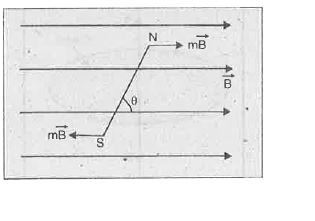 This torque tends to align the magnetic dipole in the direction of `vecB`. If the dipole is rotated against the action of this torque, work has to be done, which is STORED in the form of potential energy of the dipole. Work done in rotating the dipole through an angle `d theta` against the torque is given by `dW=taud theta=MBsinthetad theta` If the magnetic dipole is rotated from `theta_(1)andtheta_(2)`, total work done will be `W=intdW=MBint_(theta_(1))^(theta_(2))sinthetad theta` = `-MB(costheta_(2)-costheta_(1))` This work done is the energy stored U `therefore""U=-MB(costheta_(2)-costheta_(1))` If the dipole is rotated from `theta_(1)=90^(@)" to "theta_(2)=theta` then `U=-MB(costheta-cos90^(@))` `U=-MBcostheta` or `U=-vecM*vecB`. |
|
| 25. |
Distinguish between extrinsic and intrinsic semiconductors . |
Answer» SOLUTION :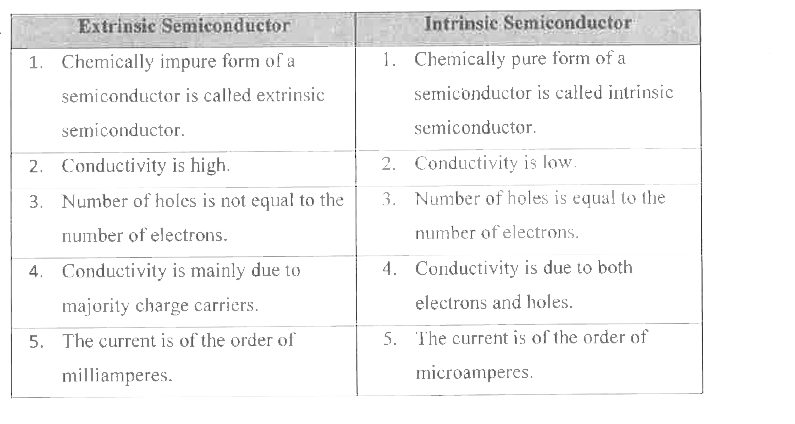
|
|
| 26. |
Identify the correctly matched pair |
|
Answer» a) `{:("Material ","Example"),("DIAMAGNETIC","Gadolinium"):}` |
|
| 28. |
Describe with a neat diagram Quinche's method to demonstrate interference of sound waves and to determine the wavelength and speed of the sound waves. |
Answer» Solution :Quincke's tube consists of two glass U-tubes, A and B as shown in the figure. Tube A has two openings at S and E, and is held fixed. Tube B can be slided in or out of tube A. A source of SOUND, e.g., a vibrating tuning fork, is held at S and the ear is hel against the opening E. 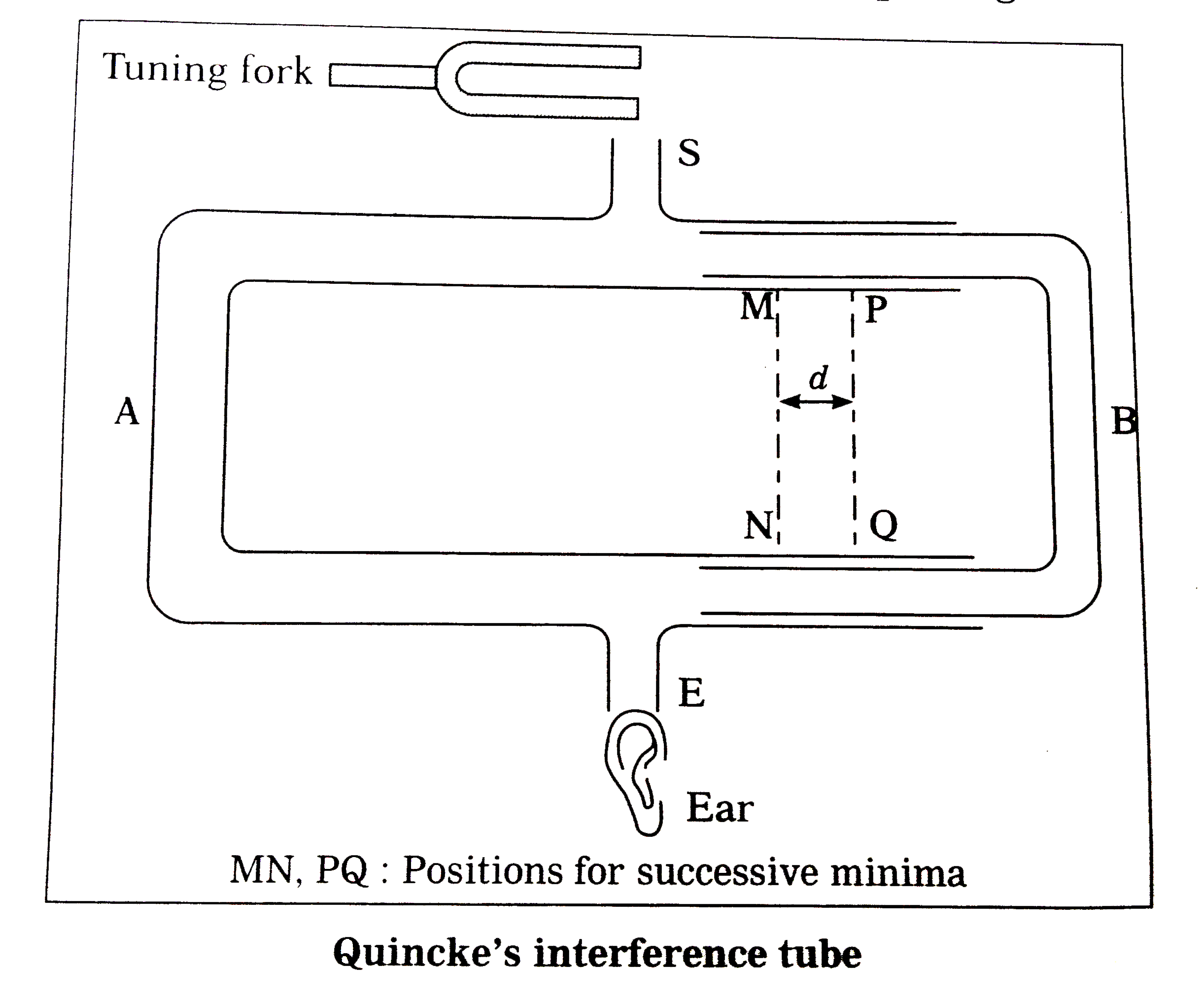 Sound waves from S arrive at E travelling along the paths SAE and SBE. Since these two waves are derived from the same source S, they are coherent. When the two paths are equal or differ by a whole NUMBER of wavelengths, the waves meet at the end E in phase. then the listener HEARS a loud sound corresponding to constructive interference. Drawing out the tube B slowly, the sound dies away and becomes a minimum when the path difference, `SBE-SAE`, is `lambda//2`, where `lambda` is the wavelength of the sound. Then, the waves meeting at E are in opposite phase to each other, cancelling each other out in destructive interference. If the tube B is drawn further out by an equal distance, the path difference will be one wavelength and the loud sound reappears. If the next minimum (say, PQ) is d, then the wavelength `lambda=2d`. the SPEED of sound in air is `v=n lambda`, where n is the frequency of the source S. Thus, the wavelength of the sound can be obtained by measuring d, and the speed of sound can be determined when a source of known frequency is used. |
|
| 29. |
When a galvanometer is shunted with a 4Omega resistance, the deflection is reduced to 1//5. If the galvanometer is further shounted with a 2Omega wire, the new deflection will be (assuming the main current remains the same) |
|
Answer» `5//13` of the DEFLECTION when shunted with `4OMEGA` only `G xx i//5 = 4 xx (4//5) or G = 16 Omega`  ,)
|
|
| 30. |
In the above question what would be the acceleration of each of the following mass ? |
|
Answer» `(4mg)/(M+m)` `a=(4mg)/(M+4m)` |
|
| 31. |
The wavelength of the series limit of the Brackett series in the hydrogen spectrum is [R equiv the Rydberg constant] |
|
Answer» `(9)/(R )` |
|
| 32. |
A thin liquid convex lens is formed in glass. Refractive index of liquid is 4/3 and that of glass is 3/2. If 'f is the focal length of the liquid lens in air, its focal length and nature in the glass is |
|
Answer» F, convex |
|
| 33. |
Most probable value of energy of X-ray photon in the values given is |
| Answer» Answer :A | |
| 34. |
In Young's experiment distance between two consecutive dark fringes is 2 mm, distance between central maximum and third dark fringe will be ...... |
|
Answer» Solution :`x_(n)=(2n-1)(beta)/(2), beta=2m , n=3` `=(5 beta)/(2)=5XX(2)/(2)=5` mm |
|
| 35. |
A positively charged particle moving along x-axis with a certain velocity enters a uniform electric field directed along positive y-axis. Its |
|
Answer» VERTICAL VELOCITY CHANGES but HORIZONTAL velocity remains constant |
|
| 36. |
16 tuning forks are arranged in increasing value of frequencies Each tuning fork gives 6 beat per sec with either neighbour tuning forks if the last frequency in an octave of the first frequency what would be the lowest frequency? |
|
Answer» Solution :FREQUENCIES are arranged In increasing order frequency of PTH TUNING fork `n_p=n_1+(p-1)n=n_1+(16-1)xx6` ` n=15xx6 =90`Hk |
|
| 37. |
The momentum of a photon of energy 1 Mve in kg m/s will be : |
| Answer» Answer :A | |
| 38. |
For a series LCR circuit the power loss at resonance is |
|
Answer» `(V^(2))/([OMEGA L-(1)/(omega C)])` where `X_(L)=omega L` and `X_(C )=(1)/(omega C), omega` is ANGULAR frequency. At resonance, `X_(L)=X_(C )`, hence Z = R : `therefore V_(R )= V` (supply voltage) `therefore` R.M.S. current, `I=(V_(R ))/(R )=(V)/(R )` Power loss `I^(2)R=V^(2)//R`. |
|
| 39. |
In the circuit shown in the fig, the switch ‘S’ is closed at time t = 0. The current in branch AB is represented by z and is taken to be positive when it is from A to B. (a) Write the value of z immediately after the switch is closed. (b) Write the value of z infinite time after the switch is closed. (c) Write z as a function of time (t) and plot the variation of z with time. (d) At what time t_(0) the current z becomes zero ? |
|
Answer» (B) `-(V)/(3R)` (C) `Z=(4V)/(3R)[e^(-(3t)/(RC))-(1)/(4)]` `(##IJA_PHY_V02_C08_E01_104_A01##)` (d) `t_(0) = (2R)/(3) l n2` |
|
| 40. |
A short bar magnet has a length 2l and a magnetic moment 10 Am^(2). Find the magnetic field at a distance of z = 0.1m from its centre on the axial line. Here , l is negligible as comppared to z |
|
Answer» `4 XX 10^(-3) T` |
|
| 41. |
In a single slit experiment why the intensity of secondary maximum become less as compared to the central maximum. |
| Answer» Solution :The CENTRAL maximum is DUE to the constructive INTERFERENCE of wavelengths from all parts of the slit with the increase in the value of n, the WAVELETS from lessser and lesser, parts of the slit produces constructive interference to form secondary maximum . Hence, the intensity of secondary maximum decreases with increase in values in ns. | |
| 42. |
If the mass of the electron (9xx10^(31) kg) is taken as unit of mass, the radius of the first Bohr orbit (0.5xx10^(-10)m) as unit of length and 500 newton as the unit of force, then the unit of time in the new system would be |
|
Answer» `3 xx10^(22)` s |
|
| 43. |
What is reflection of light ? Explain laws of reflection |
Answer» Solution :The phenomenon in which the light incident on OPAQUE and shining surface and returns back from that surface is CALLED reflection of light. In figure, AB is incident ray, B is incidence POINT and BC is reflected ray and `bar(BN)` is normal to the surface. Angle of reflection r or `theta` : The angle between reflected ray and the normal to the reflecting surface. Angle of incidence i or `theta`: The angle between incident ray and the normal to the reflecting surface at the point of incidence lie in the same plane. Laws of reflection : (1) Incidence angle and reflection angle are same. [`therefore` i = r] (2) The incident ray, reflected ray and the normal to the reflecting surface at the point of incidence lie in the same plane shown in the figure abcd. (3) These laws are valid at each point on any reflecting surface whether plane or CURVED. These laws are valid at each point on any reflecting surface whether plane or curved. |
|
| 44. |
Set the drifts suffered by boat in increasing order (a) d=1000 m, V_(R) = 2m//s, V_(b) = 4 m//s ( b) d=500 m, V_(R) =1 m//s, V_(b) = 6 m//s ( c) d=1000 m, V_(R) = 6 m//s, V_(b) = 6 m//s (d to width of river V_(R) to velocity of river V_(b) to velocity of botat). The boat moves perpendicular to width of the river |
|
Answer» a,B,c |
|
| 45. |
Write down the applications of Nano technology? |
| Answer» Solution :• Energy storage • Defense and security • Metallurgy and MATERIALS • Electronics • Optical engineering and COMMUNICATION • BIOMEDICAL and drug delivery • Agriculture and FOOD • Cosmetics and paints • Biotechnology • TEXTILE | |
| 46. |
A rectangular coil of area 2.0 xx 10^(-4) m^2 and 80 turns is pivoted about one of its vertical sides. The coil is in the radial horizontal magnetic field of 9.0 xx 10^(-3) T. What is the torsional constant of the spring connected to the coil if a current of 0.1 mA produces an angular deflection of 10^@ ? |
| Answer» SOLUTION :`1.44 XX 10^(-9)` Nm per DEGREE | |
| 47. |
The objective of a microscope is first illuminated with blue light. Then, it is illuminated by yellow light, without changing the experimental set up. In the second case its resolving power. |
|
Answer» will increase |
|
| 48. |
Two parallel infinite plates are chaged oppositely with densites +sigma _(2) four point 1,2,3,4 are located as difference between2 and 1 is V_(2-V_(1) (a) which of the densites (+sigma _(1) or sigma _(2) is larger in magnitude? (b) what is the potential diffence beween 4 and 3 ? |
|
Answer» |
|
| 49. |
When two tunning forks A and Bare soundedtogether , 4 beats per secondare heard . Thefrequencyof the fork B is 384Hz . Whenone ofthe prongsof the forkA is filled and soundedwith B , the beat frequencyincreases, then the frequencyof the fork A is |
|
Answer» 389Hz HENCE `V_(A)= 388Hz` |
|