Saved Bookmarks
This section includes 7 InterviewSolutions, each offering curated multiple-choice questions to sharpen your Current Affairs knowledge and support exam preparation. Choose a topic below to get started.
| 1. |
The wavelength of green light in air and in glass is 5300overset@A. The refractive index of glass is : |
|
Answer» 1 |
|
| 2. |
The mass of a body is measured as 2.00 xx 10^(3) Kg. Its significant figures is |
|
Answer» 6 |
|
| 3. |
What does swallowing a book mean? |
|
Answer» To READ only some parts |
|
| 4. |
A person with vibrating tuning fork of frequency 338 Hz Is moving towards a vertical wall with a speed of 2 ms^(-1) . Velocity of sound in air is 340 ms^(-1) . The number of beats by that person per second is : |
|
Answer» 2 `v. = ((v+ u_(0))/(v - u_(0))) ` v = `((340 + 2)/(340 -2)) 338 ` = 342 Hz. `THEREFORE` No. of beats heard by the person= v. - v = 342 - 338 = 4 Hz. So CORRECT choice is b. |
|
| 5. |
A metal rectangular parallelipiped ismoved parallel to itselfwith constant acceleration a . Findthe electric field developed insidethe metal and surface density of chargesproduced. |
|
Answer» |
|
| 6. |
It is desired to measure the magnitude of field between the poles of a powerful loud speaker magnet. A small flat search coil of area 2 cm^(2) with 25 closely wound turns, is positioned normal to the field direction, and then quickly snatched out of the field region. Equivalently, one can give it a quick 90^(@) turn to bring its plane parallel to the field direction. The total charge flown in the coil (measured by a ballistic galvanometer connected to coil) is 7.5 mC. The combined resistance of the soil and the galvanometer is 0.50 Omega. Estimate the field streng of magnet. |
|
Answer» Solution :According to laws of ELECTROMAGNETIC induction, we know that `varepsilon=-(dphi_(B))/dt` Hence, induced current, `I=varepsilon/R=-N/R(dphi_(B))/dt` and the total induced charge `Q=int_"inital"^"final"dQ=int_(i)^(f)-N/R(dphi_(B))/dtdt` `=(-N)/Rint_(i)^(f)dphi_(B)=(-N)/R|phi_(B)|_(i)^(f)=-N/R(phi_(f)-phi_(i))` But `phi_(i ) = BA and phi_(f)=0`(because now plane of coil is parallel to the magnetic field) `Q=N/R(BA-0)=(NBA)/R or B = (QR)/(NA)` In present problem `N = 25,A=2cm^(2)=2XX10^(-4)m^(2),Q=7.5mC=7.5xx10^(-3)C and R=0.5Omeha` ` therefore B=(QR)/(NA)=((7.5xx10^(-3))(0.50))/(25xx2xx10^(-4))=0.75T.` |
|
| 7. |
AP-N-P transistor is used in common-emitter mode in an amplifier circuit. A change of 40muA in the base current brings a change of 2mA in collector current and 0.04 V in base-emitter voltage. Find the (i) input resistance (R_(1)) and (ii) the base current amplification factor (beta) . (iii) If a load of 6kOmega is used, then also find the voltage gain of the amplifier |
| Answer» SOLUTION :(i)`1KOMEGA`,(II)50 , (iii)300 | |
| 8. |
The radioacitve decay of an element is shown in the graph. a. What is the sort of functional decay shown here? b. What is the change in activity in equal intervals of time? c. Find the half-life. d. Can you find the decay constant? If so, what is its value ? |
|
Answer» Solution :a. Exponential DECAY b. y DECREASES by the same RATIO C. Approximately 70s. d . Hint : Apply `LAMBDA = (0.931)/(T_(1/2))` |
|
| 9. |
Which of the following is a tributary? |
|
Answer» A STREAM or river that flows into a LARGER river |
|
| 10. |
A regular hexagon of side 10cm has a charge 5muC at each of its vertices. Calculation the potential at the centre of the hexagon. |
|
Answer» Solution :If .q. is the CHARGE, potential at .O. is `9 xx 10^(9) xx q/a`, where .a. is the SIDE of the exagon. TOTAL potential `=(6 xx q xx 9 xx 10^(9))/(a)` `=(9 xx 10^(9) xx 6 xx 5 xx 10^(-6))/(10 xx 10^(-2))=2.7 xx 10^(6)V or 2.7MV` 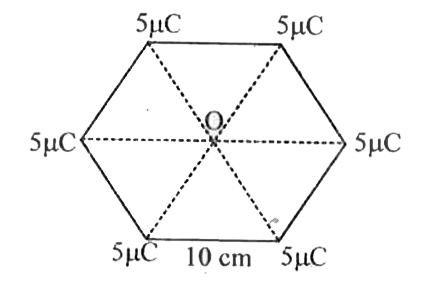
|
|
| 11. |
The image of an object formed by a lens on the screen is not in sharp focus. Suggest a method to get a clear focussing of the image on the screen without disturbing the positions of the object, the lens or the screen. |
| Answer» Solution :For GETTING a SHARP IMAGE, we have to use light ofsuitable WAVELENGTH. This is because focal length: of a lens depends upon wavelength. | |
| 12. |
Potential Inside Conductor is Always |
|
Answer» Zero |
|
| 13. |
In an intrinsic se:miconductor the forbidden energy band is of the order of |
|
Answer» 1 eV |
|
| 14. |
A ray incident at 15^(@) on one refracting surface of a prim of angle 60^(@),suffers a deviation of 55^(@). What is the angle of emergance? |
|
Answer» `95^(@)` `60^(@) + 55^(@) = 15^(@) + e` `e = 115 - 15 = 100^(@)` |
|
| 15. |
Five persons A, B, C, D & E are pulling a cart of mass 100kg on a smooth surface and cart is moving with acceleration 3m//s^2 in east direction. When person A' stops pulling, it moves with acceleration 1m//s^2in the west direction. When person 'B' stops pulling, it moves with accele-ration 24m//s^2 in the north direction. The magnitude of acceleration of the cart when only A & B pull the cart keeping their directions same as the old direction is |
|
Answer» `26 m//s^(2)` |
|
| 16. |
A sound wave propagates in a medium of Bulk modulus B by means of compressions and rare fractions. If P_c and P_r are the pressures at compression and rarefaction respectively, 'a' be the wave amplitude and k be the angular wave number then |
|
Answer» `P_c` is maximum and `P_r`is minimum. |
|
| 17. |
A tube of length h (which is wide enough so that surface tension effects can be neglected) filled with air at atmosphere pressure and closed at one end. Now tube is lowered in a tank of mercury to a depth h as shown. It is seen that mercury rises a distance x into the tube. If the mercury barometer also reads h, then |
|
Answer» <P>`h(h-x)=h^(2)` At BOTTOM most POINT, `P_(0)+deltagh=P'+deltagximplies2deltagh=(deltagh^(2))/(h-x)+deltagximplies(2h-x)(h-x)=h^(2)` |
|
| 19. |
What is value of absolute RI ? |
| Answer» SOLUTION :N=`(C_0)`/`(C_v)` = VELOCITY of loght in vaccum/Velocity LIGHT in the MEDIUM | |
| 20. |
Considering the circuit and data given in the diagram calculate the currents flowing in the diodes D_(1) and D_(2) with linear characteristics.Forward resistance of D_(1) and D_(2) is 20 Omega |
Answer» Solution :Since the positive of bettery is connected to P-type both DIODES `D_(1)` and `D_(2)` are forward biased .Hence they may be replaced by short (closed ) switch associated with their forward RESISTANCE as shown in Fig.  The resistance of `20Omega` and `20Omega` in parallel `(1)/(R)=(1)/(20)+(1)/(20)=(2)/(20)` (or) `R=(20)/(2)=10 Omega` Therefore ,total CURRENT 1 in the circuit `I=(1)/(100+10)=(1)/(110)` amp and `I_(1)=I_(2)=(1)/(2)xx(1)/(110)=(1)/(220)amp` |
|
| 21. |
A driver under water, looks obliquely at a fisherman standing on the bank of a lake. Would the fisherman look taller of shorter than what he actually is? |
| Answer» Solution :The displacement of the IMAGE of the HEAD of the fisherman will be GREATER than that of foot. So the fisherman will LOOK taller than what he actually is. | |
| 22. |
Explain power produced in electrical circuit. |
|
Answer» Solution :`rArr` In electrical cell, as long as chemical reaction takes PLACE it provide electrical power. `rArr` A simple schematic diagram for electric cell (electrochemical cell ) is shown in figure below.  `rArr` Two rod are kept in electrolyte. One rod act as positive electrode and second rod act as negative electrode. `rArr` When external resistor R is connected between positive and negative electrode power dissipated in R DEPEND on current (I) and potential difference (V), [ P = `I^(2) R ` and P = VI] `therefore Delta K = H` `therefore Delta W= IV Delta ` t`"" ` (from equation (2) ) from work energy theorem , `Delta K = Delta W = I Delta ` V ` therefore (Delta W)/(Delta t) = ` VI `(Delta W)/(Delta t) = `P = Power `therefore ` P = VI `rArr` Power: Energy dissipated PER unit time is callee power. From Ohm.s LAW, V = IR P = (IR) R = `I^(2) ` R P = V `((V)/(R)) = (V^(2))/(R) ` THUS, there are three equation of power p = VI, P = `I^(2) ` R and P= `(V^(2))/(R)` `rArr` J/s or watt is unit of power . `rArr` Ohmic loss : In a conductor energy gained by charges or energy Jost in form of heat energy is called Ohmic loss or energy loss. `rArr`In above equation power dissipated in resistor (R) depend on current passing through conductor and potential difference V between conductor. `rArr` Power transmitted at very large distance is at very high voltage then current flowing in them is also of very large value. Hence, high voltage danger sign is provided because electricity at such high voltage is not safe. |
|
| 23. |
A pitcher contains 10 kg of water at 20^(@)C. Water comes to its outer surface through its porus walls and gets eveaporated. The latent heat required for evaporation is taken from the water inside the pithcer, thus the inside water is cooled down. It is given that the rate of evaporation is 0.2 g/s. Calculate the time in which the temperature of the water inside drops is 15^(@)C. Given that the specific heat of water is 4200J//kg^(@)C andlatent heat of vaporization of water is 2.27xx10^(6) J/kg. |
|
Answer» |
|
| 24. |
An object is placed in front of a convex mirror of a convex mirror of focal length 60 cm.If the image formed is half of its size, the postion of the image is : |
| Answer» ANSWER :A | |
| 25. |
The maximum value of an A.C. voltage coming in our houses is ………. % more than that of its r.m.s. value. |
|
Answer» 1.414 `=sqrt2-1=1.414-1.00` =0.414 `THEREFORE` Percentage INCREASES `(DeltaV)/V_"rms" XX 100 =0.414xx100%` =41.4% |
|
| 26. |
The V-I characteristic of a silicon diode is as show in the followingcalulate the resistance of the diode at (i) I_(D)=15 mA and (ii) V_(D)=10 V |
|
Answer» SOLUTION :Thediode d characteristicscan beconsideredas astraightlinebetween`I=10` mAand I= 20mA. SoOhm.slawcan beused tocalculatethe resistance (fromgraph)and at`I=10 mAV=0.7 V` `:. ` Resistance`R_(fb) = (Delta V)/( Delta I)` `=(0.8 - 0.7)/( (20 - 10)m= (0.1 V)/(10 mA)` `=(0.1v)/( 10^(-2) A) =10 SIGMA ` (ii) At`V= -10 V,I = -1muA` `R_(fb)= (V)/(I)= = (-10V)/( -1 muA)= (10V)/(10^(-6) A) =10^(7) Sigma` 
|
|
| 27. |
What is the approximate energy released by the complete annihilation of an alpha particle? |
| Answer» Answer :D | |
| 28. |
At what temperature will the r.m.s. velocity of gas be three times its value at N.T.P. |
|
Answer» `9xx273^@K` |
|
| 29. |
A boy with a radio, playing a music at a frequency 'f' is moving towards a wall with velocity v_(b). A motrist is following the boy with a speed v_(m) Find the expression for the beat frequency heard by the motorist., if the speed of sound is v |
|
Answer» `((V+v_(m))/(v+v_(B)))f` For REFLECTED sound waves `f'=(v/(v+v_(b)))xxf` 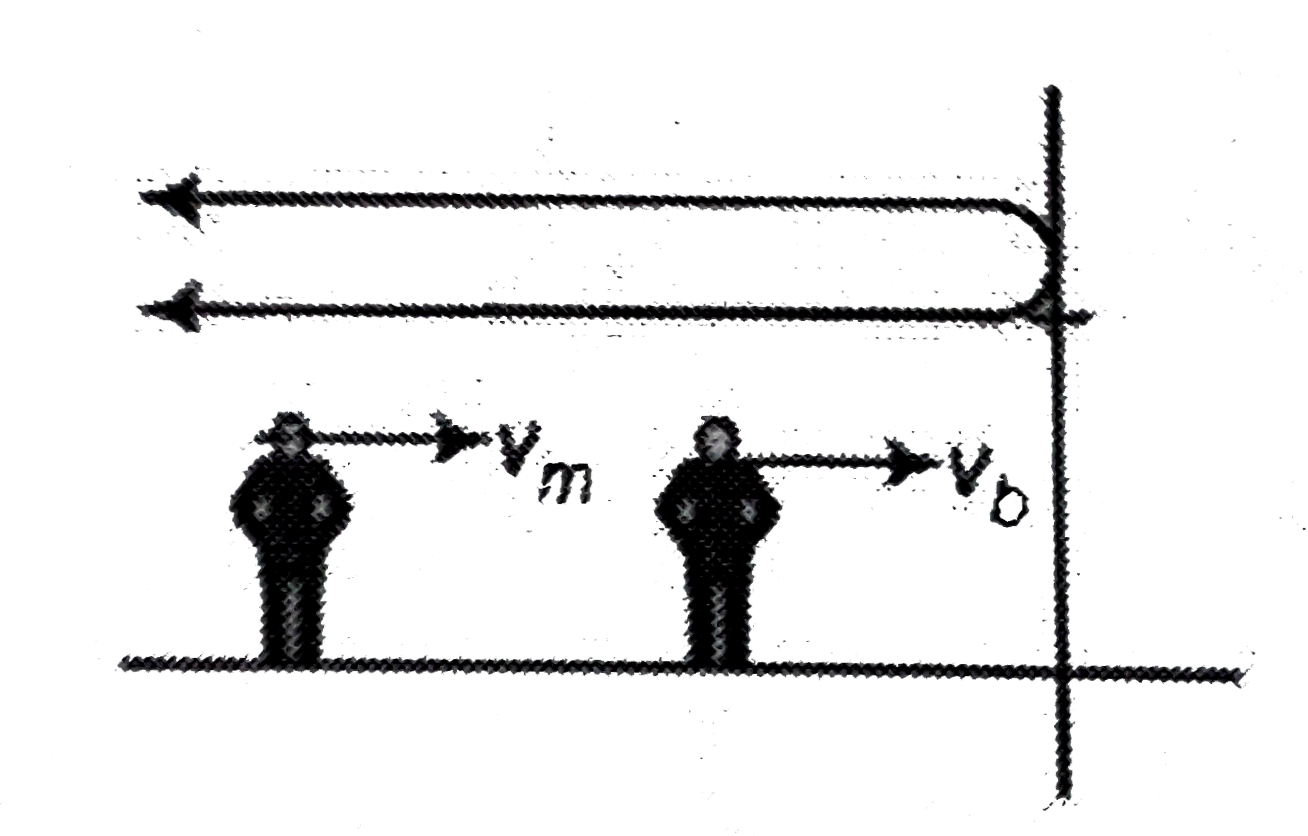 `rArr""` Sound reflected from WALL `f'=((v+v_(m))/(v))xxf'=((v+v_(m))/(v+v_(b)))f` Beat frequency f" - f' `=((v+v_(m))/(v))xxf'=((v+v_(m))/(v+v_(b)))f` `=((v+v_(m))/(v-v_(b)))f'-((v+v_(m))/(v+v_(b)))f=(2v_(b)(v+v_(m)))/((v^(2)-v_(b)^(2)))f` |
|
| 30. |
A wire of mass m and length l is placed on a smooth incline making an angle theta with the horizontal, whose fornt view is shown in Fig. When a finite amount of charge is passed through it in an infinitesimal time, the wire immediately acquires some velocity and then ascends the incline by a distance s. For this small duration, we can neglect the gravitational force because the current can be considered very large due to small time duration. The amount of charge passed through the wire is |
|
Answer» `(msqrt(2gssin theta))/(Bl)` `F_m=IBl=(dq)/(dt)xxBl=ma` [For this small duration dt, we can neglect gravitational force because I would be very LARGE due to small passage time of charge.] `implies m(dv)/(dt)=(dq)/(dt)xxBl implies mdv=dqxxBl` `implies mv=qxxBl` `implies v=(qxxBl)/m implies q=(mv)/(Bl)` where q is the charge passed through the wire and v is the velocity aquired by the wire just after charge had been passed through it. From kinamatics, `v^2=2g SIN theta s` `q=(msqrt(2gssin theta))/(Bl)` 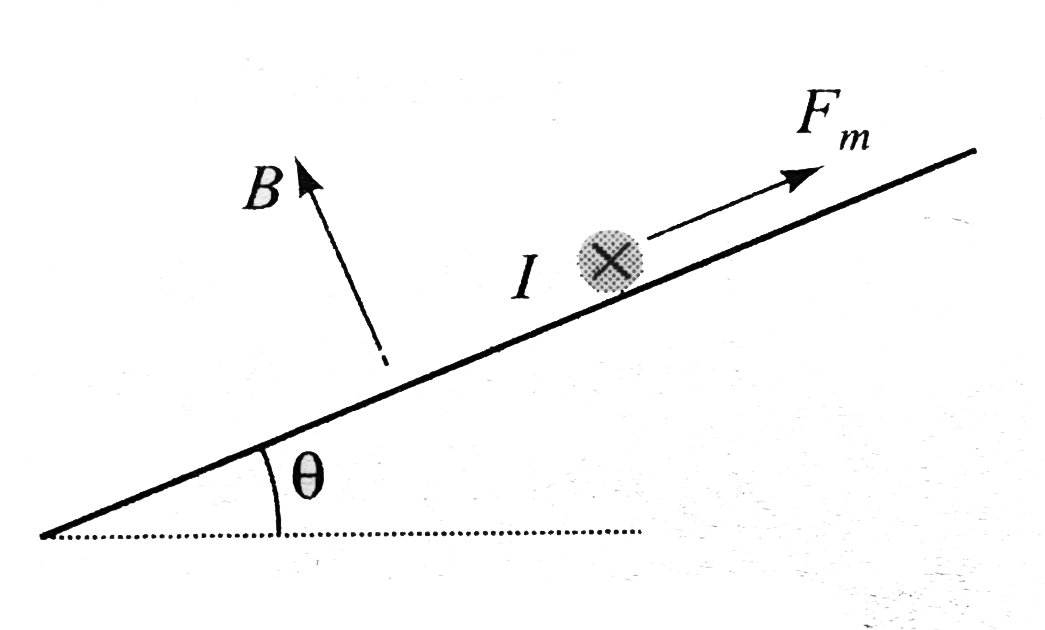
|
|
| 31. |
In the question number 3, the net power consumed over a full cycle is |
|
Answer» 586 W `therefore = P = V_("rms")I_("rms")cos phi=220xx2.2xx1=484 W` |
|
| 32. |
The following values can be rounded off to four significant figures as follows : |
|
Answer» Solution :(a) `36.879~~36.88` ( `:'9 gt 5 :. 7` isincreased by one i.E.I Rule) (B) `1.0084~~1.008` ( `:' 4 LT 5 :.8`LEFT unchanged i.e. II Rule) (c) `11.115 ~~ 11.12` ( `:'` last 1 is ODD it is increased by one i.e.III Rule) (d) `11.1250~~11.12` ( `:'` 2 is even it is left unchanged i.e. III Rule) (e) `11.1251~~11.13` ( `:' 51 gt 50 :.2` is incresed by one i.e. I Rule) |
|
| 33. |
A chain of length L and mass per unit length rho is piled on a horizontal surface. One end of the chain is lifted vertically with constant velocity by a force P. |
|
Answer» P as function of height X of the end above the surface will be `rho(gx+v^(2))` `(dv)/(dt)=0`(v is contant) `P=rhoxg+rhov^(2)` `w_(P)+w_(G)=DeltaKE` `w_(P)=+underset0oversetLint rhoxgdx+underset0oversetLint(rhodx)v^(2)` `w_(P)=(rhoL^(2)g)/2+rhoLv^(2)` |
|
| 34. |
For a prism, angle of prism is 60^@ and it.s refractive index is 1.5, find (1) angle of incidence corresponding to the angle of minimum deviation and (2) angle of emergence for angle of maximum deviation. |
|
Answer» Solution :For MINIMUM deviation, `r_1 = r_2 and A = r_1 + r_2` `thereforeA = 2r_1` `r_1 = A/2 = 60 /2 = 30^@` Now, n = 1.5 and `n = (sin i)/(sin r_1)` `therefore n sin r_1 = sin i` `therefore 1. 5 xx sin 30^@ = sin i` `therefore 1.5 xx 0.5 = sin i ` `therefore i = 48^@ 35` (2) For maximum deviation , `i = 90^@` ` therefore1.5 = (sin 90^@)/(sin r_1) thereforer_1 = 41^@ 48.` `therefore r_2 = A - r_1 = 60 - 41^@ 48. = 18^@ 12.` `( because r_1 + r_2 =A)` `therefore1.5 sin r_2 sin e (because n sin r_2 = sin e)` `thereforesin e = 0.4685` `thereforee = 27.9^@` |
|
| 35. |
If there is no torsion in the suspension thread, then the time period of a magnet executing SHM is |
|
Answer» `T=(1)/(2PI)SQRT(I)/(MB)` |
|
| 36. |
Mosley's law for characteristic X-rays 1/lambda=R (z-b)^(2) (1/n_(1)^(2)-1/n_(2)^(2)) is Which of the following statements is/are correct? |
|
Answer» It is applicable to all those atoms to which Bohr's theory is not applicable. For higher values of `n_(1) and n_(2)` difference in their energy levels is small. Therefore, emitted photons will not corresponds to X-rays. Therefore, Moseley.s law cannot be applied to such transitions, also SINCE characteristic X-rays are emitted for CERTAIN transititions in atom having large Z, it become applicable to such transitions. |
|
| 37. |
Determine the current in each brance of the network showin in |
|
Answer» Solution :Each branch of the network is assigned an unknow CURRENT to be determined by the application of Kirchhoff s rules. To reduce the number of unknowns at the unknow current in each branch. We then have three unknowns `I_(1) , I _(2) and I _(3)` which can be fond by alllying the second rule of Kirchhoff to three different CLOSED loops. Kirchhoff.ssecond rule for the closed lop ADCA GIVES. `10- 4 (I _(1) - I _(2)) + 2 (I _(2) + I_(3) -I _(1) - I _(1) =0` that is, `7I _(1) - 6I_(2) - 2I_(3) =10` For the closed loop ABCA. we get `10-4I_(2) -2 (I _(2) + I_(3)-I_(1) =0` that is `2I_(1) -4I_(2) -4I_(3) =-5` Equations (`3.80a,b,c)` are three simultaneous equations in three unknowns. These can be solved by the usual method to give ` I _(1) =2.5A. I _(2) = (5)/(8) A, I _(3) =1 (7)/(8) A` The currents in the various branches of the network are `AB: 5/8 A, CA: 2 (1)/(2) A, DEB: 1(7)/(8) A` `AD : 1 (7)/(8) A, CD :0A, BC: 2 (1)/(2) A` It is easily verified that Kirchhoff.s second rule applied to the REMAINING closed lops does not provide any additional independent equation, that is, the above values of currents satisfy the second rule for every closed loop of the network. For example, the total voltage drop over the closed loop BADEB `5 V + ((5)/(8) xx 4) V - ((15)/(8) xx 4) V` equal to zero, as required by Kirchhoff s second rule. |
|
| 38. |
In nuclear reaction ,""_(2)He^(4)+X^(A) rarr ""_(z+2)Y^(A+3)+R,Rdenotes |
|
Answer» ELECTRON |
|
| 39. |
A boat moves relative to water with a velocity which is n times less than the river flow velocity. At angle of the stream direction must the boat move to minimise drifting? |
Answer» SOLUTION :in thisproblem. Onethingshouldbe carefullynotedofboatis lessthanthe riverflowvelocity. Insucha CASE, boatcannotreachthe pointdirectlyoppositeto itsstartingpointi.e.,driftcanneverbezero , thustominimizethedriftboatstartat anangle` theta ` fromnormaldirectionupsterm asshown 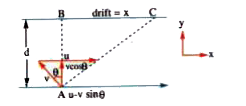 Nowagainif wefindthe COMPONENTSOF velocityof boatand perpendiculartotheflowthesearevelocityalongtheriver` V_t= u - V sintheta` andvelocityperpendicularto theriver`,V_y= v costheta ` timetakento crosstheriveris`t= ( d )/( v_y)= (d )/( cos theta)` In thistimedrift` X=(v_A) t= ( u-v sintheta) (d)/(v_y) =(d)/(v costheta)` in thistimedrift`x =( v_x)t=( u- V sintheta ) (d)/( vcos theta) (or) x= (ud )/( v )sec theta-dtantheta ` the driftx isminimumwhen `( dx )/(d theta ) =0(or)( (ud)/(v)) ( sectheta, tantheta)- dsec^2theta =0` ` (or)(a)/(v )sin theta=1(or) sin theta= ( v )/( u )= (1 )/(n)( asv=(u )/(n))` sofor minimumdriftthe boatmustmoveat an angle` theta= sin ^(-1)((v)/( u ))`fromnormaldireactionor anangle`(pi)/(2)+ sin ^(-1) ((v)/(u ))`fromsteamdirection. |
|
| 40. |
A bar magnet 8 cm long is placed in the magnetic meridian with the N pole pointing toward geographical north.Two neutral points separated by a distance of 6 cm are obtained on the equatorial axis of the magnet.If horizontal component of earth's field is 3.2xx10^(-5) T,then pole strength of magnet is |
|
Answer» 5 ab amp cm `r=3cm,B_(H)=3.2xx10^(-5)T,m=?` In case of N to N position neutral point is obtained at equator of dipole.At neutral point `B_(H)=B_(eq)` `B_(H)=(mu_(0))/(4pi)(M)/((r^(2)+l^(2))^(3//2))` `B_(H)=(M)/((r^(2)+l^(2))^(3//2)`(in C.G.S. SYSTEM) `therefore m.2l=(B_(H)(r^(2)+l^(2))^(3//2))/(2l)=(3.2xx10^(-5)xx10^(4)(9+16)^(3//2))/(8)` `m=(3.2xx10^(-1)xx(5^(2))^(3//2))/(8)=5ab A cm` |
|
| 41. |
A glass slab of thickness 4cm contains the same number of waves as 5 cm of water when both are traversed by the same monochromaticlight. If the refractive index of water is 4/3, then hat of glass is |
|
Answer» `5/3` |
|
| 42. |
SI unit of electrical conductivity is |
|
Answer» `OMEGA m ` Accroding to definition `sigma = (1)/(RHO)` `therefore ` SI unit of `sigma = (1)/(Omega m) = (ʊ )/(m) = ʊ m^(-1) (because (1)/(Omega) = ʊ )` |
|
| 43. |
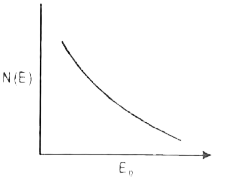
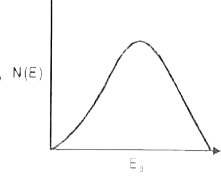
The energy spectrum of beta-particle {no. N (E)] as a function of beta -energy [E_(0)] from radioactive source is : |
|
Answer»
|
|
| 44. |
There is an isolated planet having mass 2M and radius 2R, where M and R are the mass and radius of the earth. A simple pendulum having mass m and length 2R is made to small oscillations on the planet. Find the time period of SHM of pendulum in second. (Take pi = 3.00, g = 10 m//s^(2), sqrt2= 1.41) |
|
Answer» |
|
| 45. |
A 100 g wire is held under a tension of 220 N with one end at x=0 and the other x=10.0m. At time t=0 pulse 2 is sent along the wire from the end at x=0. What position x do the pulses begin to meet? |
|
Answer» |
|
| 46. |
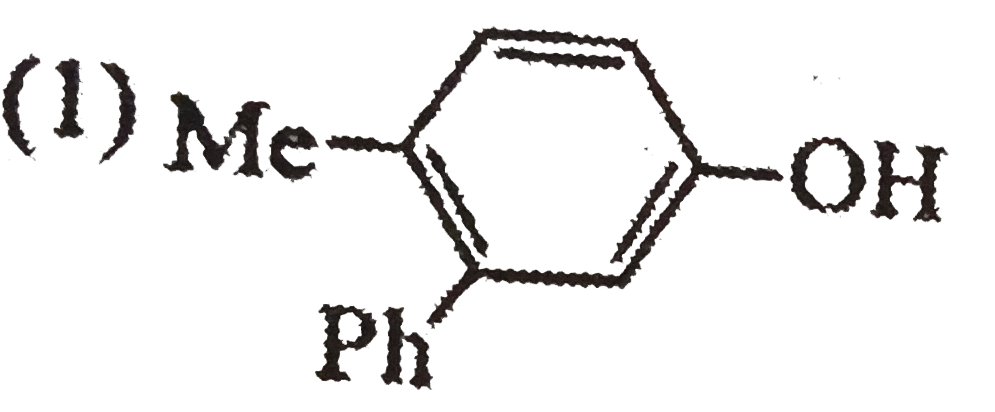
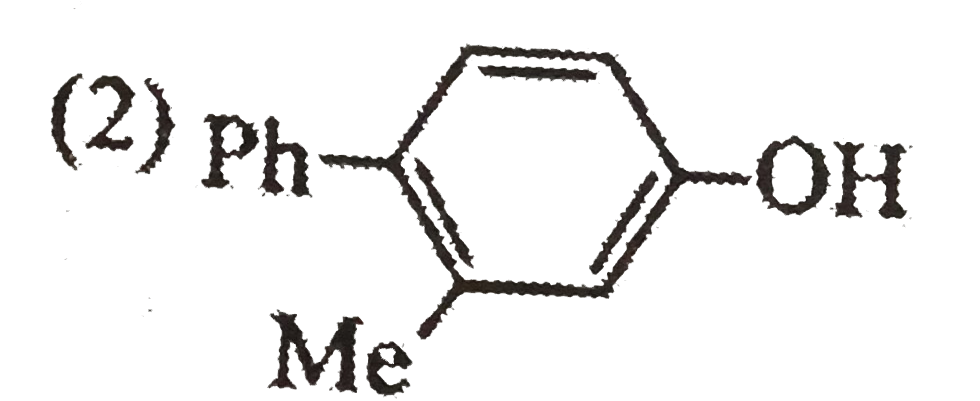
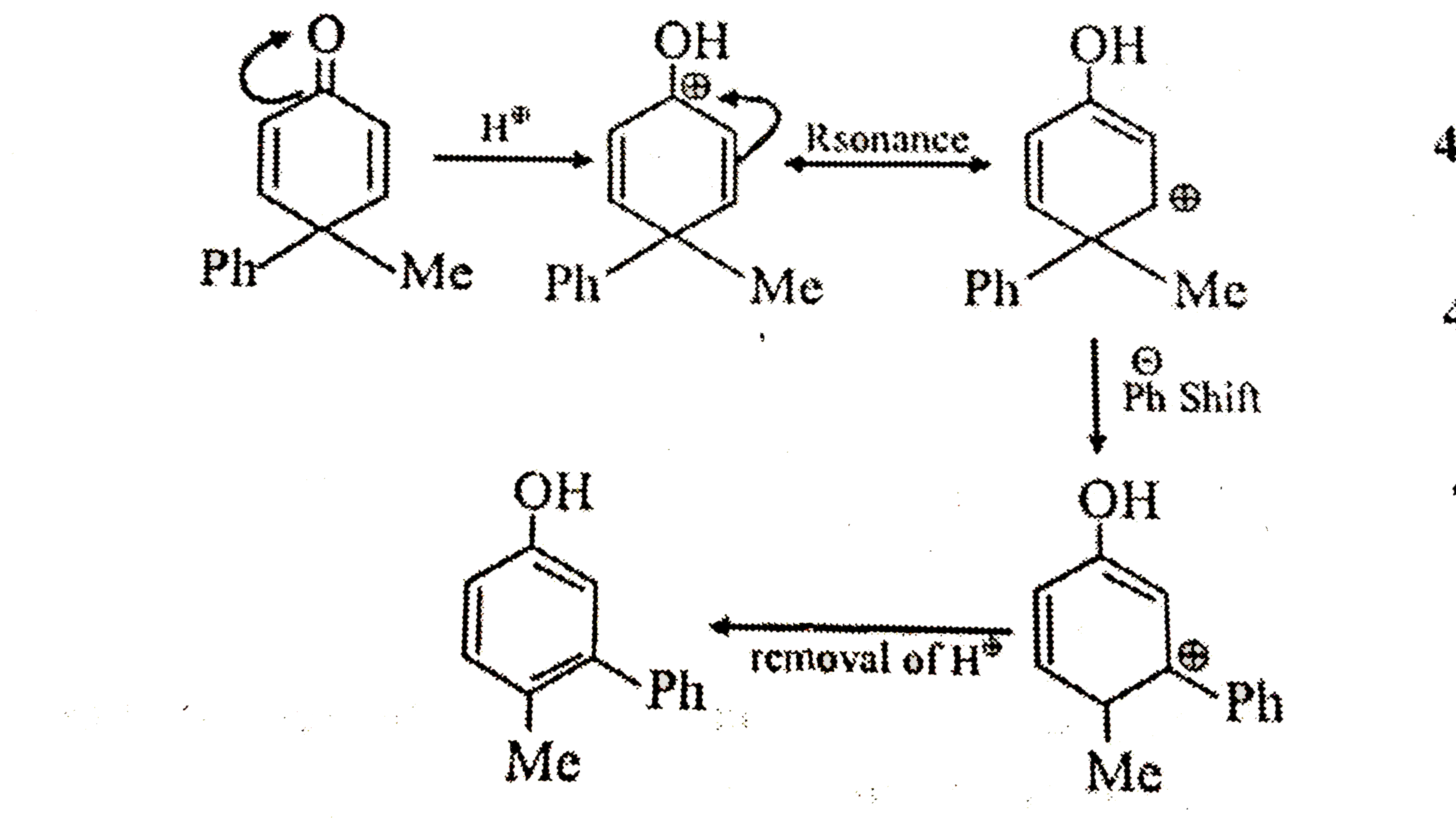
Identify the majorproduct in thefollowingreaction. |
|
Answer»
|
|
| 47. |
The earth's core is known to contain iron . Yet geologists do not regard this as source of earth's magnetism . Why ? |
| Answer» SOLUTION :Iron present in earths' core is in MOLTEN state . The temperature of this molten iron is MUCH higher than the curie POINT . So this iron cannot have any ferromagnetism . | |
| 48. |
the displacement y of a particle in a medium can be expressed as y = 10^(-6) sin (100 t + 20 x + (pi)/(4) )m where t is in seconds and x in metre The speed of wave is : |
|
Answer» 2000 m/s comparing it with standard form y = r sin `(omega t + kx + phi ) ` `omega = 100 s^(-1) and k = 20 ` `therefore v = (omega)/(k) = 5 ms^(-1)` correct CHOICE is (d). |
|
| 49. |
Which of the following statements is untrue about the Third Estate: |
|
Answer» The THIRD ESTATE was made of the poor only |
|