Saved Bookmarks
This section includes 7 InterviewSolutions, each offering curated multiple-choice questions to sharpen your Current Affairs knowledge and support exam preparation. Choose a topic below to get started.
| 1. |
Light rays emerge from denser medium (n_2), refract from curved surface and then travel through rarer medium (n_1), formula for this is …......... |
|
Answer» `-(n_2)/(U)+(n_1)/(V)=(n_1-n_2)/(R)` |
|
| 2. |
(A):Displacement can decrease with time,but distance can never decrease with time. (R ):Distance can be many valued function ,but displacement can be single valued function. |
|
Answer» |
|
| 3. |
A ray of light is incident on the surface of glass plate at an angle of inceidence equal to Brewsters angle phi.If n represents the refractive index of glass with respect to air, then the angle between the reflected and the refracted rays is : |
|
Answer» `90+ PHI` |
|
| 4. |
In case of head on collision, when the impact parameter is minimum theta=…………. Rad |
| Answer» Solution :KNOWLEDGE based question | |
| 5. |
The splitting of while light into seven colors on passing through the prism is: |
|
Answer» reflection |
|
| 6. |
What is the magnifying power of a telescope whose objective and eyepiece have focal lengths 180 cm and 3 cm, respectively ? |
| Answer» SOLUTION :`|m| = |f_(0)/f_(E)| = 180/3 = 60` | |
| 7. |
The de-Broglie wavelength of a tennis ball of mass 60g moving with a velocity of 10 ms^(-1) is approximately (planck's constant, h = 6.63 xx 10^(-34) Js) |
|
Answer» `10^(-33)` m |
|
| 8. |
As the temperature of a metallic resistor is increased, the product of its resistivity and conductivity ___________. |
|
Answer» INCREASE |
|
| 9. |
The electric field in a region of space varies as E=(xhati+2yhatj)+3zhatk) V/m (a). Consider an elemental cuboid whose one vertex is at (x,y,z) and the three sides are dx, dy and dz, sides being parallel to the three co-ordinate axes. Calculate the flux of electric field through the cube. (b). Usig the expression obtained in (a) find the charge enclosed by a spherical surface of radius r, centred at the origin. |
|
Answer» (B). `8epsilon_(0)PIR^(3)` |
|
| 10. |
A spring is kept compressed by trying its ends together tightly. It is then placed in acid and dissolved. What happened to it's stored potential energy ? |
| Answer» Solution :The MOLECULES of acid acquire the KINETIC energy equal to the LOSS of POTENTIAL energy. | |
| 11. |
Electron beam enter an electric field normal to the field. Then their path in the electric field is . |
| Answer» Answer :A | |
| 12. |
Figure 5-50 shows Atwood's machine, in which two containers are connected by a cord (of negligible mass) passing over a frictionless pulley (also of negligible mass). At time t = 0, container 1 has mass 1.30 kg and container 2 has mass 2.80 kg, but container 1 is losing mass (through a leak) at the constant rate of 0.200 kg/s. At what rate is the acceleration magnitude of the containers changing at (a) t = 0 and (b) t = 3.00 s? (c) When does the acceleration reach its maximum value ? |
| Answer» SOLUTION :(a) `0.653" m"//"s"^(3)`, (B) `0.896" m"//"s"^(3),` ( C ) 6.50 s | |
| 13. |
According to Newton's law of cooling, the rate of cooling of a body is proportional to (Deltatheta)^(n), where Deltatheta is the difference of the temperature of the body and the surroundings, and n is equal to : |
|
Answer» 1 RATE of cooling `prop(T-T_(0))^(1)` `:.n=1` CORRECT choice is (a). |
|
| 14. |
S.H.M. wave is represented by y = 0.5 sin (x + 628t) in C.G.S. system then frequency of wave velocity will be |
|
Answer» 50 HZ |
|
| 15. |
Derive equa1ion of mobility in terms of relaxation time (tau). Wrile its unit. |
|
Answer» Solution :`rArr` Drift velocity of electron in PRESENCE of external electric field, `|v_(d) | = (EE)/(m) .tau` (Velocity = acceleration `xx ` time ) `tau ` = time INTERVAL between two successive collision `(|v_(d)|)/(E) = (e tau)/(m)` `therefore MU = (e tau )/(m)` SI unit `(ms^(-1))/(VM^(-1)) = m^(2) V^(-1) S^(-1)` |
|
| 16. |
A long conducting wire of radius 5 cm, carrying current of 2 A is placed with its axis coinciding with Y-axis and lies on XZ-plane. Calculate the magnetic field induction at point A (3 cm, 3 cm, 3 cm) and (8 cm, 8 cm, 8 cm) if relative magnetic permeability of conductor is 300. |
|
Answer» |
|
| 17. |
Outline the path-breaking experiments of Faraday and Henry and highlight the contributions of these experiments to our understanding of electromagnetism. |
|
Answer» Solution :Faraday's and Henry's experiments: Experiment 1 : A magnet induces due to relative motion due to relative motion (i) The apparatus consists of a coil with a galvanometer G and a bar magnet. (ii) When the bar magnet (NS) was at rest, the galvanometer shows no deflection. (iii) When North pole of the bar magnet MOVED towards the coil, galvanometer shows the deflection in one DIRECTION indicating the flow of current in the coil. (iv) When North pole of the bar magnet moved away from the coil, galvanometer again showed the deflection but now in the opposite direction. (v) The deflection of the galvanometer was large when the bar magnet was moved faster towards (or) away from the coil. (vi) When south pole of the magnet was brought near the coil (or) moved away from the coil the deflections in the galvanometer are opposite to that observed with the north pole for similar movements. Conclusion : (i)Whenever there is a relative motion between a coil and a magnet, induced current flows through the coil. (ii) Large induced e.m.f. (or) current is produced in the coil if the relative motion between magnet and the coil is large. Experiment 2: Current induces current due to relative motion of coils : (i) The bar magnet is replaced by a secondary coil `C_2` connected to a bàttery as shown in figure. (ii) The steady current in the coil `C_2` produces a steady magnetic field. (iii) As coil `C_2` is moved towards the coil `C_1` the galvanometer shows a deflection. This indicates current is induced in the coil `C_(1)`. (iv) When coil `C_2` is moved away, the galvanometer shows a deflection again, but opposite direction. (v) The deflection lasts as long as coil `C_(2)` is in motion. vi) When the coil `C_2` is held fixed and `C_1` is moved, the same effects are observed. Conclusion : Induced e.m.f (or) current is produced, when there is a relative motion between the coils. Experiment 3 : Changing current, induces current without relative motion : (i) Faraday showed that this relative motion is not an absolute requirement. (ii) Figure shows two coils `C_1 and C_2` held stationary. (iii) Coil `C_1` is connected to a battery through a TAP key K and coil `C_2` is connected to a galvanometer (G). It is observed that the galvanometer shows a momentary deflection when the tap key K is pressed. 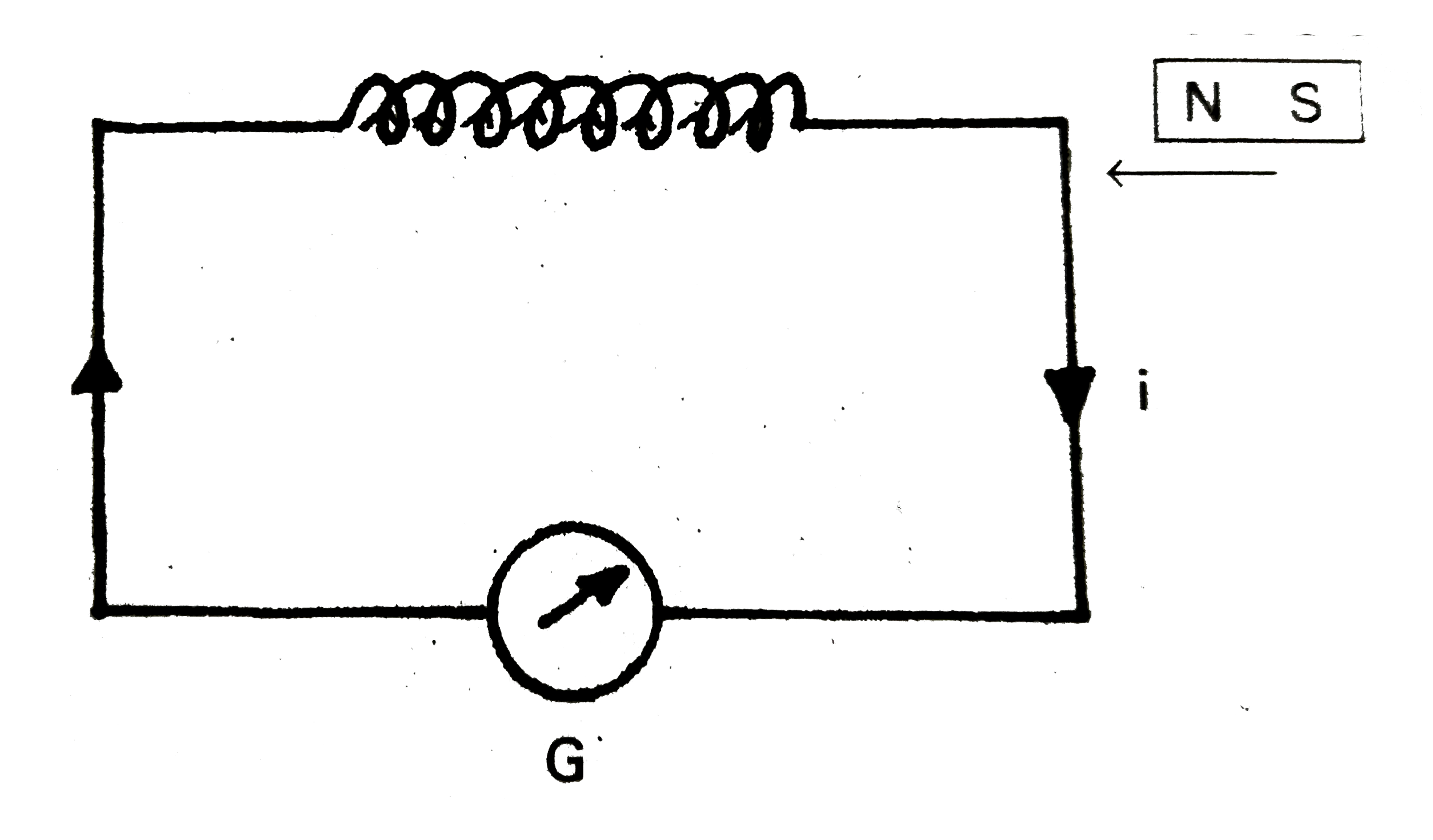 (v) The pointer in the gahanonter returns to ZERO immediately v the key is held pressed continoulsy, deftection in the galvanometer. (vii) When the key is released, the galvanmeter showe deflection again but in the opposite direction ltbfrgt (viii) Deflection of the galvanometer incresses IOT when wooden bar is replaced by iron bar. 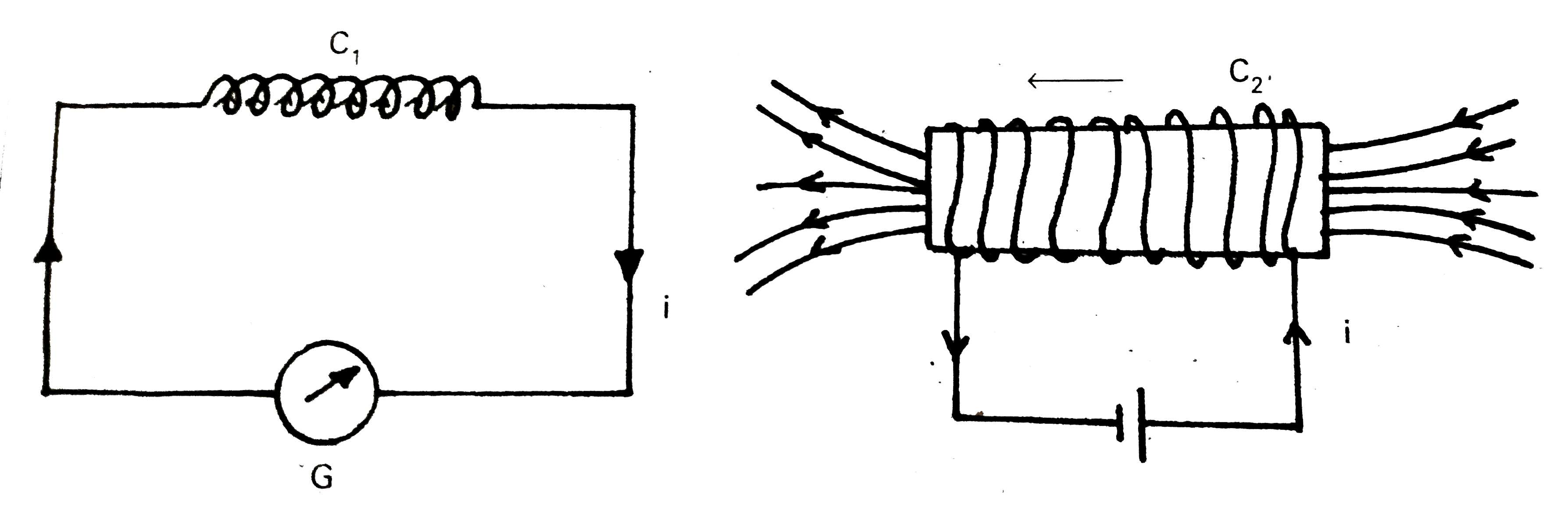 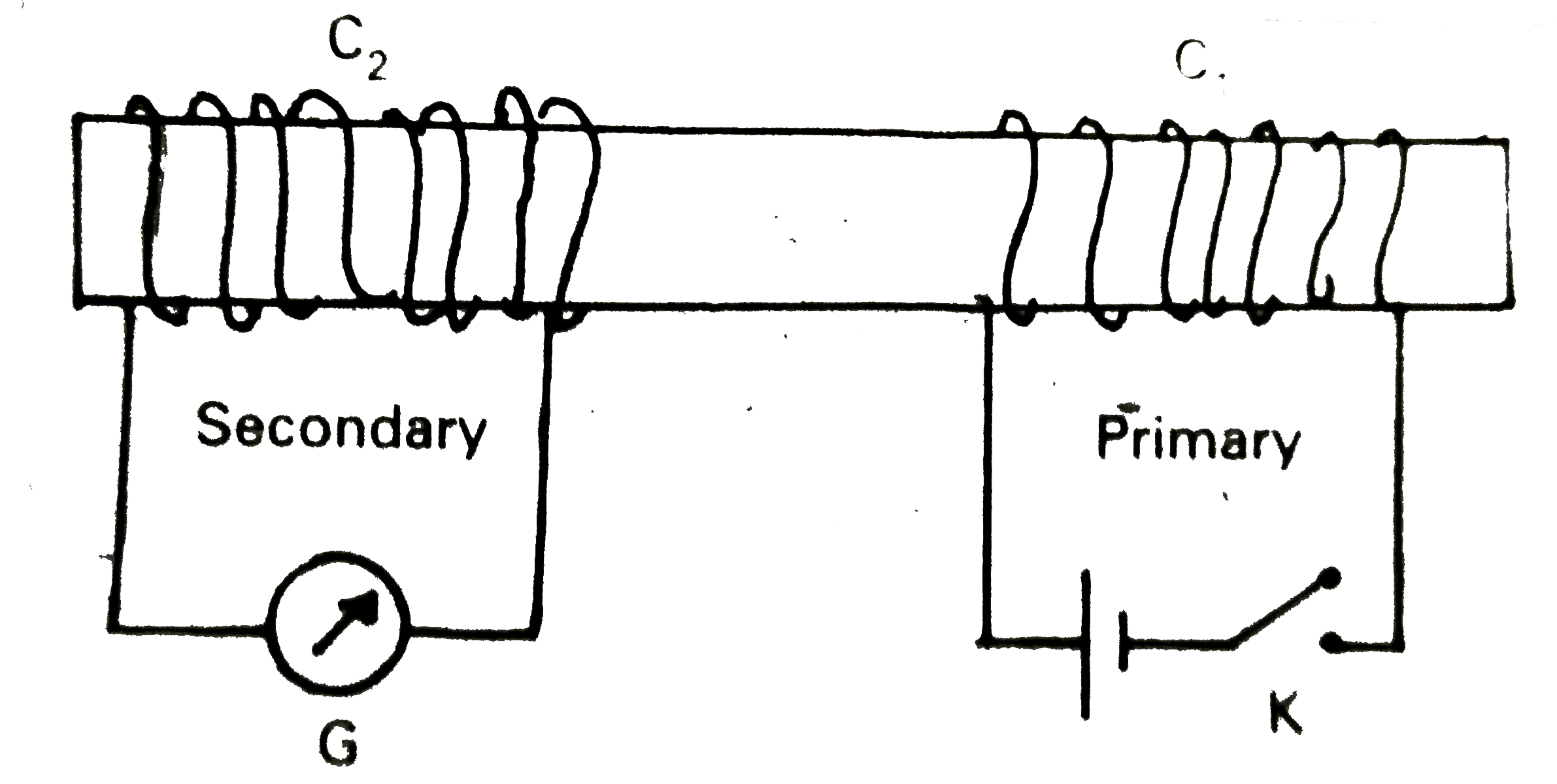
|
|
| 18. |
Why do we observe a spectrum in the medium deviation ? |
| Answer» SOLUTION :This is because SMOKE particles SCATTER blue LIGHT preferentially. | |
| 19. |
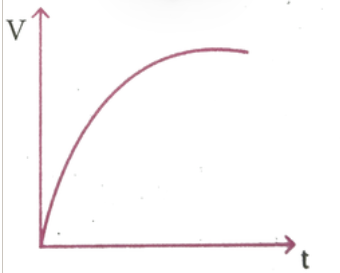
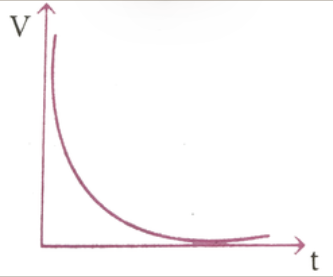
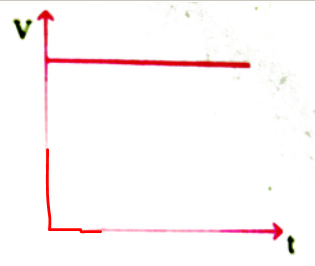
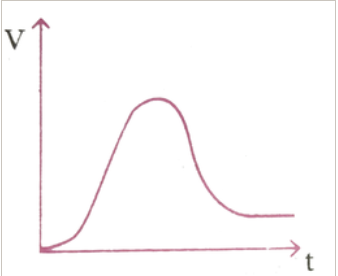
An indeal cell is connected to a capacitor through a voltmeter. The reading V of the voltmeter is plotted agains time. Which of the following best represents the resulting curve ? |
|
Answer»
|
|
| 20. |
The wavelengths of light absorbed by the complexes [Ni(H_2O)_6]^(2+),[Ni(en)_3]^(2+),[Ni(H_2O)_4en]^(2+) are lamda_1, lamda_2,lamda_3 respectively. The correct order of wavelengths is |
|
Answer» `lamda_1 gt lamda_2 gt lamda_3` strength of ligand is EN `gt H_2O`. Hence, energy absorbed WOULD be in order of `[NI(en)_3]^(2+) gt [Ni (H_2O)_4en]^(2+) gt [Ni (H_2O)_6]^(2+)` Hence, wavelength order would be `[Ni(H_2O)_6]^(2+) gt [Ni(H_2O)_4 en)]^(2+) gt [Ni (en)_3]^(2+)` `(lamda_1) (lamda_2) (lamda_3)` Hence, `(lamda_1 gt lamda_3 gt lamda_2)`. |
|
| 21. |
A point source S is moving with a speed of 10 m/s in XY plane as shown in figure. The radius of curvature of the concave mirror is 4 m. If the speed of the image is sqrt2x m/s, then find x. [The says in the question are paraxial rays] |
|
Answer» |
|
| 22. |
A uniformly charged wire, carrying charge q, is laid in the form of a semicircle of radius R. Find the electric field generated by the semicircle at its centre. |
|
Answer» |
|
| 23. |
When does the force acting on a charged particle moving in a uniform magnetic field is Maximum? |
| Answer» Solution :Charged particle MOVES perpendicular to FIELD OR `theta= 90^(@)` where `theta` is the angle between DIRECTION of MAGNETIC field and velocity | |
| 24. |
Explain magnetic declination. |
Answer» Solution :A magnetic needle, which is free to swing HORIZONTALLY would then lie in the magnetic MERIDIAN and the north pole of the needle would point towards the magnetic north pole.  The angle between north direction shows by magnetic needle and true north direction at any place is CALLED magnetic DECLINATION at that place. The angle between the geographic meridian and magnetic meridian at a place is called magnetic declination. The declination is larger at higher latitudes and smaller near the equator. The declination in India is small, it being 0°41 .E at Delhi and 0°58. Wat Mumbai. Thus, at both these places a magnetic needle shows the true north QUITE accurately. |
|
| 25. |
(A) : The resistance of a coil for direct current is 5 ohms. An alternating current is sent through it. The resistance will remain same. (R) : The resistance of a coil does not depend upon nature of current. |
|
Answer» Both 'A' and 'R' are true and 'R' is the correct EXPLANATION of 'A'. |
|
| 26. |
In a two-slit interference pattern, the intensity at the peak of the central maximum is I_0(a) At a point in the pattern where the phase difference between the waves from the two slits is 60^@ , what is the intensity? (b) What is the path difference for 480 nm light from the two slits at a point where the phase angle is 60^@? |
| Answer» SOLUTION :`(a) 0.75I_0 , (B) 80 NM` | |
| 27. |
In which form the missing link in the differential equations of electromagnetic waves were provided ? |
|
Answer» Displacement CURRENT |
|
| 28. |
A long solenoid with 15 turns per cm has a small loop area 2.0cm^(2) placed inside the solenoid normal to its axis. If the current carried by the solenoid changed steadiy from 2.0A to 4.0A in 0.1 s, what is the induced emf in the loop while the current is changing? |
| Answer» SOLUTION :`7.5xx10^(-6)V` | |
| 29. |
A chain of length l lies in a pile on the floor and its mass per unit length linearly increases from lambda to 2lambda from end point A to end point B. If its end point A is raised vertically by applying force at a constant speed V_(0). Then |
|
Answer» The magnitude of force applied F when y = 3l is `(3)/(2)lambda l g` |
|
| 30. |
Define the term wavefront. Using Huygen's wave theory, verigy the law of reflection. |
|
Answer» Solution :Wave front : Wave front is the continuous LOCUS of all such particles of the medum which are vibrating in the same PHSE. Laws of reflection on the basis of Huygne's wave theory : Let XY be the reflecting surface and AB is the incident wave and A'B' be the reflected wave front. Let, v be the speed of light Time TAKEN by the light to go from point B to B' is equal to the fo from A to A'. Hence,BB'= AA' (common) `/_AB B'=/_A A'B("each "90^(@))` `DeltaABB'=DeltaB'A'A(R.H.S)` Hence,` /_BAB'=DeltaA'B'A(C.P.C.T.)` `/_i=/_r` 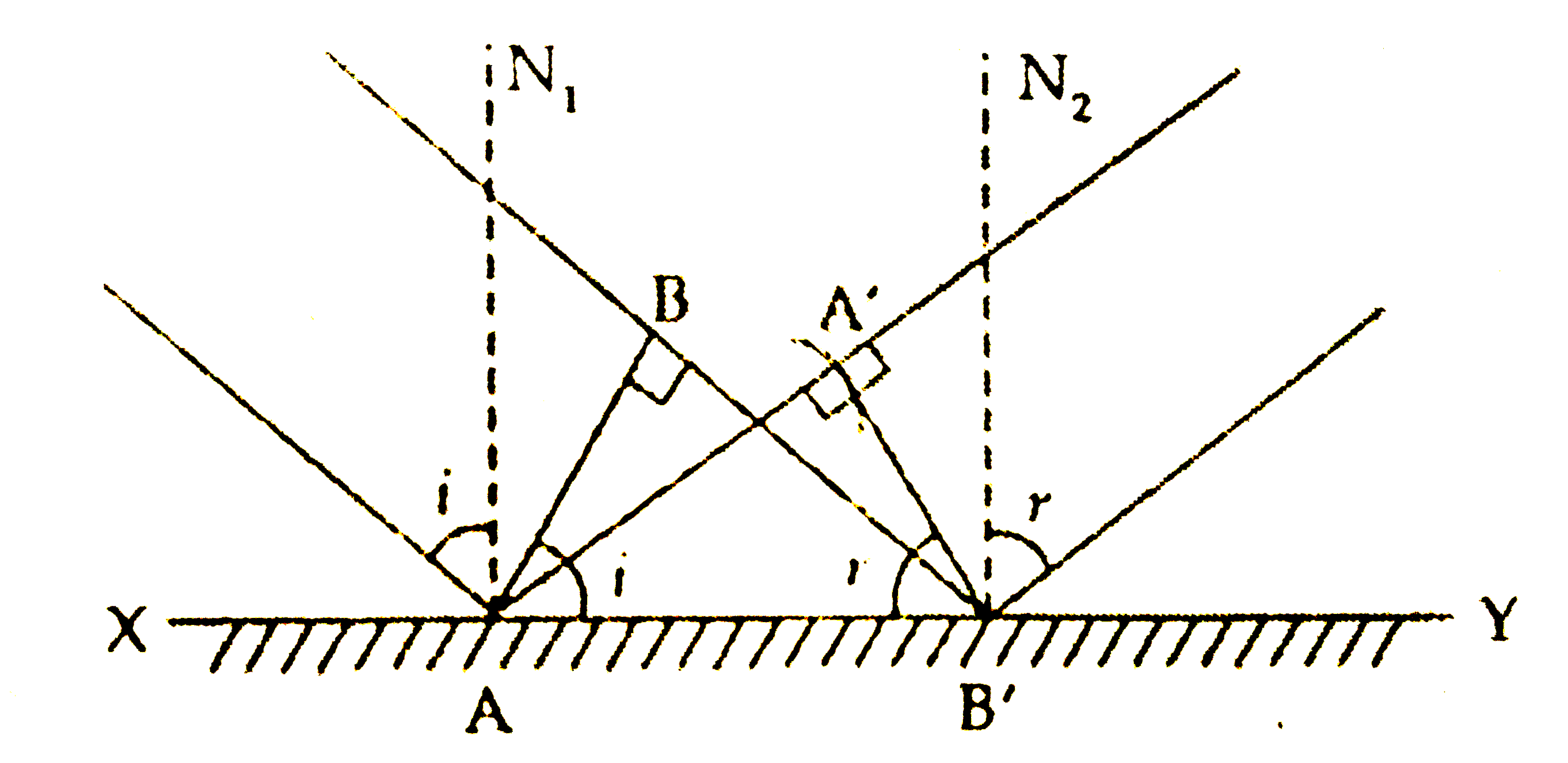 Hence, angle of INCIDENCE = angle of reflection. |
|
| 31. |
The outputcharacteristicsof ann-p-ntransistorrepresent,[I_C =Collectorcurrent,V_(CE )= potentialdifferencebetweencollectorand emitterI_B= Basecurrent, V_( B B)- voltagegiventobaseand emitter] |
|
Answer» CHANGEIN `I_C `as `I_B `and ` V_(B B)`aarechanged |
|
| 32. |
What is resonance in a series LCR circuit ? Derive the expression for resonant angular frequency . |
|
Answer» SOLUTION :The phenomenon of IMPEDANCE of the series LCRcircuit becomingminimumand current in the circuit becomingmaximumat a PARTICULAR frequencyof the appliedalternatingvoltage is called electrical resonance . At resonance , `X_C=X_L` or `1/(W_0C)=W_0L` `rArr W_0^2=1/(LC)` or `W_0=1/sqrt(LC)` If `gamma_0`is the frequencyof the appliedalternatingvoltage when the series LCR circuit is at resonance , `W_0=2pigamma_0` `2pi gamma_0 =1/sqrt(LC)` `gamma_0=1/(2pisqrt(LC))` |
|
| 33. |
Draw V-I Characteristics of a p-n junction diode. Answer the following questions, giving reasons- (i) Why is the current under reverse bias almost independent of the applied potential upto a critical voltage? (ii) Why does the reverse current show a sudden increase at the critical voltage? Name any semiconductor device which operates under the reverse bias in the break down region. |
|
Answer» Solution :V-I CHARACTERISTICS of p-n junction diode - (i) Under the reverse bias condition, the HOLES of p-side are attracted towards the negative terminal of the battery and the electrons of the n-side are attracted towards the positive terminal of the battery. This increases the depletion layer and the potential barrier. However, the MINORITY charge carriers are drifted across the junction producing a small current. At any temperature the number of minority carriers is constant so there is the small current at any applied potential. This is the reason for the current under reverse bias to be almost independent of applied potential. At the critical voltage, avalanche break down and takes place which results in a sudden flow of large current. (ii) At the critical voltage, the holes in the n-side and conduction electrons in the p-side are accelerated due to the reverse-bias voltage. These minority carriers acquire sufficient kinetic energy from the ELECTRIC field and collide with a valence electron. Thus, the bond is finally broken and the valence electrons move into the conduction band resulting in enormous flow of electrons and thus formation of hole-electron PAIRS. Thus, there is a sudden increase in the current in the critical voltage. Zener diode is a semiconductor device which operates under the reverse bias in the break down region. 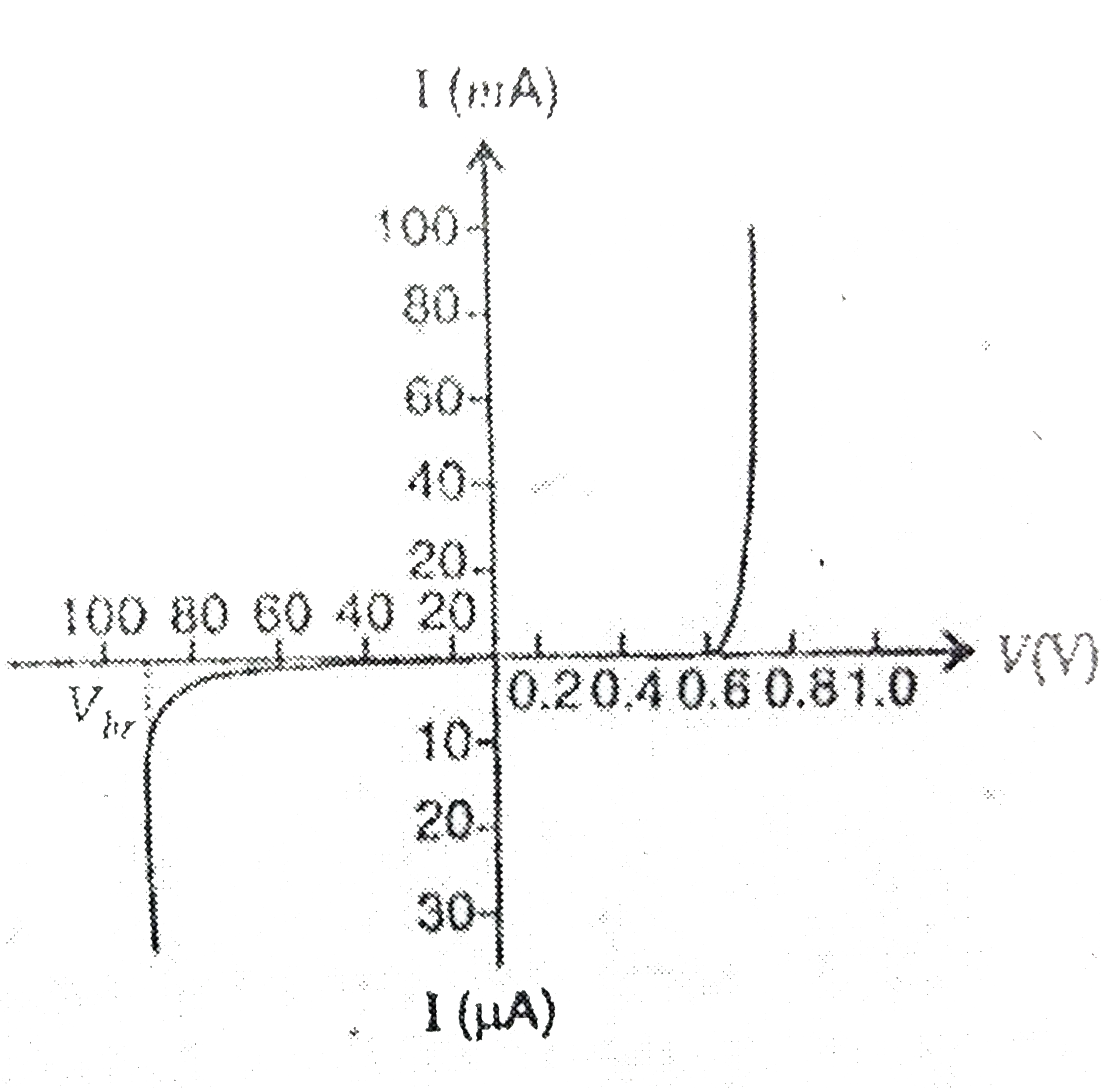
|
|
| 34. |
Two metal plates 50cm xx 50cm have a separation of 2cm. The metal plates are separated by 2 dielectric material constant 4 and 6 and of thickness 0.8 cm and 1.2 cm respectively. Find the effective capacity. |
|
Answer» |
|
| 35. |
If the distance of the far point for a myopia patient is doubled, the focal length of the lens required to cure it will become |
|
Answer» Half |
|
| 36. |
A straight wire of mas 200 g and length 1.5 m carries a current of 2 A.It is suspended in mid-air by a uniform horizontal magnetic field B. The magntiude of B ( in tesla) is (Takeg = 10m s-^(2) ) |
|
Answer» 2 |
|
| 37. |
The V-I characterisctic for a p-n junction diode is plotted as shown in the figure. From the plot we can conclude that [V_(b)to breakdown voltage, V_(k)to knee voltage] |
|
Answer» the forward BIAS resistance of diode is very HIGH, almost infinity for small values of V and after a CERTAIN value it BECOMES very low |
|
| 38. |
What is the angle which the rays of the sum must make with surface of water (n= 1.33)in a lake, so that the reflected rays are completely polarised in a plane parallel to the surface ? |
| Answer» ANSWER :A | |
| 39. |
Determine V_(CE) in the following silicon based transistor circuit |
|
Answer» 6.8V 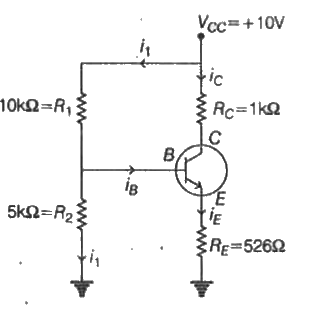 USING KVL to CE circuit `V_(C C) = i_(C) R_(C ) + V_(CE) + i_(E) R_(E)` `=i_(C) R_(C) + V_(CE) + i_(C) R_(E) " " ( :. i_(E) ~~ i_(C))` `rArr V_(CE) = V_(C C) - i_(C) (R_(C)+ R_(E))`…(i) By Ohm.s law, current `i_(1)` is: `i_(1) = (V_(C C))/(R_(1) + R_(2)) = (10V)/(15 k Omega) = (2)/(3) mA` Now, `V_(2) = i_(1) R_(2)` `= (2)/(3) mA xx 5 k Omega = (10)/(3)` `V_(2) = 3.3V` KVL to base circuit gives, `V_(2) = V_(BE) + i_(E) R_(E)` For silicon transistor, `V_(BE) = 0.7 V rArr i_(E) = (V_(2) - V_(BE))/(R_(E))` `=(3.3 - 0.7)/(526) ~~ 5mA` So, `i_(C) ~~ i_(E) = 5mA` HENCE, from Eq (i) `V_(CE)` is `V_(CE) = V_(C C) - i_(C) (R_(C) + R_(B))` `=10 - 5mA (1 k Omega + 526 Omega)` `~~2.4V` |
|
| 40. |
Potentiometer is an ideal instrument, because |
|
Answer» no current is drawn from the SOURCE of unknown emf |
|
| 41. |
A flat curve an a highway has a radius of curvature 400 m. A car goes around a curve at a speed of 32 m//s. What is the minimum value of coefficient of friction that will prevent the car from sliding ? (g=9.8 m//s^(2)) |
|
Answer» Solution :Given: `r = 400m, v=32 m//s` Maximum safety speed of car along curved horizontal road to prevent SLIDING is `v=sqrt(mu RG)` `32^(2)=mu XX 400 xx 9.8` [SQUARING on both SIDES] `mu=((32)^(2))/(400xx9.8)` `mu=0.261` |
|
| 42. |
A 44mP inductor is connected to 220 V. 50 Hz ac supply. Determine the rms value of the current in the circuit. |
|
Answer» Solution :Here `L=44m H=44xx10^(-3)H`, `v=50Hz, E_("RMS")=220V` `"REACTANCE of inductor, "X_(L)=Lomega=Lxx2piv` `=44xx10^(-3)xx2xx3.14xx50=13.82Omega` `"Current (rms) through the circuit"` `I_("rms")=(E_("rms"))/(X_(L))=(220)/(13.82)=15.9A` |
|
| 43. |
A radioactive sample contains 10^(-3) kg each of two species A and B with half-life 4 days and 8 days respectively. The ratio of the amounts of A and B after a periof of 16 days is |
|
Answer» `1:2` |
|
| 44. |
The moving coil galvanmeter has a current 1 A for a particular number of turns and area of coil and magnetic field B_1=4xx10^3telsa .If the magnetic field B_2=8xx10^(-3)(Wb)//m^2 in a galvanometer. The current for same deflection becomes: |
|
Answer» 0.5A |
|
| 45. |
Magnitude of induced emf in a circuit is given by ______ law and the direction of induced current can be obtained by applying _____ law. |
|
Answer» |
|
| 46. |
Explain amplitude modulation. Derive the voltage equation of an amplitude modulated wave. |
|
Answer» Solution :Amplitude modulation In AM, the amplitude of the carrier WAVE is varied in accordance with the modulating signal, while frequency of the carrier wave remains constant. The given figure shows the principle of amplitude modulation. Fig `(a)` shows the audio electric signal, fig. `(b)` shows carrier wave of constant amplitude and fig. `(c )` shows the amplitude modulated wave.   Mathematical analysis Let the carrier `(c )` and modulating `(m)` waves be represented as `e_(c)=E_(c)sinomega_(c)t...(1)` `e_(m)=E_(m)sinomega_(m)t...(2)` From the definition of AM, the maximum amplitude `E_(C)` of the carrier will have to be made proportional to the instantaneous value of the modulating wave `E_(m)sinomega_(m)t.` This is shown in fig. `(a)`. `i.e.E(t)` or `(E_(c))_(AM)` `E_(c)+K_(a)e_(m)` `E(t)=E_(c)+K_(a)E_(m)sinomega_(m)t` `E(t)=E_(c)(1+(K_(a)E_(m))/(E_(c))sinomega_(m)t)...(3)` `K_(a)` is propotionality constant which determines the maximum variation in amplitude for a given signal voltage `E_(m)`.  The instantaneous voltage of the resulting AM wave is `e=E(t)sinomega_(c)t` `=E_(c)(1+m_(a)sinomega_(m)t)sinomega_(c)t,...(4)` where `m_(a)=(K_(a)E_(m))/(E_(c))...(5)` is called the modulation index or modulation factor or depth of modulation. The modulation index when multiplied by `100,` gives percentage of modulation. Eq.`(4)` can be expressed as `e=E_(c)sinomega_(c)t+(m_(a)E_(c))/(2)cos(omega_(c)-omega_(m))^(t)` `-(m_(a)E_(c))/(2)cos(omega_(c)+omega_(m))^(t),...(6)` where the trigonometrical realtion `sinAsinB=(1)/(2)[cos(A-B)-cos(A+B)]` has been used. Side bands. In eq.`(6),` we have three terms, one is the ORIGINAL carrier frequency, `omega_(c)`, and the other two represent  the same and the different of the carrier and modulation frequencies. The carrier envelope produced by amplitude modulation in shown in Fig. `(b)`. The sum  `omega_(c)+omeha_(m)` is the frequency of the upper side band (USB) and the difference `omega_(c)-omega_(m)` is the frequency of the LOWER side band (LSB). For modulation by complex wave forms of SPEECH or music, a great many such side frequency PAIRS will exist, one pair for each frequency component, these side frequency groups are called side bands. The band width required for transmission of an amplitude modulated radio- frequencies signal is equal to twice the highest ( of all the frequencies present ) modulating frequency Fig. `(c )` shows the frequency apectrum as is indicated by eq. `(6).` of these, the central frequency `i.e.,` the carrier, has the highest amplitude and the other two are disposed symmetrically about it, having amplitude which are equal to each other, but which can never exceed half the carrier amplitude. |
|
| 47. |
Cyclotron frequency of electron when accelerated in 1 T magnetic field is ______ . |
|
Answer» 28 MHz Frequency of cyclotron `f_(c)=(BQ)/(2pim)` `f_(c)=(1xx1.6xx10^(-19))/(2xx3.14xx9xx10^(-31))=2.79xx10^(10)Hz` `=27.9xx10^(9)Hz~~28GHz` |
|
| 48. |
A ball is to be shot from level ground with a certain speed. Figure 4-38 shows the range R it will have versus the launch angle theta_(0). The value of theta_(0) determines the flight time, let t_(max) represent the maximum flight time. What is the least speed the ball will have during its flight if theta_(0) is chosen such that the flight time is 0.500t_(max)? |
| Answer» SOLUTION :42.0 m/s | |
| 49. |
Four molecules of a gas have velocity 2km/s, 4km/s, 6 km/s and 8km/sec. respectively. The ratio of their root mean square velocity and average speed is |
|
Answer» 0.913 |
|
| 50. |
An AC generator consists of a coil of 10,000 turns and of area 100 cm^(2). The coil rotates at an angular speed of 140 rpm in a uniform magnetic field of3.6 xx 10^(-2)T. Find the maximum value of the emf induced. Data : N=10,000, A=10^(2)cm^(2)= 10^(-2)m^(2), v=140 rpm=(140)/(60) rps, B = 3.6xx10^(-2)T, E_(0)=? |
|
Answer» SOLUTION :`E_(0) = NAB omega = NAB 2 pi V` `=10^(4)xx10^(-2) XX 3.6 xx 10^(-2) xx 2 pi xx 7/3` `E_(0) = 52.75` V |
|