Saved Bookmarks
This section includes 7 InterviewSolutions, each offering curated multiple-choice questions to sharpen your Current Affairs knowledge and support exam preparation. Choose a topic below to get started.
| 1. |
A polynomial with one degree is called: |
|
Answer» Monomial |
|
| 2. |
An inductance L and a resistor of resistance R are joined in series connected to a.c. source of frequency omega. What is the power dissipated to the circuit ? |
|
Answer» `V^2R/(R^2+omega^2L^2)` |
|
| 3. |
The radii of two charged metal spheres are 5 cm and 10 cm both having same charge 75 mC. If they are connected by a wire, the quantity of charge transferred through the wire is |
| Answer» Answer :A | |
| 4. |
In 1959, Lytteton and Bondi suggest that the expansion of the Universe could be explained fi mattercarried a net charge. Supposethat the Universe is made up of hydrogenatoms with a number density N, which is mainted a constant. Let the charge on the proton be , e_(p) = -(1+q) e where e si the electronic charge. (a) Find the critical value of y suchthat expansion may start. (b) Show that the velocity of expansion is propertional to the distance from the center. |
|
Answer» Solution :(a) Suppose the universe is a sphere of radius R and itsconstituenthydrogenatoms are distributed uniformly in the sphere. As hydrogenatomcontainsone protonand one electron, therefore, chargeon eachhydrogen atom, `e_(H) = e_(p) + e = -(1+y) e + e = -ye = (ye)` if E electric field intensity at distanceR, on the surfaceof the sphere, then according to Gauss's theroem, `oint vec(E) . vec(ds) = (q)/(in_(0)) , i.e.,E(4pi R^(2)) = (4)/(3) (pi R^(2) N |ye |)/(in_(0))` `E = (1)/(3) (N|ye|R)/(in_(0))`...(i) Now, mass of each hydrogen atom = `m_(p)` = mass of a proton. If `G_(R)` is gravitationalfield at distnaceR on the surface of the sphere, then `-4 pi R^(2) G_(R) = 4 pi G, m_(p) ((4)/(3) pi R^(3) N) or G_(R) = -(4)/(3) pi G m_(p) NR`...(ii) `:.` Gravitational force on this atom is`F_(1) = m_(p) xx G_(R) = - (4pi)/(3) Gm_(p)^(2) N R`...(iii) andcoulomb force on hydrogen atom at R is`F_(2) = (ye) E = (1)/(3) (N y^(2) e^(2) R)/(in_(0))` using (i) The expansion would start when coulomb repulsion `(F_(2))` on hydrogen atom is larger than the gravitationalforce of attraction `(F_(1))`on the hydrogen atom. The critical value of y to start expansion would be when `F_(2) = F_(1) i.e.,(1)/(3) (N y^(2) e^(2) R)/(in_(0)) = (4pi)/(3) G m_(p)^(2) NR` or`y^(2) = (4pi in_(0)) G ((m_(p))/(e))^(2) = (1)/(9xx10^(9)) = (6.67xx10^(-11)) ((1.66xx10^(-27))^(2))/((1.6xx10^(-19))^(2)) = 79.8xx10^(-38)` `y = SQRT(79.8xx10^(-38)) = 8.9xx10^(-19) = 10^(-18)` This is the critical value of y correspondingto whichexpansion of universe would start. (b) Net forceexperienced by the hydrogen atom, `F = F_(2) - F_(1)= (1)/(3) (N y^(2) e^(2) R)/(in_(0)) - (4pi)/(3) Gm_(p)^(2) NR` If acceleration of hydrogen atom is represendedby `d^(2)R// dr^(2)`, then `m_(p) (d^(2)R)/(dr^(2)) = F = (1)/(3) (N y^(2)e^(2))/(in_(0)) R - (4pi)/(3) Gm_(p)^(2) N R = ((1)/(3) (N y^(2) e^(2))/(in_(0)) - (4pi)/(3) G m_(p)^(2) N) R` `:. (d^(2)R)/(dr^(2)) = (1)/(m_(p)) [(1)/(3) (N y^(2) e^(2))/(in_(0)) - (4pi)/(3) G m_(p)^(2) N]R = alpha^(2) R` where `alpha^(2) = (1)/(m_(p)) [(1)/(3) (N y^(2) e^(2))/(in_(0)) - (4pi)/(3) G m_(p)^(2) N]` The genralsolution of EQN. (iv) is`R = A e^(alpha t) + B e^(-alpha t)` As we are lookingfor expansion, `B = 0. :.R =A e^(alpha t)` velocity of expansions, `v = (dR)/(dr) = A e^(alpha t) (alpha) = alpha A e^(alpha t) = alpha R` Hence, `vprop R`, whichwas to be proved. |
|
| 5. |
The half life of a radioactive substance is 13 years. The decay constant is |
|
Answer» `1.69xx10^(-10) S^(-1)` |
|
| 6. |
A particle moves in a closed orbit around the origin ,due to a force which is directed towards the origin.The de-Broglie wavelength of the particle varies cyclically between two value lambda_(1),lambda_(2) with lambda_(1)gtlambda_(2).Which of the following statement are true? |
|
Answer» The PARTICLE could be moving in a circular orbit with origin as centre. `implies` Path of motion of a particle can not be circular because in tghat case `vecFbotvecv` and so v=constant. `implies` Given particle MUST be moving in an elliptical orbit where its angular momentum gets conserved .Hence mvr=constant `impliesmvprop(1)/(p)implies(1)/(lambda)prop(1)/(r)` `(because lambda=(h)/(mv)impliesmvprop(1)/(lambda))implieslambdaprop r` `implies lambda prop r prop (1)/(v)` (`because` vr=constant) `implies (lambda_(2))/(lambda_(1))=(r_(2))/(r_(1))implies` If `r_(2)ltr_(1)` then `lambda_(2) lt lambda_(1)implieslambda_(1)gtlambda_(2)` `implies` When de-Broglie wavelength ofa particle equal to `lambda_(2)` (which is SMALLER then `lambda_(1)`),it distance from the origin would be `r_(2)ltr_(1)` which means that it would be closer to origin `implies`Options (B) and (D) are CORRECT. |
|
| 7. |
A sharp image is observed through a compound microscope. Now if the eye pieces pushed slightly into the microscope tube. State if |
|
Answer» CLEARER IMAGE will be seen |
|
| 8. |
'n' conducting wires of same dimensions but having resistitives 1,2,3...........n are connected in series the equivalent resistivity of the combination is |
|
Answer» `(N(n-1))/(2)` |
|
| 9. |
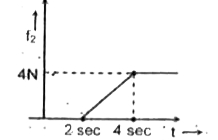
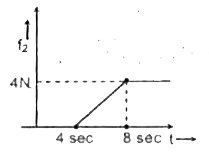
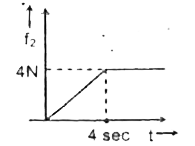
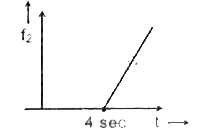
Two blocks of masses 4 kg and 2 kg are connected by a string. The arrangement is placed on a rough horizontal surface as shown in figure. A time varying force F = 2t. Newton is applied to 2 kg block. The variation of friction force (f_(2)) on the 4 kg block, as a function of time, is represented by the graph : |
|
Answer»
|
|
| 10. |
A parallel plate capacitor with only air between the plates has a capacitance of 8pF. What will be the capacitance if the distance between the plates is reduced by half and the space between them is filled with a substance of dielectric constant 6? |
|
Answer» Solution :`C_0 = (A epsi_0)/(d) = 8pF` When the distance is reduced to half and dielectric MEDIUM FILLS the GAP, the new capacitance will be `C = (epsi_r Aepsi_0)/(d//2) = (2 epsi_r A epsi_0)/(d)` ` = 2 epsi_r C_0` `C = 2 xx 6 xx 8 = 96 PF` |
|
| 11. |
B^(2)/(mu_(0)), where B is magnetic induction and mu_(0) is permeability of free space, has the same dimensions as : |
|
Answer» energy Now `(B^(2))/(mu_(0))=(M^(2)T^(-4)A^(-2))/(MLT^(-2)A^(-2))` `=[ML^(-1)T^(-2)]` =energy density. Hence CORRECT CHOICE is `(b)`. |
|
| 12. |
What is distance of closest approach? |
| Answer» Solution :The minimum DISTANCE between the centre of the nucleus and the ALPHA partilce just before it gets REFLECTED back through `180^(@)` is defined as the distance of CLOSEST APPROACH `r_(0)` (also known as constant distance). | |
| 13. |
A sphere of mass m is rolling without sliding along positive x-axis on a rough horizontal surface of coefficient of friction mu. It elastically collides with a wall and then returns. The correct statement of frictional force (f) acting on the sphere is |
|
Answer» `F = mu MG hati` before collision and `f = mu mg hati` after collision |
|
| 14. |
A step up transformer has transformation ratio of 3: 2. What is the voltage in secondary if voltage in primary coil is 30 V ? |
|
Answer» 45 V Transformation RATIO `r=N_2/N_1=3/2` `therefore epsilon_2/epsilon_1=N_2/N_1` `therefore epsilon_2/30=3/2` `therefore epsilon_2`=45 V |
|
| 15. |
"To emit a free electron from a metal surface a minimum amount of energy must be supplied" For metal A (tungsten) - work function is 4.52 eV for metal B (thoriated tungsten) it is 2.6 ev, for metallic (oxide coated tungsten) it is 1 eV Which will you prefer as a good electron emitter and why? |
| Answer» Solution :Work function for metallic OXIDE coated tungsten is small (1EV.) Hence this material is GOOD elec TRON emitter | |
| 16. |
A 5V battery with internal resistance 2 Omegaand a 2V battary with internal resistance 1Omegaare connected to as 10 Omegaresistor as shown in the figure. The current in the 10 Omegaresistor is |
|
Answer» `0.27AP_2 "to " P_1` |
|
| 17. |
A horizontal overhead power line is at a height of 1m from the ground and carries a current of 100 A from east to west. The magnetic field directly below it on the ground is (mu_(0)=4pixx10^(-7)TmA^(-1)) |
|
Answer» `2.5 XX 10^(-7)` T SOUTHWARD |
|
| 18. |
A 100muF capacitor in series with a 40Omega resistance is connected to 110 V, 60 Hz supply . a. What is the maximum current in the circuit ? b. What isthe time lag between the current maximum and the voltage maximum ? |
|
Answer» Solution :Data supplied`C= 100 mu F, R = 40 Omega , E_(rms) = 110 V , v = 69Hz` ` E_0 = E_(rms)XX sqrt(2) = 110 xx 1.414 = 155.6 V` a.` i_m (E_0)/(Z) = (E_0)/(sqrt(R^2 + ( (1)/(omega C) )^2)) = (155.6 )/(sqrt(40^2 + ( (1)/(10^(-4) xx 2 xx 3.14 xx 69) )^2) ) = 3.242 A` B. ` tan phi = (1)/(omega CR)` ` tan phi = (1)/(10^(-4) xx 2 xx 3.14 xx 69 xx 40)= 0.6635` `phi = tan^(-1) (0.6635) = 30.11^@ = 30^@ = (30 xx pi)/(180) = pi/6` `phi = omega t , t = phi/omega = (pi)/(6 xx 2 xx pi xx 69) = 1.21 xx 10^(-3) s = 1.21 ms ` |
|
| 19. |
Ther is no couple acting when two barmagnets are placed coaxially since |
|
Answer» there are no FORCES on the PLOTS |
|
| 20. |
Which of the following best describes a perfectly inelastic collision free of external forces ? |
|
Answer» TOTAL linear momentum is never conserved |
|
| 21. |
A current carring small loop behaves like a small magnet. If A be its area and M its magnetic moment, what will be the current in the loop ? |
|
Answer» M/A I = M/A |
|
| 22. |
The force between two charges separated by a distance 1m is 1.8N. The charges are in the ratio 1: 2 then the charges are |
|
Answer» `5mu C, 5mu C` |
|
| 23. |
Nucleus contains positively charged protons, chargeless neutrons, called ? |
| Answer» SOLUTION :NUCLEONS | |
| 24. |
What's frequency range of radiowaves? |
| Answer» Solution :The FREQUENCY range is from a few `KHundersetz` to NEARLY frew HUNDRED `MHundersetz` | |
| 25. |
An external force of 10 newton acts normally on a square area of each side 50 cm. The stress produced in equilibrium state is |
|
Answer» `10N/m^2` |
|
| 26. |
In the given figure the tension in the string OB is 30 N. find the weight W and the tension in the string OA. |
|
Answer» Solution :Let `T_(1) and T_(2)` be the tnesions in the strings OA and OB respectively. According to lami.s theroem 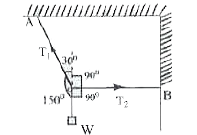 `(T_(1))/(sin 90^(0))=(T_(2))/(sin 150^(@))=(W)/(sin120^(@)) (T_(2)=30 N)` or solving `w= 30 sqrt(3)N and T_(1)=60 N` |
|
| 27. |
In one complete cycle, which field's average value is zero in the propagation of electromagnetic wave ? |
|
Answer» Both ELECTRIC and magnetic field. `E=E_(y)=E_(0)sin(omega t-kx)` `B=B_(Z)=B_(0)sin (omega t-kx)` `rArr lt E gt = E_(0) lt sin (omega t- kx) gt = E_(0)XX 0=0` `lt B gt = B_(0) lt sin (omega t- kx) gt = B_(0)xx 0 =0` |
|
| 28. |
By connecting shunt of 12Omega resistance, the deflection of galvanometer decreases to 10 marks from 50 marks, then the resistance of galvanometer is _____ |
|
Answer» `24Omega` = 12(5 - 1) `thereforeG=48Omega` |
|
| 29. |
An object attached to a light spring oscillates in S.H.M. on horizontal smooth surface. The ratio of maximum P.E. to maximum K.E. is : |
|
Answer» `1//2` `:. ((P.E.)_("max"))/((K.E.)_("max"))=1` `:.` Correct choice is ( c ). |
|
| 30. |
A proton and an electron have same kinetic energy. Which one has greater de-Broglie wavelength and why? |
| Answer» Solution :As `lamda=(h)/(sqrt((2mK)))` and kinetic energy K is CONSTANT, HENCE `lamdaprop(1)/(sqrtm)` i.E., electron particle, being LIGHTER, will have the larger de-Broglie wavelength. Thus `lamda_(e) GT lamda_(p)`. | |
| 31. |
The coefficient of friction between a body and the surface of inclined plane at45^@ is 0.5. Ifg=9.8m/s^2 The acceleration of the body downwards in m/s^2 is |
|
Answer» `4.9/sqrt2` |
|
| 32. |
What Interence do you draw from above result? |
| Answer» Solution :The length of DIPOLE antenna DECREASES as frequency of TRANSMISSION is INCREASED. | |
| 33. |
A conductor with a positive charge |
|
Answer» is ALWAYS at +ve potential. |
|
| 34. |
The ratio of primary and secondary turns in a transformer is 1: 200. If 220 V A.C. is fed to primary, voltage across secondary will be ……. |
|
Answer» Solution :`epsilon_1`= 220 V , `N_1/N_2=1/200, epsilon_2`= ? `epsilon_1/epsilon_2=N_1/N_2` `therefore 220/epsilon_2=1/200` `therefore epsilon_2=220xx200` = 44000 V =44 kV |
|
| 35. |
Speed of electromagnetic wave in a medium of in_(r )=1.3 and mu_(r )=2.14 is ……. . |
|
Answer» `3.6xx10^(8)m//s` `therefore v=(c )/(n)` but `n = sqrt(mu_(r )in_(r ))` `therefore v=(c )/(sqrt(my_(r )in_(r )))` `= (3xx10^(8))/(sqrt(2.14xx1.3))` `= (3xx10^(8))/(sqrt(2.782))=(3xx10^(8))/(1.67)` `therefore v=1.796xx10^(8)` `therefore v ~~ 1.8 xx 10^(8)m//s` |
|
| 36. |
The wires which connect the battery of an automobile to its starting motor carry a current of 300a (for a short time). What is the force per unit length between the wires if they are 70cm long and 1.5 cm apart? IS the force attractive or repulsive? |
|
Answer» Solution :1. Magnetic force exerted per unit length of either of two extremely long, THIN parallel wires, separated by perpendicular distance y and carrying currents `I_(1)andI_(2)` is, `F/l=(mu_(0)I_(1)I_(2))/(2piy)` = `((4pixx10^(-7))(300)(300))/((2PI)(0.015))` `thereforeF/l=1.2N/m` 2. Total magnetic force on either of two equally long wires is, `F=1.2xxl` = `1.2xx0.7` `thereforeF=0.84N` 3. Above force is REPULSIVE because of opposite directions of electric currents in the given wires. |
|
| 37. |
In a galvanometer, 5% of the total current in the circuit passes through it. if the resistance of galvanometer is G, the shunt resistance S connected to galvanometer is |
| Answer» ANSWER :B | |
| 38. |
The frequency of a source of sound as measured by an observer when the source is moving towards him with a speed of 30 m/s is 720 Hz. The apparent frequency when the source is moving away after crossing the observer is x xx 10^2 Hz what is the value of x.......... (velocity of sound is 330 m/s) |
|
Answer» |
|
| 39. |
A satellite in Earth orbit maintains a panel of solar cells of area 2.90 m^(2) perpendicular to the direction of the Sun's light rays. The intensity of the light at the panel is 1.39 kW//m^(2). (a) At what rate does solar energy arrive at the panel? (b) At what rate are solar photons absorbed by the panel? Assume that the solar radiation is mono- chromatic, with a wavelength of 550 nm, and that all the solar radiation striking the panel is absorbed. (c) How long would it take for a "mole of photons" to be absorbed by the panel? |
| Answer» SOLUTION :2.047 EV | |
| 40. |
Obtain an expression for electrical conductor. |
| Answer» SOLUTION :This QUESTION ANSWER GIVEN in EVALUATION question III-1 | |
| 42. |
In a concave mirror experiment, an object is placed at a distance x, from, the focus and the image is formed at a distance x_2 from the focus. The focal length of the mirror would be |
|
Answer» `x_1 , x_2` |
|
| 43. |
A train approaching a hill at a speed of 40 km/hour sounds a whistle of frequency 580 Hz when itis at a distance of 1 km from a hill. A wind with a speed of 40 km/hour is blowing in the direction of motion of the train. The frequency of the whistle as heard by an observer on the hill is 100y (velocity of sound in air = 1200 km/hour).Find y |
|
Answer» |
|
| 44. |
The near point and the far point of a child are at 10 cm and 100 cm. If the retina is 2,0 cm behind the eye-lens, what is the range of the power of the eye-lens? |
|
Answer» |
|
| 45. |
An ac generator G with an adjustable frequency of oscillation is used in the circuit, as shown. Thermal energy produced by the resistance R in time duration 1 mus, using the source at resonant condition, is |
|
Answer» `0 J` |
|
| 46. |
A constant voltage dc source is connected, as shown in Fig. A2.7, across two resistors of resistances 400 kOmega and 100 k Omega. What is the reading of the voltmeter, also of resistance 100 kOmega, when connected across the second resistor as shown? |
|
Answer» 111 V across the DC supply is `450 KOMEGA`. CURRENT drawn from supply `1000 V//450 kOmega = 1//450A`. Potential DIFFERENCE across voltmeter is `(50 xx 1000)/450 V = (1000)/9 V = 111V` . |
|
| 47. |
The current amplification factor for CE configuration is 0.9.Find out the current amplification factor for CE configuration? |
| Answer» SOLUTION :`beta=alpha/(1-alpha)=0.9/(1-0.9)=0.9/0.1=9` | |
| 48. |
Ratio of 5th Bohr's orbit radius to 7th Bohr's orbit radius of electron in hydrogen atom is: |
|
Answer» 25/7 |
|
| 49. |
A transmitting antenna at the top of tower has a height 32m and height of receiving antenna is 50m. Minimum distance between them for satisfactory LOS mode of communication is |
|
Answer» 40km |
|
| 50. |
(a) How does one demonstrate, using a suitable diagram, that unpolarised light when passed through a polaroid gets polarized ? (b) A beam of unpolarised light is incident on a glass-air interface. Show, using a suitable ray diagram, that light reflected from the interface is totally polarised , when mutani_(B), where mu is the refractive index of glass with respect to air and i_(B) is the Brewster's angle. |
Answer» SOLUTION :(a)  The components of electric vector associated with light wave, along the direction of aligned molecules of a polaroid, get absorbed. As a result after PASSING through it, the components perpendicular to the direction of aligned molecules will be obtained in the form of plane polarised light. (b) When unpolarised light is incident on the BOUNDARY between two TRANSPARENT media, the reflected light is polarised, with electric vector perpendicular to the plane of incidence when the relfected and refracted light rays make a right angle, as shown in the figure below.  Since, `/_CBQ+/_QBD=90^(@)` `(90-i_(B))+(90-r)=90^(@)` `i_(B)+r=90^(@)` `r=90-i_(B)` Using Snell.s law, `mu=(sini_(B))/(sinr)` `=(sini_(B))/(SIN(90-i_(B))` `=(sini_(B))/(cosi_(B))` `mu=tani_(B)` |
|