

Saved Bookmarks
This section includes 7 InterviewSolutions, each offering curated multiple-choice questions to sharpen your Current Affairs knowledge and support exam preparation. Choose a topic below to get started.
| 1. |
A central fringe of the interference pattern produced by a light of wavelength 6000Åis shifted to the position of 5th bright firnge when a glass plate of refractive index 1.5 is introduced in the path of the ray. Calculate the thickness of the glassplate. |
|
Answer» |
|
| 3. |
The focal lengths of the eyepiece and the objective of an astronomical telescope are 2 cm and 100 cm respectively. Find the magnifying power of the telescope for normal adjustment and the length of the telescope. |
|
Answer» `50 , 102 cm ` |
|
| 4. |
The resistance in two gaps of a meter bridge are 10 Omega and 30 Omega respectively. If the resistances are interchanged the balance point shifts by |
|
Answer» 33.3 cm |
|
| 5. |
A number of identical cells, n, each of emf epsi , internal resistance r connected in series are charged by a d.c. source of emf epsi , using a resistor R.(i)Draw the circuit arrangement.(ii) Deduce the expressions for (a) the charging current and (b) the potential difference across the combination of the cells. |
Answer» Solution :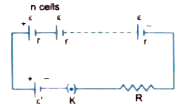 (a) The TOTAL internal resistance of n CELLS in series = nr Total resistance of entire circuit = R + nr Total emf of n cells in series = `n epsi` ` therefore `The charging CURRENT ` = ((epsi. - n espi))/((R + nr ))` (b) The potential DIFFERENCE across the combination of the cells ` V=n epsi + I.(nr)`, where I is the charging current. |
|
| 6. |
A positive charge 'Q' is fixed at a point.A negatively charged particle of mass 'm' and charge q' is revolving in a circular path of radius 'r_1' with 'Q' as the centre. The change in potential energy to change the radius of the circular path from r_1 to r_2 in joule is |
|
Answer» ZERO |
|
| 7. |
A force of 10N is applied on a body for 3 sec and the corresponding displacement is 6 m. The power of the source is |
|
Answer» 20 W |
|
| 8. |
(a) Draw a schematic sketch of a cyclotron. Explain clearly the role of crossed electric and magnetic field in accelerating the charge. Hence derive the expression for the kinetic energy acquired by the particles. (b) An alpha-particle and a proton are relased form the centre of the cyclotron and made to accelerate. (i) Can bothbe accelerated at the same cyclotron frequency? Give reason to justify your answer. (ii) When they are accelerated in turn, which of the two will have higher velocity at the exit slit of the dees ? |
|
Answer» Solution :(a) Schematic sketch of cyclotron - The combination of crossed electric and magnetic fields is used to increase the energy of the CHARGED particle. Cyclotron uses the fact that the FREQUENCY of revolution of the charged particle in a magneitc field is independent of its energy. Inside the dees and particle is shielded from the electric field and magnetic field acts on the particle and makes it to go round in acircular path inside a dee. Every time the particle moves from one dee to the other it comes under the ifluence of electric field which ensures to increase the energy of the particle as the sign of the electric field changed alternately. The increased energy increases the radius of the circular path so the acceleratedparticle moves in a spiral path. Since, radius of trajectory, `r = (vm)/(qB)` HENCE, the kinetic energy of ions `=(1)/(2)mv^(2)=(1)/(2)m(r^(2)q^(2)B^(2))/(m^(2))""K.E.=(1)/(2)(r^(2)q^(2)B^(2))/(m)` (b) (i) Let us consider m `rarr` mass of proton q `rarr` charge of proton mass of alpha particle = 4m ,charge of alpha particle = 2q cyclotron frequency, `v = (BQ)/(2 pi m) rArr v alpha (q)/(m)` (ii) VELOCITY, `v = (Bqr)/(m), v alpha (q)/(m)` For proton, velocity, `v_(p) alpha (q)/(m)` For alpha particle, velocity, `v_(alpha) alpha (2q)/(4m) or v_(alpha) alpha (q)/(2m)`. Thus, particles will not exit the dees with same velocity. The velocity of proton is twice than the velocity of alpha particle. |
|
| 9. |
Two point charges 4mu C and 9muC are separated by 30cm. Find the point where the strength of the field is zero. |
|
Answer» Solution :The distance x of the null POINT `4mu C` CHARGE and between the two charge is `(4)/(x^(2)) = (9)/((30-x)^(2)) (or) x = (30)/(sqrt((9)/(4))+1)= (30 xx 2)/(5) = 12cm` |
|
| 10. |
The mass of a neutron |
|
Answer» Is EXACTLY equal to that of a PROTON |
|
| 11. |
Which of the following elements when added as an impurity into the germanium produces a p - type semiconductor? |
|
Answer» P |
|
| 12. |
A ray of light falls on a denser-rarer boundary from denser side. The critical angle is 45^(@). The maximum undergo is |
|
Answer» 20 cm `i=theta_(c)=45^(@)` `THEREFORE` Deviation, `delta=180^(@)-2i=90^(@)` |
|
| 13. |
Two equal resistances, 400 Omegaeach, are connected in series with a 8 V battery. If the resistance of first one increases by 0.5%, the change required in the resistance of the second one in order to keep the potential difference across it unaltered is to |
|
Answer» increase it by 1`OMEGA` VOLTAGEACROSS`R_1or R_2` `V_1=V_2=( 400 xx 8 )/( 800)= 4V ` Case II : ` R_1 . = R_1 + ( 0.5%)xx R_1 = 420Omega` ` V_(1) .=(8 )/( R_1 . +R_2.) xx R_2.` `implies4 = (8)/( 402+R_2.) xx R_2 .` `implies402+R_2 .= 2 R_2.implies R_2 . =402Omega ` ` DeltaR_2 =R_2. -R_2=402- 400= 2Omega ` 
|
|
| 14. |
Let f: Rrarr R be defined by f (x) = 2X-3 AAx epsilonR,which of the follwing is f^(-1)(x)- |
| Answer» Answer :C | |
| 15. |
Heat is supplied to a diatomic gas which expands at constant pressure. The % of change in internal energy to heat supplied is |
|
Answer» 71.4 increase in internal ENERGY `=nc_(V)dT` `(DELTAU)/(dQ)=(1)/(gamma)=(5)/(7)=71.4%` |
|
| 16. |
The phenomenon involved in the reflection of radio-waves by ionosphere is similar to |
|
Answer» DISPERSION of light by water MOLECULES during the formation of a rainbow |
|
| 17. |
A light of wavelength 1 is incident on an object of size b. If a screen is at a distance D from the object, identify the correct condition for the obervation of different phenomena a) if b^(2) = D1, Fresnel diffration is obserbed b) if b^(2) gt gt D1, Fraunhofer diffraction is obserbed c) if b^(2) lt lt D1, Fraunhofer diffraction is obserbed d) if b^(2) gt gt D1, the approximation of geometrical optics is applicable |
|
Answer» a, B and d are true |
|
| 18. |
A telescope with magnification M = 15 was submerged in water so that the inside of the telescope is filled up with water. To make the system work as a telescope within the former dimensions, the objective was removed. What was the magnification of the telescope after the change? mu of the material of the eye-piece=1.5 and mu of water =(4)/(3) |
|
Answer» |
|
| 19. |
An equimolar mixture of a mono atomic and diatomic gas is subjected to continuous expernsions such that dQ=(1)/(3)dU+(1)/(2)dW. The equation of the process in terms of the variable P & V will be |
|
Answer» `PV^(5//4)`=constant From `1^(ST)` LAW of THERMODYNAMICS, `dQ=du+dw` `dQ=ncdt. C=®/(gamma-1)+(R )/(1-n)` for `PV^(n)` process. |
|
| 20. |
To identify whether the transistor is working or not, using multimeter, which statement serves the purpose? |
|
Answer» The common lead of MULTIMETER is connected to base and other lead to first EMITTER and then to COLLECTOR, only 1st connection shows the continuity |
|
| 21. |
(a). The equipotential curves in x,y plane are given by x^(2)+y^(2)=V when V si potential Draw the rough sketch of electric field lines in x-y plane. (b). Repeat the above question if the potential field is given by V=x^(2)+y^(2)-4x+4 |
|
Answer» (B). `(##IJA_PHY_V02_C06_E01_020_A02##)` |
|
| 22. |
Brilliance of diamond is due to |
|
Answer» shape. |
|
| 23. |
The number of electrons striking the screen of CRT is 7.5xx10^(15) in 10 s. Calculate the electric current. |
|
Answer» Solution :`i= q/t = ("ne")/t = (7.5xx10^(5) XX 1.6xx10^(-19))/(10)` `=120 MU A` |
|
| 24. |
Find the current in the sliding rod AB (resistance = R) for the arranged shown in Fig. B is constant and is out of the paper. Paralllel wires have no resistance. upsilon is constant. Switch is closed at time t = 0. |
|
Answer» Solution :PROCEEDING as in Q.29 above, `- L (dI)/(dt) + B upsilon d = IR` or `L (dI)/(dt) + IR = B upsilon d` `:. I = (B upsilon d)/(R ) + A E^(-Rt//L)` where A is an arbitrary constant. At t = 0, I = 0`:.` From (i), `A = - (B upsilon d)/(R )` Putting this value of A in (i), we get `I = (B upsilon d)/(R ) = (B upsilon d)/(R ) e^(-Rt//L) = (B upsilon d)/(R ) (1 - e^(-Rt//L))` This is the required current in sliding rod AB. |
|
| 25. |
Three resonant frequencies of a string are 90, 150 and 210 Hz. Which overtones are these frequencies? |
| Answer» SOLUTION :`2^(nd), 4^(TH) and 6^(th)` | |
| 26. |
Derive an expression for drift velocity of free electrons in a conductor in terms of relaxation time. |
|
Answer» Solution : We know that in the absence of an external ELECTRIC field E, the conduction electrons in aconductor move randomly with VELOCITIES `vecu_1 , vecu_2, vecu_3,.......vecu_n`such that their mean VALUE`(vecu_1 + vecu_2 + vecu_3 + ..........+vecu_n )/(N) = 0.` However, in the presence of an external electric field `vecE`, electrons experience an acceleration `veca = - (e vecE)/(m) `. If `t_1, t_2, t_3`..... be the times before two successive collisions for different electrons, then the final velocities acquired by different electrons are `vecv_1 = vecu_1 + veca t_1 , vecv_2 = vecu_2 + veca t_2 ,.... vecv_n = vecu_n + veca t_n` ` therefore `Mean value of electron velocity in the presence of an electric field = Drift velocity `vecv_d = (vecv_1 + vecv_2 + vec v_3 +........+vecv_n)/(n)` ` = ( (vecu_1+ vecu_2 + vecu_3 + .........+vecu_n)/(n) ) + veca ( (t_1 + t_2 + t_3+.......+t_n)/(n))` ` = veca tau = (e vecE)/(m) tau` Where `tau = (t_1 + t_2 + t_3 +......+t_n)/(n)` = RELAXATION time . |
|
| 27. |
Two point charges Q and -Q/4 are separated by a distance x. |
|
Answer» Potential is zero at a point on the axis which is x/3 on the right side of the charge - Q/4 |
|
| 28. |
In an experiment on photoelectric effect, the slope of the cut-off voltage versus frequency of incident light is found to be 4.12xx 10^(-15) v s. Calculate the value of Planck’s constant. |
| Answer» SOLUTION :`6.59xx10^(-34)JS` | |
| 29. |
A : One of the images in double refraction doesn.t obey the principles of refraction. R : Extraordinary image in double refraction doesn.t obey the principles of refraction because its velocity changes with direction. |
|
Answer» Both A and R are true and R is the correct EXPLANATION of A |
|
| 30. |
A bar magnet having a magnetic moment of 1.0xx10^4 J/T is free to rotate in a horizontal plane.A horizontal magnetic field B=4xx10^(-5) T exists in the space.The work done (in Joules )in rotating the magnet slowly from a direction parallel to a direction60^@ from the field will be ____ |
|
Answer» |
|
| 31. |
Find the minimum e.m.f. of the power supply at which the electrolysis of acidified water can take place, if the combustion of 1 g of hydrogen liberates 1.45xx10^(2)kJ. |
Answer»  `=lamdaK=(lamdaA)/(eN_(A)Z)` |
|
| 32. |
Find the equivalent resistance between A & B in the given network. |
|
Answer» Solution :When hypothetical battery is connected to the given circuit the current DISTRIBUTION will be as SHOWN. `(1)/(R_(AB))=((R+3r))/(r(r+3R))+(1)/(r )` `=(R+3r+r+3R)/(r(r+3R))` `rArr R_(AB)=(r(r+3R))/(4(R+r))` 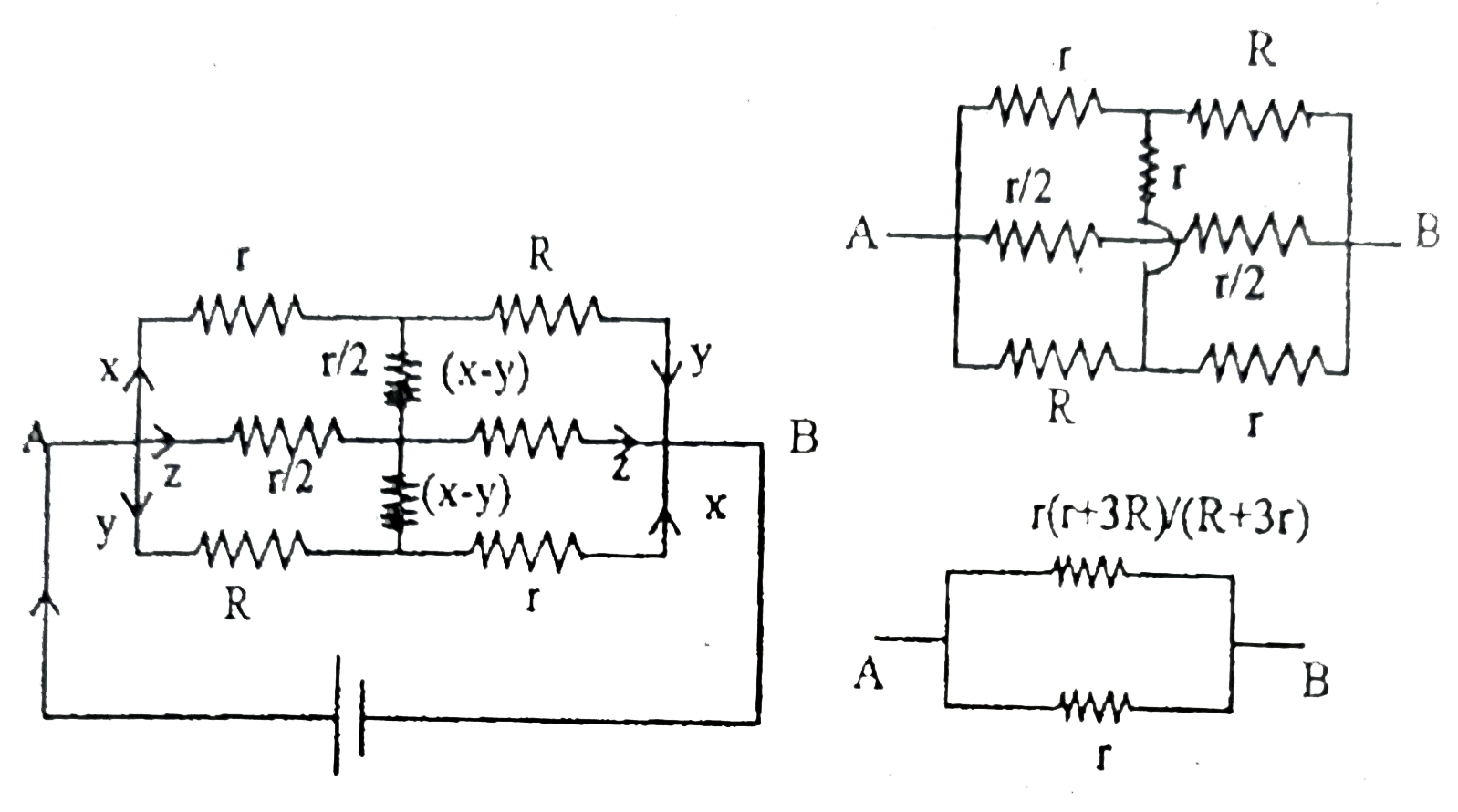
|
|
| 33. |
A chargedmetallic sphere A is suspended by a nylon thread another charged metallic sphere b heldby an insulating centers is 10 cmas shown in Fig. 1.7(a). The resulting repulsion of A is noted (for example, by shining a beam of light and measuring the deflection of its shadow on a screen). Spheres A and B are touched by uncharged spheres C and D respectively, as shown in Fig. 1.7(b). C and D are then removed and B is brought closer to A to a distance of 5.0 cm between their centers, as shown in Fig. 1.7(c). What is the expected repulsion of A on the basis of Coulomb’s law? Spheres A and C and spheres B and D have identical sizes. ignore the sizes ofa and b in comparison to the separation between theircenters |
|
Answer» Solution :Letthe originalcharge on spere a be q and that on b beq at a distance r beteen THEIRCENTRES the magnitude of the `F=(1)/(4piepsilon_(0))(qq)/(r^(2))` NEGLECTING the sizes of sperhers aand b in comparionsto r when an identical but UNCHANGED spere c touches a the chargesredisitribute on a and c and by symmetry each sprere carries a charge `q//2`similary after d touchesb the rredistributedcharge on each isof the electrosatic FORCE on each is `F=(1)/(4pi epsilon_(0))((q//2)(q//2))/(r//2)^(2)=(1)/(4piepsilon_(0))(qq)/(r^(2))=F` THUS the electrostaticforce on a due to b remainsunaltered |
|
| 34. |
The earth's magnetic induction at a certain point is [7x 10^(-5)Wbm^-2]. This is to be annulled by the magnetic induction at the centre of a circular conducting loop of radius 15 cm. The required current in the loop is |
|
Answer» 0.56 A |
|
| 35. |
(A): Potentiometer is much better than a Voltmeter for measuring emf of cell (R): A potentiometer draws no current while measuirng emf of a cell at balancing point. |
|
Answer» Both 'A' and 'R' are TRUE and 'R' is the CORRECT explanation of 'A' |
|
| 36. |
A photon with energy h omega = 250 keV is scattered at an angle theta = 120^(@) by a stationary free electron. Find the energy of the scattered photon. |
|
Answer» Solution :The wave LENGTH of the incident photon is `lambda_(0) = (2pic)/(omega)` Then the wavelength of the final photon is `(2pic)/(omega) + 2pi cancel lambda_(C) (1-cos theta)` and the energy of the final photon `cancel H omega' = (2pi cancel h c)/((2pi c)/(omega) +2pi lambda_(c)(1-cos theta)) = (homega)/(1+(h omega)/(mc^(2))(1-cos theta))` `= (h omega)/(1+2((h omega)/(mc^(2)))SIN^(2)(theta//2)) = 144.1kV` |
|
| 37. |
In the potentiometer circuit shown , the null oint is at X . State with reason , where the balance point will be shifted when resistance R is increased , keeping all other parmeters unchanged , |
|
Answer» |
|
| 38. |
A good photographic print is obtained by an exposure of 2s at a distance of 1m from a 60 candela lamp. What time of exposure must be given to get equally satisfactory results at a distance of 2m from a 200 cadela lamp ? |
|
Answer» |
|
| 39. |
What is heavy hydrogen ? Where it is used ? |
| Answer» Solution :The ISOTOPES of HYDROGEN having same ELECTRON and proton but higher mass is KNOWN as heavy hydrogen. | |
| 40. |
The resistance of two conductors in series is 18 Omega and the resistance becomes 4 Omega when connected in parallel. Find the resistance of individual conductors. |
|
Answer» |
|
| 41. |
Electromagnet is used in ... |
|
Answer» ELECTRIC bells |
|
| 42. |
The specific activity of a preperation consisting of radioactive C0^(58) and nonradioactive Co^(59) is equal to 2.2.10^(12) dis(s.g). The half-life of Co^(58) is 71.3 days. Find the ratio of the mass of radioactive cobalt in that preperation to the total mass of the preparation (in per cent). |
|
Answer» Solution :We see that Specific activity of the SAMPLE `(1)/(M+M)` { Activity of `M gm` of `Co^(58)` in the sample} Here `M` and `M'` are the masses of `Co^(58)` and `Co^(59)` in the sample. Now activity of `M` gm of `Co^(58)` `=(M)/(58)xx6.023xx10^(23)xx(In 2)/(71.3xx86400) dis//sec` `= 1.168xx10^(15)M` Thus from the PROBLEM `1.168xx10^(15)(M)/(M+M')= 2.2xx10^(12)` or `(M)/(M+M)= 1.88xx10^(-3) i.e., 0.188%` |
|
| 43. |
What is meant by Fraunhofer lines? |
| Answer» SOLUTION :When the SPECTRUM obtained from the Sun is examined , it consistsof large number of dark lines ( line ABSORPTION spectrum ) . These dark lines in the solar spectrum are KNOWN as Fraunhoferlines . | |
| 44. |
A resistance of 300 Omega is connected in series with inductor of self-inductance 1 H and capacitor of capacitance 20 mF. This combination is connected to an AC source whose angular frequency is 100 rad/s. Impedance of the circuit is |
|
Answer» 200 `OMEGA`. `X_(L) = omegaL = 100 X 1 =100 Omega` `X_(C) = (1)/(omegaC) = (1)/(100xx20xx10^(-6)) Omega = 500 Omega` Net impedance of the circuit can be written as follows : = `sqrt(R^(2)+(X_C-X_(L))^(2))` `implies Z = sqrt(300^(2)+ (500-100)^(2)Omega)` Hence option ( c) is CORRECT. |
|
| 45. |
अवतल दर्पण की फोकस-दूरी उसकी वक्रता-त्रिज्या की |
|
Answer» दुगुनी होती है |
|
| 46. |
From where did the ship sail for the voyage? |
|
Answer» America |
|
| 47. |
A light bulb, a capacitor and a battery are connected together as shown here, with switch S initially open. When the switch S is closed, then which one of the following is true |
|
Answer» the BULB will light up for an instant when the CAPACITOR STARTS charging |
|
| 48. |
The t_(0.5) of a radioactive element is related to its average life by the expression |
|
Answer» `T_12=1.44 T_(AV)` |
|
| 49. |
What is Thomson's model of atom ? |
| Answer» SOLUTION :It DISCOVERED ELECTRONS, -vely charged particles matter is neutral and ATOM has a positive charge equal and OPPOSITE to that of electrons. | |