

Saved Bookmarks
This section includes 7 InterviewSolutions, each offering curated multiple-choice questions to sharpen your Current Affairs knowledge and support exam preparation. Choose a topic below to get started.
| 1. |
Define ‘disintegration constant’ and ‘mean life’ of a radioactive substance. Give the unit of each. |
|
Answer» Solution :Disintegration or decay constant : ACCORDING to LAW of radioactive decay the instantaneous rate of disintegration `(-(dN)/(dt))` of a radioactive element is directly proportional to the actual number of nuclides of that element present at that instant i.e., `-(dN)/(dt)=lambdaN`, where `lambda` is the disintegration constant. Hence, disintegration constant of a radioactive substance is defined as the ratio of its instantaneous rate of disintegration to the number of nuclides present at that TIME. Its SI unit is `s^(-1)`. MEAN life : Mean life of a radioactive substance is the time at which the rate of disintegration (ie., ACTIVITY) as well as the number of nuclides left undecayed have been reduced to `e^(-1)(or 1/eth)` of their initial values. SI unit of mean life is second. Disintegration constant is reciprocal of mean life i.e, `lambda = 1/tau`, where `tau` is the mean life. |
|
| 2. |
The motion of copper plate is damped when it is allowed to oscillate between the two poles of a magnet. What is the cause of this damping ? |
| Answer» Solution :The CAUSE of damping is setting up of induced eddy currents in COPPER plate when magnetic flux linked with it CHANGES on account of its oscillation between the TWO POLES of a magnet. | |
| 3. |
Consider a two particle system with particles having masses m_(1)andm_(2). If the first particle is pushed towards the centre of mas through a distance d, by what distance should the second particle be moved, so as to keep the centre of mass at the same position? |
|
Answer» `(m_(2))/(m_(1))d` |
|
| 4. |
A particle A is moving in xy plane with the constant speed of 2pi m//s along the path x^(2)+y^(2)+120y=0. At time t=0. When A is at the origin, another particle B starts moving from origin with constant acceleration is such a way that at time t=5s velocities of both the particles are found to be equal. If sense of motion of A is clockwise, calculate the average speed of B over first five second. |
|
Answer» `2pi m//s` `theta=pi//6` `vecV_(A)=-v_(0)cos30^(@)hati-v_(0)SIN30^(@)hatj` `=-(v_(0))/(2)[sqrt(3)hati+hatj]` `rArrvecV_(B)=vecV_(A)=-(V_(0))/(2)[sqrt(3)hati+hatj]` `veca_(B)=(-V_(0))/(2)[sqrt(3)hati+hatj]` Since particle starts moving with uniform acceleration so it will move on a straight line `vecS_(B)=vecU_(B)t+(1)/(2)veca_(B)t^(2)=0+(V_(0))/(20)[sqrt(3)hati+hatj]xx25` `|vecS_(B)|=` Distance travelled by particle `B=(2pi)/(20)xx25xx2=5pi` Average SPEED of particle `B` over first five second `(5pi)/(5)=pim//s` Second method `:' veca_(B)=`CONSTANT, to `0 lt V_(B) lt 5sec = |(vecV_(B(a))+vecV_(B(5)))/(2)|=(V_(0))/(2)=pim//s` 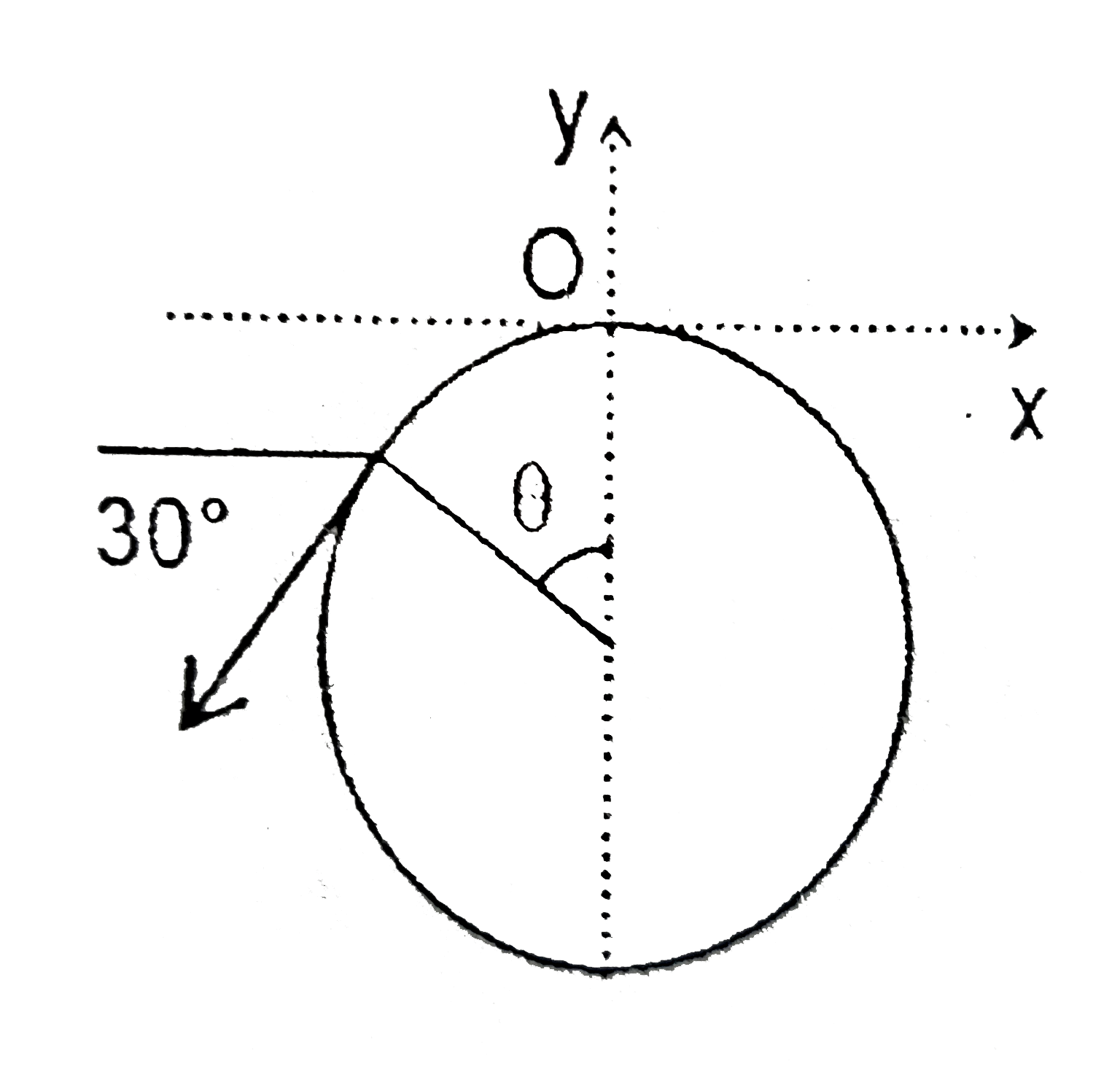
|
|
| 5. |
The audible range of frequencies is |
|
Answer» 20KHZ to 20MHz |
|
| 6. |
Is the magnification equal to the magnifying power in this case ? Explain. |
| Answer» Solution : YES. Angular MAGNIFICATION = `(D)/(|U|) = (25)/(((50)/(7))) = 3.5 ` | |
| 7. |
When the value of R in the balanced Wheatstone bridge, shown in the figure, is increased from 5 Omega to 7 Omega, the value of S has to be increased by 3 Omega in order to maintain the balance. What is the initial value of S? |
|
Answer» `2.5 Omega` sinceP and Qhasconstantvalue ` thereforeP/Q =`constant`IMPLIES R/5 ` = constant Nowas perthe questiongivenin orderto maintainthe balance ` R/S = 5/S`( initially ) and ` R/S=(7 )/((S +3))`(finally ) comparingeqn(i ) and (ii) ` therefore(5)/S(S )= (7 )/((S +3)) implies 5 (S+3) = 7 S` ` implies5S+ 15 = 7S implies 7S-5S =15` `implies2S= 15 impliess=(15)/(2) = 7.5Omega ` |
|
| 8. |
A beam of 450 nm light is incident on a metal having work function 2.0 eV and placed in a magnetic field B. The most energetic electrons emitted perpendicular to the field are bent in circular arcs of radius 20 cm. Find the value of B. |
|
Answer» Solution : The KINETIC energy of the most energetic electrons is ` K= (HC/ lambda)- varphi` ` =( 1242eV nm / 450 nm) - 2.0e V.` ` = 0.76 e V = 1.2 XX (10^-19)J` ` The linear momentum = mv = (sqrt(2mK)).` ` = (sqrt (2 xx (9.1 xx (10^-31) kg) xx (1.2 xx (10^-19)J)))` ` = 4.67 xx (10^-25) kg (ms^-1).` ` When a charged particle is SENT perpendicular to magnetic field, it goes along a circle of RADIUS. ` r = (mv/ qB)` ` Thus, 0.20m = (4.67 xx (10^25)kg m (s^-1)/ (1.6 xx (10^-19)C)xx B).` ` or, B= (4.67 xx (10^-25)kg (ms^-1))/((1.6 xx (10^-19)C) xx (0.20m))= 1.46 xx (10^-5).` |
|
| 9. |
A triode whose mutual conductance is 2.5 m A / volt and anode resistance is 20 kilo ohm , is used as an amplifier whose amplification is 10. The resistance connected in plate circuit will be |
| Answer» Answer :B | |
| 10. |
The function of a moderator in a nuclear reactor is |
|
Answer» To slow down the NEUTRONS |
|
| 11. |
A charged particles oscillates about its mean equilibrium position with a frequency of 10^(9) Hz. What is the frequency of the electromagnetic waves produced by the oscillator ? |
| Answer» Solution :The FREQUENCY of electromagnetic wave is same as that of oscillating charged PARTICLE about its EQUILIBRIUM position, which is `10^(9)` Hz. | |
| 12. |
During inelastic collision between two objects, which of the following quantity always remains conserved? |
|
Answer» Total linear MOMENTUM |
|
| 13. |
Which of following statements is wrong? |
|
Answer» Resistance of a voltmeter is very high. |
|
| 14. |
The electrostatic force between protons is how many times stronger than gravitational force. |
|
Answer» `10^(34)` |
|
| 15. |
A diamagnetic substance is brought near a strong magnet, then it is |
|
Answer» ATTRACTED by a MAGNET |
|
| 16. |
A uniform cylinder of length L and mass M having crosssectional area A is suspended, with its length vertical, from a fixed point by a massless spring, such that it is half submerged in a liquid of density sigma at equilibrium position. The extension x_(0) of the spring when it is in equilibrium is : |
|
Answer» `(Mg)/k(1-(Lasigma)/M)` `kx_(0)+((AL)/2sigmag)-Mg=0` `x_(0)=Mg[1-(Lasigma)/(2M)]` So, CORRECT choice is (b). |
|
| 17. |
Two blocks connected by aspring rest on a smooth ITIM horizontal plane as shown in figure. A constant force F starts acting on block m_(2)as shown in the figure. Which of the following statements are not correct? |
|
Answer» Length of the SPRING INCREASES continuously if `m_(1) gt m_(2)` `F/(m_(1) + m_(2))` Hence, centre of mass of the system moves with a constant acceleration. Initially, there is no tension in the spring, therefore `m_(2)`has an acceleration `F//m_(2)`and it starts to move to the right. Due to its motion, the spring elongates and a tension is developed. Therefore, acceleration of `m_(2)` decreases while that of m, increases from initial value zero. The blocks starts to perform SHM about their centre of mass and the centre of mass moves with the acceleration calculated above. Hence, option (b) is correct. Since the blocks perform SHM about centre of mass, therefore the length of the spring varies periodically. Hence, option (a) is wrong. Since magnitude of the force F remains constant, therefore amplitude of oscillations ALSO remains constant. So, option (C) is also wrong. Acceleration of my is maximum at the instant when the spring is in its minimum possible length, which is equal to its natural length. Hence, at initial moments, acceleration of `m_(2)`is maximum possible. The spring is in its natural length, not only at initial moment but also at time t= T, 27, 37, ...... where T is the period of OSCILLATION. Hence, option (d) is also wrong |
|
| 18. |
Give the relation between geometric length (l_g) and magnetic length (l_m) of a bar magnet |
|
Answer» `l_(m) =(5)/(6) l_g` |
|
| 19. |
A basic communication system consists of (A) transmitter (B) information source (C) user of information (D) channel ( E) reciever Choose the correct sequence in which these are arranged in a basic communication system. |
|
Answer» ABCDE 
|
|
| 20. |
36 cells each of internal resistance 0.5Omega and emf 1.5 V each are used to send current through an external circuit of 2Omega resistance. Find the best mode of grouping then for maximum current and the current through the external circuit. |
|
Answer» Solution :LET, 36 cells are grouped in m ROWS, each row containing n cells . Then , MN = 36 Internal resistance in each row = nr , here, r = 0.5 `Omega` Internal resistance for m rows = `(nr)/(m)`. `therefore` Total resistance in the CIRCUIT = `(R + (nr)/(m))`, here, R = 2`Omega` The emf each row = nE = effective emf of m rows, here, E = 1.5 V `therefore` Current in external circuit, ` I = (nE)/(R + (nr)/(m)) = (mnE)/(mR + nr) = (mnE)/((sqrt(mR)- sqrt(nr))^(2) + 2 sqrt(mnRr))` AsmnRr = constant, I is maximum for `(sqrt(mR) - sqrt(nr))^(2) = `0 `therefore "" mR = nr or, (36)/(n) xx 2 = n xx 0.5` or, `"" n^(2) = (36 xx 2)/(0.5) = 144` Then, n = 12 and m = `(36)/(12) = 3 ` So, the best MODE of grouping is in 3 rows, each row having 12 cells. |
|
| 21. |
Figure shows a two slit arrangement with a source which emits unpolarised light P is a polariser with axis whose direction is not given. If I_(0) is the intensity of the principal maxima when no polariser is present then the intensity of the principal maxima as well as of the first minima are |
|
Answer» `(I_(0))/(2), (I_(0))/(3)` |
|
| 22. |
What is angle of prism ? |
| Answer» SOLUTION :It is the ANGLE between TWO refracting faces ofthe PRISM. | |
| 23. |
Which cell organelle plays a crucial role in detoxifying many poisons and drugs in a cell? |
|
Answer» GOLGI apparatus |
|
| 24. |
One end of a massless spring of spring constant 100 Nm^(-1) and natural length 0.5 m is fixed and the other end is connected to a particle of mass 0.5 kg lying on a frictionless horizontal table. If the mass rotates at an angular velocity of 2 rad s^(-1), the elongation of the spring is approximately. |
|
Answer» 4 cm |
|
| 25. |
A galvanometer of resistance 20Ω is to be converted into an ammeter of range 1A . If a current of 1 mA produces full scale deflection, the shunt required for this purpose is |
|
Answer» 0.01 `(OMEGA)` |
|
| 26. |
The process of measurement |
|
Answer» Always DISTURBS the system being MEASURED |
|
| 27. |
The work done during expansion of a gas in vacuum is zero, because there is |
|
Answer» no CHANGE in volume |
|
| 28. |
Sensitivity of a potentiometer can be increased by ______the length of potentiometer wire. |
| Answer» Solution : increasing. GREATER the length of potentiometer wire, SMALLER is the potential gradient and potentiometer becomes more sensitive. | |
| 29. |
What did the man sell? |
|
Answer» Cookies |
|
| 30. |
The initial shape of the wave front of the beam is |
|
Answer» convex |
|
| 31. |
If the amplitude of sound is doubled and the frequency reduced to one-fourth, the intensity of sound at the same point will be : |
|
Answer» increasing by a factor of 2 `rArr = I alpha v^(2) r^(2)`. As amplitude r is DOUBLED and FREQUENCY is reduced to one-fourth `therefore` Intensity of wave becomes `(1)/(4)` th Hence correct CHOICE is (c). |
|
| 32. |
From the condition of the foregoing problems find how much (in pecent) the energy of the emitted photon differs from the energy of the corresponding transition in a hydrogen atom. |
|
Answer» SOLUTION :We have `EPSILON=(3)/(3) ħR` and `epsilon~=(3)/(4) ħR-(1)/(2M)((3)/(4) ħR//c)^(2)` Then `(epsilon-epsilon')/(epsilon)=(3 ħR)/(8Mc^(2))=(V_(H))/(2c)=5.5xx10^(-6)%` |
|
| 33. |
The tree referred by Mr. Johnson was |
|
Answer» EXISTENT |
|
| 34. |
A charge .q.is distrubuted over two concertric hollow conducting sphere of radii r and R (lt r) such that their surface charge densite are equal. The potential at their common centre is |
|
Answer» ZERO |
|
| 35. |
Figure shows a combination of twelve capacitors each of capacitance C forming a cube . Find the equivalent capacitance of the combination ( a) between the diagonally opposite corners A and B of cube ( b) between the diagonally opposite corners A and D of a face of the cube . |
Answer» Solution :(a) Suppose the charge supplied by the battery is Q . This will be equally divided on the three CAPACITORS connectedto A because on looking from A to B three sides of the CUBE have indentical properties . Hence each capacitor connected to A has charge `(Q)/(3)` . Similarly each capacitor connected to B ALSO has charge `(Q)/(3)` . In the figure ( b) the charges SHOWN are the charges on the capacitors ( i.e charges on their positive plates ) 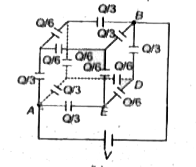 Now `V=(V_(A)-V_(E))+(V_(E)-V_(D))+(V_(D)-V_(B))` `=(Q_(3))/(C)+(Q//6)/(C)+(Q//3)/(C) =(50)/(6C)` `:. C_(eq)=(Q)/(V) = (6)/(5) C` 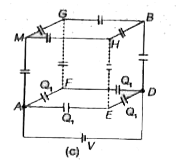 (b) On looking from A to D into the circuit and from D to A into circuit we find symmetry . Henc the charge on each of the four capaitors of the face AEDF is same ( say `Q_(1))` . It means there is no charge on the capacitors between F and G nd between E and H . Hence to find the equivalent capacitance the combination may be taken without these two capacitors which has been shwon in the figure (d). 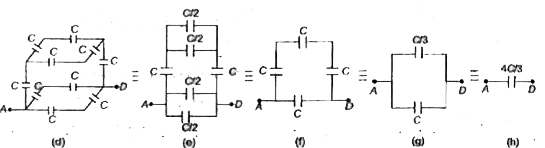
|
|
| 36. |
The turns of solenoid, designed to provide a given magnetic fulx density along its axis, are wound to fill the space between two concentric cylinder of fixed radii.How should the diameter d of the wire used be chosen so as to minimize the heat dissipated in the winding? |
|
Answer» WIRE should be multiple of 5d |
|
| 37. |
In a Balmer series the transition from other orbits ends up in……. orbit. |
|
Answer» First |
|
| 38. |
A charge is placed on an insulated conductor in the form of a perfect cube. What will be the relative charge density at various points on the cube (surface , edges, corners ), what will happen to the charge if the cube is in air? |
| Answer» Solution :Charge DENSITY at the corners, and EDGES will be GREATER than the charge density at the surface if the cube is PLACED in air, charge may LEAK from corners and edges. | |
| 39. |
Direction of current produced in a circuit on account of motional emf is given by _____. |
|
Answer» |
|
| 40. |
We can't have isolated poles? Why? |
| Answer» SOLUTION :All magnetic fields are caused by ELECTRIC currents. There is on way to DIVIDE up a CURRENT and obtain a single magnetic pole. | |
| 41. |
A diverging beam of light from apoint source S having divergence angle alpha, falls symmetrically on a glass slab as shown. The angles of incidence of the two extrem rays are equal. If the thickness of the glass slab is t and the refractive index n, then the divergence angle of the emergent beam is |
|
Answer» <P>zero Applying Snell's law at P,`(1)/(2)n=(sinalpha//2)/(sinr)` (i) Applying Snell's law at Q, `(1)/(2)n=(sinbeta//2)/(sinr)` (ii) From Eqs. (i) and (ii), `alpha=beta` Therefore, (b) is the correct answer. ltbgt 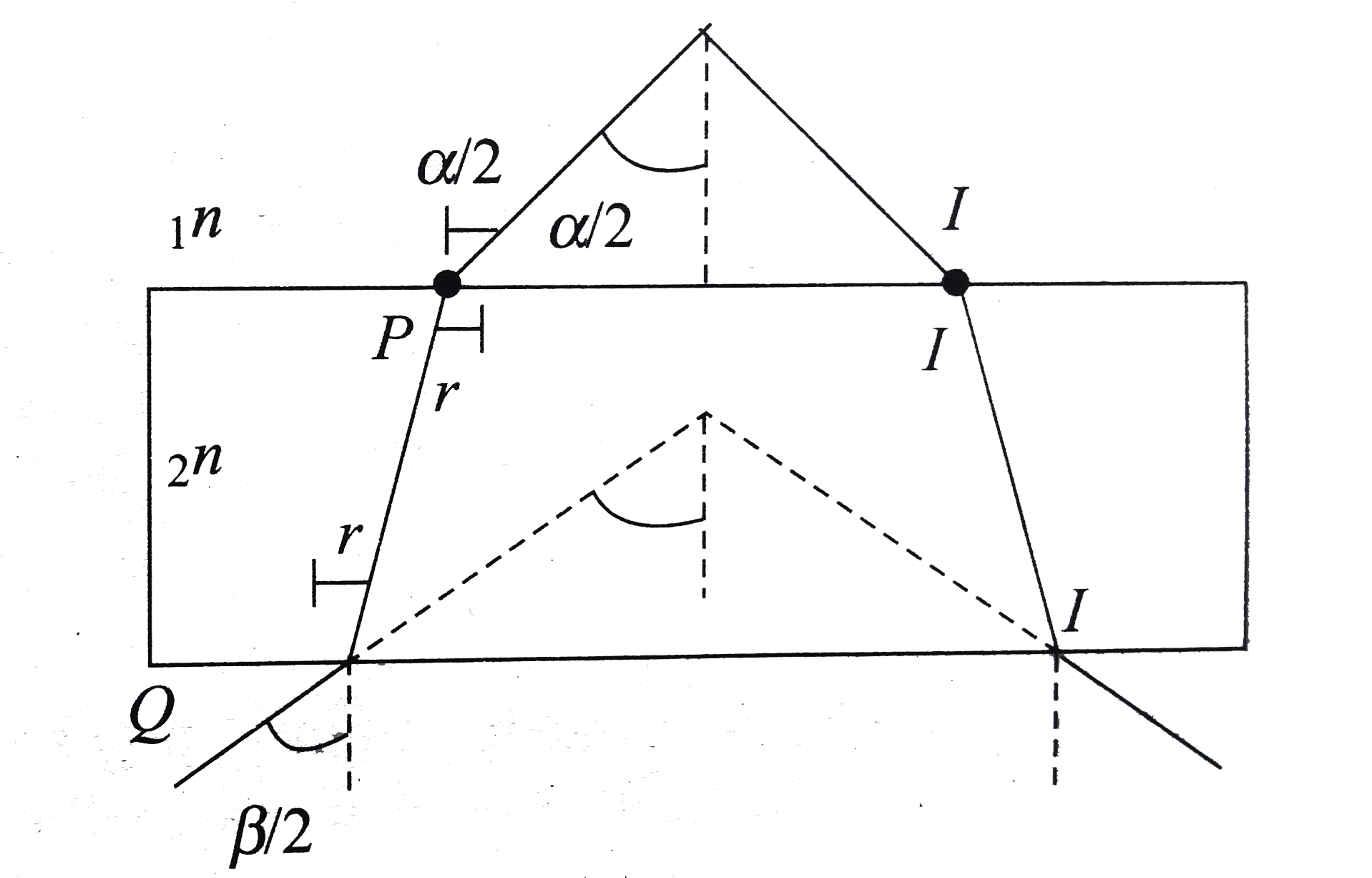
|
|
| 42. |
Frequency of light is 6 xx 10^(15) Hz. Its wavelength in free space is |
|
Answer» 50 nm |
|
| 43. |
(A): In an N type semiconductor fermi level shifts towards conduction band (R) : Donor impurities are present in N-type semi conductor. |
|
Answer» Both 'A' and 'R' are true and 'R' is the CORRECT explanation of 'A' |
|
| 44. |
वस्तविक संख्याओ x तथा y के लिए परिभाषित कीजिए कि xRy ,यदिऔर केवल यदि x-y+v2 एक अपरिमेय संखया है तो संबंध R |
|
Answer» स्वतुल्य है |
|
| 45. |
The maximum intensity in Young.s double slit experiment is I_0. Distance between slits is d= 5 lambda, where lambda is the wavelenght of the monochromatic light used in the experiment. What will be the intensity of light in front of one of the slits on a screen at a distance D= 10d. |
|
Answer» SOLUTION :Path difference `trianglex = (yd)/(D)` Here, `y= (d)/(2)= (5 lambda)/(2)(" as "d= 5 lambda)" and "D= 10d= 50 lambda` So `trianglex = ((5lambda)/(2))((5lambda)/(50lambda))= (lambda)/(4)` CORRESPONDING PHASE difference `phi = (2lambda)/(lambda)XX (lambda)/(4)= (pi)/(2) I= I_(0) cos^(2) (lambda/4)= (I_0)/(2)`. |
|
| 46. |
(a) A conductor A with a cavity as shown in figure (a) is given a charge Q. Show that the entire charge must appear on the outer surface of the conductor. (b) Another conductor B with charge q is inserted into the cavity keeping B insulated from A. Show that the total charge on the outside surface of A is Q + q figure (b) ( C) A sensitive instruments is to be shielded from the strong electrostatic fields in its environment. Suggest a possible way. |
|
Answer» Solution :(a) As we know, electric field inside the charge conductor is zero. `vecE_(in)=0` Select a Gaussian surface which encloses the cavity in the conductor as shown in figure (a). From Gauss.s law, `oint vecE. DVECS = Q/epsilon_(0)` `therefore vecE =0` (Inside) `therefore` Charge enclosed q=0 Hence, charge given to the conductor, Q will be distributed on its surface only. (b) By placing conductor B with charge .Q. in cavity of conductor A, - q charge is induced on the cavity surface. And + q charge is induced on the outer surface of conductor A. Now, total charge surface on of A will become Q + q. (c) Suppose, we have electrically neutral metallic conductor A having some cavity (empty space) and we have another electrically neutral metallic conductor C which is to be completely protected against external electric field. For this, we place < inside the cavity of A but at the same tim isolated from A (i.e. A and C are not inte connected). Now, suppose A is subjected to somi external electric field as shown in abov figure. Here as soon as we apply thir-external electric field, free electrons on th. outer surface of A displace immediately ii the direction opposite to externally appliec electric field Ea because of this, anothe: electric field gets developed inside A called induced electric field `vecE_(i)`in a directior opposite to `vecE_(a)` . When `E_(i) = E_(a)` free electronsdo not move at all and thus become static on the outer surface of A. Here, A is said to be in "Electrostatic EQUILIBRIUM condition". Now, for all the points on the Gaussian surface 1 (surrounding to cavity and very close to cavity) we have E = 0, because `q_("enclosed")=0`surface of cavity remains chargeless as it was before the application of external electric field. It means that surface of cavity remains unaffected though conductor A is exposed to external electric field. Moreover, inside the cavity there is no charge as conductor C is electrically neutral. Hence, for all the points on Gaussian surface 2 also, E = 0. Thus, C gets complete protection by the surface of cavity. Here, however strong applied electric field may be there is no INDUCTION of charge on the surface of C. That is why C is said to be "Electrostatically shielded" against external electrical conditions outside A. Note : During thunderstorm with lightening (especially in rainy season) when we are inside the car with doors and windows closed we are in the cavity of a metallic body of a car and so we remain safe in the car due to "electrostatic shielding". Thus, during lightening in the atmosphere, ONE should not stand on the open road. Instead, it is always preferable to be inside the closed car. |
|
| 47. |
You are driving toward a traffic signal when it turns yellow. Your speed is the legal speed limit of v_(0)=55km//h, your best deceleration rate has the magnitude a=5.18 m//s^(2).Your bestreaction time to begin braking is T=0.75s. To avoid having the front of your car enter the intersection after the light turns red, should you brake to a stop or continue to move at 55 km/h if the distance to the intersection and the duration of the yellow light are (a) 40 m and 2.8 s, and (b) 32 m and 1.8 s ? Give an answer of brake, continue, either ( if either strategy works ), or neither ( if neither strategy works and the yellow duration is inappropriate ) . |
|
Answer» |
|
| 48. |
According to de-Broglie.s explanation of Bohr.s second postulate of quantization, the standing particle wave on a circular orbit for n=4 is given by |
|
Answer» `[2PI r_n = 4/LAMBDA]` |
|
| 49. |
If L,C,R denote the inductance, Capacitance and resistance repectively, the dimenstional formula of C^(2)LR is : |
|
Answer» `ML^(2)T^(-1)I^(0)` `=q^(2)xx(dt)/((dq)/(dt))xx(I)/((q)/(t))` DIMENSIONALLY`=(dt)^(2)xxt~~t^(3)=M^(0)L^(0)T^(3)I^(0).` Hence correct choice is `(b)`. |
|
| 50. |
The shape of wavefront emitted by a light source in the form of a narrow slit is |
|
Answer» Spherical |
|