Saved Bookmarks
This section includes 7 InterviewSolutions, each offering curated multiple-choice questions to sharpen your Current Affairs knowledge and support exam preparation. Choose a topic below to get started.
| 1. |
As shown in figure, a long wire kept vertically on the plane of paper carries electric current-I. A conducting ring moves towards the wire with velocity v with its plane conducting with the plane of paper. Find the induced emf produced in the ring when it is at a perpendicular distance r from the wire. Radius of the ring is a and a lt lt r. |
|
Answer» Solution :Magnetic FIELD at a distance r from the wire carrying current is `B =(mu_0I)/(2pir)` `THEREFORE` Magnetic flux linked with the RING, `phi=B(pia^2)` `=(mu_0I)/(2pir)xxpia^2` `=(mu_0Ia^2)/(2r)` `therefore` EMF `epsilon=-(dphi)/(dt)` `=-d/(dt)((mu_0Ia^2)/(2r))` `=(mu_0Ia^2)/2 (1/r^2)(dr)/(dt)` `therefore epsilon = (mu_0Ia^2)/(2r^2) v (because (dr)/(dt)=v)` |
|
| 2. |
Electric field due to an infinitely long plane sheet of charge varies with the distance 'r' from the sheet as |
|
Answer» `E propt 1/R` |
|
| 3. |
Two masses m_(1) and m_(2) are initially at rest at infinite distance. They approach each other due to gravitational attraction. What is the speed of approach at a distance r between them? |
|
Answer» `(2G)/(r(m_(1)+m_(2)))` If v is the relative VELOCITY of approach then by LAW of CONSERVATION of energy. `(1)/(2) ((m_(1)m_(2))/(m_(1)+m_(2)))v^(2)-(Gm_(1)m_(2))/(r )=0` or `v=[(2G(m_(1)+m_(2)))/(r )]^((1)/(2))` Thus correct CHOICE is (b). |
|
| 4. |
Why are pole pieces of a galvanometer made concave ?or what is the importance of radial magnetic field in a moving coil galvanometer? |
| Answer» Solution :Concave pole pieces PRODUCE STRONG radial MAGNETIC field. The plane of the COIL is parallel to the magnetic field lines for all POSITIONS of the coil. So irrespective of the position of the coil, torque acting on the coil will be the same . | |
| 5. |
Lines joining places of equal angle of declination are called |
|
Answer» Isogonic |
|
| 6. |
Figure shows the potential due to similarly charged infinite sheets with charge per unit are sigma_2 and sigma_1. From examining third plot we can deduce that |
|
Answer» `sigma_2gtsigma_1` |
|
| 7. |
Find the electric field on the axis of a charged disc. |
|
Answer» Solution :Consider a disc of uniform surface charge density `'sigma'`. Let US calculate the electric field due to a charged ring of radius r. from the centre and having a width, dr. Here we are using the expression for electric field INTENSITY for a charged ring of radius r at a point on the axis at a distance x from the centre. `E=(kxq)/((x^(2)+r^(2))^(3//2))` directed along the axis outwards from the centre. Thus electric field due to elementary ring. `dE=(kxdq)/((x^(2)+r^(2))^(3//2))`, directed along the line OP. Now, the area of the ring, `dS=2pir.dr` Charge on the elementary ring `implies dq=sigma2pirdr`, Thus, electric field due to entire disc `|E|_(p)=intdE=kxunderset(0)overset(R)INT(sigma2pirdr)/((x^(2)+r^(2))^(3//2))=(1)/(4piin_(0))x.sigmapiunderset(0)overset(R)int(2r)/((x^(2)+r^(2))^(3//2))dr` `E=(sigma)/(2in_(0))[1-(x)/((x^(2)+R^(2))^(1//2))]=(sigma)/(2epsilon_(0))(1-costheta)`, where `theta` = semi vertical angle subtend by the disc at P. Also, as `Rrarroo,E=(sigma)/(2in_(@)`, which is the electric field in front of an infinite plane SHEET of charge. 
|
|
| 8. |
An ac source is connected to a resistive circuits. Which of the following statements are false ? |
|
Answer» CURRENT leads ahead of voltage in phase |
|
| 9. |
An electromagnetic wave of v = 3MHz passes from vacuum into dielectric medium with epsilon = 4.0 epsilon_(0). Then : |
|
Answer» wavelength is doubled and FREQUENCY BECOMES half `:. C=v lambda implies C PROP lambda` so when `C. =C // 2, lambda.=lambda // 2` |
|
| 10. |
LASER is device for |
|
Answer» Producing a beam of white LIGHT |
|
| 11. |
Using Gauss'stheorem show mathematically that for any point outside the shell , the field due to a uniformaly charged thin spherical shell is the same as if the entire charge of the shell is concentrated at the centre? Why do you expect the electric field inside the shell to be zero according to this theorem? |
| Answer» Solution :To SHOW that at any point outside the SPHERICAL shell electric field is same as if whole CHARGE of shell is concentreated at the centre , see Short Answer Question number 40.At the point inside the shell , ACCORDING to Gauss theorem, we expect the electric field to be zero because there is no charge present inside. Hence electric flux and consequently electric field at that point will be zero. | |
| 12. |
A radioactive decay can form an isotope of the original nucleus with the emission of particles : |
|
Answer» one `ALPHA" and two "beta` |
|
| 13. |
Energy of a hydrogen atom with principal quantum number n is shown by E = (-13.6)/(n^(2)) eV. The energy of a photon ejected when the electron jumps from n = 3 state to n = 2 state of hydrogen is approximately. |
|
Answer» `1.9eV` `=13.6((1)/(4)-(1)/(9))eV=1.9eV` |
|
| 14. |
A galvanometer of resistance 40Omega and current passing through it is 100 μ A per division. The full scale has 50 divisions . If it is converted into an ammeter of range 2A by using a shunt, then the resistance of ammeter is |
|
Answer» `40/399Omega` |
|
| 15. |
Five persons A, B, C, D & E are pulling a cart of mass 100kg on a smooth surface and cart is moving with acceleration 3m//s^2 in east direction. When person 'A' stops pulling, it moves with acceleration 1m//s^2 in the west direction. When person 'B'stops pulling, it moves with acceleration 24m//s^2 in the north direction. The magnitude of acceleration of the cart when only A & B pull the cart keeping their directions same as the old direction is |
| Answer» Answer :C | |
| 16. |
Which of the following is the correct prefix with the word "favorable" |
|
Answer» Semi-favorable |
|
| 17. |
Focal lenghts of objective and eye-piece of telescope 200 cm and 2 cm respectively. If a building of 50 m height at 2 km away is observed from this, then height of image of objective will be ...... |
|
Answer» 5 cm `u_0=-2xx10^5` cm `(1)/(v_0)-(1)/(u_0)=(1)/(f_0)` `THEREFORE (1)/(v_0)=(1)/(f_0)+(1)/(u_0)` `therefore (1)/(v_0)=(1)/(200)+(1)/(-2xx10^5)=(1)/(200)-(1)/(2xx10^5)` `(1)/(v_0)=(999)/(2xx10^5)` `therefore v_0=(2xx10^5)/(999)` cm Now `("dimensions of image")/("dimensions of object")=((v_0)/(u_0))` `therefore` Image DIMENSION`=((v_0)/(u_0))xx`Object dimension `=((2xx10^5)/(999)xx(1)/(2xx10^5))xx(50xx100)` `(5000)/(999) ~~5` cm |
|
| 18. |
Give any two differences between Fresnel and Fraunhoffer diffraction. |
Answer» SOLUTION :
|
|
| 19. |
A bar magnet M is dropped so that it falls vertically throughthe coil C [Fig. 6.29). The graph obtained for voltage produced across the coil vs time is shown in Fig. 6.30. (a) Explain the shape of the graph. (b) Why is the negative peak longer than the positive peak? |
|
Answer» Solution :As the mynet APPROACHES the coil C, magnetic flux linked with coil increases and an emf is induced in it which opposes the in- crease in flux. When magnet is fully inside the coil, magnetic flux linked with coil becomes constant and, HENCE, induced emf falls to zero. As the magnet falls below the coil, magnetic flux of the coil decreases. As a result, an induced emf is SET up which opposes the decrease in flux i.e., which tends to increase the magnetic flux. Thus, induced emf now is in a direction OPPOSITE to that EARLIER. As velocity of magnet has increased during its fall, the negative peak of emf is longer than the positive peak. When the magnet has fallen through large distance, magnetic flux of coil becomes constant and induced emf vanishes. |
|
| 20. |
The magnifying power of an astronomical telescope in the normal adjustment position is 100. The distance between the objective and eye piece is 101 cm . Calculate the focal lengths of objective and eye piece. |
| Answer» SOLUTION :`f0=100 CM,fe=1cm` | |
| 21. |
What will be the temperature at which a solution containing 6 g of glucose per 1000 g water with boil, if molal elevation constant for water is 0.52/1000 g. |
|
Answer» `1000.173^(@)`C `DeltaT_(b)=(1000xxK_(b)xxw)/(180xx1000)=0.0173^(@)C` HENCE boiling point of solution =b.p of WATER + `DeltaT_(b)=100+0.0173^(@)C` |
|
| 22. |
1 mole = ……………… millimoles |
|
Answer» 100 |
|
| 23. |
Explain the Rutherford experiment on the scattering of alpha particles and state the conclusion drawn from the result. |
|
Answer» The schematic diagram of scattering of `alpha`-particles is shown in Fig. B is a block of lead having a thin tunnel. This tunnel terminates into a hole H inside the block. The radiun source emits `alpha`-particles in all directions. Most of `alpha`-particles are absorbed by the lead block. A thin pencil of `alpha`-RAYS comes out of the tunnel and falls on a gold foil. The gold atoms scatter the `alpha`-particles. When scattered `alpha`-particles fall on a screen S coated with zinc sulphide (ZnS),they produce flashes. These flashes are observed through the telescope T. Particles scattered through DIFFERENT angles can be observed by rotating the ZnS screen along with the telescope. 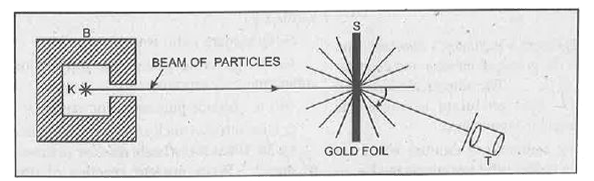 . . Observations. (i) Most of the `alpha`-particles were scattered by small angles of the order of a few degrees. (ii) Some `alpha`-particles werescattered in the backward direction i.e. by angles more than `90^(@)`. (iii) A few of `alpha`-particles were reflected nearly STRAIGHT back. Conclusion. (i) Since a large NUMBER of `alpha`-particles sufferpractically no deviation, it means that major portion of atom is empty space. (ii) The scattering of `alpha`-particles through large angle showed that these `alpha`-particles experienced a very strong electric force of repulsion. This indicates that the entire +ve charge of atom is confined in a small part of the volume of atom. (iii) The backward scattering of `alpha`-particles shows that most of the mass of atom concentrated in a small protion of the volume of the atom. |
|
| 24. |
The equation of a stationary wave is y= 4 sin ((pix)/(5))cos (100pi t) . The wave is formed using a string oflength 20cm. The second and 3rd antipodes are located at positions (in cm) |
|
Answer» 7.5, 12.5 |
|
| 25. |
(A): In pair annihilation, an electron and position destroy each other and produce 2 gamma -rays (R) : 2 gamma-rays produced will have equal momentum in opposite direction and momentum is conserved |
|
Answer» Both .A. and .R. are TRUE and .R. is the correct EXPLANATION of .A. |
|
| 26. |
Two charged balls moving in the same direction with same velocity v are placed in an electric field. After some time, one ball moves with velocity v/2 at an angle of 60^(@) with the initial direction and the other ball moves at right angles to the initial direction with a velocity v'. Then, the value of v' is |
|
Answer» `v/sqrt2` |
|
| 27. |
When the number of turns in a coil is doubled without any change in the length of the coil, its self-inductance becomes |
|
Answer» 4 times. |
|
| 28. |
In a series combination of R, L and C to an A.C. Source at resonance if R = 200 hm, then impedance Z of the combination is |
|
Answer» 200 hm |
|
| 29. |
The least distance of distinct vision of a man is 45cm. He uses a lens of focal length 15 cm for reading . The magnification which hegets |
|
Answer» 4 |
|
| 30. |
Two charges +q and -q are kept at (-x_1,0) and (x_1,0)respectively in the x-y plane. Find the magnitude and direction of the net electric field at the origin (0,0) |
|
Answer» Solution :LET two charges of +q and -QBE KEPT at POINTS A and B having coordinates `(-x_1,0)and (x_1,0) `as shown in the x-y plane Net electric field origin point ` O= oversetto E= oversetto(E_A) +oversetto (E_B) ` But ` oversetto (E_(A)) =(1)/(4piin _0) .(q)/(x^(2)) ` , along AOB and ` oversetto (E_(B)) = ( 1)/(4 pi in _0).(q)/(x^(2)) ` along OB. Hence net electric field at point O `oversetto (E)=2 XX (1)/(4 pi in _0) . (q)/(x^(2)) =(q)/(2 pi in_0 x^(2))` along AOB. 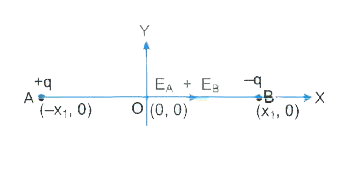
|
|
| 31. |
A thin film is illuminated by wavelength 600 nm in free space at nearly normal incidence. Calculate the minimum thickness of a thin film (mu = 3/2 ) that results in constructive interference in the reflected light. |
|
Answer» Solution :For constructive INTERFERENCE `2MU t = (2N + 1)lamda/2` n=0,1,2, ..... For n=0, 2 `(3/2) t = 600/2 , t= 100nm` |
|
| 32. |
The density of the stretched string is changed by 2% without change in tension and radius. The change in transverse wave velocity. |
|
Answer» 2% INCREASE |
|
| 33. |
Consider thesituation of the previous problum. (a) Find the tension in the string in equilibrium. (b) Suppose the ball is slightly pushed aside and released. Find the time period of the small oscillations. |
|
Answer» Solution :(a) Tension in the string in equilibrium `T cos 60^@ = mg ` ` T = (10^-1) xx 2 = 0.20 N.` (b) Straightening the same fig, now the resultant FORCE 'R' induces the accln.on the PENDULUM ` T = 2 pi (sqrt(i/g))` ` = 2 pi (sqrt(10 xx (10^-2)/9.8))` ` = 0.45 sec.` . |
|
| 34. |
A boat moves relative to water with a velocity which is 'n' times the river flow a) If n lt 1 boat can not cross the river b) If n = 1 boat can not cross the river without drifting c) If n gt 1 boat can cross the river along shortest path d) Boat can cross the river what ever is the value of n excluding zero value |
|
Answer» only a is CORRECT |
|
| 35. |
If yellow light in young's double slit experiment is replaced by blue light of same intensity, then |
|
Answer» FRINGE WIDTH will decrease |
|
| 36. |
A lead sphere of mass m falls in a viscous liquid with a terminal velocity v0. Another lead sphere of mass S m through the same liquid will fall with the terminal velocity: |
|
Answer» `v_(0)` `therefore` VOLUME is also 8 times the first sphere or radius is 2 times the first sphere. As TERMINAL velocity `V oo r^(2)`. `therefore` Velocity becomes 4 times`rArrv^(2)=4v_(0)` Thus correct choice is (b) Hence the correct choice is (c). |
|
| 37. |
Two charged spherical conductors of radii R_(1) and R_(2) when connectedby a connecting wireacquirecharges q_(1) and q_(2) respectively. Find the ratio of theircharge densitiesin terms of theirradil ? |
|
Answer» SOLUTION : When two charged spherical conductors are connected by a conducting wire, they ACQUIRE the same potential. `(kq_1)/R_1=(kq_1)/d` or `q_1/R_1=q_2/R_2 RARR q_1/q_2=R_1/R_2` Hence, the RATIO of surface CHARGE densities `sigma_1/sigma_2=(q_1//4piR_2^1)/(q_2//4piR_2^2)=(q_1R_2^2)/(q_2R_2^1)` `=R_1/R_2xxR_2^2/R_1^2=R_2/R_1` |
|
| 38. |
A 20 kg block B is suspended from a cord attached to a 40 kg cart A. The ratio of the acceleration of the cart in cases (i) & (ii) shown in figure immediately after the system is released from rest is _________ . (neglect friction) . |
| Answer» | |
| 39. |
What does the poet not want to forget? |
|
Answer» His slumber |
|
| 40. |
An insulating spherical shell of uniform surface charge density is cut into two parts and place at a distance d apart as shown in figure. vecE_p and vecE_Q denote the electric fields at P and Q, respectively. As d (i.e. PQ) rarr oo |
|
Answer» <P>`|vecE_(P)|gt|vecE_(Q)|` The ELECTRIC field inside any point of the sphere is zero. |
|
| 41. |
The ratio of the wavelength for the transition from n = 2 to n = 1 in Li^(++).He^(+) and H is |
|
Answer» `1 : 2 : 3` `1/lambda=Z^2R (1/n_1^2-1/n_2^2)`For, `Li^(+ +), z = 3` `lambda prop 1/z^2``He^(+),z= 2` `lambda_(He^(+)) : lambda_(He^(+)) : lambda_(H) = 4 : 9 : 36`H, Z = 1 |
|
| 42. |
A bomb at rest at the summit of a cliff breaks into two equal fragments. One of the fragments attains a horizontal velocity of 20sqrt(3) ms^(-1). The horizontal distance between the two fragments, when their displacement vectors is inclined at 60^@ relative to each other is (g = 10ms^(-2)) |
| Answer» Answer :D | |
| 44. |
A point charge +Q is placed at the centre 0 of an uncharged hollow spherical conductor of inner radius 'a' and outer radius 'b'.Find the following. The magnitude of electric field vector at a distance (i) r=a/2, and (ii) r=2b, from the centre of the shell. |
|
Answer» SOLUTION :To show USING Gauss’s LAW expression Expression for electric field for RADIUS, Expression for electric field for radius. |
|
| 45. |
Two protons are at a distance of 0.53 xx 10^(-10) m. Calculate the potential energy of the system in eV. |
|
Answer» |
|
| 46. |
The charge flowing through a resistance R varies with time t as Q = at - bt^(2), where a and b are positive constants. The total heat produced in R is: |
|
Answer» `(a^(3)R)/(6B)` |
|
| 47. |
Statement-1: When cathode rays strike a hard metallic surface highly penetrating radiation is obtained. bacause Statement-2 :The shortest wavelength limit of X-rays produced is inversely proportional to the accelerating voltage. |
|
Answer» Statement -1 is TRUE, statement -2 is True, Statement -2 is a CORRECT explanation for Statement -1. |
|
| 48. |
Draw the graph showing distribution of kinetic energy of electrons emitted during beta decay. |
Answer» SOLUTION :
|
|
| 49. |
A point charge +Q is placed at the centre 0 of an uncharged hollow spherical conductor of inner radius 'a' and outer radius 'b'.Find the following. The magnitude and sign of the charge induced on the inner and outer surface of the conducting shell. |
|
Answer» Solution :As the electrostatic FIELD inside a conductor is ZERO, using Gauss’s law, charge on the inner SURFACE of the shell = -Q Charge on the outer surface of the shell = +Q |
|
| 50. |
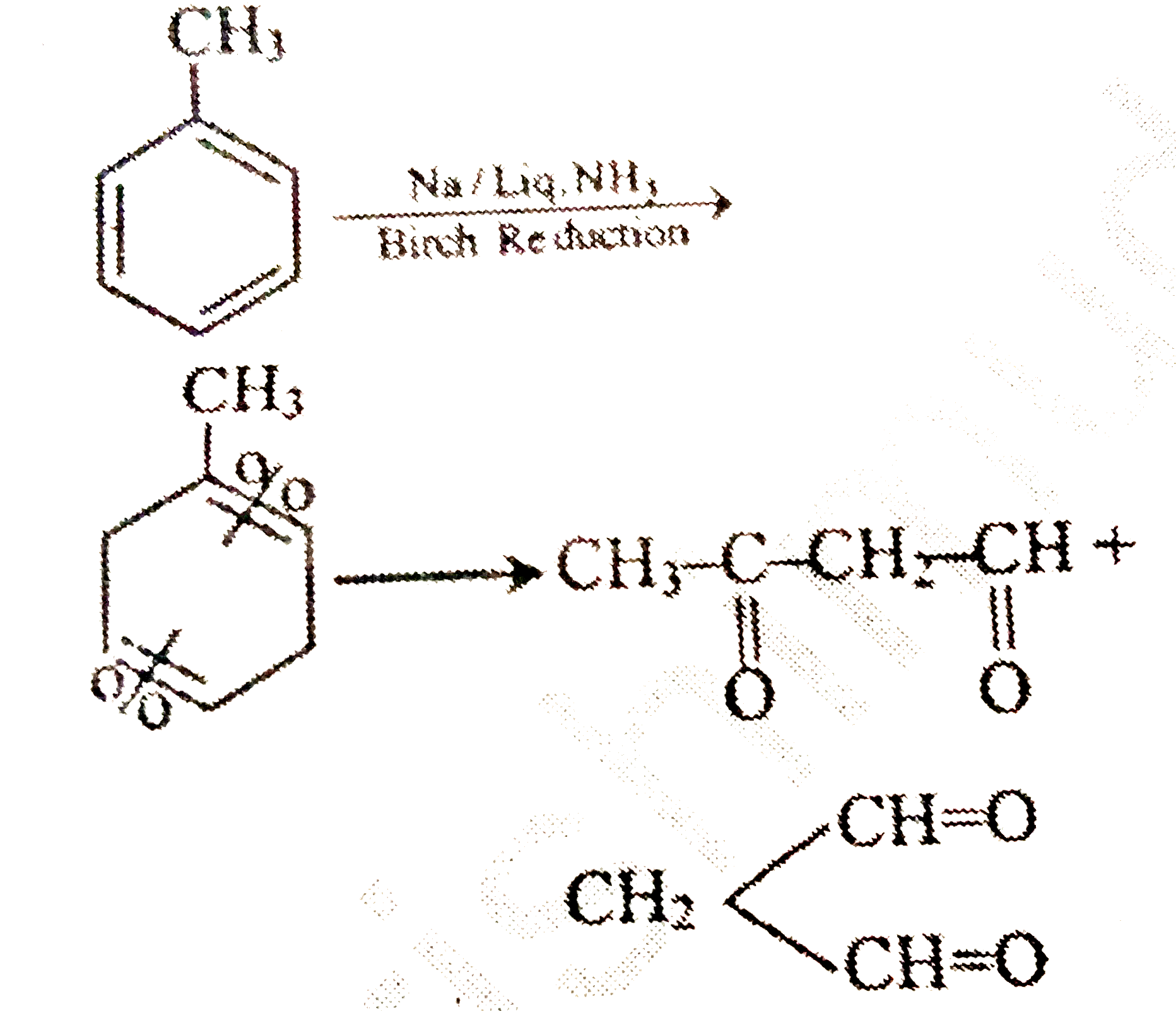
Product: |
|
Answer»
|
|