

Saved Bookmarks
This section includes 7 InterviewSolutions, each offering curated multiple-choice questions to sharpen your Current Affairs knowledge and support exam preparation. Choose a topic below to get started.
| 1. |
Show that in the free oscillation of an LC circuit, the sum of energies stored in the capacitor and the inductor is constant with time. |
| Answer» SOLUTION :`U = (1)/(2) LI^2 + (1)/(2) (q^2)/(C )` | |
| 2. |
Assertion : The relativevelocity of two photons travellingin opposite directions is C. Reason :The rest mass of a photon is zero . |
|
Answer» If both the ASSERTION and reason are true statement andreason is correct explanation of the assertion . RELATIVISTIC mass of photon - The relativistic momentum of photon is`p=(m_(0)V)/(sqrt(1-((v^(2))/(c^(2))))` But`p=(h)/(lambda)` ` :. (h)/( lambda)=(m_(0)V)/(sqrt(1-((v^(2))/(c^(2))))` `m_(0)=(h)/(v lambda)sqrt(1-((v^(2))/(c^(2)))` For a photon v=c , then , `m_(0)=0` |
|
| 3. |
Calculate the wavelength of an electron accelerated under a p.d of 150 V. |
|
Answer» SOLUTION :`V=150V,m=9.1xx10^-31kg` `E= 1.6 xx10^-19 C,h=6.62xx10^-34Js` `lambda=h/SQRT(2meV` `=(6.62xx10^-34)/sqrt(2xx9.1xx10^-31xx1.6xx10^-19xx150)=1xx10^-10m=1A^@` |
|
| 4. |
Is electric current a scalar or vector quantity ? Give reason. |
| Answer» Solution :ELECTRIC current is a scalar QUANTITY as LAWS of ORDINARY ALGEBRA are used to add electric currents. | |
| 5. |
1 g of hydrogen is converted into 0.993g of helium in a thermonuclear reaction. The energy released is |
|
Answer» `63xx10^7` J |
|
| 6. |
The magnetic moment of a magnet is 5Am^2 . If the pole strength is 25 Am , its length is : |
|
Answer» 10 m |
|
| 7. |
Consider two charges +q and -q placed at B and C of an equilateral triangle ABC. For this system, the total charge is zero. But the electric field (intensity) at A which is equidistant from B and C is not zero. Why? |
| Answer» SOLUTION :Charges are scalars, but the ELECTRICAL INTENSITIES are vectors and add vectorially. | |
| 8. |
Give the magnitude and direction of the net force acting on (a) a drop of rain falling down with a constant speed(b)a cork of mass 10 g floating on water(c ) a kite skillfully held stationary in the sky(d) a car moving with a constant velocity of 30 km/h on a rough road(e ) a high - speed electron in space far from all material objects, and free of electric and magnetic fields. |
|
Answer» SOLUTION :(a) As the rain drop is falling with a constant speed, its acceleration a = 0. Hence net force F = ma = 0. (b) As the cork is floating on water, its WEIGHT is being balanced by the UPTHRUST (equal to weight of water displaced). Hence net force on the cork is zero. (c ) As the kite is held stationary, net force on the kite is zero, in accordance with Newton.s first law. (d) Force is being applied to overcome the force of FRICTION. But as velocity of the car is constant, its acceleration. a = 0. Hence net force on the car F = ma = 0. (e ) As no field (gravitational / electric / magnetic) is acting on the electron, net force on it is zero. |
|
| 9. |
Monochromatic light ofwavelength 632.8 nm is produced by a helium-neon laser. The power emitted is 9.42 mW. a. Find the energyand momentum of each photon is the light beam. b. How many photons per second, on the average, arrive at a target irradiated by this beam? (Assume the beam to have uniform cross-section which is less than the target area). c. How fast does a hydrogen atom have to travel in order to have the same momentum as that of the photon? |
|
Answer» Solution :`LAMBDA=632.8 nm=632.8xx10^(-9)m, P=9.42 mW=9.42xx10^(-3)W` a.`E=hupsilon=h(C )/(lambda)=(6.6xx10^(-34)xx3xx10^(8))/(632.8xx10^(-9))=3.14xx10^(-19)J=1.96eV` `p=(h)/(lambda)=(6.6xx10^(-34))/(632xx10^(-9))=1.044xx10^(-27) KG ms^(-1)` B. `P=nh upsilon, n=(P)/(h upsilon)=(Plambda)/(hc)=(9.42xx10^(-3)xx632.8xx10^(-9))/(6.6xx10^(-34)xx3xx10^(8))=3xx10^(16)` photon/s c.`mv=1.044xx10^(-27), v=(1.044xx10^(-27))/(1.67xx10^(-27))=0.625m//s` |
|
| 10. |
The horizontal acceleration that should be given to a smooth inclined plane of angle sin^(-1)((1)/(l)) to keep an object stationary on the plane, relative to the inclined plane is : |
|
Answer» `(G)/(sqrt(l^(2)-1))` `mg sin theta= ma costheta` `a = g tan theta( :.sin theta =(1)/(l))` `gxx(1)/(sqrt(l^(2)-1))=(g)/(sqrt(l^(2)-1))` (a) is the choice. 
|
|
| 11. |
The audio signal voltage is given by V_(m) = 2 sin 12 pi xx 10^(3)t. The band width and LSB if carrier wave has a frequency 3.14 xx10^(6) "rad"//s. |
| Answer» Answer :A | |
| 12. |
Scientist ……..invented electron. |
|
Answer» Roentgen |
|
| 13. |
An extended object kept under water in a deep container appears distorted when seen from near the edge of the container. It so happens because |
|
Answer» the appears depth of the points away from the edge |
|
| 14. |
What we call to the rectifier which rectifies only half of each a.c. input supply cycle ? |
|
Answer» |
|
| 15. |
In the given circuit, the voltmeter records 5 V. The resistance of the voltmeter in Omega is |
|
Answer» 200 |
|
| 16. |
Chech that the ratio ke^(2)//"G m"_(e)m_(p) is dimensionless. Look up a table of Physical Constants and setermine the value of this ratio. What does the ratio signify? |
| Answer» SOLUTION :`2.4xx10^(39)` this is the RATIO of ELECTRIC force to thegravitational FORCEBETWEEN an electronand a proton | |
| 17. |
A charged particle, initially at rest O, when released follows a trajectory as shown. Such a trajectory is possible in the presence of |
|
Answer» ELECTRIC field of constant MAGNITUDE and varying direction |
|
| 18. |
In a potentiometer with a cell of unknown emf the balance point was obtained at 60 cm and with a cell of emf 1.5 volt at 45 cm from the same end. Calculate the unknown e.m.f. of the cell. |
|
Answer» |
|
| 19. |
When a -particle of energy 3.5 MeV approaching gold nucleus, it undergoes scattering by 180^@, then distance of closest approach is : |
|
Answer» `12.7 xx 10^(-14)m` `r_(0)=(9 xx 10^(9) xx 2 xx 79 xx (1.6 xx 10^(-19))^(2))/(5.5 xx 10^(6) xx 1.6 xx 10^(-19))m`. `=41.4 xx 10^(-15)m` |
|
| 20. |
The effective resistance between A & B of the shown network Where resistance of each resistor is R, is |
| Answer» Answer :A | |
| 21. |
Three point charges 1C, -2C, and -2C are placed at the vertices of an equilateral triangle of side one metre. The work done by an external force to increase the separation of the charges to 2 metres in joules is : (in_0 permittivity of air) |
|
Answer» `(1)/(4 pi epsi_0)` |
|
| 22. |
The direction of the magnetic field due to a solenoid is given by |
Answer» Solution :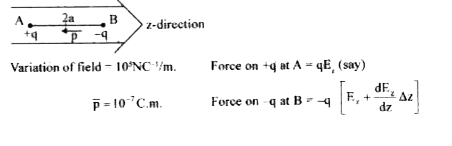 Variation of field `=10^(5)NC^(-1)//m " FORCE on +q at A"=qE_(z) ("say")` `vecp=10^(-7)C.m. " Force on -q at B=-q" [E_(z)+(d E_(z))/(DZ) trianglez]` |
|
| 23. |
A cylindrical capacitor has two co-axial cylinders of length 15 cm, and radii 1.5 cm and 1.4 cm. The outer cylinder is earthed and the inner cylinder is given a charge of 3.5 muC. Determine the capacitance of the system and - the potential of the inner cylinder. Neglect end effects (i.e., bending of field lines at the ends). |
|
Answer» Solution :LENGTH of a co - AXIAL cylinder L = 15 cm = 0.15 m `q = 3.5 mu C = 3.5xx10^(-6) C ` Inner radius `r_(1)` = 1.4 cm= 0.014 m Outer radius`r_(2)` =1.5 cm 0.015 m Capacitance of a co -axial cylinder , `C= (2PI in_(0)L)/("In"b//a)=(4piin_(0)L)/(2"In" b//a)=(L)/("2kIn"b//a)` `=(0.15)/(2xx9xx10^(9)xx2.303xx"log" (0.015)/(0.014))` `=(0.15xx10^(-9))/(18xx2.303xx"log"1.07)` `=(0.15xx10^(9))/(18xx2.303xx0.0298)` `:. C = 1.2 xx10^(10)F` and POTENTIAL V `=(q)/(C) = (3.5xx10^(-6))/(1.2xx10^(-10))=2.9xx10^(4)` V |
|
| 24. |
Assertion:The whole mass of the atom is concentrated in the nucleus. Reason:The whole mass of the atom is concentrated in the nucleus Reason:The mass of a nucleus can be either less than or more than the sum of the masses of nucleons present in it. |
|
Answer» If both ASSERTION and reason are true and reason is the correct explanation of assertion . |
|
| 25. |
Resistivity of the material of a conductor of uniform cross-section varies along its length as rho=rho_(0)(1+alphax). Find the resistance of the conductor, if its length is l and area of corss-section A. |
|
Answer» `(rho_(0)l)/(A)[1+(ALPHA l)/(2)]` |
|
| 26. |
The weight of a man in a lift moving upwards is 608 N while the weight of the same man in the lift moving downwards, with the same acceleration is 368 N. His normal weight in Newton is |
|
Answer» 488 When lifts moving UPWARDS w (G+ a) = 608...(1) When lifts moving downwards m (g-a) = 368...(2) From EQUATIONS (1) and (2), `(m(g + a))/( m(g-a)) =608/368` ` (g+a)/(g-a)=38/23` `implies 23g +23a = 38g-38a` `implies I5g = 61A` `therefore a =(15g)/61=(15xx10)/61=2.4ms^(-2)` From equation (1) m (g + a) = 608 `implies` m (10+ 2.4) = 608 `implies` m (12.4) = 608 `m=608/12.4=49.03` Normal weight, `mg = 49.03 xx 10 = 490.3 kg`. |
|
| 27. |
What is logic gate ? |
| Answer» SOLUTION :A digital circuit which emitter allows a signal to pass through it or stops it called a gate. Such gates allow the signal to pass through it only when some LOGICAL conditions are COMPLETELY SATISFIED. Therefore, they are called logic gates. | |
| 28. |
A light ray is travelling from air to water. Velocity of light in water is 2.25 x 10^8 m/s If angle of incidence is 30° calculate angle of refraction |
| Answer» SOLUTION :Refractive index of flint glass rod and CARBON disulfide are nearly equal. Hence no REFRACTION (or reflection) take PLACE | |
| 29. |
The earth is acted upon by the gravitational force of attraction due to the sun. Then why does the earth not fall towards the sun ? |
|
Answer» SOLUTION :By Kepler's second LAW `T^2alphar^3 (T_2//(T_1))^2=(r_2/(r_1))^3=(2/1)^3=8T_2//T_1=sqrt8=root(2)(2)thereforeT_2=root(2)(2)xxT_1thereforeT_2=365xx2xx1.414=1032days` |
|
| 30. |
The reactance of a capacitor of capacitance CmuF for an a.c. of frequency 400/pi Hz is 25 Omega. What is the value of C ? |
| Answer» ANSWER :B | |
| 31. |
A straight line conductor of length 0.4 m is moved with a speed of 7m/s perpendicular to a magnetic field of intensity 0.9 Wb/m2. The induced e. m. f. across the conductor is. |
|
Answer» 5.04 V |
|
| 32. |
What is the unit of capacitance ? State their units and dimensions. |
|
Answer» |
|
| 33. |
A current 'I' is flowing along an infinite, straight wire, in the positive Z-direction and the same current is flowing along a similar parallel wire 5m apart, in the negative Z-direction. A point P is at a perpendicular distance 3m from the first wire and 4m from the second. What will be magnitude of the magnetic field vec(B) at P? |
|
Answer» `(5)/(12) (mu_(0I)`  Here is this case from the given DATA, MAGNETIC field due to first wire, `B_(1)= (mu_(0)I)/(2pi xx 3)` and magnetic field due to second wire, `B_(2)= (mu_(0)I)/(2pi xx 4)` `:.` Net magnetic field at point P, `B= SQRT(B_(1)^(2)+ B_(2)^(2))= (mu_(0)I)/(2pi) sqrt((1)/(9) + (1)/(16))= (mu_(0)I)/(2pi) xx sqrt((25)/(9 xx 16))= (mu_(0)I)/(2pi) xx (5)/(12)= (5mu_(0)I)/(24pi)` None of the given options is correct |
|
| 34. |
Derive a relation between mean or average value of AC and its peak value. |
|
Answer» Solution :i. The magnitude of an alternating current in a circuit changes from one instant to other instant and its direction also reverse for every half cycle. ii. During positive half cycle, current is taken as positive and during negative cycle it is negative. Therefore mean or average value of symmetrical alternating current over one complete cycle is zero. iii. Therefore the average or mean value is measured over one half of a cycle. These electrical terms. average current and average voltage can be used in both AC and DC circuit analysis and calculations. iv. The average value of alternating current is defined as the average of all values of defined as theaverage of all values of current over a positive half-cycle or negative half-cycle. V. The instantaneous value of sinusoidal alternating current is given by the equation `i=I_(m)sin omegat" or "i=I_(m)sintheta("where"theta=omegat)` whose GRAPHICAL representation is given in Figure. vi. The sum of all current over a half-cycle is given by area of positive half-cycle (or negative half-cycle). Therefore, `I_(av)=("Area of positve half-cycle"("ornegative half -cycle"))/("Base length of half-cycle")" "...(1)`  vii. CONSIDER an elementary strip of thickness `dtheta` in the positive half-cycle of the current wave. Let i be the mid-ordinate of that strip. Area of the elementary strip `=id""theta` Area of positive half-cycle `=int_(0)^(PI)id""thetaint_(0)^(pi)\I_(m)=-I_(m)[cospi-cos0]=2I_(m)` Substituting this equation (1) , we get (The base length of half-cycle is`pi`) Average value of AC,`I_(av)=(2I_(m))/(pi)` `I_(av)=0.637I_(m)` viii. Hence the average value of AC is 0.637 times the maximum value `I_(m)` of the alternating current. For negative half-cycle, `I_(av)=-0.637I_(m).` |
|
| 35. |
Correct relation between edge length and radius for FCC is |
|
Answer» `4r=sqrt 2A` |
|
| 36. |
At what distance from the centre of the Moon is the point at which the strength of the resultant of the Earth's and Moon's gravitational fields is equal to zero? The Earth's mass is assumed to be eta=81 times that of the Moon, and the distance between the centres of these planets n=60 times greater than the radius of the Earth R. |
|
Answer» SOLUTION :LET R be the sought DISTANCE, then `(gammaetaM)/((nR-r)^2)=(gammaM)/(r^2)` or `etar^2=(nR-r)^2` or `sqrtetar=(nR-r)` or `r=(nR)/(SQRT(eta+1))=3*8xx10^4km`. |
|
| 37. |
In the loop shown, all curved sections are either semicircles or quarter circles. All the loops carry the same current. The magnetic fields at the centres have magnitudes B_(1),B_(2),B_(3) and B_(4) (i) B_(4) is maximum (ii) B_(3) is minimum (iii) B_(4)gtB_(1)gtB_(2)gtB_(3) (iv) B_(1)gtB_(4)gtB_(3)gtB_(2) |
|
Answer» (i),(ii),(iii) 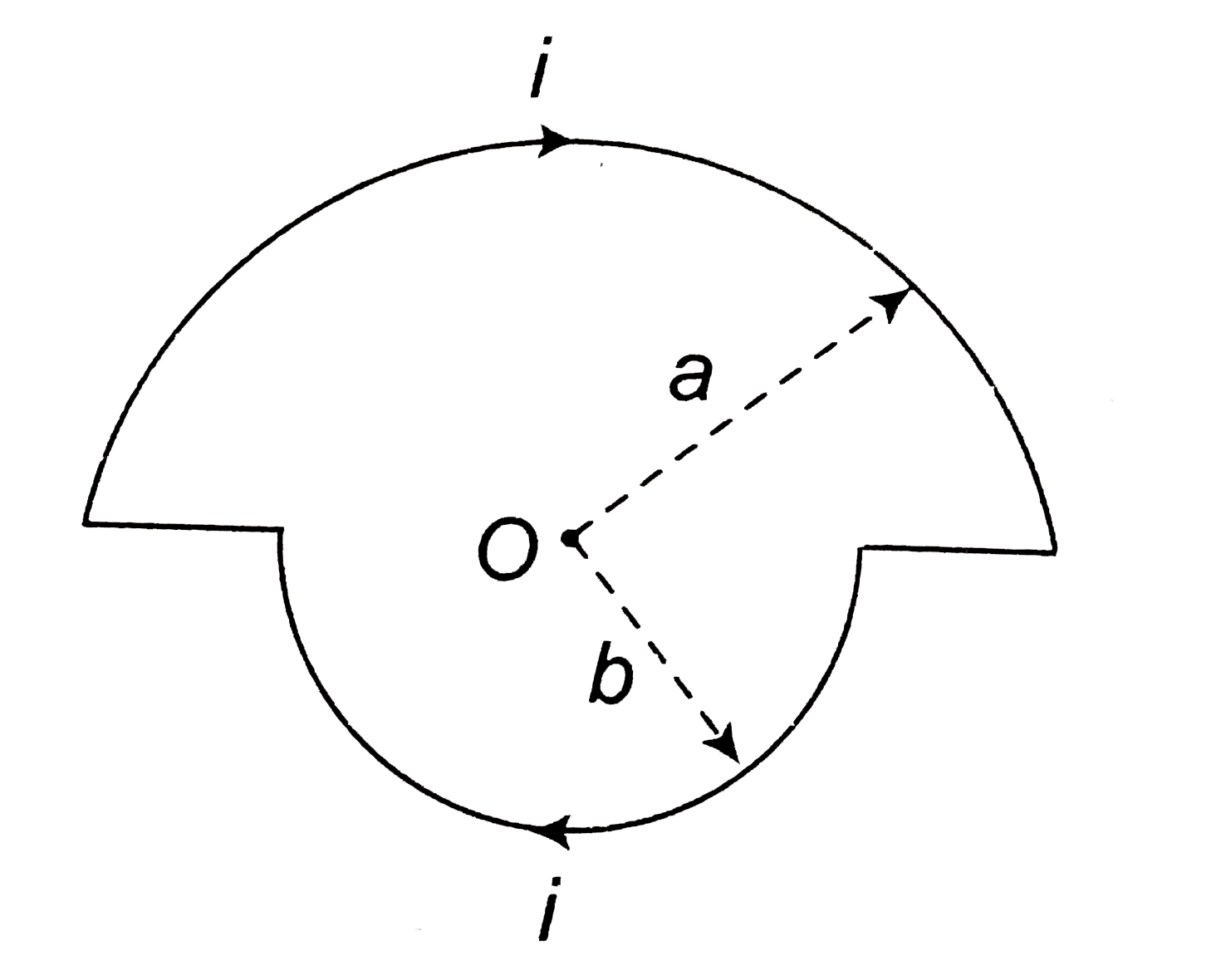 `B_(1)=(mu_(0)i)/4(1/a+1/B)=(mu_(0)i)/4(1/a+1/(2b)+1/(2b))` 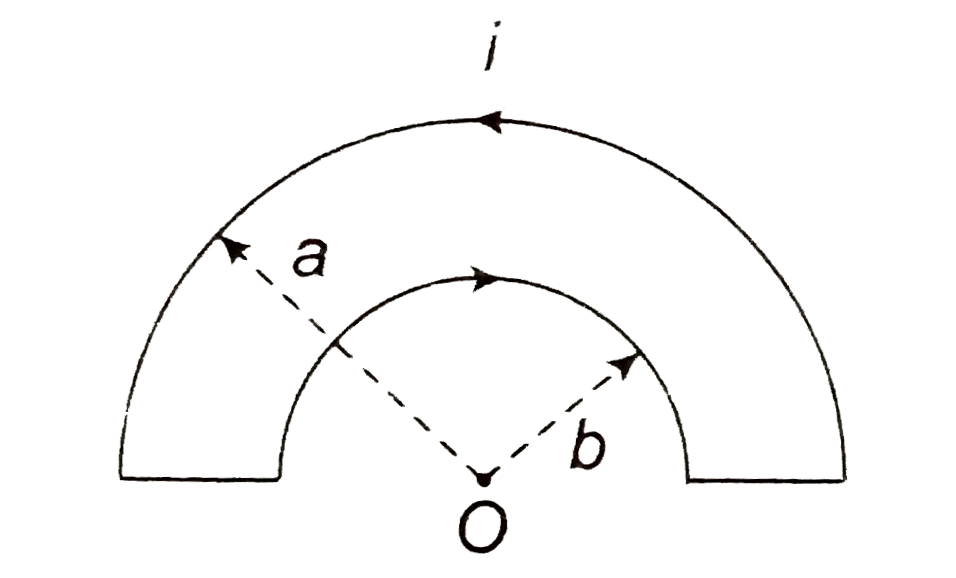 `B_(2)=(mu_(0)i)/4(1/b-1/a)=(mu_(0)i)/4(1/(2b)+1/(2b)-1/a)` 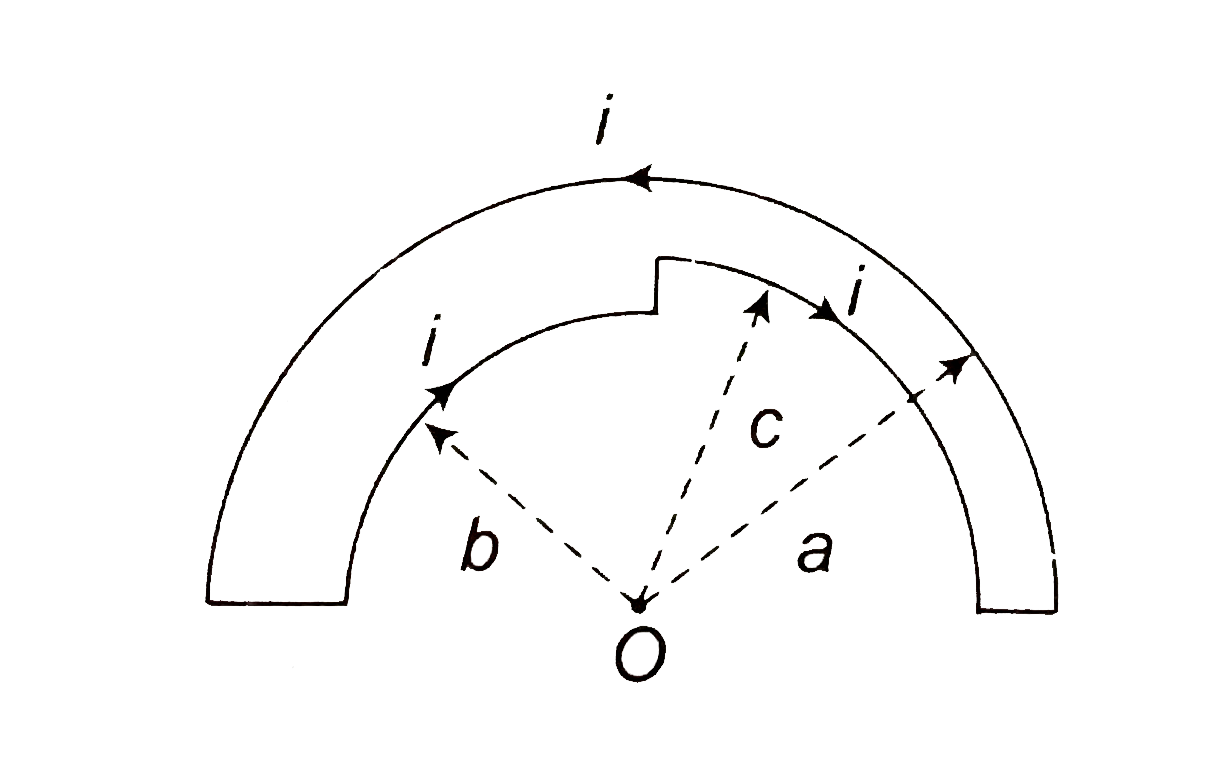 `B_(3)=(mu_(0)i)/4(1/(2b)+1/(2C)-1/a)` 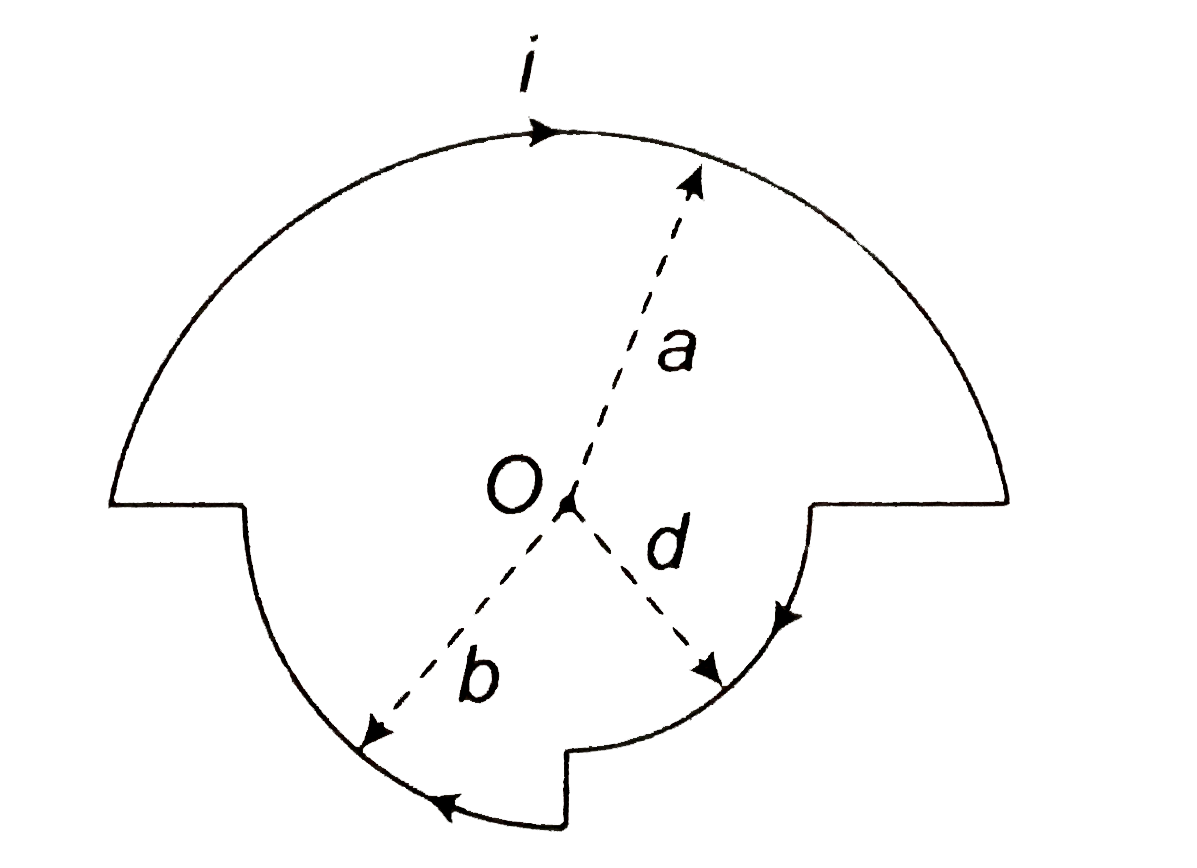 `B_(4)=(mu_(0)i)/4(1/a+1/(2b)+1/(2d))` Comparing `B_(1)` and `B_(4)`, since `d LT b,B_(4)gtB_(1)` Comparing `B_(2)` and `B_(3)` since `blt c, B_(4)gtB_(3)` `B_(4)gtB_(1)gtB_(2)gtB_(3)` |
|
| 38. |
In conditions of the previous problem find the frequency and the period of the variation of kinetic energy. |
|
Answer» `K=2.50cos^(2)(20pit+(3pi)/(4))=1.25[1+cos(40pit+(3pi)/(2))]=1.25(1+sin40pit)` The FREQUENCY of energy oscillations is `v_(K)=40pi//(2PI)=20Hz`, the period is `T_(K)=0.05` s. |
|
| 39. |
The focal lengths of the objective and the eyepiece of a microscope are 2 cm and 5 cm respectively and the distance between them is 20 cm. Find the distance of the object from the objective when the image seen by the eye is 25 cm from the eyepiece. Also find the magnifyingpower. |
|
Answer» |
|
| 40. |
A ray of lightof frequency 5 xx 10^14 Hz is passed through a liquid. If the wavelength of light in the liquid is 450 nm, then the refractive index of the liquid will be : |
|
Answer» 1.5 |
|
| 41. |
Interference is produced with two coherent sources of same intensity. If one of the sources is covered with a thin film so as to reduce the intensity of light coming out of it, then |
|
Answer» bright fringes will be less bright and DARK fringes will be less dark |
|
| 42. |
Discuss the similarities between the energy stored in the electric field of charged capacitor and the energy stored in the magnetic field of a current-carrying coil. |
|
Answer» |
|
| 43. |
The output of an OR gateis connected to the input of a NOT gate. Name the equivalent logic gate. |
Answer» SOLUTION :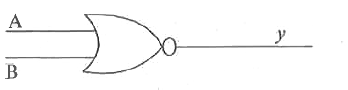 EQUIVALENT LOGIC GATE is NOR gate . |
|
| 44. |
An infinitely long cylinder is kept parallel to an uniform magnetic field B directed along positive z-axis. The direction of induced current as seen from the Z axis will be |
|
Answer» CLOCKWISE of the +ve Z axis |
|
| 45. |
Obtain the bindig energy of the nuclie ""_(26)^(56)Fe and ""_83^(209)Bi in units of MeV from the following data.m(""_(26)^(56)Fe) = 55.934939 u "" m(""_(83)^(209)Bi) = 208.980388 u |
|
Answer» SOLUTION :`BE = [(Nm_p + (A - Z)m_n) - M]c^2` `1u = 931 MEV` `:. Be " of" ""_(26)^(56) Fe = [(26 xx 1.007825 + 30 xx 1.008662) - 55.934939]931 MeV = 492 MeV` `:. BE//"nucleon" = (492)/(56) = 8.79 MeV` Similarly BE/nucleon of `""_(83)^(209)Bi = 7.84 MeV`. |
|
| 46. |
The electric field at the surface of a charged spherical conductor is 10 KV//m. The electric field at a distance equal to the diameterfrom its centre will be - |
|
Answer» `2.5" V/m"` |
|
| 47. |
Prove the Boolean identity : (A+B)(A+C) = A+BC |
|
Answer» SOLUTION : Proof: Applying the LAW of distribution on LHS of the equation, we GET ` (A+B) (A+C) =A A +AC+BA + BC ` ` =A+AC+AB +BC` ` =A(1+C+B)+BC` ` =A+BC` ` [ :.1+C+B=1]` ` thereforeLHS=RHS ` thegivenidentityisproved . |
|
| 48. |
Does Coulomb's law of electric force obey Newton's third law of motion ? |
| Answer» Solution :YES, It obeys. FORCES exerted by two CHARGES on each other are always equal and OPPOSITE. | |
| 49. |
The maximum surface charge density of a uniformly charged spherical radius R and wall thickness 't', so that it will not burst apart, is |
|
Answer» `SQRT((sigma_m epsilon_0 t)/R)` |
|