

Saved Bookmarks
This section includes 7 InterviewSolutions, each offering curated multiple-choice questions to sharpen your Current Affairs knowledge and support exam preparation. Choose a topic below to get started.
| 1. |
Two bombs of 10 and 15 kg are thrown from acanon with the same velocity in in the same direction. Which bomb will reach the ground first ? |
| Answer» Solution :both will reach SIMULTANEOUSLY becouse the TIME of flight does not depend on the mass (if AIR RESISTANCE is NEGLIGIBLE) | |
| 3. |
When a plastic rod rubbed with wool is brought near the knob of a negatively charged gold leaf electroscope, the gold leaves |
|
Answer» CONTRACT |
|
| 4. |
A coolie lifts a box and walks on horizontal smooth surface, the work done by him against gravity is : |
|
Answer» ZERO |
|
| 5. |
An LCRseries circuit has a resistance of 25 Omega and a reactance of 93.25 Omega. If the reactance is capacitive, what is the phase angle between the current and applied emf ? Does the applied emf lag behind or lead the current ? |
|
Answer» Solution :Date : ` R = 25 Omega, |X_(L) - X_(C)| = 93.25 Omega` (capacitive) Since the reactance is capacitive , ` X_(C) gt X_(L)` The phase angle ` phi ` is geven by ` tan phi = (X_(L) - X_(C))/R = (-93.25)/25` ` = - 3.730` ` :. Phi = tan ^(-1) (- 3.730)` ` = -75^(@)` `{:(log 93.25,," "1.9696),(log 25,,ul(-1.3979)),(,," "0.5717):}` AL ` 0.5717 = 3.730` i.e. the applied emf lags BEHIND the current by ` 75^(@)`. |
|
| 6. |
(A): There may be an induced emf in a loop without induced current (R): Induced current depends on the resistance of the loop |
|
Answer» Both A and R are true and R is the correct EXPLANATION |
|
| 8. |
Why are elemental dopantsfor Silicon on Germanium usually chosen from group XIII on group XV ? |
|
Answer» Solution :While preparing N or P type semiconductor from pure semiconductor, size of impurity atoms should be nearly equal to the size of SI or GE atoms (so that SYMMENTRY of crystalline structure, would be maintained before and after the doping.) Also, the type of impurity atoms should be such that after its bonding through covalent bonds with the host crystal, we should GET required free charge carriers. Above conditions are fulfilled by elements in `13^(th)` and `15^(th)` group (XIII and XVth group) and so they are SELECTED for preparing N and P type semiconductors. |
|
| 9. |
Static charge is a source of………………..but nor of…………….. . |
|
Answer» |
|
| 10. |
State the nature and any four properties of alpha-particle. |
|
Answer» Solution :Nature of `alpha`-particles (1) An alpha particle is a helium NUCLEUS, i.e., a doubly ionized helium atom. It consists of two protons and two neutrons. (2) Mass of the `alpha cong 4u` Charge on the `alpha-"particle"=2 xx "charge on the PROTON"` Properties of `alpha`-particles : (1) Of the three types of radioactive radiations, `alpha`-particles have the maximum ionising power. It is about 100 times that of `BETA`-particles and `10^(4)` times that of `gamma`-rays. (2) They are deflected by electric and magnetic fields since they are charged particles. Their deflection is less than that of B-particles in the same field. (3) They affect photographic plates. (4) They cause fluorescence in fluorescent materials such as zincsulphide. (5) They emerge from the nuclei with TREMENDOUS speeds in the range of `(1)/(100)`th to `(1)/(10)`th of the speed of light in free space. |
|
| 11. |
Which is the most unstable elementary particle in an atom? |
| Answer» Solution :Neutron is the most UNSTABLE elementary in an ATOM. It decays into PROTON, ELECTRON and antineutrino. | |
| 12. |
A radio can tune to any station to 7.3MHz to 12 MHz band. The corresponding wavelength band is |
|
Answer» 25m-40m `lambda_(2)=(c)/(v)=(3xx10^(8))/(12xx10^(8))=25m` Corresponding to the given frequency bands, the wavelength band is 25m-40m. |
|
| 13. |
Select the correct statement : (Only force on a particle is due to electric field) |
|
Answer» A CHARGED particle moves along the electric LINE of force. |
|
| 14. |
A signal emitted by an antenna from a certain point can be received at another point of the surface in the form of |
|
Answer» Sky wave |
|
| 15. |
A straight current carrying conductor is kept along the axis of circular loop carrying current . The force exerted by the straight conductor on the loop is …… . |
|
Answer» PERPENDICULAR to the PLANE of the loop |
|
| 16. |
For a radio signal to travel 150 km from the transmitter to a receiving antenna, it takes |
|
Answer» `5xx10^(-4)` second |
|
| 17. |
Given the mass of iron nucleus as 55.85 u and A = 56, find the nuclear density. (u = 1.67 xx 10 ^(-27) kg, r = 1.2 xx 10 ^(-15)m ) |
| Answer» SOLUTION :`rho = M/C = (55.85 XX 1.6603 xx 10^(-27))/(4/3 xx pi xx (1.2 xx 10^(-15))^(3)) xx 1/56 = 2.29 xx 10^(17) kgm^(-3)` | |
| 18. |
The sun appears to be elliptical during sunset. What is the reason behind it? |
|
Answer» |
|
| 19. |
A flyover bridge is in the form of a circular arc of radius 39.5m. What is the limiting speed at which a car can cross the bridge without loosing contact with the road, at the highest point ? (Assume that centre of gravity of the car is 0.5 m above the road and g = 10 m/s^2 ). |
|
Answer» SOLUTION :Since the centre of gravity of the car is 0.5 m above the ROAD, the effictive RADIUS 39.5 + 0.5 =40 m `THEREFORE` For equilibrium (mv^2)/r=mg thereforev^2=rg `V=SQRT(rg)=sqrt(40xx10)=20` m/s. |
|
| 20. |
A rectangular coil of area of cross-section is placed as shown. A magnetic field B is applied along Z-axis. The torque on the coil is |
|
Answer» ABI along +Y-axis `THEREFORE vectau = vecM XX vecB =-(IA)hati xx Bhatk` `vectau = - (BIA)(-hatj) = BIAhatj` |
|
| 21. |
In YDSE and apparatus as shown in figure wavelength of light used in lambda. The screen is moved away from the source with a constant speed V. Initial distance between screen and plane of slits was D. Suppose P is the point where 5^("th") order maxima was lying at t = 0, then after how much time third - order maxima will lie at this point P on that screen? |
| Answer» Answer :B | |
| 22. |
Give two uses of UV rays. |
|
Answer» SOLUTION :Uses : (i) In the analysis of the structure of ORGANIC compounds. (ii) In high RESOLVING power microscopes. (iii) In the study of bacteria. |
|
| 23. |
The ill effectsassociatedwith thevariatiion of the periodof revolution of the particleina cyclotron due tothe increase of itsenergyare eleminated by slow monitoring(modulating ) the frequency of accelertingfield. Accordingto whatlaw omega (t) shouldthis frequencecy by mointoredif the masgneticinductionis equalto B and theparticleacquiresan energyDelta Wper revolution ? The charge of theparticle is q and its mass is m. |
|
Answer» Solution :The BASIC condition is the relatistiv equaction, `(mv^(2))/(r) = Bqv`, or, `mv = (m_(0) v)/(sqrt(1 - v^(2)//c^(2))) = BQR`. Or calling, `omega = (Bq)/(m)`, we GET, `omega = (omega_(0))/(sqrt(1 + (omega_(0)^(2) r^(2))/(c^(2)))), omega_(0)= (Bq)/(m_(0)) r` is the radius of theinstantanceous orbit, The time of ACCELERATION is, `t = sum_(n = 1)^(N) (1)/(2 v_(n)) = sum_(n = 1)^(N) (pi)/(omega_(n)) = sum_(n)^(N) (pi W_(n))/(q Bc^(2))` `N` is the numbr of crossingof either `Dee`. But,n `W_(n) = m_(0) c^(2) + (n Delta W)/(2)`, therebeing two crossings of theDees per revolution. So, `t = sum (pi m_(0) c^(2))/(qB c^(2)) + sum (pi Delta W_(n))/(2q B c^(2))` `= N (Pi)/(omega_(0)) + (N (N + 1))/(4) (pi Delta W)/(qB c^(2)) = N^(2) (piDelta W)/(4 q Bc^(2)) (N gt gt 1)` Also, `r = r_(N) (v_(N))/(omega_(N)) = (c)/(pi) (del t)/(del N) = (Delta W)/(2q Bc) N` Hence finally, `omega = (omega_(0))/(sqrt(1 + (q^(2) B^(2))/(m_(0)^(2) c^(2))xx (Del W^(2))/(4 q^(2) B^(2) c^(2))) N^(2))` `= (omega_(0))/(sqrt(1 + ((Delta W)^(2))/(4 m_(0)^(2) c^(4)) xx (4 q Bc^(2))/(pi Delta W) t)) = (omega_(0))/(sqrt(1 + at))`, `a = (q B Delta W)/(pi m_(0)^(2) c^(2))` |
|
| 24. |
n a Geiger-Marsden experiment, what is the distance of closest approach to the uranium nucleus of a 5.0 MeV alpha-particle before it comes momentarily to rest and reverse its direction? |
|
Answer» |
|
| 25. |
An electron of charge e and mas m is moving in a circular path of radius r with a unifrom angular speed omega . Then which of the following statementa are correct? |
|
Answer» The equivalent current flowing in the CIRCULAR path is proprotional to `r^(2)`. `therefore` The current flowing in the loop. `I = e/T = e/(2pi//omega)=(eomega)/(2pi)` Hence, STATEMENT (a) is incorrect. Area of the loop, `A = PIR^(2)` Magnetic moment of the loop, `M = IA= (eomega)/(2pi)PI r^(2) = (er^(2)omega)/2` Hence, statement (b) is correct. As `M = e/(2m)L` where L is the angular momentum of the electron. Hence. statement (c) is incorrect. Angular momentum `=2m(dA)/dt` where `(dA)/dt` is the area velocity. Hence, statement (d) is correct. |
|
| 26. |
Find theinductance of a unitlength ofa cableconsistingof two thin-walledcoaxialmetalliccylindersif theradiusof theoutside cylinderis eta = 3.6 timesthat of the insideone. Thepermeabitityof a medium betweenthe cylinders is assumedto beequal to unity. |
|
Answer» SOLUTION :Between the cables, where`a lt R lt b`, the magnetic field`vec(H)` satisfies `H_(varphi) 2PI r = 1` or `H_(varphi) = (I)/(2pi r)` So `B_(varphi) = (mu mu_(0) I)/(2pi r)` The associated flux per unit lengthis, `Phi = int_(r = a)^(r = b), (mu mu_(0) I)/(2pi r) xx 1 xx dr = (mu mu_(0) I)/(2pi)` In`(b)/(a)` Hence, the inductance per unit LENGTH `L_(1) = (Phi)/(I) = (mu mu_(0))/(2pi) In eta`, where `eta = (b)/(a)` We get `L_(1) = 0.26 (mu H)/(m)` |
|
| 27. |
Answer the following: (a) If one of two identical slits producing interference in Young's experiment is covered with glass so thatthe lightintensity passing through it is reduced to 50%, find the ratio of the maximum and minimum intensity of the fringe in the interference pattern. (b)Whatkindof fringes do you expect to observeif white lightis used instead of monochromatic light ? |
|
Answer» SOLUTION :After the introduction of the glass SHEET (SAY on the second slit ) . We have ` (I_2)/( I_2) =50% =(1)/(2) ` ` therefore ` Ratio of the AMPLITUDES ` = ( a_2)/(a_1)=sqrt( (1)/(2) ) =(1)/(sqrt(2)` |
|
| 28. |
transverse simple harmonic wave is travelling on a string. The equation of the wave: |
|
Answer» Is the GENERAL EQUATION for displacement of a particle of the string at any instant t |
|
| 29. |
Explain the determination of unknown resistance usingmeter bridge. |
|
Answer» Solution :The meter bridge is another form of Wheatstone.s bridge. It consists of a uniform manganin wire AB of one meter length. This wire is stretched along a meter scale on a wooden board between two copper strips C and D. Between these two copper strips another copper strip E is mounted to enclose two gaps `G_(1) and G_(2)`. An unknown resistance P is CONNECTED in `G_(1) ` and a standard resistance Q is connected in `G_(2)`. A jockey (conducting wire) is connected to the terminal E on the CENTRAL copper strip through a galvanometer (G) and a high resistance (HR). The exact position of jockey on the wire can be read on the scale. A Lechlanche cell and a key (K) are connected across the ends of the birdge wire. The position of the jockey on the wire is adjusted so that the galvanometer shows zero deflection. Let the point be J. The lengths AJ and JB of the bridge wire now replace the resistance R and S of the Wheatstone.s bridge. Then  `(P)/(Q)=(R)/(S)=(R..AJ)/(R..JB) "" ...(1) ` where R. is the resistance per unit length of wire `(P)/(Q)=(AJ)/(JB)=(l_(1))/(l_(2)) "" ...(2)` `P=Q(l_(1))/(l_(2)) ""...(3)` The bridge wire is soldered at the ends of the copper strips. Due to imperfect contact, some resistance might be introduced at the contact. These are called end resistances. This error can be eliminated, if another set of readings are taken with P and Q interchanged and the average value of Pis found. To find the specific resistance of the material of the wire in the coil P, the radius r and length `L` of the wire is measured. The specific resistanceor resistivity r can be calculated using the RELATION Resistance `=rho (l)/(A)` By rearranging the above equation, we get `rho=` Resistance `xx(A)/(l) ""...(4)` If P is the unknown resistance, equation (4) BECOMES `rho=P (pi r^(2))/(l)` |
|
| 30. |
क्षेत्रफल के आधार पर भारत का सबसे बड़ा राज्य कौन सा है? |
|
Answer» उत्तर प्रदेश |
|
| 31. |
A system consists of N_(0) nucleus at t = 0. The number of nuclei remaining after half of a half-life (that is, at time t=1/2T_(1/2)) |
|
Answer» `N_0/2` |
|
| 32. |
x-y plane separates two media, zge0contains a medium of refractive index 1 and zle0contains a medium of refractive index 2. A ray of light is incident from first medium along a vectorhati+hatj-hatk. Find the unit vector along the refracted ray. |
|
Answer» Solution :The law of refraction in vector form is `mu_(1)(hat(e)_(1)xxhat(N))=mu_(2)(hat(e)_(2)xxhat(n))` Here `hat(e)=(hat(i)+hat(J)-hat(k))/(sqrt(3))` `=` unit vectore along incident ray `hat(n)=hat(k)=` unit vector along normal or incidence point `:. mu_(1)(hat(e)_(1)xxhat(n))=mu_(2)(hat(e)xxhat(n))` `hat(e)_(2)=xhat(i)+yhat(j)+zhat(k)` `=` unit vectore along REFRACTED ray or `1{((hat(i)+hat(j)-hat(k))/(sqrt(3)))xxhat(k)}=2{(xhat(i)+yhat(j)+zhat(k))xxhat(k)}` or`(-hat(j)+hat(i))/(sqrt(3))=2{-xhat(I)+yhat(j)}` or `x= (1)/(2sqrt(3)), y=(1)/(2sqrt(3))` As `hat(e)_(2)` is a unit vector, THEREFORE `|hat(e)_(2)|=1` `RARR sqrt(x^(2)+y^(2)+z^(2))=1` or `sqrt((1/(2sqrt(3)))^(2)+((1)/(2sqrt(3)))+z^(2))=1` or ` sqrt(((1)/(12)+(1)/(12)+z^(2)))=1` or `(1)/(6)+z^(2)=1` `:. z^(2)= 1-(1)/(6)=(5)/(6)` `:. z=+-sqrt(((5)/(6)))` Since refracted ray is in negative z-axis region `:. z=-sqrt((5)/(6))` `:. hat(e)_(2)=(1)/(2sqrt(3))hat(i)+(1)/(2sqrt(3))hat(j)-sqrt(((5)/(6)))hat(k)` 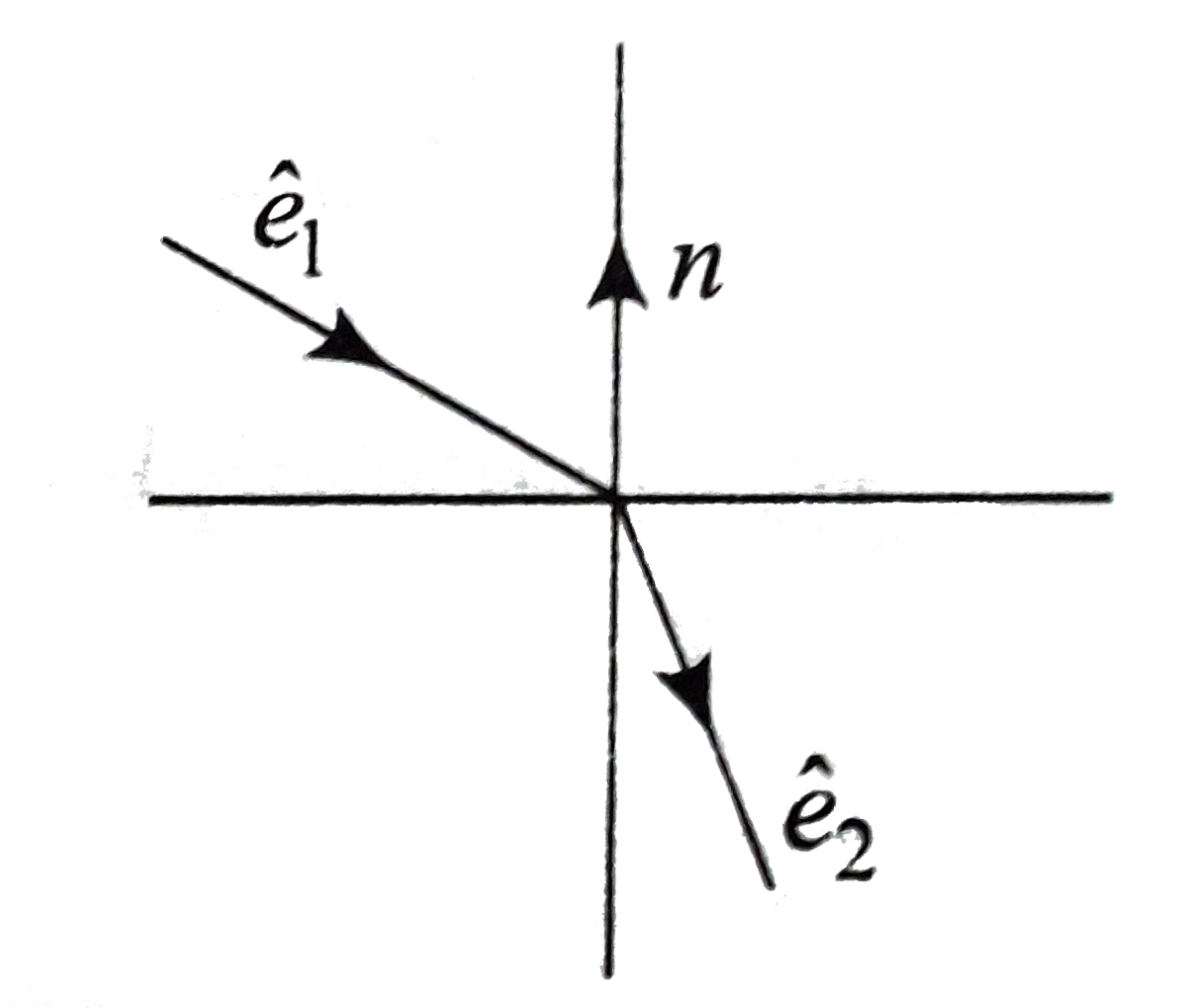
|
|
| 33. |
For air or vacuum, K = _____ and fror all other insulating material K = _____. |
| Answer» SOLUTION :`1,GT1,K LT1` | |
| 34. |
यदि वस्तु की गति का पथ सरल रेखीय हो,तो ऐसी गति कहलाती है |
|
Answer» वृत्ताकार गति |
|
| 35. |
If force on a particle vecF = (Sin at)hati + (cos at)hatj and displacement vecS = sin(frac{at}{3}hati) + cos(frac{at}{3})hatj are functions of time (t) then value of t at which they are perpendicular for first time is (a is positive constant and t>0) |
|
Answer» `t = FRAC{pi}{2]` |
|
| 36. |
Which rays are not the portion of electromagnetic spectrum |
|
Answer» X-rays |
|
| 37. |
In a stationary wave the amplitude of vibrating particle |
|
Answer» Minimum |
|
| 38. |
According to Rutherford, the size of the nucleus is: |
|
Answer» `10^-15`m to `10^-14`m |
|
| 39. |
Who helped the boy out of his misery? |
|
Answer» The doctor |
|
| 40. |
Find the decay constant and the mean lifetime of Co^(55) radionuclide if its activity is known to decrease4.0% per hour. The decay product is nonradioactive. |
|
Answer» SOLUTION :If the decay CONSTANT (in `("HOUR")^(-1)`) is `lambda`, then the ACTIVITY after one hour will decrease by a factor `E^(-lambda)`. Hence `0.96= e^(-lambda)` or `lambda= 1.11xx10^(-5)s^(-1)= 0.0408 per hour` Themeanlife time is `24.5 hour` |
|
| 41. |
To draw the maximum current from a combination of cells, how should be the cells be grounded ? |
|
Answer» Parallel |
|
| 42. |
(i) Derive an expression for drift velocity of electrons in a conductor. Hence deduce Ohm's law.(ii) A wire whose cross-sectional area is increasing linearly from its one end to the other, is connected across a battery of V volts. Which of the following quantities remain constant in the wire ?(a) drift speed (b) current density(c) electric current(d) electric field Justify your answer. |
| Answer» Solution :(ii) Out of four quantities given here only (c) electric CURRENT remains constant in the wire. All theremaining three quantities NAMELY : (a) drift speed, (B) current density, and (d) electric field do not remain constant because their values depend upon the cross-section area of conductorwhich is increasing linearly from one end to the other. | |
| 43. |
Three gas molecules have velocities respectively equal |
|
Answer» `3xx10^2` m/s |
|
| 44. |
Two plates ( area =s ) charged to + q_(1)and +q_(2)(q_(2) lt q_(1))are brought closer to form a capacitor of capacitance C. The potential difference across the plates is |
|
Answer» `(q_(1)-q_(2))/(2C)` Inner plates accumulate equal and opposite charge `Q=(q_(1)-q_(2))/(2)`and that actually MAKES the capacitor Now `V=(Q)/(C )`. |
|
| 45. |
The time interval observed in a frame at rest is "____________" that observed in a moving frame |
| Answer» Answer :A | |
| 46. |
If an alpha-particle is projected normally through a uniform magnetic field, then the path of the alpha-particle inside the field will be |
|
Answer» CIRCULAR |
|
| 47. |
A ray of light covers distance .d. in time t, in air and distance 10 d in time t_2, in medium, then critical angle for medium is ..... |
|
Answer» `sin^(-1)((t_1)/(t_2))` sinC=`1/n=v/c` `therefore` sinC=`(d_m//t_2)/(d_a//t_1)` [`because d_m` and `d_a` are distances COVERED in air and medium] `thereforesinC=(d_mt_1)/(d_at_2)` `=(10d xx t_1)/(d xx t_2)` `(10t_1)/(t_2)` `therefore C=sin^(-1)((10t_1)/(t_2))` |
|
| 48. |
For a L-C-R series circuit List I - with List-II (Terms have their usual meaning) |
|
Answer» `"a"RARR"E, b"rarr"d, C"rarr"F"` |
|
| 49. |
A +very charged body attracts a pith ball pendulum towards it Does it mean that the pith ball pendulum is nagatively charged ? |
| Answer» Solution :Not NECESSARILY. A +vely charged body can induce negative charge on the NEARER end of the uncharged BALL, THUS causing an attraction between the TWO. | |
| 50. |
A vessel of depth 2d cm is half filled with a liquid of refractive index mu_(1) and the upper half with a liquid of refractive mu_(2). The apparent depth of the vessel seen perpendicularly is |
|
Answer» `d((mu_(1)mu_(2))/(mu_(1)+mu_(2)))` |
|