

Saved Bookmarks
This section includes 7 InterviewSolutions, each offering curated multiple-choice questions to sharpen your Current Affairs knowledge and support exam preparation. Choose a topic below to get started.
| 1. |
A narrow stream of vanadium atoms in the ground state .^(4)F_(3//2) is passed through a transverse strongly inhomogeneous magnetic field of lengthl_(1)=5.0 cm as in the Stern-Gerlach experiment. The beam splitting is observed on a screen located at a distance l_(2)=15 cm from the magnet. The kinetic energy of the atoms is T=22 meV. At what value of the gradient of the magnetic field induction B is the distance between the extreme components of the split beam in the screen equal to delta=2.0 mm ? |
|
Answer» Solution :In the homogeneous magnetic field the atom experience as force `F=gJmu_(B)(delB)/(delƵ)` Depending on the sign of `J`, this can be EITHER UPWARD or downward. Suppose the latter is true. The atom then traverses first along a parabola inside the field and , once outside, in a straight line. The toal distance between extreme lines on hte screen will be `delta=2gJmu_(B)(delB)/(delƵ){(1)/(2)((l_(1))/(V))^(2)+(l_(1))/(V).(l_(1))/(V)}//m_(V)` Here `m_(V)` is the MASS of hte vanadium atom. (The first term is the displacement within the field and the second term is the displacement due to the transverse velocity acquired in the magnetic field). Thus using `(1)/(2)m_(v)V^(2)=T`  we get `(delB)/(delƵ)=(2Tdel)/(gmu_(B)Jl_(1)(1_(1)+2l_(2)))` For vanadim atom in the ground state `.^(4)F_(3//2)`. `g=1+((3xx4)/(4)+(3xx5)/(4)-3xx4)/(2xx(3xx5)/(4))=1+(30-48)/(30)=1-(18)/(30)=(2)/(5)` `J=(3)/(2)`, using other data, and substituting we get `(delB)/(delƵ)=1.45xx10^(13)G//m` This VALUE differs from the answer given in the BOOK by almost a factor of `10^(9)`. For ncutral atoms in sterm Gerlach experimeters, the value `T=22 meV` is much too large. A more appropriate value will be `T=22 meV` i.e., `10^(9)` times smaller. Then one gets the right answer. |
|
| 2. |
How does the angle of dip change as one goes from magnetic pole to the magnetic equator ? |
| Answer» Solution :Dip DECREASES from `90^@` to `0^@` as one GOES from magnetic POLE to the magnetic equator. | |
| 3. |
The upper atmosphere layer is Known as _____. |
|
Answer» TROPOSHERE |
|
| 4. |
Deuterons are accelerated in cyclotron that has an oscillatory frequency of 10^(7) Hz and a dee radius of 50 cm. The strength of the magnetic field needed to accelerate the deuterons is : |
|
Answer» 1.21 T |
|
| 5. |
The order of magnitude of earth's magnetic field in tesla is _____. |
| Answer» SOLUTION :`10^-5` TESLA | |
| 6. |
There is a table having 3 columns and4 rows . Based on the table ,there 3 questions . Question has 4 options (a) , (b), (c) and (d) , Only one of the four options is correct . What are the characteristics of turbulent flow ? |
|
Answer» (I) (iii) (K) |
|
| 7. |
There is a table having 3 columns and4 rows . Based on the table ,there 3 questions . Question has 4 options (a) , (b), (c) and (d) , Only one of the four options is correct . What are the characteristics of steady flow ? |
|
Answer» (III) (i) (K) |
|
| 8. |
There is a table having 3 columns and4 rows . Based on the table ,there 3 questions . Question has 4 options (a) , (b), (c) and (d) , Only one of the four options is correct . What are the characteristics of laminar flow ? |
|
Answer» (IV) (iv) (J) |
|
| 9. |
Distinguish between nuclear fission and fusion. |
Answer» SOLUTION :
|
|
| 10. |
Current in a circuit falls from 5A to 0A in 0.1s if an average emf of 200V is induced,determine the self inductance of the coil. |
| Answer» SOLUTION :dI=5-0=5A, dt=0.1s, `EPSILON`=200V, L=?, `epsilon =L(dI//dt`), `L=epsilondt//dI=200xx0.1//5=4H` | |
| 11. |
An electron emitted by heated cathode and accelerated through a potential difference of 2.0 kV, enters a region with uniform magnetic field of 0.15 T. Determine the trajectory of the electron if the field (a) is transverse to its initial velocity , (b) makes an angle of 30^@ with the initial velocity. |
|
Answer» Solution :When accelerated through a potential difference of `V = 2.0 kV = 2000 V,` the electron will aquire a speed given by `v = sqrt((2eV)/(m_e)) = sqrt((2 xx 1.6 xx 10^(-19) xx 2000)/(9.1 xx 10^(-31))) = 2.65 xx 10^(7) ms^(-1)` (a) When the MAGNETIC field B = 0.15 T is TRANSVERSE to the initial velocity of electron, its trajectory will be a circle of radius `r = (m_e v)/(eB) = (9.1 xx 10^(-31) xx 2.65 xx 10^(7))/(1.6 xx 10^(-19) xx 0.15) = 10^(-3) m or 1 mm`. The circular path is in a plane perpendicular to direction of `vecB`. (b) When the magnetic field `vecB` makes an angle `theta = 30^@` with the initial velocity, the electron will describe a HELIX path of radius `r. = (m_e v sin theta)/(e B) = r sin theta = 10^(-3) xx sin 30^@ = 0.5 xx 10^(-3) m " or " 0.5 mm` and a FORWARD velocity of `v cos 30^@ = 2.65 xx 10^(7) xx cos 30^@ = 2.3 xx 10^(7) ms^(-1)` along `vecB`. |
|
| 12. |
The current in the inner coil is I = 2t^(2). Find the heat developed in the outer coil between t =0 and t seconds. The resistance of the outer coil is R and take b gt gt a. |
|
Answer» Solution :Let the current I be in the OUTER coil. The field at CENTRE `B = (mu_(0)^(I))` The flux through the inner coil = `(mu_(0)Ipia^(2))/(2b)` The induced emf produced in the outer coil `epsilon = -(dphi)/(dt)` `(mu_(0)OUA^(2))/(2b)(d)/(dt)(2t^(2)) = (2mu_(0)PIA^(2)t)/(b)` Current induced in the outer coil = `(epsilon)/(R ) = (2mu_(0)pia^(2)t)/(bR)` Heat developed in the outer coil = `int_(0)^(t)l^(2)"Rdt"= int_(0)^(t)(4mu_(0)^(2)PI^(2)a^(4)t^(2)Rdt)/(b^(2)R^(2))=(4mu_(0)^(2)pi^(2)a^(4))/(b^(2)R) (t^(3))/(3)` |
|
| 13. |
A point mass of 1 kg collides elastically with a stationary point mass of 5 kg. After their collision, the 1 kg mass reverses its direction and moves with a speed of 2 m/s. Which of the following statements are correct for the system of these two masses? |
|
Answer» Total momentum of the SYSTEM is 3 kg m/s. |
|
| 14. |
A rectangular block of glass (R.l. = 3/2) is kept in water (R.l. = 4/3). The critical angle for total internal reflection between glass and water is |
|
Answer» `SIN^(-1)(2/3)` |
|
| 15. |
In a p-n junction, width of depletion region is 300 nm and electric field of 7 xx 10^(5) V//m exists in it. (i) Find the height of potential barrier. (ii) What should be the minimum kinetic energy of a conduction electron which can diffuse from the n-side to the p-side? |
|
Answer» SOLUTION :(i) `V=Ed = 7 xx 10^(5) xx 300 xx 10^(-9)= 0.21 V` (ii) KINETIC energy =EV = 0.21 eV |
|
| 16. |
In a transistor the width of |
|
Answer» EMITTER REGION is SLIGHTLY more than that of collector region |
|
| 17. |
If K_(1) and K_(2) are maximum K.E. photoelectron emitted when lights wavelength lambda_(1) and lambda_(2) respectively incident a metallic surface .If lambda_(1)=3lambda_(2),then….. |
|
Answer» `K_(2)GT(K_(2))/(3)` `K_(2)=(hc)/(lambda_(2))-phi_(0)` and `(hc)/(lambda_(2))=(K_(2)+phi_(0))`…..(ii) `THEREFORE K_(1)-K_(2)=hc[(1)/(lambda_(1))-(1)/(lambda_(2))]` `=hc[(1)/(3lambda_(2))-(1)/(lambda_(2))]=-(2hc)/(3lambda_(2))` `=-(2)/(3)(K_(2)+phi_(0))[because` From result (1)] `therefore K_(1)=K_(2)-(2)/(3)K_(2)-(2)/(3)phi_(0)=(K_(2))/(3)-(2)/(3)phi_(0)` `therefore K_(1)lt(K_(2))/(3)` |
|
| 18. |
What is the unit of energy in atomic and nuclear physics?Define it. |
|
Answer» Solution :ELECTRON volt (EV) is the unit of energy in atomic and nuclear physics. 1 eV (electron volt):When I electron is ACCELERATED under potential DIFFERENCE of 1 volt energy acquired by it is CALLED electron volt. `therefore1eV=1.602xx10^(-19)` J and 1J=`6.242xx10^(18)`eV 
|
|
| 19. |
A space charge of density rho is uniformly distributed in an infinitely long cylinder of radius R Then, for any point at distance r from the axis (relative permittivity = 1) |
|
Answer» the ELECTRIC field is `E=(rhor)/(2 in_0)` for 0 lt R lt R |
|
| 20. |
In the question 38, the amplitude of magnetic field part of the given wave is |
|
Answer» `2XX10^(-8)T` `E_(0)=3.1" NC"^(-1)` `therefore""B_(0)=(E_(0))/(c)=(3.1)/(3xx10^(8))=1.03xx10^(-8)T` |
|
| 21. |
A magnetic field of 5 xx 10^(-5) Tis produced at a perpendicular distance of 0.2 m from a long straight wire carrying electric current. If the permeability of free space is 4 xx 10^(-7)Tm/A The current passing through the wire in A is |
|
Answer» 45 ` R = 0.2 m` and ` mu_0 = 4pi xx 10^(-7) mT//A` Magnetic field PRODUCED by long STRAIGHT current (I) carrying wire is given by `B = (mu_0)/(2pi) . I/r rArr 5 xx 10^(-5) = (4 pi xx 10^(-7) )/(2pi) xx (I)/(0.2)` ` rArr I = (5 xx 10^(-5) xx 2pi xx 0.2)/(4pi xx 10^(-7) ) =0.5 xx 10^2 = 50 A` |
|
| 22. |
For tungsten, atomic energy level of K, L & M are given 69.5 keV, 11.3 keV and 2.30 keV respectively. For obtaining charcteristic K_(beta)&K_(alpha)lines for tungsten, what should be the required minimum accelerating potential and lambda_("min") ? Also calculate lambda_(alpha) and lambda_(beta). |
|
Answer» Solution :Required minimum accelerating POTENTIAL `=("ionisation energy")/(e)=69.5 kV` For this accelerating potential , `lambda_("min")=(HC)/(eV_("max"))=(12400)/(69.5 xx 10^(3))Å = 0.178Å` wavelength for `K_(alpha)` `lambda_(alpha)= (12400)/((69.5-11.3))Å=0.213Å` wavelength for `K_(beta)` `lambda_(beta)=(12400)/((69.5-230)xx10^(3))Å=0.184 Å` |
|
| 23. |
In the Bohr model of the hydrogen atom, in the lowest energy state the electron revolves round the proton at a speed of 2.2 xx 10^6 m/s in a circular orbit of radius 5.3 xx 10^-11 m. (a) What is the orbital period of the electron? (b) If the orbiting electron is considered to be a current loop, what is the current I? (c) What is the magnetic moment of the atom due to the motion of the electron? |
|
Answer» B. `I=qf=(e)(v/(2pir))` LTBR `C. M=IA=((ev)/(2pir) (pir^2)=(evr)/2` |
|
| 24. |
Red light of wavelength 6500 Å from a distant source falls on a slit 0.50 mm wide. What is the distance between the two dark bands on each side of the central bright band of the diffraction pattern observed on a screen placed 1.8 m from the slit. |
|
Answer» `2.2 mm` `a = 0.50 mm = 0.5 xx 10^(-3)` m D = 1.8 m The distance between the dark bands on each SIDE of CENTRAL bright band is the WIDTH of central maximum. `thereforebeta_("central") = (2lambdaD)/(a) = (2 xx 6500xx 10^(-10)xx 18)/(0.5 xx 10^(-3))` `= 4.68 xx 10^(-3)`m `= 4.68 mm` For circular aperature, we get circular fringes and the width of central bright band in this CASE is `beta_("central") = 2(1.22 lambda)/(a)D = (2 xx 1.22 xx 6500 xx 10^(-10) xx 1.8)/(0.5 xx 10^(-3))` ` = 5.71 xx 10^(-3) m = 5.71 mm`. |
|
| 25. |
A point charge Q is placed inside a conducting spherical shell of inner radius 3R and outer radius 5R at a distance R from the centre of the shell. The electric potential at the centre of the shell will be. |
|
Answer» `(1)/(4 pi epsi_0 ) . (Q)/(R )` |
|
| 26. |
A block of mass M is attached with a string of mass m and length l as shown in figure. The whole system is placed on a planet whose mass and radius is three times the mass and radius of earth. Find the ratio of maximum and minimum velocity of wave pulse. Assume the acceleration due to gravity on the earth to be g. |
|
Answer» `V_("MAX")/V_("MIN") = SQRT(1 + m/M)` |
|
| 27. |
A polythene piece , rubbed with wool , is found to be have - ve charge of 4 xx 10^(-7)C.The number of electrons transferred from wool to polythene is : |
|
Answer» `1.5 XX 10^12` |
|
| 28. |
All the medium particles along the path of stationary wave performs |
|
Answer» S.H.M. |
|
| 29. |
The weakest acid among the following is |
|
Answer» WATER |
|
| 30. |
The ratio of potential gradients is 1:2, the resistance of two potentiometer wires of same length are 2Omega and 4Omega respectively. The current flowing through them are in the ratio |
|
Answer» `1:2` |
|
| 31. |
A physical quantity is represented by X=M^a L^b T^(-c). If the percentage error in the measurement of M, L and T are 2alpha %,beta%,3 gamma%, respectively then maximum percentage error in X is |
|
Answer» `(a alpha + b beta - C GAMMA)%` |
|
| 32. |
Where do you find the null points in the combined field due to a bar magnet and the earth , when the S-Pole of the magnet is kpet towards the north of the earth ? |
| Answer» SOLUTION :On the AXIAL LINE of the MAGNET | |
| 33. |
What's the nuclear equation ? |
| Answer» Solution :When (Z) ATOMIC NUMBER (No. of protons) of an element, REMAINING PARTICLES (N) to fulfillthe MASS number (A) are neutrons.N=A-Z `impliesA=Z+N` | |
| 34. |
Derive an expression for the difference in tensions at the highest and lowest points for a particle performing vertical circular motion. |
Answer» Solution :Consider a small BODY ( or particle) of mass m tied to a string and revolved in a vertical circle of radius r at a place where the accerleration due to graviy is g. At EVERY instant of its motion, the body is acted upon by TWO forces, namely, its weight `vec(mg)` and the tension `vecT` in the string.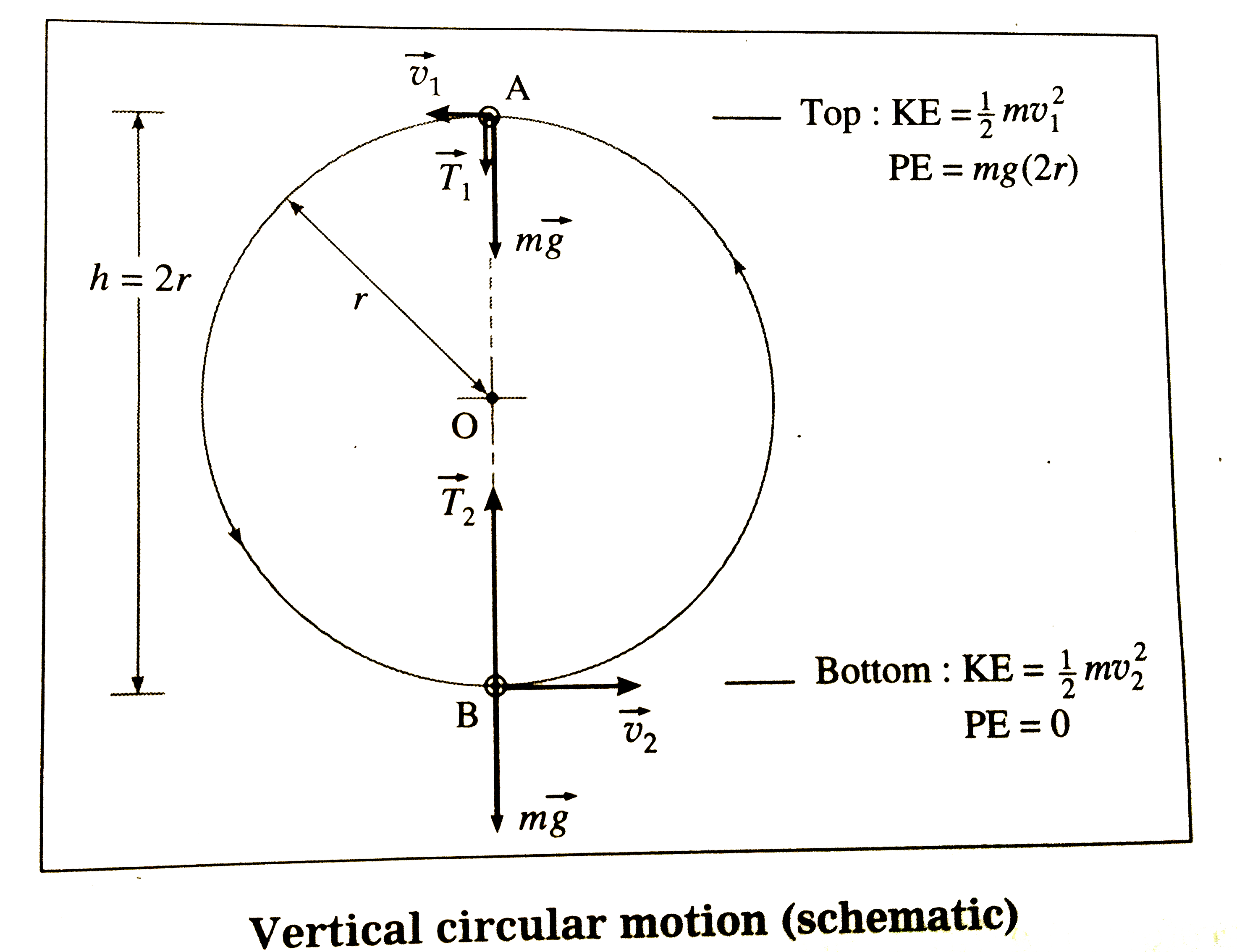 let `v_(2)` be the speed of body and `T_(2)` be the tension in the string at the lowest point B . We take the reference level for zero potential energy to be the bottom of the circle. THen, the body has only kinetic energy `(1)/(2)mv_(2)^(2)` at the lowest point. `therefore T_(2) = (mv_(2)^(2))/(r) + mg ""...(1)` and the total energy at the bottom ` = KE + PE = (1)/(2) mv_(2)^(2) + 0` ` = (1)/(2) mv_(2)^(2)""...(2)` Let `v_(1)` be the speed and `T_(1)` the tension in the string at the highest point A. As the body goes from B to A, it rises through a height h = 2r. `therefore T_(1)=(mv_(1)^(2))/(r) -mg""...(3)` and the total energy at A = KE + PE ` = (1)/(2) mv_(1)^(2) +mg(2r) ""...(4)` Thus, from Eqs. (1) and (3), `T_(2) -T_(1)=(mv_(2)^(2))/(r)+mg-((mv_(1)^(2))/(r)-mg)` ` = (m)/(r)(v_(2)^(2)-v_(1)^(2))+2mg""...(5)` Assuming that the total energy of the body is conserved, the totl energy at the bottom = total energy at the top Then, from Eqs. (2) and (4), ` (1)/(2)mv_(2)^(2)=(1)/(2)mv_(1)^(2)+mg(2r)` `thereforev_(2)^(2)-v_(1)^(2)=4gr""...(6)` Substituting this in Eq. (5), `T_(2)-T_(1)=(m)/(r)(4gr)+2mg` ` =4mg+2mg` = 6 mg Therefore, the difference in the TENSIONS in the string at the highest and the lowest points in 6 times the weight of the body. |
|
| 35. |
How many photons of frequency 10^(14) Hz will make up 19.86 J of energy ? |
|
Answer» Solution :Total energy emitted per second = Power `xx` time 19.86 J = Power `xx` 1s `therefore` Power = 19.86 W Number of photons, `n = (P)/(E) = (P)/(H UPSILON)` `= (19.86)/(6.6 xx 10^(-34) xx 10^(14)) = 3.009 xx 10^(20)` `n = 3 xx 10^(20)` `n_(p) = 3 xx 10^(20)` |
|
| 36. |
The equivalent capacitance between A and B will be "A.-|C|-|2C|-|4C|-|8C|-|oo|-.B" |
| Answer» Answer :B | |
| 37. |
Refracted ray from an equilateral prism will be parallel to surface is incidence angle is ....... (mu=1.5) |
|
Answer» `28^@` `therefore n=(1)/(sinC)` `thereforesinC=1/n=(1)/(1.5)=0.6667` `thereforeC=41^@48^@` `therefore r_2=41^@48.` Now,`A=r_1+r_2` `thereforer_1=A-r_2` `=60^@-41^@48.` `thereforer_1=18^@12.`  Now using Snell.s law for AB, n = `(sini)/(sinr_1)` `therefore sini=nxxsinr_1` `=1.5xxsin^@13.` `=1.5xx0.3123=0.4684` `therefore i=28^@` |
|
| 38. |
A vertical straight conductor carries a currentvertically upwards. A point P lies to the east ofit at a small distance and another point Q lies tothe west at the same distance. The magneticfield at P is_______. |
|
Answer» greater than at Q.same as at Q |
|
| 39. |
Figure 25-22 shows a parallel plate capacitor of plate area A and plate separation d. A potential difference V_0 is applied between the plates by connecting a battery between them. The battery is then disconnected and a dielectric slab of thickness b and dielectric constant k is placed between the plates as shown. Assume A=115 cm^2,d=1.2cm, V_0=85.5 V, b=0.780 cm and k=2.61 What is the capacitance C_0 before the dielectric slab is inserted? (b) What free charge appears on the plates? (c ) What is the electrci field E_0 in the gaps between the plates and teh dielectric slab? (d) What is the electric field E_1 in the dielectric slab? |
|
Answer» Solution :a) From Eq.25-9 we have `C_0=(epsilon_0A)/d=((8.85 times 10^-12 F//m)(115 times 10^-4 m^2))/(1.24 times 10^-2 m)` `=8.21 times 10^-12 F =8.21 pF` b) From Eq.25-1 `q=C_0V_0=(8.21 times 10^-12 F)(85.5V)` `=7.02 times 10^-10 C=702 pC` Because the BATTERY was DISCONNECTED before the slab was INSERTED. the free charge is unchanged. |
|
| 40. |
Apply the binomial theorem (Appendix E)for the kinetic energy of a particle. (a) Retain the first two terms of the expansion to show the kinetic energy in the form K = (first term) + (second term). The first term is the classical expression for kinetic energy. The second term is the first-order correction to the classical expression. Assume the particle is an electron. If its speed v is c/20, what is the value of (b) the classical exopression and (c ) the first-order correction? If the electron's speed is 0.85c, what is the value of (d) the classical expression and (e ) the first-order correction? (f) At what speed parameter beta does the first-order correction become 10% on greater of the classical expression? |
|
Answer» |
|
| 41. |
Room temperature is 20^(@)C. What is this temperature in Kelvins? |
| Answer» SOLUTION :To CONVERT to KELVINS, add 273: Room temperature is 20+273=293K. | |
| 42. |
A particle is dropped from rest vertically from a height The time taken by it to fall through successive distances of 1 m cach will then be : |
|
Answer» All EQUAL being equal to `sqrt(2/g)`sec. `1=(1)/(2)g.t_(1)^(2)`or `t_1sqrt((2)/(g))` `:.` Interval to coverfirst meter distance `=(sqrt((2)/(g)-sqrt(0)))=sqrt((2)/(g))(sqrt(1)-sqrt(0))` Similarly intervel to cover third meter `=sqrt((2)/(g))(sqrt(3)-sqrt(2))` Ration of intervals `=(sqrt(1)-sqrt(0)):(sqrt(2)-sqrt(1)):(sqrt(3)-sqrt(2))` |
|
| 43. |
Obtain the expression of electric field at any point by continuous distribution of charge on a line. |
Answer» SOLUTION :Suppose, line is divided into smaller elements of dl length and `VECR`is the POSITION vector of any smaller element and its linear charge density is `lambda`and its charge is `lambdadl`. 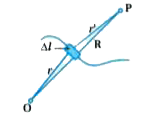 Suppose a point P (inside or outside) WHOSE, position vector is `vecR`. P is at `r.`distance from Al element and unit vector is `vecr`. Electric field at P due to `lambdaDeltal` `vec(DeltaE) = (klambda Deltal)/(r.)^(2).hatr` Total electric field at P by superposition principle. `vecE = sum_(Deltal) (klambdaDeltal)/(r.)^(2).r` By integration method. `vecE = int_(l) (klambdadl)/(r.)^(2).hatr` |
|
| 44. |
Rainbow is never observed on the surface of the moon. Why ? |
| Answer» SOLUTION :Because there is no ATMOSPHERE on the MOON. | |
| 45. |
n the circuit shown in the figure, the paint F is grounded as shown. Which of the following is a wrong statement? |
|
Answer» Potential at Eis ZERO |
|
| 46. |
For the b+ (positron) emission from a nucleus, there is another competing process known as electron capture (electron from an inner orbit, say, the K–shell, is captured by the nucleus and a neutrino is emitted). e + ""_(Z)^(A)X to ""_(Z - 1)^(A)Y + v Show that if beta+ emission is energetically allowed, electron capture is necessarily allowed but not vice–versa. |
|
Answer» Solution :CONSIDER the competing processes : `""(Z)^(A)RARR""(Z-1)^(A)Y+e^(+)+v_(e)+Q_(1)"(poitron emission)"` `e^(-)+""(Z)^(A)Xrarr""(Z-1)^(A)Y+v_(e)+Q_(2)"(electron capture)"` `Q_(1)=[m_(N)(""(Z)^(A)X)-m(N)(""(Z-1)^(A)Y)-m(e)]c^(2)` `=[m(""(Z)^(A)X)-Zm(e)-m(""(Z-1)^(A)Y)-(Z-1)m(e)-m_(e)]c^(2)` `[m(""(Z)^(A)X)-m(""(Z-1)^(A)Y)-2m_(e)]c^(2)` `Q_(2)=[m_(N)(""(Z)^(A)X)+m(e)-m_(N)(""(Z-1)^(A)Y)]c^(2)=[m(""(Z)^(A)X)-m(""(Z-1)^(A)Y)]^(2)` This means `Q(1) GT 0` implies `Q_(2) GT0` but `Q_(2) gt0` does not necessarily mean `Q_(1)gt0`. Hence the result. |
|
| 47. |
If the radii of two copper sphers are in the ratio 1:3 and increase in their temperatures are in the ratio 9:1 then the ratio of the increase in their internal energy will be |
|
Answer» `1:4` |
|
| 48. |
Input characteristics of an NPN transistor in (CE mode ) is drawn between ………. . |
|
Answer» `I_(B) and V_(BE)` |
|
| 49. |
A light wave travels through a medium carrying energy in three dimensional space. Energy spread is described by |
|
Answer» rays originating from the source 
|
|