

Saved Bookmarks
This section includes 7 InterviewSolutions, each offering curated multiple-choice questions to sharpen your Current Affairs knowledge and support exam preparation. Choose a topic below to get started.
| 1. |
Calculate binding energy per n ucleon of ""_(83)Bi^(209). Given mass of ""_(83)Bi^(209)=208.980388 a.m.u, mass of neutron =1.008665 a.m.u. and mass of proton =1.007825 a.m.u. Take 1 a.m.u. =931 M eV. |
|
Answer» `:.` Mass of `""_(83)Bi^(209)=83xx1.007825+126xx1.008665` `=210.741265` a.m.u. Mass DEFECT of `""_(83)Bi^(209)=210.741265-208.980388` `=1.760877` a.m.u. `:.` Binding energy of `""_(83)Bi^(209)` `=1.760877xx931` M EV So B.E./nucleons `=(1.760877xx931)/(209)` `=7.844` M eV/A. |
|
| 2. |
STATEMENT-1 Interference phenomena is based upon conservation energy principle. STATEMENT-2 All the bright fringes are of the same intensity in YDSE. |
|
Answer» STATEMENT-1 is true Statemetnt-2 is True,Statement -2 is a CORRECT explanation for statement -1. |
|
| 3. |
Soft iron is preferred as the core of a transformer in the form of sheets due to its |
|
Answer» Low retentivity, low COERCIVITY and low HYSTERESIS loss |
|
| 4. |
Light of wavelength 600nm is incident normally on a slit of width 0.2 mm. The anuglular width of central maxima in the diffraction pattern is (measured from miminum to minimum ) |
|
Answer» `6XX10^(-3)` rad Angular width of central maxima is = `=((2lambdaD)/(a))/(D)` `=(2lambda)/(a)` `=(2xx6xx10^(-7))/(2xx10^(-4))` `=6xx10^(-3)` rad |
|
| 5. |
Shortest wavelength limit of X-rays produced by an X-ray tube to be operating at 30 kV is 0.414Å. Planck's constant is: |
|
Answer» `5.623xx10^(-34)J-SEC` `:.v=(eV lambda)/(C)=6*624xx10^(-34)J` sec. |
|
| 6. |
Draw a neat labelled diagram of image formed in a refracting telescope. Give the expression for magnification of an object, for an image formed at infinity. |
Answer» SOLUTION :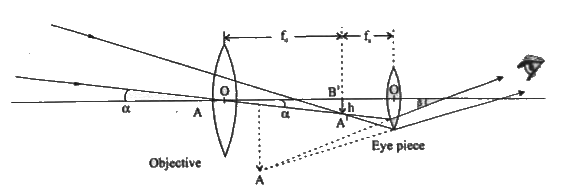 Here, `L=f_(0)+f_(e)`. `tan alpha= -(h)/(f_(0))=alpha` for small angles. `tan beta= (h)/(f_(e))= beta` for small angles. and`m= (beta)/(alpha) = - (f_(0))/(f_(e))`. The -ve sign indicates that the FINAL IMAGE is inverted. Note : The largest lens objective in USE has a diameter of 40 inches, which is at the Yerkes observatory in Wisconsin, USA. |
|
| 7. |
The temperature of the Sun's external layer (the photosphere) is about 6000 K. Why don't hydrogen atoms, the main component of the photosphere, leave the Sun's surface? |
|
Answer» The escape velocity is `v = sqrt(2 gamma m_(o.)//R_(o.)) = 6.1 xx 10^5 m//s` It may be seen that the root-mean-square velocity is only 1/51 of the escape velocity. THEREFORE only a small fraction of the atoms whose SPEEDS are much greater than the average speed (SEE `xi` 25.2) can at any given time escape from the Sun.s gravitational field. They create what is called the solar wind. |
|
| 8. |
The time -averaged energy in a sinusoidal electromagnetic wave is |
|
Answer» OVERWHELMINGLY ELECTRICAL |
|
| 9. |
Time taken by the sunlight to pass through a slab of 4 cm and refractive index 1.5 is ...... s. |
|
Answer» `2xx10^(-8)` `thereforen=(CT)/(d)` `THEREFORE t=(nd)/(c)=(1.5xx4xx10^(-2))/(3xx10^8)` `therefore t =2xx10^(-10)` s |
|
| 10. |
Define mass defect and binding energy. How does binding energy per nucleon vary with mass number ? What is its significance ? |
|
Answer» Solution :1. Mass defect `(Delta M)` : The difference in mass of a nucleus and its constituents is called the mass defect. The nuclear mass M is always less than the total mass, `Sigma m`, of its constituents. Mass defect, `(Delta M)=[Z m_(P)+(A-Z)m_(n)-M]` 2. Binding energy : The energy required to break the nucleus into its constituent nucleons is called the binding energy. Binding Energy, `(E_(b))=Delta MC^(2)=[Zm_(P)+(A-Z)m_(n)-M]931.5 MEV`. Nuclear binding energy is an indication of the stability of the nucleus. Nuclear binding energy per nucleon `E_(bn)=(E_(b))/(A)`. 3. The following graph represents how the binding energy per nucleon varies with the mass number A. 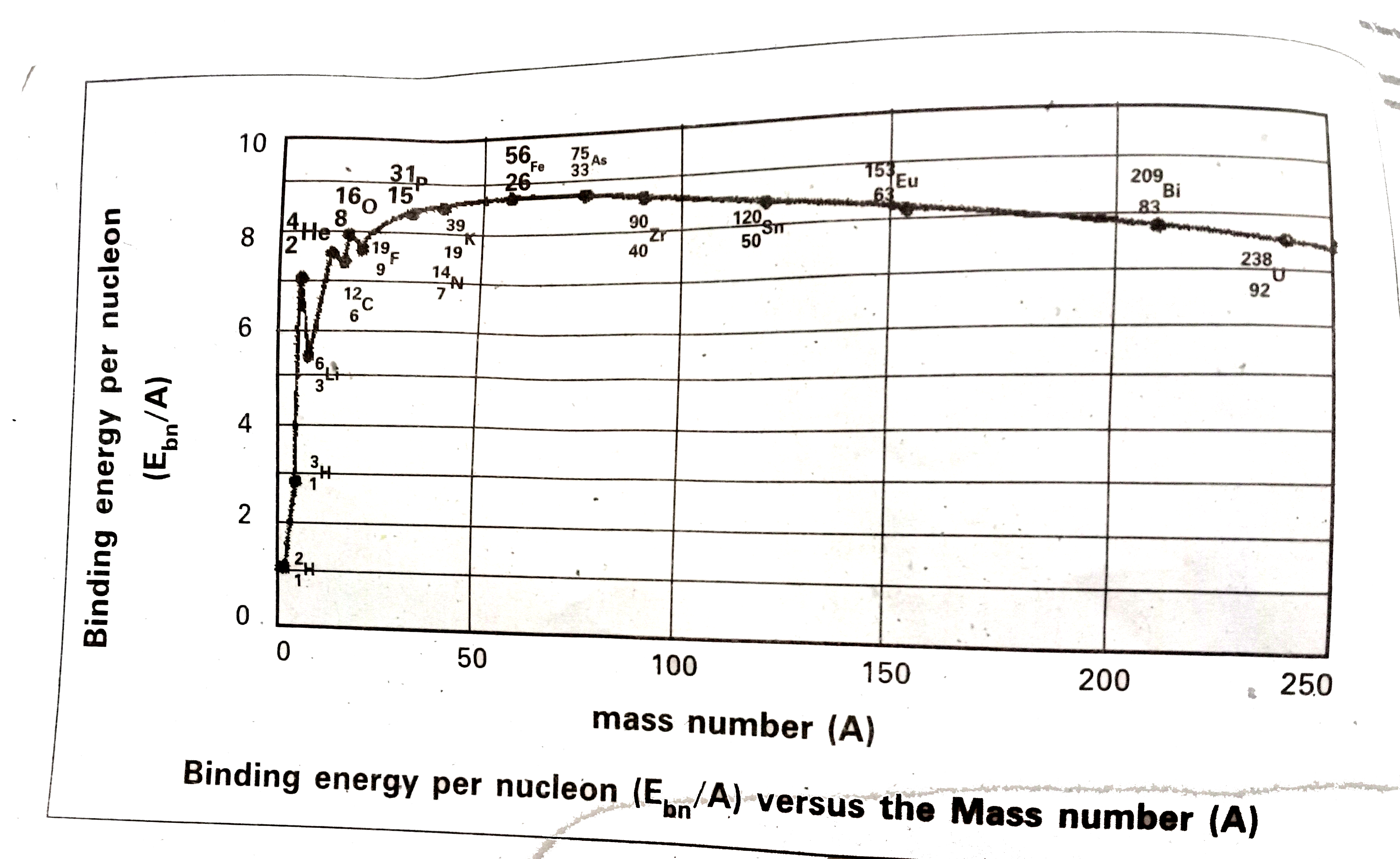 4. From the graph that the binding energy is highest in the range 28 lt A lt 138. The binding energy of these nuclei is very close to 8.7 MeV. 5. With the increase in the mass number the binding energy per nucleon decreases and CONSEQUENTLY for the heavy nuclei like Uranium it is 7.6 MeV. 6. In the region of smaller mass numbers, the binding energy per nucleon curve shows the characteristic minima and maxima. 7. Minima are associated with nuclei cotaining an odd number of protons and neutrons such as `._(3)^(6)Li, ._(5)^(10)B, ._(7)^(14)N` and the maxima are associated with nuclei having an even number of protons and neutrons such as `._(2)^(4)He, ._(6)^(12)C, ._(8)^(16)O`. Significance : 8. The curve explains the relationship between binding energy per nucleon and stability of the nuclei. 9. Uranium has a relatively low binding energy per nucleon as 7.6 MeV. Hence to attain greater stability Uranium breaks up into intermediate mass nuclei resulting in a phenomenon called fission. 10. On the other hand light nuclei such as hydrogen combine to form heavy nucleus to form helium for greater stability, resulting in a phenomenon called fusion. 11. Iron is the most stable having binding energy per nucleon 8.7 MeV, and it neither undergoes fission per fussion. |
|
| 11. |
A parallel-plate air capacitor of plate separation 2mm and capacitance 1muF is charged to 100V. A dielectric slab of relative permittivity 50 is now inserted so as to fill the space between the plates. (i)Find the polarisation charge on one of the boundaries of the dielectric slab. (ii) Find the magnitude of the polarisation of the dielectric slab. (epsilon_(0) = 8.85 xx 10^(-12) C^(2)//N.m^(2)) |
|
Answer» Solution :Data: `C_(0) = 10^(-6) F, d=2 XX 10^(-3) m, k=50, V=100 V`, `epsilon_(0) = 8.85 xx 10^(-12) C^(2)//N.m^(2)` `therefore Q_(p) = Q(1-1/k)= C_(0)V(1-1/R)` `therefore Q_(P) = Q(1-1/k) = C_(0)V(1-1/k)(therefore Q=C_(0)V)` `=10^(-6) xx 100 xx 49/50 = 49 xx 2 xx 10^(-6) = 9.8 xx 10^(-5)C = 98 MU` C (ii) SINCE the magnitude of the polarisation, `P=sigma_(p) = Q_(p)/A` and `C_(0) = (Aepsilon_(0))/d`. `P=(Q_(p).epsilon_(0))/(C_(0)d) = ((9.8 xx 10^(-5))(8.85 xx 10^(-12)))/((10^(-6))(2 xx 10^(-3)))` `=0.49 xx 8.85 xx 10^(-7) = 4.3365 xx 10^(-7) C//m^(2)` |
|
| 12. |
Paragraph : A particle vibrates in S.H.M. along a straight line. Its velocity is 4 cm/s when its displacement is 3 cm and velocity is 3 cm/s when displacement is 4 cm. A point mass oscillates along the x-axis according to the law x=x_(0)cos omegat-(pi)/(4). If acceleration of the particle is written as a=A cos (omega t+delta), then |
|
Answer» `A=x_(0)oemga^(2),delta=(pi)/(4)` `:.` ACCELERATION `a=(dv)/(dt)=-x_(0)omega^(2)cos(omegat-(pi)/(4))` `=x_(0)omega^(2)cos(pi+omega t-(pi)/(4))` Now compparing it with `a=A cos (omega t+delta)`, We have `A=x_(0)omega^(2)` and `delta=(3pi)/(4)`. So correct choice is ( c ). |
|
| 13. |
Assertion: Gases also behave as fluids. Reason: Gas molecules are bounded by cohesive forces. |
|
Answer» If both ASSERTION & Reason are true & the Reason is a correct explanation of the Assertion. |
|
| 14. |
A weight of mass m hangs on a thread. The thread is deflected by an angle alpha_0and let go. Find the tension of the thread as a function of the angle alpha . |
|
Answer» `T-F_(2) = mv^(2)//L` To find the velocity apply the law of conservation of energy `mgh_(0) = mgh +mv^2//2` Hence `T = mg cos alpha +(2mg)/l (h_0 -h)` However , `h_(0) = 1 (1- cosalpha_(0)), h = l ( 1 - cos alpha) , ` therefore `h_0 -h = l (cos alpha_(0) - cosalpha_0)` Substituting into the EXPRESSION for the tension of the thread we obtain `T = mg (3 cos alpha - 2 cos alpha_0)` 
|
|
| 15. |
Find the ratio of energies required to excite a diatomic molecule to the first vibrational and to the first rotational level. Calculate that ratio for the following molecules: Molecule, omega, 10^(14s^(-1) d, pm (a) H_(2) 8.3 74 (b) HI 4.35 160 (c ) I_(2) 040 267 Here omega is the natural vibration frequency of a molecule, d is the distance between nuclei. |
|
Answer» Solution :For the first ROTATIONAL level `E_(rot)= 2(ħ^(2))/(2I)=(ħ^(2))/(I)` and for the first vibrational level `E_(vib)= .ħ omega` Thus `xi=(E_(vib))/(E_(rof))=(Iomega)/(ħ)` Here `omega=` frequency of VIBRATION. Now `I= mud^(2)=(m_(1)m_(2))/(m_(1)+m_(2))d^(2)` (a) For `H_(2)` moleculeI `=4.58xx10^(-41)gm cm^(2)` and `xi= 36` (b) For HI moleculeI `=4.2xx47xx10^(-40) gm cm^(2)` and `xi= 175` (c ) For `I_(2)` moleculeI `=7.57xx10^(-38) gm cm^(2)` and `xi= 2872` |
|
| 16. |
Consider a uniform electricfield E=3xx10^(3) hatiN/C(a) what is the flux of this fieldthriought a square of 10 cm on a side whose plane is parallel to the yz plane (b)hwhat is the flux through the samea 60^(@)m anglewith the x axis |
| Answer» Solution :CHARGES 1 AMD 2 are negative CHARGE 3 is positiveparticle 3 has the highest charge to MASS ratio | |
| 17. |
Who is scolding Beinkensopp for coming late? |
|
Answer» Sir |
|
| 18. |
A liquid having a coefficient of volume expansion gamma is filled in a cylindrical vessel made out of glass having coefficient of lienar expansion alpha = (gamma)/( 5) . At room temperature , the level of liquid in the vessel isl_(0) and when the temperature is increased by Delta T, the level of liquid in the vessel becomes l~~ l_(0)= ( 1+ n alpha Delta T). What is the value of n ? [Given, alpha Delta T lt lt 1] |
|
Answer» |
|
| 19. |
What happens if the field is not uniform? |
| Answer» SOLUTION :There will be both TRANSLATIONAL and ROTATIONAL MOTIONS. | |
| 20. |
Three particles of the same mass lie in the x-y plane. The (x, y) coordinates of their positions are (1, 1), (2, 2) and (3, 3) respectively. The (x, y) co-ordinates of the centre of mass are: |
|
Answer» (1, 2) `x=(mxx1+mxx2+mxx3)/(m+m+m)=(1)/(3)(1+2+3)=2` Similarly, `y=(mxx1+mxx2+mxx3)/(3M)=(1)/(3)(1+2+3)=2` |
|
| 21. |
A telescope has an objective lens of focal length 150 cm and an eyepiece of focal length 5 cm. If a 50 m tall tower at a distance of 1 km is observed through this telescope in normal setting, the angle formed by the image of the tower is theta, then theta is close to : |
|
Answer» `1^(@)` Let the angle formed by tower be `ALPHA` `tan alpha=(50M)/(1km)=(50)/(1000)=(1)/(20)` `alpha=(2.86)^(@)` Let the angle formed by image be `beta` `tan beta=m tan alpha` `=30xx(1)/(20)` `tan beta=1.5` `beta=56.31~~57^(@)` Which is closest to `60^(@)`. |
|
| 22. |
For a planet having mass equal to mass of the earth but radius is one fourth of radius of the earth. Then escape velocity for this planet will be |
|
Answer» `11.2" KM"//s` If R is `1//4"TH"` of radius of earth then `v._(e )=2v_(e-"earth")=2xx11.2" km"//s =22.4" km//s`. |
|
| 23. |
A balanced wheatstone bridge is shown the values of currents i_(1) and i_(2) ar |
|
Answer» 0.9A, 0.6A |
|
| 24. |
In the decay ""^(64)Cu rarr""^(64) Ni+e^(+) + v,the maximum kinetic energy carried by the positron is found to be 0.650 MeV. (a) What is the energy of the neutrino which was emitted together with a positron of kinetic energy 0.150 MeV ? (b) What is the momentum of this neutrino in kg-m/s? Use the formula applicable to a photon. |
|
Answer» |
|
| 25. |
Franz thinks- will they make them sing in German- even the pigeons? What could this mean? |
|
Answer» German would USE brutal force over everyone |
|
| 26. |
The ratio of number of turns in primary and secondary coil of a transformer is 1:20 the ratio of current in primary and secondary coils will be .... |
|
Answer» Solution :`I_2/I_1=N_1/N_2` Now, `N_1/N_2=1/20` `therefore I_1/I_2=N_2/N_1=20/1` `therefore` RATIO of CURRENTS is 20 :1 |
|
| 27. |
In the satellite communication, the up linking frequency range is |
|
Answer» `0.896` to `0.901` GHZ |
|
| 28. |
Give convection for electric or magnetic field emerging out of the plane of the paper and going into the plane of paper. |
|
Answer» Solution :1. A current or a ELECTRIC or magnetic field emerging out of the plane of the paper is depicted by a DOT `o.` of plane of paper is depicted by a cross `ox`. 2. A current or field emerging out of plane of paper is represented by `o.` (dot). 3. A current or field GOING inside is represented (going IP. by `ox` (cross)). 4. A dot appears like the tip of an arrow pointed at you, a cross is like the feathered tail of an arrow moving away from you. |
|
| 29. |
A galvanometer of 50 Omega resistance when connected across the terminals of a battery of emf 2V along with the resistance 200 Omega the deflection produced in the galvanometer is 10 divisions. If the total number of divisions on the galvanometer ·scale on either side of central zero is 30, then the maximum current that can pass through the galvanometer is |
|
Answer» `0.24 A` |
|
| 30. |
In the arrangement shown in the fig the cylinder is insulating one. Both sides same diatomic gas is trapped by two insulting massless pistos with the help of an ideal spring. The natural length of the spring is equal to the length of the cylinder. initial state of the gases are as shown in the figure. What is the value of energy stored in the spring ? |
|
Answer» `P_(0)V_(0)` `x=(V_(0))/A` Also `P_(0)A=2KX` `(P_(0))/x=2kximpliesP_(0)V_(0)=2kx^(2)` `:.1/2k(2x)^(2)=1/2k4x^(2)=2kx^(2)=P_(0)V_(0)` |
|
| 31. |
In the arrangement shown in the fig the cylinder is insulating one. Both sides same diatomic gas is trapped by two insulting massless pistos with the help of an ideal spring. The natural length of the spring is equal to the length of the cylinder. initial state of the gases are as shown in the figure. Now the gases are heated slowly, such that their temperature becomes three times to their initial temperature. The total heat given to the system is |
|
Answer» `12P_(0)V_(0)` `P_(0)A=2k(V_(0))/A` `IMPLIES(P_(f))/(P_(0))=(V_(f))/(V_(0))impliesP=(P_(0))/(V_(0))V` Now `:. Q=dU+W` `=2 5/2 (P_(1)V_(1)-P_(0)V_(0))+w` `=12 P_(0)V_(0)` |
|
| 32. |
In fig.25-46 two parallel plate capacitors (with air between the plates) are connected to a battery. Capacitor 1 has a plate area of 1.5 cm^2 and an electric field of magnitude 3500 V//m. Capacitor 2 has a plate area of 0.70 cm^2 and an electric field of magnitude 1500 V//m (a) What is the total charge on the two capacitors? (b) If the first plate area is cut in half does the total charge increase, decrease, on remain the same? |
| Answer» Solution :`a) 5.6 TIMES 10^-12 C` (b) decreasing area decrease the charge Q | |
| 33. |
A particle is launched from a height 8R above the surface of earth and it is given a speed ((GM)/(8R)) parallel to the surfaces then |
|
Answer» It will escape FRO the gravitational field of earth. It MUST be either an apogee or a perigee. But since the speed will be INCREASING, the launch point must be the perigee. |
|
| 34. |
Answer the following questions : (e ) If the earth did not have an atmosphere, would its average surface temperature be higher or lower than what it is now? |
| Answer» Solution :If the earth did not have an atmosphere, then its average SURFACE TEMPERATURE will be lesser than what it is now because in that CASE green house EFFECT will be absent. | |
| 35. |
The F-layer persists in earth's atmosphere at night because |
|
Answer» It is a TOP most layer in earth's atmosphere which is highly ionized and inspite of RECOMBINATION, ionization persists to some degree. |
|
| 36. |
A closed vessel impermeable to heat contains ozone (O_3) at a temperature of t_1 = 527^@C. After some time the ozone is completely converted into oxygen (O_2). Find the increase of the pressure in the vessel ifq=34 kcal have to be spent to form one g-mole of ozone from oxygen. M_1= Molecular weight of ozone = 48 and M_2 = molecular weight of oxygen 32, C_vof oxygen = 5 cal/deg. mole. |
|
Answer» |
|
| 37. |
(A): If changing current is flowing through a machine of iron eddy currents are produced (R): Change in magnetic flux through an area causes eddy currents |
|
Answer» Both A and R are true and R is the CORRECT explanation |
|
| 38. |
If kinetic energy of emitted electron is made double then its de-Broglie wavelength will become……times initial de-Broglie wavelength. |
|
Answer» `sqrt(2)` but `p^(2)=sqrt(2mK)` `therefore lambda =(h)/(sqrt(2mK))` `therefore lambda prop (1)/(sqrt(K))`[`because(h)/(sqrt(2m))` same ] `therefore (lambda_(2))/(lambda_(1))=sqrt((K_(1))/(K_(2)))` `therefore (lambda_(2))/(lambda_(1))=sqrt((K)/(2K)) therefore (lambda_(2))/(lambda_(1))=(1)/(sqrt(2))` |
|
| 39. |
An n-p-n transistor is biased to work as an amplifier, which of the following statements is not correct? |
|
Answer» The electrons GO from base region to collector region |
|
| 40. |
A particle moves in a straight line with retardation propotional to itsdisplacement. Loss of K.E. for any displacement x is proportional to : |
|
Answer» `x^2` If time INTERVAL is kept the same `v prop x` and `v^2 prop x^2` `:.K.E. E_k prop v^2` or `E_k prop x^2` |
|
| 41. |
A : The chief characteristic of series resonant circuit is voltage magnification. R : At resonance the voltage drop across inductance (or capacitance) is Q times the applied voltage. |
|
Answer» If both ASSERTION & REASON are TRUE and the reason is the correct EXPLANATION of the assertion, then MARK (1) |
|
| 42. |
Find the emf across the points P and Q whichare diametrically opposite points of a semicircular closed loop in a magnetic of each branch. |
Answer» SOLUTION :INDUCED EMF = 2Bav
|
|
| 43. |
What is meant by a linearly polarised light? Which type of waves can be polarised? Briefly explain a method for producing polarised light. Two polaroids are placed at 90^(@) to each other and the intensity of transmitted light is zero. What will be the intensity of transmitted light when one more polariod is placed between these two bisecting the angle between them ? Take intensity of unpolarised light as l_(0) |
Answer» Solution :A LIGHT wave is said to be linearly polarised if its electric FIELD vector vibrates just in ONE direction perpendicular to the direction of propagation. Only tranverse waves can be polarised. Light can be polarised by reflecting it from a transparent medium. The extent of polarisation depends on the angle of INCIDENT. At a particualr angle of incidence, called Brewster angle, the reflected light is completely polarised as shown below : 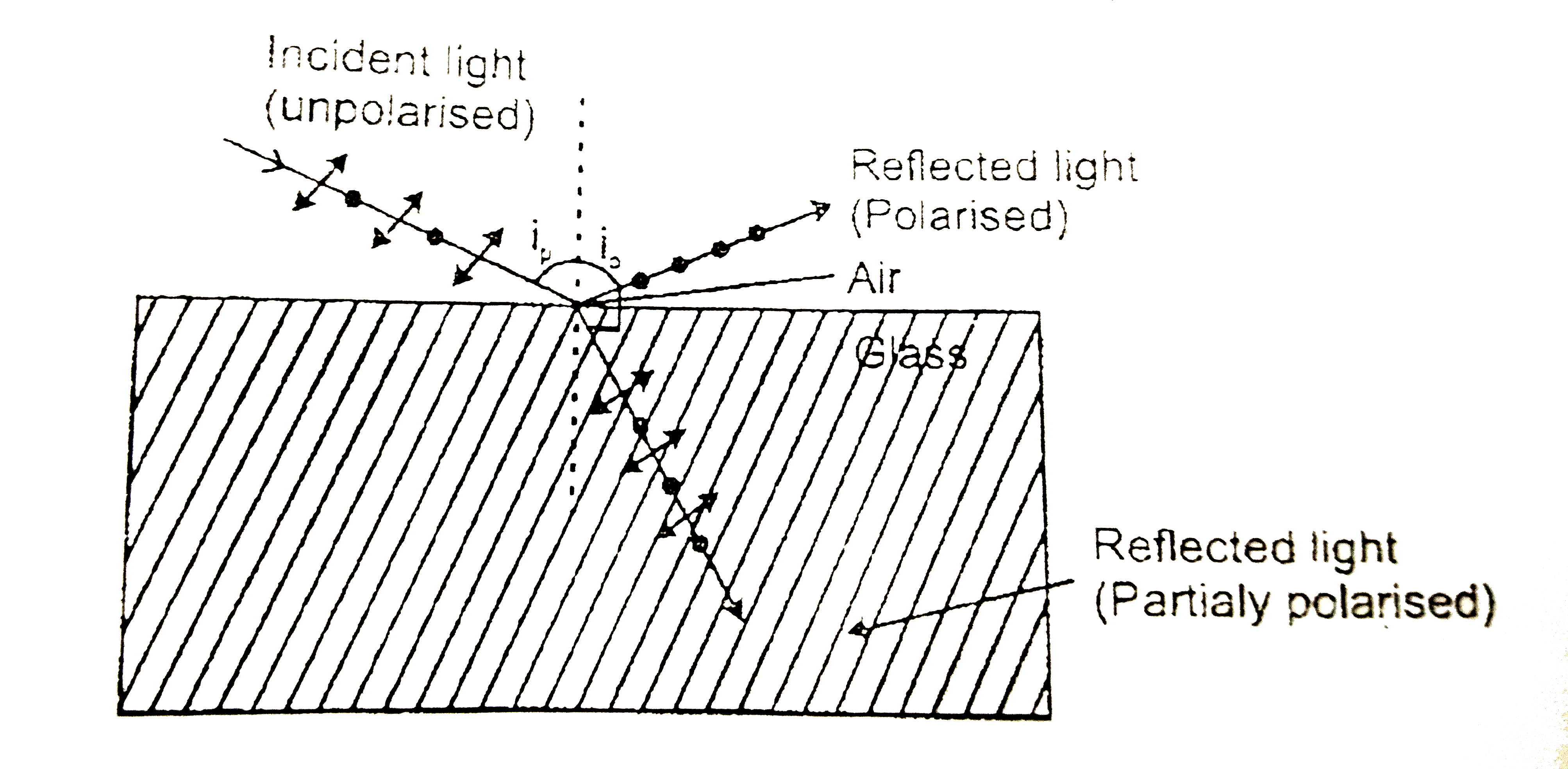 Numerical : `l=l_(0) cos^(2) theta=l_(0)xx((1)/(sqrt2))^(2)=(I_(0))/(2)` Resultant intensity `l_(R)=l cos^(2) theta=l_(0)(I_(0))/(2)xx((1)/(sqrt2))^(2)=(I_(0))/(4)` |
|
| 44. |
A nucleus at rest splits into two nuclear parts having radii in the ratio: 1:2. Their velocities are in the ratio: |
|
Answer» `6:1` `4//3pir_(1)^(3).pv_(1)=4//33pir_(2)^(3).pv_(2)` Here `r_(2)=2r_(1)` `4//3pir_(1)^(3).pv_(1)=4//3pi(2r_(1))^(3).v_(2)` `v_(1)=8v_(2)` `v_(1)/v_(2)=8/1` |
|
| 45. |
Speed of a solid sphere after rolling down an inclined plane is : |
|
Answer» `((10)/(7)gh)^(1//2)` `THEREFORE (7)/(10)mv^(2)=mgh""v=sqrt((10)/(7)gh)` |
|
| 46. |
If tube length Of astronomical telescope is 105cm and magnifying power is 20 for normal setting, the focal length of the objective is: |
| Answer» Answer :A | |
| 47. |
A 900pF capacitor is charged by 100 V battery as in figure (a). How much electrostatic energy is stored by the capacitor? (b). The capacitor is disconnected from the battery and connected to another 900pF capacitor as in figure (b). What is the electrostatic energy stored by the system? |
|
Answer» Solution :The charge on the CAPACITOR is `Q=CV=900 xx 10^(-12) xx 100=9 xx 10^(-8)C` The energy stored by the capcitor is `=(1/2)CV^(2)=(1/2)QV=(1/2)xx 9 xx 10^(-8) xx 100=4.5 xx 10^(-6)J` (b) In the STEADY situation, the two capacitors have their positive plates at the same potential and their negative plates at the same potentia. Let the common potential difference be V.. The charge on each capacitor is then Q.=CV.. By charge conservation conservation, `Q.=Q/2`. This implies `V.=V/2`. The total energy of the system is `=2 xx 1/2 Q.V.=1/4 QV=2.25 xx 10^(-6)J`. There is a transient period before the system settles to the situation (b). During this period, a transient current flows from the first capacitor to the second. Energy is lost during this time in the FORM of heat and electromagnetic radiation. |
|
| 48. |
On horizontal surface of a truck a block of mass 1 kg is placed (mu = 0.5) and truck is moving with acceleration 5 ms^-2, then frictional force on block will be |
|
Answer» 5 N |
|
| 49. |
Carbon resistors commonly used in electronic circuits are made of |
|
Answer» COPPER and carbon |
|
| 50. |
Calculate the energy released when three alpha-particle (""_2He^4) fuse to form a carbon (""_6C^(12)) nucleus. Given m(""_2He^4)=4.002603 amu. |
|
Answer» Solution :`3 ""_2He^4 to ""_6C^(12)+Q` `therefore Q=m (3 ""_2He^4)-m(""_6C^(12))=12.0078-12=0.007809` `therefore` Energy released `=0.007809 xx931 MeV =7.27` MeV |
|