

Saved Bookmarks
This section includes 7 InterviewSolutions, each offering curated multiple-choice questions to sharpen your Current Affairs knowledge and support exam preparation. Choose a topic below to get started.
| 1. |
In the circuit shown, if the10 Omegaresistance is replaced by20 Omegathen what is the amount of current drawn from the battery ? |
| Answer» Solution :The given Wheatstonebridge is balanced.Therefore , there is no CURRENTIN 10 ` OMEGA`wire. If ` 10 Omega `wire is replacedwith ` 20 Omega`wire,the bridgestill remains balanced. | |
| 2. |
The refractive index of glass with respect to water is (9)/(8). while that of turpentine with respect to water is (10)/(9). The refractive index of glass with respect to turpentine is |
|
Answer» `(5)/(4)` |
|
| 3. |
In a semiconducto |
|
Answer» The number of FREE ELECTRONS is more than that in a conductor |
|
| 4. |
(20)/(pi^(2))H inductor is connected to a capacitor of capacitance C. The value of C in order to impart maximum power at 50 Hz is |
| Answer» Solution :`5 mu F` | |
| 5. |
A beam of light is linearly polarized . You wish to rotate its direction of polarization by 90^(@) using one or more ideal polarizing sheets . To get maximum transmitted intensity , how many sheets should you use ? |
|
Answer» 1 |
|
| 6. |
A bob of a simple pendulum of mass 40gm with a positive charge 4 xx 10^(-6)C is oscillating with time period T_1,. An electric field of intensity 3.6xx10^4 N/c is applied vertically upwards now time period is T_2. The value of is (g = 10m//s^2) |
|
Answer» `0.16` |
|
| 7. |
A bar magnet 20 cmin length is placed with its south poletowards geographical north the neutralpointsare situatedat a distance of 40 cm from the centre of the magent if H=3.2xx10^(-5)weber/metre^(2) then thepole strength of themagnet is |
|
Answer» `9000 ab -axxcm` `THEREFORE`for axial line B=H=`(mu_(0))/(4pi)(2m)/(d^(3))` `H=(4ml)/(d^(3))` `(Hd^(3))/(4L)` =m |
|
| 8. |
Electrons are emitted with kinetic energy T from a metal plate by an irradiation of light of intensity J and frequency upsilon Then which of the following will be true? |
|
Answer» `T PROP J` ` rArr J = (e (dN)/(dt))(H upsilon) rArr J prop (dN)/(dt)` `(dN)/(dt)` = rate of emission of electrons and `E = h upsilon` = energy of each electron . Again, as PER the theory of photoelectric emission, `h upsilon KE _(max) + phi_(0) rArr h upsilon = T + phi_(0)` `rArr` T is linearly increasing with `upsilon` . |
|
| 9. |
If the distance travelled by a freely falling body in the last second of its journey is equal to the distance travelled in the first 2s,the time of descent of the body is |
|
Answer» 5s |
|
| 10. |
A grass hopper can jump maximum distance of 1.6m. It spends negligible time on the ground. How far can it go in 10 seconds? |
|
Answer» Solution :`u^(2)/g=1.6 u^(20) =16, u=4 m//s` `4 COS THETA =4 xx 1/sqrt(2) =2sqrt(2)`m/s `S = 4 cos theta.t=2sqrt(2) xx 10, S=20sqrt(2)`m |
|
| 11. |
Which mode of propagation is used by short wave broadcast services having frequency range from a few MHz upto 30 MHz ? Explain diagrammatically how long distance communication can be achieved by this mode. Why is there an upper limit to frequency of waves used in this mode? |
|
Answer» Solution :Sky WAVE propagation / Ionospheric reflection. ELECTROMAGNETIC waves of these frequencies are REFLECTED, by the ionosphere towards the earth. Electromagnetic waves of frequencies higher than 30 MHz PENETRATE the ionosphere and escape. |
|
| 12. |
Just outside a sharp point on a conductor , we ill have , a larger ______ than just outside gradually curving places on the conductor. |
|
Answer» Electric FIELD |
|
| 13. |
Statement I: In a hydrogen atom, if the difference in the energy of the electron between the second orbit and third orbit is E, then the ionisation potential of hydrogen atom will be 3.2 E. Statement II: The minimum energy (in eV) electrons must have for all the lines of all the series of H_2 spectrum to appear when the H_2 atoms are excited is 10.2 eV. |
|
Answer» A Statement I is true, statement II is FALSE. |
|
| 14. |
A capacitor of 50 muF is charged to 10 volts. Its energy in joules is |
|
Answer» `2.5 XX 10^(-3)` |
|
| 15. |
The moment of inertia of a uniform circular disc of radius R and mass M about an axis passing from the edge of the disc and normal to the disc is |
|
Answer» `MR^(2)` M.I. about its one edge =`MR^(2)+(MR^(2))/2` (Perpendicular to the PLANE) MOMENT of inertia =`3/2MR^(2)`. 
|
|
| 16. |
Hydrogen (""_(1)H^(1)), Deuterium (""_(1)H^(2)), single ionised Helium (""_(2)He^(4))^(+) and doubly ionised lithium (""_(3)Li^(6))^(++) all have one electron around the nucleus. Consider an electron transition from n=2 to n=1. If the wavelength of emitted radiation are lamda_(1),lamda_(2),lamda_(3) and lamda_(4) respectively then approximately which one of the following is corrent ? |
|
Answer» `lamda_(1)=lamda_(2)=2lamda_(3)=lamda_(4)` `(1)/(lamda_(ik))=RZ^(2)[(1)/(n_(k)2)-(1)/(n_(i)2)]` here R and `n_(k),n_(i)` are constant, `:.lamda_(ik)prop(1)/(Z^(2))` `:.lamda_(1):lamda_(2):lamda_(3):lamda_(4)=(1)/((1)^(2)):(1)/((1)^(2)):(1)/((2)^(2)):(1)/((3)^(2))` `=(1)/(1):(1)/(1):(1)/(4):(1)/(9)` `:.lamda_(1):lamda_(2)=1:1` `:.lamda_(1)=lamda_(2)` `lamda_(1):lamda_(3)=1:(1)/(4)` `:.(lamda_(1))/(lamda_(3))=(1)/((1)/(4))implieslamda_(1)=4lamda_(3)` and `lamda_(1):lamda_(4)=1:(1)/((1)/(9))` `:.(lamda_(1))/(lamda_(4))=(1)/((1)/(9))implieslamda_(1)=9lamda_(4)` `:.lamda_(1)=lamda_(2)=4lamda_(3)=9lamda_(4)` |
|
| 17. |
White light is incident on one of the refracting surfaces of a prism of angle 50^(@). If the refractive indices for red and blue colours are 1.641 and 1.659 respectively. The angular separation between these two colours when they emerge out of the prism is |
|
Answer» `0.9^(@)` `delta_(B) - delta_(R) = (mu_(B) - mu_(R))A` =`(1.659 - 1.641) XX 5^(@) = 0.09^(@)`. |
|
| 18. |
The temperature coefficient of a material is 4 xx 10^(-4) per ""^(@)C. Calculate the temperature at which resistance of the conductor becomes 40% more than its value of 0^(@)C. |
|
Answer» Solution :The RESISTANCE of the conductor at temperature `t ""^(@)C` is given by: `R= R_(0) (1 + alpha t)` `rArr 1.4 R_(0) = R_(0) (1 + 4 xx 10^(-4)t)` `rArr t= (0.4)/(4 xx 10^(-1)) = 1,000^(@)C` |
|
| 19. |
What is the self inductance of an air core solenoid 50cm long and 2cm radius if it has 500 turns? Find the magnetic flux when a current of 2 amp passes through it |
| Answer» SOLUTION :`7.89 XX 10^(-4)H, 15.78 xx 10^(-4) WB` | |
| 20. |
What is quantisation of electric charges? |
| Answer» SOLUTION :Charge on any body is an integer multiple of THECHARGE of an electron or proton i.E. `q=+- N e, ` where n=0,1,2,3,…. | |
| 21. |
Two slits separated by a distance of 1 mm are illuminated with light of wavelength 6000overset@A. The interference fringes were observed on a screen placed 100 cm from the slits. The distance between the third dark fringes and the fifth bright fringes is equal to : |
|
Answer» 0.60 mm |
|
| 22. |
A point charge q is placed at origin Let vec(E)_(A),vec(E)_(B) andvec(E)_(C) be the electric field at three points A (1,2,3), B (1,1,-1) and C (2,2,2) due to charge q. Then [i]vec(E)_(A)botvec(E)_(B)[ii]|vec(E)_(B)|=4|vec(E)_(C)| select the correct alternative |
|
Answer» only [i] is correct |
|
| 23. |
Prove laws of refraction using Hugyen's principle. |
Answer» Solution :Let us consider a PARALLEL beam of light is incident on a refracting plane surface XY such as a glass surface. The incident WAVEFRONT AB is in rarer medium (1) and the refracted wavefront A.B. is in denser medium (2). These wavefront are PERPENDICULAR to the incident rays L, M and refracted rays L.,M. respectively. By the time the point A of the incident wavefront touches the refracting surface, the point B is yet to travel a distance BB. to touch the refracting surface B..  `t=(BB.)/(v_(1))=(A A.)/(v_(2))(or)(BB.)/(A A.)=(v_(1))/(v_(2))` (i) The incident rays, the refracted rays and the normal are in the same plane. (ii) Angle of incidence, `i = angle NAL = 90^(@) - angle NAB = angle BAB.` Angle of refraction, `r = angle N.B.M. = 90^(@) - angle N.B.A = angle A.B.A.` For the two right angle triangles `Delta ABB. and Delta B.A.A`. `(sini)/(sinr)=(BB.//AB.)/(A A.//AB.)=(BB.)/(A A.) = (v_(1))/(v_(2))=(c//v_(2))/(c//v_(1))` Here, c is speed of light in vacuum. The ratio c/v is the constant, called REFRACTIVE index the medium. The refractive index of medium (1) is, `c//v_(1) = n_(1)` and the of medium (2) `c//v_(2) = n_(2)`. `(sini)/(sinr) = (n_(2))/(n_(1))` In product form, `n_(1) sin i = n_(2) sinr` Hence, the laws of refraction are proved. |
|
| 24. |
A: The work done by magnetic field on a moving charge is zero. R: The magnetic force acting on a moving charge has no component in the direction of velocity. |
|
Answer» If both Assertion & REASON are true and the reason is the correct explanation of the assertion then MARK (1) |
|
| 25. |
Explain the effect of dielectriccapacitance of parallel plate capacitor and obtainthe formula of dielectric constant. |
|
Answer» Solution :Let us have two large plates each of area Aseparated by a distance d. The charge on the plates is `pm` Q corresponding to the charge density `pm sigma` . When there ls vacuum between the plates `E_(0)= (sigma)/(in_(0))` and the potential difference `V_(0)`. `:. V_(0)=E_(0)d` If `C_(0)` is the capacitance , `C_(0)=(Q)/(V_(0))` `= (sigmaA)/(E_(0)d) "" [because Q = sigmaA]` `C_(0)= (in_(0)A)/(d) "[ because E_(0)= (sigma)/(in_(0))implies in_(0)= (sigma)/(E_(0)]` Consider a dielectric inserted between the plate FULLY OCCUPYING the intervening region. So, th dielectric is polarised by the field and surfaccharge density `pm sigma_(p)`ARISE on the plates. Hence, electric field between two plates, `E= E_(0)-E_(p)` `:. E =(sigma)/(in_(0))-(sigma_(p))/(in_(0)) "" [because E_(p)=(sigma_(p))/(in_(0))]` `:. E = (sigma-sigma_(p))/(in_(0))` and electric potential difference V= Ed `= (sigma-sigma_(p))/(in_(0)).d` For linear dielectric ap is proportionalto `sigma` Hence `sigma- sigma_(p)` is also proportional to `sigma` so we can write `sigma- sigma_(p)= (sigma)/(K)` Where K is a oonstant characteristic of dielectric. `:. V= (sigmad)/(in_(0)K)=(Qd)/(A in_(0)K)[because sigma = (Q)/(A)` and from (2)] The capacitance with dielectric between the plate is then, `C = (Q)/(V)= (A in_(0)K)/(d)= K(Ain_(0))/(d)` `:. C = KC_(0)` [ From equation ] Hence, capacitance of capacitor with dielectric medium of dielectric constant K becomes K times the capacitance of capacitor with vacuum as medium. The product to `epsilon_(0)K` is called the permittivity of the medium and is denoted by `EPSILON` . `:. epsilon = epsilon_(0)K` `:. K = (epsilon_(0))/(epsilon_(0))= (C)/(C_(0))= (E_(0))/(E)` Deflnldon of dielectric constant : "The ratio of 1. permittivity of the medium to the permittivity of vacuum is known as dielectric constant". `:. K = (epsilon)/(epsilon_(0))` OR "The ratio of intensity of electric field in vacuum to the intensity of electric field in dielectric medium is known as dielectric constant". `:. K = (E_(0))/(E)` |
|
| 26. |
A glass beaker is filled with water up to 5 cm. It is kept on top of a 2 cm thick glass slab. When a coin at the bottom of the glass slab is viewed at the normal incidence from above the beaker, its apparent depth from the water surface is d cm. Value of d is close (the refractive index of water and glass are 1.33 and 1.50,respectively) |
|
Answer» 2.5 |
|
| 27. |
The coil of dynamo is rotating in a magnetic field. The developed induced e.m.f. changes and the number of magnetic lines of force also changes. Which of the following condition is correct |
|
Answer» Lines of FORCE minimum but INDUCED e.m.f. is zero |
|
| 28. |
What is biasing of a diode ? |
| Answer» Solution :When we APPLY an external BATTERY ACROSS the two ends of diode, it is CALLED BIASING. | |
| 29. |
An electron of mass m, when accelerated through a potential difference V, has de-Broglie wavelength lamda, the de-Broglie wavelength associated with a protom of mass M and accelerated through the same potential difference V will be |
|
Answer» <P>`lamda(m)/(M)` `(lamda_(p))/(lamda_(c))=(lamda_(p))/(lamda)=sqrt((m)/(M)) or lamda_(p)=lamdasqrt((m)/(M))`. |
|
| 30. |
Figure shows a series LCR circuit connected to a variable frequency 230 V source. L = 5.0 H, C = 80muF, R = 40 Omega. (a) Determine the source frequency which drives the circuit in resonance. (b) Obtain the impedance of the circuit and the amplitude of current at the resonating frequency. (c) Determine the rms potential drops across the three elements of the circuit. Show that the potential drop across the LC combination is zero at the resonating frequency. |
|
Answer» Solution :(a) `50 rad s^(-1)` (b) `40 Omega, 8.1A` (C ) `V_(Lrms)=1437.5V, V_(Crms)=1437.5V, V_(RRMS)=230V` `V_(LCrms)=I_(rms)=(omega_(0)L-(1)/(omega_(0)C))=0` |
|
| 31. |
A calcite crystal placed over an ink dot is rotated. On seeing through the crystal one finds |
|
Answer» two STATIONARY dots |
|
| 32. |
The energy gap in case of which of the following is maximum? |
|
Answer» GERMANIUM |
|
| 33. |
A uniform bar with mass m lies symmetrically across two rapidly rotating fixed rollers. A and B with distance 'l' between the bars centre of mass and each roller. The rollers whose direction of rotation are shown in figure slip against the bar with coefficient of friction mu. Suppose the bar is displaced horizontally by a small distance 'x' and then released, find the time period of oscillation. |
| Answer» SOLUTION :`2pi sqrt((L)/(mu G))` | |
| 34. |
The graphical representation of the equations x + 2y = 3 and 2x + 4y + 7 = 0 gives a pair of |
|
Answer» PARALLEL lines |
|
| 35. |
A body of mass m, moving with the some velocity v collides with another body of same mass moving with same speed but in the opposite direction, sticks to it. The velocity of the compound body after collision is : |
|
Answer» `nupsilon` `mupsilon + m (-upsilon)= (m + m) V. impliesV.= 0` HENCE correct choice is c). |
|
| 36. |
What does the word 'mysterious' mean? |
|
Answer» IMPOSSIBLE to understand |
|
| 37. |
How do you represent plane polarized and unpolarised light ? |
Answer» SOLUTION :
|
|
| 38. |
Identify the wrong statement with reference to a solar cell |
|
Answer» a. It is a p-n junction diode with no external bias |
|
| 39. |
Light with an energy flux of 18 W//cm^(2) falls on a non-reflecting surface at normal incidence. I f the surface has an area o f 20 cm^(2), find the average force exerted on the surface during a 30 minute time span. |
|
Answer» <P> Solution :The total energy falling on the surface is `U = (18 W // cm^(2) ) xx (20cm^(2) ) xx (30 xx 60) = 6.48 xx 10^(5) J` Therefore, the total momentum delivered (for complete absorption) is`P= (U)/( c)=(6.48 xx 10^(5) J)/(3xx10^(8)m//s) = 2.16xx10^(-3) kg m//s` The average FORCE EXERTED on the surface is `F = (P)/(t ) = (2.16 xx10^(-3))/(0.18xx10^(4)) = 12xx10^(-6)N` |
|
| 40. |
Power P is to be delivered to a device via transmission cables having resistance R_(C)lf V is the voltage across R and I the current through it, find the power wasted and how can it be reduced. |
|
Answer» Solution :Cable used as transmission cable has power, P = `I^(2)R_(C)` `R_(C) `= resstance of cable P = VI GIVEN power can be transmitted in TWO different ways. (1) Low voltage and high current (2) High voltage and low current At low voltage and high current power transmitted according to P `prop I^(2)` will be higher. At low voltage and high current power transmitted according to P `prop I^(2)` will be less. Thus, when transmission is done at higher voltage dissipation (WASTAGE) will be less. |
|
| 41. |
A long solenoid has 500 turns. When a current of 2 A is passed through it, the resulting magnetic flux linked with each turn of the solenoid is 4 xx 10^(-3)Wb. The self-inductance of the solenoid is |
|
Answer» 4.0H |
|
| 42. |
Obtain the binding energy of the nuclei ""_(26)^(26)Fe and ""_(83)^(209)Biin units of MeV from the following data: m (""_(26)^(56)Fe ) = 55.934939 u"" m (""_(83)^(209)Bi ) = 208.980388 u |
| Answer» SOLUTION :8.79 MEV, 7.84 MeV | |
| 43. |
The S.I. unit of specific heat capacity is |
|
Answer» `J mol^(-1)K^(-1)` |
|
| 44. |
A change particle is projected in an XYZ space with initial velocity V_(0) hat(i) from the origin. The particle follows the trajectroy as shown in the figure in column - I and column - II contains the possible uniform field or combination of uniform fields in any direction. Choose the correct option(s) from columnII which can result the given trajectory in column I. |
|
Answer» |
|
| 45. |
A long solenoid connected to a 12 V d.c. source carries a steady current of 2A. When the same solenoid is connected to an a.c. source of 12 V at 50 Hz, the current flowing is 1A. Why is the current reduced in latter case? Calculate inductance of the solenoid. |
| Answer» SOLUTION :33 MH. | |
| 46. |
As shown in the figure, P and Q are two coaxial conducting loops separated by some distance. When the switch S is closed, a clockwise current I_P flows in loop P (As seen by E) and an induced current I_Q flows in loop Q. In which direction this induced current I_Q will flow as seen by E ? |
|
Answer» <P>clockwise 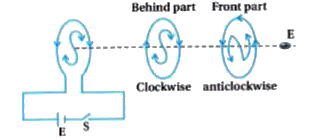
|
|
| 47. |
A disc of mass m and radius r is gently placed on another disc of mass 2m and radius r. The disc of mass 2m is rotating with angular velocity omega_(0) initially.The disc is placed such that axis of both are concident. The coefficient of friction is mu for surfaces of contact Assume that pressure on disc is uniformely distributed. Angular velocity 'omega' when both discs start rotating together without slipping |
|
Answer» `(2omega_(0))/(3)` `V_(A)=omega(lsin30^(@))=V_(0)` `implies omega=(2V_(0))/(l)` `L_(ICR)=(I)_(ICR^(omega))` `(I)_(ICR)=I_(cm)+MD^(2)=(ml^(2))/(12)+m((l)/(2))^(2)=(ml^(2))/(3)` `(I)_(ICR)=((ml^(2))/(3))((2v_(0))/(l))=(2mv_(0)l)/(3)` 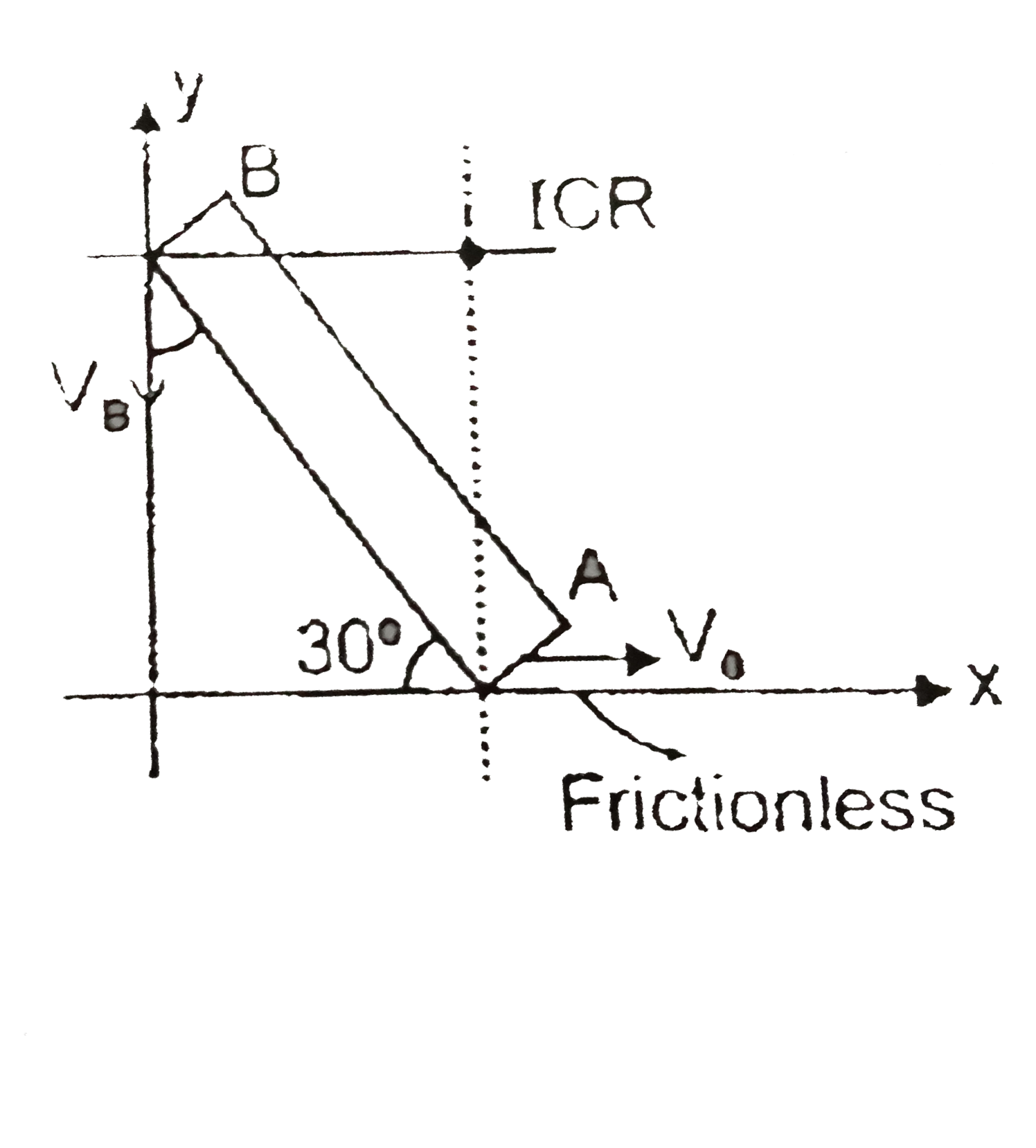
|
|
| 48. |
Two waves are generated on a string of length 4.0 m to produce a three-loop standing wave with an amplitude of 1.0 cm.The wave speed is 100 m/s. Let the equation for one of the waves be of the form y(x,t) =y_m sin(kx +omegat). In the equation for the other wave, what are (a) y_m (b) k, (c) omega and (d) the sign in front of w! |
|
Answer» |
|
| 49. |
The irradiation of lithium and beryllium targets by a monoergic stram of protons reveals that the reaction Li^(7)(p,n) 1.65 MeV is initialted whereas the reaction Be^(9)(p,n)B^(9)-1.85MeV does not take place. Find the possible values of kinetic energy of the protons. |
|
Answer» Solution :Since the reaction `Li^(7)(p,N)Be^(7)(Q= -1.65MeV)` is initiated, the incident proton energy must be `ge(1+(M_(p))/(M_(d)))xx1.65= 1.89MeV` since the reaction `Be^(9)(p,n)B^(9)(Q= -1.85MeV)` is not initiated `TLE(1+(M_(p))/(M_(ve)))xx1.85= 2.06MeV` Thus `1.89MeVleT_(p)le2.06MeV` |
|
| 50. |
Two radio stations broadcast their programmes at the same amplitude A, and at slightly differentfrequencies omega_1 and omega_2respectively, where omega_2 - omega_1 = 10^3Hz . A detector receives the signals from the two stations simultaneously. It can only detect signals of intensity gt= 2A^2 . The time interval between successive maxima of the intensity of the signal received by the detector is 10^(-n) sec . Find n |
|
Answer» |
|