Saved Bookmarks
This section includes 7 InterviewSolutions, each offering curated multiple-choice questions to sharpen your Current Affairs knowledge and support exam preparation. Choose a topic below to get started.
| 1. |
Velocity of particle at time t=0 is 2ms^(-1).A constant acceleration of 2ms^(-2) act on the particle for 1 second at an angle of 60^(@) with its initial velocity .Find the magnitude velocity and displacement of the particle at the end of t=1s. |
|
Answer» `sqrt(3) m//s` |
|
| 2. |
A coil of self inductance of 1H and resistance 200Omega is connected to an A.C. source offrequency 200/pi Hz. The phase difference between voltage and current will be ... |
|
Answer» `30^@` `=tan^(-1) [(2pixx200/pixx1)/200]` `=tan^(-1) [2]` `therefore delta=63^@` |
|
| 3. |
If minimum deviation is delta_m, for prism then refractive index of material of prism is ...... |
|
Answer» `MU=(SIN(A+deltam))/((2)/(SINA//2))` |
|
| 4. |
(A) : Inductive reactance of an iductor in DC circuit is zero. (R): Angular frequency of DC circuit is zero. |
|
Answer» Both 'A' and 'R' are true and 'R' is the correct explanation of 'A'. |
|
| 5. |
An electric field of strength E = 1.0 kV//cm produces plarization in waterequivalent to the correctorientation of onlyone outof N . The electric moment of a water molecule equals p = 0.62.10^(-29) C.m. |
|
Answer» Solution :The TOTAL polarization is `P = (E - 1) epsilon_(0) E`. This must equals`(n_(0) p)/(N)` where `n_(0)` is the concertaition of water molecules. Thus `N = (n_(0) P)/((e - 1) epsilon_(0) E) = 2.93xx10^(3)` on putting the values |
|
| 6. |
In Young's double slit experiment, the fringe width is found to be 0.4 mm. If the whole apparatus is immersed in water of refractive index , without disturbing the geometrical arrangement, the new fringe width will be ..... |
|
Answer» `0.3` MM |
|
| 7. |
Obtain the binding energy (in MeV) of a nitrogen nucleus (" "_(7)^(14)N). Given m(" "_(7)^(14)N) = 14.00307 u. |
|
Answer» Solution :SINCE a nucleus of `" "_(7)^(14)N` CONTAINS 7 protons and 7 NEUTRONS, hence mass DEFECT of `" "_(7)^(14)N` `DeltaM = 7(m_(H))+7m_(n) - m( " "_(7)^(14)N ) = 7 xx 1.007825 + 7 xx 1.008665 u - 14.00307 u = 0.11236 u` `therefore` Binding energy `E_(b) =Delta M xx 931.5 MeV =0.11236 xx 931.5 MeV =104.7` MeV. |
|
| 8. |
What is meant by a wave font? |
| Answer» Solution :LOCUS of all having same PHASE of VIBRATION is CALLED wavefront | |
| 9. |
Three resistances 2 Omega , 3 Omega and 4 Omegaare connected in parallel . The ratio of currents passing throughthem when a potential differences is appliedacross its ends will be |
|
Answer» `4: 3: 2` `rArr I_(1): I_(2) : I_(3)= (1)/(2): (1)/(3): (1)/(4) rArr I_(1): I_(2): I_(3) = 6: 4: 3` |
|
| 10. |
A charged particle with charge q enters region of constant, uniform and mutually orthogonal fields vecE and vecB , and comes out without any change in magnitude or direction of vecu, then |
|
Answer» `vecv=(VECEXXVECB)//E^(2)` |
|
| 11. |
Which of the following is temperature dependent |
|
Answer» Molarity |
|
| 12. |
A uniform solid cylinder of mass M and of radius R rotates about a frictionless axle. Two masses are suspended from a rope wrapped arround the cylinder. If the system is released from rest, the tension in each rope is? |
|
Answer» `(MMG)/(M+m)` |
|
| 13. |
A man floating on a raft in water flowingat 2kmph observesa motor lauch overtakinghim at t = 0. Then lauch travels withthe speed of 20kmp relativeto still water . After travellingfor a time of 1 hr , thelauch turns back towards raft.How far from from the original point of crossing do they meet and whatis the total time elapsed ? |
|
Answer» Solution :Figureshows point A,B,C and Dalongbank . `A to` pointof crossing for firsttime . `B,D to` POSITIONS of raft and boat when boat turns back . 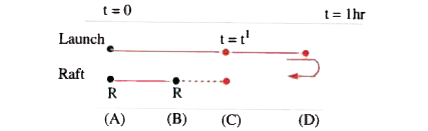 `C to ` Possitions of raft and boat during the second crossing . NOTE: If we fix the OBSEVER on the bank , raft has a speed of 2kph, boathas a speed of 20+2=22 kph fordistance AD and 20-2=18kph for distanceDC. Fix the observer on raft. W.r.t. raft, boathassamevelocityupstream as well ad downstream . Hence, if the boattravels for 1hr, while movingaway from raft, it travelsthe sametime while approachingthe raft,. `therefore ` timebetween two crossings =t=2h. We now FINDTHE distancetraveled by raft in2 hr `= 2 xx 2 = 4` km. |
|
| 14. |
State the unit of dielectric constant of a medium. |
| Answer» SOLUTION :DIELECTRIC CONSTANT is a UNITLESS QUANTITY. | |
| 15. |
An astronaut on a stranged planet finds that acceleration due to gravity is twice as that on the surface of the Earth. Which of the following could explain this? |
|
Answer» Both the mass and the radius of the planet are TWICE as that of Earth. `therefore 2=(M.)/(M)xx(R^(2))/(R.^(2))` is satisfied only when `M.=(M)/(2) and R.=(R^(2))/(2)` So, CORRECT choice is (C ). |
|
| 16. |
The Hall effect turned out to be out observable in a semi-condutor whos conduction electron mobility was eta= 2.0 times that of the hole mobility. Find the ratio of hole and conduction electron concetration in that semiconductor. |
Answer» Solution : When the sample contains unequal number of carries of both types whose mobilites are DIFFERENT, static equilibrium (i.e no transvese movement of either ELECTRON or holes) is impossible in a magnetic field. The trnasverse electric field acts DIFFERENTLY on electrons and holes. If the `E_(y)` that is set up is a shown, the net Lorentz force per unit charge (effective transverse electric field) on electron is `E_(y)-v_(x)^(-)B` and on holes `E_(y)+v_(x)^(+)B` (we are assuming `B=B_(Ƶ)`). There is then a transverse drift of electrons and holes and the net transverse current must vanish in equilibrium. Using MOBILITY `u_(0)^(-)N_(e)e(E_(y)-u_(0)^(-)E_(x)B)+N_(k)eu_(0)^(+)(E_(y)+u_(0)^(+)E_(x)B)=0` or `E_(y)=(N_(e)u_(0)^(-2)-Nu_(0)^(+2))/(N_(e )u_(0)^(-)+N_(h)u_(0)^(+))E_(x)B` On the other hand `j_(x)=(N_(e )u_(0)^(-)+N_(h)u_(0)^(+))eE_(x)` Thus, the Hall coefficient is `R_(H)=(E_(y))/(j_(x)B)=(1)/(e )(N_(e )u_(0)^(-2)-N_(h)u_(0)^(+2))/(e(N_(e )u_(0)^(-1)+N_(h)u_(0)^(+))^(2))` We see that `R_(H)=0` when `(N_(e ))/(N_(h))=(u_(0)/(u_(0)^(-)))^(2)=(1)/(eta^(2))=(1)/(4)` |
|
| 17. |
The earth may have even reversed the direction of its field several umes during its bustory of 4 to 5 billion years. How can geologists know about the earth's field in such distant past? |
|
Answer» Solution :(d) Magnetic poles of Earth are FOUND to be changing their positions at a rate of 10 km/ year. Study made so far in this regard has SHOWN that positions of magnetic field of Earth get reversed over `10^6` YEARS approximately. At the bottom of sea, basalt COMES out from volcano explosions which contains iron. This gives indication of above phenomenon. When this basalt cools down and becomes solid, it gives information of magnetic field of Earth. Life of such solid ROCKS can be estimated which ultimately indicates reversal of magnetic field of Earth. |
|
| 18. |
Compose the expression for a quantity whose dimension is length, using velocity of light c, mass of a particle m, and Planck's constant h. What is that quantity? |
|
Answer» Solution :The unit of `cancelh` is Jpule.sec. Since `mc^(2)` is the rest mass enegry, `(cancelh)/(mc^(2))` has the dimension of TIME and multiplying by `c` we get a QUANTITY `cancellambda_(c) =(cancelh)/(mc)`. whose dimension is lingth. This quantity is called reduced compton wavelength. (The NAME compton wavelengths is traditionally reserved for `(2PI cancelh)/(mc))`. |
|
| 19. |
What do you understand by a complex or a composite signal ? Explain frequency spectrum and band width. |
|
Answer» SOLUTION :Complex signal. A signal which CONSISTS of collection of MANY components, each of different frequency is called a complex signal. Frequancy SPECTRUM. The collection of all the component frequencies is called frequency spectrum. BAND width. The range `(i.e.` width) of the frequency spcctrum is called band width of the signal. |
|
| 20. |
When mixture of 'A' reacts with with I_(2)//OH^(-), then how many moles of CHl_(3) will form ? |
|
Answer» 3 mole |
|
| 21. |
Draw the graph showing the variation of resistivity with temperature for silicon. |
Answer» SOLUTION :
|
|
| 22. |
Two small drops of mercury each of radius R coalesce to form a single drop. Find the ratio of the total surface energies before and after the change. |
|
Answer» Solution :`2[4/3 pi R^3]d = 4/3 pi r^3d` `THEREFORE r^3 = 2R^3` `therefore r = 2^(1/3)R` `because E = T XX A` `therefore E_1/E_2 = (2(4piR)^2T)/(4pir^2T) = (2R^2)/r^2` = `(2R^2)/(2^(2/3)R^2) = 2^(1/3):1` |
|
| 23. |
In the circuit shown in figure AB is a uniform wire of length L = 5m. It has a resistance of 2 Omega//m. When AC = 2.0 m, it was found that the galvanometer shows zero reading when switch s is placed in either of the two positions 1 or 2. find the emf E_(1). |
|
Answer» |
|
| 24. |
A planet moves around the sun in an elliptical orbit with the sun at one of its foci. The physical quantity associated with the motion of the planet that remains constant with time is |
|
Answer» velocity |
|
| 25. |
At Curie point, a ferromagnetic material becomes |
|
Answer» NON magnetic |
|
| 26. |
What is net charge on electric dipole ? Why ? |
|
Answer» `- Q ` |
|
| 27. |
Imagine what would happen if the value of G becomes : (i) 100 times of its present value (ii) 1/100 times of its present value |
|
Answer» Solution :(i) EARTH’s attraction would be so LARGE that you would be CRUSHED to the earth. (II) We can easily jump from the top of a multi-storey building. |
|
| 28. |
If linear charge density of a wire as shown in the figure is lambda |
|
Answer» POTENTIAL at the centre is `(lambda)/(2 epsi_(0))` |
|
| 29. |
Whena viscousliquid flows , adjacentlayersopposetheir relativemotion by applyinga viscousforcegiven by F = - eta A (dv)/(dz) where , ete= coefficientof viscosity, A = surface areaof adjacentlayers in contact, (dv)/(dz) = velocity gradient Now , a viscous liquid havingcoefficient of viscosityetais flowingthrough a fixedtube of lengthl and radiusR undera pressure difference P between the two ends of the tube . Nowconsider a cylindrical vloumeof liquidof radius r . Dueto steadyflow ,net forceon the liquidincylindricalvolumeshouldbe zero .- eta 2pirl (dv)/(dr) = Ppir^(2) - int _(v)^(0),dv = P/(2 eta l) int_(tau)^(R) rdr( :'layerin contactwith the tube is stationary )v = v_(0)(1- (r^(2))/(R^(2))), wherev_(0) = (PR^(2))/(4nl):."" Q = (piPR^(4))/(8sta l) Thisis calledPoisecuille'sequation . The viscousforceon the cylindricalvolume of the liquidvaries as |
|
Answer» ` F PROP R^(2)` |
|
| 30. |
The final image formed in an astronomical refracting telescope with respect to the object is |
| Answer» Solution :virtual inverted. | |
| 31. |
A wave of frequency 500 Hz has a wave velocity of 350 m/s. Find the distance between two points which are 60^@ out of phase. |
| Answer» SOLUTION :`0.116m` | |
| 33. |
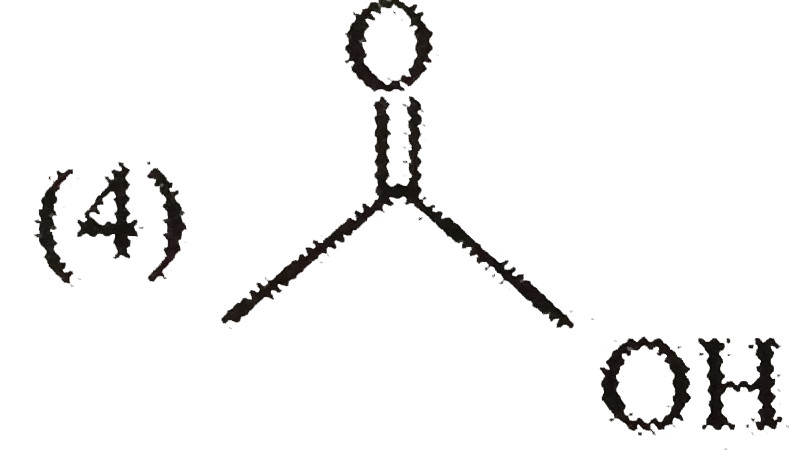
CH_(3)-overset(O)overset(||)(C)-OHoverset(ND_(3))underset(Delta)(to)(A)overset(Br_(2))underset(KOH)(to)(B) Product (B) is - |
| Answer» Solution :`CH_(3)-NH_(2)` | |
| 34. |
R.m.s. velocity of helium molecules at N.T.P. is 1300 m/s. Atmospheric pressure is = 1.013xx10^5 N/m^2.Density of helium at N.T.P. is |
|
Answer» `0.018 kg/m^3` |
|
| 36. |
The black lines in the solar spectrum during solar eclipse can be explained by |
|
Answer» PLANK's law |
|
| 37. |
An elevator which can carry a maximum load of 1800 kg (elevator + passenger ) is moving up with a constant speed of 2 m/s . The frictional force opposing the motion is 4000 N. Determine the power of motor in H.P. |
|
Answer» 69 hp |
|
| 38. |
A 1MeV positron and a 1 MeV electron meet each moving in opposite directions. They annihilate each other by emitting two photons. If the rest mass energy of an electron is 0.51 MeV find the wavelength of each photon |
|
Answer» |
|
| 39. |
A solenoid that is 85.0 cm long has a cross-sectional area of 17.0 cm^(2). There are 1210 turns of wire carrying a current of 6.60 A. (a) Calculate the energy density of the magnetic field inside the solenoid. (b) Find the total energy stored in the magnetic field there (neglect end effects). |
| Answer» SOLUTION :(a)55.5 J/`m^(3)`,(B)8.01 `xx 10^(-2) J` | |
| 40. |
A string in a musical instrument is 50 cm long and its fundamental frequency is 800 Hz. If a frequency of 1000 Hz is to be produced, then required length of string is : |
|
Answer» 62.5 `therefore (v_(1))/(v_(2)) = (l_(2))/(l_(1)) rArr l_(2) = (800)/(1000) xx 50 ` = 40 cm Correct CHOICE is c. |
|
| 41. |
In the Q. No. 9. find average energy density corresponding to electric and magnetic fields. |
|
Answer» |
|
| 42. |
A 1kW heater is meant to operate at 200 V. (a) What is its resistance ? (b) How much power will it consume if the line voltage drops to 100 V ? (c ) How many units of electrical energy will it consume in a month (of 30 days) if it operates 10 hr daily at the specified voltage? |
|
Answer» <P> Solution :a) The resistance of an electric APPLIANCE is GIVEN by,`R=(V_(S)^(2))/(W)"so,"R=((200)^(2))/(1000)=40Omega` b) The .actual power. consumed by an electric appliance is given by, `P=((V_(A))/(V_(S)))^(2)XXW"so,"P=((100)/(200))^(2)xx1000=250W` c) The total ELECTRICAL energy consumed by an electric appliance in a specified time is given by, `E=(SigmaW_(1)h_(1))/(1000)kWh` `"So, "E=(1000xx(10xx30))/(1000)=300kWh` |
|
| 43. |
Bohr's model for the hydrogen atom predicts that the absorption spectra involve |
|
Answer» ACCELERATING electrons |
|
| 44. |
In a pitcher when water is filled some water comes to outer surface slowly through its porous walls and gets evaprated. Most of the latent heat needed for evaporation is taken from water inside and hence this water is cooled down. If 10 kg water is taken in the pitcher and 12 gm water comes out and evaporated per minute. Neglect heat transfer by convection and radiation to surrounding, find the time in which the temperature of water is pitcher decreases by 5^(@)C. |
|
Answer» Solution :It is given that 12 gm WATER is evaporated per minute, thus heatrequired per minute for it is `Q=mL_(v)` `=12xx540=6480` cal/min After time t, mass of inside water is `m=10000-12t` If in further tiem t`dt,dm=12 dt`, mass is vapourized and the temperature of inside water falls by dT we have `(10000-12t)xx1xxdeT=12 dT 540` or `dT=12xx540(dt)/(10000-12t)` Integrating the above expanssion in PROPER limits, we get `int_(T_(0))^(T_(0)-5)dT=12xx540xxint_(0)^(t)(dt)/(10000-12t)` `5=540 In (10000/(10000-12t))` or `E^(5//540)=10000/(10000-12t)` or `t=10000/12 [e^(1//108)-1]` `=7.737` minutes `Q=m^(3)DeltaT` `=10000xx1xx5` `=50,000` calories As obtained from the given DATA that 6480 calories of heat is required per minute to vapourize 12 gm water thus if in time t minutes, temperature of inside water falls by `5^(@)C` we have `50000=6480t` or `t=50000/6480` |
|
| 45. |
Definetheterms : (I )Declination (ii )InclinationorDip . |
|
Answer» SOLUTION :Theanglebetweenthemagneticmeridianandthegeographicmeridianis KNOWNAS themagneticdeclination. The anglebetweentheearth .smagneticmeridian( horizontalcomponentof earth.sfield) andtheearth.stotalmagneticfieldisknownastheangleofdip . |
|
| 46. |
A thin metal plate is being bombarded by a perpendicular beal of gas particlesfrom both sides as shown in the figure. The solid dots are representing the melecules hitting from left side and the faint dots are the molecules hitting frm right side. The mass of these gas particles is m=10^(-26)kg and velocity before hitting is v_(0)=5m//s. Volume density of the gas particles on both sides is n=10^(25) per m^(3). Each beam has an area A=1m^(2) and the collisions are perfectly elatic. What is the external force F (in newton) required to move the plate with a constant velocity v=2m//s |
|
Answer» Solution :`F=2m ETA A[(v_(0)+V)^(2)-(v_(0)-v)^(2)]` `=2(10^(-26))(10^(25))(1)[(5+2)^(2)-(5-2)^(2)]` `=0.2xx40=8N` |
|
| 47. |
Which of the following devices is full duplex ? |
| Answer» Answer :A | |
| 48. |
Explain the forward characteristics of the p-n junction diode by drawing circuit and graph. |
Answer» Solution :The configuration of the circuit for the p-n junction diode forward characteristics is shown in the figure.  The battery is connected to the diode through a potentiometer (or reheostat) so that the applied voltage to the DIRECTED can be changed. For different values of voltages, the value of the current in noted. A GRAPH between `V to I` is obtained in first quadrant for Si diode as shown in figure. Here, current is of the order of mA.  In forward bias, the current first increases very slowly, (almost neglibible) till the voltage across the diode crosses a certain value. After the characteristic voltage, the diode current increases exponentially, even for a very small increase in the diode bias voltage. This voltage is called the thershold voltage or cut-in voltage. `~0.2` V for GERMANIUM diode and `-07` V for silicon diode. Usually the p-n junction diode current flow in ONE direction so it is used for rectification of A.C. voltage. If the forward voltage is increased beyond the value of its safety voltage a very large current is generated so overheating can cause the p-n junction diode to be destroyed. Junction diodes of Ge or Si do not cause any damage to the `100^(@)C and 170^(@)C` temperaturesrespectively. |
|
| 49. |
What is amplification ? Explain the working of a common emitter amplifier with necessary diagram. |
|
Answer» Solution :Amplification `:` The process of RAISING the strength of a weaksignal is called amplification and the device which accomplishes this job is called an AMPLIFIER. Amplifiers are of two types.(1) Power amplifier(2) Voltage amplifier. Amplification factor `:`The ratio between output voltage to the input voltage is called amplification factor. `A = ( V _(0))/( V_(i))` Common emitter transistor amplifier `:` 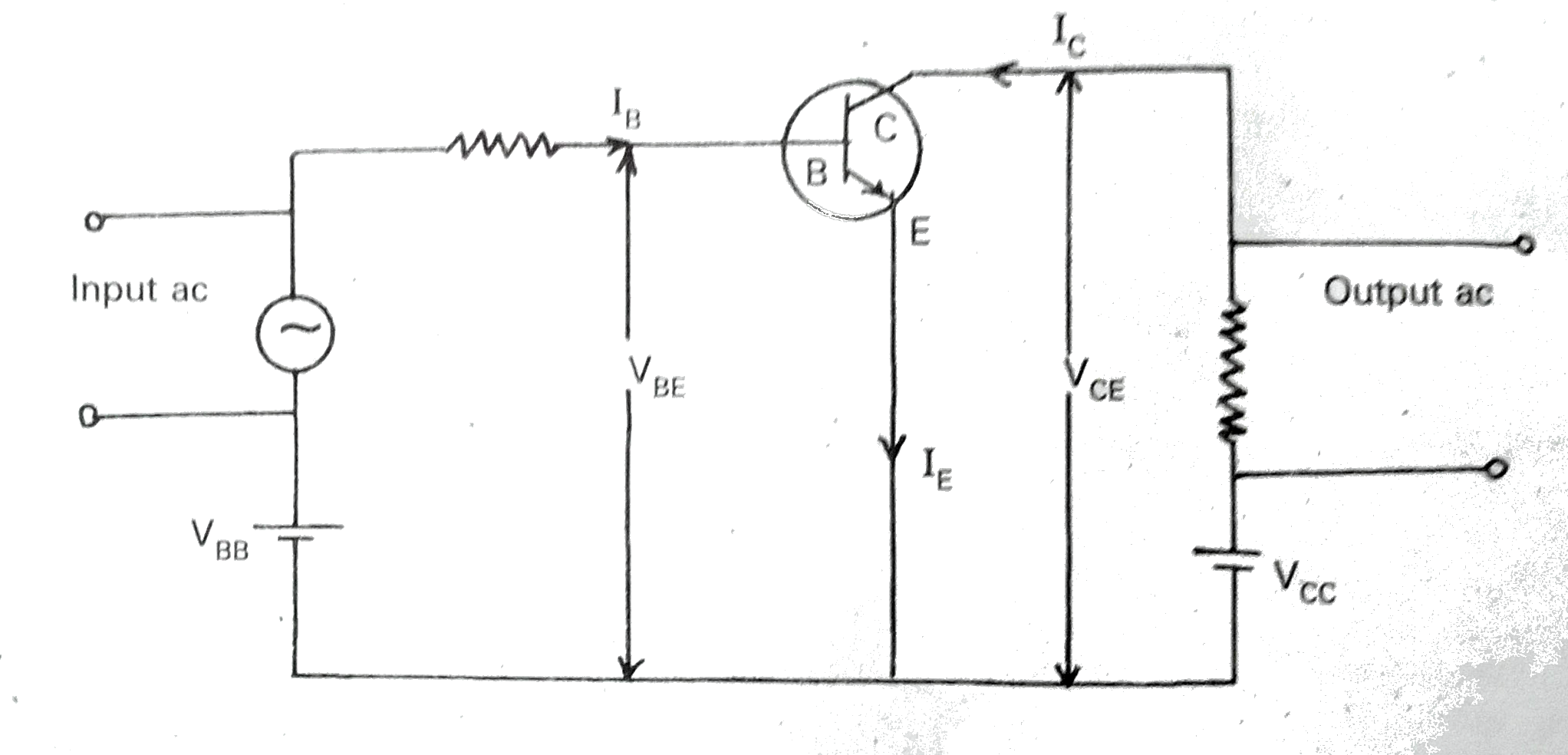 Then-p-n common emitteramplifier circuit is shown in figure. In this circuit the battery `V _(B B )` provides the biasing voltage `V_(B E)` for the base emitter junction. The emitter junction is forward biased and the battery `V _( C C ) ` provides the biasing voltage `V _(C E)` for the emitter collector junction.The junction is reverse biased . Most of the electron from emitter cross the base region and move into the collector. The input signal to the amplified is connected in series with the biasing battery`( V_(B B))` .A load resistance `R_(L)` is connectedin the collector circuit and output voltage is taken across `R_(L)`. As the base emitter voltage`( V_(BE ))` changes due to input signal, the base current changes `( I_(B ))`. This results in large change in collector current `( Delta I_(C ))`. The change in collector emitter voltage `( Delta V_(CE))` is taken across `R_(L) `. Thus amplified output is obtained across `R_(L)`. Current gain `( beta)``:` The ratio of change in collector current to the change in base current is called current gain (or ) current amplification factor. `beta= ( Delta I_(C ))/(Delta I_(B))` Voltage gain `( A _(V )) :` It is the ratio of change in output voltage `( Delta V _(C E))`to the change in input voltage `( Delta V_(BE ) )`. Voltage gain `= (Delta V_(C E))/( DeltaV_(BE))= betaxx ( R_(L))/( R_(i))` Power gain `:` It is definedas the productof current gain and voltage gain. Powergain `( A _(p))=` Current gain `xx `Voltage gain. |
|
| 50. |
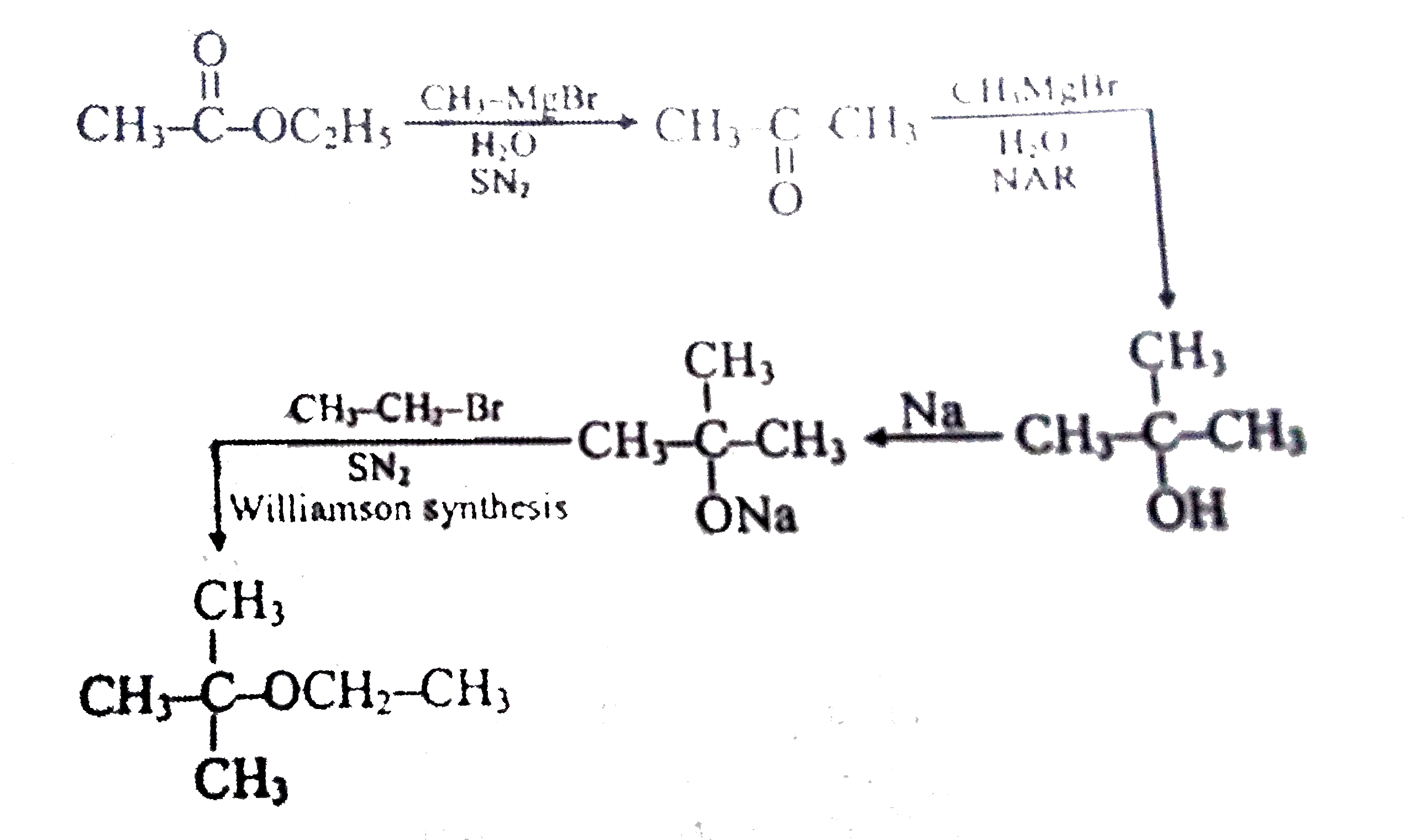
Consider the following sequence of reactions . The final product (C) is - |
|
Answer»
|
|