

Saved Bookmarks
This section includes 7 InterviewSolutions, each offering curated multiple-choice questions to sharpen your Current Affairs knowledge and support exam preparation. Choose a topic below to get started.
| 1. |
A scientist with a stopwatch says that he can measure the speed at which he throws a stone upward. What do you think his method is? |
| Answer» SOLUTION :The time TAKEN by the stone to come back to the ground is `t = 2u/g` . Where U is the velocity of the stone to START. Now `u = gt/2` , hence knowing the time t taken by the stone to come to the ground, u can be calculated. | |
| 2. |
Derive an expression for the torque experienced by adipole due to a uniform electric field . |
|
Answer» <P> Solution :Torque EXPERIENCED by an electric dipole in the uniform electric field : Consider an electric dipole of dipole moment `vecp` placed in a uniform electric field `vecE` whose field lines are equally spaced and point in the same direction . The charge +q will experience a force q `vecE` in the direction of the field and charge -q will experience a force -q `vecE` in a direction opposite to the field . Since the external field `vecE` is unform the total force acting on the dipole is zero . These two forces acting at different points will constitute a couple and the dipole experience a torque . This torque tends to rotate the dipole . (Note that electric field lines of a uniform field are equally spaced and point in the same direction). The total torque on the dipole about the point O`vectau=VEC(OA)xx(-qvecE)+vec(OB)xxqvecE` Using right -hand corkscrew rule it is found that total torque is perpendicular to the PLANE of the paper and is directed into it. The magnitude of the total torque `tau=|vec(OA)|(-qvecE)sintheta+|vec(OB)||qvecE|sintheta ` `vectau =q E 2 a sin theta ` 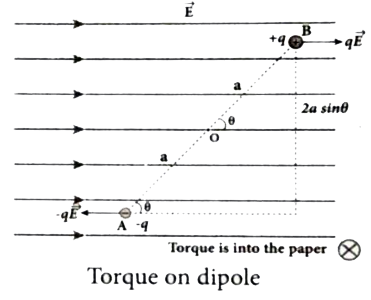 where `theta ` is the angle made by `vecp` with `vecE` . Since p =2aq the torque is written in terms of the vector product as `vectau=vecpxxvecE` The magnitude of this torque is `tau =PE` sin `theta` and is maximum when `theta=90^(@)` This torque tends to rotate the dipole and align it with the electric field`vecE` . Once `vecp` is aligned with `vecE` the total torque on the dipole becomes zero. |
|
| 3. |
A short bar magnet of magnetic moment m=0.32 JT^(-1) is placed in a uniform magnetic field of 0.15 T.If the bar is free to rotate in the plane of the field, which orientation would correspond to its (a) stable and (b) unstable equilibrium? What is the potential energy of the magnetic in each case? |
|
Answer» Solution :(i) For stable equilibrium of bar magnet placed in external UNIFORM magnetic field,weshould have `OVERSET(to)(m)|| overset(to) (B) rArr` angle between `overset(to) and overset(to) (B)` should be `theta=0^@`. Now, in this case, magnetostatic potential energy is given by formula, `U= - m B cos theta` `therefore U_("min") = - mB (because theta=0^@ rArr cos theta =1)` `therefore U_("min") = - (0.32) (0.15) ` `therefore U_("min") = -0.048` J (ii) For unstable equilibrium condition we should have `overset(to)(m) || (-overset(to)(B) ) rArr theta = 180^@`. In this case, `U= - m B cos theta ` `therefore U= mB cos (-1)` `therefore U_("max") = +mB` `=(0.32) (0.15)` `therefore U_("max") = 0.048` J |
|
| 4. |
The magnitude of the induced emf is equal to the time rate of change of.. |
|
Answer» MAGNETIC FORCE |
|
| 5. |
is found experimentally that 13.6 eV energy is required to separate a hydrogen atom into a proton and an electron. Compute the orbital radius and the velocity of the electron in a hydrogen atom. |
|
Answer» `10.6xx10^(-11)m` |
|
| 6. |
If the current in the primary circuit of a pair of coils changes from 5 amp to 1 amp in 0.02 sec, calculate (i) induced emf in the secondary coil if the mutual inductance between the two coils is 0.5H and (ii) the change of flux per turn in the secondary, if it has 200 turns. |
| Answer» SOLUTION :(i) 100V, (II) `-0.01Wb` | |
| 8. |
For normal vision, eye the least distance of object from eye? |
| Answer» Solution :For NORMAL EYE, the least distance of distinct vision is 25 cm. | |
| 9. |
Which of the following is a dimensional variable? |
|
Answer» force |
|
| 11. |
Define the term 'current sensitivity' of a moving coil galvanometer. |
|
Answer» SOLUTION :CURRENT sensitivity of amoving coil galvanometer is defined as deflection produced PER unit curent flowing through it. Current sensitivity = `(phi)/(I )= (NAB)/(k)` |
|
| 12. |
A 5.0xx10^(2)N object is hung from the end of a cross - sectional area 0.010 cm^(2). The wire stretches from its original length of 200.00 cm to 200.50 cm.Determine the Young's modulud of the wire : |
|
Answer» `1.0xx10^(11)N//m^(2)` |
|
| 13. |
Where did they plan to go to save themselves? |
|
Answer» ALPHA Centauri |
|
| 14. |
The number of photo-electrons emitted for light of a frequency upsilon (higher than the threshold frequency upsilon_(0)) is proportional to |
|
Answer» THRESHOLD frequency `(v_(0))` |
|
| 15. |
A solenoidof inductance 2 H carries a current of 1 A. What is the magneticenergy stored in a solenoid ? |
|
Answer» 2J |
|
| 16. |
A body is kept on a rough horizontalsurface of angleof friction 'alpha'and movedbyapplying a force of magnitudeF makinganglethetawith horizontal . Arrange the following casesin the orderof increasing magnitude for F . Fis pulling force and theta= alpha F is pullingforce and theta= 0 F is pullingforce and alpha = theta= 0 F is pushing force and theta= alpha |
|
Answer» IV,III,iiand i |
|
| 17. |
A tuning fork of frequency 500Hz when sounded on the mouth of resonance tube the lengths of air column for first and second resonance are recorded as 10cm and 40cm respectively. The room temperature is 20°C. The velocity of sound at the room temperature obtained from the explanation is |
|
Answer» `300 m//s` |
|
| 18. |
A stone is thrown vertically upward with a speed of 10.0 ms^(-1) from the edge of a cliff 65 m high.How much later will it reach the bottom of the cliff ? What will be its speed just before hitting the bottom ? |
| Answer» SOLUTION :4379 s,37.14 `MS^(-1)` | |
| 19. |
A 0.0500 kg lead bullet of volume 5.00 xx 10^(-6) m ^(3) at 20.0^(@)C hits a block that is made of an ideal thermal insulator and comes to rest at its center. At that time, the temperature of the bullet is 327^(@)C. Use the following information for lead : Coefficientof linear expansion : alpha = 2.0 xx 10^(-5)// ""^(@)C Specific heat capacity :c = 128 J // ( kg . ""^(@)C ) Latent heat of fusion :L_(1) = 23 300 J // kg Melting point :T_("melt") = 327^(@)C What additional heat would be needed to melt the bullet ? |
|
Answer» 420J |
|
| 20. |
How can charge be fully transferred from one spherical call conductor to another? |
| Answer» SOLUTION :If a charged spherical conductor is placed inside a rel actively bigger uncharged spherical conductor and a wire is CON nected between two, then charge will be completely TRANSFERRED from the small spherical conductor to bigger spherical conductor tor as charge RESIDES on the outer surface. | |
| 21. |
What is the magnetic field at the center of the loop shown in figure ? |
| Answer» SOLUTION :The MAGNETIC field due to CURRENT in the upper hemisphere and LOWER hemisphere of the circualr coil are equal in magnitude but opposite in direction. Hence, the net magnetic field at the center of the loop (at point O) is zero., `VEC B = vec 0` | |
| 22. |
The ratio of areas of the electron orbits for the first excited state and the ground state for the hydrogen atom is ..... |
|
Answer» `16:1` For GROUND state n= 1 and radius `r_(1) prop1` Now if A is area then `A PROP r^(2)` `:.A_(2)prop r_(2)^(2) prop 16 and A_(1) prop r_(1)^(2) prop 1` `:.(A_(2))/(A_(1))=(16)/(1) :.16:1` |
|
| 23. |
Suppose the initial charge on the capacitor in Exercise 7.7 is 6 mC. What is the total energy stored in the circuit initially ? What is the total energy at later time? |
|
Answer» Solution :Here, `q_(m) = 6mC = 6 xx 10^(-3) C` `THEREFORE` TOTAL energy stored in the circuit initially = total energy stored at any LATER time `= U = 1/2 .q_(m)^(2)/C = ((6 xx 10^(-3))^(2)/(2 xx 30 xx 10^(-6))) = 0.6 J` |
|
| 24. |
Intensity of gravitationalfield inside the hollow spherical shell is : |
|
Answer» variable THUS CORRECT choice is (b). |
|
| 25. |
A cube made from wires of equal length is connected to a battery as shown in the figure. The magnetic field at the centre of the cube is |
|
Answer» `(12mu_0l)/(sqrt2piL)` |
|
| 26. |
The time constant of the given circuit is : |
|
Answer» `(3RC)/5` |
|
| 27. |
The height of a transmitting antenna is 200m. Radius of earth is 6.4*10^6m. Why is it necessary to use satellite for long distance transmission? |
| Answer» SOLUTION :SPACE waves can not be REFLECTED back by iono sphere. Space wave can be reflected back to earth by MAKING use of ARTIFICIAL satellite. | |
| 28. |
Energy of a charged capacitor is U. Now it is removed from a battery and then is connectec to another identical uncharged capacitor it parallel. What will be the energy of eacl capacitor now ? |
|
Answer» `(U)/(4)` When ANOTHER similar charge-less capacitor is CONNECTED with it, the charge on each capacitor becomes `(Q)/(2)` . Hence energy of these both `U_(1) =U_(2)` `=((Q//2)^(2))/(2C)=(Q^(2))/(4xx2C)` From equation (1) `:. U_(1) = U_(2) = (U)/(4)` |
|
| 29. |
An aeroplane gets its upwards lift due to the phenomenon described by |
|
Answer» a)Archimedes' principle |
|
| 30. |
Modulation factor determines : |
|
Answer» Only the STRENGTH of the TRANSMITTED signal |
|
| 31. |
The suggestion of Niel's Bohr was that electrons revolve around the nucleus in circular orbits called what ? |
| Answer» SOLUTION :STATIONARY | |
| 32. |
A particle of charge q is moving with velocity v in the presence of crossed Electric field E and Magnetic field B as shown. Write the condition under which the particle will continue moving along x- axis. How would the trajectory of the particle be affected if the electric field is switched off? |
|
Answer» SOLUTION :Using the CONDITION mvr `=(nh)/(2pi) ` For H-atom `n=I, V=(h)/(2pimr)` Time period T `=(2pir)/(v)` `T=(4pi^(2)mr^(2))/(h), I=Q/T=(eh)/(4pi^(2) mr^(2))` M=IA `M=(eh)/(4pi^(2) mr^(2)) (PIR^(2))` `M=(eh)/(4pi m)` |
|
| 33. |
Figure shows a conductor of length l having a circular cross section. The radius of cross section of the conductor varies linearly from r_1 to r_2 along its length. IF the specific resistance of the material of the conductor be rho, find the resistance of the conductor. |
|
Answer» Solution :Let the axis of the conductor be along the x axis of the coordinate system. At x=0, radius of crosssection is `r_1` and at x=1 radius of cross section is `r_2`. ltbr Radius of cross section varies along the length of the conductor,So it can be written that `(dr)/(dx)=k` ( where k is constant) Now intergrating the above equation , we get , `r=kx+c` where c is integration constant when x=0, `r=r_1` `therefore r_1=k.0+c or , c=r_1` So, `r=kx+r_1` ...(1) Again when x=l, then `r=r_2` `thereforer_2=kl+r_1` or, `k=(r_2-r_1)/l` .....(2) From equation (1) and (2) , we get `r=(r_2-r_1)/lx+r_1` At a distance x from the LEFT side of the conductor, RESISTANCE of a circular disc of THICKNESS dx is `dR=rho(dx)/(pir^2)=rho(dx)/(pi[((r_2-r_1)/l)x+r_1]^2)` `therefore` Total resistance of the conductor, `R=rho/piint_0^1dx/([((r_2-r_1)/l)x+r_1]^2}` Let `((r_2-r_1)/l)x+r_=uor,dx=(l/(r_2-r_1))du` when x=0 then `u=r_1` and when x=1 then `u=r_2`. `thereforeR=(rhol)/piint_(r_1)^(r_2)(du)/((r_2-r_1)u^2)=(rhol)/(pi(r_2-r_1))[-1/u]_(r_1)^(r_2)` `=(rhol)/(pi(r_2-r_1))[1/r_1-1/r_2]=(rhol)/(pir_1r_2)` This is the REQUIRED resistance. |
|
| 34. |
A metallic spherical shell of radius r_1 is surrounded by another concentric metallic spherical shell of radius r_2. The space between the two shells is filled with a dielectric of dielectric constant K. If a charge Q is given to the inner shell, the charge appearing on the outer surface of the outer shell is |
|
Answer» `+Q` |
|
| 35. |
Two bodies moving towards each other collide and move away in opposite directions. There is some rise of temperature of bodies in the process. Explain the reason for rise of temperature and state what type of collision it it ? |
| Answer» Solution :This is CASE inelastic collision . HEAR, the BODIES SUFFER loss of kinetic energy Now, there is a rise in the TEMPERATURE of the bodies. | |
| 36. |
Show that a moving electron cannot spontaneously change into an x-ray photon in free space. A third body (atom or nucleus) must be present. Why is it needed? |
| Answer» SOLUTION :to CONSERVE MOMENTUM | |
| 37. |
As shown in figure a bar magnet suspended by a conducting spring is made to oscillate up and down. Then ........ |
|
Answer» deflection of galvanometer is zero. As time passes the velocity of magnet decrease and hence induced EMF in the spring GOES or decreasing. |
|
| 38. |
What is angle of devition ? |
| Answer» SOLUTION :The angle between the incident RAY and refracted ray is CALLED angle of deviation. | |
| 39. |
(A) : A planar circular loop of area A and carrying current 1 is equivalent to magnetic dipole of dipole moment M = 1 A. (R) : At large distance, magnetic field of circular loop and magnetic dipole is same |
|
Answer» Both 'A' and 'R' are true and 'R' is the correct EXPLANATION of 'A'. |
|
| 40. |
Plot the graphs of the functions C_(6)^(h) and C_(8)^(h**). (Choose the scale of the scale of the x-axis so that the graphs can be convementry compared. For instance, for n = 6 you can use the scale 1: 13 mm and for n=8 the scale 1:10 mm.) |
Answer» SOLUTION :See Fig. It may be seen from the figure that the probability of a UNIFORM DISTRIBUTION increases rapidly with n. 
|
|
| 41. |
A 12 Omega resistance and an inductance of 0.05//pi Hz with negligible resistance are connected in series. Across the ends of this circuit is connected a 130 V alternating voltage of frequency 50 Hz. Calculate the alternating current in the circuit and the potential difference across the resistance and that across the inductance. |
|
Answer» |
|
| 42. |
A linearly polarized electromagnetic wave given as vec(E )=E_(0)cos(kz-omega t)hat(i) is incident normally on a perfectly reflecting infinite wall at z = a. Assuming that the material of the wall is optically inactive, the reflected wave will be given as |
|
Answer» `vec(E )_(r )=E_(0)(kz-omega t)hat(i)` `THEREFORE` Reflected wave `vec(E )=E_(0)cos {kz - omega t}hat(i)` Reflected wave propagates in negative x - direction hence reflected wave `vec(E )_(r )=-E_(0)cos{K(-Z)-omega t+pi}hat(i)` `=-E_(0)cos{-(kz+omega t)+pi}hat(i)` `=+E_(0)cos(kz+omega)hat(i)` `[because cos(-theta)=cos theta " and " cos(pi+theta)=-cos theta]` `therefore vec(E )_(r )=E_(0)cos(kz+omega t)hat(i)` |
|
| 43. |
At the moment t =0 , a force F = kt ( k is a constant) is applied to a small body of mass m resting on a smooth horizontal plane.The permanent direction of force F , makes an anglebeta with the horizontal . Calculate i) The velocity of the body at the moment of its breaking off the plane . ii) The distance traversed by the body upto this moment |
|
Answer» SOLUTION :The free body diagram of mass m is shown in figure . For vertical equilibrium ` F sin beta + N = mg ( or ) As F = KT ` `:. ktsin beta + N = mg `........... (1) 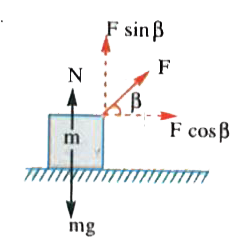 Equation of motion of mass m is `F cos beta = ma` ` or kt cos beta = m (dv)/(dt) ( as " "a=(dv)/(dt)), dv=(kt)/(m) cos beta dt ` Integrating ` int_0^(v) dv = (k)/(m) cos betaint_0^(t) dt ` `[v]_0^(v) = (k)/(m) cos beta [(t^(2))/(2)]_0^(t) implies v= (k cos beta )/( 2 m ) t^(2)` ........... (2) At the moment of breaking off the PLANE N =0 . If ` tau` is the corresponding time , then ` :.` From (1) `k tau sin beta = mg or tau = (mg)/(k sin beta ) `........... (3) `:.` The velocity at the moment of breaking off the plane is given by putting ` t= tau ` in equation ( 2) , so `(v=v_0)` ` v_0 = (k cos beta )/( 2 m) tau^(2) = ( k cos beta )/(2 m) ((mg)/(k sin beta ))^(2)` `:. v_0=(mg^(2) cos beta)/( 2 k sin^(2) beta)` (b) Equation (2) may be expressed as ` (dx)/(dt) = (k cos beta )/(2m ) t^(2)` Integrating `[x]_0^(x)=(k cos beta)/( 2m) [(t^3)/(3)]_0^(t)` `:. x = (k cos beta )/( 6 m) t^(3)` When the body breaks off the plane , we have ` :. x_0=(k cos beta )/( 6m) ((mg)/( k sin beta ))^(3) = (m^(2)g^(3) cos beta)/( 6k^(2) sin^(3) beta )` |
|
| 44. |
The resistance of a wire is20Omega. What will be new resistance, if it is stretched uniformly 8 times its original length? |
|
Answer» Solution :`R_1 =20 Omega , R_2=?` LET the original length `(l_1)` be l. The new length `L_2 =8L_1(i.e)l_2=8l` The original resistance. `R_1 =rho(l_1)/(A_1)` The new resistance `R_2=rho(l_2)/(A_2)=(rho(8l))/(A_2)` Though the wire is stretched its volume is unchanged Initial volume =Final volume `A_1l_1=A_2I_2,A_1l=A_28l` `(A_1)/(A_2)=(8l)/l=8` By dividing equation `R_2` by equation `R_1` we get `(R_2)/(R_1) =(rho(8l))/(A_2)xx(A_1)/(rhol)RARR (R_2)/(R_1)=(A_1)/(A_2)XX8` Substituting the value of `(A_1)/(A_2)` we get `(R_2)/(R_1)=8xx 8 =64 rArr R_2=64 xx20 =1280 Omega` HENCE, stretching the length of the wire has increased its resistance. |
|
| 45. |
A spherical conducting shell of inner radius r_(1) and outer radius r_(2) has a charge Q. ls the electric field inside a cavity (with no charge) zero, even if the shell is not spherical, but has any irregular shape ? Explain. |
|
Answer» SOLUTION :Charge placed at the centre of a shell is q. Hence, a charge of magnitude - q will be induced to the inner surface of the shell and + q charge induced on the outer surface of the shell. `:. ` Surface charge density at the inner surface of the shell is , `sigma=(q)/(A)=(-q)/(4pir_(1)^(2))` Surface charge density at the outer surface of the shell is `sigma_(0)=(q)/(A)=((+q)(+Q))/(4pir_(2)^(2))` Where `r_(1)` and `r_(2)` are radius of inner and outer of shell and Q is the magnitude of charge placed on the outer surface of the shell 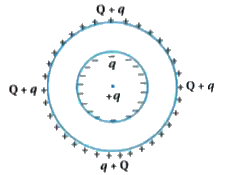 (B) YES The electric field intensity inside a cavity is zero, even if the shell is not spherical and has any irregular shape. Take a closed LOOP such that a part of it is inside the cavity along a field line while the rest is inside the conductor. Net work done by the field in CARRYING a test charge over a closed loop is zeru because the field inside the conductor is zero. Hence, electric field is zero whatever is the shape. |
|
| 46. |
State the principle on which transformer works. Explain its working with construction. Derivean expressionfor ratio of e.m.f.s and currentsin terms ofnumber ofturnsin primaryand secondarycoil. A conductorof any shape, havingarea 40 cm^(2)placed inair is uniformaly chargedwith a charge0.2 muC. Determine the electricintensityat a pointjustoutsideits surface. Also,find mechanicalforceper unitarea of thechargedconductor. [epsi_(0) = 8.85 xx 10^(-12) S.I. units] |
|
Answer» Solution :Numerical : Given : ` Q = 0.2 muC= 0.2 xx 10^(-6)C, A = 40 cm^(2) =40 xx 10^(-4) m^(2)` `epsi_(0) = 8.85 xx 10^(-12)` SI units The electricfieldintensity just outsidethe surfaceof a chargedconductorof any shapeis `E = (sigma)/(epsi_(0)) = (Q)/(Aepsi_(0)) [ :' sigma = (Q)/(A)]` `:. E = (0.2xx 10^(-6))/(40 xx 10^(-4) xx 8.85xx 10^(-12))` `:. E = 5.65 xx 10^(6) N/C` Now, the mechanicalforce per unit area of a conductor is `F = 1/2 epsi_(0) E^(2)` `= 1/2 xx 8.85 xx 10^(-12) xx (5.65 xx 10^(6))^(2)` `:. F = 141.25 N//m^(2)` |
|
| 47. |
Draw the circuit diagram of a full wave rectifier. Explain its working showing its input and output waveforms. |
Answer» Solution :The circuit arrangement of a full-wave rectifier using two diodes `D_(1)`, and `D_(2)`, has been drawn here. We use a centre tap transformer having its SECONDARY wound into two equal parts such that voltages at any instant at A (input of DIODE `D_(1)`,) and B (input of diode `D_(2)`,) are out of phase with each other. Let initially input voltage at A is positive then it will be negative voltage at B at that instant. Consequently diode `D_(1)`, being in forward bias, conducts while `D_(2)`, being in REVERSE bias, does not conduct. We get output current and hence output voltage across load resistance R, joined between X and Y due to `D_(1)`. Aler hall-cycle of a.c. input, voltage at A becomes negalive and that at B positive. Now diode `D_(1)` does not conduct but `D_(2)` conducts and output voltage is again OBTAINED across `R_(L)` in the same direction. Thus, output is obtained throughout the input wave cycle. The input and output waveforms have been shown in the figure. 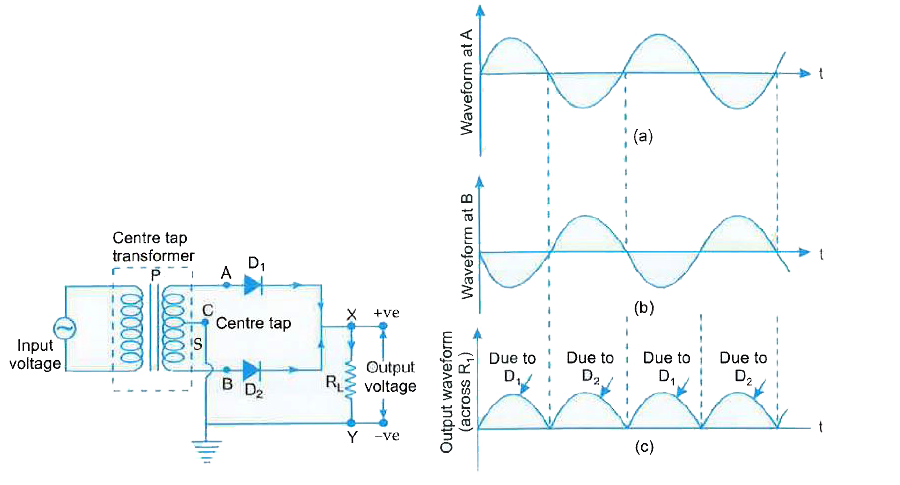
|
|
| 48. |
Two smallidentical electric dipoles AB and CD, each of dipole moment vecp are kept at an angle of 120^(@) to each other in an external electric field vecE pointing along the x-axis as shown in the figure. Find the (a) dipole moment of the arrangement, and (b) magnitude and direction of the net torque acting on it. |
|
Answer» Solution :As shown let two identical electric dipoles AB and CD are kept at an ANGLE `theta=120^(@)`, where their dipole MOMENTS have magnitude `|vecp_(A)|=|vecp_(C )|=p` The resultant dipole moment of the COMBINATION `|vecp_(R)|=2p "cos"(theta)/(2)=2p" cos"(120^(@))/(2)=2p" cos"60^(@)=2p xx (1)/(2)=p`. and the resultant dipole moment subtends an angle `(theta)/(2)=60^(@)` from either of two dipoles `vecp_(A) or vecp_(B)`. THEREFORE, `vecp_(R )` subtends an angle `30^(@)` from +X direction.  If the system is SUBJECTED to electric field `vecE` directed along +X direction, the torque acting on the system is `vec tau=vecp_(R ) xx vecE` Thus, the magnitude of torque is `|vectau|=pE sin 30^(@)=(1)/(2)pE`and the torque is directed into the plane of paper i.e., the torque tends to align the system along the direction of electric field `vecE`. |
|
| 49. |
A capillary tube is attached horizontally to a constant head arrangement. If the radius of the capillary tube is increased by 10%, the rate of flow of liquid changes by: |
|
Answer» `+10%` Then Pressure DIFFERENCE P = CR …(i) RESISTANCE `R.=(8etal)/(pi((110r)/100)^(4))` `=(100/110)^(4)((8etal)/(pir^(4)))` `thereforeR/(R.)=(110/100)^(4)=(1.1)^(4)=1.4641` `C.R.=CR` `(C.)/CR/(R.)=1.4641` `therefore%` age increase= (1.46-1) `xx` 100 = + 46% `therefore` Correct choice is (b). |
|
| 50. |
If LCR - circuit if resistance increases, quality factor |
|
Answer» INCREASES finitely |
|