Saved Bookmarks
This section includes 7 InterviewSolutions, each offering curated multiple-choice questions to sharpen your Current Affairs knowledge and support exam preparation. Choose a topic below to get started.
| 1. |
In the circuit, the value of beta is 100. find I_B,V_(CE),V_(BE) and V_(BC), when I_C=1.5mA. The transistor is in active, cut off or saturation state? |
|
Answer» Solution :`beta=100,I_C=1.5mA=1.5xx10^(-3)A,V_CC=24V` `beta=(I_C)/(I_B)` `I_B=(1.5xx10^(-3))/(100)=15muA` To calculate `V_CE` we apply kirchhoff.s rule CEFDC, therefore `V_CC=I_Cxx4.7kOmega+V_CE` `24=1.5xx10^(-3)xx4.7xx10^(3)+V_(CE)` `V_CE=24-7.05=16.95V`  Again applying Kirchhoff.s rule to loop ABEFDCA, we get, `V_CC=I_Bxx220kOmega+V_BE` `V_BE=24-3.3` `V_BE=20.7V` GOING along loop ABCA,we get `I_Bxx220kOmega+V_BC=I_Cxx4.7kOmega` `15xx10^(-6)xx220xx10^(3)+V_BC=1.5xx10^(-3)xx4.7xx10^(3)` `V_BC=7.05-3.3=3.75V` As `V_CEltV_BE`, both the juction are forward biased.So, the transistor is in the saturation state. |
|
| 2. |
Name of units of some physical quantities are given in List - 1 and their dimensional formulae are given in List - 2, Match correct pair in lists. {:("List - 1","List - 2"),((a) pas ,(e) L^2T^(-2)K^(-1)),((b) NmK^(-1), (f) MLT^(-3)K^(-1)),((c) J Kg^(-1)K^(-1), (g) ML^(-1)T^(-1)),((d) Wm^(-1)K^(-1), (h) ML^(2)T^(-2)K^(-1)):} |
|
Answer» `a- h , b - g , C - E, d - f ` |
|
| 3. |
A particle performing S.H.M. of amplitude 10squrt2 cm. At what distance from the mean position the P.E. is equal to K.E. |
|
Answer» `+-sqrt22`CM |
|
| 4. |
In a rectangle ABCD (BC=2AB). The moment of inertia along which axis willbe minimum |
| Answer» SOLUTION :About EG, the maximum distancefrom the AXIS is the LEAST . | |
| 5. |
A wire of resistance 2 ohms per meter is bent to form a circle of radius 1 m. The equivalent resistance between its two diameterically opposite points, A and B as shown in the figure is ….. |
|
Answer» `PI Omega` |
|
| 6. |
Find the total negative and positive charges in 500 cc of water Given: Avogadro's number is 6.023 xx 10^(23) g^(-1)mol^(-1), molecular weight of water in 18. |
| Answer» SOLUTION :`pm2.68xx10^7` C | |
| 7. |
A point charge produces an electric field 2 NC^(-1) at a point 0.5 m distant from it. Calculate the value of q. |
|
Answer» Solution :Data supplied, `E=2NC^(-1),` r=0.5 m FIELD intensity `E=(1)/(4pi epsi_(0)) q/r^(2) therefore 2=(9 xx 10^(9) xx q)/((0.5)^(2)) therefore q=5.55 xx 10^(-11)C` |
|
| 8. |
In a compound microscope, magnifying power is 95 and distance of the object from objective lens is 1/3.8 cm and focal length of the objective lens is 1/4 cm. What is the magnification of eyepiece? |
|
Answer» 10 |
|
| 9. |
Justify that repulsion is a surer test of electrification. |
| Answer» SOLUTION :When an uncharged body is shown to be a charged body, opposite CHARGES are induced on the uncharged body. As a result, there will be an attraction between two bodies.We can.t CONFIRM WHETHER a body is uncharged or oppositely charged. But repulsion will confirm that both the bodies have same TYPE of charge | |
| 10. |
While travelling back to his residance in the car, Dr.Pathak was caught up in a thunderstrom. It become very dark. He stoppeddrivingthe car and waitedfor thunderstorm to stop. Suddenly, he noticeda childwalkingalone on the road. He askedthe boyto come inside that Dr. Pathakshould meet hsi parents. The parents the boy at his residence. The boy insistedthat Dr. Pathak should meet hsi parents. The parents expressedtheir gratitudeto Dr. Patak for his concern for safety of the child. Answer the following questions basedon the above information : (a) Why is it safer to sitinside a car during thunderstrom ? (b) Which two values are displayedby Dr. Pathak in his actions ? (c) Which values are reflectedin parent's respone to Dr. Pathak ? (d) Givean example of a similar action on your part in the past from everyday life. |
|
Answer» Solution :(a) During thuderstrom, the chargewill be coming to the outer surface of the car. But there will be no electric lines of force (or electricfield) inside the car. The car acts as an electricshield and bence protects the person sitingin the car from external electric field. (b) Dr. PATHAK showed (i) the concernfor safery of the boy by callingthe boy to come into the car duringthunderstrom. (ii) the helpingnatureas hedroppedthe boya his residance. (c) Parents of the boy showed humility and expressed the gratitude to Dr. Pathak. (d) ONE day, I was on a joy ride with my friends. We sawan injuredperson bleeding profusely by the roadside. We stopped, calledthe police ADN an ambulance. The injuredpersonwas shifted to a nearby hospital and his life was SAVED by the DOCTORS. |
|
| 11. |
Followingfigures show an arrangement of bar magnets in different configurations . Each magnet has magnetic dipole momentvec(m). Which configuration has highest net magnetic dipole moment ? |
|
Answer»
|
|
| 12. |
Magnetic flux |
|
Answer» is ALWAYS positive |
|
| 13. |
Figure shows a small, plane strip suspended from a fixed support through a string of length l. A continuous beam of monochromati clight is incident horizontally on the strip and is completely absorbed. The energy falling on the strip per unit time is W. (a) Find the deflection of the string from the vertical if the mirror stays in equilibrium. (b) If the strip is deflected slightly from its equilibrium position in the plane of the figure, what will be the time period of the resulting oscillations? |
Answer» Solution : (a) The linear momentum of the light falling per unit time on the strip is W/c. As the light is incident on the strip, its momentum is absorbed by the mirror. The change in momentum imparted to the strip per unit time is thus W/c. This is equal to the force on the strip by the light beam, the weight of the strip and the force due to tension add to ZERO. If the string makes an angle theta with the VERTICAL, T cos theta = mg ` and T sin theta = W/c`. Thus,`tan(theta) = (W/ MGC).` (b) In equilibrium, the tension is ` T= ([(mg)^2 + (W/c)^2]^(1/2))` ` or, T/m = ([(g^2)+(W/mc)^2]^(1/2)). ` This PLAYS the role of effective g. The time period of small oscillations is ` t=(2pi (sqrt(l/(t//m))))= 2 pi ((sqrt l)/([ (g^2) + (W/mc)^2]^1/4).` |
|
| 14. |
A Young's double slit experiment uses a monochromatic source. The shape of the interference fringes formed on a screen is..... |
|
Answer» hyperbola |
|
| 15. |
Calculate the length of a nichrome spiral for an electric hot plate capable of heating 21 g of water to the boiling point in 8 min. The initial temperature of water is 20^@C, the efficiency is 60%, the diameter of the wire is 0.8 mm, the voltage is 220 V. the resistivity of nichrome is 10^(-4) ohm-m. Neglect the heat required to heal the kettle. |
|
Answer» |
|
| 16. |
A long straight wire in the horizontal plane carries a current of 50A in north to south direction. Give the magnitude and direction of vecB at a point 2.5 m east of the wire. |
|
Answer» SOLUTION :Here `I = 50 A and R= 2.5m` `:.` MAGNITUDE of magnetic field `B = (mu_0 I)/(2 PI R) = (4 pi xx 10^(-7) xx 50)/(2 pi xx 2.5) = 4 xx 10^(-6) T`. 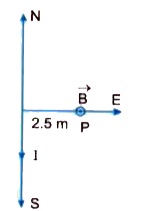
|
|
| 17. |
A neutral spherical conductor has a cavity. A point charge q is located inside it. It is in equilibrium. An external electric field (E) is switched on that is directed parallel to the line joining the centre of the sphere to the point charge. (a) What is the direction of acceleration of the charge particle inside the cavity after E is switched on. (b) How is the induced charge on the wall of the cavity affected due to the external field. |
|
Answer» (B). Not AFFECTED. |
|
| 18. |
The types of modulation which are possible are |
|
Answer» ONE only |
|
| 19. |
If the measurement errors in all the independent quantities are known, then it is possible to determine the error in any dependent quantity. This is done by the use of series expansion and truncating the expansion at the first power of the error. For example, consider the relation z =x/y. If the errors in x, y and z are Deltax, Deltay " and " Deltaz, respectively, then zpm Delta z= (x + y)/( y pm Delta y) = x/y (1 pm (Delta x )/( x ) ) ( 1 pm ( Delta y)/(y) )^(-1) The series expansion for(1 pm (Delta y )/( y) )^(-1) , to first power in Delta y // y " is " 1 pm (Delta y // y ).The relative errors in indepen- dent variables are always added. So the error in z will beDelta z = z ( (Delta x )/( x) + (Delta y )/( y) ) The above derivation makes the assumption that Delta x // x lt lt 1, Delta y // y lt lt 1 . The above derivation makes the assumption that Consider the ratior = (1 -a )/( 1 + a)to be determined by measuring a dimensionless quantity a. If the error in the measurement ofa isDelta a ( Delta a // a lt lt 1), then what is the error r in determining r ? |
|
Answer» `(DELTA a )/((1 + a)^2)` |
|
| 20. |
The reaction of (S)-2 bromobutane with OH^(-) to produce (R )-butane-2-ol will be - |
|
Answer» first ORDER in 2-bromobutane only RATE = K [Substrate][`OH^(-)`] |
|
| 21. |
A radioactive material of half-life time of 69.3 days is kept in a container. 2/3 rd of the substance remains undecayed after (given ln3/2 = 0.4) |
|
Answer» (a)20 DAYS |
|
| 23. |
The power factor of an ac circuit is 0.5. What will be the phase differences between the voltage and current in that circuit ? |
| Answer» SOLUTION :POWER FACTOR `cosphi=0.5, phi=cos^-1_0.5=60^@=pi/3` | |
| 24. |
A body projected vertically with a velocity 'u' from the ground .Its velocity a)At half of maximum height u/2 b)3//4^(th) of maximum height (u)/(sqrt(2)) c)At 1//3^(rd) of maximum height sqrt((2)/(3))u d) At 1//4^(th) of maximum height (sqrt(3))/(2)u |
| Answer» Answer :C | |
| 25. |
A man with normal near point (25 cm ) reads a book with small print using a magnifying glass : a thin convex lens of focal length 5 cm . a What is the closest and the farthest distance at which he should keep the lens from the page so that can read the book when viewing through the magnifying glass ? b. What is the maximum and the minimum angular magnification (magnifying power ) possible using the above simple microscope ? |
|
Answer» SOLUTION :a. `(1)/(v) - (1)/(u) = (1)/(f), v = -25 cm, f = 5 cm` -`(1)/(25) - (1)/(u) = (1)/(5) , - (1)/(u) = (1)/(5) + (1)/(25) = (6)/(25) ` u = `(-25)/(6) cm = - 4.2 ` cm To see the object at the farthest POINT, its image must be FORMED at infinity. i.e., v = `- infty "" therefore - (1)/(u) = (1)/(5), u= -5 ` cm i.e., the object is placed at 5 cm from the magnifying GLASS b. maximum angular MAGNIFICATION = m = `(D)/(|u|) = (25)/(|(25)/(6)|) = 6 ` minimum magnification = `(D)/(|u|) = (25)/(|5|)= 5 ` |
|
| 26. |
State Huygen's principle. Show, with the help of s suitable diagram, how this principle is used to obtain the diffraction pattern by a single-slit. Draw a plot of intensity distribution and explain clearly why the secondary maxima become weaker with increasing order (n) of the secondary maxima. |
|
Answer» SOLUTION :Diffraction of light (plane wavefront) from a single slit: As shown in figure when a plane wavefront WW. is incident normally on a NARROW single-slit AB, each point on unblocked portion ADB of wavefront sends out secondary wavelets in all the directions. for secondary wavelets meeting at symmetrical central point O on the screen, the path difference betweenn wave is zero and hence the secondary waves reinforce each other giving rise to central maximum at point O. consider secondary waves travelling in a direction making an angle `theta` with DO and reaching the screen at point P. obviously, path difference betwee extreme secondary waves reaching P from A and B. `Delta=BC=ABsintheta=asintheta`. If this path difference `asintheta=lamda`, then point P will have minimum intensity. in this situation, wavefront may be supposed to consist of two equal halves (known as half period elements) AD and DB and for every point on AD there will be a corresponding point on DB having a path difference `lamda/2`. consequently, they nullify effect of each other and point P behaves as first secondary minimum. In GENERAL, if path difference `asintheta_(n)=nlamda,` where n=1,2,3, . . , then we have nth secondary minima corresponding to that angle of diffraction `theta_(n)`, because then the wavefront AB is divided into an even number of half period elements and effect of all odd numbered half period elements is nullified by even numbered half period elements.  However, if for some point `P_(1)` on the secondary waves `BP_(1)` and `AP_(1)` differ in path by `(3lamda)/(2)`, then point `P_(1)` will be the position of first secondary maxima. because in this situation, wavefront AB may be divided into three equal parts such that path difference between corresponding points on first and second parts will be `(lamda)/(2)` and they will nullify. but secondary waves from third part remain as such and give rise to first secondary maxima, WHOSE intensity will be much less than that of central maxima. In general, if path difference `asintheta_(n)=(2n+1)(lamda)/(2)`, where n=1,2,3, . . , then we have nth secondary maxima corresponding to these angles. |
|
| 27. |
Which of the following frequencies will be suitable for beyond-the-lorizon communication using sky waves ? |
|
Answer» 10 kHz |
|
| 28. |
A body of mass M is pressed between two hands. Each hand exerts a horizontal force F. The net horizontal force acting on the body is |
|
Answer» F |
|
| 29. |
Electric field lines cannot form closed loops and thus are discontinuous in nature. |
| Answer» Solution :False- In a CHARGE free region , electric FIELD LINES are CONTINUOUS curves WITHOUT any breaks. | |
| 30. |
A charge of 1muC is divided into two parts such that their charges are in the ratio of 2:3. These two charges are kept at a distance 1m apart is vacuum. Then, the electric force between them (in N) is |
|
Answer» `0.216` `:. q_(1)=2/5xx5xx1 mu C` and `q_(2)=35xx1 muC` Electrostatic force between the two charges `F=1/(4pi epsilon_(0))(q_(1)q_(2))/(r^(2))` `=(9xx10^(9)xx2xx10^(-6)xx3xx10^(-6))/(5xx5xx(1)^(2))` `=2.16xx10^(-3)N` `~~0.00216N` |
|
| 31. |
Give the relation betweeen transistor parameters alpha and beta |
|
Answer» `β=(1-α)/α` |
|
| 32. |
ElectricdipolemomentofCuSO_4molecule is3.2 xx 10 ^(-28)Cm. Findtheseparationbetweencopperand sulphateions. |
| Answer» Solution :`p = q (d) rArr ` LENGTHOF DIPOLE` d = (3.2 xx 10 ^(-28))/( 1.6 xx 10 ^(-19)) = 2 xx10 ^(-9) CM ` | |
| 33. |
Suppose a charge + q on Earth's surface and another +q charge is placed on the surface of the Moon . (a) Calculate the value of q required to balance the gravitational attraction between Earth and Moon (b) Suppose the distance between the Moon and Earth is halved would the charge q change ? (Take m_(E)= 5.9xx10^(24)kg m_(M)= 7.348 xx10^(22) kg) |
|
Answer» Solution :MASS of the Earth `M_(E) = 5.9xx10^(24)` kg Mass of the moon `M_(M) = 7.348 xx10^(22)` kg Charge placed on the surface of Earth and Moon = q (a) Required charge to balance the `F_(G)` between Earth and Moon `F_(C)= F_(G) "(or)" (1)/(4piepsilon_(0)) (q^(2))/(r^(2)) = (GM_(E)xxM_(M))/(r^(2))` `q^(2)= GxxM_(E)xxM_(M)xx4piepsilon_(0)= 320 .97 xx10^(25)` `q= sqrt(320.97xx10^(25)) = 5.665 xx10^(13)=5.67xx10^(13)C` (B) The distance between Moon and Earth is `(1)/(4piepsilon_(0))(q^(2))/(r) = (GM_(E)xxM_(M))/(r) ` So q `= 5.67 xx10^(13)C` There is no change . |
|
| 34. |
The magnification of a compound microscope is 30 and the focal length of its eye piece is 5cm. Calculate the magnification produced by the objective, when the image is to be formed at least distance to distinct vision (25cm) |
|
Answer» 5 `=M_(0)xx(1+D/(f_(E)))` `30=M_(0)(1+25/5)` `M_(0)=5` |
|
| 36. |
Derive an expression for the induced emf developed when a coil of N turns, and area of cross-section A, is rotated at a constant angular speed omega in a uniform magnetic field B. (b) A wheel with 100 metallic spokes each 0.5 m long is rotated with a speed of 120 rev/min in a plane normal to the horizontal component of the Earth's magnetic field. If the resultant magnetic field at that place is 4 xx 10^(-4) T and the angle of dip at the place is 30^(@), find the emf induced between the axle and the rim of the wheel. |
|
Answer» Solution :(a) Consider a coil PQRS of N turns, each of area A, held in a uniform magnetic field `vecB`. Let thecoil be rotated at a steady angular velocity w about its own axis. Let at any instant t, normal to the area (i.e., the area vector `vecA`) subtends an angle `theta = omegat` from direction of magnetic field `vecB`. Then, at that moment, the magnetic flux linked with the coil is `phi_(B) = NvecB.vecA = N B A cos theta = cos omega t` `therefore` Induced emf `varepsilon = -(dphi_(B))/DT = - d/dt (NBA cos omegat` `= - N B A d/dt (cos omegat)` `= N B A omega SIN omegat` (b) Here number of spokes N = 100, length of each spoke L = 0.5 m, angular frequency `omega = 120 "rev"//"min" = (120)/60 rps = (120)/60 xx 2pi"rad s"^(-1) = 4pi "rad s"^(-1),` earth.s RESULTANT magnetic field `B_(E) = 4 xx 10^(-4)T` and angle of dip `delta = 30^(@)` As wheel is being rotated in a plane normal to the horizontal component `(B_(H))` of the earth.s magnetic field, hence induced emf between the axle and the rim of the wheel due to any one spoke. 1` varepsilon = 1/2 B_(H) varepsilonl^(2)=1/2B_(E) cos deltaomegal^(2)= 1/2 xx(4xx10^(-4))xx cos30^(@) xx4pi xx(0.5)^(2) =5.4 xx 10^(-4) V` As all the 100 spokes are joined in parallel, the total induced emf will be same as the emf due to one spoke. `implies` Total induced emf `= 5.4 xx 10^(-4)V or 0.54 mV` 
|
|
| 37. |
A uniform surface charge of density sigma is given to a quarter of a disc extending up to infinity in the first quadrant of x-y plane. The centre of the disc is at the origin O. Find the z-component of the electric field at the point (0,0,z) and the potential difference between the point (0,0,d) and (0,0,2d) |
|
Answer» |
|
| 38. |
The Electric field is given by vec(E)= (vecF)/(q_0), here the test charge q_0should be a) Infinitesimally small and positive b) Infinitesimally small and negative |
|
Answer» only a |
|
| 39. |
For air at room temperature the atmospheric pressure is 1.0xx10^(5)Nm^(-2) and density of air is 1.2 Kg m^(-3). For a tube of tength 1.0 m closed at one end the lowest frequency generated is 84 Hz. The value of gamma (ratio of two specific heats) for air is |
|
Answer» 2.1 |
|
| 41. |
Describe the function of a transistor as an amplifier with the neat circuit diagram. Sketch the input and output wave form. |
|
Answer» Solution :A transistor operating in the active region has the capability to amplify weak SIGNALS. Principal : (i) Amplification is the process of increasing the signal ( increase in the AMPLITUDE.) (ii) If a large amplification is required , the transistors are cascaded with coupling elements like resistors, capacitors, and transformers which is called as multistage amplifiers. (iii) Here, the amplification of an electrical with a single stage transistor amplifier as shown in Figure.  Construction: (i)Single stage indicates that the circuit consists of one transistor with the allied components. An NPN transistor is connected in the common emitter configuration. (ii) The Q point or the operating point of the transistor is fixed so as to get the maximum signal swing at the output (neither towards SATURATION point nor towards cut-off ). (iii) A load resistance `R_(c)` is connected in series with the collector circuit to measure the output voltage. (iv) The capacitor `C_(E)` allows only the ac signal to PASS through. (v) The emitter bypass capacitor `C_(E)` provides a low reactance path to the amplified ac signal. (vi) The coupling capacitor `C_(C)` is used to couple one stage of the amplifier with the next stage while constructing multistage amplifier`V_(S)`is the sinusoidal input signal source applied across the base-emitter. (vii)The output is taken across the collector emitter. Collector current `I_(C)=betaI_(B)[:'beta=(I_(C))/(I_(B))]` (viii) Applying Kirchhoff's voltage law in the output loop , the collector -emitter voltage is given by `V_(CE)=V_("CC")-I_(C)R_(C)` Working of the amplifier: (i) During the positive half cycle: Input signal `(V_(S))` increases the forward voltage across the emitter -base . As a result , the base current `(I_(B))` increases. (ii) Consequently , the collector current `(I_(C))`increases `beta` times. This increases the voltage `(V_(CE))` . Therefore , the input signal in the positive direction produces an amplified signal in the negative direction at the output . Hence , the output signal is output signal is reversed by `180^(@)` During the negative half cycle : (i) Input signal `(V_(S))` decreases the forward voltage across the emitter - base. (ii) As a result , base current `(I_(B))` decreases and in TURN increases the collector current `(I_(C))` . (iV) Thus, the input signal in the negative direction produces an amplified signal in the positive direction at the output . (V) Therefore , `180^(@)` phase reversal is observed during the negative half cycle of the input signal . |
|
| 42. |
A coil of inductance 0.2 henry is connected to 600 volt battery. At what rate, will the current in the coil grow when circuit is completed? |
|
Answer» Solution :As the BATTERY and INDUCTOR are in parallel, at any INSTANT, EMF of the battery and self emf in the inductor are equal `|e|=L(DI)/(dt)` or `(dI)/(dt)=(|e|)/(L)=(600 V)/(0.2H)=3000 As^(-1)` |
|
| 43. |
What are cathode rays? |
| Answer» SOLUTION :A CATHODE ray is a stream of electrons that are seen in vaccum TUBES. It is called a "cathode ray" because the electrons are being emitted from the negativecharged element in the vaccum TUBE called the cathode. | |
| 44. |
Explain , using suitable diagrams , the difference in the behaviour of a (i) conductor and (ii) dielectric in the presence of external electric field . Define the terms polarisation of a dielectric and write its relation with susceptibility. |
|
Answer» Solution :(i) When a conductor is placed in a uniform electric field `vecE_(0)` , free electrons present inside conductor drift in a direction opposite to the external electric field , till the electric field `vecE` , produced by drift of free electrons within the conductor just becomes equal and opposite to the external field `vecE_(0)` . Thus the net electric field `E_0 - E.` at any point inside the conductor is zero . (ii) When a dielectric slab is placed in the electric field `vecE_(0)` . the electrons in atoms / molecules of dielectric get PULLED in a direction opposite to the applied electric field. The separation between the charges is such that the force due to the external electric field is just balanced by the restoring force due to internal electric fields in the atom/molecule . The molecules , thus develop an induced DIPOLE moment and the dielectric is said to be polarised . Let `vecE_(p)` be the internal electric field in the dielectric due to polarisation of charge . Thus , net electric field in the presence of dielectric becomes `E = E_0 - E_p` It is observed that `E = (E_(0))/(E_(0) - E_(p)) = (E_0)/(K)` , where K is the dielectric constant of the given dielectric . The polarisation vector `vecp` of a dielectric is DEFINED as the dipole moment developed in the dielectric per unit VOLUME when placed in an external electric field . Thus , polarisation vector `vecp = ("Net dipole moment")/("Volume of dielectric")` For linear isotropic dielectrics , the polarisation vector `vecp` is found to be directly proportional to external electric field `vecE_(0) `i.e, `vecp prop vecE_(0)` or `vecP = x_(e) vec E_0` Here `X_(e)` is a constant which is characteristic of a dielectric and is known as the electric SUSCEPTIBILITY of given dielectric . |
|
| 45. |
A coil having 200 turns has a surface of 0.15 m^2. A magnetic field of strength 0.2 T applied perpendicular to this changes to 0.6 T in 0.4 s. then the induced emf in the coil is …. V. |
|
Answer» 45 `B_1=0.2 T , B_2=0.6T` `DELTAT`=0.4 s MAGNITUDE of INDUCED emf `epsilon=N (Deltavarphi)/(Deltat)` `=N(AB_2-AB_1)/(Deltat)` `=NA(B_2-B_1)/(Deltat)` `=200xx0.15xx(0.6-0.2)/0.4` = 30 V |
|
| 47. |
The unpolarised light is incident on polarisers placed above the other, so what is the angle between these two polarisers so that the than the intensity of the transmitted light is (1)/(3) than the intensity of incident light? |
|
Answer» `54.7^(@)` If the intensity of transmitted light from firs polariser `I_(1)` `I_(1)=I_(0) cos^(2) THETA` `=(I_(0))/(2)` [From ILLUSTRATION 10] Now the intensity of transmitted light FRON second polariser `I_(1)=(I_(0))/(3)` given, `:.I_(2)=I_(1) cos^(2) theta` `:.(I_(0))/(3)=(I_(0))/(2) cos^(2) theta` `(2)/(3)= cos^(2) theta` `:. cos theta.=sqrt((2)/(3))` `:. sin (90^(@)-theta)=0.8165` `:. 90^(@)- theta=54.7^(@)` `:. theta=90^(@)-54.7^(@)` ` :. theta=35.3^(@)` |
|
| 48. |
Derive, making use of an integral, the formula for the moment of inertia of a right circular cone about its height. |
|
Answer» `I=int_0^h(3MR^2z^4dz)/(2h^5)=(3MR^2)/(2h^5)int_0^hz^4dz.=(3MR^2h^2)/(2h^5xx5)=0.3MR^2` 
|
|
| 49. |
What is meant by mutual induction ? |
| Answer» Solution :When an ELECTRIC current passing througha coil changeswith time , an EMF is INDUCED in the neighhouring coil. This phenomenon is known as MUTUAL induction . | |
| 50. |
What is the meaning of 'worries'? |
|
Answer» SPIRIT of the person |
|