Saved Bookmarks
This section includes 7 InterviewSolutions, each offering curated multiple-choice questions to sharpen your Current Affairs knowledge and support exam preparation. Choose a topic below to get started.
| 1. |
There is one charged tiny spherical oil drop and the magnitude of electric field intensity at a point on its surface is E. If n such drops are combined to make a single drop then what will be the net electric field intensity at a point on the surface of the bigger spherical drop. Assume that charge is uniformly distributed over the volume of oil drop. |
| Answer» SOLUTION :`N^(1//3) E` | |
| 2. |
Three sound waves of equal amplitudes have frequencies (v - 1), v , (v + 1) . They surperpose to give beats. The number of beats produced per second will be : |
|
Answer» 3 y = a sin 2`pi` (v - 1) t+ a sin `2 pi v t + a sin 2pi`(v+1) t. Now a sin `2 pi (v - 1) t + a sin 2pi (v + 1) ` a `[ 2 COS 2 pit sin pi v t] ` `y = a sin 2 pi vt + 2 a cos 2 pi t sin 2 pi v t.` `y = a (1 + 2 cos 2 pi t ) sin 2 pi v t ` = A sin `2 pi v t` Where A = `a(1 + 2 cos 2 pi t) ` is resultant amplitude . Since intensity `prop ("Amplitude")^(2)` `therefore` Intensity will be maximumif cos `2pi t ` =+ 1 `rArr "" 2pi t = 0, 2pi, 4pi, 6pi,.. `etc. `rArr "" t= 0 , `Is, 2s, 3S, .... etc. `therefore` Time period of maximum intensity is 1 second so frequency of maximum intenstiy is 1 Hz or beat frequency is 1 Hz. `rArr ` Choice is (c) . |
|
| 3. |
What is a polar and non-polar molecule ? |
|
Answer» |
|
| 4. |
Differentiate between three segments of a transistor on the basis of their size and level of doping, |
| Answer» Solution : EMITTER : It is of MODERATE size and heavily doped. Base: It is very THIN and LIGHTLY doped. Collector : It is moderately doped and larger in size. | |
| 5. |
A narrow beam of natural light falls on the surface of a thick transparent plane-parallel plate at the Brewster angle. Its top surface. Find the degree of polarization of beams 1-4 (Fig.) |
|
Answer» Solution :SINCE natural light is incident at the BREWSTER's angle, the reflected light `1` is complately polarized and `P_(1) = 1`. Similarly the ray `2` is incident on GLASS air surface at Brewster's angle `(tan^(-1).(1)/(n))` so `3` is also completely polarized. Thus `P_(3) = 1` Now as in `5.167(b)` `P_(2) = (rho)/(1 - rho) = 0.087` if `rho =0.080`   Finally as shown in the figure `P_(4)= ((1)/(2)-(1)/(2)(1-2rho)^(2))/((1)/(2)+(1)/(2)(1-2rho)^(2)) =(2rho(1-rho))/(1-2rho(1-rho)) = 0.173` |
|
| 6. |
Energy stored in a coil of self-inductance 40mH carrying a steady current of 2 A is |
|
Answer» 0.8 J |
|
| 7. |
Calculate the separation between the particles of a system in the ground state, the corresponding binding energy, and the wavelength of the first line of Lyman series,if such a system is (a) a mesonic hydrogen atom whose nucleus is a proton (in a mesonic atom an electron is replaced by a meson whose charge is the same and mass is 207 si that of an electron), (b) a positronium consisting of an electron and positron revolving around their common centre of masses. |
|
Answer» <P> Solution :In a mesonic system, the reduced mass of the system is related to the mass of the meson `(m_(mu))` and proton `(m_(p))` by`mu=(m_(mu)m_(p))/(m_(mu)+M_(p))= 186.04 m_(e )` Then, separation between the particles in the GROUND state `=( ħ^(2))/(mue^(2))` `=(1)/(186) ( ħ^(2))/(m e^(2))` `E_(B)=(meason) =(mu e^(4))/(2 ħ^(2))= 186xx13.65eV` `=2.54 keV` `lambda_(1)=(8 piħc)/(3E_(b)(meason))=(lambda_(1)(Hydr og e n))/(186)= 0.65nm` (on USING `lambda_(1)(Hydrogr en)=121nm)` (b) In the postitronium `mu=(m_(e )^(2))/(2m_(e ))=(m_(e ))/(2)` The sepration between the particles is the ground state `=2(ħ^(2))/(m_(e )e^(2))= 105.8p m` `E_(b)(positronium)=(m_(e))/(2).(e^(4))/(2ħ^(2))=(1)/(2)E_(b)(H)=6.8eV` `lambda_(1)(postironium)=(2lambda_(1)(Hydrog en)=0.243nm` |
|
| 8. |
Draw and explain the image formation in spherical mirrors. |
|
Answer» Solution :The image can be LOCATED by graphical construction. To locate the point of an image, a minimum of two rays must meet at that point. (i) A ray parallel to the principal axis after reflection will pass through or appear to pass through the principle FOCUS. (Figure(a) )  (ii) A ray passing through or appear to pass through the principal focus, after reflectionwill travel parallel to the principal axis(Figure(b))  (iii) A ray passing through the centre of curvature RETRACES its path after reflection as it is a case of normal incidence. (Figure(C))  (iv) A ray falling on the pole will get reflected as PER law of reflection keeping principal axis as the normal. (Figure(d)) 
|
|
| 9. |
A detector is released from rest over a source of sound of frequencyf_(0) = 10^(3) Hz. The frequency observed by the detector at time t is plotted in the graph. The speed of sound in air is (g = 10 m//s^2) |
|
Answer» 330 m/s |
|
| 10. |
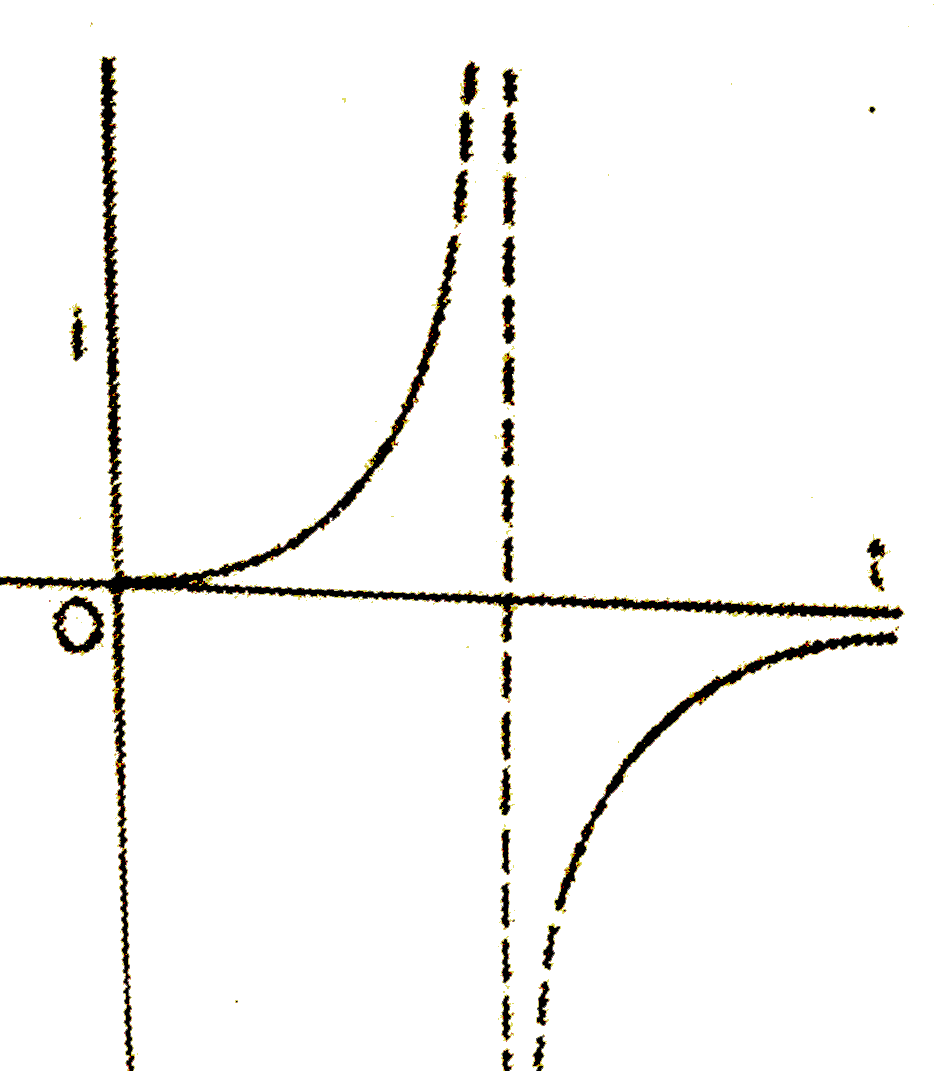
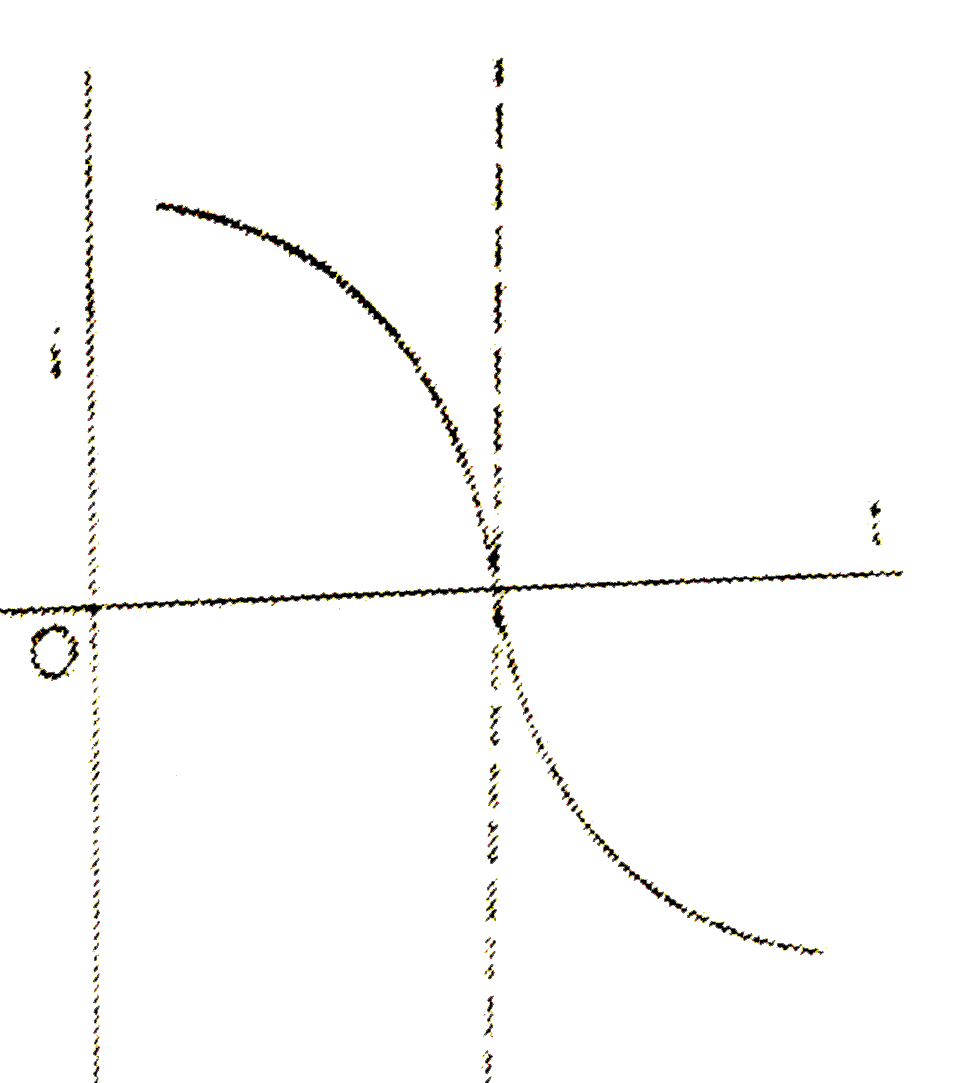
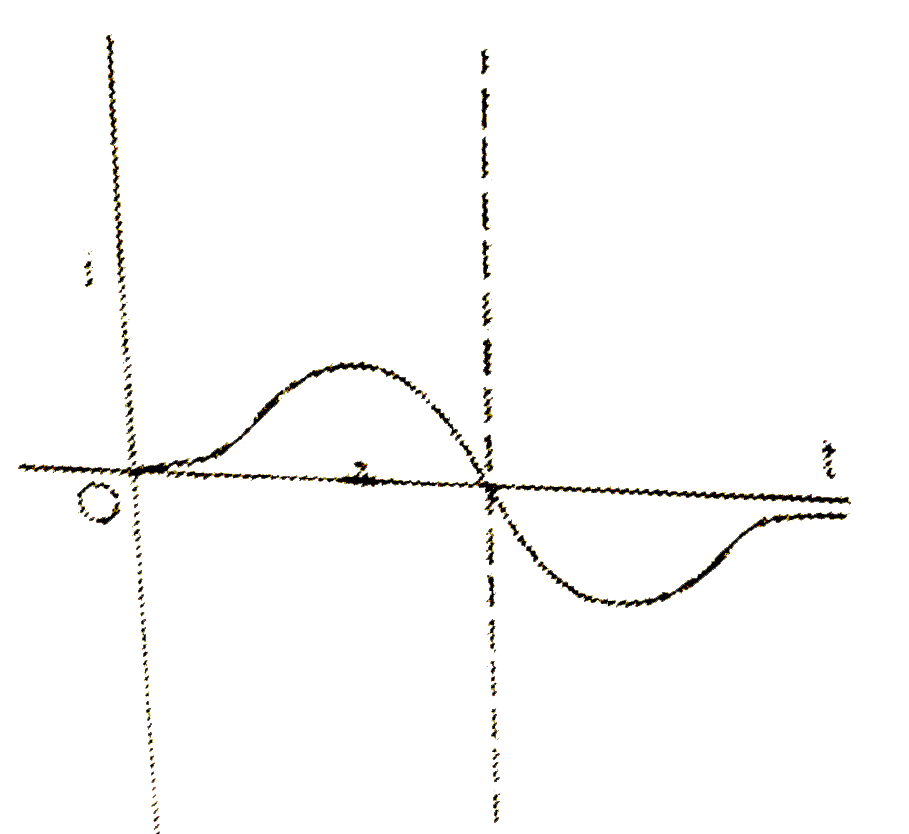
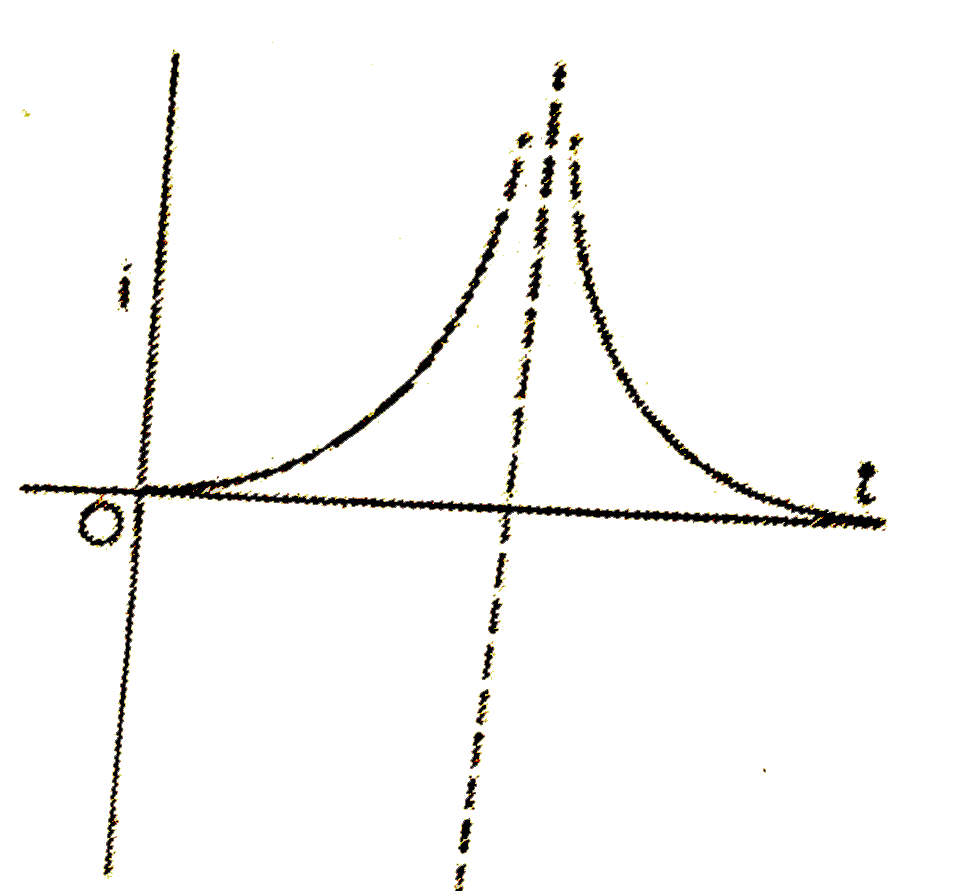
A long bar magnet moves with constant velocity along the axis of a fixed metal ring. It stars form a large distance from the ring, passes through the ring and then moves away far from the ring. The current i flowing in the ring is plotted against time t. Which of the following best represents the resulting curve? |
|
Answer» |
|
| 11. |
Let n_(r) and n_(b) be respectively the number of photons emitted by a red bulb and a blue bulb of equal power in a given time. Then : |
|
Answer» `n_(r)=n_(B)` For red coloured LIGH, `n_(r)` ismore because v is less. |
|
| 12. |
Assertion (A) : Microwaves are used in Radar. Reason (R ) : Microwaves are radiowaves having very small wavelengths. |
|
Answer» If both ASSERTION and rason are TRUE and the reason is the correct explanation of the assertion. |
|
| 13. |
A gold leaf electroscope is charged and the leaves are observed to diverge by a certain amount. A beam of X-rays is allowed to fall upon the electroscope for a short period. The leaves would : |
|
Answer» collapse |
|
| 14. |
A small ball of volumeV and densityrho is held inside a cubical containerof sideL filled with an idealliquidof density4 rho as.Nowif thecontainerstartedmovingwithconstant acceleration a and theball it hitsthe topcornerpoint Q of the container. Thenfindthe valueof k .Giveng = 10 m//s^(2) |
|
Answer» Solution :Acceleration of the ball in y direction will be ` a_(y) = (4 rho Vg - rho Vg)/(rho V) = 3G` For the BALLTO hit the topof the container ` L/2 = 1/2 3"gt"^(2) RARR t - sqrt(L/(3g))` In the frameof container , along the container `( 4 delta _(a)-deltav_(a))/(deltav) = 3a, 1/2 3at^(2) = L ` `rArr a = 2g ` 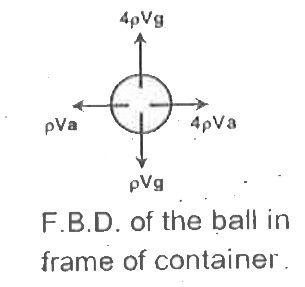
|
|
| 15. |
How are each of the following quantities of a SHM affected by doubling the amplitude ? Maximum acceleration |
| Answer» Solution :`a_("MAX") = omega^(2)A RARR` Maximum acceleration also doubles on DOUBLING the AMPLITUDE. | |
| 16. |
The induced emf in a L-R circuit is maximum: |
|
Answer» at the TIME of switching on due to high resistance |
|
| 17. |
A small bulb is placed at the bottom of a tank containing water to a depth of 80 cm. What is the area of the surface of water through which light from the bulb can emerge out? (Refractive index of water is 1.33. (Consider the bulb to be a point source) |
Answer» Solution :As SHOWN in Fig. 9.03 the LIGHT RAYS starting from a POINT object O (bulb in present case) situated at a depth h from surface of water can spread at the surface of a cone of semi-vertex angle ic equal to the critical angle of water.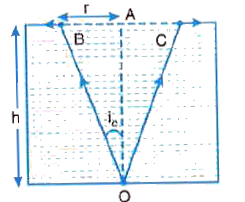 Thus, AB = AC = r= h `tan i_(c)`, where h= 80 cm = 0.8 m But by defintion `sin i_(c ) =1/n =1/1.33 = 0.75` `therefore r = h tan i_( c) =(h sin i_( c))/sqrt(1-sin^(2)i_( c))= (0.8 xx 0.75)/sqrt(1-(0.75)^(2)) = 0.91 m` `therefore` Area of water surface through which light can emerge out: ` A =pir^(2) = 3.14 xx (0.91)^(2) = 2.6 m^(2)` |
|
| 18. |
What advice is given through the clothes of the children? |
|
Answer» Never ACCEPT people for who they are |
|
| 19. |
Find the expression for the potential energy of a system of two point charges q_(1), and q_(2) glocated at vecr_(1) and vecr_(2) respectively in an external electric field vecE. (b) Draw equipotential surfaces due to an isolated point charge (-q) and depict the electric field lines. (c) Three point charges +1muC,-1 muC and +2muC are initially infinite distance apart. Calculate the work done in assembling these charges at the vertices of an equilateral triangle of side 10 cm. |
|
Answer» Solution :(a) To find the potential energy of a system of two point CHARGES `vecr_(1) and vecr_(2)` situated at points and respectively in an external electric field `VECE`, first we calculate the work done in bringing the charge `q_(1)`. from infinity to `vecr_(1)`. Work done in this step is `W_1=q_1V(vecr_(1))," where "V(vecr_1)` is the electrostatic potential at `vecr_(1)`. Now we consider the work done in bringing `q_(2)" to "vecr_(2)`. In this step work W, is done against the electric field and work `W_2` is done against the field due to charge `q_1.` Obviously `W_(2)=q_(2)V(vecr_(2))," where "V(vecr_(2))` is the electrostatic potential at `vecr_(2)` and `W_(12)=(q_(1)q_(2))/(4pi epsi_(0).r_(12)) "where "r_(12)=|vecr_(1)-vecr_(2)|` = distance between `q_(1) and q_2` Total work done in bringing `q_(2)" to "vecr_(2)=W_(2)+W_(12)=q_(2) V(vecr_(2))+(q_(1)q_(2))/(4pi in_(0).r_(12))` Potential energy of the system U. = The total work done in assembling the configuration `U=W_(1)+W_(2)+W_(12)=q_(1) V(r_(1))+q_(2)V(r_(2))+(q_(1)q_(2))/(4pi epsi_(0).r_(12))` (b) Equipotential surfaces due to an isolated point charge-q are drawn here and electric field lines have been depicted. 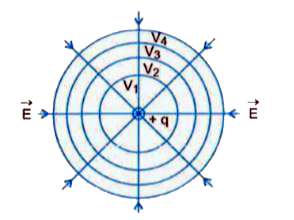 (C) Hence `q_(1)=+1 muC=+1 xx 10^(-6) C, q_(2)=-1muC=-1 xx 10^(-6) C, q_(3)=+2muC=+2 xx 10^(-6) C and r_(12)=r_(13)=r_(23)=10 CM =0.1m` Work done is assembling the charges =Potential energy of charge alignment `W=U=1/(4pi epsi_(0)) [(q_(1)q_(2))/(r_(12))+(q_(1)q_(3))/(r_(13))+(q_(2)q_(3))/(r_(23))]` 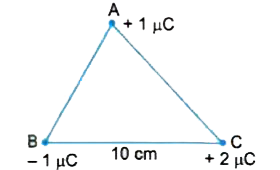 `=9 xx 10^(9) [(1 xx 10^(-6)) xx (-1 xx 10^(-6))/(0.1) +(1 xx 10^(-6)) xx (2 xx 10^(-6))/(0.1) +(-1 xx 10^(-6)) xx (2 xx 10^(-6))/(0.1)]` =0.09J |
|
| 20. |
Two long parallel wires are placed vertically, 10cm apart. One of them carries a current of 20A and other carries a current of 25A. Both the currents flow in the upward direction. A third wire carrying a current of 5A flowing downward is placed between the two parallel wires in such a way that its distance from the wire carrying current 20A is 6 cm. Calculate the force per unit length experienced by the third wire. |
| Answer» Solution :`2.9 XX 10^(-4) NM^(-1)` | |
| 21. |
On what principle is magnifying glass based. |
| Answer» Solution :It is based on the principle that when an OBJECT is placed WITHIN the focal length of a convex LENS as ERECT WRT object, virtual and magnified image is formed on the same side of the lens as the object. | |
| 22. |
A coil A is connected to an A.C. ammeter and another coil B to A source of alternaing e.m.f. How will the reading of ammeter change if a copper plate is introduced between the coils as shown. |
| Answer» SOLUTION :Reading of ammeter will DECREASE DUE to EDDY currents. | |
| 23. |
Using the Hund rules, find the magnetic moment of the ground state of the atom whose open subshell is half-filled with five electrons. |
|
Answer» Solution :We have `5d` electrons in the only UNFILLED shell. Then `S=(5)/(2)`. Maximum value of `L` consistent with Pauli's principle is `L=0`. Then `J=(5)/(2)`. So by Lande's formula `g=1+((5)/(2)(7/2)+(5)/(2)(7/2)-0)/(2(5)/(2)((7)/(2)))=2` Thus `mu=gsqrt(J(J+1))mu_(B)=2(sqrt(35))/(2)mu_(B)=2sqrt(35)mu_(B)`. The ground state is `.^(6)S_(5//2)`. |
|
| 24. |
Meiosis is termed as reduction division because |
|
Answer» CHROMOSOME NUMBER is same in parent and daughter cells |
|
| 25. |
A _____used in parallel of load in a full wave rectifier acts as a____ |
| Answer» SOLUTION :CAPACITOR, FILTER | |
| 26. |
Obtain the dimensional formula for co-efficient of self-induction. |
|
Answer» SOLUTION :INDUCED EMF E is GIVEN by `E = -Ldi/dt` `THEREFORE [L] = [E//di//dt]` = work/charge `[M^1L^2T^-2]/[A^1T^1]= [M^1L^2T^-3A^-1]` ` therefore [L] = [M^1L^2T^-3A^-1]/A^-1//T^-1]` = `M^1L^2T^-2A^-2` |
|
| 27. |
The current flowing through a galvanometer is 10^(-6)mA and producer a deflection of one scare division.If the resistance of moving coil is 500 ohms the voltage across the coil, in volts, is : |
|
Answer» `5XX10^(-5)` |
|
| 28. |
A particle having charge q enters a region of uniform magnetic field vecB (directed inwards) and is deflected a distance x after travelling a distance y. The magnitude of the momentum of the particle is |
|
Answer» `(QBY)/(2)` |
|
| 29. |
A copper wire and an iron wire, each having an area of corss-section A and lengths L_(1)andL_(2) are joined end to end. The copper end is maintained at a potential V_(1) and the iron end at a lower potential V_(2). If sigma_(1)andsigma_(2) are the conductivities of copper and iron respectively, the potential of the junction will be |
|
Answer» `(sigma_(1)V_(1)+sigma_(2)V_(2))/((sigma_(1))/(L_(1))+(sigma_(2))/(L_(2)))` Resistance of iron wire, `R_(2)=(L_(2))/(sigma_(2)A)` Let V is the POTENTIAL at the JUNCTION. As the wires are connected in SERIES same CURRENT flows in the wires. `therefore (V_(1)-V)/(R_(1))=(V-V_(2))/(R_(2))` or `V_(1)R_(2)-VR_(2)=VR_(1)-V_(2)R_(1)ORV(R_(1)+R_(2))=V_(1)R_(2)+V_(2)R_(1)` or `V=(V_(1)R_(2)+V_(2)R_(1))/(R_(1)+R_(2))` Substituting the values of `R_(1)andR_(2)`, we get `V=(V_(1)((L_(2))/(sigma_(2)A))+V_(2)((L_(1))/(sigma_(1)A)))/((L_(1))/(sigma_(1)A)+(L_(2))/(sigma_(2)A))=(V_(1)sigma_(1)L_(2)+V_(2)sigma_(2)L_(1))/(sigma_(2)L_(1)+sigma_(1)L_(2))` `V=((V_(1)sigma_(1))/(L_(1))+(V_(2)sigma_(2))/(L_(2)))/((sigma_(2))/(L_(2))+(sigma_(1))/(L_(1)))` 
|
|
| 30. |
(A): When number of turns in a coil doubled, coefficient of self inductance of the coil becomes four times. (R): Coefficient of self inductance is proportional to the square of number of turns. |
|
Answer» Both .A. and .R. are TRUE and .R. is the CORRECT EXPLANATION of .A. |
|
| 31. |
Biological importance of ozone layer is |
|
Answer» ozone layer controls `O_(2)//H_(2)` ratio in atmosphere |
|
| 32. |
Four capacitors, each of capacitance 4 muF, are connected as shown here. The equivalent capacitance between the points A and B will be |
|
Answer» `16 muF` |
|
| 33. |
Two soap bubbles of Radius R and r coalesce such that R>r. What is the radius of the common surface. |
|
Answer» <P> Solution :USE the FOLLOWING CONCEPTS`P_1V_1 + P_2V_2 = P` `VP_1 = P + 46/R v_1 = 4/3 piR^3` `P_2 = P + 46/R V_2 = 4/3 pir^3` and solve. |
|
| 34. |
A rope is wound round a hollow cylinder of mass 2 kg and radius 0.5 m. If the rope is pulled with aforce of 80 N, the angular acceleration of the cylinder will be - |
|
Answer» 20 rad/`s^(2)` Torqueactingon thecylinderbypullingtheropewitha force Fis `T=r Fsin theta ` `=F.(rsin theta)=F.r _(1) ` `=80xx0.5 = 40n-m` `and1=Mr^(2) = 2xx(0.5)^(2)= 0.5 kgm^(2)` `thereforealpha =( tau)/(I)(40N -m)/(0.5 KG - m^(2))=80 rad //s^(2)` |
|
| 35. |
A source of light emits a continuous stream of light energy which falls on a given area. Luminous intensity is defined as |
|
Answer» Luminous energy EMITTED by the SOURCE per second |
|
| 36. |
The linear portions of the characteristic curves of a triode valve give the following readings {:(V_(g)"(volt)",0,-2,-4,-6),(I_(p)(mA)" for "V_(p)=150" volts",15,12.5,10,7.5),(I_(p)(mA)" for " V_(p)=120" volts",10,7.5,5,2.5):} The plate resistance is |
|
Answer» 2000 ohms |
|
| 37. |
Electrons are emitted from a photosensitivesurface when it is illuminated by green light but electron emission does not take place by yellow light. Will the electrons be emitted when the surface is illuminated by (i) red light, and (ii) blue light ? |
|
Answer» SOLUTION :(i) No electron will be emitted when illuminated by RED light. (II) Electron EMISSION takes place with BLUE light. |
|
| 38. |
When light of frequency 6 xx 10^(14) Hz is incident on a photosensitive metal, the kinetic energy of the photoelectron ejected is 2e V. Calculate the kinetic energy of the photoelectron in eV when light to frequency 5 xx 10^(14) Hz is incident on the same metal. Given Planck's constant, h = 6.625 xx 10^(-34) Js, 1 eV = 1.6 xx 10^(-19). |
|
Answer» Solution :`hv = omega + K.E.` `(6.625 xx 10^(-34) xx 6 xx 10^(14))/(1.6 xx 10^(-19)) = omega + 2eV` ..(i) `(6.625 xx 10^(-34) xx 5 xx 10^(14))/(1.6 xx 10^(-19)) = omega + K.E.` ...(II) (i) - (ii)`implies K.E. = 1.5859 EV` Detailed Answer: According to EINSTEINS photoelectric EQUATION, hv = W + KE where, W = Work function for incident frequency `v = 6 xx 10^(14) Hz`, `(6.625 xx 10^(-34) xx 6 xx 10^(14))/(1.6 xx 10^(-19))eV = W + 2 eV` ...(i) also for frequency `5 xx 10^(14)` Hz, `(6.625 xx 10^(-34) xx 5 xx 10^(14))/(1.6 xx 10^(-19))eV = W + K.E.` ...(ii) Subtracting (ii) -(i) `(6.625 xx 10^(-34) xx 10^(14))/(1.6 xx 10^(-19))[5 - 6] eV = K.E. - 2 eV` -0.414 eV = K.E. - 2 eV K.E. = 2 - 0.414 = 1.585 eV |
|
| 39. |
Determine the spectral symbol of an atomic singlet term if the total splitting of that term in a weak magnetic field of induction B= 3.0KG amounts to DeltaE= 104 mu eV. |
|
Answer» Solution :For SINGLE TERM `S=0, L=J,g=1` Then the TOTAL splitting is `deltaE= 2Jmu_(B)B` Substitution gives `J=3(=deltaE//2mu_(B)B)` The term is `.^(1)F_(3)`. |
|
| 40. |
To convert galvanometer into voltmeter |
|
Answer» LOW RESISTANCE in series |
|
| 41. |
A small disk of mass m lies on the highest point of a sphere of radius R. A slight push makes the disk start sliding down. Find the force of pressure of the disk on the sphere as a function of the angle its radius vector makes with the vertical. Where does the disk lose contact with the sphere? Friction is to be neglected. |
|
Answer» `F_(2) - N =mv^(2)//R` To find the velocity apply the law of conservation of energy mgh `=mv^2//2`Since h = (1 — cos ), we obtain after some simple transformations `N = mg (3 cos alpha - 2) ` When the washwer leaves the sphere it ceases to press against it and the reaction becomes ZERO. The condition for the loss of contact is `cos alpha = 2//3 , alpha = 48^@h= R//3` 
|
|
| 42. |
Plane microwaves are incident on a long slit having a width of 5.0 cm. The wavelength of the microwaves if the first diffraction minimum is formed at theta = 30^(@) |
|
Answer» 2.5 cm |
|
| 43. |
A photodiode is to be designed to detect visible light radiation of all possible colours. The energy band gap for semiconducting material used to fabricate the photodiode should be |
| Answer» SOLUTION :EQUAL to or LESS than 1.8 EV | |
| 44. |
If a 10muF capacitor is to have a energy content of 1 J, it must be placed across a potential difference of : |
|
Answer» 50 V |
|
| 45. |
Give one method of generating a sinusoidal AC. |
| Answer» Solution :A SINUSOIDAL AC can be generated by rotating a coil in a uniform magnetic FIELD at a CONSTANT speed. | |
| 46. |
Give the factors that are responsible for transmission impairments. |
|
Answer» SOLUTION :ATTENUATION . DISTORTION (HARMONIC). NOISE . |
|
| 47. |
A battery of 10V and negligible internal resistance is connected across the diagonally opposite corners of a cubical network consisting of 12 resistors each of resistance 1 Omega. Determine equivalent resistance of the network and the current through the battery. |
|
Answer» Solution :Let ABCDKLMN be the skeleton cube formed by joining twelve equal wires each of resistance r. Let the current ENTER the cube at corner A and after passing through all twelve wires, let the current leave at N, a corner diagonally oppsoite to corner A. For the SAKE of convenience, let us suppose that the total current is `6 I`. At A, this current is divided into three equal parts each `(2 I)` ALONG AB,AD and AL as the resistance along these paths are equal. At into two equal parts each equal to `i` because resistance along the two paths are eaual. Thus, the distribution of current in the various arms of skelton cube is shown according to Kirchhoff's First rule. The current leaving the cube at N is again `6 I`. If `epsilon` is the emf of the battery used, then applying Kirchhoff's SECOND rule to the closed circuit ALKN `epsilon` A, we GET `2 Ir + Ir + 2 Ir = epsilonor 5 Ir = epsilon` Where `epsilon` is the e.m.f. of the cell of negligible internal resistance. If R is the resistance of the cube between the diagonally opposite corners A and N, then according to Ohm's Law, we have ` 6 I xx R = epsilon` From (i) and (ii), ` 6IR = 5 Ir or R = 5/6 r` Here, `r= 1 Omega`, so `R = 5/6 xx 1 = 5/6 Omega` Current through battery `= ("voltage of battery")/("total resistance")` ` = 10/(5//6) = 12 A` 
|
|
| 48. |
A 600 W carrier is modulated to a depth of 75% by a 400 Hz sine wave antenna power. |
|
Answer» Solution :TOTAL POWER in the modulated wave `P_("total")=P_("CARRIER")[1+(m_a^2/2)]=600(1+(0.75)^2)=768.75W` |
|
| 49. |
The reactance of a capacitor of 1/pi in areA.C. circuit having frequency of 50Hz is ..... |
|
Answer» `100Omega` `therefore X_C=1/(OMEGAC)=1/(2pifC)=1/(2pixx50xx1/pi)=1/100` `therefore X_C=10^(-2) Omega` |
|
| 50. |
Isn't the result of the previous problem in contradiction with the fact that the ideal gas isochore in p-T coordinates is represented by a linear graph, while the iso chore of saturated vapour is nonlinear. ( see 35.3 Fig. 35.2)? |
| Answer» Solution :As distinct from an ideal gas, whose MOLECULAR concentration (and density) does not change in an isochoric process, the molecular concentration and density) of a saturated VAPOUR rises with temperature because of additional EVAPORATION of the liquid. 22.3. The density of saturated vapour at `55^(@)C is 104.3 g//m^(3)`. Therefore at this temperature 8 g of saturated vapour occupies a VOLUME of `(8)/(10.4.3)=7.6xx10^(-3)m=7.6` litres. In a smaller volume there will be a PRECIPITATION of dew. | |