

Saved Bookmarks
This section includes 7 InterviewSolutions, each offering curated multiple-choice questions to sharpen your Current Affairs knowledge and support exam preparation. Choose a topic below to get started.
| 1. |
Using Huygen's construction, draw a figure showing the propagation of a plane wave reflecting at the interface of the two media. Show that the angle of incidence is equal to the angle of reflection. |
|
Answer» Solution :Laws of reflection by Huygen's PRINCIPLE : LET PQ be reflecting surface. Let a plane wavefront AB moving through the medium (air) towards the surface PQ meet at the point B. Let C be the velocity of ligh and t be the time of A to reach A' then A A =ct. By the Hugygen's principle, secondary wavelets starts from B and cover a distance ct in time t and reaches at B'. To obtain new wavefront, draw circles with point B as centre and ct (A A '=BB') as radius. Draw a tangent A 'D from the point A'. Then A ' D represents the reflected wavelets which travel at right angle. Therefore, incident wavefront AB and reflected wavefront A'D and normal lies in the same plane. In `Delta ABAand Delta DBA`'. ` A A '=BD =ct` `BA '=BA'["Common"]` ` angle BAA '=angle BDA' ["each" 90^@]` ` therefore Delta ABA 'approx Delta DBA ["by "R.H.S]` ` angle ABA =angle DA B [C.P.C.T]` ` therefore` incident angle `i -` reflected angle r ` angle i=angle r` Hence, the laws of reflection is proved. 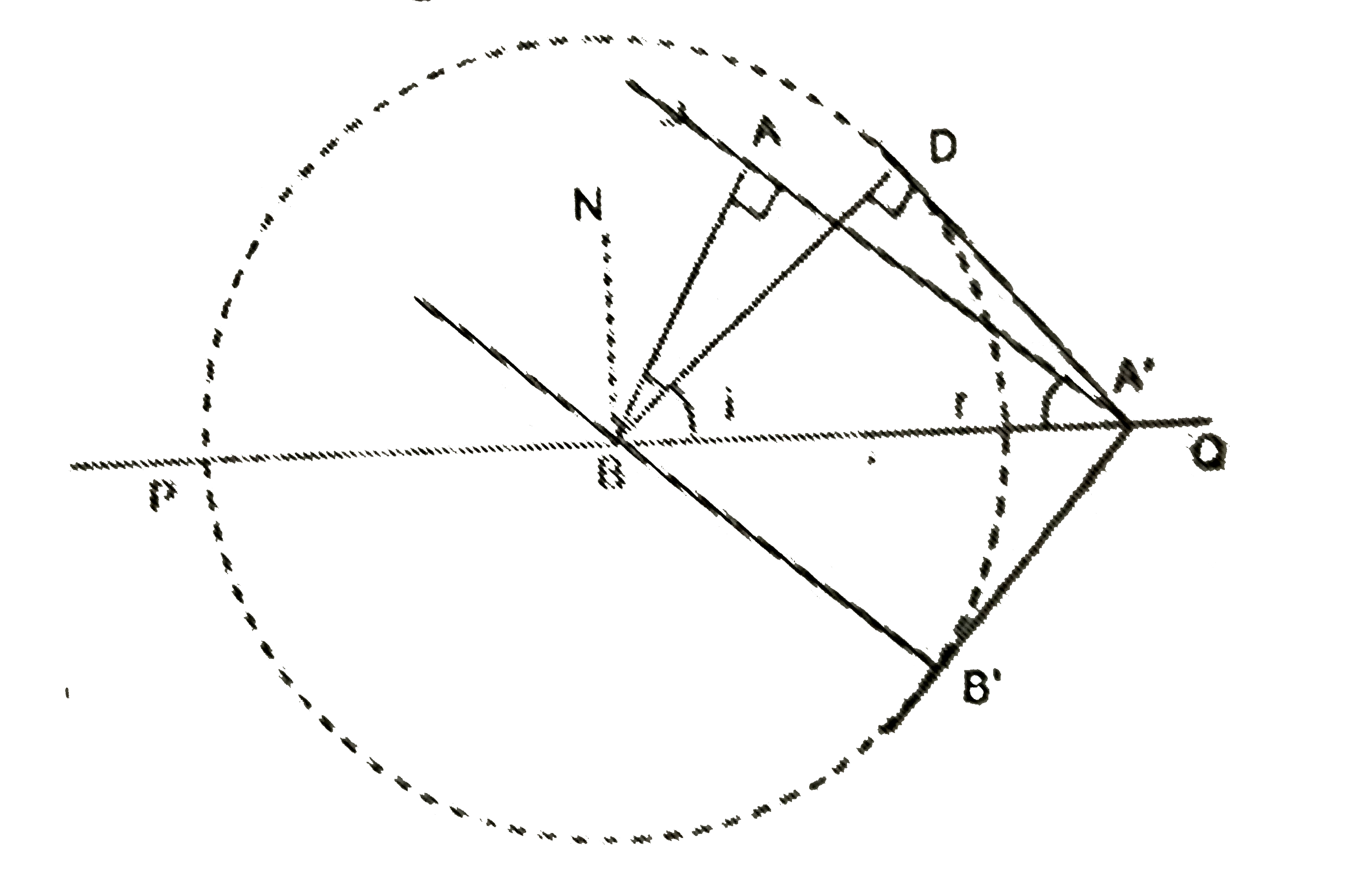
|
|
| 2. |
Making use of the expression for the hydrostatic pressure, derive an expression for the magnitude of the Archimedes force. |
Answer» Solution :ONE of the possible arguments is as follows. Consider separately the volume in the LIQUID which will be filled by the object being immersed (Fig.). The volume is acted upon by the FORCES of hydrostatic pressure, indicated by small arrows. The resultant of these forces is the buoyancy F. Since the liquid is in a state of equilibrium, `F = P_1`, where `P_1` is the weight of the respective volume of the liquid. It is obvious that if we PLACE the object of interest into the liquid, the same hydrostatic forces will act on it and, consequently, its buoyancy will be equal to the weight of the liquid displaced by the object. 
|
|
| 3. |
After losing two electrons to which particle does a helium atom get transformed into ? |
| Answer» SOLUTION :`ALPHA` PARTICLE. | |
| 4. |
What sections are containted in the prism ? |
| Answer» SOLUTION :(i) Refracting FACE, (II) Refracting edge, (iii) Angle of the prism, (IV) Principal section. | |
| 5. |
The surface of a metal is illuminated with the light of 400 nm. The kinectic energy of the ejected photoelectrons was found to be 1.68 eV. The work function of the metal is (hc = 1240 eV nm) |
|
Answer» 1.51 eV `w_(0)=(lambda_(c))/(lambda)-(1)/(2)mv_("max")^(2)` `=(1240)/(400)-1.68=1.41eV` |
|
| 6. |
An electron with a velocity of 2.4 xx 10^(6)ms^(-1) flies into a uniform electric field of intensity 135 Vm^(-1). It moves along a field line until it comes to rest. What is the distance travelled by the electron before coming to rest within the field. |
|
Answer» |
|
| 7. |
A plane mirror produces a magnification of …..... |
|
Answer» zero `therefore` Magnification, `m=(f)/(f-u)=("Infinite")/("Infinite-u")=("infinite")/("INFINTE")=+1` Image will be ERECT and magnification will be positive. |
|
| 8. |
(i) An a.c.Source of voltage V = V_(0)" sin"omegat is connectedto a seriescombination of L,Cand R . Usethephasordiagram toobtainexpressionfor impedanceof thecircuitand phaseanglebetweenvoltage andcurrent. Find theconditionwhen currentwill bephase with thevoltage. Whatis thecircuitin thisconditioncalled ? (ii)In a seriesLRcircuitX_(L)= R andpowerfactorof the circuitis P_(1). Whencapacitor whichcapacitanceC such thatX_(L) =X_(C) is putin series, the powerfactorbecomesP_(2) .Calculate P_(1)//P_(2) |
|
Answer» <P> Solution :`P= COS theta= (R )/(Z )` |
|
| 9. |
A straight horizontal wire of mass 10 mg and length 1m carries a current 2A what minimum magnetic field should be applied in the region so that the magnetic force on the wire may balance its weight |
|
Answer» `4.9 XX 10^(-5) T ` |
|
| 10. |
In a series L–C–R circuit X_L, X_C and R are the inductive reactance, capacitive reactance and resistance respectively at a certain frequency f. If the frequency of a.c. is doubled, what will be the values of reactances and resistance of the circuit? |
| Answer» Solution :`X_(L) = omega L, X_( C) = (1)/(omega C),` R independent | |
| 11. |
Tritium has a half life of 12.5 years against beta decay. What fraction of a sample of pure tritium will remain undecayed after 25 years? |
|
Answer» one half |
|
| 12. |
In requency modulation : |
|
Answer» The AMPLITUDE of MODULATED wave varies as frequncy of CARRIER wave |
|
| 13. |
The figure shows an energy level diagram for the hydrogen atom. Several trasitions are markedas I,II,III, …… The diagram is onlyindicative and not to scale. Then, (##MTG_WB_JEE_CHE_MTP_01_E01_040_Q01.png" width="80%"> |
|
Answer» The transition in which a Balmerseries photon absorbed is VI. In transition (VI), photon of Balmerseries is absorbed. In transitionII ` E_(2) = -3.4 eV, E_(4)= 0.85 eV, DeltaE =2 .55 eV` ` DeltaE =(12400 eV Å)/( 1030Å)=12.0 eV` So difference of energyshouldbe 12.0 eV (approx) Hence, ` n_(1) = 1 and n_(2)= 3 ` `(-13.6 eV) (-1.51 eV) THEREFORE `Transition is V. For longest wavelength, energy difference should be minimum So in visibleportionof hydrongen atom, minimum energy emitted is intransition IV. |
|
| 14. |
From the conditions of the foregoing problem determine the boost time tau_0 in the reference frame fixed to the rocket. Remember tau_0=int_(0)^(tau)sqrt(1-(v//c)^2)dt, where dt is the time in the geocentric reference frame. |
|
Answer» SOLUTION :The boost time `tau_0` in the reference frame fixed to the rocket is related to the time `tau` elapsed on the EARTH by `tau_0=underset(0)overset(tau)intsqrt(1-v^2/c^2)dt=underset(0)overset(tau)INT[1-(((w^'t)/(c))^2)/(1+((w^'t)/(c) )^2)]^(1//2)dt` `=underset(0)overset(tau)int(dt)/(sqrt(1+((w^'t)/(c))^2))=c/wunderset(0)overset((w^'tau)//c)int (DXI)/(sqrt(1+xi^2))=c/w1n[(w^'tau)/(c)+sqrt(1+((w^'tau)/(c))^2)]` |
|
| 15. |
Fundamental frequency of a closed organ pipe of length I is given by |
|
Answer» `UPSILON //2L` HERTZ |
|
| 16. |
Radio waves of constant amplitude can be generated with |
|
Answer» FILTER |
|
| 17. |
A tungsten (Z=74) target is bombarded by electrons in an x-ray tube. The K, L and M energy levels for tungsten have the energies 69.5, 11.3, and 2.30 ke V, respectively. (a) What is the minimum value of the accelerating potential that will permit the production of the characteristic K_(alpha) and K_(beta) lines of tungsten? (b) For this same accelerating potential, what is lambda_(min)? What are the (c ) K_(alpha) and (d) K_(bet) wavelengths? |
| Answer» SOLUTION :(a) 69.5kV, (B) 17.8 PM, (C ) 21.3 pm, (d) 18.5 pm | |
| 18. |
A prism of angle 80^(@) has refractive index sqrt(2). A light ray is incident at 45^(@) on one face. The totla deviation of the ray is |
|
Answer» `75^(@)` |
|
| 19. |
A parallel plate air capacitor of capacitance C_0 is connected to a cell of emf V and then disconnected it. A dielectric slab of dielectric constant K, which can just fill the air gap of the capacitor, is now inserted in it. Which of the following is correct? |
|
Answer» Charge on PLATES becomes `KC_0V` |
|
| 20. |
Plotting a graph of log t_(1//2) against log [A]_(0) of a rectant for a first order reaction, the slope will |
|
Answer» `-1` `logt_(1//2)=log0.693-log K=`consatnt 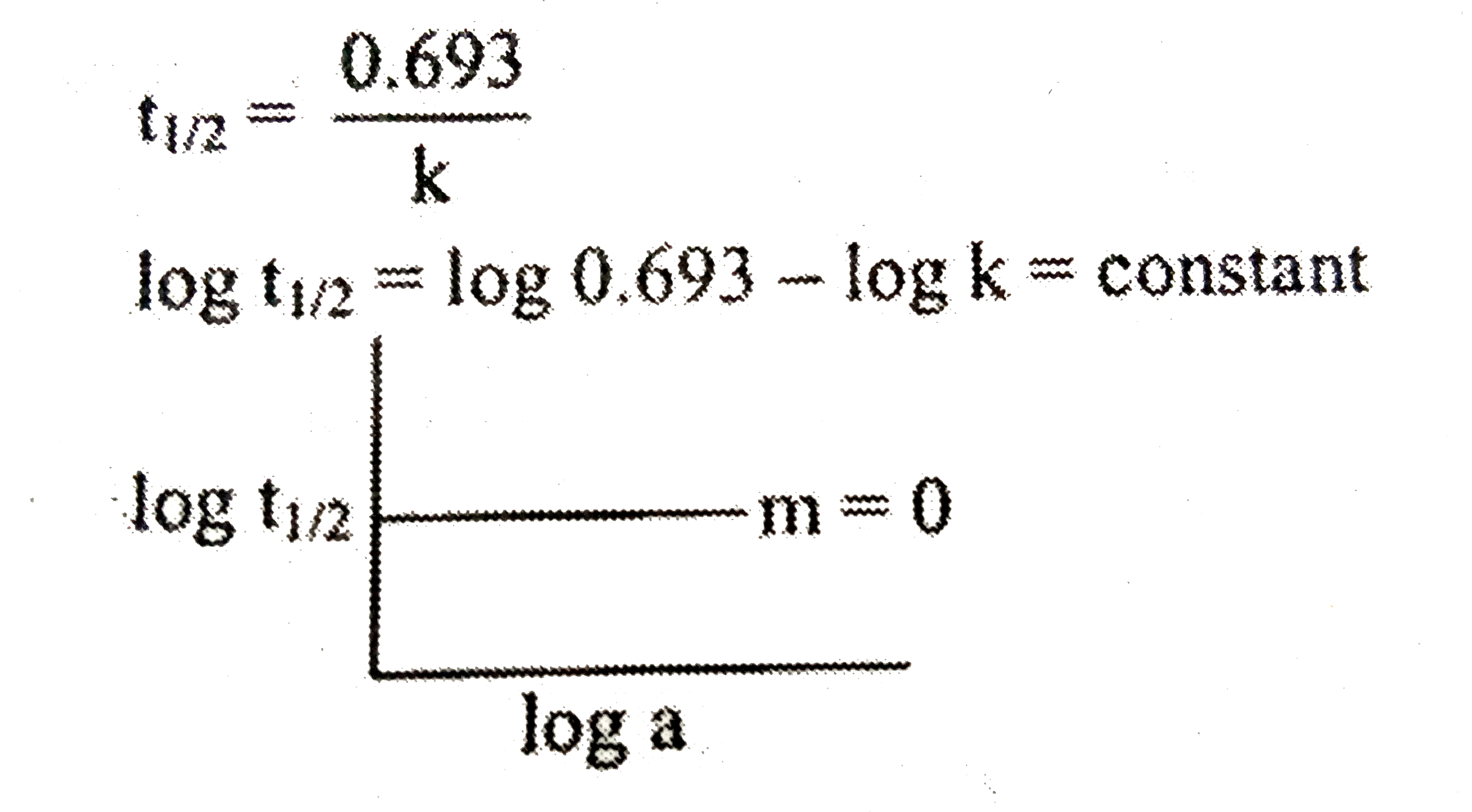
|
|
| 21. |
What we name the magnetic flux linked with a circuit when unit current flows through it? |
| Answer» SOLUTION :COFFICIENT of self-induction. | |
| 22. |
If lambda_(v), lambda_(m) and lambda_(x) represent wavlength of visiblelight, microwaves and X - rays respectively, then |
|
Answer» `lambda_(m) LT lambda_(X) lt lambda_(V)` |
|
| 23. |
In Young's double slit experiment monochromatic light of wavelength 630 nm illuminates the pair of slits and produces an interference pattern in which two consecutive bring fringes are separated by 8.1 mm. Anther source of monochromatic light produces the interference pattern in which the two consecutive bright fringes are separated by 7.2 mm. Find the wavelength of light from the second source. What is the effect on the interference fringes in the monochromatic source is replaced by a source of white light? |
|
Answer» Solution :Position of the nith bright fringe is given by `(N lamda D)/(d)` from the central bright fringe. The separation between two consecutive bright fringes is `(lamda D)/( d)` With `lamda_1` = 630 NM, we have `(lamda_1D)/(d) `= 8.1 mm With `lamda_2, = (lamda_2 D)/(d) == 7.2 mm` dividing , we GET `(lamda_1)/(lamda_2) = (8.1)/(7.2)` `rArr lamda_2 = (7.2)/(8.1) xx lamda_1 = 8/9 xx 630 = 560 nm` When the monochromatic light is replaced by a white light, . (i) the central bright remains white and (ii) all the other colours will form individual maxima with the least wavelength VIOLET forming its bright fringe CLOSE to the central bright fringe . |
|
| 24. |
Two lenses of power 3D and -1D are kept in contact. What is focal length and nature of combined lens? |
|
Answer» <P>50 CM, CONVEX `F = (1)/(P) = (1)/(2) m = 50 cm` |
|
| 25. |
A radioactive nucleus A undergoes a series of decays as given below. The mass number and atomic number of are 176 and 71 respectively. Determie the mass and atomic number of A4 and A. |
|
Answer» Solution :DETERMINING the MASS and atomic NUMBER of A4 and A. `A_(4)`: Mass number :172 Atomic number : 69 |
|
| 26. |
Conduction current flows: |
|
Answer» only through resistance |
|
| 27. |
Considering theearth's magnetism to be due to a very powerful short magnet embedded at its centre placed with its south pole pointing north, show that, latutde (lambda) of any place bears a definite relation with the dip (delta) of the place and that definite relation is tan delta=2 tanlambda |
| Answer» | |
| 28. |
The acceleration time graph of a particle moving along a straight line is shown in figure .At what tim the particle acquires its initial velocity. |
|
Answer» SOLUTION :`a=a_(0)t+a_(1)`,0,a=`a_(1)`=10,a=0 at t=4 seconds. 0=+4`a_(0)`+10,`a_(0)`=-2.5 a=2.5 t+10,`(DV)/(DT)`=-2.5t+10 `int`dv=`int`(-2.5t+10)dt, V=`-2.5(t^(2))/(2)`+10t+c t=0,C=`v_(0), v=-2.5(t^(2))/(2)+10t+v_(0)` `v=v_(0)-2.5(t^(2))/(2)+10t=0,2.5(t^(2))/(2)=10t` t=8 seconds 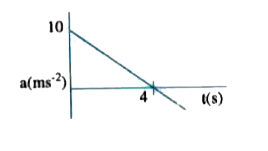
|
|
| 29. |
When a current of 5mA is passed through a galvanometer having a coil of resistance 15Omega, it shows full scale deflection. The value of the resistance to be put in series with the galvanometer to convert it into to voltmeter of range 0-10V is |
|
Answer» `2*535xx10^3Omega` `R=V/I_g-G=(10)/(5xx10^-3)-15` `=2000-15=1*985xx10^3Omega` |
|
| 30. |
The X-z plane separates two media A and B of refractive indicesmu_1 = 1.5 and mu_2 = 2.A ray of light travels from A to B. Its directions in the two media are given by unit vectors baru_1= ahati + bhatj and baru_2= c hati +dhatj. Then |
Answer» SOLUTION : ` tani=a/b so SINI(a)/(sqrt(a^2 +b^2))` ` and tanr= (C )/(d ) , sinr = (c )/( sqrt(c^2 +d^2))` ` mu_1sin I = mu_2sin r` ` ((3)/(2)) ((a)/(sqrt(a^2 +b^2)))=2 ((c )/(sqrt(c^2 +d^2)))` BUTAS` a HATI + b hatjand c hati + d hatj` are unitvectorsso ` sqrt(a^2+b^2 ) = sqrt(c^2 +d^2)=1` hence`3/2a= 2c , so (a)/(c ) = (4 )/(3) ` |
|
| 31. |
Energy released in the fission of a single _91U^235 nucleus is 20 meV. The fission rate of a _92U^235 filled reactor operating at a power level of 5W is : |
|
Answer» `1.56xx10^(-11) s^(-1)` |
|
| 32. |
A radio wave of freqency 840 MHz is sent towards an aeroplane. The frequency of the radio echo has a frequency 2.8 KHz more than the original frequency. Then the velocity of aeroplane is |
|
Answer» 3 Km/sec |
|
| 33. |
What will be the inputs of A and B for Boolean expression (bar(A + B))+(bar(A.B))=0 ? |
|
Answer» 0,0 |
|
| 34. |
The dimensions of electric intensity are: |
|
Answer» `[M^1L^-1T^3A^1]` |
|
| 35. |
A uniform but time-varying magnetic field B(t) exists in a circular region of radius a and is directed into the plane of the paper, as shown in the figure. The magnitude of the induced electric field at point P at a distance r from the centre of the circular region |
|
Answer» is ZERO `oint vecE.vec(dl) = (dphi)/(dt)` or `E(2pir) =d/(dt) (vecB.vecA)` `2pirE=pia^2 ((dB)/(dt))cos 0^@` or `E=a^2/(2r) (dB)/(dt)` or `E prop 1/r` 
|
|
| 36. |
A block of ice of mass M= 50 kg slides on a horizontal surface. It starts with a speed v=5.0m/s and finally stops after movng a distance s=30 m. What is the mass of ice that has melted due to friction between block and surface? Latent heat is fusion of ice is L_(f)=80 cal/g. |
|
Answer» |
|
| 37. |
mu_0 and in_0 are the magnetic permeability and the electric permittivity, respectively, of free space. phi is the electric flux across any Gaussian surface. Then the displacement current is defined as |
|
Answer» `(dphi)/(DT)` |
|
| 38. |
A capstan is a rotating drum (cylinder) over which a rope or cord slides in order to increase the tension due to friction. If the difference in tension between the two ends of the rope is 500 N and the capstan has a diameter of 10 cm and rotates with angular velocity 10 rad//s. Capstan is made of iron and has mass 5 kg, specific heat 1000 J//kg K. At what rate does temperature rise? Assume thatthe temperature in the capstan is uniform and all the thermal energy generated flows into it. Express your answer as xxx10^(-4)^(@)C Fill up value of x. |
|
Answer» `P=ms(dT)/(dt)` `(dT)/(dt)=500xx5xx10^(-2)xx10=5XX10^(-2)` `x xx10^(-4)=5xx10^(-2)=500` |
|
| 39. |
A negatively charged disc is rotated clock-wise. What is the direction of the magnetic field at any point in the plane of the disc? |
|
Answer» Into the page |
|
| 40. |
Two plane mirrors are inclined at angle theta = 60^@ with each-other. A ray of light strikes one of them. Find its deviation after it has been reflected twice-one from each mirror. |
|
Answer» Solution :Case I:`delta_(1)`=CLOCKWISE deviation atA=`180^@ -2i_(1)` `delta_(2)`anticlockwise deviation at B=`180^@-2i_(2)` Now, from `Delta` OAB, we have angle O + angle A + angle B = `180^@` `implies i_(1) - i_(2) = theta` As `i_(1)>i_(2), delta_(1) `=(180^@ - 2i_(2)) - (180^@ - 2i_(1))` `=2(i_(1) - i_(2))=2theta=120^@` Case II:`delta_(1)`=clockwise deviation atA=`180^@ -2i_(1)` `delta_(2)`anticlockwise deviation at B=`180^@-2i_(2)` Now, from `Delta` OAB, we have angle O + angle A + angle B = `180^@` or, `theta+ (90^@-i_(1)) + (90^@ - i_(2))=180^@ implies i_(1) + i_(2)=theta` Hence, the net angle clockwise deviation=`delta_(2) +delta_(1)` `=(180^@-2i_(2))+(180^@-2i_(1))=360^@-2(i_(1)+i_(2))=360^@-2theta` `implies`Net anti-clockwise deviation =`360^@ - (360^@-2theta) = 2theta=120^@` 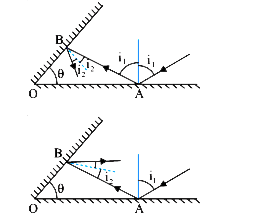 |
|
| 41. |
The length of a telescope is 36 cm. The focal lengths of its lenses can be : |
|
Answer» `-30 CM, -6 cm` |
|
| 42. |
Total number of tetrahedral void in FCC unit cell is...... |
|
Answer» 2 |
|
| 43. |
A little charged bead is inside the hollow frictionless sphere manufactured from the insulting material. Sphere has a daimeter of 50 cm. The mass of the bead is 90mg, its charge is 0.5muC. What minimum charge must carry an object at the bottom of the sphere to keep hold the charged bead at the vertax of the sphere in stable equilibrium ? |
|
Answer» `4.9xx10^(-8)C` |
|
| 44. |
A heavy but uniform rope of length L is suspended from a ceiling, Write the velocity of a transverse wave travelling on the string as a funtion of the distance from the lower end. |
| Answer» SOLUTION :`SQRT(GX)` | |
| 45. |
The earth is a bg dipole of moment 64xx10^(22)Am^(2) . Calculate the horizontal and vertical components of the earth's magnetic field at a place of latitude 30^(@) South. (Radius of the earth =6000km) |
|
Answer» |
|
| 46. |
The simple Bohr model is not applicable to He^(+) atom because He^(4) is an insert gas He^(4) has neutrons in the nucleus He^(4) has one more electron Electron are not subject to central forces |
|
Answer» Both a&b are true |
|
| 47. |
Which of the following uses radio frequency to produce nano-particles? |
|
Answer» PLASMA arching |
|
| 48. |
What is the probability of extracting two aces in succession from a pack as in Problem 18.1 (a) if the ace extracted first is returned to the pack, (b) if the ace extracted first is not returned? |
|
Answer» (b) If the extracted ace is not returned to the pack, the probability of extracting the second ace will be 3/35. The probability of extracting two aces in succession is equal to the product of the probabilities. |
|
| 49. |
A double convex lens of refractive index 1.5 has radii of 20 cm. Incident rays of light parallel to theaxis will come lo converge at a distance from the lens is |
|
Answer» 20cm |
|
| 50. |
What is the use of astronomical telescope? |
Answer» Solution :An astronomical telescopeis used to get the magnification of distant astronomical objects LIKE stars, PLANETS, moon etc. the image formed by astromonical telecsope will be INVERTED. It has an obective of long focal length and a much larger aperture than the eyepiece. Light from a distant object enters the objective and a real image is formed in the tube at its second focal point. The eyepiece magnifies the image producing a final inverted image.  Magnification of astronomical telescope The magnification m is the ratio of the angle `beta` subtended at the eye by the final image to the angle `alpha` which the object subtends at the lens or the eye. `m = (beta)/(alpha)` From the diagram, `m = (h//f_(e))/(h//f_(0))` `m = (f_(0))/(f_(e))` The LENGHT of the telescope is approximately, `L = f_(0) + f_(e)` |
|