Saved Bookmarks
This section includes 7 InterviewSolutions, each offering curated multiple-choice questions to sharpen your Current Affairs knowledge and support exam preparation. Choose a topic below to get started.
| 1. |
A current carrying loop consists of 3 identical quarter circles of radius R, lying in the positive quadrants of the x-y, y-z and z-x planes with their centres at the origin, joined together. Find the direction and magnitude of B at the origin. |
|
Answer» Solution :1. I current carrying ARC having a radius R SUBTEND ANGLE `theta` at centre point then, magnetic field is given by `B=(mu_(0)Itheta)/(4piR)`. 2. Magnetic field at O from current carrying loop at xy-plane, `vecR_(n)=(mu_(0)I)/(4piR)(pi/2)hatk` `vecR_(n)=(mu_(0)I)/(4(2R))hatk` 3. Magnetic field at O from current carrying loop at yz-plane, `vecR_(n)=(mu_(0)I)/(4(2R))hati` 4. Magnetic field at O from current carrying at zx-plane, `thereforevecR_(n)=(mu_(0)I)/(4(2R))hatj` `thereforevecR_(n)=vecR_(1)+vecR_(2)+vecR_(3)` = `(mu_(0)I)/(4(2R))(hati+hatj+hatk)` `vecR_(n)=(mu_(0)I)/(8R)(hati+hatj+hatk)` 
|
|
| 2. |
Two magnets of moments m and 2m are mounted to form a cross. The combination rests horizontally when suspended by a silk fibre. Find the angle which the weaker magnet makes with the meridian. |
|
Answer» |
|
| 3. |
In which of the following cases total internal reflection can not be obtained ? |
|
Answer» a RAY GOING from GLASS to air |
|
| 4. |
What is the nature of the magnetic field in a moving coil galvanometer? |
| Answer» SOLUTION :Radial magnetic FIELD, which is always PERPENDICULAR to the area VECTOR of the coil. | |
| 5. |
A father racing his son has half the kinetic energy of the son, who has half the mass of the father. The father speeds up by 1.0 m/s and then has the same kinetic energy as the son. What are the original speeds of (a) the father and (b) the son ? |
|
Answer» |
|
| 6. |
""_(1)H^(1)+""_(1)H^(1)+""_(1)H^(2) rarr X+""_(1)e^(0)+ energy. The emited particle is : |
|
Answer» Neutron |
|
| 7. |
A rider on a horse back falls forward when the horse suddenly stops. This is due to |
|
Answer» The INERTIA of the horse |
|
| 8. |
If the temperature of the body is increased by 500^@K, the radiation emitted by it increasedfactor of 16. The new temperature of the body is |
|
Answer» `1000^@C` |
|
| 9. |
The focal length of a convex lens of R.I. 1.5 in air is 2 cm. The focal length of the lensin a liquid of R.I. 1.25 will be |
|
Answer» 10 cm |
|
| 10. |
S_1 and S_2 are two sources of sound emitting sine waves. The two sources are in phase. The sound emmited by the two sources interfere at point F. The waves of wavelength: (Find incorrect option): |
|
Answer» 1M will result in CONSTRUCTIVE interference |
|
| 11. |
A ring rolls down an inclined plane. At the bottom its kinetic energy is E. Theratio of its rotational K.E. to the translational K.E. is : |
|
Answer» `1:4` Translational K.E. = `(1)/(2)mv^(2)` `therefore (R.K.E.)/(T.K.E.)=(1)/(1)` |
|
| 12. |
Mentionthe variousenergy lossesin a transformer. |
|
Answer» Solution :(i) Core loss or Iron loss This loss takes place in transformer core. HYSTERESIS loss (Refer section 3.6) and eddy current loss are known as core loss or Iron loss. When transformer core is magnetized and demagnetized repeatedly by the alternating voltage APPLIED across primary coil, hysteresis takes place due to which some energy is lost in the form of HEAT. Hysteresis loss is minimized by using steel of high silicon content in making transformer core. Alternating magnetic flux in the core induces eddy currents in it. Therefore there is energy loss due to the flow of eddy current, called eddy current loss which is minimized by using very thin LAMINATIONS of transformer core. (ii) Copper loss Transformer windings have electrical resistance. When an electric current flows through them, some amount of energy is dissipated due to Joule heating. This energy loss is called copper loss which is minimized by using wires of larger diameter. (iii) Flux leakage Flux leakage happens when the magnetic lines of primary coil are not completely linked with secondary coil. Energy loss due to this flux leakage is minimized by winding COILS one over the other. |
|
| 13. |
A short magnet is placed with its magnetic axis on the magnetic meridian, with its N-pole facing north. A neutral point is found on the perpendicular bisector at 10cm from the centre of the magnet. If B_H =0.4 xx 10^(-4) T, then find the magnetic moment of the magnet? |
| Answer» SOLUTION :`0.4 Am^(2)` | |
| 14. |
Give SI unit of magnetic field from Biot-Savart law. |
|
Answer» Solution :According to Biot-Savart LAW, `dB=mu_(0)/(4pi)Idl(SINTHETA)/r^(2)` `dB=((T*m)/A)((A*m)/m^(2))` = T (TESLA) If we take I = I A, dl = 1 m, r = 1 m and `theta=90^(@)`, then `dB=mu_(0)/(4pi)=(4pixx10^(-7))/(4pi)=10^(-7)` tesla `therefore` 1 tesla = `10^(7)` dB Thus, one tesla is `10^(7)` times the magnetic field produced by a CONDUCTING wire of length one meter and carrying current of one AMPERE at a distance of one meter from it and perpendicular to it. |
|
| 15. |
An analyser is inclined to polariser at an angle of 30^(@) .The intensity of light emerging from the analyser is 1/nth of that is ncident on the polariser .Then n is equal to |
|
Answer» 4 |
|
| 16. |
Use (i) the Ampere's law for vecH and (ii) continuity of lines of vecB, to conclude that inside a bar magnet, (a) lines of vecH run from the N pole to S pole, while (b) lines of vecB must run from the S pole to N pole. |
|
Answer» SOLUTION :Consider a magnetic field line of `vecB` through the bar MAGNET as shown in figure. It must be a CLOSED loop. Let C be the amperian loop. Then `int_(Q)^(P) vecH.dvecl=int_(Q)^(P)(vecB)/(mu_0).dvecl gt 0` (i.e., POSITIVE) It is so because the angle between `vecB` and `dvecl` is less than `90^@` inside the bar magnet. So `vecB.dvecl` is positive. Hence, the lines of `vecB` must run from S pole to N pole inside the bar magnet. According to Ampere's law, `oint_(PQR) vecH.dvecl=0 :. oint_(PQR)vecH.dvecl=int_(P)^(Q) vecH. dvecl=int_(Q)^(P) vecH.dvecl=0` As `int_(Q)^(p) vecH.dvecl gt 0`, so `int_(P)^(Q)vecH.dvecl lt 0` (i.e., NEGATIVE) It will be so if angle between `vecH` and `dvecl` is more than `90^@`, so that `cos theta` is negative. It means the line of `vecH` must run from N pole to S pole inside the bar magnet. 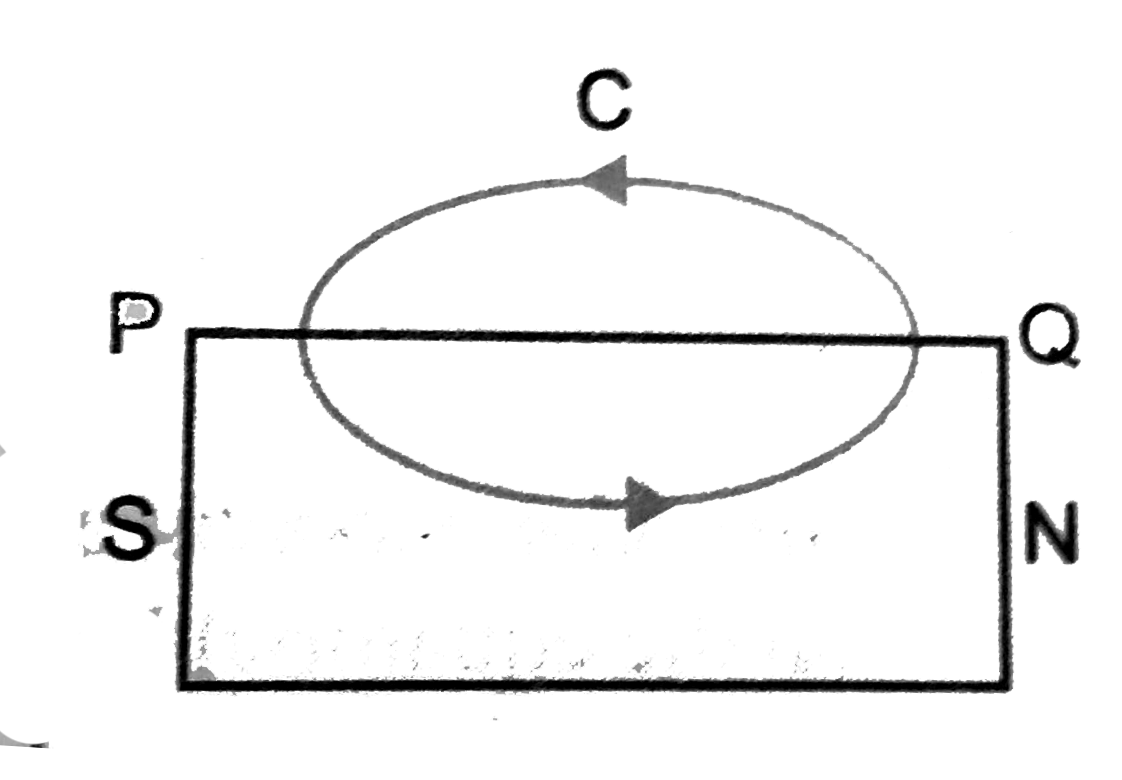
|
|
| 17. |
Draw the graph showing the variation of reactance of (a) C and (b) L with frequency v of an A.C circuit. |
|
Answer» SOLUTION :a. `X_C = (1)/(2PI v C)` b. `X_L = 2pi v L` ` therefore X_C= prop 1/v"" X_C prop v` 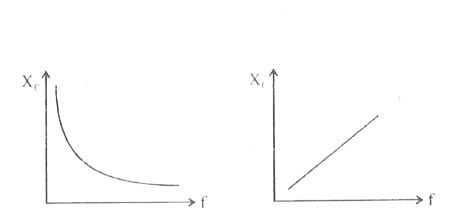
|
|
| 18. |
Equal charges q are placed at the four corners A B C D of a square of length a. The mangniture of the force on the charge at B will be |
|
Answer» `(3q^(2))/(2piepsilon_(o)a^(2))` |
|
| 19. |
In what way is diffraction from each slit related to interference pattern in a double slit experiment? |
| Answer» SOLUTION :The INTENSITY of interference FRINGES in d double slit arrangement is MODULATED by the diffraction pattern of each slit. | |
| 20. |
A substance is illuminated with light from a mercury lamp. Two nearest companions with wavelengths of 4244 Å (red companions) and 3885 Å (violet companion) are observed in the combination scattering spectrum. Find the natural frequency of vibration of the molecules of this substance. |
|
Answer» `v=(v_(1)^(viol)-v_(1)^(red))/2=c/2(1/lamda_(1)^(viol)=1/lamda_(1)^(red))` |
|
| 21. |
Find the emf (V) and internal resistance (r ) of a single battery which is equivalent to a parallel combination of two batteries of emfs V_(1) and V_(2) and internal resistances r_(1) and r_(2) respectively, with polarties as shown in figure |
|
Answer» Solution :EMF of battery is equal to potential difference ACROSS the terminals, when no CURRENT is drawn from battery (for external circuit) [Here, all the elements in the circuit are in series] Current in internal circuit `=i` `therefore i=("Net emf")/("Toltal resistance") or i=(V_(1)+V_(2))/(r_(1)+r_(2))`  `therefore V_(A)-V_(B)=V_(1)-ir_(1)""[because V_(1)" cell is discharging"]` `or V_(1)-V_(B)=V_(1)-((V_(1)+V_(2))/(r_(1)+r_(2))) r_(1) or V_(A)-V_(B)=(V_(1)r_(2)-V_(2)r_(1))/(r_(1)+r_(2))` `therefore"Equivalent emf of the battery "=V=(V_(1)r_(2)-V_(2)r_(1))/(r_(1)+r_(2))` (ii) Internal resistance of equivalent battery. `r_(1) and r_(2)` are in parallel. `(1)/(r)=(1)/(r_(1))+(1)/(r_(2)) or r=(r_(1)r_(2))/(r_(1)+r_(2))` |
|
| 22. |
An a.c. source is rated at 220 V - 50 Hz. The time taken for voltage to change from its peak value to zero is |
|
Answer» 50 sec `therefore V=V_m cos OMEGAT` Now if V=0 , `0=V_m cos omegat` `0=cos omegat` `therefore omegat=pi/2` `therefore 2pif t=pi/2` `therefore t=1/(2xx25)` `therefore t=1/(4xx50)` `therefore` t=0.005 `therefore t=5xx10^(-3)` s |
|
| 23. |
The diagram besides shows a circuit used in an experiment to determine the emf and internal resistance of the cell C. A graph was plotted of the potential difference V between the terminals of the cell against the current I, which was varied by adjusting the rheostat. The graph is shown on the right , x and y are the intercepts of the graph with the axes as shown. What is the internal resistance of the cell ? |
|
Answer» x |
|
| 24. |
The fire screen produces the sensation of cooling because it does not allow |
|
Answer» INFRA RED rays |
|
| 25. |
Find the maximum modulated frequency which could be deflected by it. |
|
Answer» 10.62 MHZ |
|
| 26. |
A person's range of distinct vision is from 6 cm to 60 cm from the eye. What spectacles would be required to see distant objects clearly and what could be his least distance of distinct vision using the spectacles? |
|
Answer» |
|
| 27. |
The resistance of a conductor is |
|
Answer» INVERSELY PROPORTIONAL to the length |
|
| 28. |
What do you mean by crevice? |
|
Answer» a narrow crack in a hurtle |
|
| 29. |
Four identical rods which have thermally insulated lateral surfaces are joined at point A. Points B,C,D & E are connected to large reservoirs. If heat flows into the junction from point B at rate of 1W and from point C at 3 W inside, flows out from D at 5 w, which relation (s) is//are correct for temperature of these points? |
|
Answer» `T_(A) lt T_(E)` 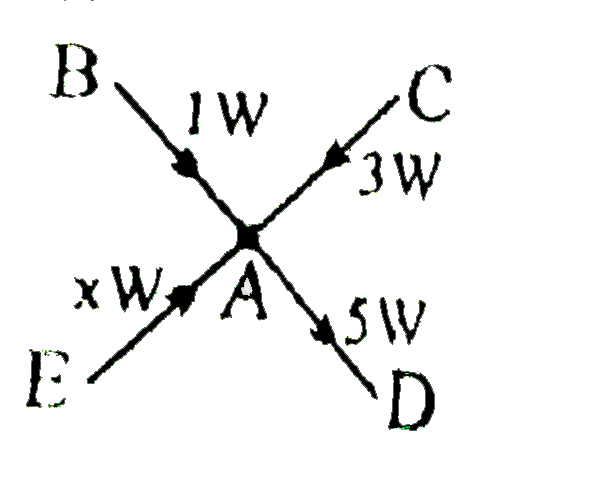 At A `x+1+3=5` `x=1` Heat in FLOWS from E `T_(E) gt T_(A)` `T_(C) gt T_(A) gt T_(D)` `T_(B)-T_(A)=T_(E)-T_(A)` `T_(B)=T_(E)` |
|
| 30. |
Figure 27-56 shows the circuit of a flashing lamp, like those attached to barrels at highway construction sites. The fluorescent lamp L (of negligible capacitance) is connected in parallel, across the capacitor C of can RC circuit. There is a current through the lamp only when it potential difference across it reaches the breakdown voltage V_(L), then the capacitor discharges completely through the lamp and the lamp flashes briefly. For a lamp with breakdown voltage V_L= 75.0 V, wired to a 95.0 V ideal battery and a 0.150 muF capacitor, what resistance R is needed for two flashes per second? |
|
Answer» |
|
| 31. |
A current carrying loop, free to turn , is placed in a uniform magnetic field. What will be its orientation, relative to vecB, in the equilibrium state? D |
| Answer» Solution :For EQUILIBRIUM the COIL should be oriented NORMAL to the magnetic field so that TORQUE ACTING on it `vec(tau) = N I (vecA xx vecB) = vecm xx vecB` is zero. | |
| 32. |
Answer the following questions : (a) In a double-slit experiment using light of wavelength 600 nm, the angular width of the fringe formed on a distant screen is 0.1. Find the spacing between the two slits. (b) Light of wavelength 5000 Å propagating in air gets partly reflected from the surface of water. How will the wavelengths and frequencies of the refleceted and refracted light be affected? |
|
Answer» Solution :`lambda = 600 nm = 600 xx 10^(-9) m` `theta = 0.1^@ = (0.1 xx 3.14)/(180)` `theta = lambda/a implies a = lambda/theta = (600 xx 10^(-9) xx 180)/(0.1 xx 3.14)` `= 3.4 xx 10^(-4) m`. (B) No change in wavelength and frequency of reflected LIGHT. But for refracted light, frequency remais same but wavelength will become `1/(1.33)` TIMES the original wavelength. |
|
| 33. |
If two mirrors are inclined at some angle and an object is placed between the mirrors and there are 7 images formed for an object. Then, what is angle between the mirrors? |
|
Answer» `54^(@)` |
|
| 34. |
A charged particle free to move in an electric field always moves along the electric field line. |
| Answer» Solution :False-Only a positive charged test , intially at rest MOVES, ALONG an ELECTRIC FIELD LINE. | |
| 35. |
Assertion (A) : Force between two point charges is directly proportional to the magnitude of the two charges and inversely proportional to the distance between them. Reason ® : Like charges repel but unlike charges attract each other. |
|
Answer» |
|
| 36. |
Two small spheres each carrying a charge q are placed r metre apart. If one of the spheres is taken around the other one ina circular path of radius r, the work done will be equal to |
|
Answer» FORCE between them `XX R` |
|
| 37. |
Answer the following questions:An ideal gas is compressed ate constant temperature. Will ita internal energy increases of decreases ? |
| Answer» SOLUTION :The internal ENERGY REMAINS the same because the internal energy of an ideal gas depends only on TEMPERATURE | |
| 39. |
Time taken by sunlight to pass through a window of thickness 4 mm whose RI is 1.5 is |
|
Answer» `2xx10^-8`s |
|
| 40. |
For what position of an object, a concave mirror forms a real image equal in size to the object ? |
|
Answer» BEYOND CENTER of CURVATURE |
|
| 41. |
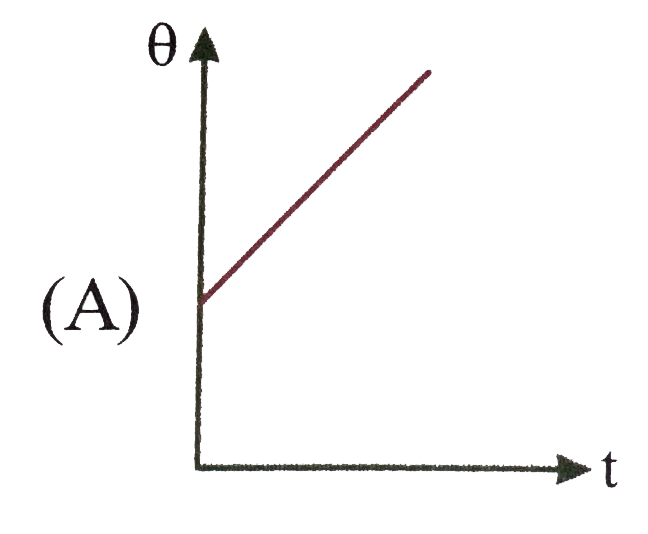
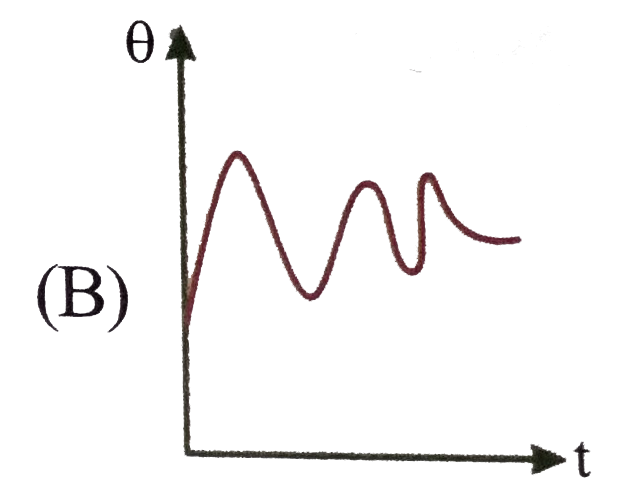
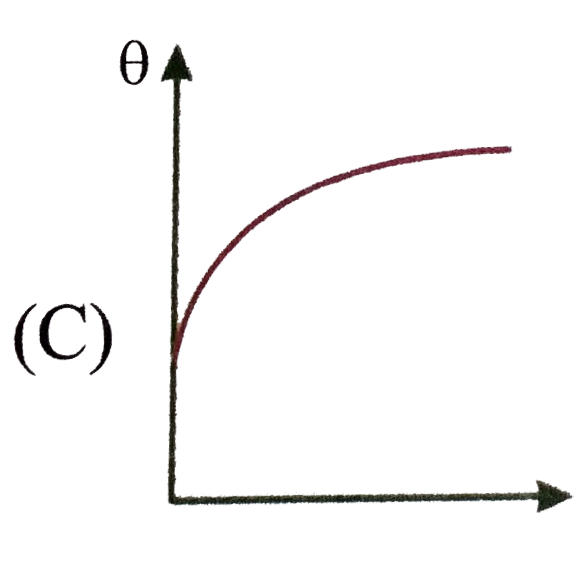
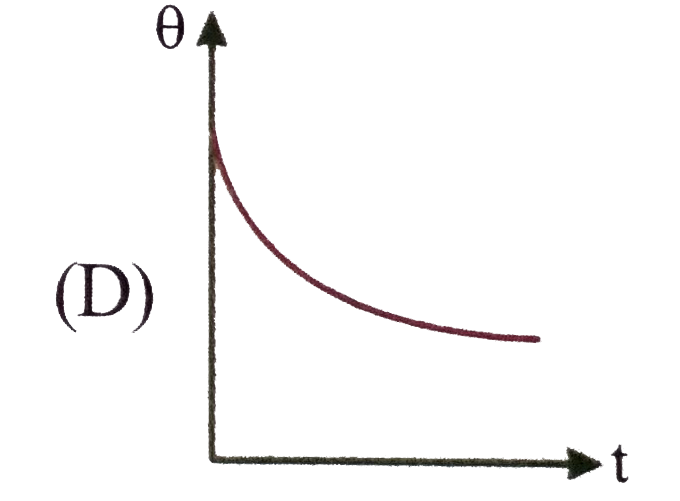
Figure shows an electrical calorimeter to determine specific heat capacity of an unknown liquid, First of all, the mass of empty calorimeter (a copper container) is measured and suppose it is m_(1). Then the unknown liquid is poured in it. Now the combined mass of calorimeter+liquid system is measured and let it be m_(2). So the mass of liquid is (m_(2)-m_(1)). Initially both were at room temperature (theta_(0)). Now a heater is immeresed in if for time interval t. The voltage drop across the heater is V and current passing through it is I. Due to heat supplied, the temperature of both the liquid and calorimeter will rise simultaneously. After t sec, heater was switched off, and final temperature is theta_(r). If there is no heat loss to surroundings. Heat supplied by the heater=Heat absorbed by the liquid+heat absorbed by the calorimeter (VI)t=(m_(2)-m_(1))S_(1)(theta_(f)-theta_(0))+m_(1)S_(c)(theta_(f)-theta_(0)) The specific heat of the liquid S_(1)=(((VI)t)/(theta_(f)-theta_(0))-m_(1)S_(c))/((m_(2)-m_(1))) Radiation correction: There can be heat loss to environment. To compensate this loss, a correction is introduced. Let the heater was on for t sec, and then it is switched off. Now the temperature of the mixture falls due to heat loss to environment. The temperature of the mixture is measured t//2 sec. after switching off. Let the fall in temperature during this time is varepsilon Now the corrected final temperature is taken as theta_(f)=theta_(f)+varepsilon If the system were losing heat according to Newton's cooling law, the temperature of the mixture would change with time according to (while heater was on) |
|
Answer»
`:. C` is correct |
|
| 42. |
Water rises to a height of 30 mm in a capillary tube , if the radius of the capillary tube is made (3//4)^(th) of the previous value , then the height to whichthe water rise in the tube will be |
| Answer» Solution :`h_(1)r_(1)=h_(2)r_(2)` | |
| 43. |
Figure shows an electrical calorimeter to determine specific heat capacity of an unknown liquid, First of all, the mass of empty calorimeter (a copper container) is measured and suppose it is m_(1). Then the unknown liquid is poured in it. Now the combined mass of calorimeter+liquid system is measured and let it be m_(2). So the mass of liquid is (m_(2)-m_(1)). Initially both were at room temperature (theta_(0)). Now a heater is immeresed in if for time interval t. The voltage drop across the heater is V and current passing through it is I. Due to heat supplied, the temperature of both the liquid and calorimeter will rise simultaneously. After t sec, heater was switched off, and final temperature is theta_(r). If there is no heat loss to surroundings. Heat supplied by the heater=Heat absorbed by the liquid+heat absorbed by the calorimeter (VI)t=(m_(2)-m_(1))S_(1)(theta_(f)-theta_(0))+m_(1)S_(c)(theta_(f)-theta_(0)) The specific heat of the liquid S_(1)=(((VI)t)/(theta_(f)-theta_(0))-m_(1)S_(c))/((m_(2)-m_(1))) Radiation correction: There can be heat loss to environment. To compensate this loss, a correction is introduced. Let the heater was on for t sec, and then it is switched off. Now the temperature of the mixture falls due to heat loss to environment. The temperature of the mixture is measured t//2 sec. after switching off. Let the fall in temperature during this time is varepsilon Now the corrected final temperature is taken as theta_(f)=theta_(f)+varepsilon If mass and specific heat capacity of calorimeter is negligible, what would be maximum permissible error in S_(l). Use the date mentioned below. m_(1)to, S_(l)to0, m_(2)=1.00kg, V=10.0V, I=10.0A, t=1.00xx10^(2)sec, theta_(0)=15^(@)C, Corrected theta_(1)=65^(@)C |
|
Answer» Solution :If `m_(1) to 0`, `S_(L) to 0`, `S_(l)=(VIt)/(m_(2)(theta_(f)-theta_(0)))` `(dS_(l))/(S_(l))=(DELTAV)/(V)+(DeltaI)/(I)+(Deltat)/(t)+(Deltam_(2))/(m_(2))+(Deltatheta_(r)+Deltatheta_(0))/(theta_(r)-theta_(0))` `=(0.1)/(10.0)+(0.1)/(10.0)+(0.01xx10^(2))/(1.00xx10^(2))+(0.01)/(1.00)+(1+1)/(50)=8%` |
|
| 44. |
Figure shows an electrical calorimeter to determine specific heat capacity of an unknown liquid, First of all, the mass of empty calorimeter (a copper container) is measured and suppose it is m_(1). Then the unknown liquid is poured in it. Now the combined mass of calorimeter+liquid system is measured and let it be m_(2). So the mass of liquid is (m_(2)-m_(1)). Initially both were at room temperature (theta_(0)). Now a heater is immeresed in if for time interval t. The voltage drop across the heater is V and current passing through it is I. Due to heat supplied, the temperature of both the liquid and calorimeter will rise simultaneously. After t sec, heater was switched off, and final temperature is theta_(r). If there is no heat loss to surroundings. Heat supplied by the heater=Heat absorbed by the liquid+heat absorbed by the calorimeter (VI)t=(m_(2)-m_(1))S_(1)(theta_(f)-theta_(0))+m_(1)S_(c)(theta_(f)-theta_(0)) The specific heat of the liquid S_(1)=(((VI)t)/(theta_(f)-theta_(0))-m_(1)S_(c))/((m_(2)-m_(1))) Radiation correction: There can be heat loss to environment. To compensate this loss, a correction is introduced. Let the heater was on for t sec, and then it is switched off. Now the temperature of the mixture falls due to heat loss to environment. The temperature of the mixture is measured t//2 sec. after switching off. Let the fall in temperature during this time is varepsilon Now the corrected final temperature is taken as theta_(f)=theta_(f)+varepsilon In this experiment voltage across the heater is 100.0V and current is 10.0A, and heater was switched on for t=700.0 sec. Initially all elements were at room temperature theta_(@)=10.0^(@)C and final temperature was measured as theta_(f)=73.0^(@)C. Mass of empty calorimeter ws 1.0 kg and the combined mass of calorimeter + liquid is 3.0 kg. The specific heat capacity of the calorimeter =3.0xx10^(3)J//kg^(@)C. The falls in temperature 350 second after switching off the heater was 7.0^(@)C. Find the specific heat capacity of the unknown liquid in proper significant figures. |
|
Answer» `3.5xx10^(3)J//kg^(@)C` `=3.5xx10^(3)J//kg^(@)C` According to ADDITION and multiplication of `S.F` |
|
| 45. |
In each situation of Column - I, two electric dipoles having dipole moments vec (p_(1)) and vec (p_(2)) of same magnitude ("that is" , p_(1) = p_(2)) are placed on x-axis symmertrically about origin in different orientations as shown. In column - II certain inferences are drawn for these two dipoles. Then match the different orientations of dipoles in column - I with the corresponding results in column - II. [In column I the co-ordinates corresponding to the centres of dipoles and dipoles having the same dipole lenght] |
|
Answer» |
|
| 46. |
At what angle should an unpolarised beam of light be incident on a medium of refractive index sqrt3 so that the reflected beam is completely polarised ? |
| Answer» ANSWER :D | |
| 47. |
(a) State the principle of an a.c. generator and explain its working with the help of a labelled diagram. Obtain the expression for the emf induced in a coil having N turns each of cross-sectional area A, rotating with a constant angular speed 'omega' in a magnetic field vecB, directed perpendicular to the axis of rotation. (b) An aeroplane is flying horizontally from west to east with a velocity of 900 km/hour. Calculate the potential difference developed between the ends of its wings having a span of 20 m. The horizontal component ofEarth's magnetic field is 5 xx 10^(-4)T and the angle of dip is 30^(@). |
|
Answer» Solution :(a) See Long Answer Question Number 1. (b) Here velocity of aeroplane `V = 900 km h^(-1) = 900 5/18 m s^(-1)` due east, span of wing l = 20 m, horizontal COMPONENT of earth.s MAGNETIC field `B_(H) = 5 xx 10^(-4)T` and angle of dip `delta = 30^(@)` As plane is flying horizontally, an induced voltage is set up between the ENDS of its wings due to the vertical component of earth.s magnetic field. `therefore` Potential difference `V = vlB_(v) = vl B_(H) tan delta = 250 xx 20 xx 5 10^(-4) tan 30^(@) = 1.44 V` |
|
| 48. |
Define fringe width in interference and derive its expression. |
|
Answer» Solution :Fringe Width. It is the distance between any two successive fringes in interference pattern. Let `S_(1), S_(2)` be the two fine slits illuminated by a monochromatic sources of wavelength `lambda`. INTENSITY of light at any point P on the screen at a distance D from the slit depends upon the path difference between `S_(2)P` and `S_(1)P`. 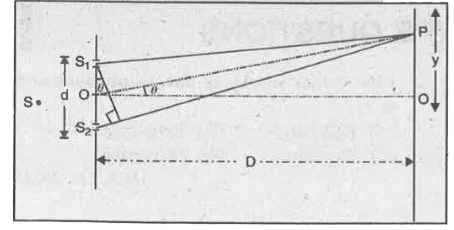 From `S_(1)` draw `S_(1)A` perpendicular to `S_(2)P`. Since `/_S_(2)S_(1)A to theta` [D is very large as COMPARED to d], therefore, `/_S_(1)AS_(2) to 90^(@)` and `AP ~~ S_(1)P`. `:. "Path difference" = S_(2)P-S_(1)P = (S_(2)A + AP) - S_(1)P` or `"Path difference" = S_(2)A = d sin theta` Since `theta` is very small, `sin theta` can be replaced by `TAN theta` . `:. "Path difference" = d tan theta = d(y)/(D)` CONSTRUCTIVE interference [Bright Fringes). For bright fringes, the path difference should be equal to an even multiple of`lambda // 2`. `:. (dy)/(D)=2n(lambda)/(2)=n lambda` or `y=n(lambda D)/(d)` If n = 0, `y_(0)=0`, which is the position of central maxima. If n = 1, `y_(1)=(D)/(d)lambda`, which is the position of first maxima. If n = 2, `y_(2)=(2D)/(d)lambda`, which is the position of Similarly `y_(n-1)=(n-1)(D)/(d)lambda` and `y_(n)=n(D)/(d)lambda` Fringe width `beta=y_(n)-y(n-1)=(D)/(d)lambda[n-(n-1)]` `beta=(D)/(d)lambda` ...(i) Destructive interference [Dark Fringes]. For dark fringes, the path difference should be an old multiple of `1 // 2`. `(d)/(D)y=(2n-1)(lambda)/(2)` or `y=(D)/(d)(2n-1)(lambda)/(2)` If n = 1, `y_(1)=(D)/(d)(lambda)/(2)`, which is the position of 1st minima. If n = 2, `y_(1)=(D)/(d)(2lambda)/(2)`, which is the position of 2nd minima. If n = 3, `y_(1)=(D)/(d)(3lambda)/(2)`, which is the position of 3rd minima. `:.` Fringe width, `beta=y_(3)-y_(2)=(D)/(d)lambda` or `beta=(D)/(d)lambda` ...(ii) From (i) and (ii), we conclude that bright and dark fringes have equal fringe width. `beta prop D` `prop lambda` `prop (1)/(d)` If d = 0, `beta= infty` i.e. dark and bright bands will be infinitely well SPACED and there will be uniform illumination. |
|
| 49. |
There is a potentiometer wire of length 1200 cmand a 60 mA curreut is flowing in it. A battery of emf 5 V and internal resistance of 20 Omegais balanced on this potentiometer wfre with a balancing length 1000 cm. The resistance of the potentiometer wire is |
|
Answer» `60 Omega`  LET terminal voltage of PRIMARY BATTERY is`V_(p)`. For any neutral point on potentiometer wire, `V_(p)` remains constant . `therefore ` potential GRADIENT, `(V)/(l) = (V_(p))/(L)` `therefore (5)/(1000) = (V_(p))/(1200)` `therefore= (1200 xx 5)/(1000) = 6V` `therefore ` Resistance of potentiometer wire `R_(p) = (V_(p))/(I)` `thereforeR_(p) = (6)/(60 xx 10^(-3)) ` `therefore R_(p) =100 Omega` |
|