

Saved Bookmarks
This section includes 7 InterviewSolutions, each offering curated multiple-choice questions to sharpen your Current Affairs knowledge and support exam preparation. Choose a topic below to get started.
| 1. |
Explain how the intensity of diffraction pattern changes as the order (n) of the diffraction bands. |
|
Answer» Solution :The diffraction pattern due to a single slit consists of a central bright maximum at `O` alingwith alternate secondary minima and maxima on either side. The intensity distribution on the screen is represented in Fig. 6(f).6. The secondary maxima ATE the points in between secondary maxima and are of rapidly decreasing intensity. If `I_(0)` is intensity of central bright maximum, then intensity of first secondary maximum, is FOUND to be `I_(0)//22`, and of second secondary maximum is `I_(0)//61` and so on. Note that intensity of central maximum is due to wavelets from all parts of the slit EXPOSED to light. In the first secondary maximum, first two parts of the slit send wavelets in opposite phase, which cancel out. Therefore, intensity of 1st secondary maximum is due to wavelets from only one third PART of slit. SIMILARLY, the intensity of second secondary maximum is due to wavelets only from one fifth part of the slit, and so on. |
|
| 2. |
(a) Using Bohr's second postulate of quantisation of orbital angular momentum, show that the circumference of the electron in the nth orbital state in hydrogen atom is a times the de Broglie wavelength associated with it. (b) The electron in hydrogen atom is initially in the third excited state. What is the maximum number of spectral lines which can be emitted when it finally move to the ground state ? |
|
Answer» Solution :(a) As per Bohr.s second postulate the angular momentum of orbiting electron is an integer multiple of`(h)/(2pi) ` i.E.,`m v r = n(h)/(2pi) `, where n = 1,2,3,…… `rArr"" 2 pi r = (n h)/(m v )` But`(h)/(m v) = lambda_(e) = de -` Broglie wavelength associated with electron and ` 2 pi r ` = circumferenceof nth electron orbit. Thus, it isprovedthat circumeferene of nth electron orbitis n TIMES the de - Broglie wavelenghtassoicatedwith it . (b) Asthe electron state ,it isin n = 4orbit. Thus, itis provedthatcircumference of nth electron orbits is n times the de - Broglie wavelenghtassociated with it . (b) As the electron is in the third excited state ,it is in n = 4 orbit. Hence, maximum number ofspectral LINES whichbe emittedbefore it comes to groundstate ` = (1)/(2) n(n-1) = (1)/(2)xx 4XX 3 = 6` . |
|
| 3. |
A diffractiongratingconsisting of 4000 slitsper centimeter is illuminated with a monochromatic light that produces the second orderdiffraction at an angle of 30 ^(@). What is the wavelenght of the light used? |
|
Answer» Solution :Number of lines per cm `=4000, m=2,0=30^(@),lambda=?` Number of lines per unitlength, `N=(4000)/(1xx10^(-2))=4xx10^(5)` Equation for DIFFRACTION maximumin GRATING is, `SIN0=Nmlambda` Rewriting, `lambda = (sin0)/(Nm)` Substituting, `lambda=(sin30^(@))/(4xx10^(5)xx2)=(0.5)/(4xx10^(5)xx2)=(1)/(2xx4xx10^(5)xx2)=(1)/(16xx10^(5))` `lambda=6250xx10^(-10)m=6250Å` |
|
| 4. |
What are four optical instruments used? |
| Answer» Solution :They are USED (i) to produce image of the close LYING objects at the least distance vision, (ii) to increase visual angle and HENCE to produce magnification and (III) to improve the resolving power of the eye. | |
| 5. |
{:("(i) Insulator","(a) Glass"),("(ii) Semiconductor","(b) Germanium"),("(iii) Conductor","(c ) Copper"),("(iv) Super conductor","(d) Mercury"):} |
|
Answer» |
|
| 6. |
Wavelength of a 1 ke V photon is 1.24 xx 10^(-9)m. What is the frequency of 1 Me V photon. |
|
Answer» `1.24 XX 10^15` HZ |
|
| 7. |
A fixed horizontal wire carries a current of 200 A. Another wire having a mass per unit length 10^(-2) kg/m is placed below the first wire at a distance of 2 cm and parallel to is. How much current must be passed through the second wire if it floats in air without any support? What should be the direction of current in it? |
|
Answer» 25 A (direction of current is same to FIRST wire) |
|
| 8. |
Two points separated by a distance of 0.1 mm can just be inspected in a microscope when light of wavelength 6000 Å is used.If the light of wavelength 4800 Å is used, this limit of resolution will become : |
|
Answer» `0.8 MM` `THEREFORE` NEW limit of resolution `= (4800)/(6000) XX 0.1 = 0.08 mm` |
|
| 9. |
Two identical capacitors A and B each having capacitance C and initial plate separation d are connected in parallel to a battery of emf V with the help of switch S. Initially the switch is kept closed for long time and then at t = 0 switch is opened. Simultaneously at t=0 the plate 2 of A state moving rightwards with constant speed v_0(with the help of some external unspecified force) and plate 4 of B starts moving leftwards with same constant speed. Plates 1 and 3 are kept fixed. The current through circuit as plates 2 and 4 move at any time t is |
|
Answer» `(CVxxv_0)/(2D)` |
|
| 10. |
Two identical capacitors A and B each having capacitance C and initial plate separation d are connected in parallel to a battery of emf V with the help of switch S. Initially the switch is kept closed for long time and then at t = 0 switch is opened. Simultaneously at t=0 the plate 2 of A state moving rightwards with constant speed v_0(with the help of some external unspecified force) and plate 4 of B starts moving leftwards with same constant speed. Plates 1 and 3 are kept fixed. The charge on capacitor B as function of time |
|
Answer» `CV[1+(v_0t)/(2D)]` |
|
| 11. |
Two identical capacitors A and B each having capacitance C and initial plate separation d are connected in parallel to a battery of emf V with the help of switch S. Initially the switch is kept closed for long time and then at t = 0 switch is opened. Simultaneously at t=0 the plate 2 of A state moving rightwards with constant speed v_0(with the help of some external unspecified force) and plate 4 of B starts moving leftwards with same constant speed. Plates 1 and 3 are kept fixed. As the plate moves, transfer of (+ve) charge takes place from |
|
Answer» PLATE 1 to plate 3 outside the CAPACITOR |
|
| 12. |
What are black holes? |
| Answer» Solution :Black holes are end stage of stars which are highly dense massive object। Its mass ranges from 20 times mass of the sun to 1 million times mass of the sun। It has very strong gravitational force such that no particle or even light can escape from it। The existence of black holes is studied when the stars ORBITING the black hole behave differently from the other starts। Every galaxy has black hole at its center। SAGITTARIUS A* is the black hole at the center of the MILKY WAY galaxy. | |
| 13. |
Four point charges +8mC, -mC, and +8mC are fixed at the points -sqrt(27/2)m, -sqrt(3/2)m, +sqrt(3/2)m and +sqrt(27/2)m respectively on the y-axis. A particle of mass 6xx10^-4kg and charge +0.1muC moves along the -x direction. Its speed at x=+oo is V_0. Find the least value of V_0 for which the particle will cross the origin. Find also the kinetic energy of the particle at the origin. Assume that space is gravity free. Given (1)/(4piepsilon_0)=9xx10^9Nm^2//C^2. |
|
Answer» <P> Similarly there are two forces of attraction due to two charges of `-1 mC`. The net force due to these force is `2F cos beta` towards left. 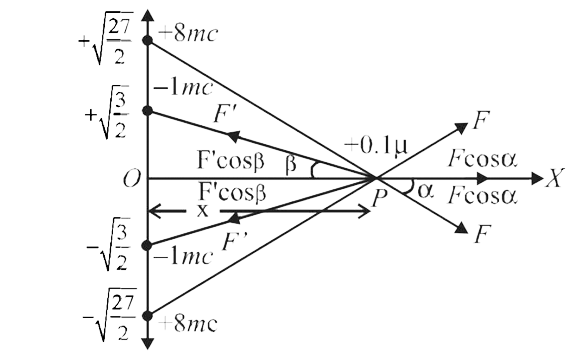 The net force on charge `0.1 muC` is zero when `2F cos alpha=2F^' cos beta` `(Kxx8xx10^-6xx0.1xx10^-6)/(sqrt(x^2+27/2))^2xx(x)/(sqrt(x^2+27/2))` `=(Kxx1xx10^-6xx0.1xx10^-6)/(sqrt(x^2+3/2))^2xx(x)/(sqrt(x^2+3/2))` `implies x=+-sqrt(5/2)` This means that we need to move the charge from `-oo` to `sqrt(5/2)` . Thereafter the attractive forces will make the charge move to origin. The electric potential of the four charges at `x=sqrt(5/2)` is `V=(2xx9xx10^9xx8xx10^-6)/(sqrt(5/2)+27/2)`-(2xx9xx10^9xx10^-6)/(sqrt(5/2)+3/2)` `=2xx9xx10^9xx10^-6[8/4-1/2]=2.7xx10^4V` Kinetic energy is required to overcome the force of repulsion from `prop` to `x=sqrt(5/2)`. The work DONE in this process is `W=q(V)` where V=p.d between `oo` and `x=sqrt(5/2)`. `:.` `W=0.1xx10^-6xx2.7xx10^4=2.7xx10^-3J` By energy conservation `1/2mV_0^2=2.7xx10^-3` `implies 1/2xx6xx10^-4V_0^2=2.7xx10^-3` `implies V_0=3m//s` K.E. at the origin Potential at origin `V_(x=0)=(2xx9xx10^9xx8xx10^-6)/(sqrt(27/2))-(2xx9xx10^9xx10^-6)/(sqrt(3/2))` `=2.4xx10^4` Again by energy conservation `K.E. =q[V_(x=(sqrt5)/(2))-V_(x=0)]` `:.` K.E. =0.1xx10^-6[2.7xx10^4-2.4xx10^4]` `=0.1xx10^-6xx0.3xx10^4` `=3xx10^-4J` |
|
| 14. |
An object is kept at a distance of 1 m from the screen. The image formed is twice the size of the object. Calculate the focal length of the lens used. Also determine its nature. |
| Answer» SOLUTION :22.22 CM, CONVEX LENS | |
| 15. |
What message do those who are our nearest give us? |
|
Answer» ACCEPT the PERSON I am |
|
| 16. |
Statement I : the power consumedwould be 50 wby each of tow200 v -100 w lamps ,when their series combinationis driven by apotential difference of 200 V . Staement II : if P is the power consumed bya series com - bination of some electrical devicesof power P_(1),P_(2),P_(3),.....,"then " , (1)/(P)=(1)/P_(1)+(1)/P_(2)+(1)/P_(3)+... |
|
Answer» Statement I is true , Statement II is true , Statement II is a correct explanation for Statement I |
|
| 17. |
Your are given three lenses L_(1), L_(2) and L_(3) each of focal length 20cm. An object is kept at 40cm in front of L_(1) as shown. The final real image is formed at the focus I of L_(3). Find the separation between L_(1) and L_(2) and L_(3). |
|
Answer» Solution :For lens `L_(1)` `(1)/(f_(1)) = ( 1)/( v_(1)) - ( 1)/( u_(1))` `(1)/( 20) = ( 1)/( v_(1)) - (1)/( -40) rArr v_(1) = 40CM` For lens `L_(3)``(1)/( f_(3)) = ( 1)/( v_(3)) - ( 1)/( u _(3))` `u_(3) = ? , f_(3) = + 20 cm, v_(3) = 20cm` `(1)/( 20) = ( 1)/( 20) + ( 1)/( u_(3))` `u_(3) = oo` It shows that `L_(2)` must render the rays parallel to the common axis. It means that the image `(I_(1))`, FORMED by `L_(1)`, must be at a distance of 20cm from `L_(2)` ( at the focus of `L_(2)` ) Therefore, distance between `L_(1)` and `L_(2) = ( = 40 + 20) = 60 cm` and distance between `L_(2)` and `L_(3)` can have any value . |
|
| 18. |
A sample of paramagnetic salt contains 2.0xx 10^(24) atomic dipoles each of dipole moment 1.5 xx 10^(-23) J T^(-1). The sample is placed under a homogeneous magnetic field of 0.64 T, and cooled to a temperature of 4.2 K. The degree of magnetic saturation achieved is equal to 15%. What is the total dipole moment of the sample for a magnetic field of 0.98 T and a temperature of 2.8 K ? (Assume Curie's law) |
|
Answer» Solution :INDUCED MAGNETIC DIPOLE moment obtained in a given paramagnetic sample of volume V at temperature `T_1` is, `(m_b)_(1) = 15%` of `(m_b)_("max")` `= 15%` of `Nm` `= (2 xx 10^(24) ) (1.5 xx 10^(-23) ) ((15)/( 100))` `= 4.5 Am^(2) ""...(1)` `M= (m_b)/( V) = ("total induced dipole moment")/("total volume")` `therefore (M_1)/( M_2) = ((m_b)_(1) ) /( V)xx (V)/( (m_b)_(2) )= ((m_b)_(1) )/( (mb)_(2) ) ""...(2)` Magnetisation obtained is given by Curie.s law, `M= C(B)/( T)` (Where `C=` Curie.s constant) `rArr M prop (B)/(T)` `therefore (M_1)/( M_2) = (B_1)/( B_2) xx (T_2)/( T_1) ` `therefore ((m_b)_(1) )/( (m_b)_(2) ) = (B_1 )/( B_2) xx (T_2)/( T_1)` `therefore (m_b)_(2) = (m_b)_(1) xx (B_2)/(B_1) xx (T_1)/( T_2)` `therefore (m_b)_(2) = 4.5 xx (0.98)/( 0.84) xx(4.2)/(2.8) = 7.875 "Am"^*(-1)` (or `JT^(-1)` ) |
|
| 19. |
The focal lengthofa converging lens are f_v and f_r for violet and red light respectively. |
|
Answer» `f_vgtf_r` |
|
| 20. |
A man of height h_(0)=2 mis bungee jumping from a platform situated at a height h = 25 m above a lake One end of an elastic rope is attached to his foot and the other end is fixed to the platform He starts falling from rest in vertical position. The length and elastic properties of the rope are chosen so that his speed will have been reduced to zero at instant when his head reaches the surface of water. Ultimetely the jumper is hanging from the rope with his head 8m above the water. Find the maxima acceleration acheived during the jump in m//s^(2)) |
|
Answer» In addition in equilibrium `mg=k(l_(2)-l_(0))` Dividing the two equations by each other we obtain a quadratic equation for l_(0) `l_(0)^(2)+2(h-l_(1))l_(0)+(l_(1)^(2)-2hl_(2))=l_(0)^(2)+4l_(0)-221=0` which gives `l_(0)=13m` When the falling jumper ATTAINS his highest speed, his acceleration must be zero and so this much occurat the same level as the final equilibrium position `(l=l_(2))` Again applying the law of conservation of energy `1/2mv^(2)+1/2k(l_(2)-l_(0))^(2)=mg(l_(2)+h_(0))` where the RATIO m//k is the same as that obtained from the equilibrium condition, namely `m/k = (l_(2)-l_(0))/g` Substituting this into the energy equation, shows that the maximum speed of the jumper is `v=18 MS^(-1)approx 65km h^(-1)` It is easy to see that his maximum acceleration occurs at the lowest point of the jump Since the largest extension of the rope (10m) is FIVE times that at the equilibrium position (2m), the greatest tension in the rope is 5 mg So the highest net force exerted on the jumper is 4 mg and his maximum acceleration is 4g. |
|
| 21. |
A rocket with an initial mass m_(0) is going up with a constant acceleration a by exhausting gases with a velocity v relative to the rocket motion, then the mass of the rocket at any instant of time is (assume that no other forces act on it) |
|
Answer» `m=m_(0)e^(-(at)/v)` `m(dv)/(DT)=F_("ext")+v(dm)/(dt)` 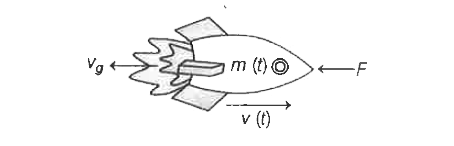 WITHOUT any EXTERNAL force `(F_("ext")=0)`, `m(dv)/(dt)=v(dm)/(dt)rArrint(dv)/v=int(dm)/m` `rArrlogv=logm+C` When, `v=0,m=m_(0)` `thereforeC=-logm_(0)` So, we have `(Deltav)/v="log"m/m_(0)*dtorm=m_(0)e^(-at//v)` |
|
| 22. |
How we are concerned with equation of continuity. |
| Answer» SOLUTION :The amount of liquid crossing any cross SECTION of a tube in a particular TIME MUST be same. | |
| 23. |
For sound waves, the Doppler formula for frequency shift differs slightly between the two situations: (i) source at rest, observer moving and (ii) source moving, observer at rest. The exact Doppler formulas for the case of light waves in vacuum are, however strictly identical for these situations. Explain why this should be so. Would you expect the formulas to be strictly identical for the two situations in case of light travelling in a medium? |
| Answer» Solution :Sound requires a material medium for it propagation.The RELATIVE motion of source and listener, need not be identical. In vacuum, light has the same speed irrespective of motion of source and observe-hence RESULTS ofDoppler effect are identical. But in a medium, light produces DOPPLER effect similar to sound. | |
| 24. |
A solid cylinder of radius R made of material of thermal conductivity K_(1) is surrounded by a cylindrical shell of inner radius R and outer radius 2R made of a material of thermal conductivity K_(2). The two ends of the combined system are maintained at two different temperatures . Then there is no loss of heat across the sylinderical surface and the system is in steady state. The effective thermal conductivity of the system is : |
|
Answer» `K_(1)+K_(2)` `:.Q_("TOTAL")=Q_(1)+Q_(2)` `rArr(K(4R^(2))d theta)/(dx)=(K_(1)R^(2)d theta)/(dx)` `rArr4K=K_(1)+3K_(2)` `rArrK=(K_(1)+3K_(2))/(4)` So, correct choice is (d). |
|
| 25. |
A multimeter reads a voltage of a certain A.C. source as 100 V. What is the peak value of voltage of A.C. source ? |
|
Answer» 200 V |
|
| 26. |
The parallel plate capacitor has potential difference of 100 V and separation between the plate is 1 mm. An electron is projected along x axis in between the plates. If the electron comes out of the plates along the x axis undevated then the magnitude and direction of magnetic field that must be applied between the plates : (particle is projected with a velocity of 10^5 m//s along x axis) |
|
Answer» `B = 1 hatk` TESLA |
|
| 27. |
चालक पदार्थ से बने असीमित आवेशितपतलीचादर के सतह केनिकट स्थित किसी बिन्दु पर विद्युतीय क्षेत्र का मान होता है ? |
|
Answer» `epsilon_0.SIGMA` |
|
| 28. |
When did Thimmakka’s husband pass away? |
|
Answer» 1991 |
|
| 29. |
{:("List-I","List - 2"),((a)m^(-1),(e)"Surface tension"),((b)Pa,(f)"Thermal capacity"),((c)Jk^(-1),(g)"Rydberg constant"),((d) Jm^(-2),(h)"Energy density"):} |
|
Answer» a - H`""` B- F `""`C -e `""` d-G |
|
| 30. |
A dipole consists of two charges separated by 6cm. The electric field at a point on the equatorial line at a distance of 4 cm from the centre of the dipole is 10^(5) NC^(-1). What are the two charges on the dipole ? |
|
Answer» |
|
| 32. |
Kinetic energy of a charged particle decreases by 100 J when it is brought from a point of 100 V potential to a point of 200 V potential, then charge of particle is ...... C. |
|
Answer» `0.1` `:. K_(1) +qV_(1)=K_(2)+qV_(2)` `:. K_(1)-K_(2)= DELTAK =q (V_(2)-V_(1))` `:. 100 = 100 q` `:. Q = +1 C ` |
|
| 33. |
What are polar and non-polar molecules ? Give their examples. |
|
Answer» Solution :The MOLECULES in which the CENTRES of positive charges and of negative charges lie at the same place, therefore, their dipole moment is zero are called non-polar MOLECULE. `CO_(2)`and `CH_4` are examples. They develop a dipole moment when an electric FIELD is applied. But in some molecules, the centres of negative charges and of positive charges do not COINCIDE. Therefore they have a permanent electric dipole moment even in the absence of an electric field. Such molecules are called polar molecules.`H_(2)O, HCl` are examples. |
|
| 34. |
A body is projected with K.E. ‘E’ so as to have a maximum horizontal range. What is the P.E. at the highest point ? |
| Answer» Answer :D | |
| 35. |
Figure shows a self-acting water lifting device called a hydraulic ram . Its working is based on the phenomenon of hydraulic impact - when a liquid flowing along a tube is suddenly stopped , then there is a sharp increase in the pressure of the liquid . Its flow can be suddenly stopped , for example , by the shutting of a valve that discharges the water from the tube . A tube with a length of l= 2 m and a diameter of d = 20 cm is lowered into a stream with a current velocity of v = 4 m/s . First let valve V_(2) be open and valveV_(1) be shut . A sharp increase in pressure will cause value V_1 to open (valve V_(2) will close at the same time) and the water will flow up into vessel A . The pressure drops , value V_(1) shuts and V_(2) opens . The water in the tube assumes its course and the phenomenon is repeated in the previous sequence . Find the amount of water raised by the ram in one hour to a height of h = 30 m if each valve opens thirty times a minute. |
|
Answer» Solution :Thus , on the basis of the LAW of conservation of energy , we can write `(Mv^(2))/(2) = mgh` where M is the mass of the water in the tube stopped by valve `V_(2)` and m is the mass of the water raised to the height h . Therefore , `(rho l pi d^(2))/(4) xx (v^(2))/(2) = rho V_(0) GH` where `V_(0)` is the volume of the water having mass m . The average volume raised in two seconds is `V_(0)= ( l pi d^(2) v^(2))/(8 gh) = 1.7 xx 10^(-3) m^(3)` One HOUR of ram operation will RAISE `V = 1.7 xx 10^(-3) xx 30 xx 60 ~~ 3 m^(3)` |
|
| 36. |
STATEMENT-1: When a body is connected to earth, all its charge flows to earth and it becomes electrically neutral. Because STATEMENT-2: Electric potential of earth is zero so the electric potential of body should also become zero. |
|
Answer» Statement-1 is TRUE , Statement-2 is True , Statement-2 is a CORRECT EXPLANATION for Statement-1. |
|
| 37. |
What is physics? |
| Answer» Solution :PHYSICS is the BASIC building block for SCIENCE, ENGINEERING, TECHNOLOGY and Medicine. | |
| 38. |
The x and y coordinates of the particle at any time are x = 5t - 2t^(2) and y = 10t respectively, where x and y are in meters and t in seconds. The acceleration of the particle at I = 2s is |
|
Answer» `-8m//s^(2)` |
|
| 39. |
If the current in an electric bulb increases by 1 %, what will be the change in the power of a bulb ? [Assume that the resistance of the filament of a bulh remains constant] |
|
Answer» INCREASES by 1% Power of a bulbP = `I^(2) ` R , where R = Resistance 0 FORCE Now, increase or 1% of current , NEW current I. = I + 1% ,I = I + 0.01 I I. = 1.01 I New Power P.= `I.^(2) ` R P.= `(1.01I)^(2) R = 1.02 I^(2)` R `(P.)/(P) = (1.02 I^(2)R)/(I^(2) R)` P.= 1.02 P = P + 0.02 P = P + 2% P Change in the power of bulb= 2% |
|
| 40. |
If a thin uniform wire of length 1m is bent into an equilateral triangle and carries a current of sqrt3A in anticlockwise direction, find the net magnetic induction at the centroid |
|
Answer» Solution :`B_("net")=3B_("each side")` `B_("net")=3(mu_(0))/(4PI)xxI/r(sin60^(@)+sin60^(@))` `(becauser=a/(2sqrt3))` `=3XX(mu_(0))/(4pi)I/r(2sin60^(@))=3xx(mu_(0))/(4pi)(I(2sqrt3))/a2xx(SQRT3)/2=18(mu_(0))/(4pi)I/a` `B=18xx10^(-7)XX(sqrt3)/(1/3)=54sqrt3xx10^(-7)T` 
|
|
| 41. |
A current is made of two components a dc component i_(1)=3A and an ac component i_(2)=4sqrt2 sin omegat. Find the reading of hot wire ammeter. |
|
Answer» Solution :`i=i_(1)+i_(2)=3+4sqrt2 sin OMEGAT` `i_("RMS")^(2)=(int_(0)^(T)i^(2).dt)/(int_(0)^(T)dt)=(int_(0)^(T)(3+4sqrt2sin omega t)^(2)dt)/(T)` `i_("rms")^(2)=(1)/(T)int_(0)^(T)(9+24sqrt2sin omega t+32 sin^(2)omegat)dt` `THEREFORE i_("rms")=5A` |
|
| 42. |
Two particle of masses m_1 and m_2have equal kinetic energies . The ratio of their momenta is |
|
Answer» `m_(1):m_(2)` `:.(P_(1))/(P_(2))=sqrt((m_(1))/(m_(2)))` |
|
| 43. |
Which scientist experimentally proved the existence of electromagnetic waves |
|
Answer» SIR J.C. Bose |
|
| 44. |
Identify the part of the electromagnetic spectrum which is produced by bombarding a metal target by high speed electrons. |
| Answer» SOLUTION :X-rays. | |
| 45. |
Which of the following spelling is correct? |
|
Answer» Neighbour |
|
| 46. |
Consider a tightly wound 100 turn coil of radius 10 cm,carrying a current of 1 A. What is the magnitude of the magnetic field at the centre of the coil? |
|
Answer» Solution : Since the coil is tightly wound, we may take cach circular lement to have the same radius R - 10 cm=0.1 m. The number of tums N=100. The magnitude of the MAGNETIC field is `B = (mu_0 N)/(2R) = (4pi xx 10^(-7) xx 10^(2) xx 1)/(2 xx 10^(-1)) = 2pi xx 10^(-4) = 6.28 xx 10^(-4) T` |
|
| 47. |
The speed of sound as measured by a student in the laboratory on a winter day is 340 m/s when the room temperature is 17^0C. What speed will be measured by another student repeating the experiment on a day when the room temperature is 32^0C ? |
| Answer» SOLUTION :`349 m//s` | |
| 48. |
An open pipe of length l is sounded together with another open organ pipe of length l + x in their fundamental tones. Speed of sound in air is V. The beat frequency heard will be (x |
|
Answer» `(VX)/(4l^2)` |
|
| 49. |
npn transistor are preferred to pnp transistor because they have |
|
Answer» low cost |
|
